
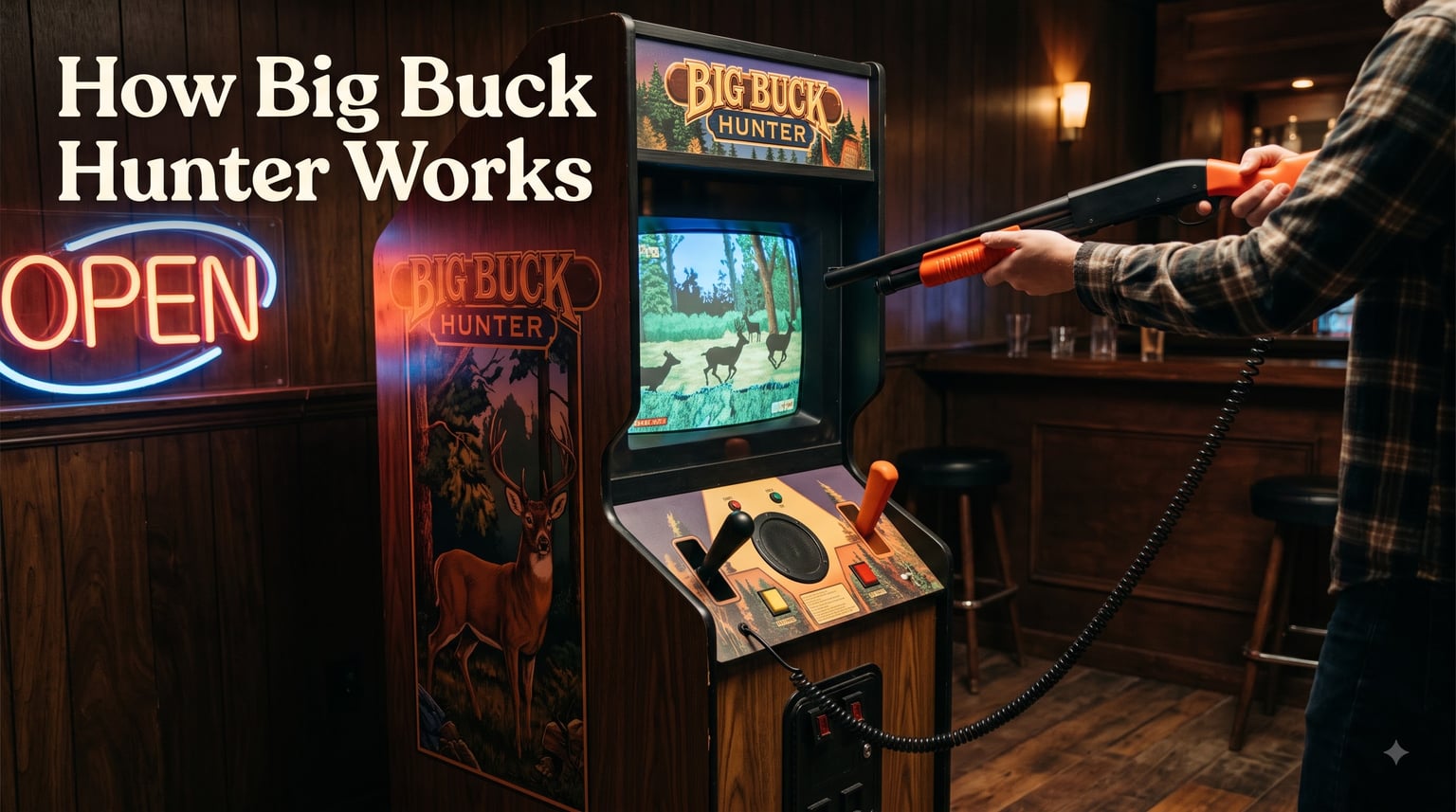
Big Buck Hunter is one of those arcade games I keep coming back to, even after 2026 of new releases. If you’ve ever wondered how Big Buck Hunter works, the short answer is simple: you pick up a pump-action shotgun-shaped lightgun, point it at the screen, and try to shoot as many bucks as possible without ever hitting a doe. The longer answer covers scoring, modes, treks, tournaments, and a quirky history that goes back to the mid-1980s.
I have spent more quarters than I’d like to admit on this franchise, and our team has tested multiple arcade cabinets and home ports to put together this complete guide. Whether you are walking up to a bar cabinet for the first time or trying to figure out if the Nintendo Switch version is worth buying, you’ll find the answers below.
Table of Contents
- What Is Big Buck Hunter?
- How the Big Buck Hunter Lightgun Works?
- Basic Big Buck Hunter Gameplay Rules
- Big Buck Hunter Game Modes Explained
- How the Big Buck Hunter Scoring System Works?
- Big Buck Hunter Multiplayer and Tournament Play
- History and Evolution of Big Buck Hunter
- Arcade vs Home Versions of Big Buck Hunter
- FAQs
- Final Thoughts on How Big Buck Hunter Works
What Is Big Buck Hunter?
Big Buck Hunter is an arcade lightgun shooter developed by Play Mechanix and published by Raw Thrills. Players use a plastic, pump-action shotgun-shaped rifle to shoot male deer (bucks) while avoiding female deer (does). Missing is fine. Hitting a doe ends your turn immediately.
The franchise first appeared in arcades in 1986 and has gone through more than a dozen official releases. Newer versions add bonus rounds, trophy animals, critters, online leaderboards, and head-to-head competition. Despite the simple premise, Big Buck Hunter has built one of the strongest competitive communities in arcade gaming, complete with a World Championship tournament series.
The game lives mostly in bars, family entertainment centers, and arcade chains in North America, but you’ll also find it on home consoles, Steam, and plug-and-play devices. It is widely considered one of the most successful coin-operated hunting games ever made.
How the Big Buck Hunter Lightgun Works?
The Big Buck Hunter arcade cabinet ships with a dedicated shotgun-shaped peripheral that fires a brief flash of infrared light when you pull the trigger. A sensor mounted around the screen detects where that flash hits and registers a shot at that screen coordinate. In most versions, this is the only way to interact with the game. There are no buttons or menus to navigate during a round.
The lightgun itself is modeled after a pump-action shotgun. After each shot, you pull the pump back and forward to “rack” the next round. This adds a tactile rhythm to play and prevents button-mashing. A single trigger pull and pump cycle equals one shot. Most cabinets let you fire as fast as you can rack, and skilled players can fire several shots per second.
On older CRT cabinets, the sensor works by reading the screen refresh at the exact moment of the trigger pull. On modern LCD cabinets, the system uses a small camera or IR sensor bar that tracks the gun’s position relative to the screen. Both systems require the gun to be calibrated before play, and most operators run that calibration daily. If you ever notice the reticle drifting off target, that is a calibration issue, not a broken gun.
The reticle on screen is a small crosshair that shows exactly where your next shot will land. Aim the crosshair, pull the trigger, pump, and you’re ready for the next shot.
Basic Big Buck Hunter Gameplay Rules
A typical round of Big Buck Hunter works like this. You insert credits, the game prompts you to pump the gun to start, and your first “trek” begins. A trek is one hunting trip through a stage. There are usually multiple treks per mode, and each trek ends when you shoot a doe, run out of ammo, or finish the stage.
Here is how a single turn plays out:
Step 1: Pump the shotgun to start your round.
Step 2: Wait for “ready on the right” and “ready on the left” to confirm the gun is calibrated.
Step 3: Shoot any buck that appears on screen. Rack the pump after each shot.
Step 4: Watch for bonus critters like turkeys, rabbits, or bears that award extra points.
Step 5: Avoid does at all costs. One doe hit ends your trek.
Step 6: After the timer runs out or you clear the screen, your score is tallied and the next trek begins.
The doe rule is the heart of Big Buck Hunter. It sounds harsh, but it forces players to read the screen carefully. Bucks and does often appear together, and does frequently walk in front of bucks to block your shot. This is by design. The game wants you to slow down, take accurate shots, and avoid panic-firing. New players almost always lose their first turn by hitting a doe that stepped in front of a buck they were about to shoot.
You have a limited number of shells per trek, usually enough for most stages. Misses cost nothing. Doe hits cost everything. The goal is to build the highest score across all the treks in your chosen mode.
Big Buck Hunter Game Modes Explained
Most Big Buck Hunter arcade releases include at least three core modes. The exact names vary slightly by version, but the structure stays similar.
Standard Mode is the classic play. You choose your difficulty, complete a fixed number of treks, and try to set a high score. Your final score is the sum of every trek’s points. This mode is what you’ll play in most tournaments because the rules are straightforward and consistent across machines.
Adventure Mode (sometimes called “Hunters Choice” or “Treks”) strings multiple stages together into a longer hunt. Each trek has its own setting and animal set, and you may unlock bonus rounds by hitting accuracy milestones. Adventure mode is the best way to see the variety of environments the game offers, from pine forests to desert plateaus.
Bonus Round is a short, fast-paced stage that usually unlocks after you reach a high enough score or finish a trek. Bonus rounds drop bonus critters and fast-moving bucks, and you typically get a few seconds of unlimited shots to rack up as many points as possible. Hitting a doe usually does not end your bonus round, but it may stop your streak.
Newer cabinets add extras like “Head-to-Head” multiplayer, mini-game collections, and seasonal events. These keep the formula fresh for regulars but are layered on top of the original three-mode structure.
How the Big Buck Hunter Scoring System Works?
Big Buck Hunter scoring is where the game gets surprisingly deep. A clean hit on a buck is worth more than a body shot, and accuracy bonuses reward consistent play. Here is how the points break down across most arcade versions.
Head shots vs body shots. A shot to the head or antlers of a buck is worth significantly more than a body shot. The exact multiplier depends on the version, but head shots typically double or triple the base value. Going for headshots is the single biggest scoring lever in the game.
Distance and timing. Bucks that appear closer to the camera or that are about to walk off-screen often award bonus points for fast reaction. Skilled players learn to prioritize the highest-value targets first.
Accuracy streaks. Many versions track a “marksman streak” that rewards consecutive hits without a miss. Breaking the streak resets the bonus. This is why pump-action rhythm matters. Racking too fast leads to misses, which break your streak.
Bonus critters. Turkeys, rabbits, bears, and other non-deer animals award instant bonus points. They are usually worth more than a regular buck body shot and are easy targets because they do not require you to worry about hitting a doe.
Final trek bonus. Many modes award a flat end-of-game bonus based on your accuracy percentage or your total score across all treks. Hitting 80% or better on accuracy usually triggers the largest payout.
Putting all of this together, a top-tier run looks like this: clean head shots, no missed shots, streak bonuses stacking up, every critter collected, and high accuracy at the end of the final trek. The math rewards patience over panic.
Big Buck Hunter Multiplayer and Tournament Play
Big Buck Hunter has supported head-to-head competition since the early 2000s. On a dual-gun cabinet, two players compete on the same screen at the same time. Each player has their own reticle, and the higher score at the end of the round wins. The game keeps a running tally of wins and losses for each player.
Beyond the cabinet, the franchise runs an active tournament scene. The Big Buck Hunter World Championship has been held annually for years, with regional qualifiers feeding into a finals event. Players compete for cash prizes, and serious competitors travel from across North America to compete.
Modern cabinets also support online leaderboards through the CoinUp Network. You can scan a QR code at the end of your game and see how your score stacks up against players at other locations. This feature has done a lot to keep the community engaged between tournament events.
History and Evolution of Big Buck Hunter
The original Big Buck Hunter debuted in arcades in 1986 from Play Mechanix. It was a simpler, more pixelated take on the deer-hunting formula, but the core “shoot bucks, avoid does” rule was already in place. The franchise went quiet for several years before Play Mechanix released Big Buck Hunter: Calling All Hunters in 2000, which became a breakout hit in bars and entertainment venues.
Raw Thrills took over publishing duties in the mid-2000s, and the games grew more polished with each release. Big Buck Hunter Pro, Big Buck Hunter World, Big Buck Hunter Open Season, and Big Buck Hunter Reloaded all built on the same lightgun formula while adding new modes, environments, and critters. The franchise has now sold tens of thousands of arcade cabinets worldwide and remains one of the highest-grossing coin-operated hunting games of all time.
Arcade vs Home Versions of Big Buck Hunter
The arcade version is where Big Buck Hunter shines. The dedicated shotgun peripheral, calibrated screen, and arcade atmosphere are impossible to fully replicate at home. If you have access to a cabinet at a bar or arcade, that is the version I’d recommend first.
Home ports are available on Nintendo Switch, PlayStation, Xbox, and Steam. They include the same modes and treks, but the controls differ. The Switch version uses motion controls with the Joycons, while Steam offers mouse, gamepad, and gyro options. Forum users consistently report that motion controls feel less precise than the real arcade lightgun, especially over longer play sessions. Sensitivity settings and Joycon drift can both throw off your aim.
Plug-and-play versions and Arcade1Up cabinets bring the lightgun experience closer to home, though quality varies. If you want the authentic feel, an Arcade1Up Big Buck Hunter with the original-style pump-action guns is the closest you can get without owning a full-size cabinet.
FAQs
How does Big Buck Hunter work?
Big Buck Hunter is an arcade lightgun shooter. You pick up a pump-action shotgun-shaped peripheral, aim at the screen, and shoot bucks while avoiding does. Hitting a doe ends your trek immediately. Your score is based on shot placement, accuracy, streaks, and bonus critters.
What is the best Big Buck Hunter strategy?
Aim for head shots over body shots, keep a steady pump rhythm to avoid misses, build accuracy streaks for bonus points, and prioritize bonus critters like turkeys and bears when they appear. Never panic-fire, because does often block bucks on purpose.
How much does a Big Buck Hunter arcade machine cost?
A used Big Buck Hunter arcade cabinet typically costs several thousand dollars depending on age, condition, and version. Full-size Raw Thrills cabinets from the last few years are at the higher end of that range, while older cabinets from the early 2000s are usually cheaper.
Is Big Buck Hunter on Nintendo Switch good?
The Switch port is a faithful port of the arcade game with the same modes and treks, but the motion controls cannot fully replicate the precision of a real lightgun. Players report reticle drift and sensitivity issues. It is fun in short bursts but does not match the arcade experience.
Final Thoughts on How Big Buck Hunter Works
Now you know how Big Buck Hunter works from the inside out. Pick up the pump-action gun, rack a shell, aim for head shots, and respect the doe rule. That is the entire game at its core. Everything else, the treks, the bonus rounds, the head-to-head cabinets, and the World Championship tournaments, builds on that simple foundation.
If this is your first time picking up the gun, drop a few quarters into a Standard mode run and pay attention to your accuracy. Once you start chaining head shots and critter bonuses without breaking your streak, the scoring system clicks. That is when Big Buck Hunter stops being a bar curiosity and starts being a game you actively want to get better at.