
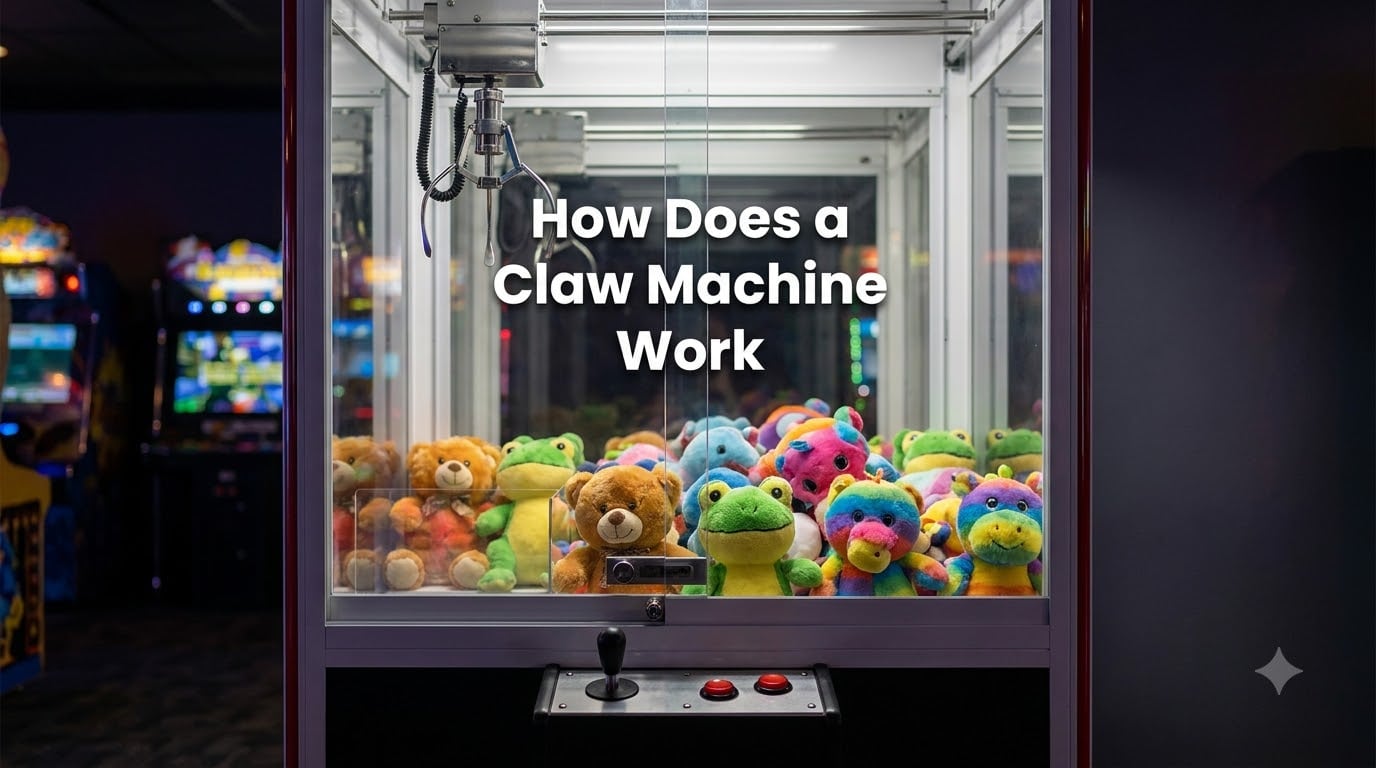
Every arcade has one. That glass box full of stuffed animals, a dangling metal claw, and the undeniable urge to try “just one more time.” But have you ever stopped mid-play and wondered how does a claw machine work behind that glass?
A claw machine is a coin-operated arcade game where a player uses a joystick to maneuver a motorized claw over prizes, then attempts to grab and deliver them to a prize chute. The claw’s grip strength is controlled by an electromagnet, and a microcontroller inside the cabinet decides when the claw holds tight and when it slips. That tiny circuit board is the real boss of every crane game you have ever played.
I have spent hours digging through arcade technician forums, manufacturer manuals, and Reddit AMAs from real claw machine operators to break this down. Whether you are a curious player who keeps losing or someone thinking about buying a machine for your business, this guide walks through every gear, wire, and setting that makes these machines tick.
Understanding the claw machine mechanism matters because it changes how you play. Once you know what the microcontroller is doing, the frustration of a dropped prize starts making sense. The machine is not out to get you personally. It is following a program.
Table of Contents
- What Is a Claw Machine?
- How Does a Claw Machine Work: Step by Step
- The Electromagnet: How Claw Machine Grip Strength Actually Works
- Payout Programming: How Claw Machines Decide When to Grip Tight
- Are Claw Machines Rigged? The Honest Answer
- Types of Claw Machines
- Claw Machine Tips: How to Improve Your Chances of Winning
- The Economics of Claw Machines: An Operator’s Perspective
- The Evolution of Claw Machines
- FAQs
- Conclusion
What Is a Claw Machine?
A claw machine (also called a crane game, grabber machine, or UFO catcher in Japan) is an arcade cabinet with a transparent glass enclosure filled with prizes. Players insert coins or tokens, then use a joystick and button to move a three-pronged metal claw suspended from a motorized carriage above the prizes.
The goal is simple to describe and maddeningly hard to execute. Position the claw over a prize, press the button, and hope the claw grabs the item, lifts it, and carries it to the drop chute without letting go.
Modern claw machines are found in arcades, malls, family entertainment centers, restaurants, movie theaters, and even laundromats. Some dispense plush toys, others hold electronics, jewelry, or candy. The basic principle stays the same across all of them.
Every machine shares the same core components: a glass display cabinet, overhead rail system with motors, a claw assembly with an electromagnet, a joystick control panel, a coin or card acceptor, and a microcontroller circuit board that runs the whole show.
How Does a Claw Machine Work: Step by Step
If you want to understand how does a claw machine work from start to finish, it helps to follow the exact sequence of events from coin drop to prize drop. Here is what happens inside the cabinet during every single play.
Step 1: The player inserts a coin or token. The coin acceptor validates the coin, sends a signal to the microcontroller, and the machine registers one credit. The control panel lights up, signaling the player can begin.
Step 2: The player uses the joystick to position the claw. Moving the joystick activates motors that travel along the X-axis (left and right) and Y-axis (forward and back) on the overhead rail system. The claw carriage slides along these rails to wherever the player directs it.
Step 3: The player presses the drop button. This triggers the Z-axis motor, which lowers the claw straight down into the pile of prizes. On some machines, the claw descends automatically after a set time limit, adding urgency to the game.
Step 4: The claw reaches the bottom and closes. When the claw touches the prize pile at the bottom of the cabinet, a sensor or limit switch detects contact. The microcontroller then sends current to the electromagnet, which causes the claw arms to close around a prize. This is where the payout programming kicks in.
Step 5: The claw lifts and the microcontroller sets grip strength. The Z-axis motor reverses, pulling the claw back up. The amount of voltage sent to the electromagnet at this moment determines how tightly the claw holds. If the machine has not reached its payout threshold, the voltage stays low and the grip stays weak. If it is time for a win, the voltage increases and the claw clamps down hard.
Step 6: The claw returns to the drop position. The X and Y motors move the claw back toward the front of the machine, above the prize chute. This is the moment of truth, and it is also the moment the claw machine mechanism is most likely to betray the player. A weak grip means the prize slips free mid-journey.
Step 7: The prize drops or it does not. If the claw held tight enough, the prize falls into the chute and the player retrieves it. If not, the prize tumbles back into the pile. The machine then resets the claw to its starting position and returns to attract mode, ready for the next coin.
The Electromagnet: How Claw Machine Grip Strength Actually Works
This is where most explanations get vague, so let us get specific. The claw’s grip strength is controlled by an electromagnet, and understanding how that electromagnet works explains everything about why claw machines feel so unpredictable.
The claw assembly contains a solenoid, which is a coil of wire wrapped around a metal core. When electrical current flows through that coil, it generates a magnetic field that pulls the metal core inward. That pulling motion is what mechanically closes the three claw arms around a prize. More current means a stronger magnetic pull, which means a tighter grip.
Here is the part that catches players off guard. The microcontroller controls exactly how much voltage reaches that solenoid on each play. The operator can program a range of grip strengths, and the machine cycles through them based on its payout settings. On a weak-grip play, the solenoid gets just enough current to close the claw partway. The claw might look like it grabbed the prize, but the arms barely exert any clamping force. The prize slips out the moment gravity and momentum take over during the lift.
On a strong-grip play, the solenoid receives full voltage. The claw arms clamp shut with enough force to hold the prize through the entire journey to the chute. The difference between a win and a loss often comes down to a few volts of electricity, decided by a circuit board before the claw even touches the prize.
Some machines also use tension screws as a mechanical backup to the electromagnet. Arcade operators on Reddit have confirmed that these physical screws can be adjusted to set a baseline grip level. But the real magic (or frustration) comes from the programmable electromagnet, which can vary the grip on every single play.
Payout Programming: How Claw Machines Decide When to Grip Tight
If you have ever felt like a claw machine grabbed a prize perfectly only to drop it inches from the chute, payout programming is the reason. Modern claw machines run on a payout rate system that functions similarly to how slot machines regulate wins.
The microcontroller tracks every coin inserted and every game played. It uses this data to determine when the claw is allowed to grip at full strength. Operators configure this through a settings menu on the control board, typically accessible with a special key that opens the machine’s service panel.
The most common programming mode is called Probability Fixed. In this mode, the operator sets a payout rate such as 1 in 12, meaning the machine will deliver one full-strength grip (one genuine winning attempt) for every 12 coins inserted. The other 11 plays get weak or medium grip strength regardless of how perfectly the player positioned the claw.
Some machines use a different system where the claw gradually increases grip strength after each play, building toward a guaranteed win after a set number of attempts. Other machines run on a time-based system where the grip weakens the longer the player takes to drop the claw, punishing hesitation.
Players often ask if there is a way to tell when a machine is ready to pay out. The honest answer is that you can get close by watching. If you see multiple players lose in a row, the machine may be approaching its payout threshold. But the microcontroller’s logic can include randomness, so there is no guaranteed method to predict the exact play.
Are Claw Machines Rigged? The Honest Answer
This is the question everyone really wants answered. Reddit threads with thousands of upvotes, investigative reports from ABC7 and Ars Technica, and countless YouTube exposés have all tackled this topic. The answer is nuanced but important.
Technically, claw machines are not rigged in the sense of being impossible to win. They do pay out, and skilled players who understand the claw machine mechanism can improve their odds significantly. But they are also not pure skill games. The electromagnet’s grip strength is programmatically controlled, which means the machine can and does limit your chances of winning based on its payout settings.
The reason it feels rigged is that the machine can do something deeply frustrating. It can deliver a weak grip that looks strong enough at first. The claw appears to grab the prize, lifts it off the pile, and carries it partway to the chute before the insufficient clamping force gives way. The prize drops in full view, creating the illusion that you almost won through skill when the outcome was determined by voltage programming before the claw even closed.
Reddit users and arcade technicians have confirmed that some machines can even be set to open the claw slightly at the highest point of the return arc, deliberately dropping prizes diagonally away from the chute. This is a setting, not a malfunction.
The legal picture varies by region. In some jurisdictions, claw machines are classified as games of skill and are exempt from gambling regulations. In others, they fall under consumer protection laws that mandate a minimum payout percentage. Japan is a notable example. Regulations there require crane games (UFO catchers) to maintain a specific win rate, often around 1 in 20 plays, and operators must display this information. In the United States, regulation is largely left to individual states, and enforcement varies widely.
Types of Claw Machines
Not all claw machines operate the same way. Manufacturers produce several distinct types, each with different claw designs, prize capacities, and target audiences.
Traditional plush claw machines are the classic model found in most arcades and malls. They feature a three-pronged claw designed for stuffed animals and soft prizes. The electromagnet controls variable grip strength, and the payout rate is fully programmable by the operator.
High-strength claw machines use a more powerful claw assembly with heavier-duty motors and a stronger solenoid. These are designed for heavier prizes like boxed electronics, large plush toys, or gift-wrapped items. The grip strength settings are higher overall, but the payout programming works the same way.
Prize cutter and mini crane machines are compact versions designed for smaller prizes like candy, small toys, or capsules. These machines often use a two-pronged or scooped claw instead of the traditional three-pronged design. They are popular in restaurants, small retail shops, and waiting areas.
UFO catchers are the Japanese standard, originally popularized by Sega. These machines often feature unique claw configurations and are subject to Japanese win-rate regulations. They tend to be more generous on average than unregulated machines in other countries, since the law requires a minimum payout frequency.
Claw Machine Tips: How to Improve Your Chances of Winning
Now that you understand the claw machine mechanism, here are strategies that actually work. None of these are cheat codes or hacks. They are practical approaches based on how the machine is programmed.
Watch other players first. The single most effective thing you can do is observe a machine before spending your own coins. Count how many attempts players make between wins. If you notice the machine has not paid out in a while, it may be approaching its payout threshold. This is not a guarantee, but it improves your odds.
Target the right prizes. Lighter and smaller prizes are easier for the claw to hold, even on medium-grip plays. A small plush toy near the top of the pile is a far better target than a large, heavy item buried at the bottom. Forum users consistently report that prizes near the edges of the pile, close to the chute, are the easiest to win.
Position carefully and use reflections. The glass cabinet creates reflections that can help you judge the claw’s position in three dimensions. Take advantage of those reflections to line up the claw directly over the center of your target prize. Precision matters more on weak-grip plays, because the claw needs to catch the prize at the perfect angle to hold on.
Manage your budget. Set a firm limit before you start playing. Because the payout system means most plays are designed to fail, chasing a loss is exactly what the machine is built to encourage. Walk away after your budget is spent, even if you feel like a win is due.
The Economics of Claw Machines: An Operator’s Perspective
Understanding the business model explains why claw machines are programmed the way they are. From the operator’s side, a claw machine is a straightforward revenue device.
The key metric is the cost-to-prize ratio. If each play costs one dollar and the average prize costs the operator three dollars, a payout rate of 1 in 8 means the machine takes in eight dollars for every three dollars in prizes it dispenses. The operator keeps the difference, minus the cost of electricity and machine maintenance.
Operators adjust the payout rate and grip strength settings to balance two competing goals. They want the machine to be profitable, but they also want occasional wins to keep players coming back. If no one ever wins, word spreads and the machine stops earning. This is why most operators settle on a payout rate that delivers enough visible wins to keep the cabinet attractive while maintaining a healthy profit margin.
Reddit AMA threads from real arcade owners reveal that well-placed claw machines in busy locations can generate significant revenue. The combination of low overhead, cheap prizes bought in bulk, and the psychological pull of near-miss experiences makes them one of the most cost-effective arcade attractions for operators.
The Evolution of Claw Machines
The first coin-operated crane machines appeared in the 1930s as purely mechanical devices. Early versions used springs and levers instead of electromagnets, and grip strength was consistent on every play. These machines were simpler and arguably more honest, since there was no computer deciding when to let you win.
The transition to electronic control happened gradually through the 1970s and 1980s. Manufacturers added microcontrollers, which gave operators the ability to program payout rates and variable grip strength for the first time. The Japanese UFO catcher boom of the 1980s, led by Sega and Taito, popularized the modern glass-cabinet design that most machines still use today.
Contemporary claw machines are fully digital, with computerized control boards, card payment systems, and network connectivity for remote monitoring. Some newer models integrate mobile app controls and digital prize tracking. The core claw machine mechanism, however, has not fundamentally changed. It is still a motorized claw driven by an electromagnet, governed by a payout algorithm.
FAQs
What is the trick to winning a claw machine?
The best trick is to observe the machine before playing. Count how many attempts other players make between wins to gauge the payout cycle. Target lighter prizes near the top of the pile and close to the chute, position the claw using glass reflections for depth perception, and always set a firm budget before you start. Since the electromagnet controls grip strength on each play, timing your attempt near the end of a payout cycle improves your odds.
How do claw machines decide when to grip tight?
A microcontroller inside the machine tracks every coin inserted and uses a programmed payout rate to determine grip strength. In Probability Fixed mode, the operator sets a ratio such as 1 in 12, meaning one out of every 12 plays receives full voltage to the electromagnet for a strong grip. The other plays receive lower voltage, resulting in a weak claw that cannot hold the prize. The decision is made before the claw closes.
Can a claw machine be manipulated?
A claw machine cannot be manipulated by the player through any external cheat or hack. The grip strength and payout rate are controlled internally by the microcontroller. However, players can improve their odds by understanding the payout cycle, choosing the right prizes, and positioning the claw precisely. The machine itself can be manipulated by the operator, who has full control over grip strength, payout frequency, and claw timing through the service panel settings.
Do claw machines ever pay out?
Yes, claw machines do pay out. Every programmable claw machine has a payout rate that determines how often a prize is won. A typical setting might be 1 win per 8 to 15 plays. In regulated markets like Japan, law requires a minimum win frequency, often around 1 in 20 plays. The machine is designed to deliver enough wins to keep players engaged while remaining profitable for the operator.
Conclusion
So, how does a claw machine work? It comes down to a motorized claw that moves along overhead rails, powered by an electromagnet whose grip strength is controlled by a microcontroller running a programmed payout system. The machine decides before each play whether to grip tight or let go, based on how many coins have been inserted since the last win.
The claw is not random, and it is not purely skill-based either. It sits somewhere in between, designed to deliver just enough wins to feel achievable while keeping the operator profitable. Understanding that balance is what separates a frustrated player from an informed one.
Next time you see that glass box full of plush toys, you will know exactly what is happening behind the scenes. The electromagnet, the solenoid, the payout algorithm, the service panel settings. Play smart, set your budget, and remember that the claw machine mechanism is doing exactly what it was programmed to do.