
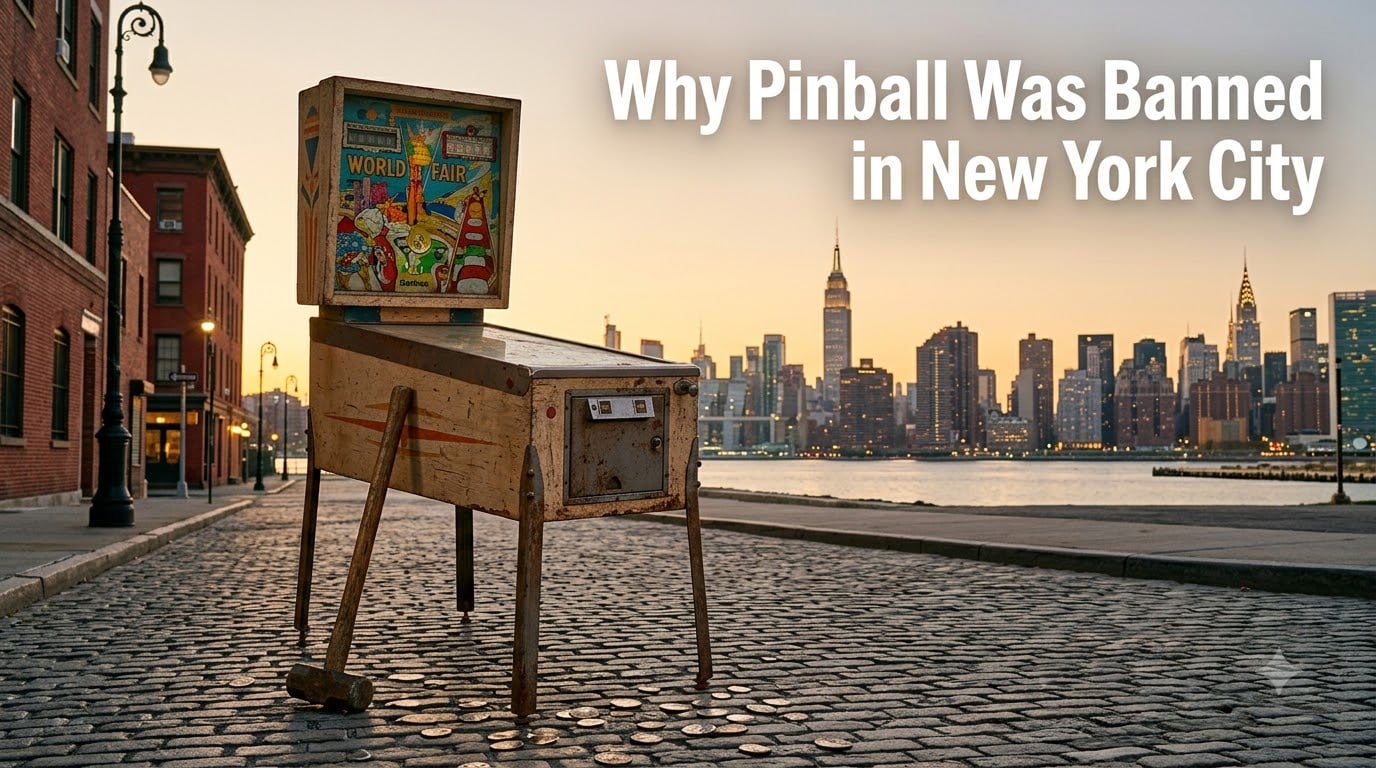
Imagine walking into a New York City bar in 1955 and finding a hidden room in the back with curtains drawn and a single pinball machine glowing in the dark. That was not a movie scene. It was real life for 34 years.
Pinball was banned in New York City from 1942 to 1976. Mayor Fiorello LaGuardia led the charge, calling pinball machines gambling devices that corrupted youth and lined the pockets of organized crime figures. Police raided candy stores, bowling alleys, and bars. They smashed machines with sledgehammers and dumped the wreckage into waterways.
If you have ever wondered why pinball was banned in New York City, the answer involves a mix of moral panic, political ambition, genuine gambling concerns, and one of the most dramatic courtroom demonstrations in arcade history.
In this article, I will walk you through the full story. We will cover the 1930s origins of pinball, LaGuardia’s personal crusade, the organized crime connection, the invention of the flipper, and how a man named Roger Sharpe saved pinball with a single called shot in 1976.
Table of Contents
- Why Pinball Was Banned in New York City: The Short Answer
- The Roots of Pinball in 1930s America
- The Gambling Problem: Why Pinball Was Considered a Menace
- Fiorello LaGuardia’s Crusade Against Pinball
- Organized Crime and the Underground Pinball Economy
- The Flipper Invention: Changing the Game
- Other Cities That Banned Pinball
- Roger Sharpe’s Historic Testimony: The Shot That Changed Everything
- Life Under the Ban: NYC’s Underground Pinball Scene
- The Legacy: How the Pinball Ban Shaped Modern Gaming
- FAQs
- Conclusion
Why Pinball Was Banned in New York City: The Short Answer
Pinball was banned in New York City from 1942 to 1976 because Mayor Fiorello LaGuardia classified pinball machines as illegal gambling devices. The machines were linked to organized crime, were believed to encourage juvenile delinquency, and operated as games of chance rather than skill since early machines lacked flippers. The ban ended in 1976 after Roger Sharpe demonstrated to the City Council that pinball required skill, not luck.
That is the short version. But the full story is far stranger and more interesting.
LaGuardia did not just pass a law and move on. He personally posed for newspapers smashing machines with a sledgehammer. He ordered police to dump thousands of confiscated machines into the Long Island Sound. He framed the ban as a patriotic duty during World War II, arguing that the metal in pinball machines should go toward military production instead.
The ban lasted nearly three and a half decades. It outlived LaGuardia himself. And it created an underground pinball culture in NYC that thrived in back rooms and speakeasies until a magazine editor named Roger Sharpe walked into a City Council hearing in 1976 and changed everything.
The Roots of Pinball in 1930s America
To understand the ban, you have to understand what pinball looked like in the 1930s. The game bore almost no resemblance to the flipper-filled machines you see in arcades today.
Pinball descended from an 18th-century French game called bagatelle, where players used a cue stick to shoot balls up a sloped table lined with pins and scoring holes. The coin-operated version arrived in the United States in 1931 when Raymond Maloney introduced Ballyhoo, a countertop machine that cost a penny per play.
The timing could not have been worse. The Great Depression had crushed the American economy, and people were desperate for cheap entertainment. Pinball fit the bill perfectly. A single penny bought a few minutes of escape. Machines appeared in candy stores, barbershops, drugstores, bars, and bowling alleys across the country.
But these early machines were purely gravity-driven. There were no flippers. You pulled a plunger, launched the ball, and watched it bounce down through pins and into scoring pockets. The player had almost no control over the outcome.
This is the critical detail. Without flippers, pinball was genuinely a game of chance. You could not aim. You could not react. You launched the ball and hoped for the best. And that made it functionally identical to a slot machine in the eyes of many lawmakers and moral crusaders.
By the late 1930s, pinball had spread to every major American city. Manufacturers like Gottlieb, Bally, and Chicago-based studios were producing thousands of machines per year. The industry was booming, but so were concerns about what these machines were really doing to communities.
The Gambling Problem: Why Pinball Was Considered a Menace
The core argument against pinball was simple. Authorities believed it was a gambling device disguised as an innocent amusement game.
Here was the problem. Early pinball machines often offered payouts. Some machines awarded free games that could be redeemed for cash or merchandise. Store owners would pay players a few cents or a candy bar for each free game they won. In some establishments, particularly in larger cities, pinball machines were wired directly into cash payout systems.
This is where the line between arcade game and gambling device blurred completely. If a machine pays out money based on an outcome the player cannot control, it is functionally a slot machine. And slot machines were already illegal in most of the country.
The game-of-chance versus game-of-skill debate became the central legal question. In the 1930s and 1940s, there was no real argument that pinball required skill. The plunger launched the ball, gravity did the rest, and the player watched. That made pinball a game of chance in every practical and legal sense.
But even after flippers were invented in 1947 and gave players genuine control over the ball, the gambling stigma stuck. Old laws stayed on the books. The image of pinball as a nickel-stealing gambling trap persisted in the minds of politicians and parents for decades.
Moral reformers also tied pinball to juvenile delinquency. They argued that children were spending their lunch money on machines, skipping school to play, and being lured into gambling habits that would follow them into adulthood. Whether these fears were justified or exaggerated, they were politically powerful.
Fiorello LaGuardia’s Crusade Against Pinball
No single person did more to ban pinball in New York City than Mayor Fiorello Henry LaGuardia. And he made it personal.
LaGuardia was already famous for cleaning up corruption in NYC when he turned his attention to pinball. He was a reformer, a showman, and a politician who understood the value of a good photo opportunity. Pinball gave him all three.
He genuinely believed that pinball machines were evil. He called them nickel-stealers and argued they robbed school children of their hard-earned money. He framed pinball operators as predators who targeted kids in candy stores and pool halls, draining families of coins during one of the worst economic periods in American history.
In 1942, LaGuardia pushed through a ban on pinball machines in New York City. The City Council passed an ordinance making it illegal to own, operate, or possess a pinball machine within the five boroughs. The penalty included fines and potential jail time.
The timing was deliberate. The United States had just entered World War II after Pearl Harbor, and LaGuardia tied the pinball ban to the war effort. He argued that the metal and materials inside pinball machines should be melted down and used for military production. In an era of rationing and scrap-metal drives, this argument carried real weight.
Then came the spectacle. LaGuardia ordered police to raid locations across the city, seizing pinball machines by the thousands. He personally posed for newspaper photographers while smashing machines with a sledgehammer. In one famous stunt, he had confiscated machines loaded onto barges and dumped into the Long Island Sound, where some remnants reportedly still rest on the riverbed today.
The message was unmistakable. Pinball was public enemy number one in New York City, and LaGuardia was the hero destroying it.
Organized Crime and the Underground Pinball Economy
LaGuardia’s moral objections were genuine, but the organized crime connection was real too. Pinball was big business, and where there is big money in 1940s New York, the mob was involved.
Pinball machine distribution and route operation in major cities was frequently controlled by organized crime figures. The machines generated steady, untraceable cash income. An operator could place a machine in a bar or candy store, collect the coins weekly, and split the profits with the store owner. No receipts, no paper trail.
In some cases, pinball machines were directly linked to numbers rackets and other gambling operations. The same networks that distributed slot machines and betting slips also distributed pinball machines. For law enforcement, the three were nearly impossible to separate.
This connection was not unique to New York. In Chicago, the pinball industry had deep ties to organized crime figures. In other cities, machine distribution routes overlapped with illegal gambling operations. The industry’s own opacity made it impossible to distinguish legitimate operators from criminal enterprises.
For LaGuardia and other reform-minded politicians, this was the clincher. Even if some pinball operators were honest businesspeople, the industry as a whole was too entangled with gambling and organized crime to be allowed. The ban was presented as a blow against the mob as much as against juvenile delinquency.
During the ban years, underground pinball culture thrived in New York City. Machines moved to back rooms of bars, behind curtained-off sections of stores, and into private clubs. Police conducted periodic raids, but enforcement was inconsistent. The ban created exactly the kind of underground economy it was supposed to eliminate.
The Flipper Invention: Changing the Game
In 1947, a company called Gottlieb released a pinball machine called Humpty Dumpty. It featured something no pinball machine had ever had before: flippers.
Flippers changed everything. For the first time, players could actively control the ball. You could aim, react, trap, and shoot with precision. The game shifted from passive observation to active engagement. Pinball became a test of reflexes, timing, and strategy.
This invention should have ended the debate overnight. Pinball was now undeniably a game of skill, not chance. A skilled player could consistently outperform a beginner. The ball’s path was no longer determined by gravity and luck alone.
But it did not work out that way. The bans were already in place. Politicians who had staked their reputations on fighting pinball were not eager to admit they had been wrong. The legal classification of pinball as a gambling device remained on the books in New York City and other cities long after flippers made that classification absurd.
The irony is striking. The very argument used to justify the ban, that pinball was a game of chance, was rendered false by the flipper. Yet the ban persisted for nearly 30 more years after flippers were introduced. Laws, once passed, are far harder to repeal than to enact.
By the 1970s, pinball machines were sophisticated electromechanical devices with complex playfields, multi-ball modes, and intricate scoring systems. They had about as much in common with the 1930s plunger-and-pray machines as a modern smartphone has with a telegraph. But legally, they were still classified as gambling devices.
Other Cities That Banned Pinball
New York City was not alone. Pinball was banned in cities across America, and understanding the broader pattern helps explain why the NYC ban lasted so long.
Chicago, the manufacturing capital of the pinball industry, banned pinball within its own city limits. This meant that companies like Gottlieb, Bally, and Williams were producing machines they could not legally sell or operate in their own hometown. The irony was not lost on anyone in the industry.
Los Angeles banned pinball starting in 1939, with similar arguments about gambling and juvenile delinquency. The LA ban persisted even longer than most, and pinball remained restricted in parts of California for decades.
Milwaukee, New Orleans, and several other cities passed their own bans throughout the 1940s and 1950s. Each city had its own timeline for repeal, but the pattern was remarkably consistent. A moral panic about gambling and youth would drive the initial ban, the ban would persist long after the justification faded, and eventually a combination of cultural shifts and legal challenges would force a repeal.
What made New York City unique was not the ban itself but its duration and its political drama. LaGuardia’s personal involvement, the sledgehammer photo ops, and the river dumps made the NYC ban the most famous and most stubborn. When other cities started repealing their bans in the late 1960s and early 1970s, New York held firm.
It would take a dramatic event to break the stalemate. And it came from an unexpected source.
Roger Sharpe’s Historic Testimony: The Shot That Changed Everything
In 1976, the New York City Council held a hearing to reconsider the pinball ban. The push for legalization was led by the amusements industry, which had been fighting the ban for years. But they needed proof that pinball was a game of skill, not chance.
They brought in Roger Sharpe.
Sharpe was not a professional pinball player. He was a magazine editor and writer who happened to be passionate about pinball. He was also good enough to back up his claims with action. The plan was for Sharpe to play a pinball machine in front of the City Council and demonstrate that skill, not luck, determined the outcome.
What happened next has become pinball legend. Sharpe set up a machine, and to make the demonstration undeniable, he called his shot. He pointed to a specific lane on the playfield and told the council members he would send the ball there.
He pulled the plunger. The ball traveled up and hit the exact lane he had called.
The council members were stunned. The demonstration was so precise and so clearly the result of controlled skill that it shattered the argument that pinball was a game of chance. You do not call a shot on a slot machine.
Sharpe later explained that even he was nervous. The stakes were enormous. If he had missed, the entire case for legalization could have collapsed. But he did not miss, and the New York City Council voted to legalize pinball later that year.
The ban that had lasted since 1942 was finally over. Pinball was legal again in New York City, and Roger Sharpe became a legend in the pinball community. His story was later turned into a film called Pinball: The Man Who Saved the Game, which dramatized the events leading up to his famous testimony.
For many pinball enthusiasts, Sharpe’s called shot is the single most important moment in pinball history. Without it, the NYC ban could have persisted for years or decades longer, and the cultural and economic impact on the pinball industry would have been devastating.
Life Under the Ban: NYC’s Underground Pinball Scene
One thing that often gets left out of the pinball ban story is what daily life was actually like during those 34 years. Pinball did not disappear from New York City. It went underground.
Throughout the 1940s, 1950s, and 1960s, pinball machines could be found in back rooms of bars, behind curtained partitions in stores, and in private social clubs across Manhattan, Brooklyn, and the Bronx. Operators who risked running machines faced fines and confiscation, but the demand was strong enough that many considered it worth the risk.
Children and teenagers were particularly affected. For kids growing up in NYC during the ban era, pinball carried an outlaw mystique. It was forbidden fruit. Stories from people who lived through the period describe sneaking into back rooms to play, being chased out by store owners during police raids, and the thrill of playing something the government said you were not allowed to touch.
Specific neighborhoods developed reputations for underground pinball. Areas around Times Square, the East Village, and Coney Island had concentrations of machines hidden in various establishments. The enforcement pattern was inconsistent. Some precincts cracked down hard, others looked the other way.
The underground scene also meant that the organized crime concerns that originally fueled the ban were perpetuated by it. When an activity is banned, the only people willing to provide it are those already operating outside the law. The ban created a self-fulfilling prophecy that kept the criminal associations alive for decades.
When legalization finally came in 1976, there was an explosion of pinball across the city. Arcades opened. Bars added machines. A generation of New Yorkers who had grown up with pinball as a forbidden thrill could suddenly play openly for the first time.
The Legacy: How the Pinball Ban Shaped Modern Gaming
The NYC pinball ban left a lasting mark on American gaming culture, even if most people today do not realize it happened.
For one thing, the ban shaped the pinball industry itself. Manufacturers had to navigate a patchwork of local laws for decades. Some companies focused on export markets or regions without bans. The constant legal threat stifled innovation in some areas while paradoxically driving creativity in others as designers worked to make machines that were clearly skill-based.
The ban also influenced the rise of video games. When Pong and early arcade video games appeared in the 1970s, they benefited from the groundwork laid by pinball’s legalization fight. Video games were classified as games of skill from the start, largely because the pinball industry had already fought and won that battle.
Today, pinball is a legitimate competitive sport. The International Flipper Pinball Association sanctions tournaments worldwide. Professional players compete for significant prize money. Modern machines from companies like Stern Pinball and Jersey Jack Pinball feature LCD screens, licensed themes, and engineering that would amaze the players of the 1930s.
The fact that this was once a banned activity, that police smashed machines with sledgehammers, that a man had to call a shot in front of a city council to prove a game required skill, all of it feels absurd in hindsight. But it happened, and the story is worth remembering as a cautionary tale about moral panics, overreach, and how long bad laws can survive after their justification disappears.
FAQs
When did pinball stop being illegal?
Pinball became legal again in New York City in 1976 when the City Council voted to lift the ban after Roger Sharpe demonstrated that the game required skill. Other cities repealed their bans around the same period, with most American cities legalizing pinball by the late 1970s.
Who is the greatest pinball player of all time?
Roger Sharpe is widely regarded as one of the most important figures in pinball history for his 1976 testimony that ended the NYC ban. In competitive terms, players like Keith Elwin, Bowen Kerins, and Cayle George are considered among the greatest modern tournament players. Sharpe himself was not a tournament champion but his called shot in front of the City Council made him legendary.
Why was pinball illegal in LA?
Pinball was illegal in Los Angeles starting in 1939 for the same reasons as in New York City. Authorities classified early pinball machines as gambling devices because they lacked flippers and operated as games of chance. The ban in LA was driven by concerns about gambling, juvenile delinquency, and connections to organized crime, and it persisted for decades before eventual repeal.
What arcade game was banned in NYC for 30 years?
Pinball was banned in New York City for 34 years, from 1942 to 1976. Mayor Fiorello LaGuardia pushed through the ban, classifying pinball machines as illegal gambling devices. The ban was lifted after Roger Sharpe demonstrated to the City Council that pinball was a game of skill by calling and successfully making a specific shot.
Did Fiorello LaGuardia really smash pinball machines?
Yes. Mayor Fiorello LaGuardia personally posed for newspaper photographs while smashing confiscated pinball machines with a sledgehammer. He also ordered thousands of seized machines to be loaded onto barges and dumped into the Long Island Sound as part of his campaign against what he called nickel-stealing gambling devices.
How did Roger Sharpe prove pinball was a game of skill?
Roger Sharpe proved pinball was a game of skill during a 1976 New York City Council hearing by calling his shot. He pointed to a specific lane on the playfield and told council members he would send the ball there, then successfully hit that exact lane. This precise demonstration of controlled aim convinced the council that pinball required skill rather than luck.
Conclusion
The story of why pinball was banned in New York City is one of the strangest chapters in American entertainment history. What started as a reasonable concern about gambling and youth exploitation morphed into a 34-year prohibition that outlived its justification by decades.
Fiorello LaGuardia’s sledgehammer campaign, the organized crime connections, the invention of flippers, and Roger Sharpe’s called shot are all pieces of a story that sounds too dramatic to be real. But every detail happened, and together they shaped the pinball industry and arcade culture in ways we still see today.
The next time you see a pinball machine in a bar or arcade, take a moment to appreciate how close the game came to disappearing entirely. If not for one man calling his shot in front of a skeptical City Council in 1976, the flashing lights and ringing bells of pinball might have remained a forbidden thrill hidden behind curtained back rooms.
Pinball survived the ban, the moral panic, and the sledgehammers. It earned its place as a legitimate game of skill, and it did so the hard way.