
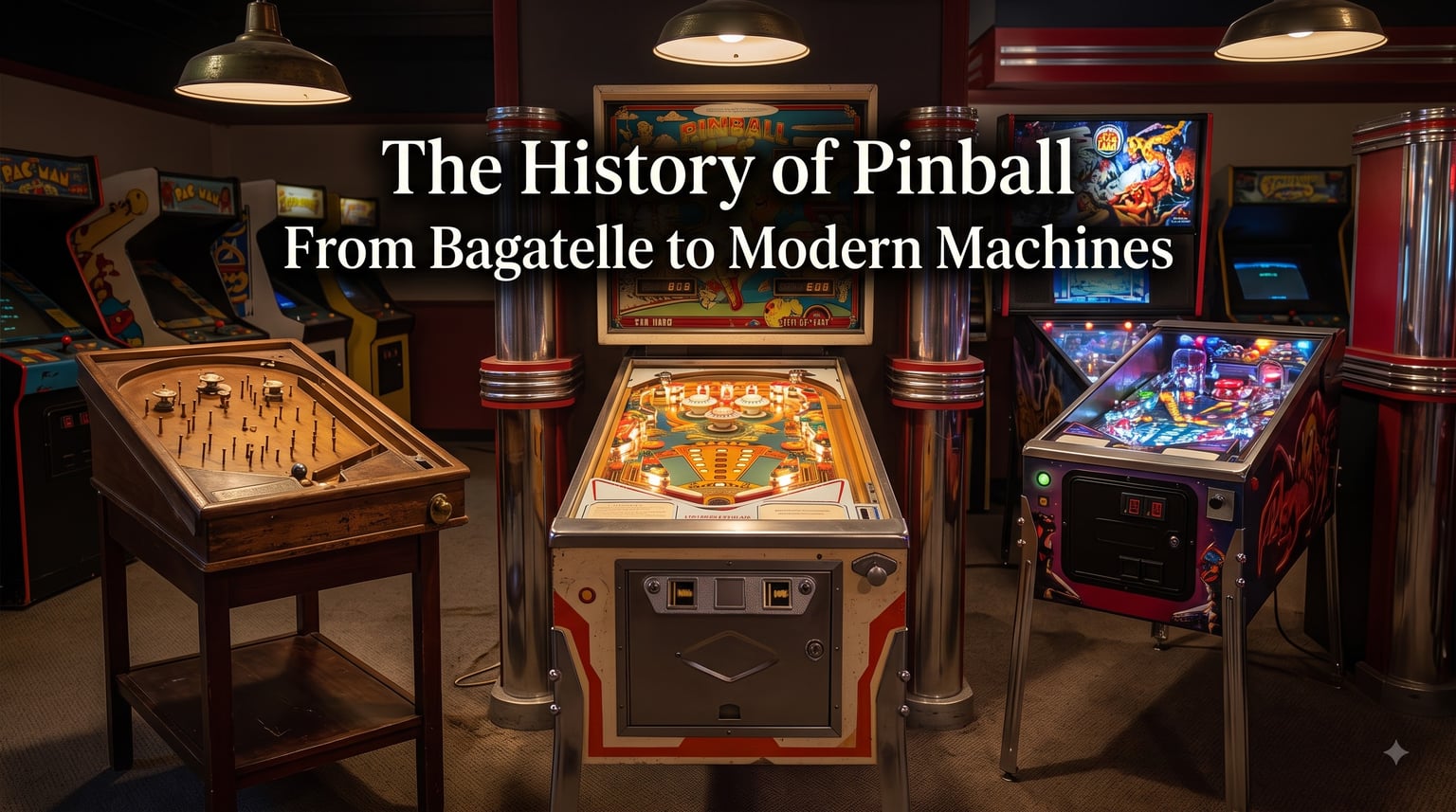
Pinball has survived moral panics, citywide bans, world wars, and the rise of video games. It started as a parlor game for French aristocrats and grew into a multi-billion-dollar arcade industry. The history of pinball spans over 250 years, filled with unlikely inventors, courtroom drama, and technical breakthroughs that shaped how we play today.
I have spent years researching arcade culture, talking to collectors, and playing machines from every major era. What I found is that pinball is not just a game. It is a story about American ingenuity, moral panic, and survival against the odds.
This guide walks you through every major era of pinball evolution, from the Bagatelle tables of 18th-century France to the LCD-packed machines of 2026. You will meet the inventors who changed the game, the politicians who tried to kill it, and the players who brought it back from the dead.
Whether you are a collector, a competitive player, or someone who just dropped a quarter into a machine at a bar, understanding the history of pinball gives you a deeper appreciation for every flipper press, bumper hit, and skill shot.
Table of Contents
- Bagatelle Origins: The Birth of Pinball in 18th Century France
- Montague Redgrave and the Spring-Loaded Plunger (1871)
- The First Coin-Operated Pinball Machines (1931)
- Electric Pinball and the Tilt Mechanism (1933-1935)
- World War II and Its Impact on Pinball (1941-1945)
- The Golden Age and the Flipper Revolution (1947-1958)
- The Banning of Pinball and the Fight for Legalization (1942-1976)
- The Electronic Era and Solid-State Revolution (1970s-1990s)
- Modern Revival and the Future of Pinball
- FAQs
- Conclusion
Bagatelle Origins: The Birth of Pinball in 18th Century France
The history of pinball begins in France during the 1770s with a tabletop game called Bagatelle. The name comes from the Chateau de Bagatelle, a estate in the Bois de Boulogne near Paris, where the game reportedly gained popularity after a party hosted by Count d’Artois in 1777.
Bagatelle was played on a small wooden table with pins set into the playing surface and scoring holes at the far end. Players used a cue stick to launch a ball from one end of the table toward the scoring holes at the other. The pins acted as obstacles, sending the ball bouncing in unpredictable directions.
This is where the word pinball comes from. Those early metal pins stuck into a wooden board were the literal pins that gave the game its identity. Without Bagatelle, there is no pinball.
The game spread quickly through French high society and then across Europe. By the early 1800s, variations of Bagatelle appeared in England, Germany, and eventually the United States. Each region added its own twist, but the core concept remained the same: launch a ball, watch it bounce off obstacles, and hope it lands in a scoring zone.
What made Bagatelle different from other parlor games of the era was its blend of skill and chance. A skilled player could aim the ball with some precision, but the pins introduced enough randomness that no two plays were identical. That tension between control and chaos became the defining characteristic of every pinball machine that followed.
Early Bagatelle tables were handcrafted from mahogany or walnut, with brass pins and ivory balls. They were luxury items, owned by aristocrats who displayed them alongside chess sets and billiards tables in their gaming rooms. It would take another century for the game to evolve into something the general public could enjoy.
Montague Redgrave and the Spring-Loaded Plunger (1871)
The next major leap in the history of pinball came from an unlikely source: a British inventor named Montague Redgrave living in Ohio. In 1871, Redgrave patented a series of improvements to the Bagatelle table that would transform it from a parlor novelty into a commercial product.
Redgrave’s most important innovation was the spring-loaded plunger. Instead of using a cue stick to launch the ball, players pulled back a spring-powered rod that propelled the ball into the playfield. This change was enormous. It standardized the launch mechanism, made the game more compact, and introduced a level of physical feedback that cue sticks could never match.
That same spring-loaded plunger design is still used on pinball machines today. Every time you pull back that plunger and feel the resistance build before releasing the ball, you are experiencing an invention that is over 150 years old.
Redgrave also reduced the size of the playing surface, replacing the large Bagatelle tables with smaller, more affordable units that could fit on a countertop or bar top. He replaced the ivory balls with cheaper metal balls and redesigned the scoring holes to create more varied gameplay.
The Redgrave Bagatelle was manufactured in the United States and proved popular enough that production continued until 1927. For over 50 years, these improved Bagatelle tables sat in bars, pool halls, and drugstores across America, quietly building the audience that would eventually make pinball a national phenomenon.
What Redgrave could not have predicted was that his plunger mechanism would become the foundation for a coin-operated industry that would define American amusement culture for decades. He built the bridge between a French parlor game and the arcade machines we know today.
The First Coin-Operated Pinball Machines (1931)
The history of pinball as a commercial industry began in 1931 with the release of Baffle Ball, widely recognized as the first commercially successful coin-operated pinball machine. It was manufactured by Automatic Industries, a company founded by Arthur Paulin and William Howell in Youngstown, Ohio.
Baffle Ball was remarkably simple by modern standards. It had no flippers, no electricity, and no tilt mechanism. Players paid one penny for five balls, which they launched onto a playfield filled with pins and scoring holes. The game relied entirely on gravity and chance once the ball left the plunger.
Despite its simplicity, Baffle Ball was a massive hit. Automatic Industries sold over 50,000 units, and the game earned the nickname “the Great Depression savior” because of how much money it generated for bars and storefronts during one of the worst economic periods in American history. At seven balls for a penny, it was one of the cheapest forms of entertainment available.
The success of Baffle Ball attracted competitors, most notably Raymond Moloney, a distributor who was frustrated that he could not get enough Baffle Ball units to meet demand. In 1931, Moloney founded his own company, Lion Manufacturing, and released a game called Ballyhoo. The name came from a popular magazine of the era.
Ballyhoo sold 75,000 units and outsold Baffle Ball. The company eventually became Bally Manufacturing, later Bally Technologies, one of the most important names in arcade and gaming history. Meanwhile, another key player entered the scene: David Gottlieb, who founded D. Gottlieb and Company in 1927 and began producing pinball machines that would dominate the industry for decades.
By the mid-1930s, there were dozens of manufacturers producing coin-operated pinball machines. The industry was booming, but the games were still purely mechanical. Players had no way to control the ball after launch. That would change with the introduction of electricity.
Electric Pinball and the Tilt Mechanism (1933-1935)
Electricity transformed pinball from a mechanical novelty into a sensory experience. The first electric pinball machines appeared in 1933, when manufacturers began adding battery-powered lights behind the backglass to illuminate score indicators. Harry Williams, who would later found Williams Manufacturing Company, is credited with pioneering this electrification.
The addition of lights was just the beginning. Soon manufacturers added electromechanical bells, chimes, and eventually sound effects that made the games more exciting and easier to follow. Players could see their scores light up in bright numbers and hear satisfying sounds when they hit scoring targets.
In 1935, the tilt mechanism was introduced, solving one of the biggest problems in early pinball: cheating. Because the earliest machines were purely mechanical and depended on gravity, players could nudge, lift, or shake the cabinet to influence where the ball went. Skilled cheaters could manipulate the ball into high-scoring holes with surprising consistency.
The tilt mechanism solved this problem with a simple but brilliant design. A pendulum or metal ball was suspended inside a metal ring inside the cabinet. If the machine was shaken too hard, the pendulum would touch the ring, completing an electrical circuit that would disable the scoring mechanism and end the player’s turn. The word “tilt” would flash on the backglass, penalizing the player for excessive physical manipulation.
This innovation is still part of pinball today. Every modern machine has a tilt bob, and competitive players must master the art of the controlled nudge, pushing the machine just enough to influence the ball without triggering the tilt penalty. It added a layer of physical skill to a game that had previously been about luck.
The combination of electricity and the tilt mechanism created a new category of machine: electromechanical pinball. These machines used relays, solenoids, and stepper motors to control scoring, lights, and sounds. They would remain the industry standard for the next four decades.
World War II and Its Impact on Pinball (1941-1945)
World War II disrupted the pinball industry almost overnight. When the United States entered the war in December 1941, manufacturing priorities shifted dramatically. Metal, rubber, and wood were all rationed for the war effort, and pinball manufacturers suddenly found themselves unable to source the materials they needed.
Many pinball factories converted to wartime production. Gottlieb, Bally, and Williams all pivoted to manufacturing military equipment, including bomb fuses, radar components, and ammunition casings. The skilled workers who had been assembling pinball cabinets and wiring playfields turned their hands to the war effort instead.
Production of new pinball machines effectively halted during the war years. The machines that already existed in bars and arcades continued to operate, but no new titles were released. This created a backlog of demand that would explode when the war ended.
The post-war period saw a surge in pinball popularity as soldiers returned home and Americans sought entertainment. Manufacturers ramped up production, and new companies entered the market. The stage was set for the single most important innovation in pinball history.
The Golden Age and the Flipper Revolution (1947-1958)
The history of pinball changed forever in 1947 with the invention of the flipper. The game was called Humpty Dumpty, and it was produced by Gottlieb. The designer was Harry Mabs, but the man most closely associated with the flipper’s development is Steve Kordek, a self-taught designer who would shape pinball design for the next 60 years.
Humpty Dumpty featured six flippers arranged in pairs along the sides of the playfield. They were placed at the top, middle, and bottom of the table. For the first time, players could actively control the ball after it was launched, batting it back into play and aiming it toward scoring targets.
This was a revolution. Before flippers, pinball was a game of chance. You launched the ball and watched it bounce. With flippers, pinball became a game of skill. Players could save the ball from draining, aim for specific targets, and develop strategies. The flipper turned pinball from a gambling device into a game of physical coordination and timing.
Steve Kordek, who designed his first pinball machine for Genco in 1948, is credited with a second critical innovation: moving the flippers to the bottom of the playfield in their now-standard inverted-V configuration. Earlier machines experimented with flippers in various positions, but Kordek’s layout of two bottom flippers angled toward each other became the universal standard that every pinball machine still uses.
The period from 1947 through the late 1950s is known as the Golden Age of Pinball. Gottlieb dominated this era with titles like Spot Bowler (1950), which introduced the concept of score multipliers, and Bumper (1951), which refined bumper design. Williams and Bally competed fiercely, each trying to outdo the other with new features and flashier backglass art.
The flipper also changed the culture around pinball. Players began developing skills, sharing techniques, and competing for high scores. The game attracted a devoted following that treated pinball not as a casual diversion but as a pursuit to be mastered. This passionate player base would prove essential to pinball’s survival in the decades ahead.
The Banning of Pinball and the Fight for Legalization (1942-1976)
One of the most dramatic chapters in the history of pinball is its banning. Starting in the early 1940s, cities across the United States outlawed pinball machines, treating them as gambling devices that corrupted youth and encouraged delinquency.
New York City led the charge. In 1942, Mayor Fiorello LaGuardia ordered the seizure of all pinball machines in the city, personally smashing several in a publicity photo op. The ban was sweeping. Over 3,000 machines were confiscated and destroyed, and the city’s pinball industry was effectively shut down overnight.
The argument was that pinball was a game of chance, not skill, making it equivalent to a slot machine. Because players paid money and the outcome depended on random bounces, critics argued it constituted gambling. The fact that early machines sometimes offered cash payouts or free games that could be redeemed for money strengthened this argument.
New York was not alone. Chicago, Los Angeles, and dozens of other cities passed similar bans. At its peak, pinball was illegal in many of the largest markets in the United States. Manufacturers adapted by removing cash payout features and emphasizing the skill-based nature of the game, but the bans persisted for decades.
The turning point came in 1976, when the New York City Council held a hearing to reconsider the ban. A 26-year-old pinball enthusiast and magazine editor named Roger Sharpe was called to testify. Sharpe told the council that pinball was a game of skill, not chance, and offered to prove it.
In a moment that has become legendary in pinball history, Sharpe called his shot. He pointed to a specific lane on the playfield and told the council members he would send the ball there. He pulled back the plunger, launched the ball, and it traveled exactly where he had pointed. The council was convinced. The ban was lifted.
Sharpe’s demonstration proved that a skilled player could control the ball with precision, establishing pinball as a game of skill. New York’s reversal triggered a domino effect. Other cities followed suit, and by the late 1970s, pinball was legal again across most of the United States.
The Electronic Era and Solid-State Revolution (1970s-1990s)
The 1970s brought another technological revolution to pinball: solid-state electronics. In 1977, the first microprocessor-controlled pinball machines appeared, replacing the complex electromechanical relay systems with computer chips and printed circuit boards. This shift changed everything about how pinball machines were designed, programmed, and played.
Solid-state machines could do things that electromechanical machines never could. They displayed digital scores on LED readouts instead of mechanical reels. They produced a wider variety of sounds and eventually synthesized speech. They could track complex scoring rules, manage multiball modes, and run programmed game sequences that told stories across the playfield.
Three companies dominated this era: Bally, Williams, and Gottlieb. Bally led the charge with games like Eight Ball Deluxe and Flash Gordon. Williams produced groundbreaking titles like Firepower (1980), which featured the first multiball mode with more than two balls on a solid-state machine. Gottlieb struggled to adapt to the new technology and eventually exited the pinball business.
The 1980s and early 1990s were a creative peak for pinball design. Machines became increasingly sophisticated, with ramps, wire ball ramps, animatronic toys, and elaborate rule sets. Williams released The Addams Family in 1992, which became the best-selling pinball machine of all time with over 20,000 units sold. Twilight Zone (1993), also from Williams, pushed the boundaries of complexity further than any machine before it.
But the rise of video games posed an existential threat. Arcade operators found that video games like Pac-Man and Space Invaders required less maintenance, took up less space, and generated more revenue per square foot. Pinball machines, with their hundreds of moving parts and constant maintenance needs, could not compete on operating costs.
By the late 1990s, the industry was in freefall. Bally and Williams merged in 1996, and in 1999, the combined company announced it was exiting the pinball business entirely to focus on slot machines and gambling equipment. Gottlieb was already gone. For a brief moment, it looked like the history of pinball had reached its final chapter.
Modern Revival and the Future of Pinball
Pinball did not die. One company kept the flame alive: Stern Pinball, founded by Sam Stern and later run by his son Gary Stern. When Williams exited the industry in 1999, Stern was the only major manufacturer left, producing a steady stream of machines based on licensed properties like The Simpsons, Lord of the Rings, and Iron Man.
The revival began in earnest in the 2000s and accelerated through the 2010s. New manufacturers entered the market, most notably Jersey Jack Pinball, founded in 2011 by Jack Guarnieri. Jersey Jack’s first machine, The Wizard of Oz (2013), featured a massive LCD screen in the backbox, full-color LED lighting throughout the playfield, and an innovative ball-throwing mechanism. It was the most technologically advanced pinball machine ever built at the time of its release.
Modern pinball machines are technological marvels. They feature high-definition LCD screens that display animated content, custom-composed music scores, LED lighting systems that can produce millions of colors, and sophisticated computer systems that manage complex rule sets. Machines like Stern’s The Mandalorian and Jersey Jack’s Guns N’ Roses push the boundaries of what a pinball machine can do.
The competitive pinball scene has also exploded. The International Flipper Pinball Association (IFPA) tracks tournament results worldwide, and the number of ranked players has grown from a few hundred in 2006 to over 137,000 in recent years. Major tournaments like the Professional and Amateur Pinball Association (PAPA) World Championships and the IFPA World Pinball Championship draw competitors from dozens of countries.
Pinball museums and bars-with-pinball have proliferated, giving players access to machines from every era. The Pacific Pinball Museum in California, the Pinball Hall of Fame in Las Vegas, and hundreds of neighborhood pinball bars keep vintage machines in working order and introduce new generations to the game.
Digital preservation has become an important part of pinball’s future. Projects like the Pinball Arcade and Visual Pinball recreate classic machines in software, preserving games that exist on deteriorating hardware. These digital versions ensure that even as physical machines age and break, the games themselves can be experienced by future players.
As of 2026, pinball is in the midst of its strongest revival since the Golden Age. Multiple manufacturers are producing new machines, the competitive scene is thriving, and a new generation of players has discovered the unique satisfaction of controlling a steel ball with two flippers and a well-timed nudge.
FAQs
When was the first pinball machine invented?
The first commercially successful coin-operated pinball machine was Baffle Ball, released in 1931 by Automatic Industries. However, the earliest ancestor of pinball was the French game Bagatelle, which dates back to the 1770s. Montague Redgrave patented key improvements including the spring-loaded plunger in 1871.
What year did pinball get banned?
Pinball was banned starting in 1942, when New York City Mayor Fiorello LaGuardia ordered the seizure of all pinball machines. Chicago, Los Angeles, and dozens of other cities followed with similar bans. The New York ban was lifted in 1976 after Roger Sharpe demonstrated that pinball was a game of skill.
Who invented the flippers in pinball?
Flippers were introduced in 1947 on a Gottlieb machine called Humpty Dumpty, designed by Harry Mabs. Steve Kordek, another Gottlieb designer, is credited with popularizing the now-standard layout of two flippers at the bottom of the playfield in an inverted V configuration.
When was the first modern pinball machine created?
The first modern pinball machine with flippers was Gottlieb’s Humpty Dumpty, released in 1947. It featured six flippers and transformed pinball from a game of chance into a game of skill. The first solid-state electronic pinball machine with a microprocessor was released in 1977.
What is the origin of pinball?
Pinball originated from an 18th-century French parlor game called Bagatelle, named after the Chateau de Bagatelle near Paris. Players used a cue stick to launch a ball across a table studded with pins toward scoring holes. In 1871, British inventor Montague Redgrave added the spring-loaded plunger that defines pinball to this day.
Conclusion
The history of pinball is a story of constant reinvention. From a French parlor game to spring-loaded Bagatelle tables, from coin-operated penny games to electromechanical marvels, from the flipper revolution to the solid-state boom and bust, and finally to the modern revival, pinball has survived every challenge thrown at it.
What makes pinball special is that it cannot be fully replicated digitally. The physical feedback of the flippers, the unpredictable bounce of the ball off bumpers, the satisfying clack of the plunger, and the tension of a tilt warning are all tactile experiences that keep players coming back. No video game can replace the feeling of a steel ball racing across a playfield while you try to save it with a last-second flipper shot.
Understanding the history of pinball from Bagatelle to modern machines gives context to every game you play. When you pull back that plunger, you are repeating an action invented in 1871. When you hit a flipper, you are using a mechanism born in 1947. When you avoid a tilt, you are respecting a rule established in 1935. Pinball is living history, and every game keeps that history alive.
If this deep dive into pinball’s past has you curious about playing or collecting, seek out a local pinball bar or museum. Drop a few quarters into a machine from a different era. Feel the difference between a 1970s electromechanical table and a modern LCD-packed machine. The best way to appreciate pinball history is to play it.