
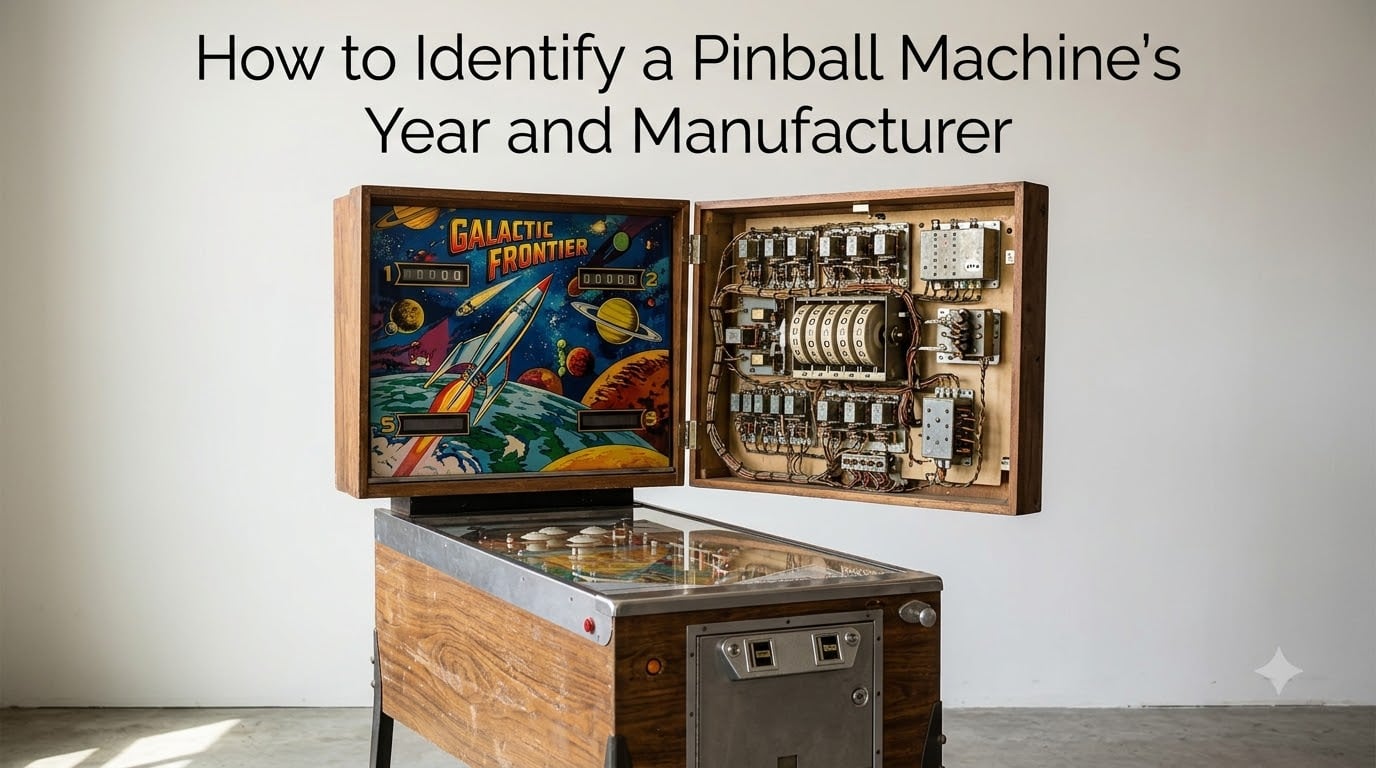
So you have a pinball machine sitting in your basement, garage, or game room, and you have no idea what year it was made or who built it. You are not alone. Our team hears this question constantly from collectors, hobbyists, and people who inherited a machine from a relative.
Learning how to identify a pinball machine’s year and manufacturer opens up a world of information. Once you know what you are looking at, you can find replacement parts, determine a fair price, connect with other owners, and understand the history behind your game.
The good news is that pinball machines carry plenty of clues. Serial numbers, cabinet designs, playfield technology, backglass artwork, and even the type of flippers all tell a story about when and where a machine was built. I will walk you through every method I use to track down this information.
Table of Contents
- How to Identify a Pinball Machine’s Year and Manufacturer: Quick Overview
- Do Pinball Machines Have Serial Numbers?
- Major Pinball Eras: A Timeline for Identification
- How to Identify by Manufacturer
- Key Visual Indicators by Era
- Online Databases for Verification
- Common Identification Mistakes to Avoid
- Frequently Asked Questions
- Wrapping Up
How to Identify a Pinball Machine’s Year and Manufacturer: Quick Overview
The fastest way to identify a pinball machine is to follow a four-step process. This approach works whether your machine is from 1948 or 2026, and it draws on the same techniques collectors have relied on for decades.
Here is the process I recommend:
- Locate the serial number. Check the back of the cabinet, inside the head box, or on the inside of the coin door. Write down every number and letter you find.
- Determine the era. Look at the technology inside. Electro-mechanical machines use relays and score motors, while solid state machines have circuit boards. Dot matrix displays appeared in 1991.
- Identify the manufacturer. Check the backglass, apron, and instruction card for brand names like Gottlieb, Williams, Bally, Stern, or Data East.
- Verify with databases. Search the Internet Pinball Database (IPDB) or Pinside using the manufacturer name and any game title you can find.
This four-step method covers roughly 95% of identification scenarios. The remaining 5% involve machines with missing backglasses, repainted cabinets, or custom modifications, which I address later in this guide.
Do Pinball Machines Have Serial Numbers?
Yes, pinball machines have serial numbers, and they are one of the most reliable identification tools available. Nearly every machine produced by a major manufacturer from the 1930s onward received a unique serial number during production.
The challenge is that there has never been an industry-wide standard for where these numbers appear or how they are formatted. Each manufacturer placed serial numbers in different locations and used different numbering systems. This is why so many people struggle to find the number on their machine.
Where to Look for Serial Numbers
Based on data from the Internet Pinball Serial Number Database (IPSND) and reports from collectors on Pinside and Reddit, here are the most common serial number locations:
- Cabinet back panel: The lower back of the main cabinet, often on a paper label or stamped directly into the wood.
- Inside the head box: Open the backbox and check the interior walls, especially the left side. Many Gottlieb machines have the number here.
- Coin door interior: Remove the coin door and look at the inside frame or the bottom of the cabinet opening.
- Playfield underside: Some manufacturers wrote or stamped numbers on the underside of the playfield board.
- Backglass frame: Williams and Bally frequently placed small labels on the backglass frame or inside the backbox door.
I recommend checking all five locations. Many machines have numbers in more than one spot, and finding two matching numbers confirms you have the correct serial.
Why Serial Numbers Matter for Dating
Serial numbers do not always encode the manufacture date directly, but they follow sequential patterns within each manufacturer’s production runs. By comparing your serial number to known ranges in databases, you can narrow down the production month and year.
For example, Gottlieb serial numbers from the 1970s follow a fairly consistent sequential order. If your machine falls between two documented games, you can estimate the production window within a few weeks.
Major Pinball Eras: A Timeline for Identification
Pinball technology evolved through four distinct eras, and each era left clear fingerprints on the machines it produced. Knowing these eras is the single most effective shortcut for identifying any pinball machine.
The Electro-Mechanical Era (1947 to 1978)
Electro-mechanical (EM) pinball machines run entirely on relays, switches, stepper units, and score motors. There are no computer chips, no circuit boards, and no digital displays. Scores appear on rolling reels or backglass lights.
If you open the backbox of an EM machine, you will see dozens of relays wired point-to-point. The sound is mechanical, with clicks and clacks from the score motor. EM machines represent the longest era in pinball history and are highly sought by collectors who appreciate their mechanical craftsmanship.
Key visual cues for EM machines include rolling reel score displays, wood cabinets with formica or woodgrain finishes, and the absence of any electronic sound effects or speech.
The Early Solid State Era (1977 to 1989)
Solid state (SS) technology replaced relays with circuit boards and microprocessors. The first solid state pinball machines appeared in 1977, and by 1979, nearly every major manufacturer had made the switch.
SS machines introduced digital score displays, typically using seven-segment LED or gas plasma readouts. They also brought electronic sound effects, speech synthesis, and more complex rule sets than EM games could achieve.
Inside the backbox of a solid state machine, you will find one or more circuit boards instead of relay banks. Microprocessors from companies like Intel and Motorola drive the game logic. This is the easiest way to tell SS from EM at a glance.
The Dot Matrix Display Era (1991 to 2013)
The dot matrix display (DMD) era began in 1991 and transformed pinball by adding a video screen to the backbox. These displays, typically 128 by 32 pixels, showed animated graphics, scores, game modes, and even short video clips.
DMD machines also introduced deeper rule sets, multiball modes, ramps, toys, and licensed themes from movies and bands. Williams dominated this era with titles like The Addams Family and Twilight Zone, which remain among the most collected machines ever made.
If your machine has an animated video screen in the backbox rather than simple numeric readouts, it falls squarely in the DMD era.
The Modern LCD and LED Era (2013 to Present)
Since 2013, pinball manufacturers have moved to full-color LCD screens and LED lighting systems. Stern Pinball introduced its SPIKE system, Jersey Jack Pinball launched with full-color LCD displays and integrated cameras, and newer companies like American Pinball and Multimorphic entered the market.
Modern machines feature high-resolution color screens, Bluetooth audio, internet connectivity, and software updates. If your machine has a color LCD screen larger than a postcard, it was built in the modern era.
How to Identify by Manufacturer
Each major pinball manufacturer left distinct signatures on their machines. Cabinet construction, backglass design, logo placement, and internal architecture all vary by brand. Here is what to look for when trying to identify the company that built your machine.
Gottlieb (1927 to 1996)
David Gottlieb’s company is the oldest major pinball manufacturer. Gottlieb produced the first commercially successful pinball machine, Baffle Ball, in 1931 and introduced flippers to the world with Humpty Dumpty in 1947.
Gottlieb machines are known for robust cabinet construction, distinctive wood tones in the EM era, and a clear logo on the backglass. During the solid state era, Gottlieb used System 1, System 80, and System 3 board sets, each with recognizable layouts.
To identify a Gottlieb, look for the Gottlieb name on the backglass lower edge or the instruction card on the apron. Gottlieb serial numbers are often found inside the head box on the left wall.
Williams (1943 to 1999)
Williams produced some of the most iconic pinball machines ever made. The company pioneered multiball play, speech in pinball, and the DMD era. Titles like Defender, Pin-Bot, FunHouse, The Addams Family, and Twilight Zone cemented Williams as a legend.
Williams cabinets typically feature a cleaner, more modern look than Gottlieb machines. The Williams logo appears on the backglass and sometimes on the lower cabinet apron. Inside the backbox, Williams used System 3 through System 11 boards in the SS era and the WPC board system during the DMD era.
Williams serial numbers are commonly found on a paper label on the back cabinet panel or inside the backbox on the right side.
Bally (1932 to 1988, later as Bally/Midway)
Bally Manufacturing was founded by Ray Moloney in 1932 and became one of the biggest names in pinball. Bally machines from the 1970s are especially prized for their artwork, sound packages, and innovative gameplay.
Bally’s solid state board set, known as the AS-2518 series, powered classics like Eight Ball Deluxe, Centaur, and Fathom. Bally merged with Williams under the WMS Industries umbrella in 1988, after which the Bally brand was used for select titles.
Look for the Bally logo on the backglass. Bally serial numbers frequently appear on the back cabinet panel or on a tag inside the backbox door.
Stern Pinball (1977 to Present)
Stern Pinball is the oldest continuously operating pinball manufacturer in the world. Sam Stern and his son Gary Stern have kept pinball in continuous production through every era since the late 1970s. Today, Stern is the largest pinball manufacturer by volume.
Stern machines span solid state, DMD, and modern LCD eras. Early Stern games used their own board sets, while modern Stern machines use the SPIKE and SPIKE 2 systems. The Stern logo is prominently displayed on the backglass and apron.
Stern serial numbers are typically found on a label inside the backbox or on the back of the cabinet. Modern Stern machines include the build date directly on the serial number label.
Data East (1987 to 1994)
Data East entered pinball in 1987 and produced machines known for their licensed themes, including titles based on Batman, Star Wars, and The Simpsons. Data East was the first manufacturer to use stereo sound in pinball.
Data East machines use a distinctive board set designed by former Gottlieb engineers. The company was reorganized as Sega Pinball in 1994, which was later acquired by Gary Stern to form Stern Pinball in 1999.
Modern Manufacturers (2013 to Present)
Several new manufacturers have entered the pinball market since 2013. Jersey Jack Pinball launched in 2011 with The Wizard of Oz and has since produced titles like The Hobbit, Dialed In, and Willy Wonka. American Pinball began production in 2016. Multimorphic offers the P3 modular platform with swappable playfields.
Each modern manufacturer clearly brands their machines on the backglass, cabinet sides, and apron. Their serial number labels include full production dates, making identification straightforward.
Key Visual Indicators by Era
When you cannot find a serial number or manufacturer logo, visual indicators become your primary identification tool. Each era produced machines with distinctive physical characteristics that you can spot without opening the cabinet.
Score Display Technology
The score display is one of the fastest era indicators. Rolling mechanical reels mean you are looking at an EM machine from 1947 to 1978. Seven-segment LED or gas plasma numeric readouts indicate solid state, typically 1977 to 1990.
An animated dot matrix screen means the machine dates from 1991 to around 2013. A full-color LCD screen means the machine was built after 2013.
Cabinet and Backglass Style
EM machines from the 1950s and 1960s often have woodgrain cabinets and painted backglasses with bold, colorful artwork. By the 1970s, cabinets shifted to solid colors with silk-screened graphics.
Solid state and DMD machines from the 1980s and 1990s typically feature black or dark cabinets with vibrant licensed artwork. Modern machines often use digital printing on the cabinet and backglass for photographic detail.
Flipper Style and Placement
Flippers were invented in 1947, so any machine without flippers predates that year. Early flippers were short and stiff. By the 1960s, flippers grew longer and more powerful, allowing more skillful play.
The number and placement of flippers also changed over time. Machines from the 1950s typically had two flippers. By the 1970s and 1980s, three, four, and even six-flipper configurations appeared. Modern machines usually feature two to four flippers.
Internal Technology as a Quick Check
If you can safely open the backbox, the internal technology tells you the era immediately. Banks of relays and a score motor confirm EM. Circuit boards with microprocessors confirm solid state or later. A DMD controller board with a ribbon cable to the display confirms the dot matrix era.
Online Databases for Verification
Once you have gathered clues from the serial number, era indicators, and manufacturer features, the next step is verification. Two databases dominate the pinball identification world, and both are free to use.
Internet Pinball Machine Database (IPDB)
The IPDB at ipdb.org is the most comprehensive pinball reference available. It contains records for over 50,000 machines spanning from the 1930s to the present. Each entry includes the manufacturer, production year, game type, number produced, playfield images, backglass images, and community ratings.
To search IPDB effectively, use the manufacturer and game name format. For example, if you see “Gottlieb” on the backglass and the title appears to be “Sinbad,” search for “Gottlieb/Sinbad.” The database will return the exact production year, model number, and technical specifications.
I use IPDB as my first stop for every identification project. The image galleries are especially helpful when you are trying to match a faded backglass or an unfamiliar playfield layout.
Pinside Machine Database
Pinside at pinside.com/pinball/machine is a modern, community-driven database with over 3,100 games cataloged. It features high-quality photos, user reviews, market pricing data, and active discussion forums.
Pinside excels at modern machine information and market values. If you are trying to identify a machine from the last 20 years or want to know what collectors are paying, Pinside is the better resource. The forum community is also quick to help with identification requests when you post photos.
Internet Pinball Serial Number Database (IPSND)
The IPSND at ipsnd.net focuses specifically on serial numbers. It collects serial number data from owners and maps numbers to specific games and production dates. If you have a serial number but no game title, IPSND can sometimes identify the machine by number alone.
The IPSND also provides tips for finding serial numbers on specific manufacturers’ machines, which is invaluable when the standard locations turn up empty.
Common Identification Mistakes to Avoid
After helping many people identify their machines, I see the same mistakes repeated. Avoiding these pitfalls will save you time and prevent misidentification.
Mistake 1: Assuming the Backglass Is Original
Backglasses fade, peel, and crack. Some owners install reproduction backglasses that may feature different artwork or even a different game title than the original. Always cross-reference the playfield layout and cabinet features with the backglass title before concluding.
Mistake 2: Confusing EM and Early Solid State
The transition from EM to solid state happened gradually between 1977 and 1979. Some machines from this period exist in both EM and SS versions with identical titles and nearly identical artwork. Always check the backbox internals before assigning an era to a late-1970s machine.
Forum users on Reddit and Pinside frequently report this confusion. If the backbox has relays, it is EM. If it has circuit boards, it is solid state. The title alone is not enough to tell you which version you have.
Mistake 3: Ignoring the Cabinet Number Stamp
Many collectors focus only on paper labels and overlook number stamps pressed directly into the wood. Gottlieb, Williams, and Bally all stamped numbers into cabinet interiors, head box walls, and playfield undersides at various points. These stamps are sometimes the only surviving serial number on a machine with missing or damaged labels.
Mistake 4: Relying on a Single Source
No single database is complete. IPDB may lack photos for rare machines. Pinside may have incomplete entries for older titles. IPSND depends on owner submissions. Always cross-reference at least two sources before making a final identification.
Frequently Asked Questions
Do pinball machines have serial numbers?
Yes, nearly every pinball machine produced by a major manufacturer from the 1930s onward has a serial number. The number is typically located on the back of the cabinet, inside the head box, on the inside of the coin door, or on the playfield underside. Each manufacturer used different numbering formats and locations.
What is the golden age of pinball machines?
The golden age of pinball refers roughly to the period from 1948 to 1958, when flippers had been invented and gameplay became skill-based rather than purely luck-driven. Some collectors extend the golden age through the early 1960s. This era produced many of the most collectible EM machines.
What game was banned in NY until 1976?
Pinball machines were banned in New York City from 1942 until 1976. Mayor Fiorello LaGuardia led the crackdown, claiming pinball was a game of chance that encouraged gambling. The ban was overturned in 1976 after Roger Sharpe demonstrated to the City Council that pinball required skill, not luck.
What is the most sought after pinball machine?
The most sought after pinball machines include The Addams Family by Williams (1992), which is the best-selling pinball machine of all time with over 20,000 units produced. Other highly desired titles include Medieval Madness, Twilight Zone, Cactus Canyon, and Big Bang Bar. Rarity, theme, and gameplay depth all drive collectibility.
What is a vintage pinball machine worth?
Vintage pinball machine values vary widely based on era, condition, title, and manufacturer. Common EM machines from the 1960s and 1970s typically sell for $300 to $1,500 in working condition. Desirable DMD-era titles like The Addams Family can sell for $6,000 to $12,000 or more. Rare and highly rated titles command the highest prices.
Wrapping Up
Identifying a pinball machine’s year and manufacturer comes down to four things: finding the serial number, recognizing the technology era, spotting manufacturer signatures, and verifying with databases. The combination of IPDB, Pinside, and IPSND gives you everything you need to confirm any identification.
Every machine tells a story through its design, technology, and construction. Once you know how to read those clues, you can trace any pinball machine back to its origin. Take your time, check multiple sources, and do not hesitate to post photos on the Pinside or Reddit pinball communities if you get stuck.
With this guide, you now have a systematic approach to learning how to identify a pinball machine’s year and manufacturer. Grab a flashlight, open that backbox, and start your identification journey.