
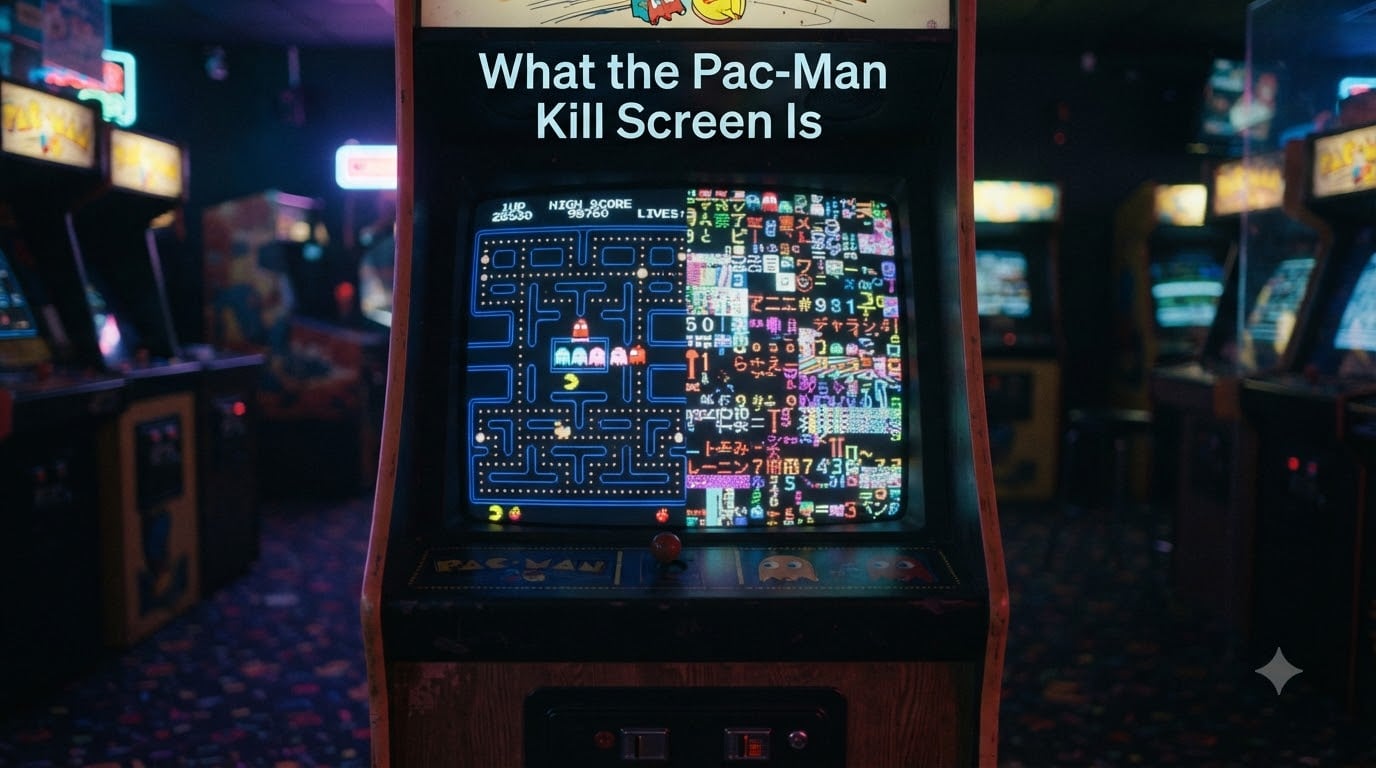
If you have ever played the original Pac-Man arcade cabinet long enough, you might have run into one of the most famous bugs in video game history. The Pac-Man kill screen is a glitch that corrupts the game at level 256, making it impossible to continue. For over four decades, this screen has fascinated arcade collectors, speedrunners, and gaming historians alike.
Our team at Coin-OP Games has spent years around original arcade hardware, and the kill screen remains one of the most talked-about phenomena in coin-op culture. Whether you own a vintage cabinet or just want to understand the glitch behind one of gaming’s greatest legends, this guide breaks down everything you need to know.
In this article, we cover what the Pac-Man kill screen is, why level 256 causes the corruption, what the screen actually looks like, the binary math behind the glitch, its discovery, and its lasting cultural impact. By the end, you will understand exactly what the Pac-Man kill screen is and why it still matters in 2026.
Table of Contents
What Is the Pac-Man Kill Screen?
The Pac-Man kill screen is an unpassable glitch that occurs when a player reaches level 256 of the original 1980 arcade game. At this point, the right half of the maze fills with garbled characters, letters, and symbols. The level becomes structurally broken, and there is no way to collect enough dots to advance.
The term “kill screen” refers to any point in a game where a programming bug makes further progress impossible. The game does not crash or freeze. Instead, it keeps running, but the level cannot be completed no matter what the player does. In Pac-Man, the corruption is so severe that the dot count rolls over to impossible numbers and the maze becomes unreadable.
This glitch is not a random occurrence. It happens every single time a player reaches level 256 on original arcade hardware. The kill screen is deterministic, meaning it is baked into the game’s code itself. No amount of skill, timing, or pattern memorization can prevent it.
For arcade enthusiasts and coin-op collectors, the kill screen is part of what makes the original Pac-Man cabinet so historically significant. It represents the hard technical ceiling of early 8-bit game design, a wall that could not be crossed with the hardware available at the time.
Why Level 256 Causes the Glitch
To understand the Pac-Man kill screen, you need to understand how computers store numbers. The original arcade hardware used an 8-bit processor, and the game’s code tracks the current level using an 8-bit integer. An 8-bit integer can store values from 0 to 255, which gives a total of 256 possible values.
This means the game can count from level 0 up to level 255 without any problem. But when the player completes level 255 and the game tries to load level 256, something goes wrong. The number 256 cannot fit in 8 bits. Instead of rolling over cleanly, the value overflows and confuses the game’s internal calculations.
Specifically, the overflow corrupts the fruit drawing routine. In normal levels, the game draws a small number of bonus fruit icons near the bottom of the maze. The game uses the level number to decide how many fruit to draw. At level 256, the corrupted counter tells the game to draw 256 fruit, which is far more than the screen can handle.
The game writes those fruit tiles directly into the maze data in memory. This overwrites walls, dots, and pathways with garbage characters. The result is the infamous split-screen glitch that every Pac-Man kill screen is known for.
If you are not familiar with binary math, think of it like a car’s odometer that only has three digits. Once you pass 999, the counter rolls back to 000. Pac-Man’s level counter does something similar at 255, but the overflow causes the game to misread the data and draw a broken maze instead of just resetting.
What Happens at Level 256
When you reach level 256, the screen splits into two distinct halves. The left side of the maze looks relatively normal, though some elements may be slightly shifted. The right side is completely corrupted, filled wall-to-wall with random game characters, numbers, and symbols.
Players often call this the “split-screen” level because the visual divide between the functional left side and the broken right side is so dramatic. The garbled tiles on the right are actually fruit icons, letters, and other game sprites stacked on top of each other with no spacing.
Here is the critical problem. To complete any level in Pac-Man, you must eat every dot in the maze. But on level 256, many of the dots have been overwritten by the corrupted fruit tiles. The game still thinks those dots exist, but they are no longer rendered on screen and cannot be collected.
Since the dot counter never reaches zero, the level can never end. Ghosts still roam the maze. Pac-Man can still move, eat the visible dots on the left side, and consume power pellets. But the missing dots make it mathematically impossible to clear the level.
This is what makes the Pac-Man kill screen so unique compared to other game-ending glitches. The game does not freeze or crash. It keeps playing, giving the false impression that progress is possible. Players have spent enormous amounts of time trying to find hidden dots or secret patterns, but the level is genuinely unwinnable.
The Integer Overflow Explained
Let us walk through the integer overflow step by step. This is the core technical reason the Pac-Man kill screen exists.
Step 1: The level counter. Pac-Man stores the current level number as a single byte in memory. A byte is 8 bits, and each bit can be either 0 or 1. With 8 bits, the highest number you can represent is 255 (binary 11111111).
Step 2: Completing level 255. When a player finishes level 255, the game increments the level counter by one. The counter tries to hold the value 256, but 256 requires 9 bits (binary 100000000). Since the counter only has 8 bits, the ninth bit is lost and the value wraps around.
Step 3: The fruit drawing routine. The game uses the level number to determine how many bonus fruit to display. In the code, this routine multiplies and offsets based on the level value. When the overflowed value enters this calculation, the routine reads a number far larger than intended.
Step 4: Memory corruption. Instead of drawing 7 fruit (the normal maximum), the routine attempts to draw 256 fruit. It writes each fruit sprite into video memory, overwriting the maze layout. Tiles that should be walls, dots, or empty corridors become stacks of garbled characters.
Step 5: Unwinnable level. The overwritten tiles destroy dots that the game still counts as uneaten. Since the dot counter never reaches zero, the level never ends. The player is stuck on an unpassable screen, which is why it is called a kill screen.
This sequence happens every time on original hardware. The programmer, Toru Iwatani and his team at Namco, did not anticipate that anyone would play long enough to reach level 256. At the time, reaching even level 20 was considered an extraordinary achievement.
History: Who First Reached the Kill Screen
The kill screen was not widely known in the early days of Pac-Man. In the 1980s, most players never got close to level 256. The arcade community gradually discovered the glitch as dedicated players pushed their skills further and higher-scoring games became more common.
The most famous moment in Pac-Man kill screen history came in 1999. On July 3 of that year, Billy Mitchell became the first person to achieve a verified perfect game of Pac-Man. He reached level 256, having eaten every dot, every ghost, and every bonus fruit across all 255 completable levels, for a maximum score of 3,333,360 points.
Reaching the kill screen with a perfect score required extraordinary precision. Mitchell had to memorize patterns for every level, avoid every unnecessary death, and collect every possible point along the way. The achievement took about six hours of continuous play on an original arcade cabinet.
There has been some debate in the arcade community about who first reached level 256. Players like Jeffrey Yee claimed to have hit the kill screen in the early 1980s, though some of those claims have been disputed. What is certain is that the kill screen became a cultural phenomenon in arcade circles long before the internet made it widely known.
For coin-op collectors, the kill screen is a badge of authenticity. If an original Pac-Man cabinet does not produce the split-screen glitch at level 256, it may be running modified or reproduction hardware. The glitch is proof that the machine is running the genuine, unmodified 1980 code.
Ms. Pac-Man and Other Kill Screens
The Pac-Man kill screen is the most famous, but it is not the only one in the Pac-Man family. Ms. Pac-Man also has a kill screen, though it behaves slightly differently depending on the version and speed settings of the cabinet.
Ms. Pac-Man was built on the same hardware platform as the original Pac-Man and shares much of the same underlying code. As a result, it also suffers from the level 256 integer overflow. The visual corruption looks similar, with garbled characters filling parts of the maze.
Jr. Pac-Man, another game in the series, has its own quirks. The maze is larger and scrolls horizontally, which changes how the corruption appears. The kill screen still exists, but the garbled patterns look different from the original Pac-Man split-screen.
Even the 2010 Google Doodle version of Pac-Man, created to celebrate the game’s 30th anniversary, included a version of the kill screen as a faithful homage. The Google team intentionally replicated the glitch for authenticity, proving just how iconic the split-screen had become.
Cultural Impact and Modern References
The Pac-Man kill screen has transcended its status as a programming bug to become a genuine cultural icon. It has been referenced in movies, television shows, books, and other video games for decades.
One of the most prominent references appears in Disney’s Wreck-It Ralph (2012). The character Bowser attends a villain support group meeting held inside the Pac-Man kill screen, surrounded by the same garbled characters that appear on the corrupted level 256 maze. The filmmakers recreated the split-screen with remarkable accuracy.
In 2026, the kill screen continues to inspire game developers. The 2015 mobile game Pac-Man 256, developed by Hipster Whale (the studio behind Crossy Road), turned the glitch into an entire game concept. Players navigate an endless vertically scrolling maze while being chased by the glitch itself, rendered as a wall of corrupted characters creeping up from below.
The documentary King of Kong: A Fistful of Quarters (2007) brought the Pac-Man kill screen and the world of competitive arcade gaming to a much wider audience. The film featured Billy Mitchell and Steve Wiebe and highlighted the obsession and dedication required to reach the highest levels of classic arcade games.
For the coin-op community, the kill screen is more than a curiosity. It represents the golden age of arcade gaming, when a single cabinet could capture the imagination of millions. The fact that a 1980 programming limitation became a beloved piece of gaming lore speaks to the enduring power of classic arcade culture.
FAQs
What is the kill screen glitch in Pac-Man?
The kill screen glitch in Pac-Man is an integer overflow error that occurs at level 256. The game stores the level number as an 8-bit value that can only hold numbers up to 255. When it tries to load level 256, the overflow corrupts the fruit drawing routine, which writes garbage characters across the maze and destroys dots needed to complete the level.
What is the kill screen in Pac-Man?
The kill screen in Pac-Man is level 256, where the right half of the maze becomes corrupted with garbled characters. The level cannot be completed because the overflow overwrites dots that the game still counts as uneaten, making it impossible to clear the screen.
What is the kill screen?
A kill screen is any point in a video game where a programming bug makes the game impossible to progress past. In Pac-Man, it specifically refers to the corrupted level 256 caused by an 8-bit integer overflow. The game keeps running but the level can never be finished.
What is the Pac-Man death theory?
The Pac-Man death theory is a popular fan interpretation that the game’s level progression represents a cycle of life and death, with the kill screen at level 256 symbolizing an end point or death of the game itself. There is no official confirmation from Namco that this was intentional.
Why is level 256 impossible in Pac-Man?
Level 256 is impossible because the 8-bit level counter overflows when it tries to store the number 256. The overflow causes the fruit drawing routine to write 256 fruit sprites into the maze memory, destroying dots that must be collected to finish the level. Since those dots no longer exist visually but are still counted, the level can never be completed.
Can the Pac-Man kill screen be beaten?
No, the Pac-Man kill screen cannot be beaten on original unmodified hardware. The level 256 glitch is deterministic and always produces the same corrupted maze. No playing technique or pattern can recover the overwritten dots, so the level is mathematically unwinnable.
Conclusion
The Pac-Man kill screen is one of the most iconic glitches in video game history. It happens at level 256 because the game’s 8-bit level counter cannot store the number 256, causing an integer overflow that corrupts the maze and destroys the dots needed to complete the level. The result is a deterministic, unpassable screen that no player can beat on original hardware.
Understanding what the Pac-Man kill screen is means understanding the technical limits of early arcade design. A single byte of memory, a programmer who never expected anyone to reach level 256, and a fruit drawing routine combined to create a cultural landmark that still fascinates gamers, collectors, and historians in 2026.
If you own an original Pac-Man cabinet, reaching the kill screen is the ultimate test of skill. If you are simply curious about arcade history, the kill screen is a perfect example of how a programming limitation became a legend. Either way, it remains a defining moment in coin-op gaming that deserves its place in history.