
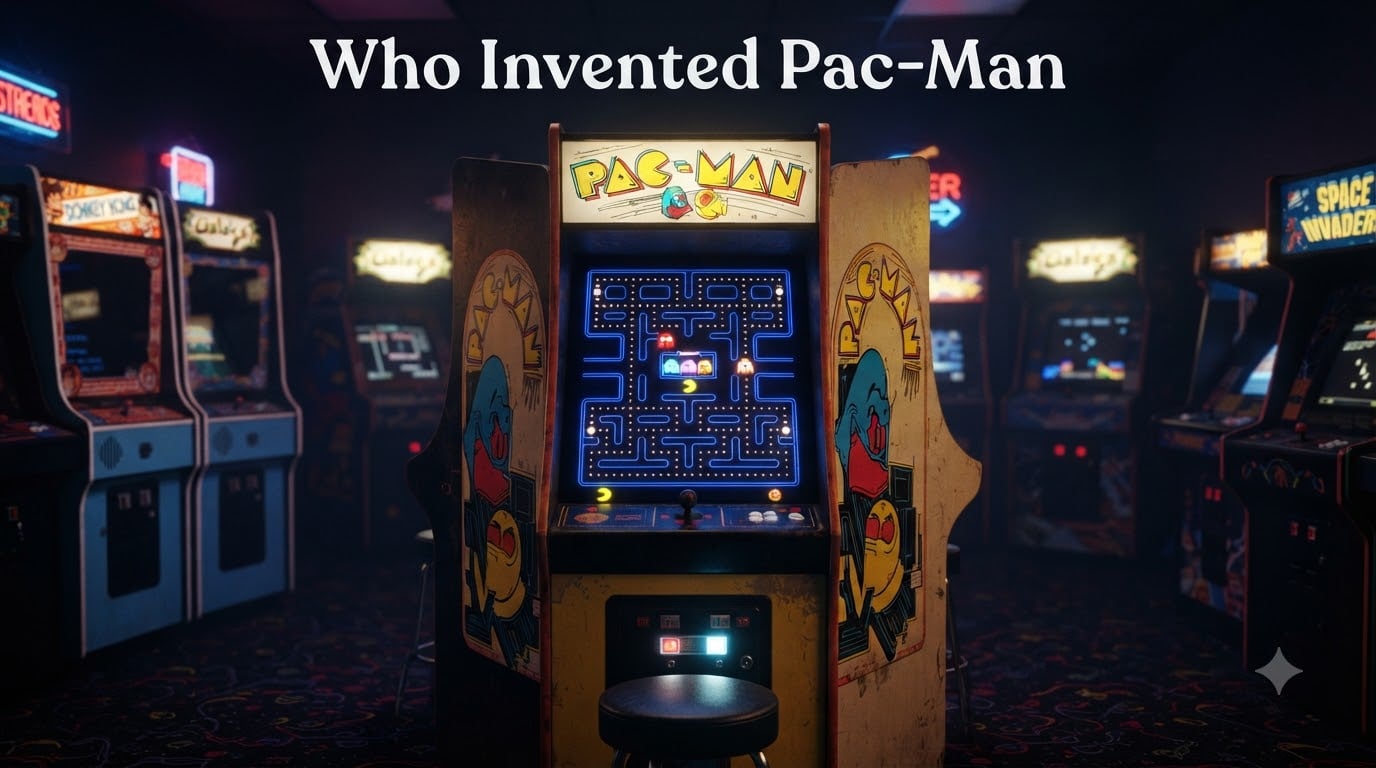
Toru Iwatani, a 24-year-old self-taught game designer working at Namco in Tokyo, invented Pac-Man in 1980. He led a nine-person development team through roughly nine months of design and programming, creating what would become the highest-grossing arcade game of all time.
At the time, arcades were dominated by violent shooters like Space Invaders. Iwatani wanted something different. He set out to build a game that would appeal to women and couples, with a theme centered around eating rather than shooting.
In this article, I’ll walk you through the full story of who invented Pac-Man. We’ll cover Iwatani’s background, the famous pizza inspiration, the development process at Namco, the four ghosts and their unique AI, his career after Pac-Man, and the lasting cultural impact of one of gaming’s most recognizable characters.
Table of Contents
- Who Invented Pac-Man?
- Toru Iwatani: The Self-Taught Designer Behind Pac-Man
- The Pizza Story: How Pac-Man Got His Shape
- Why Toru Iwatani Created Pac-Man: A Non-Violent Vision
- How Pac-Man Was Made: Development History
- Meet the Ghosts: Blinky, Pinky, Inky, and Clyde
- Toru Iwatani’s Career After Pac-Man
- Cultural Impact and Legacy of Pac-Man
- Frequently Asked Questions
- Conclusion
Who Invented Pac-Man?
Pac-Man was invented by Toru Iwatani (岩谷 徹), a Japanese video game designer employed at Namco. He began working on the concept in 1979 and released the game in Japanese arcades in July 1980. He was just 24 years old at the time of release.
Iwatani was not a programmer by training. He was a self-taught designer who had joined Namco in 1977 after graduating from Tokyo Metropolitan University. His vision for Pac-Man broke sharply from the violent, military-themed games that ruled the arcade floor.
He wanted to create something playful, colorful, and accessible. The result was a maze-chase game about a yellow circle eating dots while avoiding four ghosts, and it changed the video game industry forever.
Toru Iwatani: The Self-Taught Designer Behind Pac-Man
Toru Iwatani was born on January 25, 1955, in the Meguro ward of Tokyo, Japan. He attended Tokyo Metropolitan University, where he studied literature and education rather than computer science or engineering.
Despite having no formal programming background, Iwatani taught himself game design and programming on his own time. He joined Namco (then known as Nakamura Manufacturing) in 1977, drawn by the company’s growing presence in the amusement and arcade industry.
Before Pac-Man, Iwatani worked on several earlier arcade titles. He designed Gee Bee (1978), a block-breaking game that combined elements of pinball and Breakout. He followed it with Bomb Bee (1979) and Cutie Q (1979), both refinements of the same formula.
These early projects gave him valuable experience in game mechanics, hardware constraints, and team management. That experience directly informed the design of Pac-Man, which was far more ambitious than anything he had built before.
The Pizza Story: How Pac-Man Got His Shape
The most famous anecdote about Pac-Man’s creation is the pizza story. According to Iwatani, the idea for Pac-Man’s iconic round shape came to him when he looked at a pizza with two slices removed. The remaining shape, a circle with a wedge-shaped mouth, looked like a hungry character.
It is a great story, and Iwatani has told it many times over the decades. However, gaming historians have noted that the pizza tale may be a simplified version of the actual creative process. The shape also echoes the Japanese kanji character for “mouth” (口, pronounced kuchi), which is a square with an opening.
Regardless of which inspiration came first, the round, mouth-open design was a departure from the angular spaceships and tanks that populated arcade games at the time. The character was friendly, approachable, and instantly memorable.
Originally, the character was called “Puck-Man” in Japan, named after the puck-like shape. When the game was licensed for release in North America by Midway, the name was changed to Pac-Man to prevent vandals from altering the “P” into something profane on arcade cabinets.
Why Toru Iwatani Created Pac-Man: A Non-Violent Vision
When Iwatani started designing Pac-Man in 1979, the arcade industry was dominated by Space Invaders. Players shot aliens, bombs fell from the sky, and the entire experience was aggressive and competitive. The audience was overwhelmingly male.
Iwatani saw an opportunity. He believed arcades could be welcoming spaces for everyone, not just young men. His design goals were clear: create a non-violent game with bright colors, cute characters, and a theme that felt universal. Eating was something everyone understood and enjoyed.
The manga and anime culture of Japan also influenced his character design. Iwatani drew visual inspiration from the rounded, expressive character styles common in Japanese comics. This gave Pac-Man and the ghosts a personality that players could connect with emotionally.
The game’s mechanics reinforced this gentle approach. Power pellets let Pac-Man turn the tables on the ghosts, temporarily eating them instead of being eaten. It created a satisfying cycle of vulnerability and empowerment without a single bullet or explosion.
How Pac-Man Was Made: Development History
Pac-Man was developed over approximately nine months, starting in 1979. Iwatani led a nine-person team that included programmers, sound designers, and hardware engineers. The lead programmer was Shigeichi Ishimura, who handled the complex task of bringing Iwatani’s design to life on limited arcade hardware.
The development process followed a clear sequence:
Step 1: Iwatani created the core concept, including the maze layout, the eating mechanic, and the four-ghost chasing system. He sketched character designs and defined the rules.
Step 2: The programming team built the game using Z80-based arcade hardware. The maze, dot placement, and ghost movement patterns had to fit within tight memory constraints.
Step 3: Sound designer Toshio Kai composed the iconic sound effects, including the famous “waka waka” eating sound that became synonymous with the Pac-Man brand.
Step 4: The team tested and refined the ghost AI, adjusting difficulty so the game felt challenging but fair. Each ghost was programmed with a distinct behavioral pattern to keep gameplay unpredictable.
Step 5: Pac-Man was released in Japanese arcades in July 1980. It reached North American arcades later that same year through Midway’s licensing agreement with Namco.
Meet the Ghosts: Blinky, Pinky, Inky, and Clyde
One of Iwatani’s most innovative contributions was giving each ghost a distinct personality through unique AI behavior. This was not common in 1980, when most game enemies followed identical patterns.
Blinky, the red ghost, chases Pac-Man directly. He always heads toward Pac-Man’s current position, making him the most aggressive threat.
Pinky, the pink ghost, tries to ambush Pac-Man. She targets four tiles ahead of where Pac-Man is facing, attempting to cut him off rather than follow him.
Inky, the cyan ghost, is the most unpredictable. His movement is calculated using both Blinky’s position and Pac-Man’s position, creating a pattern that is difficult to anticipate.
Clyde, the orange ghost, is shy and scatterbrained. He chases Pac-Man when far away but panics and retreats to his corner when he gets too close.
Iwatani has said he wanted the ghosts to feel like characters in a comedy, not mindless enemies. The interplay between their different behaviors creates the strategic depth that has kept players engaged for over four decades.
Toru Iwatani’s Career After Pac-Man
After Pac-Man, Iwatani continued working at Namco for decades. He designed Libble Rabble in 1983, an innovative puzzle game involving two arrows connected by a rope. He also contributed to the development of Pole Position, one of the most influential racing games of the 1980s.
In 2007, Iwatani returned to his most famous creation with Pac-Man Championship Edition. Designed for Xbox Live Arcade, it reimagined the classic gameplay with time-limited modes, evolving mazes, and a modern visual style. Iwatani personally supervised the project, and it was widely praised by critics and fans.
Later that year, Iwatani left Namco. A popular myth circulated that he departed on bad terms, angry about not receiving proper credit or compensation for Pac-Man. This is not true. Iwatani has clarified in interviews that he left amicably to pursue a career in education.
He joined the faculty at Tokyo Polytechnic University as a professor of game design. He also lectured at Osaka University of Arts and other institutions. In his academic role, Iwatani focused on mentoring the next generation of game creators and writing about game design theory.
His teaching career has become a key part of his legacy. Many of his students have gone on to work in the Japanese game industry, carrying forward the design principles Iwatani established with Pac-Man.
Cultural Impact and Legacy of Pac-Man
Pac-Man became a cultural phenomenon almost immediately after its release. By the mid-1980s, it was the highest-grossing arcade game of all time, a title it still holds today. The character appeared on lunch boxes, t-shirts, a television cartoon series, and a pop song (“Pac-Man Fever” by Buckner and Garcia) that reached the Billboard Top 10.
In 2005, Guinness World Records recognized Pac-Man as the most successful coin-operated arcade game in history. Iwatani received a certificate at a ceremony celebrating the game’s achievements, and the recognition solidified Pac-Man’s place in gaming history.
The game’s influence extends beyond entertainment. Pac-Man has been the subject of academic research on game AI, featured in museum exhibitions on video game art, and used as a benchmark in artificial intelligence studies. The Level 256 kill screen, a famous bug that causes the game to crash when a player reaches the 256th level, has become a legendary part of gaming culture.
In the 2015 movie Pixels, Pac-Man appeared as one of the alien invaders attacking Earth. Toru Iwatani made a cameo appearance in the film as an arcade repairman. However, the actor Denis Akiyama played a fictionalized version of Iwatani on screen. This has led to some confusion, with people occasionally mistaking Akiyama for the real game designer.
It is also worth clarifying that Pac-Man was invented in Japan, not in the United States. While Midway handled the North American release and distribution, every aspect of the game’s creation, from concept to programming, took place at Namco’s offices in Tokyo under Iwatani’s direction.
Frequently Asked Questions
Was the creator of Pac-Man actually in Pixels?
Yes. Toru Iwatani made a cameo appearance in the 2015 movie Pixels as an arcade repairman. However, the actor Denis Akiyama played a fictionalized version of Iwatani on screen, which has led some viewers to mistake Akiyama for the real creator.
How was Pac-Man invented?
Toru Iwatani conceived Pac-Man in 1979 while working at Namco. He led a nine-person team through about nine months of development, with programmer Shigeichi Ishimura handling the code. The game was inspired by a pizza with two slices removed and the Japanese kanji for mouth. It was released in Japanese arcades in July 1980.
What does Toru Iwatani do now?
Toru Iwatani left Namco in 2007 and became a professor of game design at Tokyo Polytechnic University. He has also lectured at other Japanese universities and continues to speak about game design at industry events.
Who came first, Pac-Man or Mario?
Pac-Man came first. Pac-Man was released in 1980, while Mario made his debut as Jumpman in Donkey Kong in 1981. Pac-Man is three years older than the character who would eventually become Nintendo’s most famous icon.
Did Toru Iwatani receive a bonus for creating Pac-Man?
No. Despite Pac-Man generating billions in revenue, Iwatani reportedly did not receive a bonus for creating the game. He was a salaried Namco employee at the time and remained with the company for decades afterward, eventually leaving amicably in 2007 to pursue teaching.
Is the creator of Pac-Man still alive?
Yes. As of 2026, Toru Iwatani is alive. Born in January 1955, he is in his early seventies and remains active in game education and the gaming community.
Conclusion
Toru Iwatani invented Pac-Man in 1980 at Namco, and in doing so, he reshaped the entire video game industry. A self-taught designer with no formal programming education, he created a game that broke away from the violent shooters of his era and introduced the idea that arcades could be for everyone.
His design choices were remarkably forward-thinking. The non-violent eating theme, the four ghosts with distinct AI personalities, the colorful aesthetic, and the deliberate appeal to a broader audience all set Pac-Man apart from every other arcade game of its time. These decisions turned a maze-chase game into a global cultural phenomenon.
What makes Iwatani’s story especially compelling is that he never set out to create the best-selling arcade game in history. He simply wanted to design something different, something that would bring people together. The fact that he reportedly received no bonus for his creation and stayed at Namco for decades afterward speaks to his character and his genuine love of game design.
From the original arcade cabinet to Pac-Man Championship Edition in 2007, from Guinness World Records to the Pixels movie cameo, the Pac-Man legacy continues to grow. Iwatani’s later career as a professor at Tokyo Polytechnic University ensures that his design philosophy will influence game creators for generations to come.
If you want to explore more arcade history, dive into the stories behind other classic coin-op games. The golden age of arcades produced dozens of legendary titles, each with its own fascinating origin story. Understanding who invented Pac-Man is just the beginning of a much larger journey through the history of interactive entertainment.