
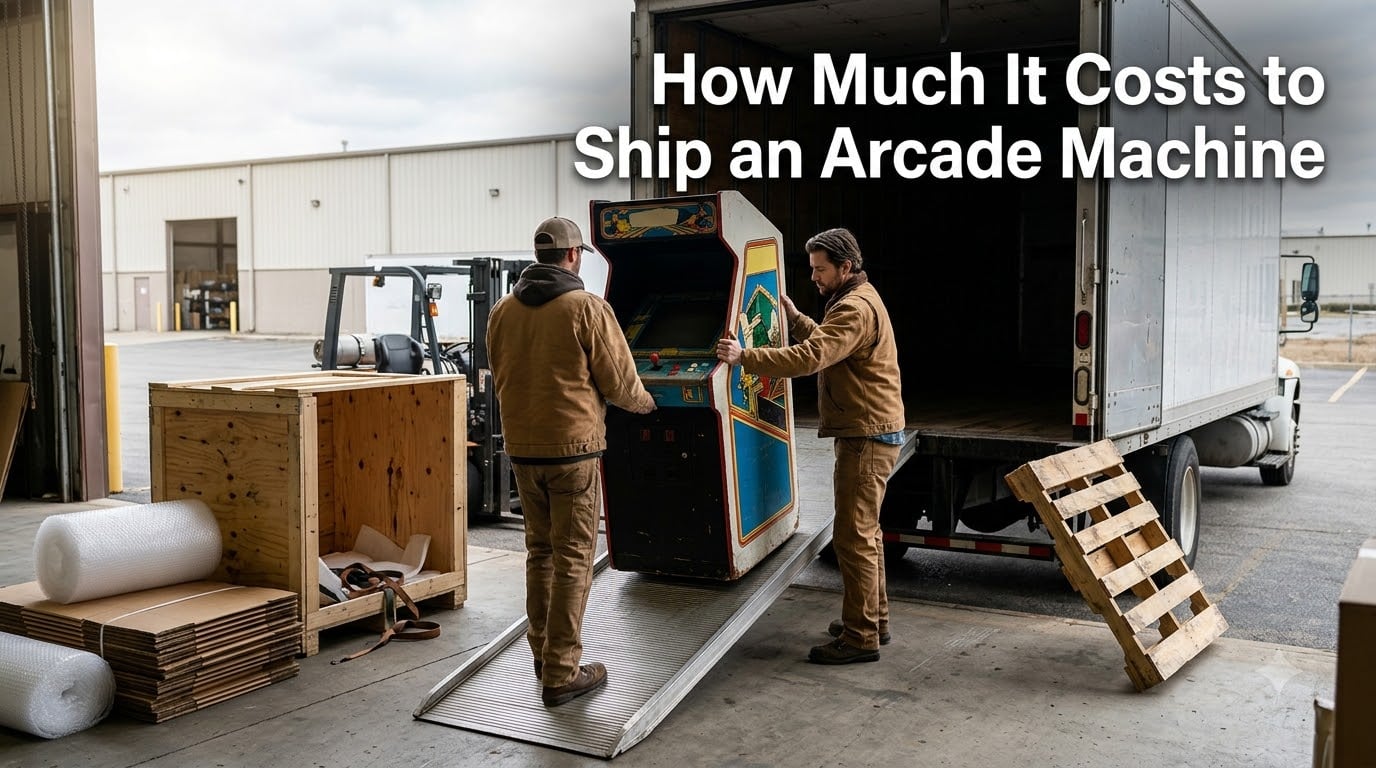
Shipping an arcade machine is one of those costs that catches buyers off guard. You find the perfect cabinet on eBay or at an auction across the country, and then you realize the shipping might cost as much as the machine itself. I have been there, and so have thousands of collectors on Reddit and arcade forums.
If you are trying to figure out how much it costs to ship an arcade machine, the short answer is between $200 and $1,500 depending on distance, size, and service level. But that range covers everything from a short local haul to a cross-country white-glove delivery of a vintage cabinet.
In this guide, I will break down real cost ranges by distance and machine type, compare freight shipping methods, and share actual quotes from collectors who have shipped machines recently. I will also cover packing steps, freight classes, and money-saving strategies that most shipping guides skip entirely.
Our team dug through forum discussions on Reddit’s r/arcade, r/cade, and Arcade-Museum to pull real-world numbers. Combined with data from major freight brokers, this guide gives you a clear picture of what to expect when you ship an arcade machine in 2026.
Table of Contents
- Quick Answer: How Much Does It Cost to Ship an Arcade Machine?
- Factors That Affect the Cost to Ship an Arcade Machine
- Shipping Methods Compared: LTL, FTL, and White-Glove Delivery
- Freight Class Explained: Why It Changes Your Price
- How Much Does It Cost to Ship an Arcade Machine: Real User Examples
- How to Pack an Arcade Machine for Shipping: Step by Step
- How to Save Money When You Ship an Arcade Machine
- Insurance and Liability: Protecting Your Investment
- Common Shipping Mistakes to Avoid
- FAQs
- Conclusion
Quick Answer: How Much Does It Cost to Ship an Arcade Machine?
Here is the cost breakdown at a glance, based on distance and machine size. These ranges come from freight broker data and real collector experiences.
Local shipping (under 500 miles): $200 to $500 for a standard full-size cabinet
Cross-country shipping (1,000+ miles): $400 to $700 for a standard cabinet, $700 to $1,500 for large or vintage machines
Oversized or non-disassembled units: $800 to $1,500+ due to dimensions exceeding standard freight tiers
Arcade1Up cabinets (countercade size): $100 to $300 via parcel shipping, but many collectors say it is not worth shipping and you should sell and rebuy locally instead
Pinball machines: $300 to $700 on average, depending on distance and whether white-glove service is included
Vintage or collector machines via specialty movers: $300 to $800 for a single game, with some specialty carriers like Beltmann charging $600 to $800 as a base rate
Most collectors report that a typical full-size arcade cabinet costs around $400 to $600 to ship cross-country using standard LTL freight. White-glove delivery, which includes inside placement and unpacking, adds $150 to $300 to the base cost.
Factors That Affect the Cost to Ship an Arcade Machine
Several variables determine where your quote falls within those ranges. Understanding these factors helps you predict costs and find ways to reduce them.
Weight: Standard arcade cabinets weigh between 150 and 350 pounds. Pinball machines run 250 to 300 pounds. Larger showcase cabinets can hit 400 pounds or more. Heavier machines cost more because freight carriers price partly by weight and partly by how the load fits on a truck.
Dimensions: This is where many buyers get surprised. A full-size cabinet measuring 34 x 34 x 80 inches may push your shipment into an oversized freight category. Anything over 12 linear feet (length plus width plus height) often triggers dimensional pricing penalties. Disassembling the machine to reduce its footprint can drop your cost by 30 to 50 percent.
Distance: Freight rates scale with mileage, but not linearly. The first 500 miles carry the highest per-mile cost because of pickup and delivery overhead. After that, additional miles cost less per mile, which is why cross-country shipping is not as expensive as you might expect relative to regional hauls.
Residential pickup and delivery: Most freight carriers add a residential surcharge of $50 to $150 per stop because residential addresses lack loading docks. If you can pick up or deliver at a business with a dock, or meet the carrier at a freight terminal, you avoid this fee entirely.
Liftgate service: If neither the pickup nor delivery location has a loading dock, you need a liftgate. This hydraulic platform lowers the machine from the truck to ground level. Expect $50 to $125 for liftgate service at each stop that needs it.
Accessorials: Additional services add up fast. Inside delivery (carrying the machine past the curb or dock) runs $75 to $200. Appointment delivery with a specific time window adds $25 to $75. Each of these is optional but necessary depending on your situation.
Seasonal demand: Freight rates fluctuate throughout the year. Peak shipping season from September through December often means higher rates and longer transit times. Shipping in January through March can save you 10 to 20 percent.
Shipping Methods Compared: LTL, FTL, and White-Glove Delivery
When you ship an arcade machine, you choose between three main freight methods. Each has different cost profiles and protection levels.
LTL (Less-Than-Truckload) Shipping: This is the most common and affordable option for a single arcade cabinet. Your machine shares truck space with other shipments, which keeps costs down. LTL is the go-to choice for standard cabinets and pinball machines. Typical cost is $300 to $700 for cross-country delivery. Transit time is 3 to 10 business days depending on distance and carrier routing.
FTL (Full Truckload) Shipping: Your machine gets a dedicated truck or at least a dedicated trailer space. This costs significantly more, usually $1,000 to $3,000, but offers the highest protection level because the machine is not handled as frequently. FTL makes sense for extremely valuable vintage machines or when you are shipping multiple cabinets at once and can split the cost.
White-Glove Delivery: This premium service includes inside placement, unpacking, debris removal, and sometimes light assembly. Carriers specializing in arcade and gaming equipment, such as Beltmann, Precision Transportation, and STI (Specialized Transportation), offer this level of service. Base rates start around $600 to $800 per game. White-glove is the safest option for vintage or irreplaceable machines.
Parcel shipping (for smaller units): Arcade1Up countercades, bartop arcades, and tabletop machines may qualify for standard parcel shipping via UPS or FedEx if they stay under size and weight limits. This costs $100 to $300 and arrives in 3 to 7 days. However, full-size Arcade1Up cabinets are too large and heavy for parcel and require freight.
Specialty arcade movers: Companies that exclusively transport arcade and pinball equipment understand how to handle fragile cabinets, CRT monitors, and delicate artwork. They charge a premium but arrive with proper equipment and experience. Many collectors on r/arcade recommend these carriers for anything vintage or worth more than $1,000.
Freight Class Explained: Why It Changes Your Price
Freight class is a standardized system carriers use to price shipments based on density, stowability, handling, and liability. Most people shipping an arcade machine for the first time have never heard of it, but it directly affects your quote.
Freight class 125 applies to dense, compact, easy-to-handle items. A well-crated arcade machine that is palletized and protected may qualify for class 125, which keeps pricing lower. Typical cost impact: standard rates without penalties.
Freight class 250 applies to lower-density, fragile, or hard-to-stow items. Many arcade cabinets end up in class 250 because they are large, fragile, and require careful handling. This pushes shipping costs significantly higher than class 125. Multiple Reddit users report that being assigned class 250 instead of class 125 increased their quote by 40 to 60 percent.
How do you get a lower freight class? Proper crating, palletizing, and dense packing materials increase your shipment’s density and may drop you from class 250 to class 125. A solid wooden crate with internal foam padding reads as a dense, stowable shipment rather than a fragile loose cabinet. The crate itself costs $100 to $300 to build or buy, but the freight savings often exceed that.
When requesting quotes, ask the broker what freight class they assigned. If it is 250, ask what it would take to reclassify at 125. This single question can save you hundreds of dollars.
How Much Does It Cost to Ship an Arcade Machine: Real User Examples
No competitor guide includes real dollar amounts from actual collectors. Our team pulled these from Reddit threads, Arcade-Museum forums, and Pinside discussions to give you honest, real-world numbers.
Cross-country standard cabinet: Multiple collectors on r/arcade report paying $400 to $700 to ship a standard full-size cabinet coast to coast via LTL freight. One user shipped a Mortal Kombat cabinet from California to New York for $525 using uShip. Another paid $480 for a Pac-Man cabinet going from Texas to Oregon.
Vintage machine via specialty mover: A collector on Arcade-Museum forums shared a quote of approximately $300 to ship a vintage machine from Texas to New Jersey using a specialty arcade transport company. That rate was competitive because the carrier had other deliveries along the same route and could combine shipments.
Oversized non-disassembled unit: A Reddit user on r/cade reported a shipping cost exceeding $1,000 for a large cabinet measuring 34 x 34 x 80 inches that was not disassembled. The dimensions pushed it into oversized freight territory, and the carrier charged a premium. Had the user removed the control panel and marquee, the cost would likely have dropped to the $500 to $600 range.
Beltmann specialty shipping: Several collectors quoted Beltmann’s base rate at $600 to $800 for a single game. Beltmann is a known specialty carrier for arcade and pinball equipment. That rate typically includes inside delivery and careful handling but varies by distance.
Precision Transportation: Recommended by multiple Reddit users for reliability and fair pricing. Collectors report quotes in the $400 to $600 range for standard cross-country cabinet shipping.
Arcade1Up shipping reality check: Nearly every collector on r/Arcade1Up who asked about shipping a full-size Arcade1Up cabinet concluded it was not worth the cost. Shipping ran $200 to $400, which was close to or exceeded the cost of buying a new unit locally. The consensus was to sell locally and rebuy at the destination.
Hidden cost warning: Several users warned about sellers offering “free shipping” and then inflating the machine price to cover it. One collector found that a “free shipping” listing was actually priced $400 above market value. Always compare the total cost of machine plus shipping rather than being swayed by “free” delivery.
How to Pack an Arcade Machine for Shipping: Step by Step
Proper packing is the single biggest factor in whether your machine arrives intact. Here is the step-by-step process collectors and professional movers recommend.
Step 1: Photograph everything. Before you touch the machine, take detailed photos from every angle. Document existing scratches, dents, or damage. These photos are your proof if you need to file an insurance claim. Photograph the inside too, especially the monitor and circuit boards.
Step 2: Remove loose and fragile parts. Take off the control panel, marquee, coin door components, and any detachable elements. Wrap each piece separately in bubble wrap. Removing these reduces the machine’s footprint and protects the most fragile components from transit damage.
Step 3: Secure the monitor. CRT monitors are the most damage-prone component in vintage machines. Place foam padding or cardboard between the monitor face and the bezel to prevent shifting. For CRTs, consider building a custom foam brace that holds the monitor firmly in place within the cabinet.
Step 4: Wrap the entire cabinet. Use multiple layers of bubble wrap, focusing on corners and edges. Then apply shrink wrap over the bubble wrap to hold everything tight. The goal is to prevent the cabinet from shifting inside its crate or on the pallet.
Step 5: Palletize or crate. For budget shipping, strap the wrapped cabinet to a heavy-duty wooden pallet using ratchet straps. For better protection, build or buy a custom wooden crate with internal foam padding. Crating costs more upfront but often reduces freight class and damage risk.
Step 6: Fill empty space. Inside the crate or between the cabinet and pallet, pack every gap with foam, packing peanuts, or cardboard inserts. Any movement during transit causes damage. The machine should not shift at all when you push on the crate.
Step 7: Label clearly. Mark the crate or pallet with “FRAGILE,” “THIS SIDE UP,” and the delivery address on multiple sides. Include a packing slip inside the crate with contact information for both sender and recipient.
Step 8: Measure and weigh the final shipment. Record the exact dimensions and weight of your packed shipment. You need these numbers accurate to get correct freight quotes. Underreporting dimensions or weight leads to rebilling charges from the carrier.
How to Save Money When You Ship an Arcade Machine
Shipping costs are not fixed. With the right strategies, you can cut your bill significantly. Here are the tactics that real collectors use.
Use freight terminal drop-off and pickup. If you can deliver the machine to a carrier’s freight terminal and pick it up at the destination terminal, you eliminate residential surcharges and liftgate fees. This saves $100 to $300 on a typical shipment. Many freight brokers offer terminal-to-terminal service at a discount.
Compare at least three quotes. Freight pricing varies widely between carriers and brokers. Use freight marketplaces like uShip, FreightCenter, and FreightQuote to compare offers. The same shipment can vary by $200 or more between carriers.
Ship during off-peak season. January through March typically offers the lowest freight rates. Avoid September through December when holiday shipping demand drives prices up. If you have flexibility on timing, waiting a few weeks can save 10 to 20 percent.
Disassemble to reduce dimensions. Removing the control panel, marquee, and other detachable parts can shrink your machine from oversized to standard dimensions. This alone can cut your shipping cost by 30 to 50 percent, as one Reddit user discovered when their quote dropped from over $1,000 to around $500.
Consolidate shipments. If you are buying multiple machines or can coordinate with another collector shipping along the same route, you can split a full truckload. Specialty movers often offer per-game discounts for multi-game shipments because it improves their route efficiency.
Skip white-glove when you can handle it yourself. White-glove service adds $150 to $300 per shipment. If you have a furniture dolly, a friend to help lift, and a clear path to the machine’s final location, standard curbside delivery saves you that premium.
Insurance and Liability: Protecting Your Investment
Freight carriers offer basic liability coverage, but it is usually not enough for a valuable arcade machine. Standard carrier liability caps at a few dollars per pound, which means a 250-pound machine might only be covered for $500 to $1,000 regardless of its actual value.
To properly protect your machine, purchase additional declared value coverage or third-party cargo insurance. Declared value coverage lets you state the machine’s actual worth and pay a premium based on that amount. For a $2,000 vintage cabinet, expect to pay $30 to $80 for full coverage. For machines worth $5,000 or more, specialized collectibles insurance may be more cost-effective.
Before shipping, check whether your homeowner’s or renter’s insurance covers items in transit. Some policies include off-premises coverage, but many exclude items shipped via freight carriers. Call your insurance provider to confirm rather than assuming you are covered.
Document the machine’s condition with photos and video before it leaves your possession. If damage occurs during transit, you need to file a claim within 24 to 48 hours of delivery. Note damage on the delivery receipt before signing it. Once you sign without noting damage, claims become much harder to win.
Common Shipping Mistakes to Avoid
Collectors who have shipped machines before have learned some expensive lessons. Here are the mistakes to watch for.
Underestimating dimensions: Measure the packed shipment, not just the bare cabinet. A crate or pallet adds inches, and those inches can push you into a higher pricing tier. Accurate measurements prevent surprise rebilling charges.
Skipping the liftgate when you need one: If the delivery address has no loading dock and no way to get the machine off the truck, you need a liftgate. Forgetting to add this service means the driver may leave without delivering, and you get charged a redelivery fee.
Insufficient insurance: Relying on standard carrier liability for a valuable machine is a gamble. If the machine is damaged or destroyed, the reimbursement will not cover replacement. Always purchase declared value coverage that matches the machine’s worth.
Poor packing on the monitor end: The CRT monitor or LCD panel is the most fragile part. Failing to brace it properly inside the cabinet is the number one cause of shipping damage. Foam padding between the monitor and bezel is non-negotiable for vintage machines.
Not comparing quotes: Accepting the first quote you receive almost guarantees you are overpaying. Freight pricing is not standardized, and different brokers negotiate different rates with carriers. Always compare at least three quotes.
FAQs
Conclusion
Figuring out how much it costs to ship an arcade machine comes down to a few key numbers. Expect $200 to $500 for local hauls, $400 to $700 for standard cross-country shipping, and $600 to $1,500 for oversized or white-glove deliveries of valuable machines. The choices you make about packing, freight class, and accessorials determine where you land in those ranges.
Start by measuring your packed shipment accurately, then compare at least three freight quotes. Consider disassembling parts to shrink dimensions and ask about freight terminal drop-off to avoid residential fees. With the right preparation, you can ship an arcade machine safely without overpaying.