
Shipping an arcade machine is not like shipping a piece of furniture. These cabinets weigh anywhere from 200 to 500 pounds, house fragile CRT monitors or LCD screens, contain sensitive circuit boards, and often represent thousands of dollars in collector value. One bad drop on a liftgate can crack a screen, snap a joystick mount, or shear a coin door hinge.
I have helped collectors pack and ship dozens of vintage cabinets over the years, and I have seen what works and what fails. This guide walks through the entire process: how to prepare your arcade machine, what packing materials to buy, whether to crate or palletize, which carriers actually handle arcades well, how to insure the shipment properly, and the mistakes that cost people their machines. Whether you are shipping a Pac-Man cabinet you bought on eBay or relocating a classic Street Fighter II to a new barcade, the steps below will protect your investment.
Table of Contents
- Understanding Arcade Machine Weight and Dimensions
- Step-by-Step Preparation Before Shipping an Arcade Machine
- Packing Materials You Need to Ship an Arcade Machine
- Crating vs Palletizing vs Blanket Wrap Methods
- Choosing a Shipping Carrier for Arcade Machines
- Insurance and Tracking for Arcade Machine Shipments
- Common Mistakes to Avoid When Shipping an Arcade Machine
- FAQs
- Final Tips for Shipping Your Arcade Machine Safely
Understanding Arcade Machine Weight and Dimensions
Before you book a shipment, you need a realistic picture of what you are moving. Arcade cabinets vary widely by era, marquee style, and control layout, and the shipping quote you receive depends heavily on accurate weight and dimension data.
Here is a typical breakdown by cabinet type:
Classic upright cabinets (Pac-Man, Galaga, Donkey Kong era): 200 to 300 lbs, roughly 25 inches wide, 30 inches deep, 70 inches tall.
Mid-generation cabinets (Street Fighter II, Mortal Kombat era): 250 to 350 lbs, slightly wider control panels, similar footprint.
Candy cabs and Japanese imports: 180 to 250 lbs, narrower profile, more delicate monitor mounting.
Cocktail table cabinets: 300 to 400 lbs, very wide footprint requiring custom crating.
Pinball machines (related but different): 250 to 350 lbs, 29 inches wide, 57 inches deep, 75 inches tall.
Knowing these numbers helps in three ways. First, it lets you spot a freight class quickly. Most arcades ship as freight class 85 to 100 because of the dense, heavy, fragile nature. Second, it helps you choose the right vehicle. Anything over 250 pounds really requires liftgate service and at least two strong movers. Third, it sets your insurance declared value expectation. Under-declaring to save on freight costs is a common mistake that backfires the moment the carrier damages the machine.
Step-by-Step Preparation Before Shipping an Arcade Machine
Preparation is where most of the protection happens. Packing materials alone cannot save a machine whose internal components are loose. Walk through these steps before you wrap a single corner.
Step 1: Photograph and Document Everything
Spend 15 minutes photographing your machine from every angle. Capture the front, back, sides, top, control panel, marquee, coin door, and serial number plate. This becomes your proof of condition if you need to file an insurance claim. Save these images with timestamps before the cabinet leaves your possession.
Step 2: Remove the Coin Door and Cash Box
Take off the coin door and remove the cash box entirely. The metal door is heavy and can swing open during transit, damaging the cabinet front or the coin acceptor mechanism. Wrap the coin door separately in bubble wrap and tape it inside the cabinet, or pack it in a separate small box with the keys and any paperwork.
Step 3: Detach the Control Panel
Most control panels unbolt with two to four screws. Removing the panel protects the joystick and button assemblies from being snapped off by sudden jolts. Wrap the panel in moving blankets and secure it inside the cabinet with zip ties, or ship it as a separate piece in a labeled box.
Step 4: Secure the Monitor
This is the most fragile and expensive component. If your machine has a CRT, the neck of the tube can crack from shock. Use foam blocks or tightly rolled moving blankets wedged around the monitor frame. If your machine has an LCD, secure the screen so it cannot shift. Some owners add a piece of rigid foam taped directly to the screen face for an extra layer of protection.
Step 5: Tape Open Doors and Loose Cables
Use painter’s tape (never duct tape on wood) to secure any access panels, speaker grilles, and marquee retainers from opening during transit. Bundle loose wiring with zip ties so nothing snags when the cabinet is tilted or rotated.
Step 6: Test the Cabinet Empty
Power on the machine one last time and confirm it works perfectly. Document this with a short video. After this, lock down any moving parts and you are ready to pack.
Packing Materials You Need to Ship an Arcade Machine
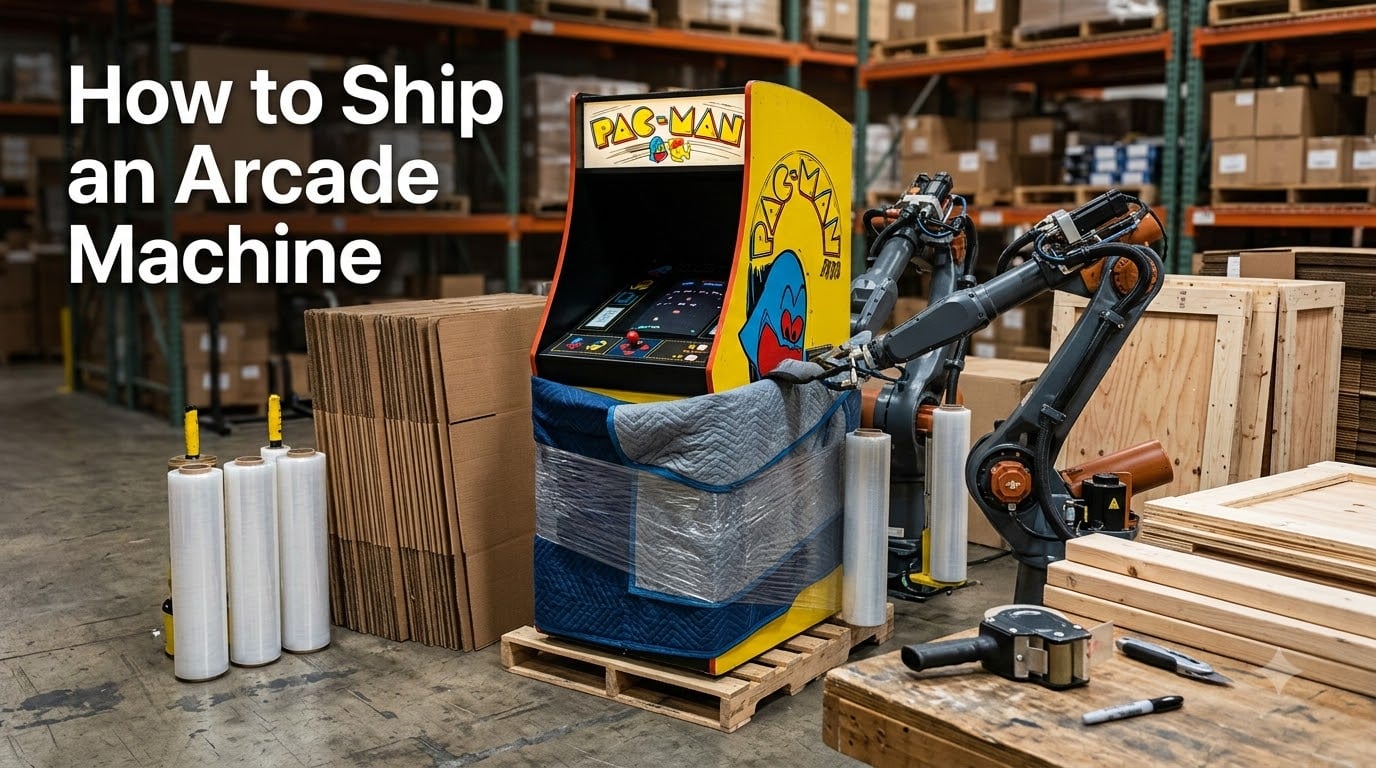
Forums consistently recommend a layered approach. The standard combo is moving blankets, foam, cardboard, and stretch wrap, applied in that order. Here is what to buy or source.
Moving blankets (4 to 6): The thick cotton or polyester kind used by professional movers. Cheap furniture pads do not absorb enough impact.
Foam sheets or bubble wrap (1/2 inch): For wrapping the monitor and any sharp cabinet edges that could punch through cardboard.
Heavy-duty stretch wrap (2 to 4 rolls): Also called pallet wrap. Holds the blankets tight and seals the cabinet against dust and moisture.
Corrugated cardboard sheets: Cut to cover every face of the cabinet, with extra layers on corners, top, and bottom.
Ratchet straps or heavy-duty zip ties: For securing the cabinet to the pallet or inside the crate.
Plywood (for crating): At least half-inch thickness for the base, with 2x2s for bracing.
Shock indicators or tilt indicators (optional but smart): Small adhesive devices that turn red if the shipment is dropped or tilted past a set angle.
One forum user described their winning packing sequence as two layers of stretch wrap, thick cardboard cut to every surface, then extra cardboard on the corners, bottoms, and front. This four-layer sandwich is what survives a long freight haul. The cardboard spreads impact across a wider area instead of letting one corner take the full hit.
Crating vs Palletizing vs Blanket Wrap Methods
You have three main options for preparing the cabinet once it is wrapped. Each has tradeoffs in cost, protection level, and carrier compatibility.
Wooden Crating (Best Protection, Highest Cost)
A custom wooden crate is the gold standard for shipping a high-value arcade. The base is plywood, the walls are 2×2 framing with plywood skin, and the top is removable for inspection. Inside, the cabinet sits on foam blocks and is braced so it cannot shift in any direction. Crates are essential for international shipments, machines valued over $3,000, and any cabinet going more than 1,500 miles.
Cost for materials runs roughly $150 to $300 depending on size. If you are not handy, many freight shipping hubs will build a crate for you for an additional fee.
Palletizing (Good Protection, Lower Cost)
Palletizing means bolting the wrapped cabinet to a standard wooden pallet so it can be moved with a forklift or pallet jack. You save on materials and the carrier can handle it with standard freight equipment. The downside is that side impacts are not as well protected. If you choose palletizing, add extra cardboard and corner guards on every exposed edge.
Blanket Wrap / White Glove (Lowest Prep, Carrier Does the Work)
Specialty carriers like the Beltman Group and several uShip haulers offer blanket wrap service. They show up with their own padding and straps, wrap the cabinet on site, and transport it inside a padded air-ride truck. This is the easiest method for the seller and is ideal for local or regional moves. Pricing is higher per mile but you skip the crating work entirely.
Choosing a Shipping Carrier for Arcade Machines
Not every carrier wants an arcade machine. They are heavy, awkward, fragile, and not always profitable for standard LTL (less-than-truckload) freight networks. Here is how to sort the options.
Specialty Arcade and Pinball Shippers
Companies like the Beltman Group have decades of experience with coin-op equipment. They know how to brace a monitor, navigate a narrow doorway, and deal with the unique geometry of a cocktail cabinet. Pricing tends to be higher than general freight, but the survival rate of the machines is much better.
uShip and Similar Auction-Style Brokers
uShip lets you post your shipment and receive bids from carriers. Forum users report good experiences and bad ones, so vet your carrier carefully. Look for transporters with reviews specifically mentioning arcade machines, pinball, or heavy fragile items. Confirm they carry cargo insurance and have a valid MC or DOT number.
LTL Freight Carriers (ABF, Estes, SAIA, XPO)
For long-distance moves, LTL freight is usually the cheapest reliable option. You book through a freight broker or directly with the carrier, choose liftgate service if the pickup or delivery is residential, and the cabinet travels in a shared truck. Make sure the cabinet is crated or palletized because LTL handling involves conveyor belts and forklift transfers that will tear apart a blanket-wrapped cabinet.
NAVL and Similar Specialty Networks
North American Van Lines has a specialty products division that handles arcade and pinball shipments. Pricing is competitive but transit times can run 3 to 6 weeks. If you are not in a rush and want a name-brand carrier with insurance backing, NAVL is a solid option.
Insurance and Tracking for Arcade Machine Shipments
Standard freight carriers include only $0.60 to $2.00 per pound of coverage in their base rate. On a 300-pound cabinet, that is $180 to $600, far below the actual replacement value. You need supplemental coverage.
Declared Value and Full Coverage
Declare the full appraised or purchase value when booking the shipment. The carrier will charge an additional percentage (typically 1 to 3 percent of the declared value) for the upgraded coverage. If you under-declare, you only recover what you declared. There is no upside to cheating yourself here.
Third-Party Shipment Insurance
If the carrier’s insurance feels thin, you can buy a separate policy from providers like Parcel Insurance Plan or Shipsurance. These policies cover damage in transit regardless of which carrier you use, and they often pay out faster than the carrier’s claims process.
Tracking and Shock Indicators
Insist on a tracking number with milestone updates. Most LTL carriers now provide detailed tracking. For high-value shipments, add a shock indicator label and a tilt indicator to the crate. These small adhesive devices turn red if the package is dropped or tilted beyond a safe angle, giving you proof of mishandling if you need to file a claim.
Photograph the Final Crate
Take photos of the finished, sealed crate or pallet just before the driver takes possession. Send these to yourself with timestamps and email them to the carrier. This creates a chain of evidence from the moment the machine leaves your hands.
Common Mistakes to Avoid When Shipping an Arcade Machine
Almost every shipping horror story traces back to one of these mistakes. I have seen all of them in forums and from customers who came to us for repair after a bad move.
Mistake 1: Skipping Internal Securing
Wrapping the outside of a cabinet does nothing if the monitor is loose inside. The monitor assembly can swing and crack the neck of a CRT with one hard jolt. Always brace the monitor internally before you wrap the exterior.
Mistake 2: Laying the Cabinet Down Without Internal Support
Yes, you can lay an arcade on its back to save vertical space, but only if you have removed the monitor or braced it so it cannot rest its weight on the glass. Laying a fully assembled cabinet on its back without preparation can break the monitor bracket and damage the control panel.
Mistake 3: Cheap Freight, No Insurance
The cheapest quote is rarely the best deal. Carriers who undercut the market often do so by running older trucks, hiring day labor, and skipping proper padding. Pair cheap freight with no insurance and you are gambling with a several-thousand-dollar machine.
Mistake 4: Forgetting the Liftgate
If either the pickup or delivery location does not have a loading dock, you need liftgate service. Without it, the driver cannot get the cabinet off the truck, and your shipment sits on the curb until you scramble to find a forklift.
Mistake 5: Using Duct Tape on Wood
Duct tape adhesive can pull the finish off a vintage cabinet when removed. Use painter’s tape for any taping directly on wood, and reserve duct tape for the outer stretch wrap and cardboard layers where it never touches the cabinet itself.
Mistake 6: Skipping the Climate Question
Arcade machines contain wood, cardboard, and electronics that do not love a hot, humid trailer. If your shipment is crossing the country in summer or winter, ask the carrier about climate control or trailer ventilation. A $50 climate surcharge beats a $2,000 humidity damage claim.
FAQs
How to transport an arcade machine?
To transport an arcade machine, secure the monitor and loose parts internally, wrap the cabinet in moving blankets and foam, apply heavy-duty stretch wrap, then crate or palletize it. Book a freight carrier with liftgate service, declare the full value, and add supplemental insurance. Specialty shippers like the Beltman Group or uShip haulers with arcade experience are the safest bet.
How heavy is an arcade machine?
Most arcade cabinets weigh between 200 and 500 pounds. Classic uprights like Pac-Man and Galaga run 200 to 300 lbs, mid-generation Street Fighter style cabinets run 250 to 350 lbs, and cocktail table cabinets can reach 400 lbs. Always weigh your specific machine before booking freight so your quote is accurate.
How much does it cost to ship a pinball machine?
Shipping a pinball machine typically costs $400 to $1,200 within the continental US, depending on distance, weight, and service level. Local moves under 500 miles can run $300 to $500. Cross-country shipments with crating and full insurance often land between $800 and $1,500. Specialty white-glove carriers charge more but deliver the machine in showroom condition.
Can you lay down an arcade machine?
You can lay an arcade machine on its back if you brace the monitor internally and remove or fully secure the control panel. Never lay down a cabinet without first making sure the monitor cannot shift, rest its weight on glass, or crack under pressure from a hard jolt. When in doubt, transport the cabinet upright on a pallet.
Do I need insurance to ship an arcade machine?
Yes, you need supplemental insurance to ship an arcade machine. Standard freight coverage only includes $0.60 to $2.00 per pound, which is far below the replacement value of a working cabinet. Declare the full value when booking, and consider a third-party policy for high-value vintage machines. Without proper coverage, you absorb every damage cost yourself.
Final Tips for Shipping Your Arcade Machine Safely
Shipping an arcade machine comes down to three habits: document everything, layer your protection, and never trust the cheapest quote. Take photos, brace the monitor internally, wrap in blankets and cardboard, crate or palletize for long hauls, declare the full value, and choose a carrier with real coin-op experience. Follow this playbook and your cabinet will arrive ready to power on and play.
For more shipping tips, packing guides, and advice on caring for your coin-op collection, bookmark Coin-OP Games and check back as we publish new guides throughout 2026.