
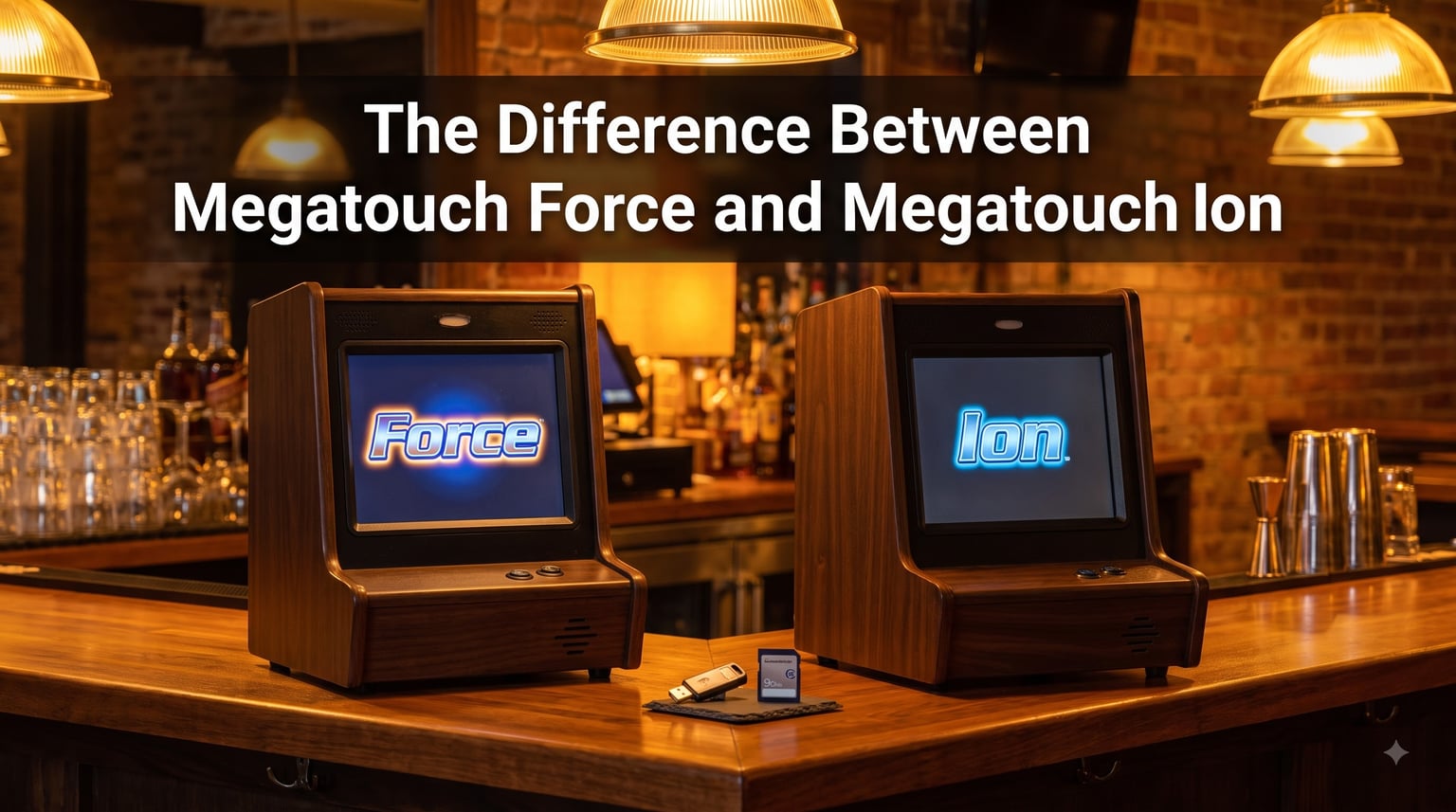
If you have spent time in a bar, diner, or bowling alley over the last two decades, you have probably played a Megatouch machine. These countertop touchscreen games from Merit Industries became a staple of social gaming, offering everything from card games to photo puzzles. Two of the most common hardware platforms you will encounter when shopping for a used machine are the Megatouch Force and the Megatouch Ion.
Understanding the difference between Megatouch Force and Megatouch Ion is essential before you spend money on a used cabinet. These are not just different software versions on the same hardware. They are entirely different computing platforms with different motherboards, different I/O boards, and different game libraries. A Force machine cannot run Ion software, and an Ion machine cannot run Force software.
I have dug through hundreds of forum posts on Arcade Museum, Pinside, and Reddit to piece together the real-world experiences of collectors and operators who have owned both platforms. The information out there is scattered across a dozen threads, some of them over a decade old. This guide pulls it all into one place so you can make an informed decision.
Whether you are building a home game room, running a bar, or just chasing nostalgia for late-night Photo Hunt sessions, this comparison will help you understand what each platform offers, where they fall short, and which one fits your needs.
Table of Contents
- The Difference Between Megatouch Force and Megatouch Ion
- What Are Megatouch Force and Megatouch Ion?
- Megatouch Force vs Ion: Hardware Platform Comparison
- Software Versions and Game Library Differences
- Cabinet Models: Force and Ion
- Security Keys: Why They Matter
- Can You Upgrade a Force to an Ion?
- Common Problems and Reliability
- Buying Considerations: Which Should You Choose?
- Tips for Shipping and Maintaining Your Megatouch
- FAQs
- Conclusion
The Difference Between Megatouch Force and Megatouch Ion
What Are Megatouch Force and Megatouch Ion?
Megatouch Force and Megatouch Ion are two consecutive hardware platforms produced by Merit Industries for their line of touchscreen countertop arcade games. Merit Industries, based in New Jersey, dominated the bar-game market from the 1990s through the early 2010s. The Megatouch line went through several platform generations before reaching Force and Ion.
The full Megatouch hardware lineage runs like this: XL, MAXX, Force, and Ion. Each platform represented a complete hardware redesign, not just a software update. Merit would release a new platform every few years, bringing faster processors, better graphics capability, and expanded game libraries.
The Megatouch Force launched in 2004 as the successor to the MAXX platform. It ran through 2011, making it one of the longest-produced Megatouch platforms. Force machines were everywhere during their peak years, sitting on bars and counters in thousands of locations across North America.
The Megatouch Ion arrived in 2006 as the next-generation platform. It ran concurrently with Force for several years before eventually replacing it entirely. Ion production continued through 2014, making it the final hardware platform Merit produced before the company ceased operations.
One thing that confuses many first-time buyers is that both platforms shipped in the same cabinet styles. You cannot tell a Force from an Ion just by looking at the outside of the cabinet in most cases. The differences are all internal, in the computing hardware and the software that runs on it.
Megatouch Force vs Ion: Hardware Platform Comparison
The hardware differences between Megatouch Force and Megatouch Ion are significant. Ion was designed as a genuine next-generation platform, addressing many of the reliability issues that plagued Force machines in the field.
Here is where the two platforms diverge on the component level.
Motherboard
The Force platform uses an ECS motherboard, originally built around Pentium III and later Pentium 4 processors. These boards were commodity PC parts of their era, which helped Merit keep manufacturing costs down. However, these boards are now 15 to 20 years old, and failures are common.
The Ion platform moved to more modern ECS, ASUS, and Intel motherboard options. These boards are generally more reliable and, importantly, easier to replace with generic off-the-shelf equivalents if they fail. One forum user on Arcade Museum reported successfully swapping a failed Ion motherboard with a generic board for a fraction of what a Merit replacement would have cost.
I/O Board
Force machines use a FORCE-specific I/O board that handles communication between the computer and the touchscreen, coin mechanism, and controls. This board is proprietary and, if it fails, you need a Force-specific replacement.
Ion machines use the Titan I/O board. This was a redesigned interface board that improved on the Force version in both reliability and serviceability. The Titan board is also proprietary to Ion, meaning Force and Ion I/O boards are not interchangeable.
Storage Media
This is one of the most practical differences for buyers and tinkerers. Force machines use 3.5-inch IDE hard drives. These older drives are increasingly failure-prone and harder to source.
Ion machines use 2.5-inch hard drives, which were more common in laptops. While the original 2.5 drives can still fail with age, many Ion owners have successfully upgraded to compact flash cards or solid-state storage, eliminating the mechanical drive failure point entirely.
One Arcade Museum user who upgraded their Force Evo 2011 with a compact flash card described the machine as “bulletproof” afterward. The same upgrade path works on Ion and is widely recommended in the collector community.
Touchscreen Controller
Force machines use the SMT-4 touchscreen controller. Ion machines switched to a USB-based touchscreen controller, which is more reliable and easier to interface with modern replacement parts.
The USB touchscreen on Ion was one of the specific improvements that forum users highlight when explaining why Ion is the better platform. It eliminated a common failure point and made repairs simpler.
Power Supply
Both platforms use standard ATX power supplies. This is good news for owners of either machine, because ATX power supplies are still widely available. However, Force machines have a known issue where the -5V rail reports incorrectly, causing boot problems that can be mistaken for more serious failures.
Quick Hardware Summary
Force runs on older ECS motherboards with proprietary I/O boards, 3.5-inch drives, and the older SMT-4 touchscreen controller. Ion runs on newer motherboards with Titan I/O boards, 2.5-inch drives, and USB touchscreen controllers. In almost every category, Ion represents a hardware improvement over Force.
Software Versions and Game Library Differences
This is where many buyers get tripped up. Megatouch software versions are tied to specific hardware platforms. A Megatouch Force 2005 software package will only run on Force hardware. A Megatouch Ion 2008 package will only run on Ion hardware. There is no cross-platform compatibility.
Each year, Merit released a new software version that added games, updated existing ones, and refreshed the interface. These annual releases were identified by year, and some years also had half-year updates.
The Magic Year: 2005.5
If you spend any time in Megatouch forums, you will see 2005.5 mentioned over and over. This half-year update for the Force platform is considered the most desirable Force software version because it was the first to include Texas Hold’em. That single game transformed the appeal of Megatouch machines in bars.
If you are shopping for a Force machine, 2005.5 or later is the sweet spot. Earlier versions lack the poker games that made Megatouch a bar staple.
Spider Solitaire and Later Additions
Spider Solitaire was another major game addition that came in later software years. Machines with Spider Solitaire tend to be more popular with casual players, and collectors often seek out software versions that include it.
Photo Hunt: The Cross-Generation Favorite
Photo Hunt, the photo difference game, was one of the most popular Megatouch titles of all time. It was already hugely popular during the MAXX to Force transition, and it carried through into both the Force and Ion platforms. If you have nostalgia for Megatouch, Photo Hunt is probably one of the games you remember.
Ion’s Larger Game Library
Because Ion was the newer platform and ran through 2014, it received the most game updates over its lifespan. Ion machines generally have larger game libraries than Force machines, simply because more software versions were released for Ion.
If game variety is your priority, Ion is the clear winner. The later Ion software versions have the most comprehensive game packages Merit ever offered.
Game Compatibility Between Platforms
To be absolutely clear: Force and Ion games are not compatible with each other. You cannot run Ion software on Force hardware. You cannot run Force software on Ion hardware. The game libraries overlap in terms of titles (both have Texas Hold’em, Photo Hunt, etc.), but the actual software packages are platform-specific.
Cabinet Models: Force and Ion
Both the Force and Ion platforms were available in a range of cabinet styles. The cabinet is the physical enclosure that houses the computer hardware, monitor, and controls. Since the same cabinet styles were used for both platforms, you need to check the internal hardware to know which platform you are dealing with.
EVO
The EVO is the most common Megatouch cabinet and was available on both Force and Ion platforms. It features a sleek, curved design that looks great but has a serious practical drawback: it is extremely fragile during shipping.
Multiple forum users on Pinside and Arcade Museum have reported EVO cabinets arriving shattered after shipping. The curved design, while attractive, does not hold up well to the rough handling of freight carriers. If you are buying an EVO cabinet, local pickup is strongly recommended.
Edge
The Edge cabinet is a slimmer design that was popular for bar installations where counter space was limited. It was available on both platforms.
Radion
The Radion cabinet offered a more rounded, modern look. It appeared on both Force and Ion platforms.
Aurora
The Aurora cabinet receives particular praise from collectors on the Pinside forums. It was available primarily on the Ion platform and is considered one of the more attractive and well-built cabinet designs.
Elite
The Elite cabinet was a premium offering with a larger screen and more upscale appearance. It was available on both platforms.
CRT vs LCD Monitors
Early Force machines came with CRT monitors, while later Force and most Ion machines switched to LCD screens. This matters for maintenance, because CRT parts for older Force machines are no longer available. If you buy an older Force with a CRT monitor and the tube fails, finding a replacement will be very difficult.
Ion machines are almost exclusively LCD, which is easier to service and replace. Most collectors prefer LCD models for this reason alone.
Security Keys: Why They Matter
The security key is a physical dongle that plugs into the Megatouch machine and unlocks the specific software version and game package. Without the correct security key, the machine will not boot its software.
Here is what you need to understand about security keys: they are platform-specific. A Force security key only works on Force hardware. An Ion security key only works on Ion hardware. They are not interchangeable.
More importantly, the security key represents most of the software value of the machine. The hardware itself is commodity PC parts from 15 to 20 years ago. The security key is what gives the machine access to its game library, and that key cannot be easily duplicated or replaced.
If you are buying a used Megatouch, verify the security key is present and matches the software version advertised. A machine with a missing key is essentially a parts machine, because replacing the key means finding the correct year and platform version from another donor machine.
One forum user on Arcade Museum reported buying an Ion Evo that had a bad hard drive and a missing key. After replacing the drive and sourcing the correct key, the machine worked fine. But those replacement parts added cost and hassle that could have been avoided with a complete machine.
Can You Upgrade a Force to an Ion?
This is one of the most common questions in Megatouch forums, and the answer is straightforward: no, you cannot convert Force hardware to Ion. The platforms use different motherboards, different I/O boards, and different software. There is no upgrade path between them.
What you can do is upgrade within a platform. Merit sold conversion kits that updated a machine to a newer software year on the same platform. For example, a Force 2005 could be upgraded to Force 2007 using a conversion kit. These kits typically included a new hard drive image and a new security key for the updated year.
Spring updates were Merit’s annual software refresh. Each spring, Merit would release an updated software version that added new games and refined existing ones. Operators would install these updates to keep their machines current and competitive.
If you want a machine with the newest possible game library, your best option is to buy an Ion with the latest software version available. You cannot make a Force machine run Ion software, so the platform choice you make at purchase time is the platform you are stuck with.
The one upgrade that works on both platforms is the compact flash storage conversion. By replacing the aging mechanical hard drive with a compact flash card, you eliminate one of the most common failure points. This upgrade does not change the software version or game library, but it dramatically improves reliability.
Common Problems and Reliability
Both platforms have their share of known issues, but the patterns are different. Understanding these failure points before you buy can save you significant money and frustration.
Force-Specific Problems
Force machines are older and were built using commodity PC parts from the mid-2000s. Several failure points are well-documented in the collector community.
Motherboard failures are the most serious Force issue. The ECS boards used in Force machines are now approaching two decades old, and capacitor failure is common. When the motherboard dies, you need a compatible replacement, which can be difficult to source.
The FORCE I/O board is another failure point. Since it is proprietary to the Force platform, a failed I/O board means finding a donor Force machine for parts.
The -5V power supply reporting issue is a known Force bug. The machine may report a power supply problem when the supply is actually fine, causing confusion during troubleshooting. This is not a real failure but a monitoring quirk that can waste hours of diagnostic time if you are not aware of it.
Older Force machines with CRT monitors face an additional problem: replacement CRT tubes and parts are no longer available. If the monitor fails on a CRT Force machine, your options are limited to finding another donor CRT or attempting a complex LCD conversion.
Ion-Specific Problems
Ion machines are generally more reliable than Force, but they have their own set of issues. The most common Ion problem reported on forums is hard drive failure. The original 2.5-inch drives are now old enough that mechanical failures are expected.
The good news is that this is the easiest Ion problem to fix. A compact flash upgrade eliminates the drive failure point entirely, and the process is well-documented in the community.
Missing security keys are another common Ion issue, usually encountered when buying a used machine. Operators sometimes kept the keys when they retired machines, or keys got separated during storage. Always confirm the key is included before buying.
The Compact Flash Fix
The single most recommended reliability upgrade for both platforms is the compact flash conversion. By replacing the mechanical hard drive with a compact flash card and adapter, you remove the most failure-prone component in the machine.
One collector on Arcade Museum described their Force Evo 2011 with a compact flash upgrade as “bulletproof.” This is not an exaggeration. Without a spinning mechanical drive, the machine has far fewer ways to fail.
Parts Availability
This is a growing concern for both platforms. Merit Industries is no longer in business, and many replacement parts are listed as NLA (no longer available). Generic PC parts like power supplies and hard drives are still easy to find, but proprietary components like I/O boards and security keys are finite resources.
If you are buying a Megatouch for long-term use, consider picking up spare parts while they are still available. A spare I/O board and a backup security key could be the difference between a working machine and a paperweight in a few years.
Buying Considerations: Which Should You Choose?
For most buyers in 2026, Ion is the better choice. It is the newer, more reliable platform with a larger game library and more serviceable hardware. But your specific situation might point you toward Force, so let us break down the decision.
Choose Ion If
You want the most reliable platform with the largest game library and easiest maintenance. Ion’s USB touchscreen controller, Titan I/O board, and 2.5-inch drive format all represent genuine improvements over Force hardware. If you are buying a machine for a home game room and want it to work with minimal hassle, Ion is the way to go.
You should also lean toward Ion if you want an LCD monitor. Most Ion machines have LCD screens, which are easier to replace and service than the CRT monitors found on older Force machines.
Choose Force If
You find a great deal on a complete, working machine. Force machines are generally cheaper than Ion machines because they are older and considered less desirable. A Force machine with the 2005.5 or later software (including Texas Hold’em) can still provide years of enjoyment.
Force is also a reasonable choice if you have nostalgia for a specific game era or if you enjoy tinkering and are comfortable replacing aging PC components. Just be aware that Force machines are more likely to need repairs.
Price Expectations
Prices for used Megatouch machines vary widely based on platform, software version, cabinet condition, and whether the security key is included. Based on forum data, working Force machines can be found for as little as $25 in local deals, while complete Ion machines in good condition can sell for several hundred dollars.
eBay pricing tends to be higher than local deals, often listing machines between $200 and $1,000. Condition and completeness matter enormously. A machine with a verified security key, working monitor, and clean cabinet will command a premium.
One Reddit user reported buying a Megatouch Force 2005 for $25 from a local seller. That kind of deal is rare but possible if you are patient and check local listings regularly.
Home Use Only vs Location Machines
The collector community places a premium on HUO (Home Use Only) machines. These are machines that were never used in a commercial bar or restaurant setting. HUO machines typically have less wear, cleaner interiors, and fewer hours of use.
Location machines have lived harder lives. They have been spilled on, bounced around, and run for thousands of hours. They can still be good machines, but inspect them carefully for wear and damage.
Free Play Modification
Many home buyers want to convert their Megatouch to free play mode so they do not need coins. This is possible on both Force and Ion platforms, typically through a BIOS or software setting. If free play is important to you, confirm the specific machine supports it before buying.
Tips for Shipping and Maintaining Your Megatouch
Shipping is one of the biggest risks when buying a Megatouch machine, especially if it is an EVO cabinet. The curved EVO design looks great but is notoriously fragile. Multiple collectors on Pinside and Arcade Museum have reported EVO cabinets arriving cracked or shattered after shipping via freight or UPS.
Local pickup is strongly recommended whenever possible. If you must ship, use a specialized arcade game shipper rather than a standard freight carrier. The extra cost is worth it to avoid receiving a pile of broken plastic.
Once you have your machine, the compact flash drive upgrade should be your first maintenance task. It is inexpensive, well-documented in the community, and eliminates the most common source of failure.
Keep the machine in a climate-controlled environment. Extreme heat and humidity accelerate the aging of electronic components. A basement game room or climate-controlled garage is ideal.
Finally, verify your security key is secure and cannot fall out during transport or play. Some owners use a small amount of tape or a retaining clip to keep the key in place. A lost key is an expensive problem.
FAQs
What is the difference between Megatouch Force and Ion?
Megatouch Force and Ion are two different hardware platforms from Merit Industries. Force was produced from 2004 to 2011 using ECS motherboards, FORCE-specific I/O boards, 3.5-inch hard drives, and SMT-4 touchscreen controllers. Ion was produced from 2006 to 2014 using newer motherboards, Titan I/O boards, 2.5-inch hard drives, and USB touchscreen controllers. Ion is the newer, more reliable platform with a larger game library.
Which is better, Megatouch Force or Ion?
For most buyers, Ion is the better choice. It is newer, more reliable, and has a larger game library. Ion’s USB touchscreen controller and Titan I/O board are genuine improvements over Force hardware. Ion machines are also more likely to have LCD monitors, which are easier to service than the CRT monitors found on older Force machines. Force is only better if you find a great deal on a working machine and are comfortable with potential repairs.
Are Megatouch Force and Ion games compatible?
No, Megatouch Force and Ion games are not compatible with each other. Force software only runs on Force hardware, and Ion software only runs on Ion hardware. The game libraries contain similar titles like Texas Hold’em and Photo Hunt, but the actual software packages are platform-specific and cannot be swapped between platforms.
Can you upgrade Megatouch Force to Ion?
No, you cannot upgrade or convert a Megatouch Force to an Ion. The two platforms use different motherboards, different I/O boards, and incompatible software. You can upgrade within a platform using Merit conversion kits that update the software year, but there is no cross-platform upgrade path. If you want Ion features, you need to buy an Ion machine.
What are the main hardware differences between Force and Ion?
The main hardware differences are: Force uses ECS Pentium III/4 motherboards while Ion uses newer ECS, ASUS, or Intel boards. Force uses a proprietary FORCE I/O board while Ion uses the Titan I/O board. Force uses 3.5-inch hard drives while Ion uses 2.5-inch drives. Force uses the SMT-4 touchscreen controller while Ion uses a USB touchscreen controller. Both use standard ATX power supplies.
Conclusion
The difference between Megatouch Force and Megatouch Ion comes down to one being the successor to the other. Ion is the newer, more reliable platform with better hardware design and a larger game library. Force is the older, cheaper option that carries more risk but can still deliver the classic Megatouch experience.
If you are buying for a home game room in 2026 and want the best experience with the least hassle, find an Ion machine with a complete security key, an LCD monitor, and a compact flash drive upgrade. That combination gives you the most reliable, most serviceable, and most game-rich Megatouch experience available.
If you find a clean, working Force machine at the right price, especially one with 2005.5 or later software, it can still be a great addition to a game room. Just go in knowing that Force hardware is more likely to need attention.
Whatever platform you choose, the security key is the single most important factor in a machine’s value. Verify it is present, matches the software version, and is the correct platform before you hand over any money. A Megatouch without its key is just a heavy conversation piece.