
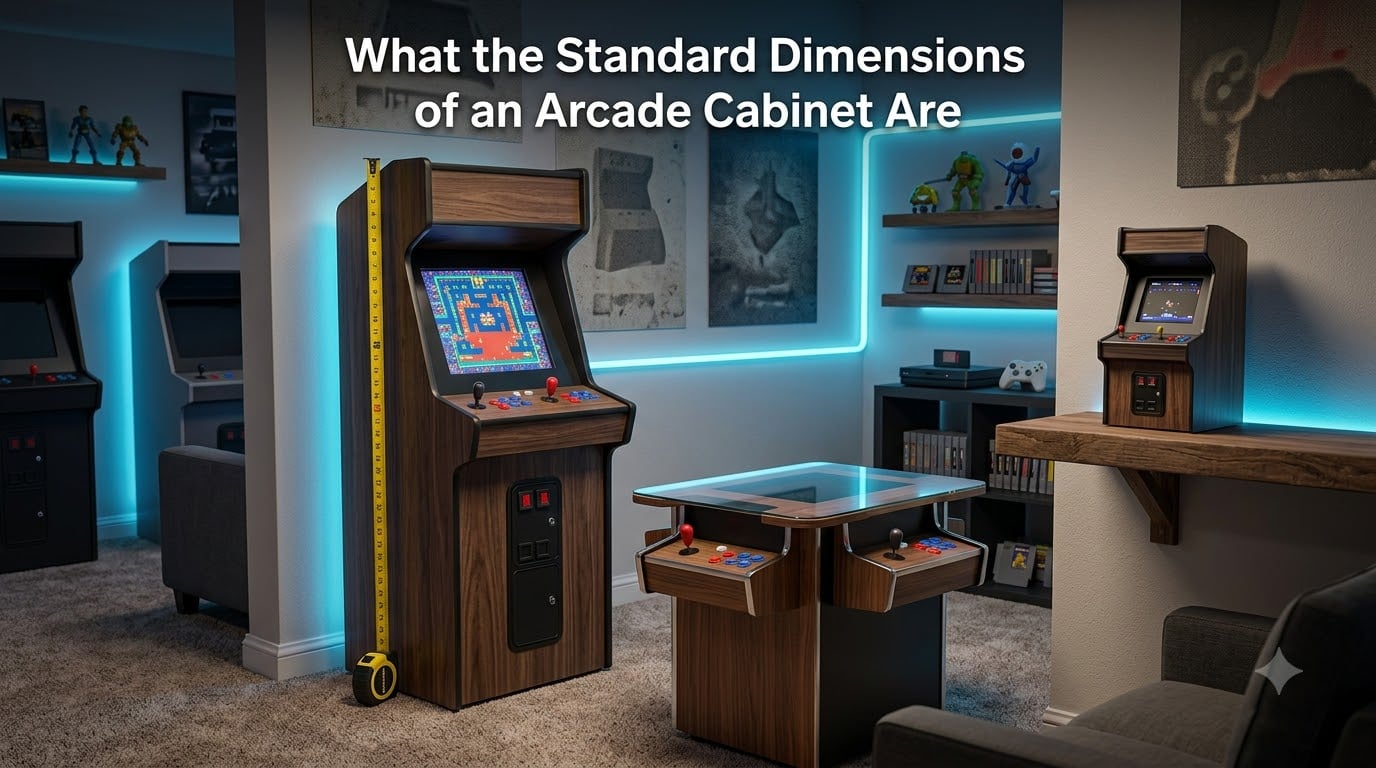
If you are planning to bring an arcade cabinet into your home, game room, or office, knowing the exact measurements before you buy saves you from a very expensive mistake. I have seen too many people order a full-size upright machine only to discover it will not fit through their front door or down a narrow basement staircase.
The standard dimensions of an arcade cabinet depend on which type you are looking at. There is no single answer, because arcade machines come in three main categories: upright (full-size), cocktail (table-style), and mini (countertop or 3/4 scale). Each has a very different footprint.
In this guide, I break down the exact width, depth, and height measurements for every cabinet type. I also cover clearance requirements, weight considerations, door-access tips, and a full imperial-to-metric conversion chart that most competing guides skip entirely.
Whether you are buying a pre-built machine, planning a DIY build, or just trying to figure out if that dream cabinet will squeeze into your spare bedroom, these numbers come from real cabinet specifications and community measurements. Let us get into it.
Table of Contents
- What the Standard Dimensions of an Arcade Cabinet Are?
- Upright Arcade Cabinet Dimensions
- Cocktail Arcade Cabinet Dimensions
- Mini Arcade Cabinet Dimensions
- Comparison Table: Arcade Cabinet Dimensions by Type
- Clearance and Space Requirements
- How to Measure Your Space for an Arcade Cabinet?
- Weight and Floor Load Considerations
- Imperial to Metric Conversion Reference
- Common Mistakes When Planning for an Arcade Cabinet
- FAQs
- Conclusion
What the Standard Dimensions of an Arcade Cabinet Are?
Standard arcade cabinet dimensions are approximately 27 inches wide, 30 inches deep, and 71 inches tall for a classic upright cabinet. Cocktail table cabinets run about 39 inches wide, 30 inches deep, and 30 inches tall. Mini arcade cabinets typically measure under 20 inches wide, under 16 inches deep, and stand between 20 and 28 inches tall.
These are the baseline numbers, but every manufacturer varies slightly. Full-size commercial arcade cabinets from the golden era of the 1980s typically ran 66 to 75 inches tall, 26 to 38 inches wide, and 21 to 34 inches deep. Modern home arcade machines tend to be a bit more compact, especially consumer brands like Arcade1Up that use scaled-down designs.
I want to be clear about one thing that trips people up constantly. The phrase “full-size” gets thrown around loosely in marketing materials. A true full-size arcade cabinet is built to commercial arcade specifications, meaning roughly 70-plus inches tall. Many consumer machines marketed as full-size are actually 3/4 scale or smaller. Understanding this distinction before you measure your space prevents the most common buying mistake I see in forums.
To measure any arcade cabinet, you need three numbers: width (side to side at the widest point, usually the control panel), depth (front to back, including any control panel protrusion), and height (floor to top of the marquee). Always measure at the widest and deepest points, not the base.
Upright Arcade Cabinet Dimensions
Upright arcade cabinets are what most people picture when they hear “arcade machine.” These are the tall, standing cabinets you would find lined up in an arcade in the 1980s and 1990s. They deliver the most authentic arcade experience but also demand the most space.
A standard full-size upright arcade cabinet measures approximately 27 inches wide, 30 inches deep, and 71 inches tall. The GameRoom Solutions full-size 2-player home arcade machine, for example, comes in at 31.5 inches wide, 29.75 inches deep, and 69 inches tall, weighing about 180 pounds. That is a solid representative example of what a modern full-size home arcade machine looks like.
Classic commercial cabinets from manufacturers like Midway, Konami, and Capcom ranged a bit wider. A typical Mortal Kombat cabinet measured roughly 28 inches wide, 33 inches deep, and 72 inches tall. Dedicated cabinets for specific games could push even wider, especially 4-player cabinets like the classic Konami Teenage Mutant Ninja Turtles cabinet, which stretched to about 40 inches wide to accommodate four sets of controls.
The control panel is usually the widest part of an upright cabinet. The base might be only 24 inches wide, but the control panel can protrude to 30 or even 38 inches across. This matters enormously when you are trying to squeeze a cabinet through a doorway, because the widest point is not at the floor.
For height, most upright cabinets fall between 66 and 75 inches (5 feet 6 inches to 6 feet 3 inches). You need ceiling clearance above that, because the marquee light and any decorative top pieces add a couple inches. If your ceiling is under 7 feet, double-check that your chosen cabinet will fit with room to spare.
Weight for a full-size upright typically ranges from 150 to 275 pounds. Commercial cabinets with heavy CRT monitors trend toward the higher end, while modern machines with LCD screens are lighter. This weight matters for delivery, floor load, and whether you can move it yourself.
Cocktail Arcade Cabinet Dimensions
Cocktail arcade cabinets, also called table-style or sit-down cabinets, are the social middle ground of arcade machines. They sit low to the ground, look like small tables, and typically allow two players to sit across from each other. The monitor faces up through a glass top.
A standard cocktail arcade cabinet measures approximately 30 to 32 inches wide, 24 to 30 inches deep, and 27 to 30 inches tall. The classic Pac-Man cocktail table, one of the most recognizable examples, measures about 30 inches wide, 30 inches deep, and 27.5 inches tall. Most cocktail cabinets follow similar proportions.
These cabinets are popular for home use because they double as a piece of furniture. You can set a drink on top (carefully) and use the machine as an actual table when you are not playing. The low profile also means they fit under windows and in spaces where an upright would be impossible.
The play surface sits at roughly 27 to 30 inches off the ground, which means most adults need a chair or stool to play comfortably. Some people prefer this seated experience, especially for long gaming sessions. Others find it less immersive than standing at an upright machine.
Weight for cocktail cabinets typically runs between 70 and 120 pounds, significantly lighter than uprights. This makes them easier to move and less of a concern for upper-floor installations. The glass top does make them more fragile during transport, though.
One thing I always point out about cocktail cabinets: the footprint is smaller, but you still need clearance for two chairs or stools plus room for two players to sit comfortably. Do not assume a 30-inch table only needs 30 inches of space.
Mini Arcade Cabinet Dimensions
Mini arcade cabinets cover a wide range, from tiny countertop units to 3/4 scale consumer machines like those from Arcade1Up. These are the most space-friendly option and have exploded in popularity for home use.
A typical mini arcade cabinet measures under 20 inches wide, under 16 inches deep, and stands between 20 and 28 inches tall without a riser. Countertop mini arcades are even smaller, sometimes as compact as 12 inches wide and 10 inches deep. The Tiny Arcade and similar keychain-sized units are a separate category entirely, measuring just a few inches.
Arcade1Up cabinets, the most popular consumer brand, deserve special attention because their dimensions cause constant confusion in online forums. An Arcade1Up cabinet without a riser measures approximately 18.75 inches wide, 19.75 inches deep, and about 45 inches tall. With the standard riser included, the height jumps to approximately 60.75 to 65.5 inches depending on the model and riser version.
Here is the controversy I see repeated across Reddit threads: Arcade1Up markets their cabinets as 3/4 scale, but many users who own both Arcade1Up machines and true full-size cabinets argue they are closer to 2/3 scale. The width of 18.75 inches is significantly narrower than the 27-inch standard of a commercial upright. This means the play experience is somewhat cramped for adults with larger hands.
The depth of an Arcade1Up (19.75 to 30.78 inches depending on the control panel configuration) is closer to the real thing, but the overall feel is undeniably smaller. Some users compensate by buying aftermarket art kits, risers, and modified control panels to bring the experience closer to full-size.
For truly small spaces like apartments or offices, mini cabinets are the practical choice. They fit on desks, shelves, or in corners where no other arcade machine would work. Just understand that you are trading authentic feel for convenience.
Comparison Table: Arcade Cabinet Dimensions by Type
To make all these numbers easy to compare, here is a side-by-side breakdown of the three main cabinet types. I have included both imperial and metric measurements so you can reference whichever system you use.
Upright (Full-Size) Arcade Cabinet: Width 27 inches (69 cm), Depth 30 inches (76 cm), Height 71 inches (180 cm), Weight 150 to 275 lbs. Best for dedicated game rooms with adequate space.
Cocktail (Table) Arcade Cabinet: Width 30 inches (76 cm), Depth 30 inches (76 cm), Height 28 inches (71 cm), Weight 70 to 120 lbs. Best for living rooms and multi-use spaces.
Mini (3/4 Scale) Arcade Cabinet: Width 19 inches (48 cm), Depth 20 inches (51 cm), Height 45 inches (114 cm) without riser, 61 inches (155 cm) with riser, Weight 40 to 60 lbs. Best for apartments and small rooms.
Countertop Mini Arcade: Width 12 inches (30 cm), Depth 10 inches (25 cm), Height 12 inches (30 cm), Weight 3 to 8 lbs. Best for desks and shelves.
This comparison shows why the type of cabinet matters so much. The jump from a mini to an upright is not gradual. You go from something a child can carry to a machine that takes two adults and a furniture dolly to move.
Clearance and Space Requirements
Knowing the cabinet dimensions is only half the battle. You also need clearance around the machine for comfortable play, ventilation, and access. I have seen people measure a cabinet, confirm it fits in a spot, and then realize they cannot actually stand in front of it.
For an upright arcade cabinet, allow at least 24 to 30 inches of clearance in front of the control panel for the player to stand comfortably. If you want room for a second person to watch or for two players to stand side by side at a 2-player cabinet, add another 18 to 24 inches on each side.
Behind the cabinet, leave at least 6 to 12 inches for ventilation and cable access. Arcade cabinets generate heat, especially older machines with CRT monitors, and they need airflow to prevent overheating. Modern LCD-based machines produce less heat but still benefit from rear clearance.
For cocktail cabinets, the clearance math is different. You need space for two chairs or stools on opposite sides of the table, plus enough room to pull those chairs in and out. Budget at least 48 inches of width and 48 inches of depth for a cocktail setup, even though the cabinet itself is only about 30 inches square.
Side clearance matters too. If you are placing a cabinet against a wall or between other furniture, leave at least 6 inches on each side. This gives you room to clean, access side panels for maintenance, and prevents the machine from feeling cramped in the space.
A good rule of thumb from experienced arcade collectors: take the cabinet’s footprint and add 30 inches in every direction for play space. That gives you a realistic picture of the actual room the machine occupies when in use.
How to Measure Your Space for an Arcade Cabinet?
Before you order any arcade machine, measure your space methodically. This is the step that most people rush, and it is also the step that prevents the most expensive mistakes. Here is the process I recommend based on what experienced collectors share in forums.
Step 1: Measure every doorway on the delivery path. Standard interior doors in the US are 30 inches wide, but the actual clear opening (accounting for the door frame and whether the door opens inward) can be as narrow as 28 inches. Measure the narrowest point. If your cabinet is wider than this, you may need to remove the door from its hinges or remove the control panel before moving the cabinet through.
Step 2: Measure hallways and stairwells. Width is important, but so are turns. If your path includes a 90-degree turn from a hallway into a room, measure the diagonal clearance at the corner. A cabinet that fits straight through a 36-inch hallway might not make it around a tight turn.
Step 3: Measure the ceiling height at the destination. This sounds obvious, but basements and rooms with dropped ceilings or ceiling fans can cause problems. A 71-inch cabinet needs at least 74 inches of clearance to account for the marquee and any top-mounted elements.
Step 4: Measure the floor space, not just the wall. Mark out the cabinet footprint on the floor with painter’s tape. Include the control panel overhang, which can extend several inches beyond the base. Then tape out the play clearance zone (30 inches in front) and see if the room still feels functional.
Step 5: Check for floor load limits. If you are placing a heavy upright cabinet on an upper floor, a manufactured home, or an older building, verify the floor can support 200-plus pounds concentrated in a small area. Most modern residential floors handle this fine, but it is worth checking for older structures.
Step 6: Plan the delivery route in advance. Know where the delivery truck will park, whether you need a lift gate, and if stairs are involved. Freight carriers typically offer curb delivery, which means you are responsible for getting the cabinet from the curb to its final spot.
Weight and Floor Load Considerations
Weight is the dimension people forget about until the delivery truck arrives. Arcade cabinets are heavy, and where you put them matters for structural reasons as much as logistical ones.
A full-size upright arcade cabinet weighs between 150 and 275 pounds. The heaviest examples are vintage commercial cabinets with 25-inch CRT monitors and heavy particleboard construction. A Midway Mortal Kombat II cabinet, for instance, weighs around 230 pounds empty. Modern home machines with LCD monitors are lighter, often in the 130 to 180 pound range.
Cocktail cabinets are lighter, typically 70 to 120 pounds. Mini cabinets like Arcade1Up units weigh about 40 to 60 pounds. This is one reason minis are so popular for apartments and upper-floor installations.
For upper-floor installations, the concern is not just total weight but weight concentration. A 200-pound cabinet standing on a base footprint of roughly 24 by 28 inches applies a concentrated load of about 0.3 pounds per square inch. Modern residential floors are engineered to handle distributed loads of 40 pounds per square foot, which this easily exceeds in the immediate area under the cabinet.
In practice, this is rarely a problem for a single cabinet on a modern wood-framed floor. But if you are building a multi-cabinet arcade room on an upper floor, or installing in an older home with uncertain floor construction, consult a contractor. The same goes for manufactured homes, which have lower floor load ratings.
Shipping weight differs from assembled weight. A flat-packed or partially assembled cabinet shipped via freight might arrive at a lower weight because packaging, internal components, and monitors ship separately. Always check both the shipping weight and the assembled weight when planning your delivery and installation.
Imperial to Metric Conversion Reference
Most arcade cabinet specifications from US manufacturers are listed in inches and pounds. If you are outside the US or prefer metric, this conversion reference covers the common measurements you will encounter. No competing guide I found includes a comprehensive conversion chart, so here it is.
Width conversions: 18 inches = 46 cm, 20 inches = 51 cm, 24 inches = 61 cm, 27 inches = 69 cm, 30 inches = 76 cm, 32 inches = 81 cm, 38 inches = 97 cm, 40 inches = 102 cm.
Depth conversions: 15 inches = 38 cm, 20 inches = 51 cm, 24 inches = 61 cm, 28 inches = 71 cm, 30 inches = 76 cm, 34 inches = 86 cm.
Height conversions: 27 inches = 69 cm, 45 inches = 114 cm, 60 inches = 152 cm, 65 inches = 165 cm, 69 inches = 175 cm, 71 inches = 180 cm, 72 inches = 183 cm, 75 inches = 191 cm.
Weight conversions: 40 lbs = 18 kg, 60 lbs = 27 kg, 120 lbs = 54 kg, 150 lbs = 68 kg, 180 lbs = 82 kg, 200 lbs = 91 kg, 230 lbs = 104 kg, 275 lbs = 125 kg.
For the UK home arcade machines referenced by The Depot, their standard machines measure approximately 87 cm tall, 56 cm wide, and 86 cm deep. In imperial, that translates to about 34 inches tall, 22 inches wide, and 34 inches deep. These are more compact than typical US full-size machines, reflecting the tighter average room sizes in UK homes.
Bookmark this section or take a screenshot. You will need it when comparing specs across manufacturers who use different measurement systems.
Common Mistakes When Planning for an Arcade Cabinet
After digging through hundreds of forum posts on Reddit, Arcade Museum, and arcadecontrols.com, the same mistakes appear over and over. Here are the ones I see most frequently, along with how to avoid them.
Mistake 1: Not measuring doorways before purchase. This is the number one complaint. Someone buys a full-size cabinet, the delivery arrives, and it will not fit through any door in the house. Measure every doorway on the path from curb to final location before you click buy.
Mistake 2: Forgetting the control panel overhang. The control panel sticks out from the cabinet body and is usually the widest point. People measure the base of the cabinet, assume that is the footprint, and then discover the control panel adds 4 to 8 inches of width. Always measure at the widest point.
Mistake 3: Confusing scale terminology. Arcade1Up markets their machines as 3/4 scale, but the actual dimensions put them closer to 2/3 scale by some measurements. If you are expecting a near-full-size experience and get something significantly smaller, that is a disappointing surprise. Read actual user measurements, not just marketing copy.
Mistake 4: Ignoring ceiling height. Basements with low ceilings, dropped ceilings, and ceiling fans all reduce available height. A 71-inch cabinet under a 72-inch dropped ceiling leaves no room for the marquee light or ventilation. Always measure floor to ceiling, not just estimate.
Mistake 5: Underestimating weight for second-floor installations. Getting a 200-pound cabinet up a flight of stairs is a serious physical challenge. Even if your floor can support the weight, getting it there might require professional movers or a furniture dolly. Plan for this before delivery day.
Mistake 6: Not accounting for depth. Depth is the measurement people forget. A cabinet that is 30 inches deep in a room that is only 8 feet wide takes up a significant chunk of usable space. This is especially true in hallways and small rooms where depth determines whether you can walk past the machine.
Mistake 7: Assuming freight delivery includes placement. Standard freight delivery is curbside. The driver is not obligated to carry the cabinet inside, up stairs, or to its final spot. If you need white-glove delivery, specify that when ordering and expect to pay extra for it.
FAQs
What is the typical size of an arcade game cabinet?
A typical full-size upright arcade game cabinet measures about 27 inches wide, 30 inches deep, and 71 inches tall. Cocktail table cabinets are about 30 inches square and 28 inches tall. Mini cabinets like Arcade1Up measure roughly 19 inches wide, 20 inches deep, and 45 inches tall without a riser.
What are the dimensions of the Arcade1Up arcade cabinet?
Arcade1Up cabinets measure approximately 18.75 inches wide, 19.75 inches deep, and 45 inches tall without a riser. With the standard riser, height increases to about 60.75 to 65.5 inches. Despite being marketed as 3/4 scale, many owners note the dimensions are closer to 2/3 scale compared to a true commercial arcade cabinet.
How tall is a standard arcade cabinet?
A standard full-size arcade cabinet stands between 66 and 75 inches tall, with most classic commercial cabinets measuring about 71 inches from floor to the top of the marquee. You need at least 74 inches of ceiling clearance to accommodate the marquee and allow for ventilation.
Will a full-size arcade cabinet fit through a standard door?
A standard US interior door is 30 inches wide with a clear opening of about 28 inches. Most upright arcade cabinets are 27 to 32 inches wide at the control panel, so many will fit but some will require removing the door from its hinges or detaching the control panel first. Always measure your narrowest doorway before ordering.
How much space do I need for an arcade cabinet?
For an upright cabinet, budget the cabinet footprint plus at least 30 inches of clearance in front for the player, 12 inches behind for ventilation, and 6 inches on each side. A single upright cabinet in a dedicated game room needs roughly a 5 by 5 foot area to be comfortable.
Conclusion
Understanding what the standard dimensions of an arcade cabinet are comes down to knowing your cabinet type. Upright machines average 27 by 30 by 71 inches, cocktail tables sit at about 30 by 30 by 28 inches, and mini cabinets like Arcade1Up come in around 19 by 20 by 45 inches. Each type serves a different space and a different play style.
Before you buy or build, measure your doorways, hallways, ceiling height, and floor space. Add 30 inches of play clearance in front of any upright machine, and never assume freight delivery includes inside placement. The numbers in this guide come from real cabinet specs and community measurements, so you can plan with confidence.
Your next step is simple: grab a tape measure, map out your delivery path, and mark the cabinet footprint on your floor with painter’s tape. Once you can see the space the machine will actually occupy, you will know exactly which cabinet type fits your room.