
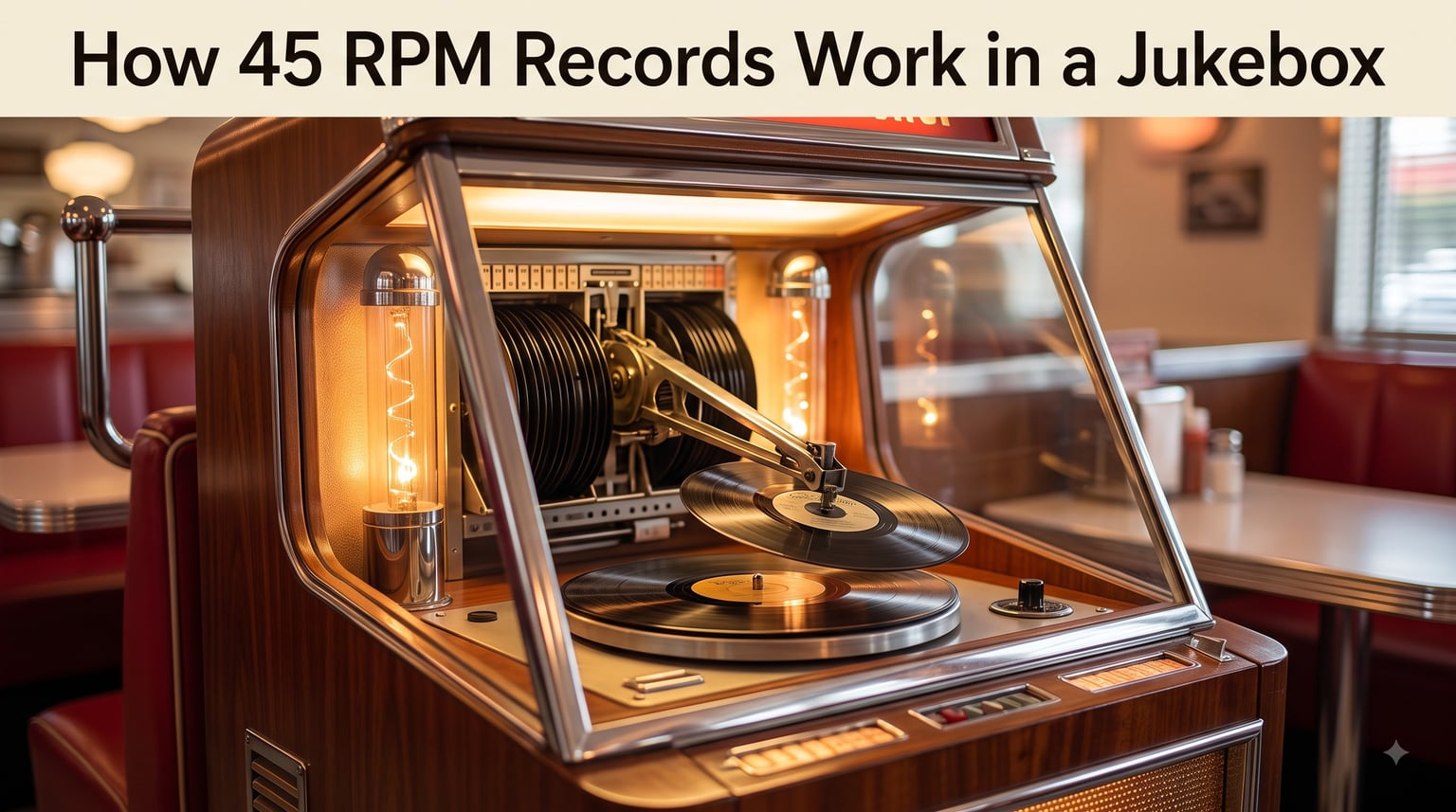
Understanding how 45 RPM records work in a jukebox starts with one simple fact: a jukebox uses a specialized 45 RPM record changer that loads records onto a turntable via a picker arm, plays the selected side, and returns the record to storage without removing it from the machine. I have spent years around these machines, and the engineering inside even a 60-year-old jukebox still impresses me every time I open one up. In this guide, I will walk you through the exact mechanics that make a coin-operated record player work, from the moment you drop a nickel to the moment the record slides back into its slot.
You will learn how the changer mechanism grabs a 7-inch vinyl record, why that record spins at 45 revolutions per minute instead of 33, what the spindle adapter does, and how brands like Seeburg, Wurlitzer, and AMi each solved the same problem in different ways. We will also cover troubleshooting tips, format comparisons, and the most common questions collectors ask me when restoring their machines.
Table of Contents
- What Is a 45 RPM Record and Why Jukeboxes Use It?
- The History of the 45 RPM Format in Jukeboxes
- How the Jukebox Record Changer Mechanism Works?
- Step-by-Step: The 45 RPM Playback Cycle in a Jukebox
- The Spindle Adapter and Center Hole Design
- The Tonearm, Cartridge, and Stylus in Jukebox Playback
- 45 RPM vs 33 RPM vs 78 RPM: Why the Difference Matters for Jukeboxes
- How Major Jukebox Brands Handled 45 RPM Differently?
- Common Jukebox Changer Problems and Troubleshooting
- Frequently Asked Questions About 45 RPM Records and Jukeboxes
- What is a 45 RPM record?
- How does a jukebox play 45 RPM records?
- Why are 45 RPM records used in jukeboxes?
- What is the difference between 33 and 45 RPM records?
- Do all jukeboxes use 45 RPM records?
- Can you play 45 RPM records on a regular turntable?
- How does a jukebox record changer work?
- What is a jukebox spindle adapter?
- Conclusion
What Is a 45 RPM Record and Why Jukeboxes Use It?
A 45 RPM record is a 7-inch diameter vinyl disc that spins at 45 revolutions per minute, designed for compact storage and high-fidelity playback of single songs or short EP sets. The format was introduced by RCA Victor on March 31, 1949, as a direct competitor to Columbia’s 33 1/3 RPM long-playing record (LP). The 45 became the standard for jukeboxes almost immediately because of three practical advantages: small physical size, fast load time, and better audio fidelity for the 3-to-5-minute songs popular in the early rock and roll era.
The standard 7-inch 45 measures 7 1/4 inches (184 mm) across, with a center hole of 1.5 inches (38 mm). That oversized hole is what makes the 45 instantly recognizable. Home turntables and jukeboxes both required an adapter (sometimes called a “spider” or “45 adapter”) to grip the disc on the smaller spindle of a standard turntable.
I have stacked 45s in jukebox magazines hundreds of times, and the engineering makes sense once you see it. Each 45 is roughly 1/8 inch thick, which means a jukebox magazine can hold between 40 and 200 records depending on the model and brand. That is a lot of music from a machine that stands less than five feet tall.
Why jukeboxes adopted 45s so quickly
Before 1949, jukeboxes played 78 RPM records, which were heavier, more brittle (made from shellac rather than vinyl), and held less playing time per side. A typical 78 held about 3 minutes of audio per side and was 10 or 12 inches across. The 45 RPM vinyl record delivered roughly the same playing time in a smaller, lighter, more durable package.
For a coin-operated machine that had to handle dozens of records per hour with minimal wear, vinyl was a game-changer. RCA called its material “Victrolac” at launch, and it could survive being dropped, slid, and flipped by a mechanical changer thousands of times without cracking.
The History of the 45 RPM Format in Jukeboxes
The history of 45 RPM records in jukeboxes is really the history of the post-war American music industry. Before 1949, jukeboxes used 78s because that was the only consumer format available. Operators (the people who placed jukeboxes in restaurants and bars) had to balance record size, capacity, and audio quality. The 78 was acceptable but bulky, and a single 10-inch 78 only held about 3 minutes per side.
When RCA launched the 45, the format war began. Columbia had introduced the 33 1/3 RPM LP just weeks earlier, in June 1948. Both formats vied for dominance through the early 1950s. Jukebox manufacturers made a practical choice: they picked the 45 because it matched their existing magazine systems and played single songs at higher fidelity.
Pre-1949 jukebox era
The earliest commercial jukeboxes appeared around 1890, using cylinder phonographs or 78 RPM discs. By the 1930s, companies like Seeburg, Wurlitzer, and Rock-Ola were producing electric jukeboxes that could hold 10 to 24 records and play both sides automatically. These machines used 78 RPM shellac records almost exclusively.
RCA launches the 45
RCA spent $1 million developing the 45 system, including the proprietary large center hole and the changer mechanism that went with it. The first 45 RPM record was “PeeWee the Piccolo” on RCA Victor, released alongside the format. Within 18 months, RCA had sold more than 25 million 45s, and jukebox manufacturers had redesigned their machines to accept the new format.
Adoption across major brands
Seeburg, Wurlitzer, AMi, and Rock-Ola all transitioned to 45-only changers between 1950 and 1955. By the late 1950s, 45 RPM was the universal jukebox format in the United States, the UK, and most of Europe. This held until the digital era, when CD-based jukeboxes began replacing vinyl machines in the late 1980s.
How the Jukebox Record Changer Mechanism Works?
A jukebox record changer is the mechanical heart of the machine, responsible for selecting, transporting, playing, and returning each 45 RPM record. The mechanism consists of four major systems working in sequence: the magazine (where records are stored), the picker arm (which grabs the selected disc), the turntable assembly (which spins and plays the record), and the return mechanism (which slides the record back into storage).
I find it helpful to think of the changer as a mechanical robot. You give it a command via coin or button, and it performs a sequence of physical actions in a precise order. Most jukeboxes from the 1950s through the 1970s used an electromechanical design with relays, solenoids, cams, and gears. There is no computer, no microchip, just wires, switches, and moving metal parts.
The magazine and record stack
The magazine is the storage rack that holds all available records in a vertical or horizontal stack. In a Seeburg V200, for example, the magazine holds 200 records (100 per side) arranged in two vertical columns. Each record sits in its own slot with a visible edge where the title strip is printed.
Title strips are those small printed cards you see through the glass front of a jukebox, listing the song title and artist. They allow customers to see what is available before making a selection. Operators printed and inserted the strips by hand every time the records changed.
The picker arm
The picker arm is the mechanical finger that grabs the selected record from the magazine. It extends into the magazine slot, grips the edge of the 7-inch disc, and pulls it out toward the turntable. Most pickers use a small claw or fork that slides under the record edge and lifts it free of the stack.
Different brands used different picker designs. Seeburg used a horizontal sliding picker. Wurlitzer used a rotating arm with a magnetic gripper. AMi used a gravity-fed system that tilted the magazine forward and let records slide into a waiting arm. Each design had its strengths and weaknesses, which I will cover in the brand section below.
The elevator and turntable
The elevator is the lifting platform that carries the record from the magazine level down to the turntable. Once the picker has pulled a record out of the stack, it places the disc on the elevator, which lowers it into position above the spinning platter. The spindle adapter is mounted on the platter, ready to receive the record’s oversized center hole.
The turntable assembly includes the motor, the platter, the spindle adapter, and the tonearm. The motor spins the platter at exactly 45 RPM using either a synchronous AC motor or a governor-regulated DC motor. Most jukebox motors from the golden era ran on 117V AC at 60 Hz and used a gear reduction to reach the precise 45 RPM speed.
The return mechanism
After the record has played both sides (or the selected side has finished), the return mechanism slides the disc off the turntable and back into its original magazine slot. This is one of the trickiest parts of the entire changer. The mechanism has to push the record horizontally without dropping it, lift it to the correct magazine height, and slide it back into position without bumping other records.
Most jukeboxes achieve this with a small motorized arm or a series of cams. Seeburg machines used a rotating record receiver that caught the disc off the platter, flipped it to play the other side if needed, and returned it to the magazine. Wurlitzer used a simpler single-side mechanism that flipped records between plays by hand.
Step-by-Step: The 45 RPM Playback Cycle in a Jukebox
The 45 RPM playback cycle in a jukebox follows a consistent sequence of mechanical actions, starting the moment you insert a coin and ending when the record returns to storage. Here is the exact step-by-step process I have observed on a working Seeburg V200 after a full restoration.
Step 1: Selection and coin drop
You press the letter and number buttons on the front of the jukebox to choose a song. Each button press triggers a small electrical contact that registers the selection. When you insert a coin (or several coins for multiple plays), a coin mechanism validates the currency and credits the appropriate number of plays. Older machines used mechanical credit accumulators; newer ones used electric relays.
Step 2: Picker grabs record
The selection signal travels to the mechanism, which reads the stored position of the chosen record in the magazine. The magazine rotates or shifts to align the correct slot with the picker arm. The picker then extends, grips the edge of the disc, and pulls it out horizontally toward the elevator platform.
Step 3: Record placement and play
The elevator lowers the record to the turntable level. The spindle adapter slides up through the center hole as the record is positioned over the platter. The tonearm lifts from its rest, swings over to the outer edge of the record, and lowers the stylus onto the vinyl. The platter is already spinning at 45 RPM, so playback begins within a fraction of a second of contact.
Step 4: Return to stack
After the stylus reaches the run-out groove at the end of the record, the tonearm lifts, swings back to its rest, and the return mechanism slides the disc off the platter. The elevator raises the record back to the magazine level, and the picker pushes it into its original slot. The mechanism then either flips to play the other side (on dual-play jukeboxes) or returns to idle waiting for the next selection.
The entire cycle from coin drop to return typically takes 3 to 5 minutes, depending on the song length and whether both sides play. Operators loved this efficiency because it meant the jukebox could serve dozens of customers per hour with minimal wear on the records.
The Spindle Adapter and Center Hole Design
The spindle adapter is the small plastic or metal piece that fits into the center hole of a 45 RPM record and holds it on the turntable. The 45’s oversized 1.5-inch center hole was a deliberate design choice by RCA, intended to make records easier to load by hand and easier for mechanical changers to handle.
On a standard home turntable, the spindle is small (about 0.285 inch) and the record sits on a flat platter around it. To play a 45, you need an adapter that fills the gap between the small spindle and the large center hole. Most adapters are simple plastic rings with a prong that fits inside the small spindle.
On a jukebox, however, the spindle is much larger. Most jukeboxes use a spindle with a diameter of about 1.4 inches, designed specifically to accept the 1.5-inch center hole of a 45 with a snug fit. No adapter is required because the spindle and hole already match.
Why the adapter matters
The spindle adapter matters because it determines how precisely the record centers on the platter. A sloppy adapter causes the record to wobble, which makes the stylus skip or jump grooves. On jukeboxes that play hundreds of records per week, this precision is critical to long-term reliability.
Original RCA 45s from the 1950s and 1960s had center holes that were sometimes slightly oversized or uneven. Operators used reaming tools to true up the holes before loading. Modern reissues have tighter hole tolerances, but they may not fit as snugly on older jukebox spindles.
Adapter wear and replacement
Spindle adapters wear out over time. After 30,000 to 50,000 plays, the inside diameter of an adapter can become loose enough to cause record wobble. Replacement adapters are still available from specialty suppliers, and many collectors 3D print custom adapters for rare or unusual jukebox models.
If your jukebox records wobble visibly when spinning, the adapter is the first thing to inspect. A worn adapter is a five-minute fix that costs a few dollars and restores playback quality immediately.
The Tonearm, Cartridge, and Stylus in Jukebox Playback
The tonearm in a jukebox holds the cartridge and stylus that physically read the grooves of the 45 RPM record and convert them into an electrical audio signal. Jukebox tonearms differ from home turntable tonearms in several key ways: they are shorter, have lower mass, use higher tracking force, and are designed for thousands of plays per week rather than gentle home listening.
The cartridge in a jukebox is typically a crystal or ceramic type, chosen for durability and high output. These cartridges generate enough signal to drive the jukebox’s built-in amplifier without a separate preamp. The stylus is usually a conical diamond tip with a 0.7-mil radius, designed for the microgroove format of the 45.
Tracking force and geometry
Tracking force on a jukebox is typically 4 to 6 grams, much higher than the 1 to 2 grams used on modern home turntables. This high force is necessary because jukeboxes are coin-operated and cannot afford to skip or mis-track when a customer pays to hear a song. The trade-off is faster stylus and record wear.
The geometry of the tonearm is also different. Jukebox tonearms are usually straight, with the stylus positioned to minimize tracking error at the outer edge of the record. This makes setup simpler but increases distortion toward the inner groove, which is why many jukebox recordings sound better in the first minute than the third.
Microgroove playback
The 45 RPM record uses microgroove technology, with grooves spaced about 250 per inch compared to about 100 per inch on a 78 RPM shellac disc. This higher density allows longer playing time and better frequency response, but it also demands a finer stylus and more precise tracking. Jukebox tonearms and cartridges are specifically designed for microgroove playback.
45 RPM vs 33 RPM vs 78 RPM: Why the Difference Matters for Jukeboxes
The difference between 33, 45, and 78 RPM records matters for jukeboxes because each format has different physical dimensions, playing times, and handling characteristics. Jukeboxes in 2026 almost exclusively use 45 RPM records because the format offers the best balance of size, capacity, and audio quality for coin-operated use. Here is a direct comparison.
| Format | Diameter | Speed (RPM) | Playing Time | Material | Jukebox Use |
|---|---|---|---|---|---|
| 78 RPM | 10 or 12 inch | 78 | 3-4 min/side | Shellac | Pre-1950 only |
| 45 RPM | 7 inch | 45 | 4-6 min/side | Vinyl | Universal from 1950 onward |
| 33 1/3 RPM (LP) | 12 inch | 33.33 | 20-25 min/side | Vinyl | Not used (too large for magazine) |
Sound quality comparison
At equal recording quality, a 45 RPM record often sounds slightly better than an LP of the same era because the higher rotational speed means the stylus moves faster through the groove, capturing more high-frequency detail. This is why audiophile reissues in 2026 are often pressed on 45 RPM 12-inch discs rather than standard 33 1/3 LPs.
However, jukebox 45s were typically mastered with reduced dynamic range and boosted midrange to cut through the noise of a bar or restaurant. Home LPs of the same song often sound warmer and more detailed.
Storage capacity
Storage capacity is where the 45 wins decisively. A jukebox magazine holding 200 records can store roughly 800 to 1,200 individual songs (both sides). The same magazine space could hold only about 50 LPs, which would limit a customer to fewer choices and reduce the operator’s revenue per machine.
Physical handling differences
The 45 is also lighter and more flexible than an LP, which makes it easier for a mechanical changer to manipulate. The thicker 78 RPM shellac discs were prone to cracking when dropped, and the heavier 12-inch LPs would damage the delicate picker mechanisms. Vinyl 45s offered the right combination of strength, weight, and flexibility for thousands of automated plays.
How Major Jukebox Brands Handled 45 RPM Differently?
Major jukebox brands handled 45 RPM records using different mechanical approaches, and the differences in design affected reliability, capacity, and sound quality. Seeburg, Wurlitzer, AMi, and Rock-Ola each developed their own changer systems, and collectors often have strong preferences for one over another based on these design choices.
Seeburg mechanisms
Seeburg was the dominant jukebox brand in the United States from the late 1940s through the 1970s. Their mechanism, often called the “Seeburg V,” used a horizontal sliding picker, a rotating magazine that could hold 100 or 200 records, and a unique “Triple 200” system in later models that tripled capacity by stacking magazines vertically. Seeburg changers are widely considered the most reliable for high-volume commercial use.
The Seeburg V200 holds 200 records (100 per side) in a single rotating magazine. The picker slides horizontally into the slot, grips the record edge, and pulls it out. After playing, the return arm catches the disc and slides it back into the original slot. This design proved so reliable that many Seeburg machines from the 1960s are still in working condition today.
Wurlitzer mechanisms
Wurlitzer is famous for the visual design of its jukeboxes (the 1015 “Bubbler” is one of the most iconic machines ever made), but their record changer mechanisms were more complex and less reliable than Seeburg’s. Wurlitzer used a rotating magazine and a magnetic pickup arm that selected records by tilting the magazine and letting the disc slide into a waiting gripper.
The famous Wurlitzer 1015, introduced in 1946 and produced until 1954, originally played 78s but was later modified for 45 RPM operation. Its bubble tube lighting made it a visual centerpiece, and its mechanism, while elegant, required more frequent service than competing machines. Many surviving 1015s have been converted to modern digital playback systems because their original changers are too fragile for regular use.
AMi and Rock-Ola
AMi (Automatic Musical Instruments) produced jukeboxes from the 1930s through the 1970s. Their mechanism used a horizontal record magazine that slid back and forth to position records for the picker. AMi machines from the 1960s, particularly the Continental and Lyric models, are prized by collectors for their reliability and clean sound.
Rock-Ola produced jukeboxes from the 1920s through the 1970s. Their 45 RPM mechanisms were similar to Seeburg’s but less widely adopted. Rock-Ola machines are known for their distinctive cabinet styling and the warm tone of their amplifiers.
Brand reliability
Based on years of collector discussions and my own restoration experience, Seeburg changers tend to be the most reliable for high-volume use, with AMi a close second. Wurlitzer changers require the most frequent service but offer the best aesthetic design. Rock-Ola falls in the middle on both reliability and visual impact.
Common Jukebox Changer Problems and Troubleshooting
Common jukebox changer problems include stuck records, tonearm tracking errors, spindle adapter wear, and magazine misalignment. Most issues are mechanical and can be diagnosed without specialized tools. Here is what I check first when a jukebox fails to play a record properly.
Stuck records and jams
A stuck record is the most common failure mode. The picker fails to grip the disc, the elevator stalls, or the return arm cannot slide the record back into the magazine. Causes include worn picker edges, misaligned elevator rails, dirty magazine slots, and weak return springs.
To diagnose, first listen for the sound of the mechanism trying to operate. If you hear clicking but no movement, a solenoid may be stuck. If you hear grinding, a gear or cam is likely jammed. Open the cabinet, identify the failed stage of the cycle, and inspect that component for wear or obstruction.
Tonearm tracking issues
If the tonearm skips, jumps, or fails to lower onto the record, the stylus may be worn or the tracking force may be incorrect. Start by inspecting the stylus under magnification. A worn stylus will have a flat or chipped tip. Replace it if you see damage.
Tracking force is adjusted via a small spring or counterweight on the tonearm. Jukeboxes typically want 4 to 6 grams. Use a stylus force gauge to verify. If the force is correct and the stylus is good, the issue may be a sticky tonearm bearing or a dirty tonearm lift mechanism.
Spindle adapter wear
A worn spindle adapter causes the record to wobble visibly on the platter. Listen for a deep thumping sound during playback, which indicates the stylus is bouncing in the groove as the record wobbles. Replace the adapter and re-test.
When to service the changer
If the changer has not been serviced in five or more years, a full mechanical service is wise. This includes cleaning all moving parts, lubricating cam followers and bearings, adjusting solenoid linkages, and replacing any visibly worn components. A good service can restore a jukebox to like-new performance and add decades to its working life.
Frequently Asked Questions About 45 RPM Records and Jukeboxes
What is a 45 RPM record?
A 45 RPM record is a 7-inch vinyl disc that spins at 45 revolutions per minute, designed for compact storage and high-fidelity playback. It typically holds one song per side (or two to four songs in EP form) and has a 1.5-inch center hole that fits the larger spindles of jukeboxes and home record players with an adapter.
How does a jukebox play 45 RPM records?
A jukebox plays 45 RPM records by using a picker arm that selects a disc from the magazine, an elevator that lowers it onto a turntable fitted with a spindle adapter, a tonearm and stylus that read the microgroove, and a return mechanism that slides the record back into its slot after playback u002du002d all without human intervention.
Why are 45 RPM records used in jukeboxes?
Jukeboxes use 45 RPM records because the format offers the right combination of small size, light weight, durability, and audio fidelity. A 7-inch vinyl 45 holds 4 to 6 minutes of music per side, fits easily into a jukebox magazine holding 100 to 200 records, and survives the mechanical handling of an automated changer better than heavier 78 RPM shellac discs or 12-inch LPs.
What is the difference between 33 and 45 RPM records?
The difference between 33 and 45 RPM records is size, speed, and playing time. A 45 RPM record is 7 inches in diameter and holds about 4 to 6 minutes per side, while a 33 1/3 RPM LP is 12 inches in diameter and holds 20 to 25 minutes per side. Jukeboxes prefer 45s because their smaller size allows more records to be stored in the same magazine space, and their higher rotational speed delivers slightly better high-frequency audio fidelity.
Do all jukeboxes use 45 RPM records?
No, not all jukeboxes use 45 RPM records. Jukeboxes manufactured before 1950 typically played 78 RPM shellac discs, and modern digital jukeboxes use CDs, hard drives, or streaming media. However, virtually every classic American jukebox from 1950 through the 1980s used 45 RPM vinyl records as the standard format.
Can you play 45 RPM records on a regular turntable?
Yes, you can play 45 RPM records on a regular turntable by using a 45 RPM adapter. The adapter is a small plastic or metal piece that fits into the large 1.5-inch center hole of the 45 and grips the smaller 0.285-inch spindle of the home turntable. Most turntables ship with a 45 adapter included, and they are also widely available for purchase separately.
How does a jukebox record changer work?
A jukebox record changer works by translating a coin or button selection into mechanical actions: a motor rotates the magazine to align the chosen record, a picker arm grips and removes the disc, an elevator lowers it onto a turntable spinning at 45 RPM, a tonearm lowers the stylus to play the song, and a return mechanism slides the record back into its original magazine slot once playback ends.
What is a jukebox spindle adapter?
A jukebox spindle adapter is the central post on the turntable that fits into the 1.5-inch center hole of a 45 RPM record. On a jukebox, the spindle is sized to accept the 45 directly without a separate adapter ring. On a home turntable, however, a small plastic or metal adapter is required to bridge the gap between the smaller spindle and the larger 45 hole.
Conclusion
Now you understand exactly how 45 RPM records work in a jukebox: from the oversized center hole that fits the jukebox spindle directly, to the picker arm that grabs each disc from the magazine, to the tonearm that traces the microgroove and the return mechanism that slides the record back into storage. The engineering that went into these machines is genuinely remarkable, and the fact that 60-year-old jukeboxes still play reliably today is a testament to that engineering.
If you own a jukebox, the best thing you can do is keep the changer mechanism clean and lubricated, replace worn spindle adapters promptly, and use only clean, undamaged 45s. The format and the machines were designed to work together, and a well-maintained changer will provide decades of trouble-free coin-operated music. For collectors considering a restoration project, focusing on the picker mechanism and the return arm will yield the biggest reliability improvements, because those two systems handle the most physical stress on every play.
Whether you are restoring a Seeburg V200, troubleshooting a Wurlitzer 1015, or just curious about the mechanical magic behind the machines your grandparents danced to, the principles remain the same. The 45 RPM record and the jukebox changer were designed as a pair, and learning how they work together is the key to keeping that American coin-operated music tradition alive for another generation.