
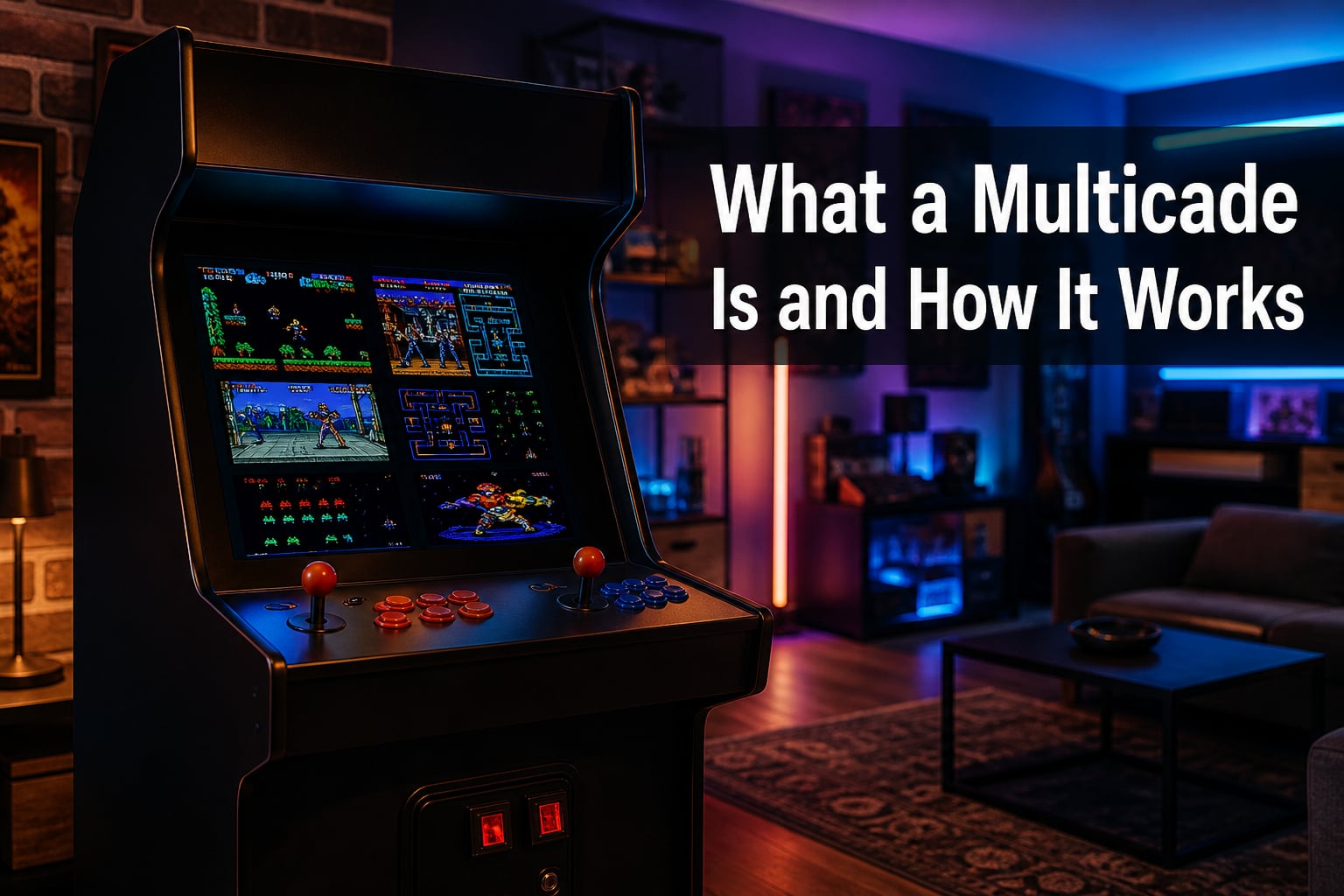
Imagine walking into an arcade in 1985. The glow of CRT screens, the click of joysticks, the unmistakable sound of Pac-Man chasing ghosts. Now imagine bringing all of that home in a single machine. That is exactly what a multicade does for your game room.
A multicade is one arcade cabinet that plays hundreds, sometimes thousands, of classic games. Instead of owning a separate machine for Pac-Man, Donkey Kong, and Galaga, you get them all in one unit. Our team has spent years exploring retro gaming setups, and we keep coming back to the multicade as the best way to experience classic arcade culture at home.
In this guide, we will explain what a multicade is, how it works under the hood, the different types available, and what to look for if you are thinking about adding one to your space. Whether you are building a man cave, setting up a family game room, or just chasing that nostalgia hit, this article covers everything you need to know.
Table of Contents
What Is a Multicade?
A multicade is a single arcade cabinet designed to play multiple classic arcade games from one machine. Also known as a multigame arcade, all-in-one arcade, or Multi Video System (MVS), it combines dozens or hundreds of titles that would normally require separate dedicated cabinets.
The term “multicade” originally came from the practice of converting classic arcade cabinets to run multiple games using modified circuit boards. In the 1990s, operators realized they could increase revenue by offering more game choices from a single cabinet. A machine sitting in a pizza parlor could switch between six or eight popular titles instead of offering just one.
Today, the word covers a much broader category. A modern multicade might be a brand-new cabinet built from scratch, a refurbished vintage cabinet upgraded with multi-game hardware, or a compact countertop unit running emulation software. What they all share is the core idea: one cabinet, many games.
The difference between a multicade and a traditional arcade cabinet is straightforward. A standard arcade cabinet runs one specific game, built around a single printed circuit board (PCB) designed for that title. A multicade runs many games, either through multiple PCBs switched electronically or through software emulation on a computer.
How a Multicade Works
Every multicade operates on one of two fundamental technologies: original hardware or emulation. Understanding the difference helps you know what you are buying and what kind of performance to expect. The short answer is that original hardware uses physical game boards to run authentic arcade chips, while emulation uses software to recreate those games on modern computer hardware.
Original Hardware (PCB-Based Multicades)
In the early days of multicades, operators used a wiring standard called JAMMA. Introduced in 1985, the JAMMA standard created a universal wiring harness that let arcade operators swap game boards in and out of cabinets without rewiring everything. This was a turning point for the industry.
With JAMMA, a single cabinet could accept different game PCBs as long as they used the same connector. Some enterprising engineers created multi-game PCBs that contained several games on one board, selectable through an on-screen menu. These were the first true multicades.
SNK’s Multi Video System, better known as the MVS, is the most famous example. Launched in 1990, the MVS let operators insert up to six game cartridges into a single cabinet. Players could choose between Metal Slug, King of Fighters, Samurai Shodown, and other titles from an on-screen menu. The MVS is still celebrated today as one of the most elegant multicade designs ever built.
Original hardware multicades appeal to purists because they run games on the actual chips the developers designed them for. There is no emulation layer, no input lag, and no compatibility issues. Every sound and sprite behaves exactly as it did in the arcade.
Emulation-Based Multicades
Most modern multicades rely on emulation. Instead of original arcade PCBs, they use a small computer, often a Raspberry Pi, mini PC, or purpose-built board, running software that mimics the behavior of original arcade hardware.
Here is how it works. The original game code, stored as a file called a ROM, contains all the instructions the arcade hardware would have executed. Emulation software reads that ROM and translates its instructions in real time so that modern hardware can run the game. The result is gameplay that looks and feels nearly identical to the original.
The software stack on an emulation multicade typically has three layers. At the bottom is the operating system, usually a lightweight Linux distribution. In the middle is the emulator itself, software like MAME (Multiple Arcade Machine Emulator) that handles the actual game execution. On top is a frontend, a visual menu system that lets you browse games by category, search by title, and view cover art.
Frontends like AttractMode, EmulationStation, and LaunchBox are popular choices. They turn what would otherwise be a technical command-line experience into something anyone can navigate with a joystick and buttons.
Emulation multicades offer a massive advantage in game selection. A single machine can hold thousands of titles spanning every era of arcade history. The trade-off is that emulation is never perfectly identical to original hardware, and some complex games may have minor audio or visual glitches. For most players, the difference is unnoticeable.
Types of Multicade Machines
Multicades come in several physical formats, each suited to different spaces and use cases. The cabinet style you choose affects everything from footprint to player count to the overall feel of the experience.
Upright Multicade Cabinets
The upright cabinet is the classic arcade form factor. Standing roughly five to six feet tall, it features a vertical monitor, a control panel at waist height, and a marquee at the top. This is the shape most people picture when they hear the word “arcade machine.”
Upright multicades deliver the most authentic arcade experience. The standing posture, the cabinet height, the feel of pressing your hands against a full-size control panel, it all recreates the original arcade sensation. Most upright multicades support one or two players side by side.
The downside is space. A full-size upright cabinet typically measures about 25 inches wide and 30 inches deep, and it weighs between 150 and 250 pounds. You need a dedicated spot for it, and moving it is a two-person job.
Cocktail Table Multicades
Cocktail multicades are shaped like low tables, with a monitor mounted face-up under a glass top. Two players sit across from each other, and the screen flips orientation depending on whose turn it is. This style was enormously popular in bars and restaurants during the early 1980s.
For home use, cocktail multicades are a smart choice when you want arcade gaming without dedicating floor space to a full cabinet. The table doubles as a functional piece of furniture. You can set a drink on it when it is not in use, and it blends into a living room or den more naturally than an upright.
The trade-off is that cocktail cabinets typically support only two players, and the controls are split across two sides rather than placed together on a single panel. Fast-paced action games can feel less responsive when you are sitting down and reaching across a table.
Countertop and Bartop Multicades
Countertop multicades, sometimes called bartop models, are compact units designed to sit on a desk, shelf, or bar. They stand about 15 to 20 inches tall and use a small LCD screen, typically between 10 and 17 inches. Despite their size, many of these units pack in hundreds of games.
These are the most space-efficient option available. If you live in an apartment or want arcade gaming in your office without committing to a full cabinet, a countertop multicade is the answer. They are also significantly lighter and easier to move than any other type.
The compromise is in the controls. Small cabinets mean small control panels, which can feel cramped for adult hands. Most countertop models are best suited for solo play or casual sessions rather than intense two-player gaming.
What Games Are on a Multicade?
The game library is the heart of any multicade. Most machines include a mix of titles from the golden age of arcade gaming, roughly 1978 through the early 2000s. You can expect to find iconic names like Pac-Man, Donkey Kong, Galaga, Frogger, Street Fighter II, and Centipede.
Beyond the classics, many multicades include games from specific genres. Fighting games like Mortal Kombat and King of Fighters are common. Shooters like 1942, Raiden, and R-Type show up frequently. Puzzle games like Tetris and Bubble Bobble are popular inclusions. Sports titles, racing games, and platformers round out many libraries.
The number of games varies dramatically. Entry-level multicades might include 60 to 100 titles. Mid-range machines often advertise 500 to 1,000 games. High-end emulation multicades can hold 3,000 or more. However, a larger number does not always mean a better experience. Many budget machines pad their counts with obscure titles, regional variants, or games that barely function.
One important thing to understand is the licensing situation. Many multicades sold today include game ROMs that are technically unauthorized copies. Some manufacturers have proper licensing agreements for their game libraries, while others operate in a legal gray area. If legitimate software ownership matters to you, look for machines from companies that disclose their licensing arrangements.
Reddit users in communities like r/cade frequently caution against trusting advertised game counts. They recommend evaluating a multicade based on the quality of its top 50 games rather than the total number. A machine with 150 excellent, fully playable titles will provide far more enjoyment than one with 5,000 games where half are broken duplicates.
Key Components of a Multicade
A multicade is built from several core components, each contributing to the overall experience. Knowing what these parts do helps you evaluate quality and understand what you are paying for.
The Control Panel is where you interact with the machine. It houses the joysticks, buttons, and sometimes additional controls like trackballs or spinners. Quality here matters more than anywhere else. Sanwa and Seimitsu are the gold standard brands for arcade controls, used in competitive fighting game tournaments worldwide. Cheap knockoff sticks feel mushy and unresponsive, which ruins the experience no matter how good the games are.
The Monitor displays the games. Classic arcade cabinets used CRT screens, which have a distinctive scanline look that many enthusiasts prefer. Modern multicades typically use LCD or LED panels, which are lighter, more reliable, and available in larger sizes. Some premium models include CRT-style filters that simulate the vintage look on an LCD screen.
The Computer or PCB is the brain of the machine. In emulation multicades, this is usually a small-form-factor PC, Raspberry Pi, or dedicated arcade board. Processing power determines how many systems the machine can emulate and how smoothly complex games run. Underpowered hardware leads to lag, audio stuttering, and dropped frames.
The Power Supply distributes electricity to all components. Arcade power supplies are designed to handle the specific voltage requirements of monitors, boards, and lighting. A well-built power supply with proper grounding prevents interference that can cause screen flicker or audio buzzing.
The Audio System includes speakers, an amplifier, and sometimes a subwoofer. Arcade sound is a huge part of the nostalgia experience. The bleeps and blasts of classic games were designed to cut through noisy arcades, and hearing them through quality speakers at home is genuinely thrilling.
Why Choose a Multicade for Your Game Room?
The biggest advantage of a multicade is simple: it replaces multiple machines. A dedicated Donkey Kong cabinet, a dedicated Galaga cabinet, and a dedicated Pac-Man cabinet would cost thousands of dollars and consume an enormous amount of floor space. A single multicade gives you all three, plus hundreds more, in one unit.
For families, a multicade creates shared entertainment that spans generations. Grandparents who grew up with Pong can play alongside kids raised on smartphones. The pick-up-and-play nature of classic arcade games means nobody needs to learn complex controls or sit through a tutorial.
Multicades also shine as social pieces. They are natural conversation starters at parties. Guests gravitate toward them, take turns playing, and bond over shared memories of their favorite titles. Very few pieces of home entertainment equipment generate that kind of spontaneous engagement.
From a collector’s perspective, a multicade offers incredible value per square foot. If you have limited space but want variety, it is the most efficient way to experience arcade history without filling your basement with individual cabinets.
What to Look for When Choosing a Multicade
Forum communities like r/cade and r/arcade have identified several factors that separate good multicades from disappointing ones. Their collective experience points to a few priorities worth keeping in mind.
Build quality should be your first filter. Cabinets made from particle board or thin MDF will not hold up over time. Look for solid wood construction, preferably plywood or medium-density fiberboard that is at least 5/8 inch thick. The cabinet should feel sturdy when you press against it, not flex or wobble.
Control quality is non-negotiable. As mentioned earlier, the difference between genuine arcade controls and cheap imitations is night and day. Ask the manufacturer or seller what brand of joysticks and buttons they use. If they cannot tell you, that is a red flag.
Game library accuracy matters more than game count. Request an actual game list before buying. Reddit users repeatedly warn that budget multicades from big-box stores often advertise huge game numbers but include broken, duplicated, or unplayable titles.
Warranty and customer support can make or break your ownership experience. Arcade machines are complex devices with monitors, computers, and wiring. When something goes wrong, you want a company that picks up the phone and ships replacement parts. Community reports consistently highlight customer service as the biggest differentiator between budget and premium brands.
Screen quality affects every moment of gameplay. Look for a monitor with decent resolution, good viewing angles, and low input lag. Cheap screens can introduce a noticeable delay between pressing a button and seeing the action on screen, which is deadly in fast-paced arcade games.
FAQs
How do you use a multicade?
Turn on the power switch, wait for the frontend menu to load, then use the joystick to browse the game list and press the primary button to select a game. Most multicades let you return to the main menu using a button combination or dedicated menu button. The process takes seconds and requires no technical knowledge.
What games are on a multicade?
Most multicades include golden age arcade classics like Pac-Man, Donkey Kong, Galaga, Frogger, Centipede, and Street Fighter II. Libraries also typically feature fighting games, shooters, puzzle games, and sports titles from the 1980s through early 2000s. Game counts range from 60 on entry-level machines to over 3,000 on high-end emulation systems.
How much does a multicade arcade machine cost?
Countertop multicades start around $150 to $400. Full-size upright machines typically range from $500 for budget models to $3,000 or more for premium cabinets with licensed games and commercial-grade components. Cocktail table multicades generally fall between $400 and $1,500 depending on build quality and game library.
What is the difference between a multicade and a regular arcade cabinet?
A regular arcade cabinet plays one specific game using a dedicated circuit board designed for that title. A multicade plays multiple games, ranging from dozens to thousands, from a single cabinet. Multicades achieve this either through multi-game PCB hardware or through software emulation running on a compact computer inside the cabinet.
Conclusion
A multicade brings the entire arcade era into a single cabinet. Whether powered by original hardware like the legendary SNK MVS or by modern emulation software, it delivers hundreds of classic games without requiring a separate machine for each title. Understanding what a multicade is and how it works helps you choose the right type, evaluate game libraries honestly, and invest in a machine that delivers years of retro gaming enjoyment. Pick your format, check the controls, and start chasing those high scores.