
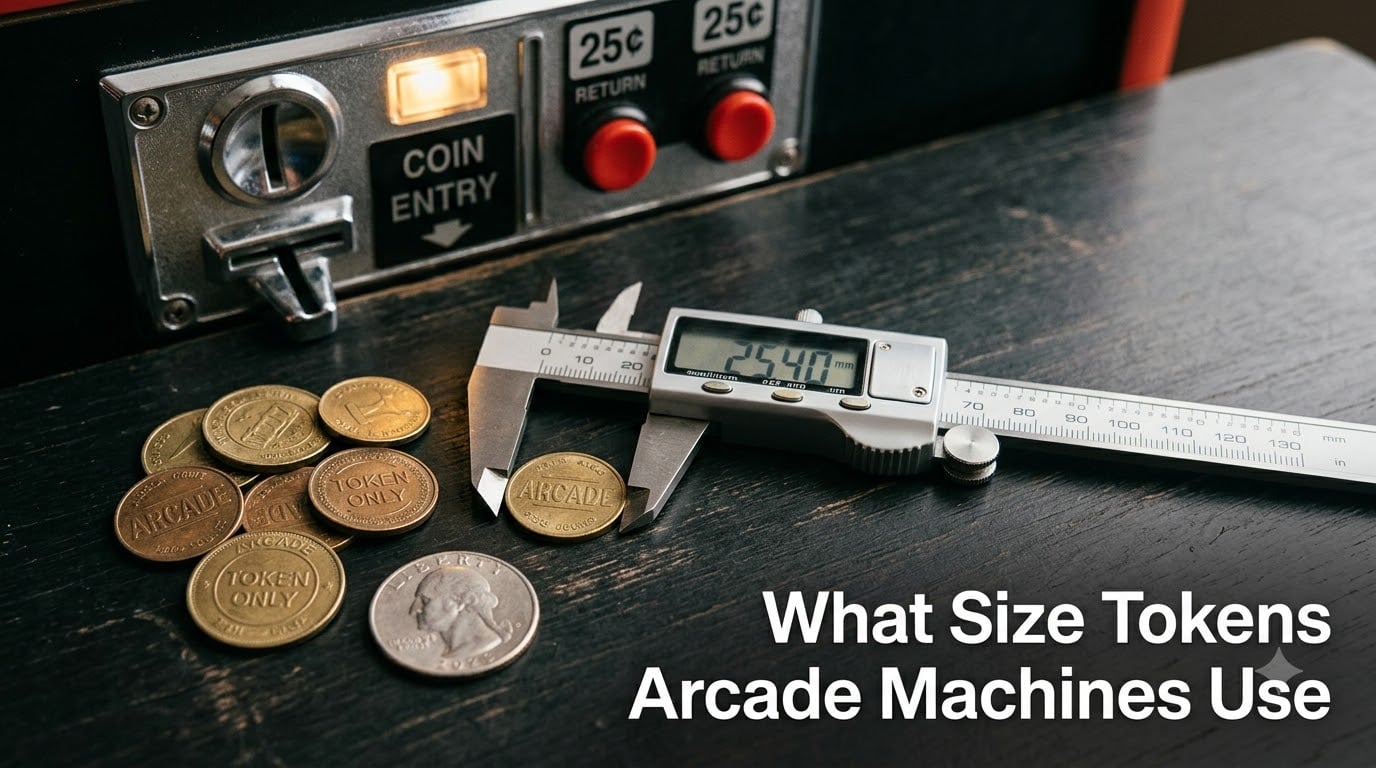
Most arcade machines use tokens that are either 0.900 inches or 0.984 inches in diameter. The 0.984 token is slightly larger than a US quarter, while the 0.900 token is slightly smaller. These two sizes have dominated coin-operated gaming for decades, and understanding arcade token sizes is essential if you run an arcade, restore cabinets, or collect vintage machines.
I have spent years around coin-operated equipment, and token sizing is one of the most common questions I hear from home arcade builders. Get the size wrong and the coin mech rejects every token you drop in. Get it right and the machine runs reliably for thousands of credits.
This guide breaks down exactly what size tokens arcade machines use, why those specific sizes exist, how to match a token to your coin mech, and what to do when a machine starts rejecting tokens that should work.
Table of Contents
- What Size Tokens Do Arcade Machines Use?
- Arcade Token Sizes Compared to a US Quarter
- Why Arcades Use Tokens Instead of Quarters
- How Coin Mechs Work With Different Token Sizes
- How to Measure Your Coin Mech for Token Compatibility
- Troubleshooting Token Rejection Issues
- Which Token Size Works With Each Machine Type
- Modern Alternatives: Cards, Apps, and Free Play
- FAQs
- Conclusion
What Size Tokens Do Arcade Machines Use?
Arcade machines use tokens in two primary sizes: 0.900 inches (about 22.9 mm) and 0.984 inches (exactly 25 mm) in diameter. These measurements refer to the coin’s diameter, and both sizes have been industry standards since the golden age of arcades in the 1980s.
The 0.984 token is by far the most common size used across commercial arcades. Chuck E. Cheese, Showbiz Pizza, and most regional arcade chains built their token systems around the 0.984-inch diameter with a thickness of 0.060 inches. If you buy generic arcade tokens in bulk today, this is almost always the size you receive.
The 0.900 token shows up frequently in older setups, specific regional operators, and some vending applications. At 0.900 inches, it is noticeably smaller than the 0.984 format and requires a coin mech specifically calibrated for that diameter.
Beyond these two dominant sizes, some manufacturers used proprietary formats. Sega produced their own distinct token size for their arcades, and various operators commissioned custom tokens with unique edge grooves, center holes, or embossed designs to prevent cross-use between venues. These proprietary tokens still followed roughly the same diameter range but featured physical details that only the venue’s own coin mechs would accept.
Here is the quick reference for the three sizes that matter most to anyone working with arcade token sizes:
0.984 inches (25.0 mm) diameter — the most common arcade token, used by major chains and most bulk suppliers. Slightly larger than a US quarter.
0.900 inches (22.9 mm) diameter — common in older machines and some specific operator setups. Slightly smaller than a US quarter.
0.955 inches (24.26 mm) diameter — the US quarter itself, included for reference since many older machines were originally set to accept real coins.
Arcade Token Sizes Compared to a US Quarter
The reason arcade tokens come in sizes close to but not identical to a US quarter is deliberate. Operators wanted tokens that felt familiar in the hand but would not work in regular vending machines, laundry machines, or parking meters. A token the exact size of a quarter would defeat the purpose, so manufacturers split the difference on both sides.
Comparing the dimensions side by side makes the differences clear. A US quarter measures 0.955 inches in diameter and 0.069 inches thick. The 0.984 arcade token is roughly 0.029 inches wider in diameter but slightly thinner at 0.060 inches. The 0.900 token is about 0.055 inches narrower in diameter than a quarter, making it easy for a coin mech to distinguish from the real thing.
The thickness difference matters just as much as diameter. Coin mechs use both the diameter opening and the thickness gauge to identify coins. A token that matches diameter but not thickness can still be rejected, which is exactly what operators want when trying to keep tokens inside their venue and quarters out.
In practical terms, none of these three coins are interchangeable in a properly calibrated coin mech. A quarter will not work in a machine set for 0.984 tokens, a 0.900 token will not work in a machine set for quarters, and the two token sizes are not cross-compatible with each other either.
Why Arcades Use Tokens Instead of Quarters
Arcades use tokens instead of quarters for five practical reasons that all come down to business control. Understanding these reasons explains why operators went to the trouble of manufacturing custom coins and calibrating machines to reject real money.
Theft reduction is the biggest factor. When a machine accepts quarters, anyone with access can empty the coin box and walk away with real cash. Tokens have no cash value outside the venue, so stealing them is pointless. An employee or intruder who takes a bag of tokens cannot spend them anywhere else.
Venue loyalty keeps players on site. Once a customer buys a cup of tokens, they have already committed their money to that arcade. They cannot decide halfway through to walk across the street and spend those tokens at a competitor. The sale is locked in.
Bundled sales and promotions become possible. Arcades can sell token bundles at a discount, like 20 dollars for 25 dollars worth of tokens, to encourage larger upfront purchases. You cannot do tiered pricing with quarters because every coin is worth exactly 25 cents.
Branding and collectibility add marketing value. Custom tokens with the arcade’s logo become miniature advertisements and, in many cases, collectibles. Some vintage arcade tokens now sell for significant amounts among collectors, which is free brand exposure that lasts decades.
Faster transactions at the counter improve throughput during busy periods. Selling pre-counted token cups or rolls is faster than making change for quarter-fed machines, especially when lines build up on weekend nights.
How Coin Mechs Work With Different Token Sizes
A coin mech, short for coin mechanism, is the device behind the coin slot that identifies and accepts or rejects coins. Understanding how it works explains why arcade token sizes have to be precise and why the wrong token gets spit back out through the reject button.
Mechanical coin mechs use a physical sorting process. The coin drops through a size gate that filters by diameter first. If the coin is too small, it falls through a hole into the reject chute. If it is too large, it cannot pass the gate at all. Only a coin matching the target diameter continues down the track.
Next, the coin passes a thickness gauge, usually a narrow slot milled into a brass or steel plate. This slot is cut to the exact thickness of the intended coin or token. A quarter at 0.069 inches will not fit through a slot cut for 0.060-inch tokens, and a thin token will rattle through a slot cut for quarters without triggering the acceptor.
Some coin mechs add a magnet test. US quarters contain copper and nickel and respond to a magnet in a specific way. Tokens made of brass, zinc, or steel behave differently, so a magnet can distinguish real coins from tokens even if the size matches. This is how operators run a token-only machine in a location where someone might try to feed it quarters.
Electronic coin acceptors take this further with optical sensors that measure diameter, thickness, and metal composition in milliseconds. These acceptors can be programmed for multiple coin or token profiles, which is why modern multi-coin mechs can accept both sizes interchangeably if the operator chooses that configuration.
The key takeaway is that a coin mech is a precision instrument. Forum discussions on arcade-museum.com and r/arcade consistently confirm that operators physically swap or adjust coin mechs when changing token sizes. You cannot make a machine accept a different token just by forcing coins through. The mech has to match.
How to Measure Your Coin Mech for Token Compatibility
Measuring your coin mech is the first step I recommend before buying any tokens. No competitor guide covers this process in detail, yet it is the single most common problem posted on arcade hobbyist forums. Here is the step-by-step method I use.
Step 1: Remove the coin mech from the cabinet. Most mechs slide out of the coin door frame after releasing a clip or lever. You need it on the bench to measure accurately, because trying to gauge dimensions while it is mounted leads to guesswork.
Step 2: Measure the diameter gate. Look for the cradle or slot where the coin first lands. Use calipers to measure the opening. A 0.984 token mech will have a gate approximately 1.0 inch across. A 0.900 mech will measure about 0.92 inch. If the gate is close to 0.955 inch, you likely have a quarter mech.
Step 3: Measure the thickness slot. Find the narrow milled channel the coin passes through and measure its width with calipers or a feeler gauge. A 0.060-inch slot indicates a 0.984 token setup. A 0.069-inch slot points to quarters.
Step 4: Test with a known coin. Drop a US quarter through the mech. If it accepts, the mech is set for quarters. If it rejects, try a token of each size. Whichever one passes through tells you the current configuration.
Step 5: Check for branding marks. Many mechs are stamped with the token size or manufacturer code. Look for markings like “0.984,” “25MM,” or a brand name. This can save you the measuring step entirely.
If your measurements do not match either standard token size cleanly, you may have a proprietary mech. Sega cabinets and some European machines used non-standard diameters. In that case, contact the cabinet manufacturer or search arcade-museum forums with your mech part number.
Troubleshooting Token Rejection Issues
Token rejection is the most frustrating problem arcade owners face, and it almost always comes down to a handful of fixable causes. Here is what I check when a machine starts spitting back tokens.
Dirty coin track. Dust, grease, and pocket lint build up in the mech over time and narrow the thickness slot. Even a thin layer of grime can reduce the effective slot width enough to reject perfectly good tokens. Remove the mech and clean the track with isopropyl alcohol and a pipe cleaner.
Worn size gate. Years of coins dropping through wear down the gate metal, eventually widening it. A worn gate may start accepting wrong-size coins or jamming on correct ones. If the gate shows visible wear or burrs, replacing the mech is usually the fix.
Mixed token inventory. If you bought tokens from multiple suppliers, you may have a mix of 0.900 and 0.984 sizes in the same bucket. They look almost identical but will only work in mechs calibrated for their specific diameter. Sort your tokens by trying them in a known-good mech.
Bent or damaged tokens. A single drop on concrete can warp a token enough to fail the thickness gauge. Check problem tokens against a straight edge. Toss any that are visibly bent.
Magnet sensitivity drift. On mechs with magnetic slug rejection, the magnet position can shift from vibration. If your mech suddenly rejects everything, check that the magnet assembly is secure and properly positioned.
Which Token Size Works With Each Machine Type
Different arcade machine types tend to use specific token sizes based on when they were manufactured and who produced them. Here is the mapping I have compiled from forum data and hands-on experience.
Arcade video cabinets from the 1980s and 1990s (Capcom, Konami, Midway) most commonly use the 0.984 token. This was the default size for American arcade operations during the industry’s peak.
Pinball machines split between 0.984 tokens and quarters. Many were originally quarter-operated and converted to tokens when placed in arcades. Check the mech before buying tokens.
Claw machines and crane games overwhelmingly use 0.984 tokens. This is the size you will find in most family entertainment centers and redemption arcades.
Coin pusher machines run on 0.984 tokens in most modern arcades, though older pushers sometimes used 0.900 or quarter-sized coins depending on the manufacturer.
Vending and non-arcade equipment like laundromats, car washes, and drink machines typically use 0.900 tokens to distinguish them from arcade tokens. This prevents arcade tokens from being used in other equipment and vice versa.
Modern Alternatives: Cards, Apps, and Free Play
Many arcades have moved away from physical tokens entirely. Card-based systems, where players load value onto an RFID card and tap to play, have replaced tokens at major chains like Dave and Buster’s and Main Event. These systems eliminate coin mech maintenance and give operators real-time data on every game.
Mobile app payment is the next step, letting players tap their phone to a reader on each cabinet. For home arcade owners, free-play mode, where the machine is set to always have credits, is the simplest option and requires no tokens at all.
Despite these modern alternatives, tokens remain popular in independent arcades, barcades, and home collections. The tactile feel of dropping a coin, the collectibility, and the retro authenticity keep token-based systems alive in 2026.
FAQs
What size are arcade tokens?
The two standard arcade token sizes are 0.900 inches (22.9 mm) and 0.984 inches (25.0 mm) in diameter. The 0.984 size is the most common, used by major arcade chains and most bulk token suppliers.
How big is a .984 token?
A 0.984 token measures 0.984 inches in diameter (exactly 25 mm) with a typical thickness of 0.060 inches. It is slightly larger in diameter than a US quarter but slightly thinner.
Why do arcades use tokens instead of quarters?
Arcades use tokens to reduce theft, lock in customer spending at the venue, enable promotional bundling, create branded collectibles, and speed up transactions. Tokens have no cash value outside the arcade, so they cannot be spent or stolen for real money.
Are arcade tokens the same size as quarters?
No, arcade tokens are not the same size as quarters. A US quarter is 0.955 inches in diameter. The common 0.984 token is slightly larger and the 0.900 token is slightly smaller. This size difference is intentional so coin mechs can distinguish between them.
What size tokens do claw machines use?
Most claw machines and crane games use 0.984-inch (25 mm) tokens. This is the standard size found in family entertainment centers and redemption arcades, matching the most common arcade token format.
Conclusion
Knowing what size tokens arcade machines use comes down to two numbers: 0.984 inches for most modern and commercial arcades, and 0.900 inches for older or specialized setups. Both are deliberately sized just off the 0.955-inch US quarter so coin mechs can tell them apart.
Before buying tokens for any machine, measure the coin mech first. The diameter gate and thickness slot will tell you exactly which size you need. And if a machine starts rejecting tokens, check for dirt, wear, and mixed inventory before replacing anything.
Whether you are restoring a single cabinet or outfitting a full arcade, getting the token size right is the foundation that makes everything else work.