
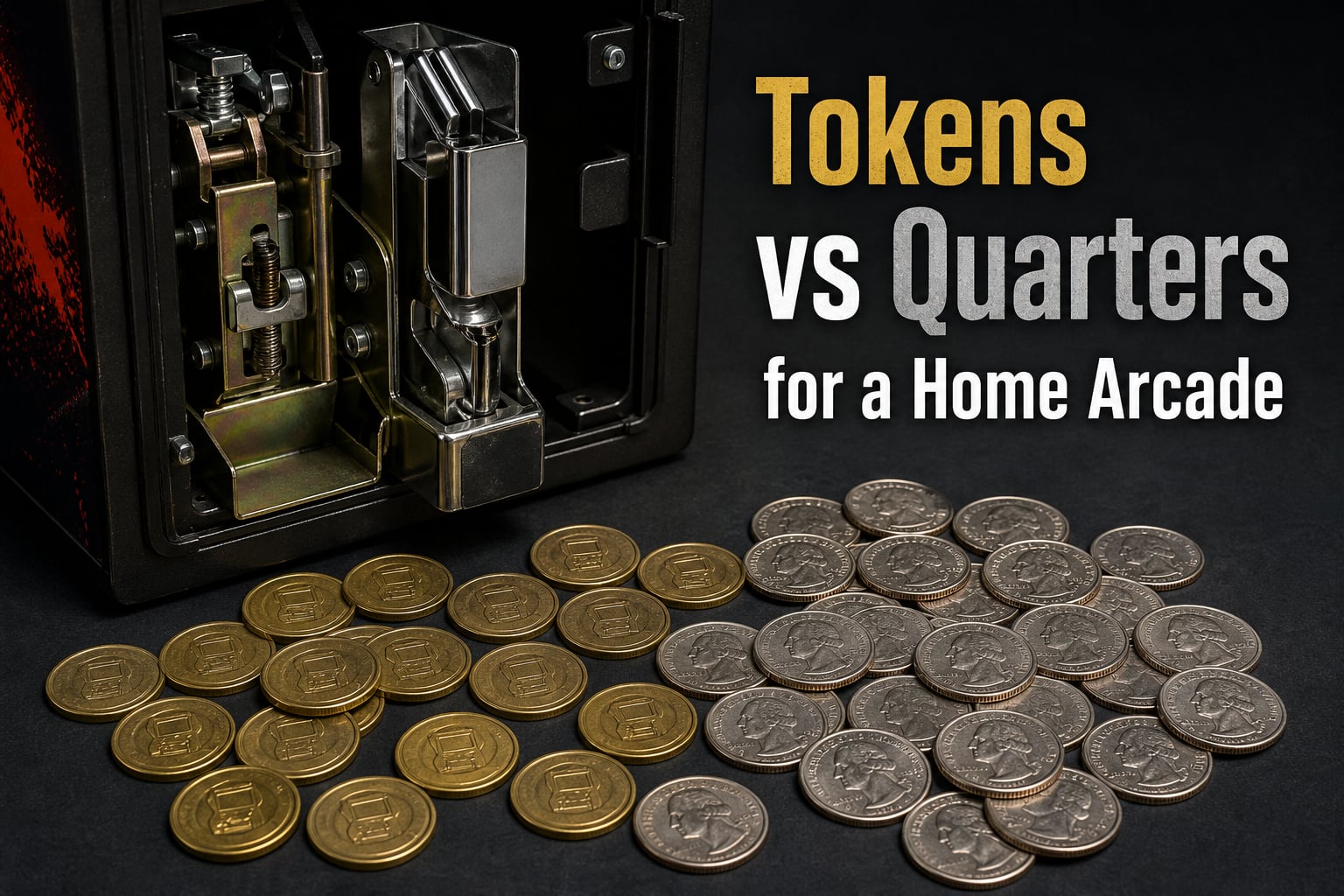
If you are building a home arcade, you will eventually face one decision that splits the collector community down the middle: do you run your machines on real quarters or switch them over to arcade tokens? It sounds simple until you start shopping for coin mechs, sourcing bulk tokens, and realizing that token size matters more than you ever expected.
Our team has spent years in home arcade forums, talked to dozens of cabinet owners, and tested both approaches in real home setups. The tokens vs quarters home arcade debate comes down to five factors: authenticity, cost, hardware compatibility, maintenance, and how much you care about quarters walking out the door when friends visit.
This guide breaks down everything you need to know. We cover token sizes, coin mech swaps, the pros and cons of each approach, running a mixed setup, and a decision framework to help you pick what works for your gameroom.
Table of Contents
- Tokens vs Quarters for a Home Arcade: The Core Difference
- Token Sizes Explained: .900 vs .984 vs Quarter
- Hardware and Coin Mech Compatibility
- Using Tokens for Your Home Arcade: Pros and Cons
- Using Quarters for Your Home Arcade: Pros and Cons
- Running a Mixed Setup: Quarters and Tokens Together
- Cost Analysis: What Each Option Actually Runs You
- How to Choose: A Decision Framework for Your Setup
- FAQs
- Final Thoughts on Tokens vs Quarters
Tokens vs Quarters for a Home Arcade: The Core Difference
The fundamental difference is simple. Quarters are real US currency that any standard coin mech accepts right out of the box. Tokens are custom coins minted to a specific diameter and thickness, designed to work only in coin mechs calibrated for that exact size.
Commercial arcades switched to tokens decades ago for business reasons. Tokens kept money inside the building, prevented theft, and let operators run promotions like four tokens for a dollar. That business logic does not apply to your basement. But tokens still carry strong appeal for home collectors chasing that authentic arcade feel.
Quarters win on universal compatibility and the satisfaction of hearing real coin hit the cash box. Tokens win on nostalgia, theft control, and that unmistakable arcade vibe. The choice is not about right or wrong. It is about what matters most in your space.
One thing to understand up front: running tokens does not mean your machines magically work differently. The game logic, the microswitch activation, the coin counter on the screen — all of that stays the same. The only thing that changes is what shape of metal drops into the slot.
Token Sizes Explained: .900 vs .984 vs Quarter
This is where most people get tripped up, so let us be precise. Token size refers to the diameter in thousandths of an inch. The two standard arcade token sizes are .900 inches and .984 inches. A US quarter measures .955 inches in diameter.
The .984 token is the most common arcade token size and sits closest to a quarter in diameter. Because of this, .984 tokens are often the easiest swap for machines that originally ran on quarters. The slight difference in diameter means a coin mech calibrated for .984 tokens will reject quarters, which is the whole point.
The .900 token is noticeably smaller than a quarter. This size was popular in certain arcade chains and family entertainment centers. Because it is smaller, a .900 coin mech rejects both quarters and .984 tokens. If you buy .900 tokens, you need .900-specific mechs.
Here is a quick reference for the three sizes you will encounter:
.900 token: 0.900 inch diameter, smaller than a quarter, used by specific arcade chains
.984 token: 0.984 inch diameter, closest to a quarter (0.955 inch), most common arcade token
US Quarter: 0.955 inch diameter, standard currency, works in factory coin mechs
Token thickness and weight also matter for mech compatibility, though diameter is the primary factor. Most quality arcade tokens are minted to match quarter thickness closely enough that the coin acceptor cradle handles them without adjustment.
Forum collectors consistently recommend .984 tokens for home arcade use. They are widely available in bulk, they feel right in your hand, and they are the easiest to find replacement mechs for. If you are starting fresh and have no existing token inventory, go with .984.
Hardware and Coin Mech Compatibility
Every coin-operated arcade machine has a coin mech (short for coin mechanism) inside the coin door. This is the physical assembly that accepts a coin, validates its size and metal content, and triggers a microswitch that credits the game. The mech is what determines what your machine accepts.
The good news for home arcade owners is that coin mechs are modular. Most machines use standard Happ Controls or equivalent mechs that slide out and swap in minutes. You do not need to rewire anything or modify the cabinet. You pull the old mech, slide in the new one, and you are done.
If your machine currently runs on quarters and you want to switch to tokens, you buy token-specific mechs sized for your chosen token. If your machine already has token mechs from its commercial life and you want to go back to quarters, you swap in quarter mechs. The process works both directions.
Here is where token size matters again. A .984 token mech will not accept a .900 token, and vice versa. You must match the mech to the token size exactly. This is why collectors on arcade-museum.com forums always tell newcomers to pick one token size and stick with it across the whole collection.
For MAME cabinets, the process is slightly different. Since MAME builds are custom, you need to wire the coin mech microswitch to your encoder (like an IPAC) using quick disconnects. The coin mech still handles the physical validation, but you are connecting the signal wire to your control interface rather than a factory game board.
One compatibility note: electronic coin acceptors that read metal signatures can be more finicky than mechanical mechs. If your machine has an electronic acceptor, check the documentation before buying tokens. Some can be recalibrated, others cannot.
Using Tokens for Your Home Arcade: Pros and Cons
Tokens are the authentic choice. When you drop a token into a slot, it feels like the arcade experience you remember. That psychological factor is real, and it is the number one reason collectors go the token route.
Pros of tokens:
Maximum authenticity — tokens create that genuine arcade atmosphere
Theft control — tokens have zero value outside your gameroom, so nobody takes them home
Nostalgia factor — custom tokens can feature your initials, a gameroom logo, or classic arcade artwork
Quarters stay in your pocket — you are not feeding real money into your own machines
Custom designs available — many sellers offer personalized minting for bulk orders
Cons of tokens:
Upfront cost — you need to buy both the tokens and the matching coin mechs
Token management — you become responsible for distributing, collecting, and storing your token supply
No interchangeability — tokens from different arcades or sizes will not work in your machines
Sourcing effort — finding quality bulk tokens takes research, and you must match the size to your mechs
Visitor confusion — friends may not understand why their quarters will not work
One collector on the arcade-museum forums put it perfectly: tokens just make the experience even more arcade-like. If you are building a gameroom specifically to recreate the feeling of walking into an arcade in 1987, tokens are the path to that feeling.
The theft point is bigger than people expect. Multiple forum users report that quarters vanish when neighborhood kids or party guests come over. People do not think twice about pocketing a quarter. Nobody pockets a token because it is worthless everywhere else.
Using Quarters for Your Home Arcade: Pros and Cons
Quarters are the zero-setup option. If your machines came with standard quarter mechs, you drop in coins and play. No sourcing tokens, no swapping hardware, no managing a token supply.
Pros of quarters:
Universal compatibility — every standard coin mech accepts quarters
Zero setup cost — no buying tokens or replacement mechs
Built-in piggy bank — your arcade collects real money you can actually spend
No token management — visitors bring their own quarters or use the ones you provide
Instant gratification — you can start playing the day you bring a machine home
Cons of quarters:
Real money disappears — quarters walk off with guests, kids, and sometimes yourself
Less authentic feel — dropping quarters feels like doing laundry, not hitting the arcade
Cash accumulation — if you play a lot, the cash box fills up and needs emptying
No customization — you cannot put your logo on a US quarter
Temptation to raid — quarters in the machine are quarters you might grab for parking meters
Several home arcade owners we found in forums use quarters specifically as a piggy bank strategy. Every game played drops 25 cents into the coin box. Over months, that adds up to a real fund for new machines, parts, or repairs. If you like that idea, quarters make financial sense.
The biggest complaint with quarters is the disappearing act. One Reddit user described hosting a birthday party and finding their quarter supply cut in half by the end of the night. If you have kids, neighbors, or frequent guests, this is a real problem that tokens solve completely.
Running a Mixed Setup: Quarters and Tokens Together
Here is an option most guides never mention: you do not have to pick one. Many home arcade owners run a mixed setup where some machines take tokens and others take quarters. This is more common than you might think.
A mixed setup works well when you have machines from different eras or sources. If you bought a cabinet that already had .984 token mechs and another that came with quarter mechs, you can leave them as-is and simply sort which machine takes which currency.
The practical challenge with a mixed setup is visitor communication. You need a clear system for telling guests which machines take what. Some owners use small signs on each coin door. Others color-code the coin slots or keep token machines in one zone and quarter machines in another.
Another mixed approach is using free play mode on some machines while running coin operation on others. Free play eliminates the currency question entirely on machines you want available for unlimited play, while coin-operated machines retain the deposit-and-play experience.
The mixed route is not for everyone. It adds a layer of management complexity. But if you have a growing collection with diverse hardware, it is a pragmatic solution that lets each machine run with whatever mech it already has installed.
Cost Analysis: What Each Option Actually Runs You
Let us talk numbers. The quarter route costs essentially nothing to start if your machines already have standard mechs. You use coins from your pocket or grab a roll from the bank. The ongoing cost is zero because the quarters cycle back to you, assuming they do not walk off.
The token route has two upfront costs. First, the tokens themselves. Bulk arcade tokens are available through arcade supply retailers, eBay sellers, and specialty token distributors. Custom-minted tokens with your own design cost more per unit but are available in smaller quantities for collectors who want something personalized.
Second, the coin mechs. Replacement mechs for specific token sizes are available through Happ Controls and other arcade parts suppliers. Most machines need one or two mechs depending on the number of coin slots. The swap takes minutes but the parts have a real cost.
Here is the cost breakdown comparison:
Quarters: zero startup cost, ongoing loss risk from theft and pocketing
Tokens: upfront cost for bulk tokens plus replacement mechs per machine, no ongoing loss risk
Mixed: varies by machine, only buy mechs for machines you want to convert
Free play: zero startup cost, but you lose the coin-drop experience entirely
For a multi-machine gameroom, the token investment scales with your collection. Converting five machines costs five times as much as converting one. Plan your budget accordingly and consider converting machines in batches rather than all at once.
How to Choose: A Decision Framework for Your Setup
Still torn? Run through these questions to find your answer.
Choose tokens if: you want maximum authenticity, you host frequent guests who might pocket quarters, you love the idea of custom-minted coins, and you do not mind the upfront investment in tokens and mechs.
Choose quarters if: you want zero setup hassle, you like the piggy bank aspect, your machines already have quarter mechs, and you trust your guests not to walk off with your coin supply.
Choose a mixed setup if: you have machines with different existing mechs, you want some machines on free play and others on coin operation, or you want to test tokens on one machine before committing to a full conversion.
Choose free play if: you care about the games themselves more than the coin-drop experience, you have small children who cannot manage coins, or you want unlimited play without managing any currency at all.
The tokens vs quarters home arcade decision is personal. There is no wrong answer. The best choice is the one that makes you excited to walk into your gameroom and start playing.
FAQs
Why do arcades use tokens instead of quarters?
Arcades use tokens for three main business reasons: tokens keep all money inside the building since they are worthless elsewhere, they prevent theft by staff and customers, and they allow operators to run promotions like selling four tokens for a dollar while each game costs one token. Tokens also create venue loyalty since tokens from one arcade do not work at competitors.
Do arcade tokens have value?
Arcade tokens have no monetary value outside the arcade that issued them. They cannot be spent as currency or exchanged for cash. However, vintage tokens from defunct arcades can have collectible value among enthusiasts, and some limited edition or custom tokens are sought after by collectors.
Why did arcades get rid of tokens?
Many modern arcades and family entertainment centers replaced tokens with reloadable swipe cards and digital payment systems. Cards reduce token manufacturing and handling costs, let operators track spending data, and offer convenience for customers who do not want to carry physical coins. Some traditional arcades and barcades still use tokens or quarters.
Do arcades use quarters?
Some arcades still use quarters, particularly older machines, pinball machines, and smaller operations. However, most large arcade chains and family entertainment centers have moved to token systems or digital card systems. Barcades and retro arcades often keep quarter operation for authenticity.
What size tokens should I buy for my home arcade?
For most home arcade setups, .984 inch tokens are the best choice. They are the most common arcade token size, closest in diameter to a US quarter (0.955 inch), and the easiest to find matching coin mechs for. The .900 inch token is an alternative size used by some arcade chains but is less common and requires .900-specific mechs.
Can my arcade machine accept both tokens and quarters?
A standard coin mech is calibrated for one specific coin size and will reject others. You cannot make a single mech reliably accept both tokens and quarters simultaneously. However, you can run a mixed setup where different machines in your collection use different mechs, some for tokens and others for quarters.
Final Thoughts on Tokens vs Quarters
The tokens vs quarters home arcade debate does not have a universal winner because the right answer depends entirely on your priorities. Tokens deliver authenticity and theft protection at the cost of upfront investment. Quarters deliver simplicity and a built-in savings fund at the cost of potential coin loss. Both approaches keep your machines playing exactly the way they were designed to.
Our recommendation: start with whatever your machines already have installed. Play for a few months. If quarters keep disappearing or the experience feels lacking, invest in .984 tokens and matching mechs for your favorite machines. The beauty of home arcade ownership is that you can always change your mind later.