
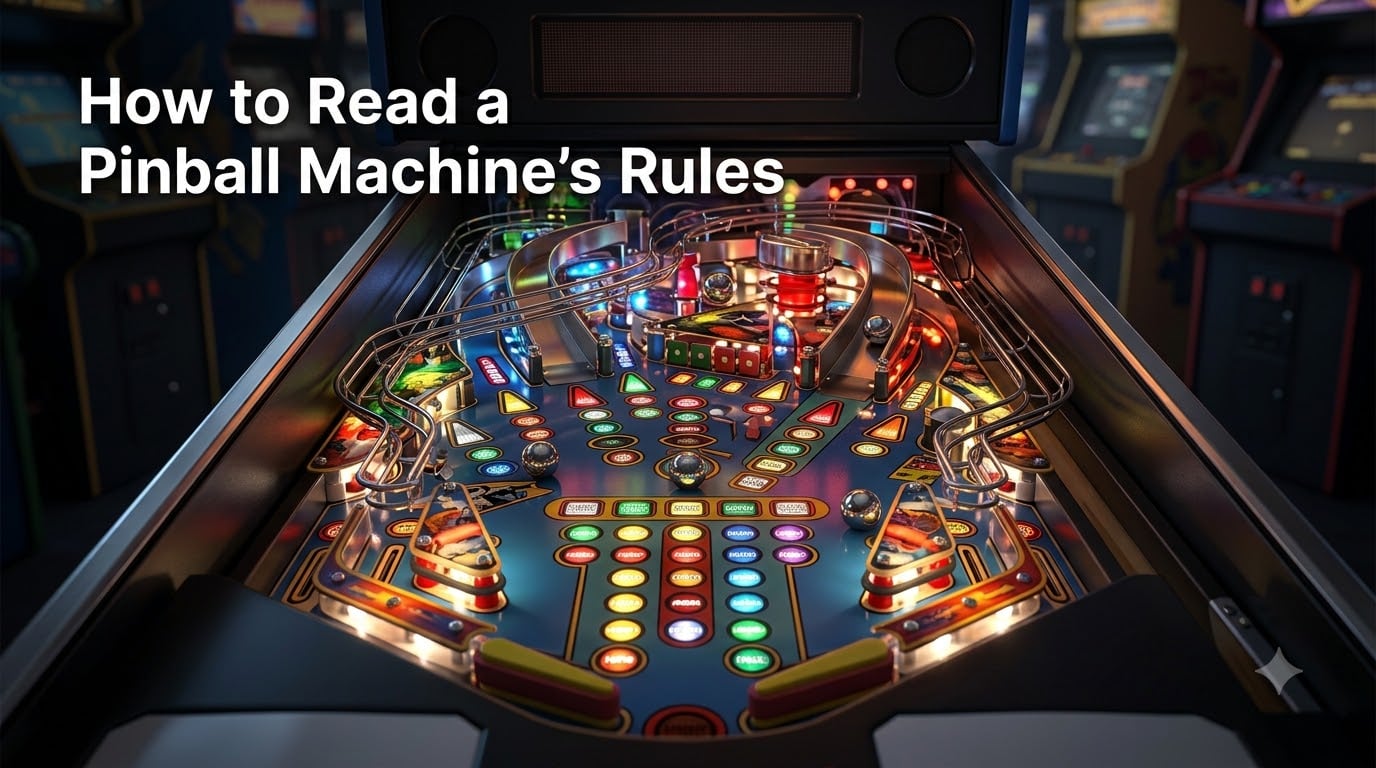
Learning how to read a pinball machine’s rules is the single biggest skill that separates casual players from high scorers. Every machine has a unique set of objectives, scoring mechanics, and strategic paths baked into its software, and the players who understand those systems consistently outscore the ones who just flail at the flippers.
When I first started playing competitively, I would drop quarters and hope for the best. Then I discovered that tournament players treat each machine like a puzzle with a known solution. The rulesheet is the answer key. Once you know how to read it, your scores jump immediately.
This guide walks you through a step-by-step method for reading any pinball rulesheet, understanding the color-coded light signals on the playfield, finding the best resources, and memorizing rules fast so you can walk up to any machine with a plan.
Table of Contents
- Why Pinball Rules Matter More Than Flipper Skills?
- How to Read a Pinball Machine’s Rules: The Step-by-Step Method
- Understanding Pinball Light Colors and Signals
- Universal Rules That Transfer Between Machines
- Where to Find Pinball Rulesheets and Resources?
- How to Practice and Memorize Pinball Rules Fast?
- FAQs
- Conclusion: Master How to Read a Pinball Machine’s Rules
Why Pinball Rules Matter More Than Flipper Skills?
You can have the fastest reflexes in the arcade and still lose to someone who knows the rules. Pinball rewards directed play, not random ball-bashing. The machine tracks every switch you hit, and the software decides what those hits are worth based on what mode you are in and what objectives you have completed.
UK Pinball Champion Craig Pullen puts it bluntly: knowing the rules can be the difference between a good score and a great score. A player who understands that two specific ramps activate a 3x multiplier will outscore a player hitting random targets every single time.
In tournament play, this becomes even more critical. You often face machines you have never played before. The players who can quickly read a rulesheet, identify the main objective, and form a strategy in five minutes are the ones who advance. I have watched players learn more from watching a single streamed game than from playing fifty games themselves, simply because the commentator explained the rules in real time.
Modern pinball machines have gotten more complex too. Games from Stern, Jersey Jack, and American Pinball pack in layered modes, deep multiball systems, and wizard modes that require completing dozens of sub-objectives. Without a system for reading and learning rules, you will barely scratch the surface of what these machines offer.
How to Read a Pinball Machine’s Rules: The Step-by-Step Method
Nobody else teaches a systematic approach to reading rulesheets, so I built one. This six-step method works on any machine, from a classic 1980s Williams title to the latest Stern release. Follow these steps in order and you will walk away with a working strategy every time.
Step 1: Find the Rulesheet for Your Machine
Start by locating a rulesheet. The best sources are PinTips.net for quick summaries, Pinball Videos at pinballvideos.com for visual walkthroughs, and community-created rulesheets on Tilt Forums for deep dives. Some manufacturers also publish official rule sheets on their websites or in the machine’s menu system.
For older machines, check the Internet Pinball Database (IPDB) which hosts scanned score cards and community rulesheets. If you cannot find a dedicated rulesheet, look for a gameplay tutorial on YouTube, which serves the same purpose in video form.
Step 2: Identify the Main Objective
Every pinball machine has one primary goal, usually reaching the wizard mode. Read the rulesheet until you find the endgame. What is the final objective the game builds toward? On some machines, it is completing all modes. On others, it is reaching a specific multiball or a final battle sequence.
Knowing the main objective gives your entire strategy a north star. Everything else you read on the rulesheet should be evaluated by asking one question: does this help me reach the wizard mode faster, or does it build my score along the way?
Step 3: Map Out the Modes
Most modern machines have a set of single-ball modes you activate by hitting specific shots. The rulesheet will list them. Write down or mentally note how many modes exist, what starts each one, and what you need to do inside each mode to complete it.
Pay attention to which modes are worth the most points and which ones feed into the wizard mode. Some modes are scoring opportunities, while others are required progress toward the endgame. Knowing the difference helps you prioritize your shots during play.
Step 4: Learn the Multiball Rules
Multiball is where the biggest points live on most machines. Read the rulesheet section on multiball carefully. You need to know three things: how to start it (usually locking balls by hitting specific shots), what the jackpot shots are during multiball, and how to earn the super jackpot.
Some machines layer multiball on top of modes, which is called mode stacking. This is one of the highest-scoring situations in pinball. If your rulesheet mentions that modes can run during multiball, make a note to combine them whenever possible.
Step 5: Find the Wizard Mode Path
The wizard mode is the reward for completing the machine’s core objectives. Trace the path backward from the wizard mode through the rulesheet. What triggers it? Usually you need to complete all modes, or finish a specific set of objectives, or reach a scoring threshold.
Once you know the path, you can plan your game from the first ball. Players who understand the wizard mode path play with purpose from the moment they plunge the ball. Players who do not will wander aimlessly and never reach the endgame.
Step 6: Identify High-Value Shots and Scoring Opportunities
The final step is finding the scoring shortcuts. Look for shots with multipliers, combos, and bonus multipliers that carry over between balls. Identify the skill shot, which is a free bonus for making a specific shot off the initial plunge. Check for any “lit” versus “unlit” shot mechanics where hitting a flashing target is worth far more than hitting it dark.
I always look for the extra ball trigger too. Most machines award one or two extra balls per game for hitting specific objectives, and those extra balls are free chances to extend your run. Knowing where they hide can add millions to your score.
Understanding Pinball Light Colors and Signals
One of the most overlooked skills in pinball is reading the playfield lights. The color and flash pattern of each light tells you what a shot is currently worth and what it does. No competitor covers this comprehensively, so here is your complete reference guide.
The lights are your real-time rulesheet. They change as modes start and stop, as you lock balls, and as jackpots become available. Train yourself to scan the playfield between shots and you will always know what to aim for next.
Green lights typically indicate a lock. When a green light is flashing on a shot, hitting that shot will lock a ball for multiball. This is your priority when you are building toward multiball.
Yellow or amber lights signal a good scoring shot. These are solid point values or shots that advance a mode. Hitting a yellow shot is rarely a waste, even if it is not your top priority at the moment.
Blue or purple lights usually indicate a power-up or mode activation. Hitting a blue-lit shot might start a mode, add a ball to multiball, or activate a temporary bonus multiplier. These shots change the state of the game.
Red lights mean jackpot or super jackpot. When you see red lights flashing, especially during multiball, those are your highest-value targets. Clearing a red jackpot shot can double your score in seconds.
White lights often indicate general inserts, bonus items, or the current active mode shot. Pay attention to which white lights are steady versus flashing, as the flash pattern tells you whether the shot is live or needs to be set up first.
Not every machine follows this exact color scheme, but the pattern holds for the vast majority of modern machines. When you approach a new game, hit a few shots and watch what color they light up. Within two minutes you will have the color language mapped.
Universal Rules That Transfer Between Machines
Not every rule is machine-specific. There are universal pinball rules that apply to nearly every machine ever made. Learning these gives you a baseline strategy you can use on any game, even before you read its rulesheet.
First, the skill shot exists on almost every machine. Plunging the ball with the right strength to land in a specific lane or upper playfield target awards bonus points before your first flipper hit. Check the lane lights at the top of the playfield when you start a game.
Second, ball lock is universal. Almost every machine with multiball requires you to hit a specific shot two or three times to lock balls before multiball starts. Look for the lock light, usually green, and hit that shot until the machine announces multiball is ready.
Third, bonus multipliers carry between balls on most machines. If you build a multiplier during ball one, it often applies to your end-of-ball bonus on balls two and three. This means building the multiplier early is more valuable than chasing big single shots.
Fourth, the ball saver is your friend. Most modern machines give you a brief ball saver period at the start of each ball, typically 10 to 15 seconds, where a drained ball is returned to the plunger. Use this time to take aggressive shots without risk.
Fifth, cradling the ball on a flipper is always the right move when you need to think. Stop the ball, look at the playfield, identify the highest-value flashing shot, and make a deliberate aim. Random flipper action drains balls and wastes opportunities.
Where to Find Pinball Rulesheets and Resources?
Knowing where to look is half the battle. The pinball community has built an impressive library of free resources over the years, and the best ones are maintained by passionate players who want to help newcomers.
PinTips.net is the go-to resource for quick rule lookups. It provides concise summaries of key objectives and scoring strategies for hundreds of machines. If you have two minutes before a tournament round, this is where you check.
Pinball Videos at pinballvideos.com is a massive library of recorded gameplay and tutorial videos. Watching a skilled player work through a machine teaches you the rules in context. Forum players report learning more from a single watched game than from fifty self-played games.
Tilt Forums hosts detailed, community-created rulesheets for competitive play. These are the deepest resources available, often written by the players who compete on those machines at the highest level. The rulesheet studying strategies thread alone is worth reading.
The Internet Pinball Database (IPDB) is the best source for older and classic machines. It hosts scanned score cards, rule summaries, and community ratings. If you are playing a machine from the 1990s or earlier, start here.
YouTube is filled with pinball tutorials. Search for the machine name plus “tutorial” or “rules” and you will usually find a walkthrough video. Craig Pullen’s instructional content is especially valued by the community for its clarity and competitive perspective.
Visual Pinball is a free software simulator that lets you play digital recreations of real machines on your computer. Tournament players use it to learn rules without spending quarters, test mode stacking strategies, and practice shots they cannot reliably hit on a real machine. It is one of the best-kept secrets for rapid rule learning.
How to Practice and Memorize Pinball Rules Fast?
Reading a rulesheet once is not enough. Forum players who have spent years learning machines report that the most effective method follows a read-play-re-read cycle that builds retention to 80 to 90 percent. Here is how to do it.
Phase one: Read before you play. Spend ten minutes with the rulesheet before you approach the machine. Identify the main objective, the multiball rules, and the wizard mode path. Do not try to memorize everything. Just get the structure in your head.
Phase two: Play with intent. Play a few games with the rulesheet fresh in your mind. Focus on executing the objectives you read about, not on your score. Try to start a mode, lock a ball, and reach multiball. Each attempt reinforces the rules through muscle memory and real-time feedback.
Phase three: Re-read after playing. Go back to the rulesheet immediately after your session. The rules you struggled with will jump out at you. Things that seemed confusing during the first read now make sense because you have felt them in action. This is where retention locks in.
Another powerful method is labbing, which is workshopping a machine with friends. You take turns playing while the others watch and call out observations. One person discovers a shot sequence, shares it, and everyone benefits. This collaborative approach is how tournament teams prepare for major competitions.
Watching tournament streams is equally effective. When skilled players stream their games with commentary, you hear the rules explained in real time as decisions are made. Pause the stream, predict the next shot, and see if you were right. This active viewing builds strategic thinking faster than passive play.
For machines you own or play regularly, use Visual Pinball to test edge cases. Want to know if mode stacking works during multiball? Test it digitally without risking a drain. Want to find the fastest path to the wizard mode? Simulate it until you find the optimal sequence. This is how top players discover strategies that casual players never find.
One warning: information overload is real. Do not try to learn five machines at once. Pick one, learn it deeply through the read-play-re-read cycle, then move to the next. Depth beats breadth every time when it comes to pinball rules.
FAQs
How to understand pinball?
To understand pinball, learn that each machine has specific objectives tracked by its software. Your goal is not just to keep the ball in play but to hit targeted shots that start modes, lock balls for multiball, build score multipliers, and ultimately reach the wizard mode. Read the machine’s rulesheet on PinTips.net, watch a tutorial video, and then play with intent rather than randomly hitting flippers.
What is a Lazarus in pinball?
A Lazarus in pinball is a ball that drains down the middle or outlane and then gets saved by the machine, typically through an auto-save or ball saver mechanism that kicks the ball back into play. The term references the biblical raising of Lazarus because the ball appears to come back from the dead.
What does the number mean at the end of pinball?
The number displayed at the end of a pinball game is your final score. In older machines, the display often shows the score with leading zeros to fill the digit count. The number at the end of each ball also reflects your accumulated points plus any end-of-ball bonus multiplied by your current bonus multiplier.
How does pinball scoring work?
Pinball scoring works through switches on the playfield that the ball hits. Each switch has a base point value assigned by the machine’s software. Points multiply through combos, mode bonuses, and score multipliers. Key scoring elements include jackpots during multiball, completed modes, skill shots, and end-of-ball bonuses. Higher-value shots are indicated by flashing colored lights on the playfield.
Conclusion: Master How to Read a Pinball Machine’s Rules
Knowing how to read a pinball machine’s rules transforms the way you play. Instead of reacting to the ball, you start directing it with purpose. Every shot has a reason, every mode has a goal, and every machine becomes a puzzle you can solve.
Start with the six-step method. Find the rulesheet, identify the main objective, map the modes, learn the multiball rules, trace the wizard mode path, and find the high-value shots. Then study the color-coded light signals so you can read the playfield in real time during play.
Use the read-play-re-read cycle to lock in your knowledge. Supplement your learning with PinTips.net for quick lookups, Pinball Videos for visual walkthroughs, and Visual Pinball for risk-free practice. Lab with friends when you can, because shared discoveries accelerate everyone’s growth.
The pinball community has built these resources for free because players genuinely want to help each other improve. Take advantage of them. Pick one machine, learn its rules deeply, and watch your scores climb. Then move to the next. That is how you go from casual player to consistent high scorer, one rulesheet at a time.