
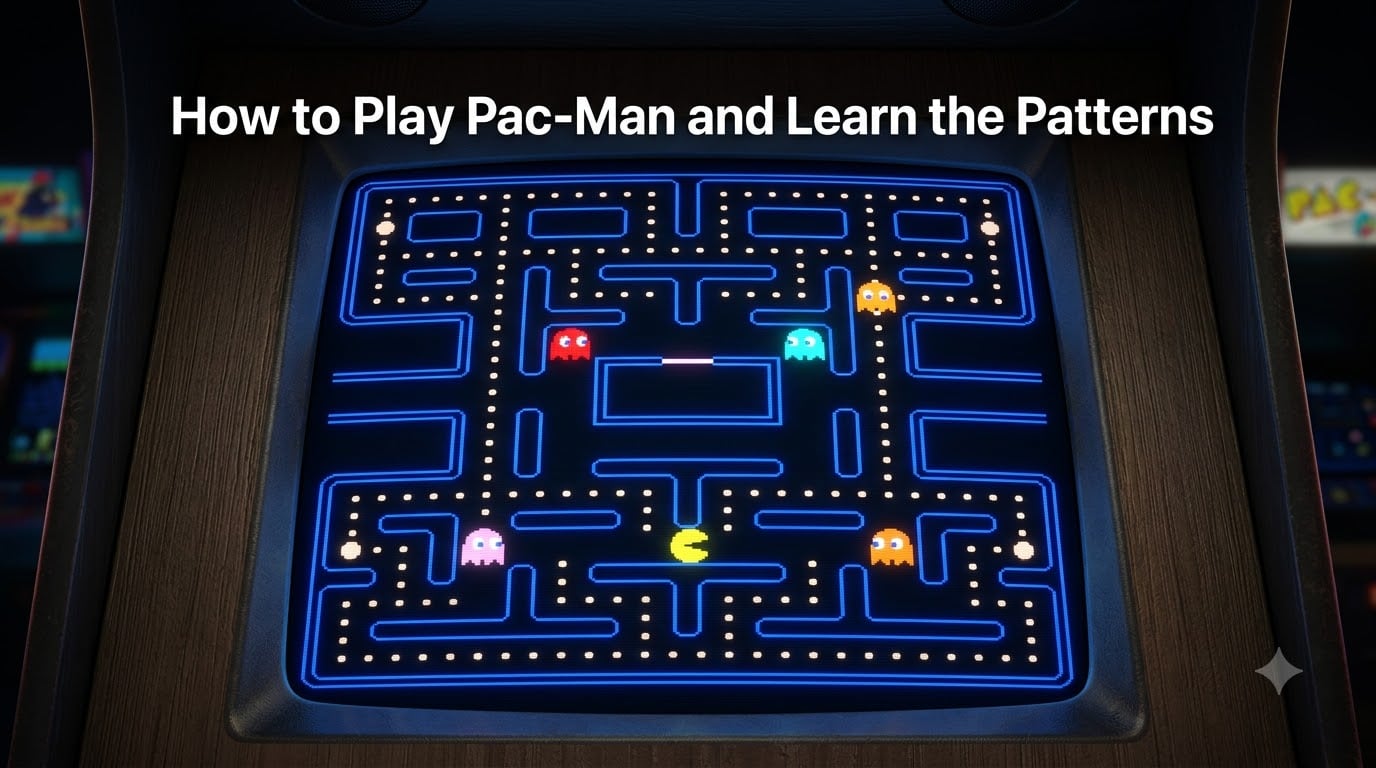
I still remember the first time I dropped a quarter into a Pac-Man cabinet. The ghosts demolished me in under thirty seconds. Like most beginners, I thought the game was pure chaos, four enemies chasing you randomly through a maze while you scrambled to eat every dot. Turns out, nothing could be further from the truth.
Pac-Man is one of the most predictable games ever made. Every ghost follows a specific targeting algorithm. Every level runs on a timed cycle of modes. And the entire maze can be cleared using memorized routes called patterns. Once I learned how the ghosts actually think, my scores tripled overnight.
In this guide, I will walk you through how to play Pac-Man and learn the patterns from scratch. We will cover the basic controls, break down each ghost’s AI personality, explain scatter and chase modes, and give you a step-by-step method for memorizing your first pattern. Whether you are playing on an original arcade cabinet, a MAME emulator, or your phone, the techniques here work across all versions of the original game.
If you have ever wondered how top players clear level after level without losing a life, it all comes down to pattern recognition. Let’s get started.
Table of Contents
- How to Play Pac-Man and Learn the Patterns: Getting Started
- Understanding the Four Ghosts and Their AI
- Scatter Mode vs Chase Mode vs Frightened Mode
- How to Learn Your First Pac-Man Pattern?
- Maze 1 Pattern Walkthrough
- Tips for Memorizing Pac-Man Patterns
- Common Mistakes to Avoid
- Advanced Techniques: High Score Strategies
- FAQs
- Conclusion
How to Play Pac-Man and Learn the Patterns: Getting Started
Pac-Man uses a four-directional movement system. You control the yellow character with a joystick, navigating through a maze filled with dots (pellets). Your goal is to eat every pellet on the screen without getting caught by the four ghosts.
The game runs on a tile-based grid. This means Pac-Man and the ghosts do not move freely. They travel along invisible tracks made up of square tiles, and they can only change direction at intersections. This tile-based movement is the foundation of why patterns work at all.
Here is what you encounter in the maze:
Pellets: The small dots worth 10 points each
Power Pellets: The four large flashing dots in the corners that turn ghosts blue (50 points each)
Fruit Bonuses: Bonus items that appear near the center of the maze, worth 100 to 5,000 points depending on the level
Energizer Effect: After eating a power pellet, ghosts become vulnerable and you can eat them for 200, 400, 800, and 1,600 points in sequence
The joystick buffers your input. If you push left before reaching an intersection, Pac-Man will turn left the moment he hits the turn. This is called pre-loading turns, and it is essential for pattern execution.
Understanding the Four Ghosts and Their AI
The single most important thing to understand in Pac-Man is that the ghosts are not random. Each one has a distinct personality and targeting system. When you know what each ghost is aiming for, you can predict exactly where they will go.
Here is a quick breakdown of all four ghosts:
| Ghost | Color | Nickname | Target |
|---|---|---|---|
| Blinky | Red | Shadow | Your current tile |
| Pinky | Pink | Speedy | Four tiles ahead of you |
| Inky | Cyan | Bashful | Complex, based on Blinky’s position |
| Clyde | Orange | Pokey | Your tile when far, scatter corner when close |
Blinky (Red) – The Shadow
Blinky is the most aggressive ghost. His target tile is always the exact square Pac-Man currently occupies. This means he chases you directly and relentlessly, taking the shortest path toward you at all times.
In later levels, Blinky enters what players call “Cruise Elroy” mode. When only a few pellets remain, his speed increases and he ignores scatter mode entirely. This is why the end of each level gets so dangerous. You need to plan your final pellet pickups so you are not cornered when Blinky speeds up.
Pinky (Pink) – The Speedy
Pinky targets the tile four spaces ahead of Pac-Man’s current facing direction. This means Pinky tries to ambush you by cutting off your path rather than chasing from behind.
A well-known quirk: if Pac-Man is facing up, Pinky’s targeting has a bug in the original code. The target tile shifts two spaces left and four spaces up, which means Pinky will sometimes end up in a surprising location when you move upward. Knowing this can save your life in tight situations.
Inky (Cyan) – The Bashful
Inky has the most complex targeting of any ghost. His target depends on both Pac-Man’s position and Blinky’s position. The game draws a vector from a point two tiles ahead of Pac-Man to Blinky, then doubles that vector. The resulting tile is Inky’s target.
In practice, this means Inky is unpredictable when you are new to the game. When Blinky is close to you, Inky also moves toward you. When Blinky is far away, Inky drifts toward the opposite side of the maze. Once you understand this relationship, you can manipulate Inky by controlling where Blinky is.
Clyde (Orange) – The Pokey
Clyde is the most unpredictable ghost for beginners but has the simplest rule. When Clyde is more than eight tiles away from Pac-Man, he targets your current tile, just like Blinky. But when Clyde gets within eight tiles, he panics and retreats to his scatter corner in the bottom-left of the maze.
This creates a back-and-forth behavior where Clyde approaches you, then runs away, then approaches again. You can use this to your advantage by letting Clyde get close so he retreats, giving you time to clear pellets.
Scatter Mode vs Chase Mode vs Frightened Mode
Ghost behavior changes based on global mode switches that happen on a fixed timer. Understanding these modes is critical for learning patterns because the same route produces different results depending on which mode is active.
There are three modes in the game:
Scatter Mode
During scatter mode, each ghost abandons chasing Pac-Man and heads to its assigned corner of the maze. Blinky goes to the top-right, Pinky to the top-left, Inky to the bottom-right, and Clyde to the bottom-left. The ghosts cycle to their corners and linger there.
Scatter mode gives you breathing room. This is when you can safely eat pellets in dangerous areas. The first scatter period lasts about 7 seconds at the start of level 1.
Chase Mode
When chase mode activates, all four ghosts switch to their individual targeting algorithms described above. This is when the real pressure begins. The ghosts pursue you using their unique personalities.
Chase mode lasts roughly 20 seconds in level 1 before scattering again. The cycle repeats several times per level, with scatter periods getting shorter and chase periods getting longer as the game progresses.
Frightened Mode
Frightened mode triggers when you eat a power pellet. All ghosts turn blue, slow down, reverse direction, and move randomly through the maze. You can eat them for progressive point values: 200, 400, 800, and 1,600 for the fourth ghost.
Eaten ghosts return to the ghost house in the center of the maze and respawn after a few seconds. As levels increase, the frightened period gets shorter until it disappears entirely, making power pellets useless for defense.
The Mode Cycle
Level 1 follows this approximate cycle:
Scatter: ~7 seconds
Chase: ~20 seconds
Scatter: ~7 seconds
Chase: ~20 seconds
Scatter: ~5 seconds
Chase: ~20 seconds
Scatter: ~5 seconds
Chase: permanent until level end
After the final scatter period, the game stays in chase mode for the rest of the level. This is why the end of each level feels so relentless. Knowing this cycle lets you time your power pellet usage and plan your route around when ghosts will scatter.
How to Learn Your First Pac-Man Pattern?
A pattern is a memorized sequence of moves that clears part or all of a maze while avoiding the ghosts. Because the ghost AI is deterministic, the same inputs produce the same ghost movements every time. If you follow the same route, the ghosts will always be in the same positions at the same moments.
This is the secret behind every Pac-Man high score. Patterns turn a frantic survival game into a rehearsed performance.
Here is how to learn your first pattern:
Step 1: Pick One Segment
Do not try to memorize an entire level at once. Break the maze into segments. The most common approach is to split it into a left half and right half, or into top and bottom corridors. Pick one segment and focus exclusively on it.
Step 2: Learn the Opening Moves
The opening of any pattern is the most important part. At the start of each level, all ghosts begin in or near the ghost house and move in predictable starting directions. Your first 5 to 10 turns set the entire trajectory of the level. Practice just the first few seconds until they become muscle memory.
Step 3: Practice Corner Steering
Corner steering means turning before you reach an intersection so your character rounds the corner smoothly without losing speed. If you wait until you are at the intersection to push the joystick, you lose several frames of movement. Over a full level, those lost frames add up and break the pattern.
To steer correctly, push the joystick in the new direction one tile before the turn. The game buffers the input and executes the turn the instant you reach the intersection. This is the single most important mechanical skill for pattern play.
Step 4: Achieve Frame-Perfect Accuracy
Frame-perfect accuracy means executing every turn at the exact right moment, every time. Pac-Man runs at 60 frames per second, and patterns require you to hit turns within a one to two frame window. This sounds intimidating, but with practice it becomes automatic.
Most pattern trainers recommend practicing on a MAME emulator with save states. This lets you replay difficult sections until you nail the timing, then string segments together into a full pattern.
Step 5: Chain Segments Together
Once you have two or three segments mastered individually, practice connecting them. The transition points are where patterns usually break, because a small timing error in one segment cascades into the next. Practice the transitions until the whole level flows as one continuous route.
Maze 1 Pattern Walkthrough
Level 1 is the best place to learn patterns because it has the slowest ghosts and the longest scatter periods. Here is a general walkthrough of how to approach the first maze using pattern principles.
The Opening
At the start of level 1, eat the pellets immediately to your left and work your way down through the left side of the maze. The ghosts are still emerging from the ghost house during the first scatter period, so you have about 7 seconds of safe time to clear the left corridor.
Most established patterns have you move left, then down, then right across the bottom of the maze. This sweeps a large section of pellets while the ghosts are scattered to their corners.
First Power Pellet
Grab the power pellet in the bottom-left corner as you sweep through. This triggers frightened mode, slowing the ghosts and letting you eat them for bonus points. During this window, continue clearing the bottom pellets.
Cherry and Strawberry Collection
The first fruit bonus appears near the center of the maze after you eat a certain number of pellets. In level 1, this is a cherry worth 100 points. The strawberry appears in level 2 for 300 points. Plan your route so you pass through the center when the fruit is available.
Fruit only stays on screen for about 10 seconds, so timing matters. In a well-executed pattern, your route naturally brings you past the center at the right moment.
Clearing the Top
After the bottom and sides are clear, move to the top corridors. By this point, the ghosts have gone through several scatter-chase cycles. Use the remaining scatter windows to safely clear the top rows, then grab the remaining power pellets if the ghosts get too close.
Finishing the Level
The last few pellets are the most dangerous because Blinky enters Cruise Elroy mode and speeds up. Save a power pellet for the final stretch if possible, or plan your final route so the remaining pellets are in a section far from Blinky’s approach path.
Tips for Memorizing Pac-Man Patterns
Memorizing patterns is the biggest hurdle for players learning Pac-Man. Forum communities like r/Pacman are full of players asking where to start. The answer is: start small and build up.
Here are the strategies that work best:
Memorize Two to Three Core Patterns
You do not need to learn a unique pattern for every level. Most experienced players memorize two or three core patterns that cover the majority of maze configurations. The original Pac-Man only has a few maze layouts that repeat, so once you have patterns for those, you can handle most of the game.
Practice on MAME
The MAME emulator is the preferred platform for pattern practice among serious players. It offers save states, slow-motion modes, and frame-accurate input. You can replay a single section dozens of times until you perfect it, something that is impossible on a real arcade cabinet.
There are also dedicated Pac-Man pattern trainer tools that overlay ghost positions and movement data on the maze, helping you visualize exactly what is happening at each frame.
Record and Review Your Sessions
Record your gameplay sessions and watch them back. When a pattern breaks, you can see exactly which turn was late or which input was missed. This is how you identify and fix specific weaknesses in your execution.
Learn One Pattern at a Time
Trying to learn multiple patterns simultaneously is a recipe for confusion. Pick one pattern for one maze and practice it until you can execute it consistently. Then move to the next. Forum users consistently report that mastering one pattern fully is more valuable than partially learning five.
Use Defensive Movement as a Backup
Even the best players break patterns sometimes. When a pattern fails, you need defensive movement skills to survive. Defensive movement means using the maze structure, tunnels, and power pellets to avoid ghosts without relying on a memorized route. This keeps you alive long enough to either recover the pattern or finish the level on instinct.
Common Mistakes to Avoid
Beginners make the same handful of mistakes over and over. Recognizing these will save you countless lives.
Panicking When a Pattern Breaks
The moment something goes wrong, most players start making random movements. This almost always leads to a quick death. Instead, stay calm and switch to defensive movement. Use the side tunnels to loop around the ghosts, grab a power pellet, and reset.
Ignoring Mode Timing
If you do not know the scatter-chase cycle, you are playing blind. You might run into a dangerous area during chase mode thinking the ghosts are about to scatter. Learn the mode schedule for each level so you always know whether the ghosts are about to relax or intensify their pursuit.
Turning Too Late at Corners
Late turns are the number one cause of broken patterns. If you consistently lose frames at intersections, your entire timing drifts and the ghosts end up in unexpected positions. Practice corner steering until early turns become second nature.
Over-Reliance on Power Pellets
Power pellets are a safety net, not a primary strategy. In later levels, the frightened period shrinks to zero, making power pellets useless for defense. If you build your gameplay around eating ghosts, you will hit a wall around level 9 or so when the ghosts stop turning blue.
Advanced Techniques: High Score Strategies
Once you have mastered basic patterns, you can push for high scores and even a perfect game.
Perfect Score Requirements
A perfect Pac-Man game scores 3,333,360 points. This requires eating every pellet, every fruit, and every ghost on every one of the 256 playable levels. It demands frame-perfect execution of patterns across hours of continuous play. Only a handful of players have ever achieved this.
Level Progression and Difficulty
Each level increases ghost speed and shortens scatter and frightened periods. By level 5, the frightened period drops to just 1 second. By level 19, it disappears entirely. Ghost speed continues to increase until it caps around level 21, but the game remains challenging due to the permanent chase mode.
The Level 256 Kill Screen
Level 256 is famous for its kill screen. Due to a bug in the game’s code, the level counter overflows and corrupts the right half of the maze. Half the screen fills with random characters, making the level impossible to complete. This effectively caps the game at 256 levels, and reaching it is considered one of the ultimate achievements in Pac-Man.
Competitive Play
Competitive Pac-Man players compete for high scores verified by organizations like Twin Galaxies. Competitive play requires consistent execution across long sessions, as a single mistake can end a run. Most competitors practice on original arcade hardware or MAME with strict authenticity settings to match the original game’s timing and behavior.
Speedrunning is another competitive format, where players race to complete specific levels or achieve target scores as fast as possible. Speedruns combine pattern execution with routing optimization, pushing the game to its mechanical limits.
FAQs
What are the patterns of Pac-Man?
Pac-Man patterns are memorized routes through the maze that exploit the deterministic ghost AI. Because each ghost follows a fixed targeting algorithm, the same sequence of turns always produces the same ghost movements. Players use these patterns to clear levels consistently without losing lives.
What is the trick to Pac-Man?
The trick to Pac-Man is understanding that the ghosts are not random. Each ghost targets a specific tile: Blinky chases your current position, Pinky aims four tiles ahead of you, Inky uses a vector based on Blinky’s position, and Clyde retreats when he gets close. Once you learn these targeting rules, you can predict and avoid every ghost.
Is there a cheat code for Pac-Man?
There is no cheat code for the original Pac-Man arcade game. The original machine has no built-in cheats or codes. The closest thing to cheating is using MAME emulator save states to practice difficult sections repeatedly. The well-known ‘patterns’ are not cheats but rather legitimate strategies that exploit the game’s predictable AI.
How do you play the Pac-Man game?
Use a joystick to move Pac-Man through a maze, eating all the small dots to complete each level. Avoid the four ghosts unless you have eaten a power pellet, which temporarily lets you eat them for bonus points. Collect fruit bonuses for extra points. The game ends when you lose all your lives.
How do you memorize Pac-Man patterns?
Break the maze into small segments and learn one section at a time. Practice on a MAME emulator with save states for frame-accurate repetition. Focus on mastering the opening moves first, then chain segments together. Most players only need two or three core patterns to handle most levels.
What are the ghost names in Pac-Man?
The four ghosts are Blinky (red, the Shadow), Pinky (pink, the Speedy), Inky (cyan, the Bashful), and Clyde (orange, the Pokey). Each ghost has a unique targeting personality that determines how it moves through the maze.
Conclusion
Learning how to play Pac-Man and learn the patterns transforms the game from a frantic chase into a masterclass in strategy and timing. Start by understanding each ghost’s targeting AI, then study the scatter and chase mode cycles that govern their behavior. From there, learn your first pattern one segment at a time, practice corner steering, and build toward frame-perfect execution.
You do not need to learn every pattern or chase a perfect score. Two or three core patterns will carry you through most of the game, and the satisfaction of watching a level unfold exactly as planned is unlike anything else in arcade gaming.
Fire up your cabinet, load up MAME, or open Pac-Man on your phone. Pick one maze, learn one segment, and start your journey from chaos to mastery. The patterns are waiting.