
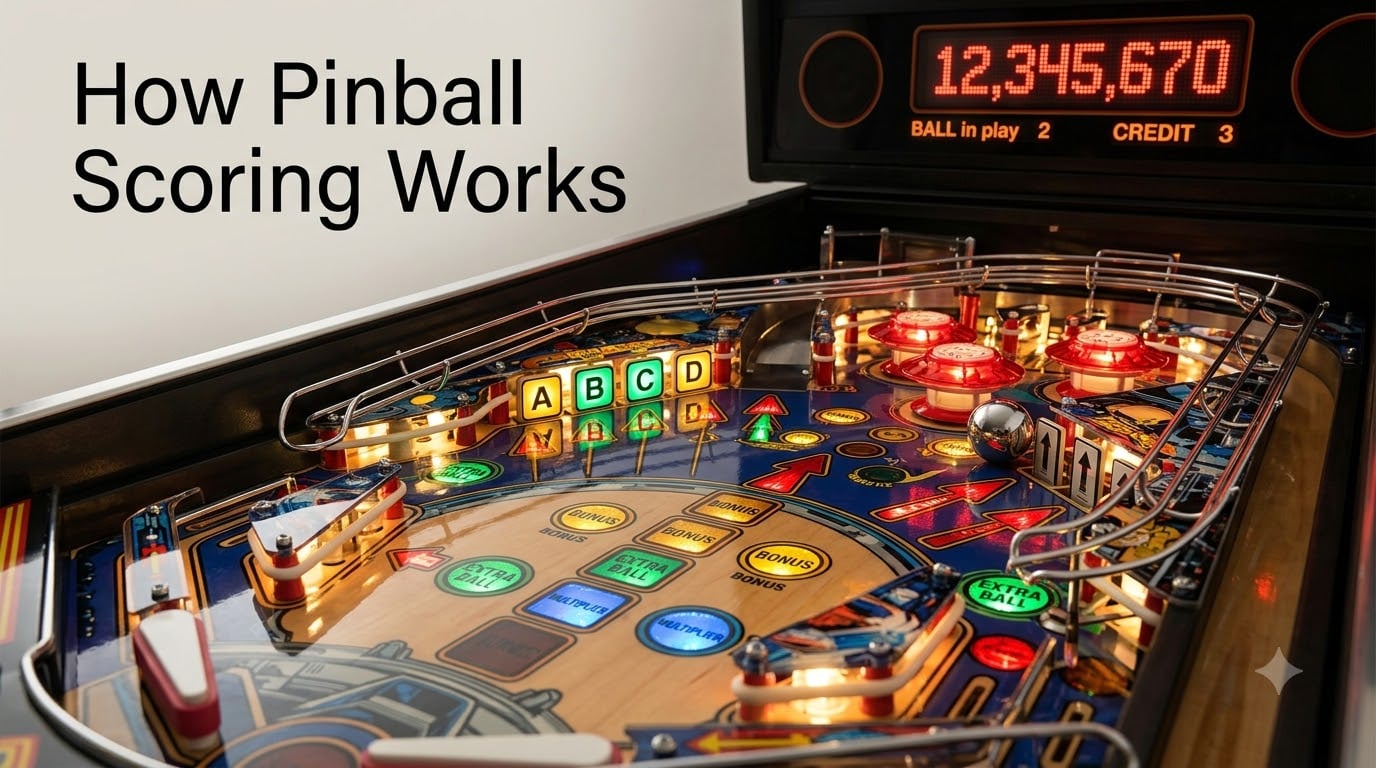
Pinball scoring works by awarding points every time the steel ball hits a target, bumper, or switch on the playfield, then layering on bigger rewards like bonus points, multipliers, jackpots, and mode completions. Unlike most games where the scoreboard tells you everything, pinball hides its best scoring opportunities behind rules you have to discover. That mystery is exactly what keeps players coming back for one more ball.
If you have ever watched a pinball score jump from a few thousand to several million in a single shot and wondered what just happened, you are not alone. The scoring system is the heart of the game, and understanding it is the difference between randomly flipping and actually playing with purpose. I have spent years on location machines and home cabinets, and the single biggest leap in my scores came from learning how the scoring actually fits together.
This guide breaks down how pinball scoring works from the ground up. We will cover the core scoring elements, how scoring has evolved across different eras of machines, how to read an unfamiliar game quickly, and the mistakes that quietly drain points from your games. Whether you are a total beginner or an intermediate player looking to push past a plateau, the goal is the same: know what the machine is actually rewarding you for.
Here is something to keep in mind as we get started. Pinball was banned in New York City from 1942 until 1976 because lawmakers believed it was a game of chance, not skill. The industry had to prove otherwise, and that history shaped how modern scoring rewards deliberate, repeatable shots over lucky bounces. Skill is baked into the scoring design itself.
Table of Contents
- How Pinball Scoring Works: The Foundation
- Core Scoring Elements Explained
- Multiball and Mode Stacking
- How Pinball Scoring Has Changed by Era?
- How to Read a Pinball Machine?
- Skill Shots: Free Points on Every Ball
- Tilt Mechanics and How They Affect Your Score
- Common Scoring Mistakes to Avoid
- How Operator Settings Change Scoring?
- FAQs
- Conclusion
How Pinball Scoring Works: The Foundation
Every point in pinball starts with a physical switch. When the ball rolls over a rollover lane, strikes a standup target, rings a slingshot, or hits a bumper, a switch closes underneath the playfield and the game registers points. On older electromechanical machines, those switch closures physically advance score reels. On solid-state and modern machines, a microcontroller reads the switch matrix and updates the digital display instantly.
The points from individual switches are usually small. A bumper hit might be worth 100 points. A target might award 1,000. Those small amounts add up during a ball, but they are not where big scores come from. The real scoring power comes from how the game stacks and multiplies those base points through bonus systems, mode objectives, and jackpot shots.
Here is the key concept that took me a while to internalize. Pinball scoring is layered. You earn base points for hitting things, you build a bonus throughout the ball, and then the game applies multipliers and jackpots on top of that accumulated total. A single well-timed shot during a high-multiplier mode can outscore an entire ball of casual flipping. That is why knowing the rules matters more than raw ball control when you are chasing high scores.
When the ball drains down the middle or outlanes, the game tallies your end-of-ball bonus. This bonus is based on what you accomplished during the ball, such as lighting lanes, completing target banks, or advancing modes. If you have a bonus multiplier active, the entire bonus gets multiplied before it is added to your score. Understanding this flow is the foundation for everything else.
Core Scoring Elements Explained
The biggest source of confusion for new players is the difference between bonus, bonus multipliers, and playfield or shot multipliers. These three terms sound similar but work in completely different ways. Let me break them down the way I wish someone had explained them to me.
Bonus: Points You Build During a Ball
Your bonus is a running total of points you collect throughout a single ball. Every time you advance a bonus-related feature, such as completing a set of drop targets or lighting all rollover lanes, you add to your bonus count. When the ball drains, the game awards that bonus as a lump sum on top of whatever you scored during live play.
On many machines, the bonus is shown as a numbered value on the display, often labeled something like “Bonus: 25,000.” That number keeps climbing as you play. The more bonus-building shots you make, the bigger the payout when the ball ends. A strong ball with a high bonus can match or exceed what you earned from live shots alone.
Bonus Multiplier: Making Your Bonus Bigger
A bonus multiplier takes that end-of-ball bonus and multiplies it. If your bonus is 25,000 points and you have a 3x bonus multiplier, you get 75,000 points added at ball drain. Most machines let you qualify for bonus multipliers by completing specific objectives, such as advancing the bonus multiplier lane or finishing a particular mode.
This is where the distinction matters. The bonus multiplier only affects your end-of-ball bonus total, not the points you earn from individual shots during play. Players who ignore the bonus multiplier are leaving thousands or tens of thousands of points on the table every single ball.
Playfield and Shot Multipliers: Real-Time Point Boosts
A playfield multiplier or shot multiplier works during live play, not at ball drain. When a playfield multiplier is active, every point you earn from every switch on the playfield gets multiplied in real time. A 2x playfield multiplier doubles everything. Some modern games stack multiple multipliers, so you could have a 2x shot multiplier and a 3x playfield multiplier running simultaneously.
This is where scores explode into the millions. If you can trigger a high playfield multiplier and then hit a valuable jackpot shot or complete a mode, the multiplied points stack up fast. The trick is knowing what triggers the multiplier and timing your big shots while it is active.
Jackpots: Big Single-Shot Payouts
Jackpots are large point awards tied to specific shots or objectives, most commonly associated with multiball modes. To score a jackpot, you typically need to qualify for multiball first, then hit the designated jackpot shot while multiple balls are in play. Jackpot values often increase each time you collect one during the same multiball, encouraging you to keep shooting for them.
Some machines feature super jackpots that only become available after collecting several regular jackpots. These can be worth enormous amounts and often require difficult combination shots. If you hear a machine announce “jackpot,” that is usually your cue that a high-value scoring opportunity just opened up.
Extra Balls: More Chances to Score
Extra balls are exactly what they sound like. The game awards you an additional ball beyond your standard allotment, usually for completing a specific objective or reaching a score threshold. That extra ball is a full additional opportunity to score, complete modes, and build bonus. On some machines, extra balls are the difference between an average game and a personal best.
Multiball and Mode Stacking
Multiball is typically the biggest single scoring opportunity in any pinball game. When you qualify for multiball, the machine releases two or more balls onto the playfield simultaneously. During multiball, jackpots become available, shot values often increase, and the chaos of multiple balls means more switch hits and more points.
To qualify for multiball, you usually need to complete a specific sequence of shots. This might mean locking balls by hitting certain targets, filling a progress meter, or completing a mode. Each machine handles this differently, which is why checking the rule sheet matters.
Mode stacking is an advanced concept that separates casual players from high scorers. On machines that allow it, you can start a second mode while the first one is still running. When two modes overlap, you earn rewards from both simultaneously. Some games even let you run a mode during multiball, combining mode scoring with jackpot multipliers for massive point totals.
Ball save is another feature tied closely to multiball. When ball save is active, the game returns any drained balls to the plunger without charging you a ball. Multiball almost always includes a ball save period to prevent the feature from ending immediately if one ball drains right away. Knowing when ball save is active lets you play more aggressively during high-scoring windows.
How Pinball Scoring Has Changed by Era?
Pinball scoring has evolved dramatically over the decades, and understanding the era of the machine you are playing helps set realistic score expectations. A good score on a 1970s electromechanical game looks completely different from a good score on a modern LCD title.
Electromechanical Era (Pre-1977)
Electromechanical, or EM, machines used physical score reels driven by stepper units and relay logic. Scores were typically in the hundreds or low thousands. A strong game might reach 10,000 to 50,000 points. The scoring was straightforward: hit targets for set values, build a bonus, and hope the multiplier kicked in at ball drain.
EM machines had no modes, no multiball in most cases, and limited bonus systems. What you saw was what you got. The skill was in ball control and shot accuracy, not in navigating complex rule sets. Many players love EM games for this purity.
Solid-State Era (1977 to Late 1980s)
The shift to solid-state electronics replaced relays with microprocessors. Digital displays replaced mechanical score reels, and scores began climbing into the hundreds of thousands and eventually millions. Sound effects, speech, and basic modes became possible. Games like Black Knight and High Speed introduced multiball and more complex scoring objectives.
Scores inflated during this period because digital displays made large numbers easy to show. A million-point game went from impossible to achievable on the right machine.
DMD Era (1990s to Mid-2000s)
The dot matrix display, or DMD, changed pinball scoring by showing animations, progress meters, and mode instructions directly on the backglass. Players could see exactly what they needed to do next. Games like The Addams Family, Twilight Zone, and Medieval Madness pushed scoring into the tens of millions and beyond.
This era introduced deep rule sets with multiple modes, wizard modes that required completing all other modes first, and complex stacking opportunities. Understanding the rules became essential for high scores.
Modern LCD Era (2010s to Present)
Today’s machines from manufacturers like Stern, Jersey Jack, and American Pinball feature full-color LCD screens with detailed instructions, real-time scoring feedback, and intricate rule sets designed by professional game designers. Scores routinely reach into the hundreds of millions or even billions on top titles.
Modern scoring emphasizes mode completion, multiball jackpots, and layered multipliers. The machines are designed to reward players who learn the rules deeply. If you walk up to a modern game without any idea what shots to prioritize, your score will reflect that. But spend ten minutes learning the rule sheet and your scores can double or triple.
The score inflation across eras is striking. What counted as a record-breaking score in 1975 might not even register as notable on a game released in 2026. The scoring systems evolved to match the technology, and that evolution continues as designers find new ways to layer rewards.
How to Read a Pinball Machine?
Walking up to an unfamiliar pinball machine can be intimidating, but there is a systematic way to figure out what it wants you to do. I use the same six-step process on every new machine I encounter, and it consistently helps me score higher within the first few games.
Step 1: Check the apron card. The apron is the metal plate at the bottom of the playfield near the flippers, and it usually holds a small instruction card. This card lists the basic objectives, how to start multiball, and what shots are worth the most. It is the fastest overview available.
Step 2: Look for flashing lights. Pinball machines communicate scoring priorities through lighting. Flashing arrows, lit inserts, and pulsing lights indicate which shots are currently active or valuable. Following the lights is a reliable strategy when you do not know the rules.
Step 3: Identify the multiball start sequence. Multiball is usually the biggest scoring opportunity, so figure out what shots start it. Look for lock inserts, which indicate where balls are stored before multiball begins, and shoot for those targets.
Step 4: Find the skill shot. Check the apron card or the display for skill shot instructions. The skill shot gives you free points on every ball if you execute the correct launch technique.
Step 5: Watch the display during play. On DMD and LCD machines, the display tells you what mode is running, what your next objective is, and how much time or progress remains. Glance at it between shots to stay oriented.
Step 6: Look up the rule sheet online. The Pinball Archive and community forums like Pinside host detailed rule sheets for nearly every machine ever made. Spending five minutes reading a rule sheet before playing can transform your score. These community-created resources are widely trusted and often more helpful than official manuals.
Skill Shots: Free Points on Every Ball
A skill shot is a bonus awarded for executing a precise ball launch instead of just sending the ball up the lane at full power. Every ball you plunge gives you a chance at a skill shot, which makes it one of the most consistent sources of free points in the game.
The exact skill shot varies by machine. On some games, you need to plunge the ball to a specific strength so it lands in a marked lane. On others, you plunge to a certain level and then make a controlled shot from the upper playfield. The apron card tells you what the skill shot requires.
Some modern machines feature a super skill shot, which is a more difficult version that pays significantly more. To attempt a super skill shot, you typically hold the flipper button during launch to bypass the normal ball path, then make a specific shot from an unusual angle. These are risky but rewarding, and experienced players learn which machines offer them.
The lesson here is simple. Never just slam the plunger and walk away. Taking a moment to execute the skill shot adds points to every single ball, and those points add up across a game.
Tilt Mechanics and How They Affect Your Score
Nudging the machine is a legitimate pinball skill, but every machine has a tilt mechanism that punishes excessive shaking. Understanding how tilt works protects your score and lets you use nudging strategically without losing balls.
Inside the cabinet, a pendulum mechanism called the tilt bob swings when the machine is moved. Minor nudges cause small swings that trigger tilt warnings, which are displayed or announced. When you get a tilt warning, ease off. The machine is telling you that one or two more significant nudges will trigger a full tilt.
If you tilt the machine, you lose the ball immediately and forfeit any bonus you would have earned at ball drain. That is a devastating penalty, especially on a ball where you have built a large bonus or activated multipliers. A tilt during multiball ends the entire multiball, costing you all remaining jackpots.
A slam tilt, triggered by very aggressive shaking or banging on the machine, can end your entire game on the spot. It is designed to detect abuse and cheating. No score is worth a slam tilt.
The skill is in controlled, small nudges. A gentle bump can redirect a ball heading for an outlane or help a bouncing ball settle toward a flipper. Experienced players nudge constantly but subtly, staying below the tilt threshold. The tilt bob can often be adjusted by operators, which is why the same machine feels different in different locations.
Common Scoring Mistakes to Avoid
After talking with players on r/pinball and Pinside, the same scoring mistakes come up over and over. Here are the ones that cost the most points.
Flipping at everything is the number one mistake new players make. When the ball is moving toward your flipper, the instinct is to flip immediately. But experienced players let the ball bounce off the flipper first, then trap it or direct it with a controlled shot. Random flipping sends the ball into slingshots and outlanes, which means drains instead of points.
Ignoring the bonus multiplier is another huge leak. If your machine has a way to increase the bonus multiplier, do it early. A 5x multiplier on a 30,000-point bonus means 150,000 points at ball drain, which can double your total score on a single ball.
Not learning the rule sheet is the mistake that caps your ceiling. Without knowing what shots trigger modes, multiball, and multipliers, you are playing randomly. Even a basic understanding of the top three objectives on a machine transforms your scoring.
Draining during multiball is heartbreaking and avoidable. When multiple balls are in play, do not panic-flip. Control the balls you can, trap one on a flipper if possible, and shoot for jackpots with the other. Multiball ends when you are down to one ball, so ball control during the chaos directly determines how many jackpots you collect.
Finally, neglecting the skill shot on every ball adds up. If your machine offers a 5,000-point skill shot and you play five balls, that is 25,000 free points you missed. Over many games, consistent skill shots add up to noticeable score improvements.
How Operator Settings Change Scoring?
Here is something almost no one talks about: the same pinball machine can score completely differently depending on how the operator configured it. Every modern machine has a settings menu that adjusts difficulty, ball count, and scoring-related features. This is a major source of confusion when players compare scores across different locations.
Ball count is the most obvious setting. Most machines default to three balls, but operators can set them to five. A five-ball game gives you more chances to score, which inflates your total compared to a three-ball game on the same machine. When someone tells you their high score, always ask how many balls they had.
Difficulty settings affect scoring indirectly by changing how forgiving the game is. An operator might set the outlanes wider, increase the tilt sensitivity, or reduce ball save duration. These settings do not change point values, but they make it harder to stay alive long enough to reach high-scoring modes and multiball.
Extra ball availability is another key setting. Some operators disable extra balls entirely or limit them. Since extra balls are full scoring opportunities, removing them significantly lowers achievable scores. A machine set to generous extra balls will produce higher top scores than one set to stingy.
If you play the same title at two different arcades and your scores are wildly different, operator settings are likely the reason. Tournament settings, which are standardized, provide the fairest comparison. For casual play, just be aware that location matters and adjust your expectations accordingly.
FAQs
What is a good score on pinball?
A good score depends on the era and title. On electromechanical machines, 20,000 to 50,000 is solid. On DMD-era games, aim for 10 to 50 million. On modern LCD titles, scores in the hundreds of millions indicate a strong game. Check the machine’s high score list to see what counts as good on that specific title.
What is the highest pinball score ever?
The highest verified pinball scores are in the billions on modern titles, with exact records varying by game and tournament settings. Score records are tracked per title since each machine scores differently. Competitive pinball organizations maintain official leaderboards for tournament play.
Is pinball skill or luck?
Pinball is primarily a game of skill. While the ball’s path involves some randomness, skilled players consistently score higher through flipper control, shot accuracy, rule knowledge, and strategic nudging. The 1976 New York City court case that lifted the pinball ban proved this by having expert players demonstrate called shots on demand.
What happens if you tilt a pinball machine?
When you tilt a pinball machine, you immediately lose the current ball and forfeit all end-of-ball bonus points. If the tilt occurs during multiball, the entire multiball ends. A slam tilt from aggressive abuse can end the entire game instantly.
How do bonus multipliers work in pinball?
A bonus multiplier increases your end-of-ball bonus by a set factor. If your accumulated bonus is 30,000 points and you have a 3x multiplier, you receive 90,000 bonus points at ball drain. The multiplier only applies to the bonus total, not to points earned from individual shots during play.
Conclusion
Understanding how pinball scoring works transforms the game from random flipping into deliberate play. The core system is simple at its base: switches award points, bonus accumulates during each ball, and multipliers plus jackpots stack on top to create big scores. Once you grasp how bonus differs from bonus multiplier differs from playfield multiplier, you start seeing scoring opportunities you used to walk right past.
The fastest way to improve is to spend five minutes reading the rule sheet for whatever machine you are about to play, execute the skill shot on every ball, and prioritize building your bonus multiplier early. Those three habits alone will push your scores higher than any flipper technique trick. Pinball rewards knowledge as much as reflexes, and now you have the foundation to put that knowledge to work.
1 thought on “How Pinball Scoring Works (September 2026)? Complete Guide”