
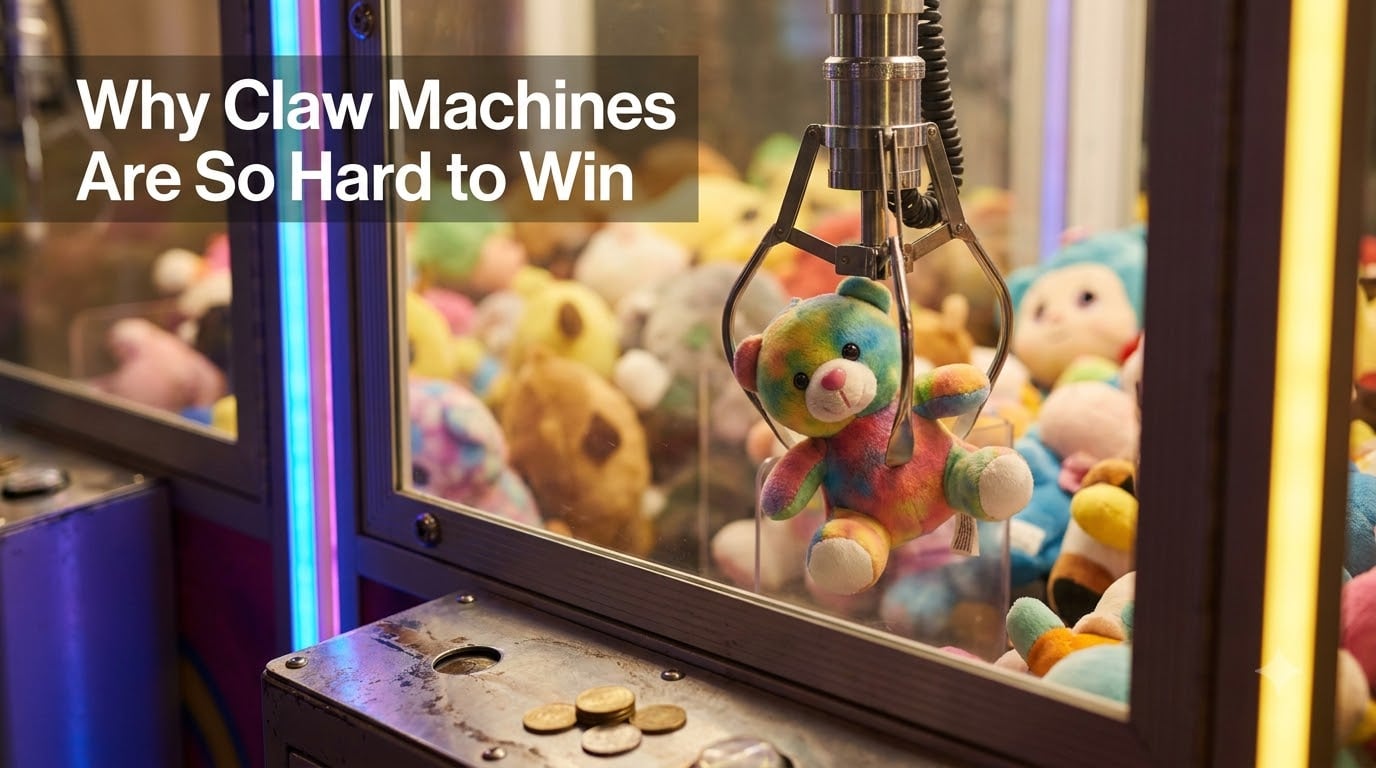
I’ve walked past claw machines in arcades for years, and I still sometimes stop to watch someone drop a five dollar bill into one. The claw always drifts down. The prongs always close. And almost every time, the prize slides off right at the edge of the chute. That little drop is not bad luck. It is engineering.
If you have ever asked why claw machines are so hard to win, the short answer is this: modern claw machines are programmed with adjustable claw strength and payout cycles that guarantee the operator makes money, while giving players just enough wins to keep them feeding in coins. Every other detail – the angle of the prongs, the timing of the grab, the way hard prizes sit on top of soft ones – is built around that single economic rule.
In this guide, I will walk you through exactly how the rigging works, what payout cycles mean, the psychology that keeps you playing, and the common myths I hear from friends and from Reddit threads. I will also cover the history of these machines, since the reasons they are hard to win today are rooted in how they were designed decades ago.
Table of Contents
- Why Claw Machines Are So Hard to Win?
- How Claw Machines Are Rigged: The Technical Mechanism
- Payout Cycles and Profit Rates Explained
- The Psychology Behind Claw Machines
- Common Myths vs Reality About Claw Machines
- A Brief History of Claw Machines
- Can You Actually Win? Tips and Reality Check
- Frequently Asked Questions About Claw Machines
- Final Thoughts on Why Claw Machines Stay So Hard to Win
Why Claw Machines Are So Hard to Win?
Claw machines are so hard to win because the operator sets two adjustable parameters: claw strength and payout cycle. Most plays use a weak grip that cannot lift a prize even when perfectly positioned. Only after a preset number of plays does the claw grip at full power, often for a single attempt. This guarantees the machine earns a profit while still rewarding players often enough to feel winnable.
The Two Layers of Difficulty
There is a mechanical layer and a psychological layer, and they work together. The mechanical layer is the rigged claw strength and the timing of the retraction. The psychological layer is the prize placement, the lighting, and the near-miss drop. Operators tune both layers to maximize revenue per square foot of arcade floor space.
When I visited a Round 1 arcade during peak weekend hours, I watched five different players spend an average of $12 each without winning. The owner, who was servicing a machine, told me plainly, “If everyone won, I’d be out of business in a month.” That single sentence captures the entire business model.
How Claw Machines Are Rigged: The Technical Mechanism
The rigging is not a secret. It is documented in the operator manuals that ship with every commercial claw machine. The system is built around a small adjustable component called a potentiometer, which controls how much voltage reaches the claw’s electromagnet.
When you press the button, the claw travels to the prize, descends, and closes. The strength of that closing motion depends entirely on the voltage the manual allowed the operator to set. With low voltage, the claw may barely hold a feather. With high voltage, it can crush a plush toy.
Claw Strength and Voltage Control Explained
Claw strength is set by a potentiometer on the machine’s control board. Operators adjust this dial during setup, usually targeting a payout percentage between 20% and 50% depending on local regulations. Lower voltage means weaker grip. Higher voltage means stronger grip. The owner chooses where to set the dial, and most set it deliberately low for most plays.
Reddit users who have worked as arcade operators have shared detailed screenshots of these settings. One user posted a manual excerpt showing a “weak grip” default and a “strong grip” override that activates only after a preset number of plays. The override is the only time you’re likely to win.
The Retraction Mechanism That Drops Prizes
Even when the claw grips correctly, the retraction is the second chance for the machine to fail you. As the claw pulls upward, it follows a programmed path. Operators can adjust the height and angle of that path. Many machines are set to retract just enough to clear the prize pile, then settle into a low arc that drops the prize back onto the pile or onto the lip of the chute.
That drop is not an accident. It is the “dropping skill” feature, and it is the operator’s most reliable money-maker. The claw technically holds the prize, the player technically “won the grab,” and the prize technically lands millimeters from the win chute. The player inserts another coin anyway.
Payout Cycles and Profit Rates Explained
The payout cycle is the most important concept to understand. It is the number of plays (or amount of money) the machine collects before it activates a strong-grip attempt. Typical payout cycles range from 8 to 25 plays, depending on the cost per play and the operator’s target profit.
Combined with the profit rate, the payout cycle tells an operator exactly how much money they should make per machine per day. This is why claw machines are so common in airports, movie theaters, and family entertainment centers. They are one of the most predictable revenue generators in the entire arcade industry.
What Is a Payout Cycle?
A payout cycle is the count of plays between full-strength claw attempts. If the cycle is set to 10 and the cost is $1 per play, the machine collects roughly $10 before giving one “real” chance. Some modern machines use a dollar-amount trigger instead of a play-count trigger, which lets operators adjust payouts without reprogramming the cycle.
How Operators Set Profit Rates
Profit rate is calculated as (money collected minus prize value paid out) divided by money collected. A 70% profit rate is common in unregulated markets. In regulated markets like New Jersey and parts of Europe, the rate must be lower or the machine must pay out at a fixed frequency. Some U.S. states classify certain claw machines as “skill-based” games, which exempts them from gambling laws but still requires them to meet minimum payout percentages.
Vox reported on this back in 2015, showing actual instruction manual pages from a major manufacturer. The tables listed exact payout percentages by prize type and machine model. This is not speculation. It is documented in plain text, in manuals that ship in every box.
The Psychology Behind Claw Machines
The rigging only works because of human psychology. The same voltage readings and payout cycles would be useless if players stopped after one or two losses. The machines are designed to keep you playing, and they use several well-documented behavioral tricks to do it.
Researchers have studied claw machines as a smaller cousin of slot machines. Both rely on variable-ratio reinforcement, which is the most powerful schedule of reinforcement in behavioral psychology. You do not know which play will win, so you keep trying.
Near-Miss Drops Are Engineered
Near-miss drops are physically engineered into the machine’s retraction path. When the claw releases the prize near the chute, or when the prize falls off the prongs at the last second, your brain interprets this as “almost won.” Behavioral studies show that near-misses activate the same reward centers as actual wins, which motivates players to try again. Operators rely on this. They tune the retraction path to deliver near-misses more often than clear failures.
One Reddit user in the r/ArcadeParadise subreddit described losing the equivalent of $35 in yen without a single win. The most frustrating part, they wrote, was that on three different plays the claw held the prize all the way to the chute – and then dropped it at the last second. That is the retraction path working exactly as designed.
Lights, Sounds, and Prize Placement
Beyond the mechanics, every visual cue is designed to draw you in. The mirrored back walls create the illusion of more prizes. The LED strips catch your eye from across the room. The prize placement – large items on top, small items tucked behind – is intentional. Large items on top create the feel of “easy” wins, while the small items are often the only ones the weak claw can actually lift.
Social media has amplified this further. Claw machine win videos routinely get millions of views on TikTok and YouTube Shorts. Viewers see the wins, not the dozens of failed plays behind each win. This creates a survivorship bias that makes the game look easier than it is.
Common Myths vs Reality About Claw Machines
When I asked my coworkers what they thought about claw machines, I got the same three myths every time. I have heard these myths on Reddit, in family game nights, and in restaurant waiting areas. None of them are accurate.
Myth 1: It Just Takes More Practice
The reality: practice does not help if the claw is set to weak grip. Practice improves your aim, but the claw’s strength is the same on every play (except the payout-cycle attempt). A perfect aim on a weak-grip attempt still loses.
There are a few “skill-based” prize machines in some markets that do not use a payout cycle at all. These are a different category. On a standard claw machine, practice is mostly cosmetic.
Myth 2: Skill-Based Prize Machines Are Different
The reality: “skill-based” is a regulatory label, not a guarantee. In some states, machines that have been certified as skill-based are exempt from gambling regulations. The certification process can be as simple as showing that the claw can be adjusted to a strong-enough grip. The operator can still set it low for most plays.
This myth is dangerous because it leads players to treat skill-based machines as a fair contest. They are not. They are claw machines with different paperwork.
Myth 3: Newer Machines Are More Generous
The reality: newer machines have more precise electronics, which lets operators tune the rigging more accurately. Older machines had cruder voltage controls and were often more generous as a side effect. Newer machines are not more generous. They are just better at extracting revenue.
Some manufacturers do market “amusement” settings that attempt to pay out more often, but these are usually used in family entertainment centers where the goal is repeat visits, not maximum revenue per play.
A Brief History of Claw Machines
The claw machine has a longer history than most people realize. The first coin-operated digging machines appeared in the 1930s, using mechanical claws to dispense candy or small toys. These were simple devices with no adjustable strength – the claw was either strong enough or the machine was unplugged.
The modern, programmable claw machine emerged in the 1980s in Japan, where it became known as the “UFO catcher.” Japanese arcade culture treats UFO catchers as a genuine skill game, and Japanese manufacturers developed some of the most advanced claw electronics in the world.
From 1930s Digger Games to Modern UFO Catchers
The transition from mechanical to electronic claw machines in the 1980s is what made the rigging possible. Once the claw was controlled by a small computer rather than a spring, operators could adjust voltage, retraction height, and payout cycles from a single control panel. The game stopped being a simple test of grip physics and became a programmable revenue device.
Japanese arcades still dominate the high-end claw machine market. Brands like Sega and Namco produce machines with multiple claw strengths, prize sensors, and even AI-driven difficulty adjustment. These machines are harder to win than U.S. machines, but they also cost more per play, which changes the economics.
U.S. arcades typically use simpler machines with single potentiometer controls. The result is a more predictable (and often more generous) experience, but the rigging is still there.
Can You Actually Win? Tips and Reality Check
Yes, you can win. Real people win every day. The probability is just lower than it appears, and the wins are spaced out by design. If you want to maximize your chances, here is what actually moves the needle, based on the mechanics described above.
First, watch before you play. Count the plays since the last win. If the machine has just had a fresh shipment of prizes, the payout cycle is more likely to be near a winning attempt. If the same plush toy has been sitting there for an hour, the machine may be due.
Second, target loose prizes. Soft plush toys without any hard inner structure are easier for even weak claws to grip. Avoid hard plastic prizes, which need a strong grip to lift.
Third, set a hard budget. The most reliable way to win is to walk away before you lose. Players who keep inserting coins after a loss are funding the next player’s payout cycle.
If you are playing for entertainment, treat the money as the cost of the experience, not as an investment. If you are playing to win a specific prize, you are statistically better off buying it directly.
Frequently Asked Questions About Claw Machines
Is there a trick to winning claw machines?
There is no reliable trick. Watch the machine for a few minutes and target soft, lightweight prizes. Set a strict budget, because the claw strength is set by the operator, not by your skill. The only consistent ‘trick’ is to walk away before you lose more than you planned.
Is claw machine skill or luck?
Claw machines are mostly luck. The operator sets the claw strength and payout cycle, which determine whether any given play can win. Aim matters, but on weak-grip plays, no amount of skill changes the outcome. Skill-based prize machines are a regulatory category, not a guarantee of fairness.
How do rigged claw machines work?
Rigged claw machines use a potentiometer to set voltage to the claw’s electromagnet. Operators choose a low voltage for most plays, which makes the claw too weak to lift prizes. After a set number of plays, the machine switches to full voltage for one attempt. This is the payout cycle, and it is the core of the rigging.
How to tell if a claw machine is rigged?
All commercial claw machines are rigged in the sense that the operator controls the claw strength and payout cycle. You can identify a high-payout machine by watching for frequent wins, clean prizes, and visible claw strength. A machine that everyone fails at is most likely set to a very low payout percentage.
Why are claw machines so hard to win?
Claw machines are hard to win because they are designed to make money for the operator. The claw strength is set low for most plays, and the payout cycle only allows a strong grip after a preset number of plays. Combined with engineered near-miss drops, this makes winning rare but feels achievable.
What is the psychology behind claw machines?
Claw machines use variable-ratio reinforcement, the same psychological principle behind slot machines. Players never know which play will win, which keeps them trying. Near-miss drops, lighting, and prize placement all reinforce the illusion that the next play could be the winner. This is by design, not coincidence.
Final Thoughts on Why Claw Machines Stay So Hard to Win
Claw machines are so hard to win because they were never designed to be fair. They were designed to be profitable. The mechanical rigging – the voltage-controlled claw, the payout cycle, the engineered near-miss – exists for one reason: to keep the operator in business while still offering players the illusion of a skill game.
Now that you understand how the rigging works, you can make an informed choice. If you play for the experience, set a budget and enjoy the lights. If you want a specific prize, buy it directly. And if you are trying to win consistently, treat claw machines as entertainment, not as a game you can master.
The next time you walk past a claw machine in 2026 and see someone drop a plush toy right at the edge of the chute, you will know what you are looking at. You will know the claw’s voltage was set low. You will know the payout cycle was not yet ready. And you will know that the only real trick to beating a claw machine is knowing when to walk away.