
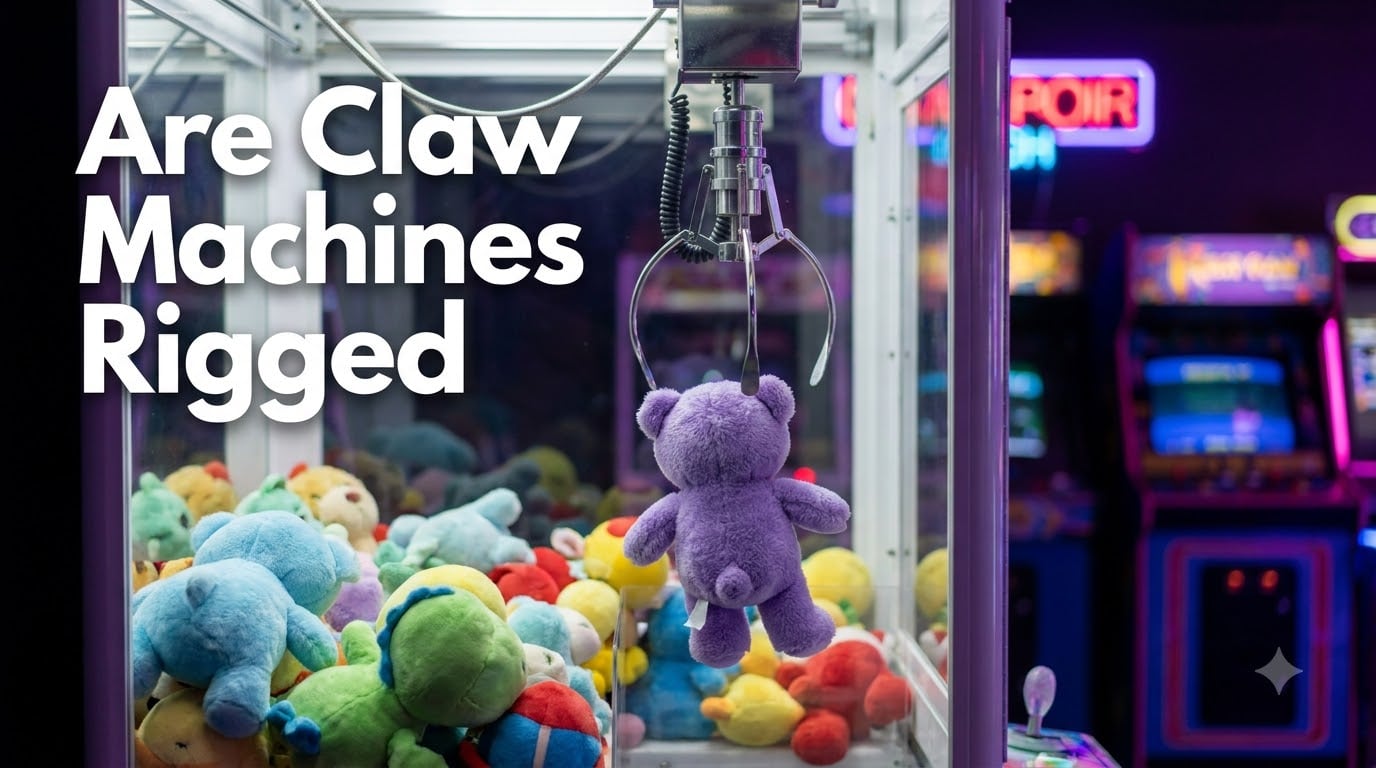
Yes, most claw machines are rigged – but not in the illegal sense you might expect. They are legally programmed with adjustable grip strength and built-in payout rates that decide exactly when you win and when you lose.
I’ve spent years around arcade machines, and I have read countless operator AMAs and forum threads on this exact topic. In this guide, I will walk you through the actual mechanics, the laws that allow this to happen, and the few signs that tell you whether a particular machine is worth your quarter.
Table of Contents
- Are Claw Machines Rigged? The Direct Answer
- How Claw Machines Really Work: Programming and Mechanics
- Understanding the Payout System
- The Near-Win Illusion: Why You Almost Win Every Time
- Signs of a Rigged Claw Machine
- How to Spot a Winnable Claw Machine
- Are Claw Machines Gambling? The Legal Perspective
- Operator Insider Perspective: Why the Rigging Exists
- FAQs
- Final Thoughts on Whether Claw Machines Are Rigged
Are Claw Machines Rigged? The Direct Answer
Yes, claw machines are rigged by design. Modern arcade claw machines contain a small computer board that controls the voltage sent to the claw’s gripper on every single play.
Most plays are set to a weak grip that physically cannot lift the prize out of the machine, even if you line the claw up perfectly. A small percentage of plays are set to a strong grip that lets you win. Operators choose how often those strong-grip plays happen, usually through a setting called the payout rate.
This is why your perfectly lined-up grab can fail while the kid next to you seems to win on their first try. It is not luck. It is the machine doing exactly what it was told to do.
How Claw Machines Really Work: Programming and Mechanics
The mechanical side of a claw machine is simple: a three- or four-pronged claw rides on a track, drops down on a prize, and either grips it or lets it slip. The interesting part is the grip itself.
Every modern claw machine has a microcontroller that sends a specific voltage to the claw’s solenoid on each grab. That voltage decides how hard the fingers close. Operators can dial this up or down using a hidden menu inside the cabinet, often accessed with a button sequence or a service key.
According to an arcade owner who did an AMA on Reddit and was later quoted by Kotaku, normal plays are typically set to 4 to 6 PSI, which is far too weak to lift a plush toy cleanly. Payout plays are set to 9 to 11 PSI, which gives the claw enough bite to actually pull a prize out.
Because the voltage is controlled per-play, even two attempts in a row with perfect positioning can give completely different results. One is a near-miss. The other is your prize.
PSI and Grip Strength Explained
PSI stands for pounds per square inch, and in this context it measures how tightly the claw’s fingers close on the prize. Higher PSI means a stronger squeeze, which usually means the prize comes out of the bin.
The gap between a losing PSI and a winning PSI is the entire business model. Operators set weak enough values that you almost always lose on normal plays, but strong enough that the rare winning grab still feels earned.
Understanding the Payout System
Every claw machine has a payout cycle. This is the ratio of losing plays to winning plays the machine will run before triggering a strong-grip grab.
In the United States, two states regulate this directly:
California: requires a minimum payout of 1 win for every 12 plays.
Nevada: requires a minimum payout of 1 win for every 15 plays.
Outside those states, operators can set the payout rate to whatever they want, as long as local law allows it. Many operators set payout rates much higher than the legal minimum, sometimes 1 in 25 or 1 in 30, because the prizes are cheap and the margin is huge.
This is why “payout” and “rigged” are not the same thing. A machine can be rigged to be difficult while still meeting the legal minimum for paying out. That is exactly how the system is designed to work.
The Near-Win Illusion: Why You Almost Win Every Time
If you have ever had the claw grab a prize, lift it halfway, then drop it right at the chute, you have experienced the near-win illusion.
This is not an accident. Claw machines are programmed so that weak-grip plays often look like close calls. The claw grabs, lifts a few inches, then loses grip at a height that makes you feel like you were one twitch away from winning.
Behavioral researchers call this the near-miss effect. It tricks the brain into thinking a win is close, which keeps players inserting coins. Combined with occasional visible wins from other players, it creates the feeling that a jackpot is just around the corner.
In reality, the near-win is engineered. The same machine can hand out ten near-misses in a row, then a clean win, then another ten near-misses. The randomness only exists within the boundaries the operator set.
Signs of a Rigged Claw Machine
Most claw machines you walk up to in the wild are going to be rigged to some degree. Here are the red flags that suggest the rigging is aggressive:
Prizes piled high with no gaps: a tight stack usually means weak grip settings, because prizes support each other and are hard to dislodge.
Long strings of losses from skilled players: if experienced players cannot win in 10 or more tries, the payout is set very low.
Prizes near the chute that never get pulled: this often signals a machine with an extreme weak grip on normal plays.
Recent refills with no winners: operators sometimes reset the payout cycle when they refill the bin.
No visible prize turnover over weeks: if the same toys sit in the same positions for a long time, the machine is likely set to a very low payout.
How to Spot a Winnable Claw Machine
Winnable machines do exist. They are just rarer than people think. Here is what I look for before I put a coin in:
Loose, messy prize stacks: loosely piled prizes are easier for the claw to grab than tightly packed ones.
A prize sticking out or balanced on top: these can be lifted cleanly without much grip.
Plush toys that are light and small: heavier, denser prizes take more grip to lift, so avoid them when you can.
Machines with visible wear around the prize chute: a worn chute often means prizes have actually been moving through it, which suggests real wins.
Recent activity from other players: if people are winning or have just won, the payout cycle may be in a strong-grip phase.
I have personally had my best luck on machines where one prize is clearly separated from the rest. That single isolated toy is often the difference between a failed grab and a clean win.
Are Claw Machines Gambling? The Legal Perspective
Whether a claw machine counts as gambling depends on where you are. In some jurisdictions, claw machines are explicitly classified as gambling devices because the outcome is partly chance. In others, they are considered skill-based games as long as the player can influence the claw’s position.
Several U.S. states have set minimum payout rates to keep claw machines on the right side of gambling laws. This is the entire reason payout rates exist. They are a legal compromise: operators get to program the difficulty, and the state gets to ensure players actually win sometimes.
Outside the United States, regulations vary widely. In some Asian markets, claw machines are reported to be less aggressively rigged than U.S. versions, with higher payout rates and easier prize arrangements. In other regions, similar payout cycles apply but with different numbers.
The short version is this: if a claw machine in your area is licensed and meets local payout rules, it is legal, even if it feels rigged.
Operator Insider Perspective: Why the Rigging Exists
It is easy to assume claw machine operators are being greedy, but the math behind the machines tells a more nuanced story.
According to operators quoted in industry forums and AMAs, a typical plush prize costs between $0.25 and $0.50 wholesale. Plays usually cost $0.50 to $1.00. With a payout rate of 1 in 12, the operator takes in roughly $6 to $12 for every prize worth under a dollar.
That margin pays for rent, electricity, repairs, employee time, and profit. Without variable grip settings, operators argue, they would have to raise prices to $5 or $10 per play, which would drive customers away entirely.
So the rigging is not just about profit. It is also about keeping the price per play low enough that casual players still find the machines appealing. The catch is that “low price” and “fair odds” rarely coexist in this industry.
FAQs
Is there a cheat for claw machines?
There is no reliable cheat. Some players swear by aiming for loosely piled or isolated prizes, or by machines with visible recent wins. Beyond that, outcomes are controlled by the operator’s payout setting, not by player skill alone.
Do people actually win claw machines?
Yes. Payout rates of 1 in 12 or 1 in 15 mean that for every 12 or 15 plays, the machine is programmed to give out a winning grab. Real people win real prizes every day, especially in arcades with fair payout settings.
How to tell if a claw machine is winnable?
Look for loose prize stacks, prizes sitting on top of the pile, light or small plush toys, and signs of recent wins like a worn chute or activity from other players. A messy bin is usually a more winnable bin.
How to tell if a claw machine is rigged?
Claw machines are almost always rigged to some degree. Signs of aggressive rigging include tightly packed prizes, long streaks of losses from skilled players, and prizes that stay in the same position for weeks with no turnover.
Are claw machines gambling?
It depends on the jurisdiction. Some U.S. states regulate claw machines with minimum payout rates so they can be classified as skill-based games rather than gambling devices. In other regions, they may be classified differently.
Final Thoughts on Whether Claw Machines Are Rigged
So, are claw machines rigged? Yes – they are programmed with variable grip strength and set payout cycles that determine when you win and when you lose. That programming is legal in most places, as long as the operator meets minimum payout requirements.
If you still enjoy playing them, that is fine. Just treat the money as the price of entertainment rather than a deposit toward a prize, and aim for the loose, light, isolated toys when you do play.