
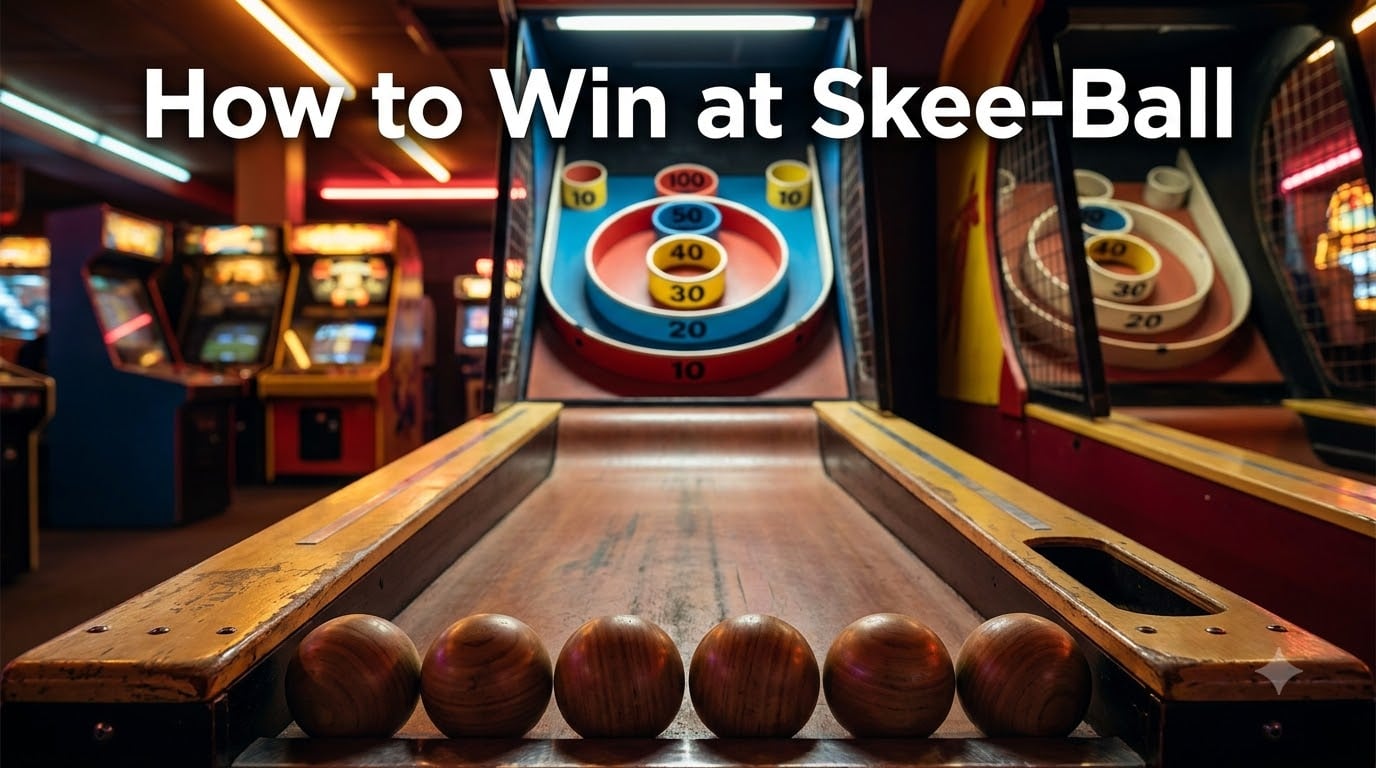
If you have ever stood at the end of a Skee-Ball lane watching your ball bounce off the rim of the 100-point hole and drop into the 10-point gutter, you already know this game can be deeply frustrating. Learning how to win at Skee-Ball is not about luck or raw arm strength. It is about technique, consistency, and understanding the physics behind every roll.
I have spent years rolling thousands of balls down arcade lanes, testing different stances, and talking to national-level competitors about what actually moves your average score from mediocre to impressive. The truth is that almost everyone gets the basics wrong because the obvious approach, aiming for the big 100-point corners, is a trap that keeps your score low.
In this guide, I will walk you through the complete system for winning at Skee-Ball. You will learn how scoring works, how to set your stance, how to control your power, and why the 40-point pocket is the single most important target on the board. I will also cover common mistakes that quietly kill your score, how to read different lane types, and what scores you should realistically aim for at each skill level.
Whether you are trying to rack up tickets at Dave and Buster’s, dominate on date night, or gear up for a local tournament, these strategies will give you a serious edge the next time you step up to the lane.
Table of Contents
- How Skee-Ball Works: The Basics
- Understanding Skee-Ball Scoring and Pocket Values
- How to Win at Skee-Ball: The Core Technique
- Aiming Strategy: Why the 40-Point Pocket Is King
- The Physics of the Ball-Hop: What No Competitor Explains
- Reading the Lane: 10-Foot vs 13-Foot Differences
- The Bank Shot: How to Hit 100-Point Corners
- Practice Drills to Build Muscle Memory
- Common Skee-Ball Mistakes and How to Fix Them
- Score Targets by Skill Level
- Tips for Playing Under Pressure
- FAQs
- Conclusion
How Skee-Ball Works: The Basics
Skee-Ball is a classic arcade rolling game invented in 1909 by Joseph Fourestier Simpson. The concept is simple. You stand at the bottom of an inclined wooden lane and roll nine balls, one at a time, up the ramp toward a target board filled with concentric scoring rings. The ball travels up the lane, hits a raised lip called the ball-hop at the top, launches into the air briefly, and drops into one of the scoring holes.
Each game uses a frame of nine balls. Your total score for the frame is the sum of whatever pockets you hit. The highest single-frame score possible is 900 points, which means landing all nine balls in the 100-point corner pockets. That is incredibly rare even for professionals.
The scoring target sits at the top of the lane and has a specific layout. The two top corners contain the 100-point holes. Below those, moving inward, you find a 50-point pocket in the upper center, flanked by 40-point holes, then 30-point, 20-point, and a wide 10-point gutter across the bottom. The exact layout can vary slightly between machines, but the principle is the same on every lane.
What makes Skee-Ball deceptively difficult is that the ball must travel up a ramp, hit the ball-hop, and land in a hole that is only a few inches wide. There is no straightforward rolling path to the high-value pockets. The ball spends part of its journey in the air, which means trajectory, speed, and release angle all matter more than how hard you throw.
This is why you see grown adults who can throw a baseball with precision completely fall apart at Skee-Ball. The skill set is completely different from throwing. It is closer to bowling or even a pendulum motion than anything involving a throw.
Understanding Skee-Ball Scoring and Pocket Values
Skee-Ball scoring is straightforward once you see the values laid out. Every pocket on the board has a fixed point value, and your job is to maximize the total across all nine balls in a frame. Let me break down the exact values and what they mean for your strategy.
Here is a complete reference table showing every pocket, its value, and the maximum possible score if you hit that pocket with all nine balls:
| Pocket Position | Point Value | Maximum (9 Balls) |
|---|---|---|
| Top corners (2 holes) | 100 | 900 |
| Upper center | 50 | 450 |
| Upper sides (2 holes) | 40 | 360 |
| Middle ring | 30 | 270 |
| Lower ring | 20 | 180 |
| Bottom gutter | 10 | 90 |
Notice something important in those numbers. Hitting the 40-point pocket with all nine balls gives you 360 points. That specific achievement is called a full circle, and it is a recognized milestone in the Skee-Ball community. A full circle means you hit the 40-point hole with every single ball in the frame.
A common question I get is what constitutes a good Skee-Ball score. The honest answer is that it depends on where you are playing and what level you are at. For casual players at a standard arcade, scoring between 150 and 200 points per frame is typical. Breaking 250 consistently puts you above most recreational players. If you can score 360, meaning a perfect full circle of 40s, you are playing at a strong intermediate level.
Tournament-level players and national champions routinely score between 400 and 600 points per frame, with the very best pushing toward the 700s and occasionally higher. The scoring ceiling is 900, but reaching it requires landing every ball in a 100-point corner, which is extraordinarily difficult even for the best players in the world.
The key takeaway from the scoring table is this: the jump from 10 to 40 points is massive, and it comes from pockets that are far more forgiving than the 100-point corners. This is the mathematical foundation for everything I will cover in the aiming strategy section.
How to Win at Skee-Ball: The Core Technique
Winning at Skee-Ball comes down to a repeatable system built on three pillars: a consistent stance, a smooth underhand roll, and controlled power. Most players fail because they treat each ball as an independent throw rather than building a repeatable motion they can reproduce nine times in a row.
National champion Joey “The Cat” Mucha and other top competitors all emphasize the same thing. Consistency beats power. A smooth, repeatable roll into the 40-point pocket nine times in a row will outscore a powerful throw that sometimes hits 100 but usually lands in the 10-point gutter.
Here is the step-by-step system I will cover in detail. I am laying it out here so you can see the full picture before we dig into each component:
Set your stance with feet shoulder-width apart and your body low
Grip the ball lightly and roll underhand with a pendulum motion
Release at the bottom of the swing arc, not on the way up
Calibrate your power to the specific lane you are playing
Aim for the 40-point pocket as your default target
Avoid the temptation to chase 100-point corners unless you have mastered the bank shot
Repeat the exact same motion for all nine balls
This system is simple to describe but takes practice to execute. The good news is that once your body learns the motion, it becomes automatic. Let me break down each step.
Step 1: Set Your Stance
Your stance is the foundation of every roll. If your body is not positioned correctly, no amount of aiming or power adjustment will save you. The most common mistake I see at arcades is players standing tall and hunched over the ball return, then trying to throw upward.
Start by standing with your feet about shoulder-width apart. If you are right-handed, your left foot should be slightly forward, closest to the lane. Lefties should reverse this. This staggered stance gives you balance and lets your dominant arm swing freely along the lane’s center line.
Bend your knees slightly and lower your center of gravity. Every top player I have studied stays low at the lane. Stars and Strikes, an arcade chain that has written about Skee-Ball technique, puts it bluntly: stay low. A low stance lets your arm swing naturally in a pendulum motion rather than requiring you to muscle the ball upward.
Keep your back straight but tilted slightly forward. You want your chest over the front of the lane, your eyes looking down the ramp toward the target. Your throwing arm should hang relaxed at your side, ready to swing back and forth like a pendulum.
One thing that helps is to pick a spot on the lane about two feet in front of you and aim your release point there. Do not look at the target holes while you are winding up. Look at your release spot, let the ball go, and trust that your calibrated power will carry it to the right pocket.
Step 2: Master the Underhand Roll
The roll is where most beginners go wrong because it feels unnatural at first. You are not throwing the ball. You are rolling it underhand with a smooth, controlled motion. Think of it like a softball pitch or a bowling release, not a baseball throw.
Grip the ball lightly with your fingers spread across the surface. You do not need to squeeze it. A tight grip creates tension, and tension creates inconsistency. Hold it just firmly enough that it will not slip out of your hand during the backswing.
Start your motion by swinging your arm straight back behind you. Keep your arm straight the entire time. This is a pendulum, not a windmill. Your elbow should not bend during the swing. Then bring your arm forward in one smooth, continuous motion and release the ball at the lowest point of the arc, right as your hand passes over the lane surface.
The release point is critical. If you release too early, the ball pops up and hits the ball-hop too hard, usually sending it flying past the target. If you release too late, the ball bounces off the lane surface and loses energy. The ideal release happens at the bottom of the swing, with your hand low and your fingers pointing toward the floor as the ball leaves your grip.
One Reddit user who goes by the handle skeeball champion put it well. They said you want the ball to roll smoothly off your hand, not bounce hard on the lane. That smooth release is what separates consistent scorers from everyone else.
Avoid flicking your wrist at the end of the roll. Wrist flicks add spin, and spin is the enemy of accuracy in Skee-Ball. A ball with spin curves off its intended path and becomes unpredictable. Professional players specifically warn against adding spin. The Mental Floss guide, which interviewed multiple national champions, makes this point explicitly: spin is not in.
Follow through after the release. Your arm should continue upward naturally after the ball leaves your hand, just like a bowler’s arm follows through after releasing the ball. This follow-through keeps your motion smooth and prevents you from cutting the roll short.
Step 3: Find Your Power
Power control is the variable that separates good players from great ones. Every lane has a sweet spot, a specific amount of force that sends the ball cleanly into the 40-point pocket. Too little power and the ball stalls before the hop, landing in the low-value pockets. Too much power and the ball rockets off the hop and flies over the target entirely.
The challenge is that the sweet spot is different on every machine. Lane length, ball material, ramp condition, and ball-hop angle all affect how much power you need. This is why the official Skee-Ball brand guide advises players to find their power on each new lane before trying to score seriously.
Here is my approach to calibrating power on a new machine. Take your first two or three balls as calibration shots. Roll at what feels like a medium effort and watch where the ball lands. If it comes up short, add a little power. If it sails over the target, pull back. Within three or four balls, you should have a feel for the right amount of force.
Less is almost always more in Skee-Ball. The Mental Floss article on professional Skee-Ball tips emphasizes this point, noting that many players over-power their rolls. A smooth, moderate roll into the 40-point pocket is worth far more over nine balls than a hard throw that sometimes hits 100 but usually misses badly.
Once you find your power, lock it in. Your goal is to reproduce that exact same force for every remaining ball in the frame. This is harder than it sounds because your body naturally wants to adjust after each shot, especially after a miss. Resist that urge. If your calibration is correct, trust it and repeat the motion.
Aiming Strategy: Why the 40-Point Pocket Is King
If you take only one thing from this entire guide, let it be this: stop aiming for the 100-point corners. The single most effective strategy in Skee-Ball is to aim consistently for the 40-point pocket. This is the advice given by the official Skee-Ball brand, by national champions, and by every coach I have spoken with.
The reasoning comes down to simple math and risk assessment. The 100-point corner holes are tiny, positioned at the extreme edges of the target, and require a nearly perfect roll to land. If you miss, and you will miss often, the ball almost always drops into the 10-point gutter or bounces back into the 20-point zone. The risk-to-reward ratio is terrible for anyone who has not mastered the bank shot.
Now look at the 40-point pocket. It sits in the upper-middle area of the target, is significantly larger than the 100-point corners, and sits in a zone where even a slightly off-target roll still lands in a decent scoring area. If you miss the 40 and drift slightly, you still might land in the 30 or 50 zones. The downside of a miss is minimal.
Hitting the 40-point pocket with all nine balls gives you 360 points. That is a full circle, a respected achievement that puts you well above the average casual player. Most people walking into an arcade will never hit 360 in a frame. If you can do it consistently, you are already winning.
The official Skee-Ball website recommends aiming for the back of the 40 pocket rather than the front edge. This gives you a small margin of error. If the ball drifts, it has room to still land inside the pocket rather than falling short into the 30 zone.
This does not mean the 100-point corners are worthless. Once you have mastered the 40-pocket strategy and can hit it reliably, adding the bank shot for corners becomes a way to push your score higher. But for the vast majority of players, the 40-pocket strategy is the fastest path to consistently high scores.
The beauty of this approach is its simplicity. You pick one target, you calibrate your power to hit it, and you repeat. No guessing, no switching targets after every ball, no chasing a corner hole that you hit once by accident. Consistency compounds, and the 40-point pocket rewards consistency more than any other target on the board.
The Physics of the Ball-Hop: What No Competitor Explains
Every Skee-Ball guide I have read mentions the ball-hop, but none of them actually explain what it does or why understanding it changes how you play. I want to fix that because the physics of the ball-hop is the hidden variable that makes Skee-Ball so tricky.
The ball-hop is the raised lip at the top of the lane, right before the target board. When your ball reaches the end of the inclined ramp, it hits this lip and is launched upward into the air. For a brief moment, usually a fraction of a second, the ball is airborne. Then gravity pulls it back down and it drops into one of the scoring holes.
This airborne phase is the entire reason Skee-Ball is difficult. If the ball simply rolled into the target, you could aim like a bowling lane and hit any pocket you wanted. But because the ball launches off the hop, its trajectory becomes a short parabolic arc. The ball’s speed, angle at the hop, and spin all determine where it lands.
Here is what happens physically. A ball traveling too fast hits the hop with excessive force and launches at a steeper angle, traveling higher and farther. It typically overshoots the target and bounces off the back wall or flies into the 10-point gutter. A ball traveling too slowly does not have enough momentum to clear the hop cleanly, and it stalls into the lower pockets.
The ideal speed produces a flat trajectory off the hop. You want the ball to barely become airborne, maintaining most of its forward momentum while spending as little time in the air as possible. This flat trajectory is what lets the ball drop into the 40-point or 50-point zone reliably.
Spin interacts with the hop in a nasty way. A ball with backspin or sidespin will change direction when it hits the lip, often unpredictably. This is another reason why a clean, spin-free release is so important. The hop punishes spin by redirecting your ball away from where you aimed.
Ball material also affects the hop. Wooden balls, which you find on older or classic machines, grip the hop differently than the lighter plastic balls on modern arcade lanes. Wooden balls tend to have a more predictable hop because they do not bounce as much off the lip. Plastic balls can skid or bounce depending on the lane surface condition.
Once you understand the ball-hop as a launch ramp rather than a gentle transition, everything about power control and release technique starts to make sense. You are not rolling a ball toward a target. You are calibrating a launch to drop the ball into a specific zone after a brief flight.
Reading the Lane: 10-Foot vs 13-Foot Differences
Not all Skee-Ball lanes are the same length, and this detail catches players off guard when they switch machines. The two standard lane lengths are 10 feet and 13 feet. The difference might not sound like much, but it completely changes how much power you need and how the ball behaves off the hop.
Here is a comparison of the two lane types:
| Feature | 10-Foot Lane | 13-Foot Lane |
|---|---|---|
| Standard length | Shorter, common in modern arcades | Longer, traditional and tournament standard |
| Power needed | Less force required | More force required to reach the hop |
| Ball-hop behavior | Ball reaches hop faster, flatter arc | Ball loses energy on the ramp, needs cleaner roll |
| Forgiveness | More forgiving of power variation | Less forgiving, demands precise calibration |
| Common locations | Dave and Buster’s, modern arcades | Tournaments, classic venues, home alleys |
National champion Elan “Skee-Ball Kid” Footerman made this point in an interview with Mental Floss. He said every lane has its own idiosyncrasies and you have to feel it out. This is not a platitude. It is practical advice. When you walk up to a new machine, take a moment to gauge the lane length and condition before you start rolling seriously.
A 13-foot lane requires more power to get the ball up the ramp and over the hop. If you are used to playing on a 10-foot machine at Dave and Buster’s and then switch to a 13-foot lane at a different venue, your calibrated power will fall short. The ball will stall before the hop and land in the 10 or 20 zones.
The reverse is also true. If you are used to a longer lane and switch to a shorter one, your usual power will send the ball flying off the hop and overshooting the target. Always recalibrate when you change machines.
Lane surface condition matters too. A worn, smooth lane lets the ball slide more freely, which can cause it to pick up speed too early. A newer or rougher surface creates more friction and slows the ball down. Some lanes have visible wear patterns from years of play, and these grooves can subtly guide or deflect your ball if you do not account for them.
The takeaway is to never assume a new lane will behave like the one you practiced on. Spend your first few balls learning the machine. It is not wasted effort, it is the single most important investment you can make in your score for that frame.
The Bank Shot: How to Hit 100-Point Corners
The bank shot is the advanced technique for consistently hitting the 100-point corner pockets. Most players aim directly at the corner, which is incredibly difficult because the target is tiny and positioned at the extreme edge. The bank shot takes a different approach entirely.
Instead of aiming straight at the corner hole, you aim for the side wall of the lane, slightly below the target board. The ball travels up the lane, hits the side wall, bounces off at an angle, and redirects into the 100-point pocket. The wall acts as a guide, narrowing the margin of error.
This technique comes directly from competitive players. A Dave and Buster’s regular shared on Reddit that if you aim for the side wall instead of the hole itself, it dramatically increases the odds of the ball landing inside the 100-point pocket. The official Skee-Ball brand also lists the bank shot as a bonus tip for advanced players.
The bank shot takes practice because the angle and power have to be precise. If you hit the wall too high, the ball bounces upward and misses. Too low, and it does not redirect enough to reach the corner. You need to find the sweet spot on the wall that reliably funnels the ball into the pocket.
My advice is to master the 40-point pocket strategy first before attempting bank shots. The bank shot is a high-risk, high-reward technique. When it works, it adds significant points to your frame. When it fails, you often end up with 10 or 20 points instead. For most players, a reliable 40-point strategy outperforms an inconsistent bank shot approach over nine balls.
If you do want to add the bank shot to your game, practice it on a machine you are already comfortable with. Use your calibration balls to test the wall angle. Once you find the right aim point and power, commit to it and repeat. Do not alternate between straight rolls and bank shots within the same frame unless you have both techniques fully mastered.
Practice Drills to Build Muscle Memory
Skee-Ball rewards repetition. The players who consistently score high are the ones who have trained their bodies to reproduce the same motion over and over without thinking about it. This is called muscle memory, and it is built through deliberate practice.
Here are four drills I recommend for building Skee-Ball muscle memory, progressing from beginner to advanced:
Drill 1: The Power Calibration Run. Take five balls and roll them at progressively increasing power levels. Start very soft and add a little more force each time. Watch where each ball lands. This drill teaches you the relationship between your effort and the ball’s landing zone. Do this every time you play on a new machine.
Drill 2: The 40-Pocket Challenge. Roll all nine balls aiming exclusively for the 40-point pocket. Count how many you hit. Your goal is to eventually hit all nine, achieving a full circle. This drill builds consistency with your primary target and trains your body to reproduce the same roll repeatedly.
Drill 3: The No-Look Roll. Set your stance, look at your release point on the lane, and roll without looking up at the target until the ball lands. This drill forces you to trust your calibrated power and release point rather than visually tracking the ball mid-flight, which can cause you to unconsciously adjust your motion.
Drill 4: The Alternating Target Drill. Roll three balls at the 40-point pocket, then three at the 50-point center pocket, then three back at the 40. This drill trains your ability to make small adjustments to your aim without losing your fundamental motion. It is an intermediate-to-advanced drill for players who can already hit the 40 consistently.
The key with all of these drills is to focus on your motion, not the score. If you get frustrated because you are missing, go back to basics. Check your stance, slow down your roll, and recalibrate your power. Frustration leads to tension, and tension destroys consistency.
Professional players treat practice differently than casual players. They are not trying to win during practice. They are trying to build a repeatable motion. The winning happens automatically once the motion is locked in. Adopt this mindset and your scores will climb steadily.
Common Skee-Ball Mistakes and How to Fix Them
After watching hundreds of players at arcades, I have noticed that almost every beginner and intermediate player makes the same set of mistakes. These errors are silent score killers because they feel natural even though they are wrong. Let me break down the most common ones and how to fix each.
Mistake 1: Aiming for the 100-point corners. This is the number one mistake I see. Players see the big 100 on the corner and naturally want to aim there. The problem is that the corner holes are tiny and positioned where a miss almost always lands in the 10-point gutter. Fix this by shifting your default aim to the 40-point pocket. Reserve the corners for when you have mastered the bank shot.
Mistake 2: Throwing instead of rolling. Many players use a throwing motion, sometimes even sidearm or overhand, to launch the ball up the lane. This destroys accuracy because it introduces variability in speed, angle, and spin. Fix this by committing to a pure underhand pendulum motion. Your arm swings like a clock pendulum, straight back and straight through.
Mistake 3: Adding wrist flick for spin. Some players think adding spin helps the ball curve into the pocket. It does the opposite. Spin makes the ball behave unpredictably off the ball-hop, curving away from your intended target. Fix this by keeping your wrist firm and neutral throughout the roll. No flick, no twist, just a clean release.
Mistake 4: Over-powering the roll. This is especially common for men and for players who play sports. More force does not mean more points. Excessive power sends the ball flying off the hop and past the target. Fix this by deliberately starting with less power than you think you need, then adding only enough to reach the 40-point zone consistently.
Mistake 5: Standing too tall. A tall stance forces you to throw downward at the lane, which creates a bouncing ball instead of a rolling one. Fix this by bending your knees, lowering your center of gravity, and getting your chest over the lane. A low stance naturally creates the pendulum arc you need.
Mistake 6: Changing your motion after every miss. When players miss, they instinctively adjust something on the next ball. They add power, change their aim, or alter their release. This constant adjustment prevents your body from ever building consistency. Fix this by trusting your calibrated motion and repeating it exactly, even after a miss. If you are consistently missing in the same direction, then make one small adjustment and stick with it.
Mistake 7: Not reading the lane. Players assume every machine plays the same and use the same power and aim regardless of the lane. Fix this by always using your first few balls to calibrate to the specific machine. Lane length, ball type, and surface condition all vary, and your strategy needs to adapt.
Fixing even two or three of these mistakes can add 50 to 100 points to your frame almost immediately. The changes are not complicated, but they require conscious effort until they become habits.
Score Targets by Skill Level
One of the most common questions I hear is whether a particular score is good. The answer depends on your skill level and where you are playing. Here is a breakdown of realistic score targets at each level of play:
| Skill Level | Typical Score Range | What It Means |
|---|---|---|
| Beginner | 90 to 180 points | Mostly hitting 10s and 20s, occasional 40 |
| Casual Regular | 150 to 250 points | Consistently hitting 20s and 30s, some 40s |
| Strong Intermediate | 250 to 360 points | Reliably hitting the 40-point pocket, approaching full circle |
| Advanced | 360 to 500 points | Full circle achieved, starting to land 50s and occasional 100s |
| Tournament Level | 500 to 700+ points | Consistent 40s and 50s, reliable bank shots for corners |
| Elite / Professional | 700+ points | National champion territory, hitting 100s regularly |
If you are currently scoring in the 90 to 180 range, your focus should be on stance and a clean underhand roll. You do not need to worry about advanced strategy yet. Just get your fundamentals solid and your score will climb naturally.
If you are in the 250 to 360 range, you are already doing a lot right. Your next goal is a full circle, hitting the 40-point pocket with all nine balls for a perfect 360. This is the milestone that separates casual players from serious ones.
Once you can hit 360 consistently, start working on your bank shot and aiming for the 50-point center pocket on selected balls. This is where incremental gains come from precision and risk management rather than fundamental technique.
Tips for Playing Under Pressure
Scoring 360 on a quiet Tuesday afternoon is very different from scoring 360 when your friends are watching or when you are in a tournament. Pressure changes everything. Your muscles tighten, your motion gets jerky, and the consistency you built through practice evaporates.
The Mental Floss article on professional Skee-Ball players touches on this. Competition introduces nerves that can derail even experienced players. National champions deal with this too, and their strategies for managing pressure are worth learning.
The most effective technique is to treat every ball the same way, regardless of context. Whether it is ball one or ball nine, whether you are ahead or behind, use the exact same pre-roll routine. Same stance, same breathing, same arm motion. Routine creates familiarity, and familiarity reduces anxiety.
Breathe before each roll. Take one slow breath as you set your stance, then roll on the exhale. This simple practice calms your nervous system and prevents the muscle tension that ruins a smooth release.
Do not check your score mid-frame if it distracts you. Some players thrive on knowing where they stand. Others fall apart the moment they realize they are close to a personal best. Know which type you are and act accordingly.
In tournament play, competitors alternate frames until each has completed ten frames, and whoever scores the most total points wins. This format means endurance matters as much as skill. You are not rolling nine balls, you are rolling ninety. Pacing yourself and maintaining your motion across multiple frames is a skill that only comes with extended practice.
FAQs
What’s a good score for Skee-Ball?
A good Skee-Ball score for casual players is between 150 and 250 points per frame. Strong intermediate players score 250 to 360, and a full circle of 360 points, hitting the 40-point pocket with all nine balls, is a recognized achievement. Tournament-level players routinely score 500 or higher.
How does Skee-Ball scoring work?
Skee-Ball scoring is based on which pocket the ball lands in after rolling up the lane and over the ball-hop. The two top corners are worth 100 points each, the upper center is 50, the upper sides are 40, the middle ring is 30, the lower ring is 20, and the bottom gutter is 10. Each frame uses nine balls and the total is the sum of all pockets hit.
What is a full circle in Skee-Ball?
A full circle in Skee-Ball means hitting the 40-point pocket with all nine balls in a single frame, for a total score of 360 points. It is a recognized milestone in the Skee-Ball community and a benchmark that separates casual players from serious competitors.
How many balls are supposed to be in a Skee-Ball?
A standard Skee-Ball frame uses nine balls. Each player rolls all nine balls up the lane one at a time, and the total score for the frame is the sum of the points from all nine rolls.
What is the trick to skee ball?
The main trick to Skee-Ball is to aim for the 40-point pocket consistently rather than chasing the 100-point corners. Use a low stance, roll underhand with a smooth pendulum motion, release at the bottom of the swing without adding wrist spin, and calibrate your power to the specific lane you are playing on. Consistency beats power every time.
How do you get 100 points in Skee-Ball?
To get 100 points on a single ball, you must land it in one of the two corner pockets at the top of the target board. The most reliable way is the bank shot technique, where you aim for the side wall of the lane below the target so the ball bounces off at an angle into the corner pocket, rather than trying to aim directly at the hole.
Conclusion
Learning how to win at Skee-Ball comes down to a few core principles that most players overlook. Set a low, balanced stance. Roll underhand with a smooth pendulum motion and a clean release. Calibrate your power to the specific lane you are playing on. And most importantly, aim consistently for the 40-point pocket rather than chasing the 100-point corners.
The full circle, a perfect 360 points from nine 40-pocket hits, is the milestone that separates casual players from serious ones. Once you can hit that consistently, you can start adding the bank shot and targeting the 50-point center pocket to push your score even higher.
Your next step is simple. Next time you are at an arcade, pick one or two fundamentals from this guide and focus on them exclusively. Do not try to fix everything at once. Master your stance first, then your roll, then your power calibration. Build the motion, trust the process, and the scores will follow.