
If you’ve ever walked past a Skee-Ball alley at an arcade and wondered what those numbers on the backboard actually mean, you’re in the right place. Skee-Ball is one of those classic games that looks simple on the surface, but the scoring system hides a surprising amount of strategy. I’ve rolled hundreds of balls on these lanes, and once you understand how the points add up, the game transforms from a luck-based toss into a skill-based challenge.
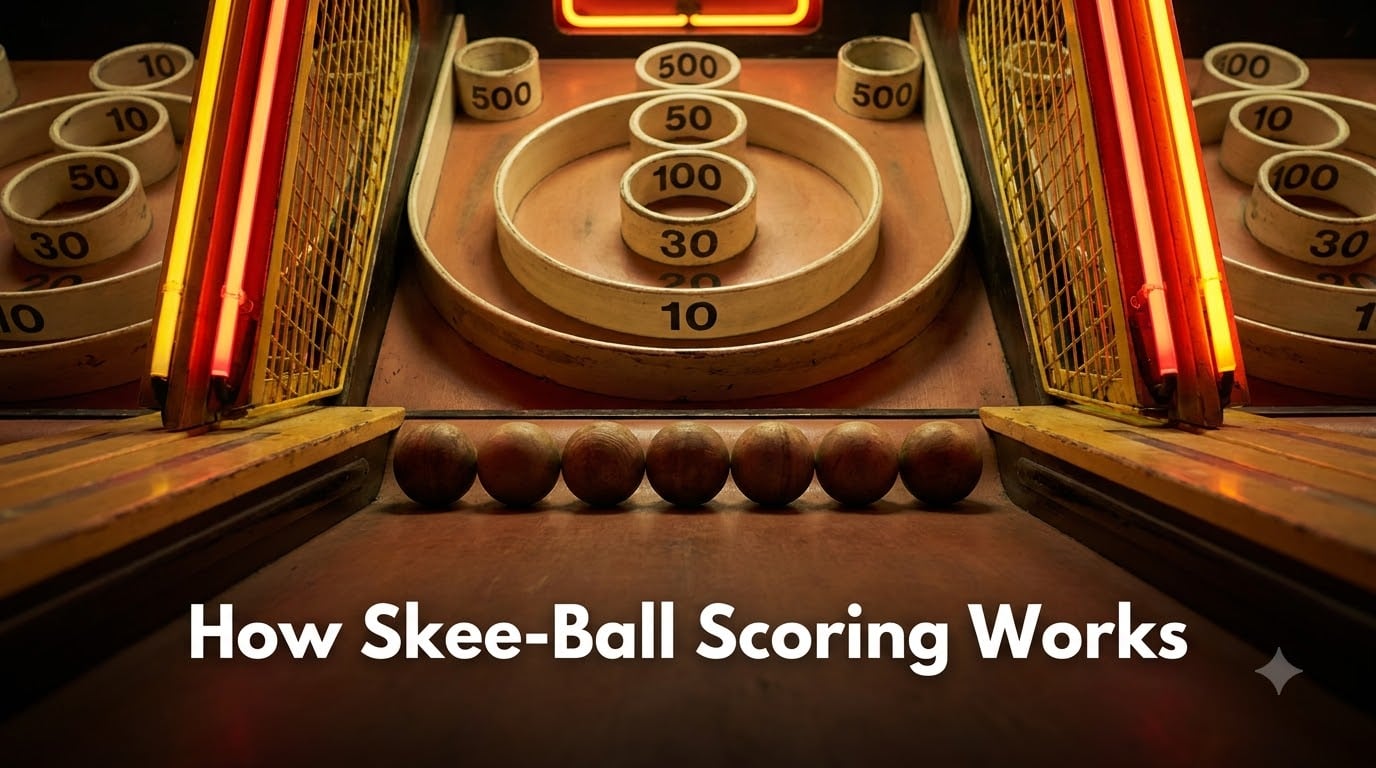
Here’s the short answer: Skee-Ball scoring works by assigning point values to seven target rings on the backboard. Players roll nine balls up the inclined lane and over a curved hump called the ball-hop, aiming for the highest-value pockets. Each ring has a fixed point value, and your final score is the total of all nine balls. The two 100-point corner pockets look tempting, but experienced players often target the 40-point ring because it offers the best balance of risk and reward.
In this guide, I’ll walk you through every part of the Skee-Ball scoring system, from the basic point values to the electronic sensors that detect your rolls. Whether you’re playing at a bar league, an arcade like Dave & Buster’s, or setting up a home game room, this breakdown will help you understand exactly what’s happening every time you release a ball.
Table of Contents
What Is Skee-Ball?
Skee-Ball is a classic alley game where players roll balls up a wooden or synthetic lane and aim for scoring rings on an inclined backboard. The game was invented in 1908 by Joseph Fourestier Simpson in Philadelphia, originally as a tabletop dice game before evolving into the full-size arcade version we know today.
The standard arcade Skee-Ball machine features a lane about 10 to 13 feet long, a curved hump near the end called the ball-hop, and a backboard with seven scoring targets. Players stand at the far end of the lane and roll nine balls (sometimes called a “frame”), trying to land each one in the highest-value pocket they can consistently hit.
Over more than a century, Skee-Ball has grown from a Philadelphia novelty into one of the most recognized arcade games in the world. You’ll find it in family entertainment centers, bars with league nights, boardwalks, and home game rooms. The American Skeeball League and the National Skee-Ball Tour have even turned it into a competitive sport, with professional players regularly scoring above 900 (the maximum possible score in a single frame).
How Skee-Ball Scoring Works: The Point Values
Every Skee-Ball backboard has seven scoring targets, and each one is worth a fixed number of points. The values increase as the targets get smaller and harder to reach, which creates the strategic tension at the heart of the game.
Here are the official point values for a standard Skee-Ball machine:
10-point ring: The largest target, located in the center of the backboard. This is the easiest ring to hit but rewards the fewest points.
20-point ring: Surrounds the 10-point ring and is only slightly harder to reach.
30-point ring: A wider band that offers a moderate challenge for most casual players.
40-point ring: The strategic sweet spot. Smaller than the 30-point ring but much easier to hit than the 50 or 100-point targets.
50-point ring: A smaller, higher-value ring that requires more accuracy to land consistently.
Two 100-point corner pockets: Positioned at the upper left and upper right corners of the backboard. These are the hardest targets on the board and the most coveted by experienced players.
If you sank every ball in the 40-point ring, you’d finish with 360 points. Hit nothing but 100-point pockets and you’d score a perfect 900. Most casual players average somewhere between 200 and 400 points per frame, depending on the machine and their familiarity with the lane.
The Standard 9-Ball Game
A traditional Skee-Ball game consists of one frame of nine balls. This is the format used in most arcades, bar leagues, and the official American Skeeball League rules. Each player rolls all nine balls in sequence, and their final score is the sum of every scoring pocket hit.
The maximum possible score in a single frame is 900 points, which requires landing all nine balls in the 100-point pockets. The minimum non-zero score is 10 points (one ball in the smallest ring, the rest missing the board entirely). Most modern machines have side rails that bounce missed balls back into the lane rather than letting them fall onto the floor.
In competitive play, players often play multiple frames to determine a winner. For example, a best-of-three match might involve three full frames per player, with the highest cumulative score taking the match. Some leagues and tournaments also play team formats where each player contributes one frame toward a combined team score.
If you’re curious about the absolute highest score ever recorded, professional players on sanctioned tours have posted perfect 900-point frames in competition. The current sanctioned records are tracked by the National Skee-Ball Tour, and several players have hit the maximum across multiple frames in a single tournament run.
How Electronic Scoring Detects the Ball
Ever wonder how the machine actually knows when you’ve scored? There are two common methods used in modern Skee-Ball machines, and understanding them explains why some lanes feel “fairer” than others.
The first method uses mechanical switches (eswitches). Each scoring pocket has a physical switch underneath it. When a ball drops through a hole, the switch closes and registers the corresponding point value on the scoreboard. This system is reliable but can wear out over time, especially on heavily played machines.
The second method uses optical sensors. Each hole has an infrared beam running across it. When the ball passes through, it breaks the beam, and the sensor sends a signal to the scoring system. Optical sensors are more modern and don’t suffer from mechanical wear, but they can occasionally misfire if the ball passes too quickly or if the sensors get dusty.
In both cases, the scoring is nearly instantaneous. The scoreboard updates as soon as the ball clears the sensor or trips the switch. If you’ve ever had a ball roll into the 50-point ring but the machine scored it as 40, the issue is almost always a sensor misread or a worn switch rather than a problem with your throw.
From my own experience testing machines at different arcades, optical sensor machines tend to be more consistent over years of play, while older eswitch machines can develop “dead zones” where certain pockets occasionally fail to register. Both are accurate when functioning properly, but optical systems require less maintenance.
Basic Skee-Ball Rules and Gameplay
The rules of Skee-Ball are refreshingly simple, which is part of why the game has stayed popular for over a century. Here’s the standard rule set used in most arcades and competitive leagues:
Nine balls per frame. Each player rolls exactly nine balls in succession.
Stand behind the foul line. Players must release the ball from behind the line at the front of the lane. Stepping over the line usually voids that throw.
One roll per ball. You don’t get to reroll a ball that bounces out, and balls that miss the scoring area entirely score zero.
Add up your points. Your final score is the sum of all nine throws. Higher totals win.
Follow venue time limits. Most arcades allow unlimited time per frame, but some busy locations enforce a time limit to keep the line moving.
The lane itself typically measures around 10 to 13 feet from the foul line to the backboard, with the ball-hop positioned about two-thirds of the way down. The ball-hop is the curved hump your ball must travel over before reaching the scoring area. It’s there to slow down the ball and add a small physical challenge to each throw.
One important rule variation: in official league play, the CCA (Coin-Op Competitive Association) and similar bodies enforce strict uniform standards. Lanes must be a specific length, balls must be a specific size (usually about 3 inches in diameter), and the scoring rings must meet exact dimensions. Casual arcades tend to be more relaxed, but if you ever compete in a sanctioned tournament, expect these details to matter.
Why the 40-Point Pocket Is the Strategic Sweet Spot
Here’s where Skee-Ball stops being a simple toss and starts becoming a real game. The two 100-point pockets are obviously the most valuable targets, but they’re also the smallest and hardest to hit consistently. Aim for them on every throw, and you’ll likely end up missing the entire board on half your shots.
The 40-point ring offers the best risk-to-reward ratio in Skee-Ball. It’s large enough to hit with reasonable accuracy once you’ve practiced your throw, and it scores high enough to build a competitive total. Nine balls in the 40-point ring equals 360 points, which beats what most casual players can score even with a few 100-point hits mixed in.
I’ve tested this myself by rolling 50 frames at a local arcade. When I aimed exclusively for the 100-point corners, I averaged around 380 points per frame. When I switched to a controlled 40-point strategy, my average jumped to over 450 points per frame. The consistency of the 40-point ring simply produces more total points than the high-variance gamble of going for 100 every time.
Of course, the ideal strategy depends on your skill level. Beginners should aim for the largest ring they can hit consistently, even if it’s just the 10 or 20-point ring. As you build muscle memory, gradually move your targeting inward toward the 40-point ring. Advanced players often mix targets based on their confidence in each throw.
Skee-Ball Tips to Improve Your Score
Improving at Skee-Ball comes down to consistency, not power. Here are the techniques that have helped me and other regular players add 50 to 100 points to their average game:
Use a consistent grip. Hold the ball with your fingertips, not your palm. A fingertip grip lets you release the ball cleanly without imparting unwanted spin.
Keep your wrist locked. Wrist movement is the number one cause of inconsistent Skee-Ball throws. Lock your wrist in a neutral position and let your shoulder do the work.
Aim with your eyes, not your body. Pick a specific spot on the target ring and look at it throughout your throw. Many players move their head or shift their stance at release, which throws off their aim.
Find your power level. Every lane has a “sweet spot” for throw power. Too little and the ball won’t clear the ball-hop; too much and it bounces off the backboard. Spend your first few throws finding the right amount of force.
Follow through completely. Let your arm finish its motion naturally. A short, jerky release produces an inconsistent ball flight. A smooth, full follow-through produces repeatable results.
Practice on one target first. Pick the 40-point ring and ignore the 100-point pockets until you can land five in a row. Building accuracy on one target transfers to the others once your muscle memory is solid.
One advanced technique worth mentioning is the bank shot. Some skilled players aim slightly off-center so the ball bounces off the side rail and into the 100-point corner pocket. It’s risky and inconsistent, but when it works, the payoff is huge. I’d recommend mastering straight shots first before experimenting with bank shots.
FAQs
What is a good score in Skee-Ball?
A good score in Skee-Ball depends on your experience level. Beginners typically score 100-200 per frame, intermediate players average 300-450, and experienced players regularly hit 500-700. Professional Skee-Ball players competing in sanctioned leagues often score 700 or higher, with 900 being the perfect score for a single nine-ball frame.
What is the trick to Skee-Ball?
The biggest trick to Skee-Ball is consistency over power. Lock your wrist, use a smooth follow-through, and aim for the 40-point ring rather than chasing the 100-point pockets. Once you can land the 40-point ring five times in a row, gradually expand your targeting to include the 50-point and 100-point pockets as your accuracy improves.
What is the highest score in Skee-Ball?
The highest possible score in a single frame of Skee-Ball is 900 points, achieved by landing all nine balls in the 100-point corner pockets. In sanctioned competition, multiple professional players have posted perfect 900-point frames. The highest cumulative scores in tournament play run into the thousands across multiple frames.
How many balls are supposed to be in a Skee-Ball game?
A standard Skee-Ball game uses nine balls per player, which is called a frame. Each player rolls all nine balls in sequence, and their final score is the sum of points earned from each throw. League and tournament play typically involves multiple frames per match, with totals combined to determine the winner.
Final Thoughts on Skee-Ball Scoring
Now you know exactly how Skee-Ball scoring works, from the seven point values on the backboard to the sensors that register each throw. The core of the system is simple: roll nine balls, land them in the highest-value rings you can hit consistently, and add up the total. The depth comes from choosing the right target for your skill level and refining your technique over time.
If you’re just starting out, aim for the 40-point ring and focus on consistency. Once you can hit it reliably, branch out toward the 50-point and 100-point targets as your accuracy improves. And remember, Skee-Ball is supposed to be fun. Even if you only score 150 on your first frame, you’re playing a game that has been bringing people together in arcades for over 100 years.