
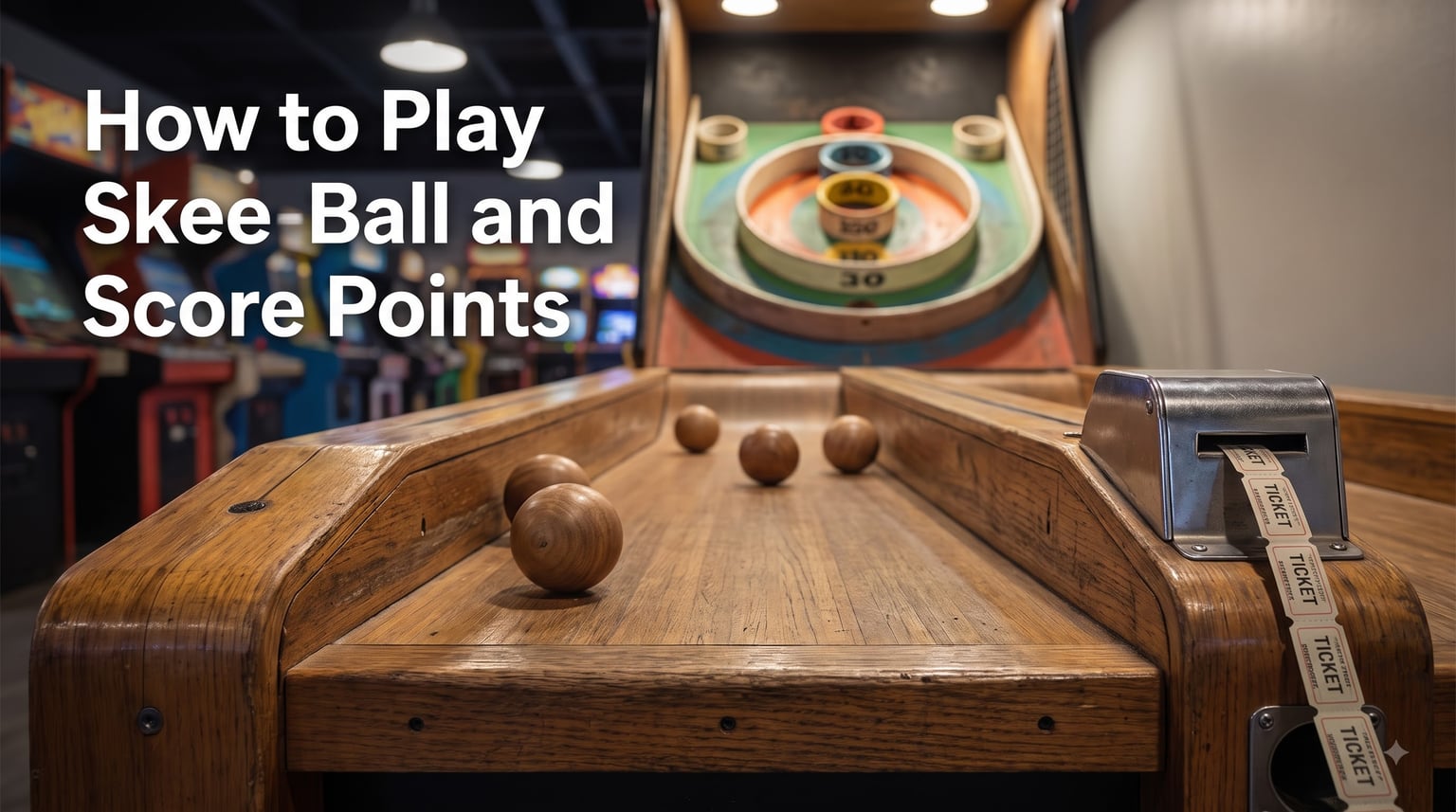
Walk into any arcade and you will hear it before you see it: the clatter of wooden balls rolling up a ramp and the satisfying thunk of one landing in a high-value pocket. Skee-Ball has been a centerpiece of arcades, boardwalks, and family entertainment centers for over a century, and it remains one of the most addictive redemption games ever made.
If you have ever watched someone rake in a massive pile of tickets while you struggled to break 100 points, this guide is for you. We are going to break down exactly how to play Skee-Ball and score points consistently, covering everything from the basic rules to the aiming strategies that top players use to dominate leaderboards.
Whether you are picking up a ball for the first time or trying to finally crack that 300-point threshold, the techniques below will change how you approach the lane.
Table of Contents
What Is Skee-Ball?
Skee-Ball is an arcade redemption game where players roll balls up an inclined lane and over a raised “ball-hop” hump that launches the ball into a target area filled with circular scoring pockets. Each pocket has a different point value, and players try to land as many balls as possible in the highest-scoring holes to earn points and redemption tickets.
The game was invented in 1909 by J.D. Estes of Philadelphia, making it one of the oldest arcade games still played today. Originally, the lane was 36 feet long, which was later shortened to the standard 10-to-14-foot alleys you see in modern arcades. The name “Skee-Ball” comes from the word “skeet,” reflecting the ski-jump shape of the ball-hop that gives each ball its arc into the scoring rings.
Today, Skee-Ball is everywhere: arcades, barcades, carnivals, bowling alleys, and even home game rooms. It has also grown into a competitive sport, with national leagues and tournaments where players chase perfect scores.
Basic Skee-Ball Rules
The rules of Skee-Ball are simple, which is part of what makes the game so enduringly popular. Here is how a standard game works:
Ball count: Each game gives you 9 balls to roll. On modern redemption machines, you insert coins or a card swipe and the balls are released into the trough.
The lane: You stand at the front of an inclined ramp that angles upward toward the target area. The ramp has a wooden or composite surface and raised sides to keep balls on track.
The ball-hop: At the top of the incline sits a raised hump called the ball-hop (or “jump”). When a ball reaches this hump at the right speed, it launches into the air and toward the scoring pockets. Too little power and the ball falls short. Too much and it bounces off the back wall unpredictably.
Scoring: After the ball clears the ball-hop, it lands in one of the circular target rings. Each ring corresponds to a point value based on its size and position. Smaller, harder-to-reach holes near the top are worth more points.
Tickets: Your total score across all 9 balls determines how many tickets or points you win for redemption prizes. Higher scores mean more tickets.
Time limits: Some modern machines enforce a time limit per ball to keep the line moving. If you take too long, the machine may auto-launch or skip your turn, so keep your pace steady.
How Skee-Ball Scoring Works
Understanding the scoring system is the foundation of learning how to play Skee-Ball and score points effectively. The target area at the top of the ramp contains multiple circular pockets arranged in a bullseye-style layout, and each one awards a different point value.
Here are the standard point values on a classic Skee-Ball alley, arranged from easiest to hardest:
10 points: The largest, lowest pockets on the outer edges. These are the easiest to hit but give you the fewest points.
20 points: The next ring up, slightly smaller and positioned closer to the center.
30 points: Mid-range pockets that require decent accuracy and consistent power.
40 points: The center pocket on most classic alleys. This is the sweet spot that skilled players target, and it sits dead center in the target area.
50 points: Two small pockets flanking the center on some machine variations. These demand precise aim.
100 points: The smallest and highest pockets, typically located at the very top corners of the target area. These are extremely difficult to hit and require near-perfect power and trajectory.
With 9 balls per game, the maximum possible score depends on the machine layout. On a classic alley with a 100-point top pocket, a perfect game is 900 points (nine 100-point shots). On machines where the top realistic target is the 40-point center, hitting all 9 balls in the 40 pocket gives you 360 points, a benchmark players call a “full circle.”
How to Play Skee-Ball and Score Points: Step-by-Step
Now we get into the technique. The best Skee-Ball players treat each roll the same way a bowler treats each frame: with a repeatable stance, consistent motion, and controlled release. Here is a step-by-step breakdown of proper Skee-Ball technique.
Step 1: Set Your Stance
Stand at the front of the lane with your dominant foot forward. If you are right-handed, your left foot should be slightly ahead. Bend your knees slightly and keep your weight balanced. A low, stable stance gives you better control over power and direction.
Do not stand tall and stiff. The number one mistake beginners make is rolling from a rigid, upright position, which kills both accuracy and consistency.
Step 2: Grip the Ball
Pick up the ball with an open palm. Cradle it loosely rather than gripping it tightly. You want the ball to roll smoothly off your fingers, not snap or spin on release.
Many top players recommend rolling with an open palm and no spin. A ball that flies straight up the ramp with no rotation is far more predictable when it hits the ball-hop.
Step 3: Aim Before You Roll
Line up your shot before you start your motion. Pick a specific target pocket and trace an imaginary line from your hand position up the ramp to that hole. Most skilled players aim for the 40-point center pocket because it offers the best balance of difficulty and reward.
Keep your eyes on the target throughout your motion. Looking at the ball or at your hand breaks your focus and throws off your aim.
Step 4: Find Your Power
This is where most players struggle. The ball needs enough speed to clear the ball-hop but not so much that it bounces hard off the back wall and ricochets out of the target area. The ideal roll has a smooth, controlled trajectory that arcs gently off the ball-hop.
Think of it as giving the ball some “oomph” without muscling it. A fluid underhand motion with a slight forward lean generates consistent power. Too hard and the ball overshoots. Too soft and it rolls back down the ramp.
Step 5: Release and Follow Through
Release the ball at the bottom of the incline as your arm swings forward. Let it roll off your fingertips naturally. Your hand should continue upward after release, just like a follow-through in bowling or basketball.
A clean follow-through keeps your trajectory consistent from roll to roll. Cut your motion short and you will lose both power and accuracy.
Step 6: Repeat the Same Motion
Consistency is everything in Skee-Ball. Once you find a motion that lands the ball in your target pocket, repeat it exactly for every remaining ball. Muscle memory is the secret weapon of every high-scoring player.
Aiming Strategy: Why the 40-Point Pocket Wins
If there is one strategy that separates casual players from skilled ones, it is this: aim for the 40-point center pocket instead of chasing the 100-point holes. This is the single most important tip for anyone learning how to play Skee-Ball and score points.
Here is the math. The 100-point pockets are tiny and sit at the extreme top corners of the target area. Even skilled players hit them maybe one out of every five attempts. Meanwhile, the 40-point pocket sits dead center, is significantly larger, and rewards consistent accuracy.
If you land all 9 balls in the 40-point pocket, you score 360 points, a “full circle.” That is a strong score on any machine and will earn you a solid ticket payout. Now compare that to a player who goes for 100-point shots, misses most of them, and ends up with balls bouncing into the 10-point gutters. That player might finish with 90 to 150 points.
The takeaway: go for consistency over heroics. Hit the 40 pocket nine times in a row and you will beat almost anyone in the arcade.
Once you can reliably hit the 40-point pocket, then start experimenting with the higher-value holes. But make the center target your bread and butter first.
The Bank Shot Technique
For players who have mastered the straight shot and want to add another weapon, the bank shot is a powerful advanced technique. Instead of rolling the ball straight up the center, you aim slightly to the side so the ball makes contact with the lane wall and angles back toward a specific pocket.
The bank shot works because the raised walls of the lane act like a bumper. When you angle your roll correctly, the ball hits the wall, redirects, and arcs off the ball-hop at a trajectory that can reach the 50 or 100-point holes more reliably than a straight shot at those targets.
To execute a bank shot, shift your starting position to one side of the lane. Aim your roll toward the opposite wall at a slight angle. The ball should make contact with the wall about halfway up the ramp, then redirect toward your target pocket off the ball-hop.
This technique takes practice to calibrate. Start by aiming for the 40-point pocket with a bank shot to learn the angle, then gradually shift your target higher as you build confidence.
Common Mistakes to Avoid
One thing that gives you an edge over the competition is knowing what not to do. Here are the most common mistakes that wreck Skee-Ball scores, and none of the top competitor guides cover them.
Throwing too hard: This is the number one killer of good scores. When you muscle the ball up the ramp, it hits the ball-hop at excessive speed, bounces off the back wall, and drops into a low-value gutter pocket. Controlled power beats raw force every time.
Inconsistent stance: If your feet, grip, or body position changes between rolls, your results will vary wildly. Pick one stance and stick with it for all 9 balls.
Adding spin to the ball: Spinning the ball may feel natural, but it makes the trajectory unpredictable after the ball-hop. Roll with an open palm and let the ball travel straight.
Chasing the 100-point holes too early: Beginners see the big numbers at the top and start gunning for them immediately. This almost always results in low scores. Build your accuracy on the 40-point pocket first.
Not watching the target: If your eyes drift to the ball or your hand mid-roll, your aim shifts. Keep your eyes locked on the target pocket from start to finish.
Rushing between balls: Some players get caught up in the excitement and start rapid-firing balls up the ramp. Take a breath, reset your stance, and treat each ball as an individual shot.
Practice Tips to Improve Your Game
Skee-Ball rewards repetition. The more you play with deliberate focus, the faster your scores will climb. Here are proven practice strategies from experienced players and competitive league members.
Focus on one target per session: Instead of switching targets every ball, dedicate an entire game to hitting the 40-point pocket. This builds the muscle memory needed for consistent scoring.
Pay attention to your misses: When the ball lands in the wrong pocket, note where it went. Missing left? Adjust your stance slightly right. Missing short? Add a bit more power. Treat every miss as feedback.
Develop a pre-roll routine: Before each ball, do the same sequence: set your feet, pick your target, take a breath, roll. A consistent routine calms your nerves and reinforces muscle memory.
Practice your power calibration: Spend a few games just working on the right amount of force. The goal is a smooth arc off the ball-hop, not a rocket or a weak lob. Once you nail the power, aim becomes much easier.
Play regularly: Like any physical skill, Skee-Ball technique fades without practice. Even a few games a week keeps your timing and feel sharp.
What Is a Good Skee-Ball Score?
Score expectations depend on your skill level and the machine you are playing on. Here are general benchmarks to help you gauge where you stand and what to aim for.
Beginner (50 to 150 points): You are still getting a feel for the game. Focus on consistent power and hitting the 40-point pocket.
Intermediate (150 to 250 points): You can hit the center pocket semi-reliably. Work on reducing the number of balls that fall into the 10-point gutters.
Advanced (250 to 360 points): You are landing most balls in the 40-point pocket and occasionally hitting higher-value targets. A full circle of 360 points puts you in this tier.
Expert (360+ points): You are consistently hitting the 40-point pocket and regularly landing 50 or 100-point shots. Scores in this range put you among the top players in any casual arcade.
FAQs
How does Skee-Ball scoring work?
Skee-Ball scoring works by awarding points based on which circular pocket the ball lands in after rolling up the ramp and over the ball-hop. Standard point values range from 10 points for the large outer pockets to 100 points for the small top-corner holes. The center 40-point pocket is the primary target for skilled players. Each game consists of 9 balls, and your total score across all rolls determines your ticket payout.
What is a good score for Skee-Ball?
A good Skee-Ball score depends on skill level. Beginners typically score 50 to 150 points, intermediate players reach 150 to 250, and advanced players score 250 to 360. Hitting all 9 balls in the 40-point pocket for a 360-point full circle is considered a strong score. Expert players who consistently hit 50 and 100-point pockets can score over 360 points per game.
What are the rules for Skee-Ball?
The rules for Skee-Ball are simple: each player gets 9 balls per game. You roll each ball up an inclined lane and over a raised ball-hop hump that launches it into a target area of circular scoring pockets. Points are awarded based on which pocket the ball lands in, ranging from 10 to 100 points. Your total score across all 9 balls determines how many redemption tickets you win.
What is the proper way to play Skee-Ball?
The proper way to play Skee-Ball is to use a consistent stance with knees bent and dominant foot forward, roll the ball with an open palm and no spin up the center of the lane, aim for the 40-point center pocket, use controlled power to clear the ball-hop, and follow through with your arm motion. Repeating the same motion for all 9 balls builds the muscle memory needed for high scores.
How many balls do you get in Skee-Ball?
You get 9 balls per game of Skee-Ball. Each ball is rolled up the inclined ramp one at a time, and your score is the total points from all 9 rolls combined.
Can you bank shot in Skee-Ball?
Yes, you can bank shot in Skee-Ball. To execute a bank shot, angle your roll toward the side wall of the lane so the ball makes contact midway up the ramp and redirects off the ball-hop toward a specific pocket. This technique can help you reach the higher-value 50 and 100-point holes more reliably than a straight shot.
Conclusion
Learning how to play Skee-Ball and score points comes down to a few core principles: master your stance, aim for the 40-point center pocket, use controlled power, and repeat the same motion for all 9 balls. The players who score the highest are not the ones chasing 100-point hero shots. They are the ones who build muscle memory and hit their target consistently.
Avoid the common mistakes that derail beginners, like throwing too hard, adding spin, or switching targets every ball. Practice with purpose, develop a pre-roll routine, and treat each ball as a focused individual shot.
The next time you step up to a Skee-Ball alley, pick the 40-point pocket, set your stance, and roll with confidence. Those redemption tickets are yours for the taking.