
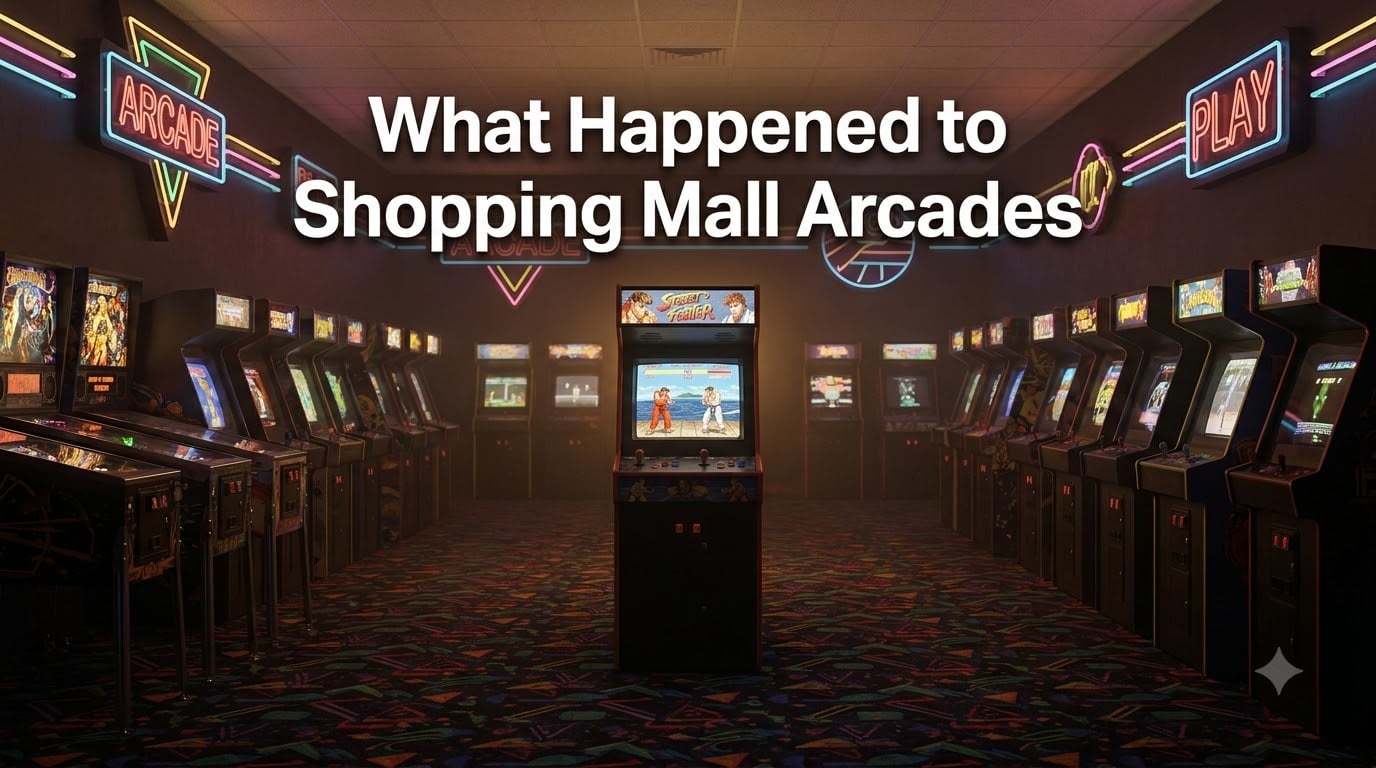
You remember the smell. A mix of burnt popcorn from the food court, that rubbery scent of old carpet, and ozone from a hundred CRT monitors stacked shoulder-to-shoulder. The flash of Street Fighter II marquees, the rattle of quarters in your pocket, the synthetic crash of a car crash in Daytona USA. That was the shopping mall arcade, and for a generation of Gen X and Millennial kids, it was the only place on Earth that mattered on a Saturday afternoon.
So what happened to shopping mall arcades? The short answer is a slow collapse driven by home consoles, mobile gaming, brutal economics, and the death of the American mall itself. By the mid-2000s, the once-mighty mall arcade was already a relic, replaced by clothing stores, fitness centers, and empty retail bays. Let me walk you through the full story, decade by decade, with the specific brands and games that defined each era.
Table of Contents
- Quick Summary
- What Happened to Shopping Mall Arcades
- The Golden Age of Mall Arcades (1970s to 1990s)
- Decade-by-Decade Timeline of Mall Arcade Decline
- The Rise of Home Gaming Consoles
- Economic Pressures: Rent, Machines, and Maintenance
- The Retail Apocalypse and Mall Decline
- Legal and Regulatory Challenges
- What Replaced Mall Arcades
- Signs of Revival: Retro Arcades, Arcade Bars, and VR
- Why Are Japanese Arcades Still Thriving
- Frequently Asked Questions
- Final Thoughts on What Happened to Shopping Mall Arcades
Quick Summary
If you only have 60 seconds, here’s the core story: shopping mall arcades peaked between 1981 and 1994, then declined steadily through the 2000s. The collapse had four main drivers: home gaming consoles (Atari, NES, PlayStation), the rise of mobile gaming, brutal fixed costs (machines cost $8,000-$15,000 each plus rent), and the retail apocalypse that killed the malls themselves. Today, the mall arcade format is essentially extinct, but a new generation of retro arcades, barcades, and VR centers carries the torch.
What Happened to Shopping Mall Arcades
Shopping mall arcades disappeared because the cultural and economic conditions that created them stopped existing. The arcade was a product of a specific moment: pre-internet teens with disposable income, no home gaming alternative, and nowhere else to socialize. Once home consoles matched arcade quality in the late 1990s, once smartphones put games in every pocket, and once malls started hemorrhaging anchor tenants, the arcade model became financially impossible.
Most mall arcades closed between 1998 and 2008. The last strongholds, like Namco Station and Time Out, hung on in larger regional malls until 2010-2015. A few specialist operators still run arcades inside enclosed malls and family entertainment centers, but the standalone mall arcade that defined a generation is gone.
The Direct Causes at a Glance
- Home gaming consoles (NES, SNES, PlayStation, Xbox) replicated arcade experiences at home for a fraction of the cost.
- Mobile gaming (starting with the iPhone in 2007) made casual games portable and free.
- Fixed costs crushed operators: $15,000 cabinets, $20,000/month mall rent, expensive repairs.
- The retail apocalypse closed over 1,000 American malls in the 2010s, removing the arcades’ host environment.
- Legal crackdowns on prize and skill-based games made redemption machines legally risky.
The Golden Age of Mall Arcades (1970s to 1990s)
The mall arcade was born in the early 1970s, right when regional shopping centers were expanding across suburban America. The first wave was simple: a few pinball machines and maybe an electro-mechanical game like Periscope. But everything changed in 1978 with Taito’s Space Invaders, and the modern arcade was born almost overnight.
By 1981, the U.S. arcade industry was pulling in roughly $7 billion per year (in today’s dollars). The mall arcade was the epicenter. Regional chains opened hundreds of locations, and three names became legendary: Namco Station, Time Out, and Space Port. Namco Station was the American arm of the Japanese arcade giant Namco, running polished, multi-floor arcades inside major malls like Westfield and Simon properties. Time Out was a U.S. chain known for its mix of classic cabinets and redemption games. Space Port was the budget-friendly chain, smaller and more focused, but absolutely everywhere in the Midwest and South.
What made the mall arcade special was the sensory experience. The carpet was always that patterned grey-and-magenta industrial weave, the lighting was dim, and the sounds were overwhelming. Pumps of synth music from Out Run blended with the digital crunch of Street Fighter II finishing moves and the cheerful beeps of skee-ball lanes. There was a specific geography to the layout: racing cabinets at the back, fighting games in the middle, pinball flanking the entrance, and claw machines guarding the exit where tired parents waited.
For teens, the arcade was the entire social infrastructure. You met friends there, you dated there, you formed rivalries over Mortal Kombat high scores. The arcade was the original social network, and you didn’t need a login. You just needed a roll of quarters and a T-shirt with your favorite cabinet logo on it.
Decade-by-Decade Timeline of Mall Arcade Decline
Here is the timeline I wish someone had given me years ago. The decline was not a single event but a slow squeeze across four decades.
| Decade | Arcade Status | Key Drivers | Estimated U.S. Arcade Locations |
|---|---|---|---|
| 1970s | Birth and rise | Space Invaders, Asteroids, mall expansion | ~10,000 by 1979 |
| 1980s | Golden Age peak | Pac-Man, Donkey Kong, Street Fighter, home console threat begins (Atari 2600, NES) | ~13,000-15,000 peak in 1981-1982 |
| 1990s | Steady decline | SNES, Sega Genesis, PlayStation, Mortal Kombat controversy, rentals climb | ~7,000-9,000 by end of decade |
| 2000s | Collapse and consolidation | Xbox Live, online gaming, PS2, iPhone launch 2007, Namco Station exits many malls | ~2,500 by 2009 |
| 2010s | Mass extinction | Mobile gaming saturation, retail apocalypse, dead malls, Time Out closures | Under 1,500 by 2018 |
| 2020s (2026) | Boutique revival | Barcades, VR centers, family entertainment centers, retro nostalgia cycle | Niche market, no mall-dominated format |
Two numbers tell the story well. The U.S. arcade industry went from $7 billion in revenue in 1981 to roughly $2 billion by 1990, and continued sliding through the 2000s. Meanwhile, mall vacancy rates more than doubled between 2010 and 2020, removing the physical host for nearly every arcade in America.
The Rise of Home Gaming Consoles
The home console was always the existential threat. Atari released the 2600 in 1977, and within four years, the great arcade crash of 1983 wiped out the entire North American gaming industry. Arcades actually survived that crash because they could offer experiences home consoles couldn’t match. The NES revived home gaming in 1985, but arcades still had the best ports, the best controllers, and the social atmosphere.
The real blow came in the mid-1990s. The Sega Saturn, Sony PlayStation, and Nintendo 64 brought 3D graphics home. Suddenly, the visual gap between arcade and console closed. Tekken 3 on PlayStation looked almost identical to the arcade version, and you could play it without feeding it quarters. By 1997, Sega’s Model 2 and Model 3 arcade boards were starting to outpace home consoles in raw power, but the economics flipped: rather than release ports to home, developers like Sega and Namco started making home games the primary version and arcades the secondary.
The Rhythm game era (1998-2004) was the last great arcade wave. Dance Dance Revolution, Beatmania IIDX, and Guitar Hero (before it went home) gave arcades a unique input method home consoles couldn’t replicate. DDR saved Japanese arcades and helped a few American mall locations survive into the 2000s. But the rhythm game was the exception, not the rule. Rhythm games needed specialized hardware, and everything else was becoming interchangeable.
Economic Pressures: Rent, Machines, and Maintenance
Even if the cultural conditions had stayed perfect, the math stopped working. A new arcade cabinet in the 1990s cost between $8,000 and $15,000. Racing simulators like Daytona USA or After Burner could hit $25,000. Operators needed to rotate 30-50 cabinets to keep a mid-size mall arcade fresh, which meant a $300,000 to $750,000 inventory investment, before rent.
Then came the rent. Class-A mall space ran $20-$40 per square foot in the 1990s and climbed to $60-$80 per square foot by 2010. A 4,000-square-foot arcade was paying $20,000 to $30,000 per month just in rent. Add in electricity (those CRT monitors pulled serious power), insurance, staff, and quarterly maintenance calls. A pinball machine needed a board swap every few months. A laserdisc game like Dragon’s Lair was a service nightmare.
Operators made money on volume, and the volume disappeared. The standard arcade game made about $20-$40 per day at peak times in the late 1980s. By 2005, that same cabinet might make $5-$10 per day. Operators I have spoken to over the years describe the tipping point as the early 2000s, when chains like Time Out started swapping standup cabinets for ticket redemption games because the redemption games pulled $100+ per day reliably from families with younger kids.
The Retail Apocalypse and Mall Decline
The death of the mall arcade cannot be separated from the death of the mall. The two died together. Sears closed 1,000+ stores between 2010 and 2020. JCPenney filed for bankruptcy in 2020. Macy’s closed 125 stores in 2020 alone. Without anchor tenants, malls lost foot traffic, which killed the small businesses and entertainment venues inside.
Indoor malls suffered first. The enclosed, climate-controlled mall was the natural home for arcades because they had no windows, no natural light, and they could blast the air conditioning to keep the machines cool. Outdoor strip malls and lifestyle centers never supported arcades well. So when enclosed malls started closing, the arcade ecosystem collapsed with them. Roughly 200 U.S. malls closed in 2010, and more than 1,000 closed between 2010 and 2020 by some counts. AMC, Sears, and JCPenney closures dragged the entire captive-audience ecosystem down with them.
Reddit’s r/deadmalls subreddit is full of users reporting the same experience. They return to their childhood mall, walk to where the arcade used to be, and find a Lane Bryant, a Hot Topic, or a Forever 21. Sometimes the arcade was one of the last tenants. A user on r/deadmalls wrote: “The arcade was one of the very last things to go. It even outlasted many other stores when the mall declined.” That is the pattern: the arcade was the canary, but the canary was rarely the first to fall.
Legal and Regulatory Challenges
Arcades also got hit by a regulatory wave that most people never saw coming. The shift from standup video games to prize and skill-based games in the 1990s made arcades legally complicated. Redemption games, where you win tickets you exchange for stuffed animals and electronics, look a lot like slot machines to a state legislator. Starting in the early 2000s, states began regulating or banning certain types of games.
Florida passed a particularly aggressive ban in 2013 that targeted games resembling slot machines. California passed laws requiring scratch-and-win games to clearly disclose odds. Several states started requiring skill-based redemption games to demonstrate measurable skill to win. Operators responded by moving toward pure entertainment games with no cash value, but those games pulled less revenue. The legal pressure accelerated the shift away from prize games and toward amusement-only models, which reduced per-machine revenue by 30-50% in affected states.
What Replaced Mall Arcades
Once an arcade closed, the space got reused fast. The most common replacements were clothing stores, especially fast-fashion chains like Forever 21, H&M, and Charlotte Russe. The lighting and layout translated well. Big-box fitness centers like Planet Fitness took over larger arcade footprints in some malls. Food court expansions also absorbed arcade spaces in struggling malls.
Some former arcades became mobile phone kiosks, ear-piercing stores, or oversized pop-up shops. A Reddit user summed up the experience: “I went to my favorite mall and realized the space where the arcade used to be they turned into a Lane Bryant.” That single line captures two decades of mall arcade history. The 4,000-square-foot space where you used to dump $20 in quarters is now selling women’s plus-size clothing.
Signs of Revival: Retro Arcades, Arcade Bars, and VR
The arcade is not dead. It just moved. The most visible revival is the barcade, a bar with classic arcade cabinets and pinball machines that opened in the 2010s. Barcade opened in Brooklyn in 2004 and now has multiple locations. Other chains like Two Bit Circus, Ground Kontrol, and Free Play Dallas have built thriving followings. These are adult-oriented, often 21+, and they let the demographic that grew up in the 1980s arcades pay $5 to play Donkey Kong with a craft beer.
Family entertainment centers (FECs) like Dave & Buster’s, Main Event, and Round One absorbed the mall arcade’s kid-friendly role. They are not in malls, but they are the closest cultural descendant. They run redemption games, rhythm games, and modern multiplayer experiences in big-box standalone locations. Dave & Buster’s now pulls over $1.5 billion in revenue annually, far more than the entire mall arcade industry did at its peak.
Esports centers, VR arcades, and retro gaming bars are filling other niches. Pinball has had a quiet but steady revival, with new pinball manufacturers like Stern pumping out modern tables with LED lighting and licensed themes. There is even a small movement of dedicated arcade collectors installing museum-style cabinets in their homes, which has created a new wave of interest in CRT monitors and original arcade boards.
What you will not find, almost anywhere in America in 2026, is the original mall arcade. The standalone coin-op room inside a regional shopping mall is functionally extinct. What replaced it is more fragmented, more adult-oriented, and more digital, but the spirit of competition is intact.
Why Are Japanese Arcades Still Thriving
Japan kept its arcades by making them something America never did: a complete social and entertainment ecosystem. A Japanese game center is part arcade, part internet cafe, part karaoke bar, and part trading card shop. You can spend an entire evening there without ever touching a video game. The Japanese arcade model sells the experience, not the individual quarter.
Cultural factors also matter. Japanese arcades have benefited from consistent foot traffic in dense urban areas, dedicated rhythm game communities (DDR and IIDX are still released regularly), and a strong cultural acceptance of gaming as a legitimate social activity. Japanese arcades also benefit from strong IP partnerships with manga and anime franchises. A new One Piece crane machine or Dragon Ball card game is a major draw in Japan in a way an American arcade cannot replicate.
The American arcade never quite figured out how to expand beyond the teen demographic. The shift to redemption games in the 1990s was an attempt to bring in families with younger kids, but it also bled the teen audience, which was the heart of the arcade. Japan kept the teen and young adult audience by evolving into something more sophisticated. American malls wanted clothing stores, not full entertainment ecosystems. The arcades that survived did so by leaving the mall.
Frequently Asked Questions
Why did arcades disappear?
Arcades disappeared because home gaming consoles matched arcade quality in the late 1990s, mobile gaming made casual games free and portable, and the fixed costs of running arcades (cabinets, rent, maintenance) became unsustainable. The retail apocalypse and the rise of online gaming removed both the customer base and the host environment (the mall).
What caused the downfall of shopping malls?
Shopping malls declined due to the retail apocalypse, starting with department store closures (Sears, JCPenney, Macy’s), the rise of e-commerce, oversupply of malls built in the 1980s and 1990s, and shifting consumer preferences toward lifestyle centers and online shopping. Over 1,000 U.S. malls closed between 2010 and 2020.
When did mall arcades peak?
Mall arcades peaked in the United States between 1981 and 1994. The industry generated roughly $7 billion in revenue in 1981 and operated an estimated 13,000 to 15,000 locations. The mid-1990s saw the beginning of a steady decline as home consoles like the PlayStation and Nintendo 64 closed the quality gap with arcades.
What replaced arcades in malls?
When mall arcades closed, their spaces were typically replaced by clothing stores (Forever 21, Hu0026amp;M, Lane Bryant), expanded food courts, fitness centers (Planet Fitness), mobile phone kiosks, or pop-up retail shops. Some larger arcade spaces were converted into family entertainment centers or specialty stores.
Do any shopping malls still have arcades?
A few large, regional malls still have arcades in 2026, mostly operated as family entertainment centers with redemption games and modern multiplayer experiences. Chains like Round One operate in select malls. However, the traditional, standalone, coin-op mall arcade is functionally extinct in most of the United States.
What is the largest abandoned mall still standing?
The largest abandoned mall in the United States is generally considered to be the Randall Park Mall in North Randall, Ohio, which was the world’s largest mall at 2.5 million square feet when it opened in 1976 and closed in 2009. Other famous abandoned malls include Rolling Acres Mall in Akron, Ohio and Lincoln Mall in Matteson, Illinois.
Why are Japanese arcades still popular?
Japanese arcades remain popular because they evolved into multi-purpose entertainment centers that include arcade games, internet cafes, karaoke, trading card shops, and crane games with popular anime and manga IPs. Dense urban foot traffic, strong rhythm game communities (DDR, IIDX), and cultural acceptance of gaming as social activity keep Japanese game centers thriving.
Final Thoughts on What Happened to Shopping Mall Arcades
What happened to shopping mall arcades is, in the end, what happens to any cultural institution that loses its host environment. The arcade did not die because the games got worse. It died because the place where the games lived, the mall, also died. The cabinets moved, but the carpets and the smells and the sounds are mostly gone. The good news is that the spirit lives on in barcades, VR centers, and the small but passionate retro gaming community. Pick up a roll of quarters next time you see a real arcade cabinet. It still feels the same.