
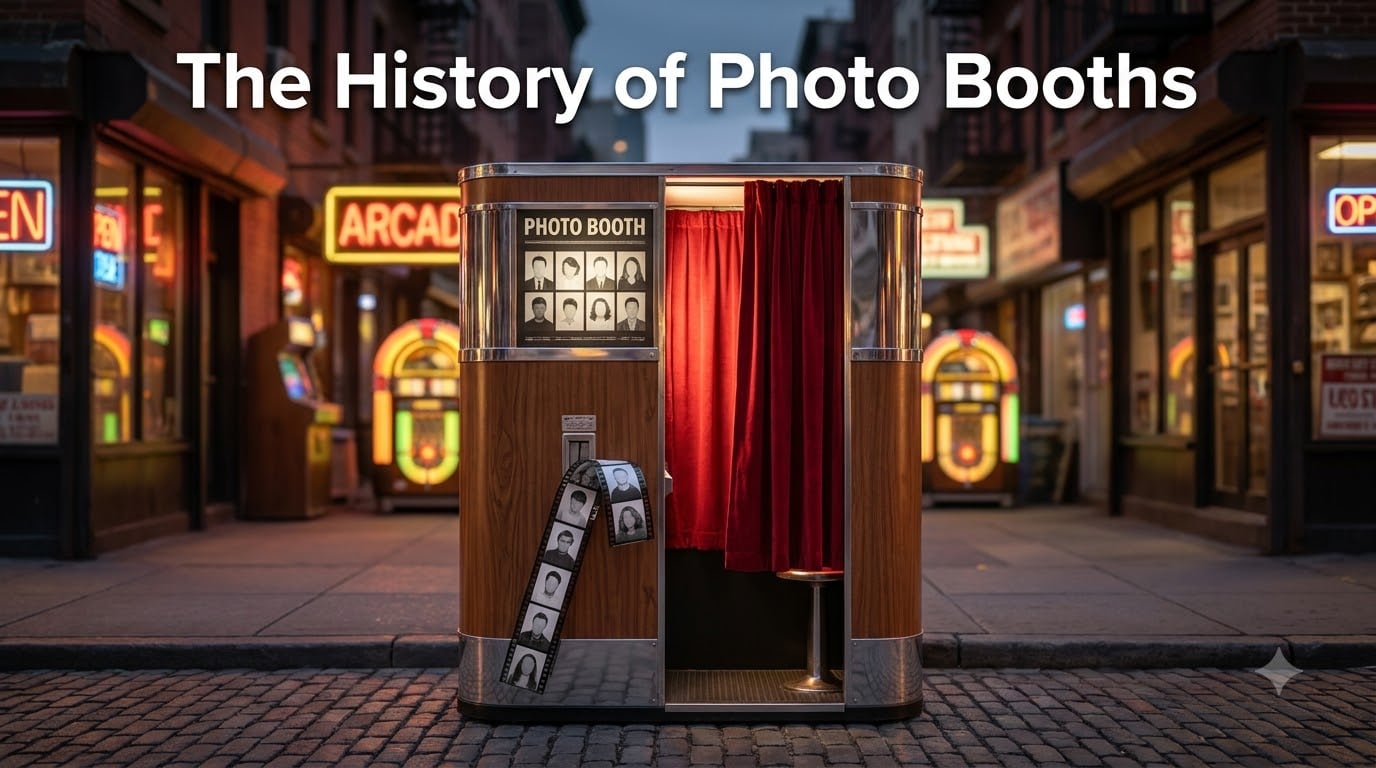
I’ve always been fascinated by the click-whir of a photo booth. The history of photo booths is a story of one immigrant’s gamble on Broadway, a flash of strobe light, and a curtain that turned strangers into self-portrait artists.
Over a century later, those same machines still pull crowds at weddings, malls, and pop-ups in cities like New York and London. In this guide, I’ll walk you through the full arc of how a coin-operated box became a cultural icon.
Table of Contents
- The History of Photo Booths: From Concept to Coin-Op Sensation
- Early Origins Before the Photomaton (1888-1924)
- Anatol Josepho and the Birth of the Photomaton (1925)
- The Rise of Coin-Op Photo Booths (1930s-1950s)
- Art, Culture, and the Warhol Effect
- The Transition to Color and the Mall Era (1960s-1990s)
- The Digital Revolution and Modern Selfie Stations
- Why Photo Booths Still Matter Today?
- Frequently Asked Questions About Photo Booth History
- Final Thoughts on the History of Photo Booths
The History of Photo Booths: From Concept to Coin-Op Sensation
The photo booth was invented by Anatol Josepho in 1925. A Siberian-born immigrant, Josepho unveiled the first fully automated, coin-operated photography machine on Broadway in New York City, and the device produced eight photo strips in about ten minutes.
That single invention launched the entire history of photo booths as we know it. Quick facts to set the stage:
First commercial booth: 1925, Broadway and 51st Street, New York City
Inventor: Anatol Josepho, originally from Siberia
Price per session at launch: 25 cents
Output: a strip of eight black-and-white portraits
Cash flow from the debut booth: over $1,000 in the first day
What started as a mechanical curiosity quickly became a worldwide phenomenon. Photo booths sat beside pinball machines and jukeboxes in arcades, then moved into train stations, drugstores, and malls.
Along the way, they picked up devoted fans including Andy Warhol, who used them as a portable studio. Today, the photo booth family tree spans vintage analog machines, open-air selfie stations, and mirror booths with built-in sharing.
Early Origins Before the Photomaton (1888-1924)
The story of the photo booth began decades before Josepho’s 1925 debut. Inventors in Europe and the United States tinkered with the idea of automated photography as early as the late 1800s.
The first known automated photography prototype appeared in 1888. A French inventor named T.E. Noire patented a concept for a coin-operated photography booth in Paris, though it never reached commercial production.
A year later, William P. Friedrich of Baltimore patented a similar design in the United States, again without ever building a working model. By 1899, Sven Mathiasen, a Norwegian inventor, received a patent for a “photographic apparatus” that could automatically take and develop photographs.
His machine was closer to working but still required attendants to operate. These early attempts all failed to answer the same problem: how do you make a booth that takes, develops, and prints a photo without help.
You can see why Josepho’s 1925 invention was so important. He solved the engineering puzzle that held back three earlier generations of inventors. The history of photo booths is really a story of patient trial and error before the breakthrough finally arrived.
The Mechanical Hurdle
Early inventors struggled with three challenges: precise timing, consistent lighting, and reliable internal film processing. Josepho’s later machine tackled all three with electric timers, a custom flash system, and a darkroom chamber built right into the booth.
That combination, more than any single idea, is what made the photo booth truly automatic.
Anatol Josepho and the Birth of the Photomaton (1925)
Anatol Josepho invented the first fully automated coin-operated photo booth in 1925. He called it the Photomaton, and it debuted on Broadway near 51st Street in New York City in September of that year.
Josepho was born in 1894 in Siberia and emigrated to the United States as a teenager. He studied engineering and worked as a portrait photographer before spending years refining his automated booth.
He reportedly filed his patent application in 1923 and spent two more years perfecting the camera, lighting, and chemical processing system. The Photomaton was roughly seven feet tall, weighed around 1,800 pounds, and contained a small darkroom inside.
Customers stepped inside, dropped a quarter, sat for a series of eight portraits spaced a few seconds apart, and waited about ten minutes for a finished strip. The results were striking: clean, evenly lit black-and-white images that looked professional even though no photographer was involved.
The Broadway location was a sensation. Crowds lined up around the block, and the booth reportedly brought in over $1,000 in its first day, an enormous sum in 1925.
Josepho eventually sold his patent and company for over $1 million, making him one of the first tech-millionaires in American history.
How the Photomaton Worked
The Photomaton used a series of electric flashes triggered by a timer, electric motors to advance the film, and a built-in darkroom that developed each strip internally. The whole process was genuinely hands-free, which was the breakthrough.
Older attempts required attendants to handle the chemicals or trigger the shutter.
The Rise of Coin-Op Photo Booths (1930s-1950s)
By the 1930s, photo booths had spread across the United States and Europe. The Great Depression slowed but did not stop their adoption, and the post-war boom of the 1940s and 1950s turned them into everyday fixtures.
You could find photo booths in train stations, drugstores, bus terminals, penny arcades, and amusement parks. They joined pinball tables, jukeboxes, and fortune-telling machines as part of the broader coin-op entertainment industry.
At the time, dropping a coin into a slot and getting something tangible back felt like magic. Three things made this era special:
Photo strips became a social ritual, especially for couples, friends, and servicemen on leave
Booths offered privacy and a tiny stage, which encouraged silliness and experimentation
Operators could make money from a small footprint, which made booths attractive to retail locations
By 1950, there were tens of thousands of photo booths in operation across the United States alone. The history of photo booths during this period is also the history of how a coin-operated machine became a community gathering point.
The Curtain Experience
The cloth curtain was more than a gimmick. It created a private, windowless space where people could let down their guard.
Hidden from the outside world, customers struck poses, made faces, and shared moments with friends. That sense of a private stage inside a public place is still part of why people love photo booths today.
Art, Culture, and the Warhol Effect
Photo booths became artistic tools almost as soon as they appeared. In the 1960s, the most famous fan of the format was the artist Andy Warhol.
Warhol used photo booth strips as raw material for portraits and self-portraits throughout his career. He treated the strips as ready-made studies in repetition, identity, and consumer culture, themes that ran through his entire artistic practice.
Several of his famous portraits, including those of Ethel Scull and himself, began as photo booth images. Other artists joined in. Surrealists in 1930s Paris experimented with photo booths for self-portraiture.
Pop artists in the 1960s used strips as collage material. Conceptual photographers in the 1970s used booths to question identity and authorship.
Even writers and musicians collected strips as informal autograph cards. Three cultural shifts happened because of this artistic interest:
Photo strips entered museum collections as serious art objects
Booths became associated with creativity, not just snapshots
Booths gained a kind of underground glamour that persists today
The Transition to Color and the Mall Era (1960s-1990s)
The 1960s and 1970s brought the first reliable color photo booths. Earlier attempts at color were expensive and finicky, but by the late 1960s, manufacturers could offer booths that produced decent color strips.
For most customers, the shift to color was the moment photo booths truly became modern. The 1980s and 1990s were the golden age of the mall photo booth.
Walk into any American shopping mall and you would find at least one booth near the food court, often with a line of teenagers waiting their turn. Strips cost a dollar or two, and friends would trade them like baseball cards.
For a generation of Americans, the mall photo booth is a core memory. Reddit threads in r/nostalgia are full of people remembering using booths with godmothers, grandparents, and childhood friends.
That feeling, more than any technical spec, is what drives the modern photo booth revival.
Coin-Op Arcade Crossover
Photo booths were physical neighbors of pinball machines, jukeboxes, and arcade cabinets throughout the 20th century. They shared the same coin mechanism, the same electrical wiring, and the same appeal: drop a coin, get something fun.
For operators of coin-op games, photo booths were a natural fit, and for customers, they were part of the same arcade experience.
The Digital Revolution and Modern Selfie Stations
The early 2000s brought the biggest change since 1925. Digital cameras replaced film, computers replaced chemical darkrooms, and printers replaced photo paper baths.
The photo booth as we knew it had to evolve. Modern digital booths offer a long list of features that earlier generations could not imagine:
Touchscreen interfaces with on-screen prompts
Green screen backgrounds for any setting you want
GIFs, boomerangs, and short video clips
Instant social sharing via QR codes or text message
Custom overlays, logos, and event branding
360-degree camera setups that capture video from every angle
Open-air booths replaced the classic enclosed booth in many venues, especially at weddings and corporate events. Mirror booths, which look like full-length mirrors until they flash to life, became popular at high-end events.
None of these formats replaced the original enclosed booth, though. Vintage analog machines still command a following at pop-ups and dedicated photo booth bars in cities like Brooklyn, Los Angeles, and London.
NYC Pop-Up Renaissance
In New York City, pop-up photo booth bars have become a small cultural movement. People line up around the block, even in freezing temperatures, to step into a vintage analog booth and walk out with a strip of black-and-white portraits.
The appeal is the same thing that drew crowds in 1925: a private curtain, a flash of light, and a small physical keepsake you can hold in your hand.
Why Photo Booths Still Matter Today?
After 100 years, the photo booth is still here. That alone is worth talking about.
Most coin-operated entertainment formats from the 20th century have come and gone, but the photo booth keeps reinventing itself. Three reasons explain the endurance:
The format is genuinely democratic. Anyone can use it, regardless of skill.
The output is tangible. A photo strip is an object you can pass around, tape to a fridge, or slip into a wallet.
The process is fun. The curtain, the countdown, the flash, all of it creates a social moment.
Preservation groups and historians are also working to keep vintage machines alive. Online communities like r/photobooth share tips on repairing mechanical parts, sourcing chemical paper, and finding old booths.
Specialized technicians can refurbish a 1950s booth and keep it running for decades. Looking ahead to 2026 and beyond, expect to see more hybrid setups that combine the nostalgia of an analog booth with the convenience of digital sharing.
The curtain is not going anywhere.
Frequently Asked Questions About Photo Booth History
Who invented the photobooth?
Anatol Josepho invented the first fully automated, coin-operated photobooth in 1925. He called his machine the Photomaton and debuted it on Broadway in New York City in September of that year.
What year was the photo booth invented?
The photo booth was invented in 1925. Anatol Josepho’s Photomaton opened on Broadway near 51st Street in New York City and produced eight black-and-white portraits in about ten minutes.
Where is the oldest photo booth?
The oldest surviving commercial photo booth locations from the 1920s are mostly gone, but the original Photomaton site on Broadway in New York City is widely recognized as the birthplace of the modern photo booth. A few 1930s and 1940s booths survive in museums and private collections in the United States and Europe.
How many vintage photo booths are left?
It is hard to say exactly, but collectors and preservation groups estimate that a few thousand fully functional vintage photo booths still exist worldwide. Most live in private collections, museums, pop-up venues, and dedicated photo booth bars in cities like New York, Los Angeles, and London.
What are some interesting facts about photobooths?
The debut Photomaton made over $1,000 in its first day on Broadway, and Josepho later sold his patent for more than $1 million. Andy Warhol used photo booth strips as source material for many of his famous portraits. The classic enclosed booth with a curtain was designed to give customers privacy and a small stage for self-expression.
Final Thoughts on the History of Photo Booths
The history of photo booths is a story of one big idea, executed well. Anatol Josepho’s 1925 Photomaton solved a problem that inventors had been working on since 1888, and the format it introduced has never quite gone away.
From Broadway to the mall food court to today’s pop-up bars, the photo booth has kept its hold on us for one simple reason: it gives everyone a private stage and a small souvenir to take home.
If you have never tried a vintage analog booth, find a pop-up near you and bring a friend. There is something about the curtain, the flash, and the ten-minute wait that no smartphone can quite copy.
And that is the most surprising part of the history of photo booths. After 100 years, the format still works.