
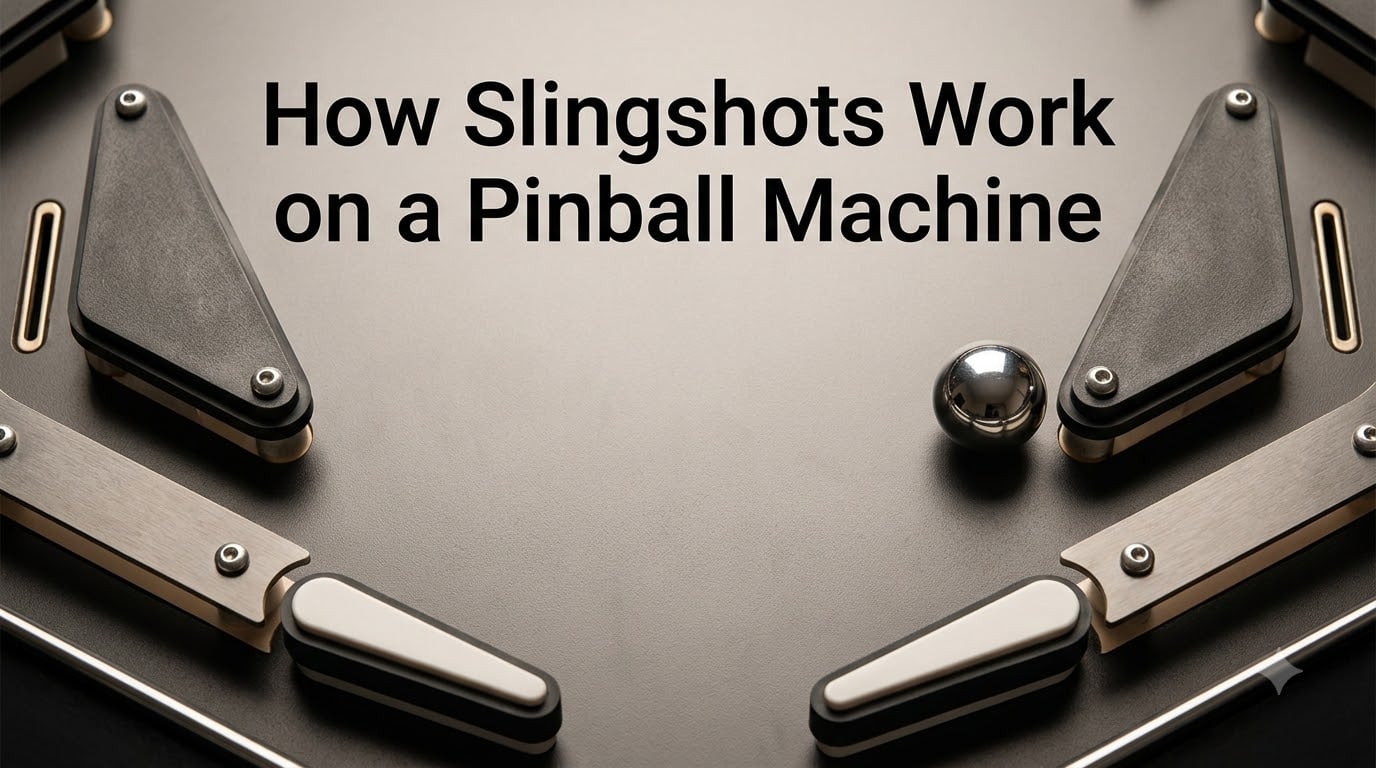
If you have ever played a pinball machine, you know that moment when the ball hits the angled rubber pad above your flippers and rockets back into play, seemingly on its own. That is the slingshot at work, and it is one of the most important, most misunderstood, and most frustrating components on the entire playfield.
In this guide, I will walk you through exactly how slingshots work on a pinball machine, from the blade switches that detect the ball to the coil that fires the kicker. I have spent years around coin-operated games, and I can tell you that once you understand the mechanism, everything from troubleshooting weak kicks to fixing machine gunning becomes a whole lot easier.
Whether you own your first machine, you are restoring a classic, or you are just curious about what is happening under the glass, this article covers the full picture. We will look at the components, the step-by-step kick sequence, common problems, and tuning tips that forum veterans and pinball technicians rely on.
Table of Contents
- What Is a Slingshot on a Pinball Machine?
- Where Slingshots Are Located on the Playfield
- The Mechanical Components of a Pinball Slingshot
- How the Slingshot Kick Mechanism Works
- Slingshot Sensitivity and Machine Gunning
- Common Slingshot Problems and Troubleshooting
- Slingshot Adjustment and Tuning Tips
- Slingshots vs Flippers: Key Differences
- Conclusion
- FAQs
What Is a Slingshot on a Pinball Machine?
A pinball slingshot is an electrically powered kicker mechanism mounted on the lower playfield, just above and to the sides of the flippers. It consists of a triangular rubber pad stretched over a metal assembly, with blade switches hidden behind it and a solenoid coil underneath. When the steel ball strikes the rubber, the slingshot fires automatically, kicking the ball back into the active play area.
Think of the slingshot as a passive defender that becomes active the instant the ball touches it. Unlike a flipper, which you control with a button, the slingshot reacts on its own using a simple electrical circuit tied directly to the game’s CPU board.
Every modern pinball machine made in the last 40-plus years uses slingshots. They sit paired on the left and right sides of the playfield, forming a V-shape that channels the ball toward the flippers while also providing an element of unpredictability that keeps gameplay exciting.
Where Slingshots Are Located on the Playfield
Slingshots sit directly above the flippers, one on each side of the inlanes. They form the inner walls of the lanes that guide the ball down toward your flipper bats. The outer edge of each slingshot also helps define the outlane, the narrow channel where the ball can drain if it slips past.
This placement is deliberate. The slingshots guard the most critical real estate on the playfield. A ball coming down from the upper play area will almost always pass by or bounce off one of the slingshots before reaching flipper territory. That contact can save the ball from draining, or it can send it straight down the middle if the angle is wrong.
The triangular shape of the rubber is part of the design. The flat face that the ball typically hits faces inward and slightly upward, so a properly functioning slingshot deflects the ball back up and toward the center of the playfield rather than letting it roll passively toward the drain.
The Mechanical Components of a Pinball Slingshot
To really understand how slingshots work on a pinball machine, you need to know the parts. The assembly is surprisingly simple, but each piece plays a specific role in the kick sequence.
Blade Switches
Behind the rubber on each slingshot sit two thin metal contact strips called blade switches. These are the sensors that detect the ball. Each blade switch consists of two flat metal pieces held slightly apart. When the ball presses against the rubber, the rubber pushes the blades together, momentarily closing the circuit.
The two blade switches on a slingshot are wired in parallel, meaning either one can trigger the kick. One switch covers the upper portion of the rubber face and the other covers the lower portion. This parallel wiring ensures the slingshot fires no matter where the ball makes contact.
The Coil (Solenoid)
The real muscle of the slingshot is the coil, also called a solenoid. This is a cylinder of tightly wound copper wire sitting underneath or behind the rubber assembly. When electricity flows through the wire, it creates a powerful magnetic field inside the coil.
Pinball coils are rated by their resistance and windings, which determine how hard they fire. A slingshot coil is designed for a quick, sharp pulse rather than sustained power. It only energizes for a fraction of a second, just long enough to deliver a solid kick.
The Kicker Arm and Iron Core
Inside the center of the coil sits a movable iron core, often called a plunger or kicker arm. When the coil energizes and creates its magnetic field, this iron core is pulled inward rapidly. The core is connected to a small metal arm or post that extends up to the surface of the playfield behind the rubber.
That rapid inward motion is what produces the kick. The arm snaps forward, pushes against the rubber, and deflects the ball. Because the movement happens in milliseconds, the kick feels instantaneous from the player’s perspective.
The Triangular Rubber
The visible part of the slingshot is the triangular rubber pad, sometimes called the slingshot rubber or sling rubber. It stretches over the metal frame and serves three jobs at once. It provides a surface the ball can bounce off of even without a kick, it transmits the force of the kicker arm to the ball, and it cushions the metal components from repeated impacts.
Over time, this rubber wears out, cracks, or loses its elasticity. Worn rubber is one of the most common reasons a slingshot feels weak or inconsistent, even when the electrical components are working perfectly.
How the Slingshot Kick Mechanism Works
Now let me walk through the full sequence of how a slingshot fires, step by step. This is the process that happens every single time the ball touches that rubber pad.
Step 1: Ball contact. The steel ball rolls or bounces into the triangular rubber on the slingshot. The impact pushes the rubber inward toward the playfield surface.
Step 2: Blade switch closes. The inward pressure from the rubber pushes one of the two blade switches together. Because both switches are wired in parallel to the same circuit, either one closing completes the connection.
Step 3: Signal reaches the CPU board. The closed switch sends an electrical signal to the pinball machine’s CPU board. The CPU registers that the slingshot has been hit. On most modern machines, this happens through the Special Solenoid circuit, which is designed to fire immediately without waiting for software processing, reducing latency to near zero.
Step 4: Coil energizes. The CPU board sends power to the slingshot coil. Electricity rushes through the copper windings, generating a strong magnetic field inside the solenoid within milliseconds.
Step 5: Iron core pulls inward. The magnetic field grabs the iron core inside the coil and yanks it inward. This is the same electromagnetic principle that powers every solenoid in a pinball machine, from flippers to pop bumpers.
Step 6: Kicker arm strikes. The iron core is mechanically linked to a kicker arm or post at the playfield surface. As the core pulls in, the arm thrusts outward against the back of the rubber.
Step 7: Ball deflects. The rubber, now driven by the kicker arm, launches the ball away from the slingshot and back into active play. The entire sequence from ball contact to deflection takes just a few milliseconds.
After the kick, the switch opens again as the rubber returns to its resting position, the coil de-energizes, and the slingshot resets, ready for the next hit. On well-maintained machines, this cycle repeats cleanly hundreds of times per game without issue.
Slingshot Sensitivity and Machine Gunning
One topic that comes up constantly on forums like Pinside and Reddit’s r/pinball is slingshot sensitivity. Sensitivity refers to how easily the blade switches trigger when the ball makes contact. If the switches are too sensitive, even a light graze fires the slingshot. If they are not sensitive enough, the ball can press hard against the rubber without triggering a kick at all.
The most notorious sensitivity problem is called machine gunning. This happens when the slingshot fires repeatedly and rapidly on its own, sometimes dozens of times in a few seconds, even when the ball is barely touching the rubber or has already moved away. Players hear a rapid-fire popping sound, which is where the term comes from.
Machine gunning occurs when the kick from the slingshot itself causes the rubber and switch blades to bounce or vibrate just enough to re-close the switch immediately after it opens. This creates a feedback loop: kick, vibration, switch closes again, kick again, vibration, and so on. The result is a slingshot that essentially fires on its own in bursts.
Forum users frequently describe machine gunning slingshots as game-ruining. Not only is the sound annoying, but the repeated kicks can send the ball rocketing unpredictably, often straight down the middle for a drain. Fixing it usually comes down to adjusting the switch gap and checking for worn or bent blades.
Common Slingshot Problems and Troubleshooting
Slingshots are mechanically simple, but they develop a predictable set of problems over time. Here are the most common issues I see, along with what causes each one.
The slingshot does not fire at all. This usually points to a wiring problem, a broken blade switch, or a blown coil. Start by checking the switch continuity with a multimeter. If the switches test fine, check whether the coil is getting voltage when you manually trigger the switch in test mode. No voltage means a wiring or CPU board issue.
The slingshot kick is weak. A weak kick is often caused by a worn or stretched rubber, a dirty or pitted switch contact, or a coil that is partially shorted. Replacing the rubber is the easiest first step and solves the problem more often than you would expect. If that does not help, clean the switch blades and check the coil resistance.
The ball drains straight through the slingshot. This frustrating scenario happens when the ball hits the rubber, the slingshot fires, but the angle sends the ball straight down the outlane or into the drain gap between the flippers. This is partly a sensitivity issue and partly an angle issue. Adjusting the switch position and checking the rubber tension can help redirect the deflection angle.
The slingshot machine guns. As described above, this is typically caused by switch gap being too small or by blades that have bent too close together over years of play. Increasing the gap between the blades so they only close on genuine ball contact is the standard fix. Some machines also have software settings that control minimum re-fire delay.
The slingshot fires intermittently. Intermittent firing usually means a loose wire connection, a cracked solder joint on the switch lug, or blades that are just barely making contact. Inspect the solder joints under the playfield and reflow any that look cracked or dull.
Slingshot Adjustment and Tuning Tips
Adjusting pinball slingshots is easier than most new owners expect, but it does require patience and access to the underside of the playfield. Forum veterans consistently say that finding the right balance is the key, because slingshots that are too passive make the game boring, while overly aggressive ones feel unfair.
To adjust the switch gap, lift the playfield and locate the blade switches behind each slingshot assembly. The gap between the two blades determines sensitivity. A smaller gap means the slingshot fires more easily. A larger gap requires more ball pressure to trigger. Most technicians recommend a gap of roughly the thickness of a business card as a starting point.
Here are the tools you will typically need for slingshot adjustment: a hex key set for loosening switch brackets, a multimeter for testing switch continuity, a switch adjustment tool or fine needle-nose pliers, and replacement rubber in the correct size for your machine.
After any adjustment, always run the slingshot test in your machine’s diagnostic menu. Most machines let you fire each slingshot manually and display switch closures on screen. This confirms the adjustment is working before you lower the playfield and start a real game.
Slingshots vs Flippers: Key Differences
People sometimes confuse slingshots and flippers because both send the ball back into play. But the two mechanisms operate very differently, and understanding the difference helps you appreciate what each one does.
Flippers are player-controlled. You press a button, the flipper coil energizes, and the bat swings up. The timing, angle, and power are all in your hands. Flippers use larger coils and longer plungers because they need to drive a heavy bat through a wide arc.
Slingshots are fully automatic. The player has no control over when they fire. The ball itself triggers the mechanism by closing a blade switch, and the slingshot coil delivers a short, fixed-power kick. The coil is smaller than a flipper coil, and the kicker arm travels only a fraction of an inch. Flippers are about skill and timing. Slingshots are about chaos, unpredictability, and keeping the ball away from the drain.
Conclusion
Understanding how slingshots work on a pinball machine gives you a real advantage whether you are playing, maintaining, or restoring a game. The mechanism is elegantly simple: blade switches detect the ball, a solenoid coil fires, and a kicker arm deflects the rubber to send the ball back into play.
The most common issues, weak kicks, machine gunning, and ball drains through the slingshot, almost always trace back to switch gap, rubber condition, or coil health. Regular cleaning, periodic rubber replacement, and careful switch adjustment will keep your slingshots performing the way the designers intended. If you want to dive deeper into pinball mechanics, bookmark this guide and check back as we add more maintenance and troubleshooting content.
FAQs
How do pinball slingshots work?
Pinball slingshots work by using two blade switches hidden behind a triangular rubber pad. When the ball hits the rubber, it pushes the blades together, closing the circuit. This sends a signal to the CPU board, which energizes a solenoid coil. The coil magnetizes, pulls an iron core inward, and drives a kicker arm against the rubber to deflect the ball back into play. The entire process takes just a few milliseconds.
What causes slingshot machine gunning?
Machine gunning happens when the kick from the slingshot causes the rubber and blade switches to vibrate or bounce just enough to re-close the switch immediately after it opens. This creates a rapid feedback loop where the slingshot fires repeatedly on its own. The most common fix is increasing the gap between the blade switch contacts so they only close on genuine ball contact.
How do I fix a weak slingshot kick?
Start by replacing the triangular rubber, which is the most common cause of weak kicks. If the rubber looks fine, clean the blade switch contacts and test coil resistance with a multimeter. A partially shorted coil or dirty switch contacts will reduce kick power. Also check that the kicker arm moves freely and is not binding inside the coil.
Why does my ball drain through the slingshot?
The ball can drain through the slingshot when the kick angle sends it toward the outlane or the gap between flippers instead of back toward the center of the playfield. This is usually caused by incorrect switch positioning, worn rubber that has lost its shape, or a slingshot that fires too late. Adjusting the switch gap and replacing aged rubber typically improves the deflection angle.
What are the cons of the slingshot in pinball?
The main drawback of slingshots is that they introduce unpredictability that can cause drains. Overly sensitive slingshots can machine gun, sending the ball ricocheting wildly. Weak slingshots fail to deflect the ball, letting it roll through to the drain. Slingshots also require regular maintenance, including rubber replacement and switch adjustment, to stay balanced.
How do I adjust pinball slingshot sensitivity?
To adjust slingshot sensitivity, raise the playfield and locate the blade switches behind the slingshot assembly. Narrowing the gap between the two metal blades increases sensitivity, while widening it decreases sensitivity. A good starting point is a gap roughly the thickness of a business card. After adjusting, run the slingshot test in your machine diagnostic menu to confirm proper operation.