
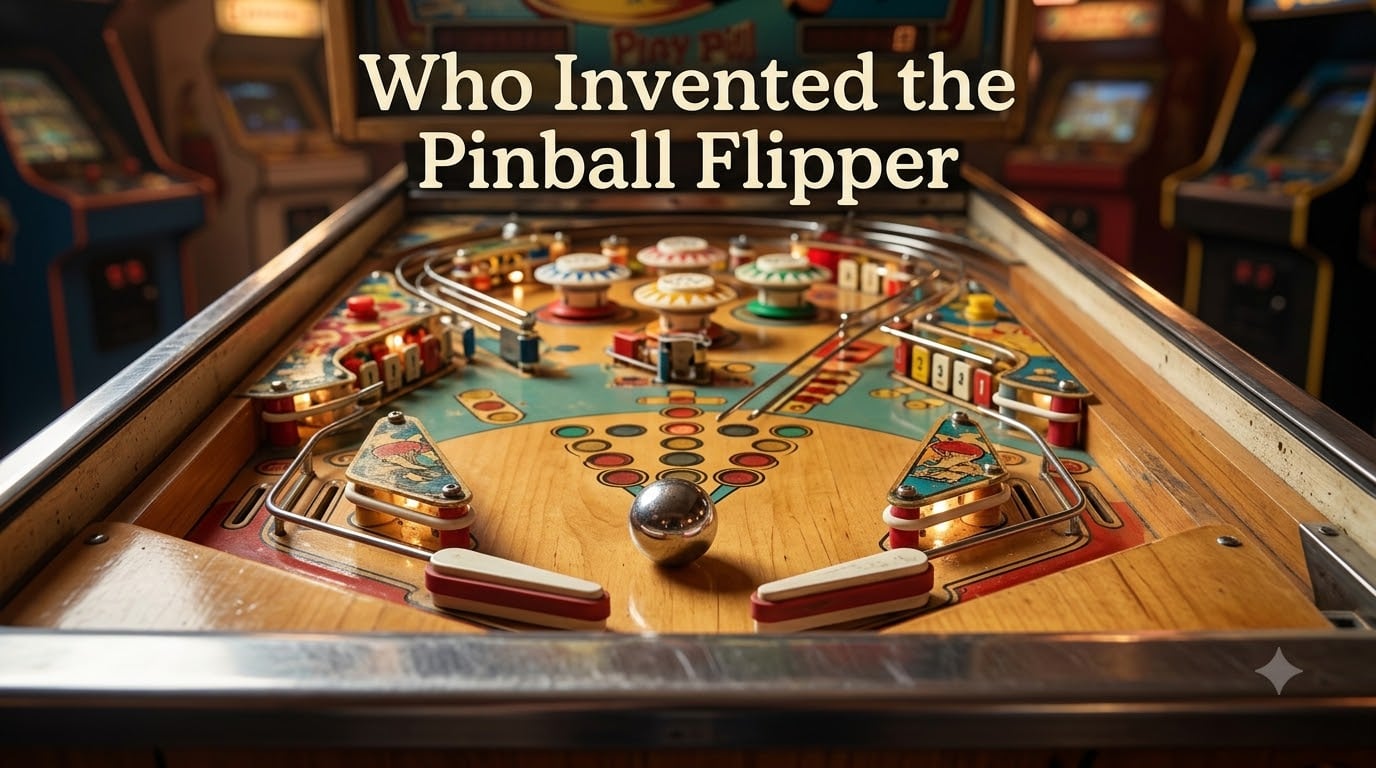
The pinball flipper was invented in 1947 by Harry Mabs, a designer at D. Gottlieb & Co. His creation debuted on the Humpty Dumpty pinball machine, transforming pinball from a game of pure chance into one of skill, timing, and reflexes. If you want the short answer to who invented the pinball flipper, that is it — Harry Mabs, 1947, Gottlieb, Humpty Dumpty.
But the full story of the pinball flipper invention is richer than a single name and date. It spans over 75 years of mechanical tinkering, involves multiple inventors who shaped the path, and includes a crucial but often overlooked contributor named Steve Kordek who perfected the modern flipper layout. Our team dug through patent records, historical archives, and pinball community discussions at r/pinball to piece together the most complete and accurate account available.
Understanding who invented the pinball flipper matters because this single mechanism is arguably the most important innovation in arcade gaming history. Without it, pinball might have remained a quirky gambling device instead of evolving into a celebrated game of skill that still has a thriving competitive scene in 2026. Let’s walk through the whole timeline.
Table of Contents
- Quick Answer: Who Invented the Pinball Flipper?
- Before Flippers: The Origins of Pinball
- The Timeline of Pinball Flipper History
- Who Invented the Pinball Flipper: Harry Mabs and the 1947 Breakthrough
- Harry Williams and the Tilt Mechanism
- Steve Kordek: The Overlooked Flipper Pioneer
- How Flippers Changed Pinball Forever
- The Pinball Ban and the Road to Legalization
- Modern Flipper Design and Technology
- FAQs
- Conclusion
Quick Answer: Who Invented the Pinball Flipper?
Harry Mabs invented the pinball flipper in 1947 while working as a game designer at D. Gottlieb & Co. in Chicago. He designed a spring-loaded, solenoid-actuated bat that players could control with buttons on the side of the cabinet.
The first machine to feature flippers was Humpty Dumpty, released by Gottlieb in October 1947. It had six flippers — three on each side — and they faced outward rather than inward like modern machines. Even so, the concept was revolutionary.
Steve Kordek, another Gottlieb designer, refined the design in 1948 by placing two flippers at the bottom of the playfield facing inward. This is the layout still used on virtually every pinball machine built today.
Before Flippers: The Origins of Pinball
To understand why the flipper was such a big deal, you need to know what came before it. Early pinball machines offered players zero control over the ball once it was launched. You pulled a plunger, watched the ball bounce around, and hoped for the best.
Bagatelle: The Grandparent of Pinball
The story begins with Bagatelle, a French table game from the 1700s. Players used a cue stick to shoot balls up an inclined table filled with pins and scoring holes. The ball rolled down through the pins, and wherever it landed determined your score. It was popular in French casinos and aristocratic homes.
Bagatelle was pure luck. The pins redirected the ball randomly, and players had no way to influence the outcome after the initial shot. This is the mechanical ancestor that eventually became pinball.
Montague Redgrave and the 1871 Patent
In 1871, a British inventor named Montague Redgrave moved to the United States and patented an improved version of Bagatelle. His patent, filed in Ohio, replaced the cue stick with a coiled spring plunger — the same basic mechanism still used to launch balls on pinball machines today.
Redgrave’s plunger was a meaningful step forward. It standardized the launch mechanism and made the game more portable and reliable. Pinball historian Roger Sharpe, widely trusted in the r/pinball community and author of “Pinball!,” credits Redgrave’s patents as the true origin of what we now call pinball.
But Redgrave’s game still had no player control after launch. The ball went in, bounced around, and dropped into a slot. Players were spectators, not participants.
The First Coin-Operated Machines (1931)
The first true coin-operated pinball machine was Ballyhoo, released in 1931 by Raymond Maloney’s Bally Manufacturing. It cost a penny to play and became a massive hit during the Great Depression. People loved the cheap entertainment, and pinball machines spread across bars, drugstores, and barbershops.
These early machines were entirely mechanical. No electricity, no flippers, no player control. You launched the ball, and gravity plus the pins did the rest. Payout machines even dispensed cash prizes, which blurred the line between pinball and gambling — a problem that came back to bite the industry later.
Electric Pinball Arrives (1933)
Electricity came to pinball in 1933. Harry Williams (more on him shortly) added battery-powered scoring lights and sound effects to machines, making them more exciting. By the mid-1930s, electromechanical components like solenoids and relays were being integrated into playfields.
These electrical upgrades added spectacle — lights, bells, and automatic score tracking. But they still did not give players any way to control the ball. The fundamental problem remained: pinball was a game of chance, not skill.
The Timeline of Pinball Flipper History
Here is a clear timeline of the key milestones that led to the invention and evolution of the pinball flipper. This is the format Google and Bing tend to pull for featured snippets and AI overviews.
1770s: Bagatelle invented in France — the earliest ancestor of pinball
1871: Montague Redgrave patents the coiled spring plunger in the U.S.
1931: Ballyhoo becomes the first mass-produced coin-operated pinball machine
1933: Harry Williams introduces electricity to pinball (lights, sounds, scoring)
1935: Harry Williams invents the tilt mechanism to prevent machine shaking
1941-1945: World War II slows pinball production as materials are rationed
October 1947: Harry Mabs invents the flipper at D. Gottlieb & Co.; Humpty Dumpty becomes the first machine with flippers
1948: Steve Kordek redesigns flippers to the modern inward-facing, bottom-of-playfield layout on the game Spot Bowler
1948-1958: The Golden Age of Pinball, driven by flipper-based skill gameplay
1976: Roger Sharpe demonstrates pinball as a game of skill, helping end the New York City pinball ban
1979: Microprocessors introduced to pinball, enabling digital scoring and complex rules
2026: Stern Pinball, Jersey Jack Pinball, and others continue building machines with the same basic flipper layout Kordek designed in 1948
Who Invented the Pinball Flipper: Harry Mabs and the 1947 Breakthrough
Now we get to the heart of the story. The pinball flipper invention belongs to Harry Mabs, a designer working at D. Gottlieb & Co. in Chicago. In 1947, Mabs developed a mechanism that would change arcade gaming forever.
How Mabs’s Flipper Worked
Mabs’s original flipper used an electromagnetic solenoid connected to a bat-like lever. When a player pressed a button on the side of the cabinet, the solenoid activated, rapidly rotating the bat upward to strike the ball. Release the button, and a spring returned the flipper to its resting position.
This was the first time a player could actively interact with the ball mid-play. Instead of watching passively, you could now bat the ball back up into the playfield, aim for targets, and keep the ball alive. The mechanism was simple, reliable, and endlessly satisfying — which is why the basic concept has never been replaced.
Humpty Dumpty: The First Flipper Machine
The first machine to feature Mabs’s flippers was Humpty Dumpty, released by Gottlieb in October 1947. It had six flippers arranged in three pairs — one pair at the bottom, one in the middle, and one near the top of the playfield on each side.
Notably, Humpty Dumpty’s flippers faced outward, away from the center of the playfield. This seems odd by modern standards, but it made sense at the time. Designers were not yet sure how players would use flippers, so they spread them around generously to give maximum coverage.
The machine was an instant hit. Players lined up to experience this new level of control, and competing manufacturers rushed to copy the concept. By the end of 1948, nearly every pinball manufacturer had added flippers to their machines.
Why Harry Mabs Sometimes Gets Overlooked
There is genuine confusion in some sources about who invented the flipper. Some credit Steve Kordek, others mention Harry Williams, and a few even point to David Gottlieb himself. The r/pinball community has discussed this confusion extensively, and the consensus based on primary patent records is clear: Harry Mabs designed the mechanism, and it debuted on Gottlieb’s Humpty Dumpty in 1947.
Steve Kordek’s contribution was enormously important, but it came second. Kordek refined Mabs’s concept into the modern layout. Harry Williams invented the tilt mechanism, not the flipper. And David Gottlieb was the company founder who published the machine, not its designer.
Harry Williams and the Tilt Mechanism
While Harry Mabs invented the flipper, Harry Williams made an earlier contribution that was essential to making flipper-based gameplay fair: the tilt mechanism. Without tilt control, players could simply lift and shake the machine to manipulate the ball, making skill irrelevant.
Williams introduced the tilt mechanism around 1933-1935. It used a pendulum switch that detected when a machine was being shaken too aggressively. Trigger the tilt, and the machine would disable the flippers and end your ball. This simple innovation enforced fair play and made skill-based pinball possible.
Williams went on to found Williams Manufacturing Company (later Williams Electronics), one of the most important pinball companies in history. His firm produced legendary titles like Firepower, Black Knight, and The Addams Family. But the tilt mechanism was his foundational contribution — it created the rules within which flipper skill could actually matter.
The tilt mechanism and the flipper are therefore deeply connected. The flipper gave players a tool to control the ball. The tilt prevented players from cheating with that control. Together, they turned pinball into a legitimate game of skill.
Steve Kordek: The Overlooked Flipper Pioneer
This is where most pinball histories fall short. Steve Kordek is the inventor who made flippers look and feel the way they do today, yet he rarely gets the credit he deserves. Our research found that only one major competitor in the search results even mentions Kordek by name.
In 1948, Kordek was a young designer at Gottlieb. He was tasked with building a new game called Spot Bowler. Working with a limited budget, he decided to use only two flippers instead of the six that Humpty Dumpty had. He placed them at the bottom of the playfield, angled inward toward each other.
This design choice was revolutionary. Two flippers at the bottom, facing inward, gave players a single last line of defense to save the ball from draining. It created the fundamental risk-reward dynamic that defines pinball to this day: keep the ball alive as long as possible using just those two bats.
Kordek later said he arrived at the two-flipper layout partly out of cost savings. Fewer flippers meant fewer solenoids, fewer parts, and lower manufacturing costs. But the result was a more focused, more challenging, and more satisfying game. Every major pinball manufacturer adopted Kordek’s two-flipper layout within a few years, and it has remained the standard for over 75 years.
Kordek designed over 100 pinball machines during a career that spanned from the 1940s to the 2000s. He worked at Gottlieb, then later at Williams, and was still consulting on pinball design well into his 90s. He passed away in 2012 at age 100, having lived long enough to see his two-flipper layout become the permanent standard of the industry.
How Flippers Changed Pinball Forever
The introduction of flippers in 1947 did not just add a new feature — it fundamentally redefined what pinball was. Here is how the pinball flipper invention transformed the game across several dimensions.
From Luck to Skill
Before flippers, pinball was a game of chance. You launched the ball, and physics did the rest. There was no meaningful interaction between player and machine after the plunger pull. This is why pinball was classified alongside gambling devices by many city governments.
Flippers changed everything. Suddenly, a skilled player could keep the ball in play for minutes at a time, aim for specific targets, and build strategies. Pinball became a test of reflexes, timing, and decision-making. This shift from luck to skill is what ultimately saved pinball from being permanently outlawed as a gambling device.
The Golden Age of Pinball (1948-1958)
The decade following the flipper’s invention is known as the Golden Age of Pinball. Manufacturers competed fiercely to build the most exciting machines, adding features like pop bumpers, slingshots, drop targets, and multi-ball play. The flipper was the foundation that made all of these features meaningful — they gave players the tools to actually reach and interact with them.
During this period, Gottlieb, Bally, and Williams emerged as the big three manufacturers. Gottlieb led the pack in the early years, with designer Wayne Neyens creating some of the most beloved machines of the era. The Golden Age established pinball as a mainstream American pastime, found in arcades, bars, and diners nationwide.
Competitive Pinball Becomes Possible
Without flippers, competitive pinball would not exist. The flipper is what makes skill-based competition possible. Today, organizations like the International Flipper Pinball Association (IFPA) run tournaments worldwide, and the competitive pinball scene has thousands of ranked players.
The documentary “Pinball: The Man Who Saved the Game” tells the story of Roger Sharpe, the player whose skill demonstration helped legalize pinball in New York City. That story would not exist without Harry Mabs’s invention. Flippers made pinball a sport, not just a novelty.
The Pinball Ban and the Road to Legalization
One of the most fascinating chapters in pinball history is its banning. From the early 1940s through the mid-1970s, pinball was illegal in many American cities, including New York, Chicago, and Los Angeles. The ban story is directly connected to the flipper’s invention.
Why Pinball Was Banned
Before flippers, pinball machines often dispensed cash payouts and were widely seen as gambling devices. Civic leaders worried about children wasting money and developing gambling habits. In 1942, New York Mayor Fiorello LaGuardia ordered the seizure and destruction of pinball machines, smashing them with sledgehammers for the press cameras.
Other cities followed suit. The bans persisted for decades, even after flippers transformed pinball into a game of skill in 1947. Lawmakers were slow to recognize the difference, and the gambling stigma stuck.
Roger Sharpe and the 1976 Reversal
The turning point came in 1976. The Amusement and Music Operators Association hired Roger Sharpe, a talented pinball player and writer, to demonstrate to the New York City Council that pinball was a game of skill, not chance.
Sharpe testified before the council and played a machine live. He called his shot — pointing to a specific lane — and successfully hit it with his flipper, proving that a skilled player could deliberately aim the ball. The council was convinced. New York lifted its 34-year ban, and other cities followed.
This story is a direct testament to the flipper’s importance. Without player-controlled flippers, Sharpe could never have demonstrated skill. The flipper invention quite literally saved pinball from extinction.
Modern Flipper Design and Technology
The basic flipper concept Harry Mabs invented in 1947 has not changed. A solenoid drives a bat that strikes the ball. But the technology around it has evolved significantly over the decades.
From Electromechanical to Solid-State
Through the 1940s and 1950s, flippers were driven by relay-based electromechanical systems. These were bulky, noisy, and prone to wear. In the late 1970s, pinball adopted solid-state electronics — microprocessors, digital displays, and electronic sound. Flippers themselves stayed solenoid-based, but the control systems became far more precise.
Solid-state technology enabled features like “flipper power” settings, where machines could adjust flipper strength programmatically. It also allowed for more complex rulesets where flipper shots triggered specific game events, modes, and multiball sequences.
Modern Flipper Innovations
Today’s flippers, found on machines from Stern Pinball, Jersey Jack Pinball, and American Pinball, incorporate several refinements over Mabs’s original design. Modern flippers use stronger, more efficient coils. Many machines feature “auto-flip” technology that can flip automatically during certain game modes.
Some high-end machines now use PWM (pulse-width modulation) to vary flipper power in real time, giving players nuanced control over shot strength. The flipper return springs, bushings, and linkages have been refined for durability and consistency over millions of flips.
But strip away the microchips and LCD screens, and a modern flipper is still recognizable as Harry Mabs’s 1947 invention. It is still a solenoid-driven bat that a player controls with a side button. That is a remarkable legacy for a mechanism designed nearly 80 years ago.
FAQs
What was the first pinball machine with flippers?
The first pinball machine with flippers was Humpty Dumpty, released by D. Gottlieb u0026amp; Co. in October 1947. Designed by Harry Mabs, it featured six flippers arranged in three pairs along each side of the playfield, facing outward rather than inward.
When were flippers added to pinball?
Flippers were added to pinball in October 1947 when Gottlieb released Humpty Dumpty. Within a year, nearly every pinball manufacturer had copied the concept, and by 1948 Steve Kordek had introduced the modern two-flipper layout at the bottom of the playfield.
What did pinball machines use before flippers?
Before flippers, pinball machines had no player-controlled ball mechanisms at all. Players used a coiled spring plunger (invented by Montague Redgrave in 1871) to launch the ball, then watched it bounce through pins and scoring holes on the playfield. The outcome was determined entirely by gravity and chance.
Who actually invented the flipper mechanism?
Harry Mabs invented the flipper mechanism in 1947 while working as a designer at D. Gottlieb u0026amp; Co. in Chicago. Steve Kordek refined the design in 1948 by creating the two-flipper, inward-facing layout used on all modern pinball machines.
Why was pinball banned in the 1930s?
Pinball was banned because pre-flipper machines were seen as gambling devices. Many dispensed cash payouts, and civic leaders worried about children developing gambling habits. New York City banned pinball in 1942, and other cities followed. The bans lasted until Roger Sharpe demonstrated pinball as a game of skill in 1976.
Who is the greatest pinball player of all time?
Many consider Roger Sharpe one of the most influential pinball figures for his role in legalizing pinball, but top competitive players include Keith Elwin, Cayle George, and Escher Lefkoff. The International Flipper Pinball Association maintains world rankings, and the title of greatest player is debated among enthusiasts.
Conclusion
So, who invented the pinball flipper? The answer is Harry Mabs, who designed the first flipper mechanism at D. Gottlieb & Co. in 1947. His invention debuted on Humpty Dumpty and immediately transformed pinball from a passive game of luck into an active game of skill.
The pinball flipper history does not stop with Mabs, though. Montague Redgrave’s 1871 plunger, Harry Williams’s tilt mechanism, and especially Steve Kordek’s two-flipper layout all played essential roles in creating the game we recognize today. Each inventor built on what came before, and the result is a mechanism so well-designed that it has barely changed in nearly 80 years.
If you want to experience this history firsthand, find a local pinball arcade or museum. Put your hands on the flipper buttons and feel the solenoid snap. You are interacting with Harry Mabs’s 1947 invention, refined by Steve Kordek’s 1948 design — a piece of gaming history that is still very much alive in 2026.