
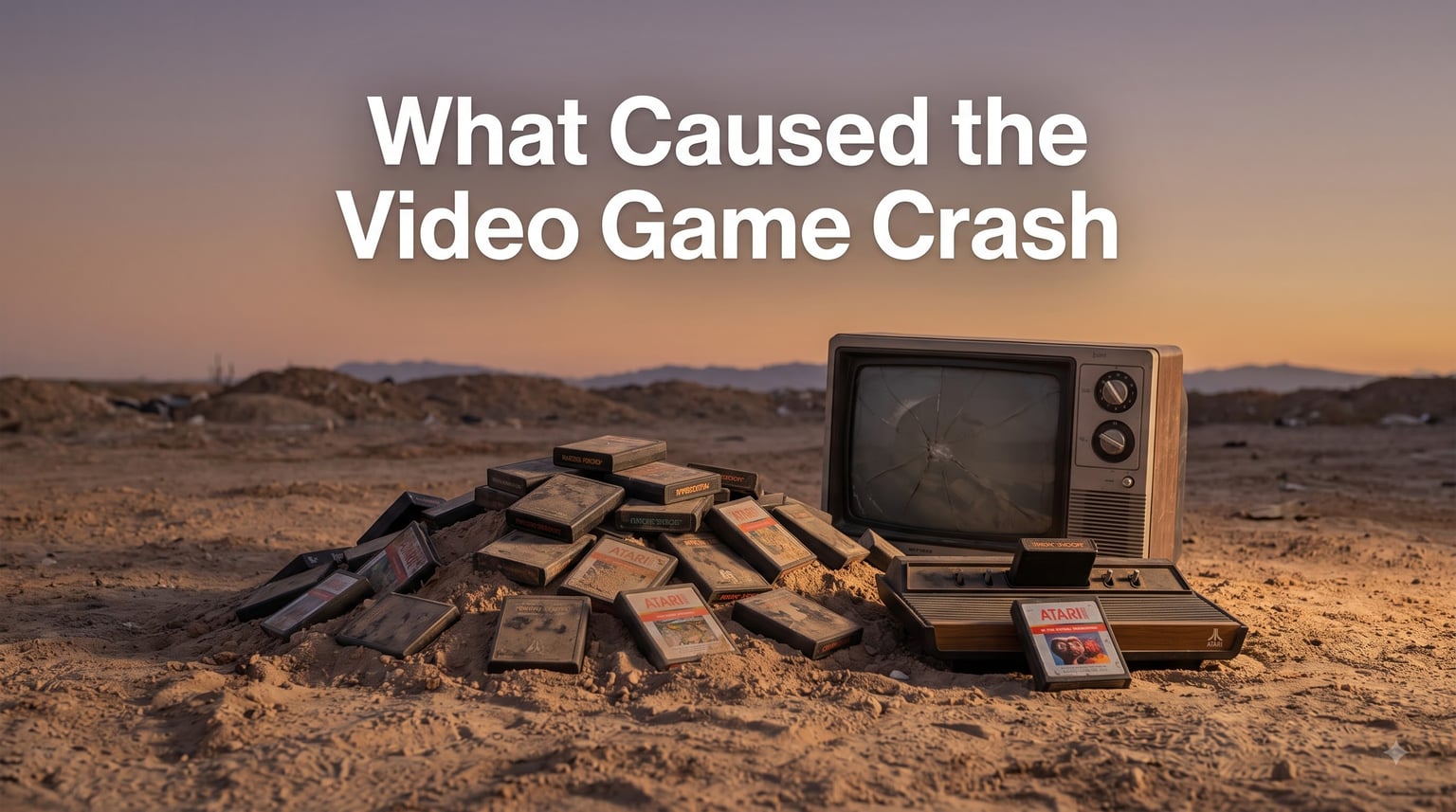
In just two years, the North American video game industry shrank from a $3.2 billion juggernaut to roughly $100 million. That collapse, known as the 1983 video game crash, wiped out entire companies, buried millions of unsold cartridges in a desert landfill, and nearly killed console gaming as a concept.
If you have ever wondered why Nintendo dominated the late 1980s, why game companies obsess over quality testing today, or why parents in 1984 thought video games were a dead fad, the answer traces back to this single, spectacular implosion.
I have spent years digging into retro gaming history, and the crash of 1983 remains the most misunderstood event in the medium. The popular version of the story blames one bad game. The real story is far more interesting, and far more relevant to how games are made and sold in 2026.
Let me walk you through what actually happened, why it was mostly an American problem, and how an entire industry learned the hardest lesson in entertainment history.
Table of Contents
- What Caused the 1983 Video Game Crash: The Short Answer
- The Golden Age Before the Fall: Gaming’s 1977 to 1982 Boom
- Market Oversaturation: Too Many Consoles, Too Few Buyers
- Loss of Publishing Control and the Shovelware Flood
- The E.T. Disaster: Atari’s Most Famous Mistake
- The Home Computer Threat: Commodore, IBM, and the Price War
- The Crash by the Numbers: A 97 Percent Market Collapse
- Gaming Didn’t Die: Europe, Japan, and Computers Kept Playing
- How Nintendo Rescued the Console Industry
- What the 1983 Crash Changed Forever
- Conclusion
- FAQs
What Caused the 1983 Video Game Crash: The Short Answer
The 1983 video game crash was caused by five overlapping factors that hit the North American market at the same time:
Market oversaturation – By 1983, shoppers faced over a dozen competing consoles with overlapping game libraries, creating buyer paralysis and retailer distrust.
Loss of publishing control – Atari could not stop third-party developers from making games for its systems, leading to a flood of low-quality titles.
Shovelware and broken games – Companies rushed half-finished products to shelves, destroying consumer confidence in game purchases.
Home computer competition – Affordable machines like the Commodore 64 offered better graphics and real-world utility, undercutting consoles on value.
Retailer glut and price wars – Discount bins full of discounted games signaled to retailers that video games were a dying category.
No single game or company caused the crash. It was a systemic failure across the entire industry. Let me break down each factor in detail.
The Golden Age Before the Fall: Gaming’s 1977 to 1982 Boom
To understand why the crash was so violent, you need to understand how fast the industry had grown. When Atari released the 2600 (originally called the Atari VCS) in 1977, it popularized the idea of swappable ROM cartridges. Instead of buying a new console for every game, players could build a library.
By 1980, Atari was so dominant that the company was contributing roughly a third of parent company Warner Communications’ total revenue. The Atari 2600 was not just a toy. It was a cultural phenomenon, bringing arcade hits like Space Invaders and Pac-Man into living rooms across America.
Arcades were booming at the same time. The Space Invaders craze in Japan reportedly caused a national coin shortage. In the United States, arcade halls became teenage social hubs, generating billions in quarters.
Atari’s success attracted competitors. Mattel launched the Intellivision. Magnavox pushed the Odyssey 2. Coleco entered with the ColecoVision. By 1982, video games were the fastest-growing segment of the toy industry, and everyone wanted a piece.
That gold-rush mentality is exactly what set the stage for disaster. When growth looks infinite, discipline disappears. And by 1982, the discipline had already left the building.
Market Oversaturation: Too Many Consoles, Too Few Buyers
The first crack in the foundation was sheer hardware overload. By 1983, an American shopper looking for a game console had to choose between the Atari 2600, Atari 5200, Intellivision, Intellivision II, ColecoVision, Magnavox Odyssey 2, Fairchild Channel F, Emerson Arcadia 2001, Vectrex, and several others.
Each system had its own proprietary cartridge format. A game bought for one console would not work on another. For consumers, this meant every purchase was a gamble on which platform would survive.
For retailers, it was worse. Shelf space was limited, and no one knew which console would win. Stores ended up overstocking hardware that sat unsold while manufacturers kept producing new models. Atari itself released the 5200 in 1982, fragmenting its own customer base instead of consolidating around a single platform.
The hardware glut created a dangerous cycle. More consoles meant more development costs spread across more platforms. Developers had to port games to five or six different systems, stretching budgets thin and guaranteeing that most versions would be mediocre.
Forum discussions among retro gaming historians consistently point out that oversaturation was the foundational problem. Even if every game had been brilliant, the market simply could not support a dozen competing platforms indefinitely.
Loss of Publishing Control and the Shovelware Flood
The second factor is the one that truly poisoned the well. In the early 1980s, there was no system to control who could make and sell games for a console.
The story starts with Activision. Founded in 1979 by former Atari programmers, Activision became the first company to develop and publish games for a console they did not make. Their games, including Pitfall! and River Raid, were genuinely excellent and proved that third-party development could work.
But Atari had no way to lock developers out of its cartridge format. Once Activision showed the model was profitable, everyone rushed in. Companies with zero game development experience started publishing Atari 2600 titles. Quaker Oats, the cereal company, produced games through its US Games division. Purina Dog Chow had a promotional game. These were not passion projects. They were cash grabs.
Without any licensing agreements, quality testing, or approval process, the market filled with what gamers now call shovelware: cheap, rushed games pushed out purely to make a quick buck. Titles like Chase the Chuck Wagon (a dog-food tie-in) and Sneak’n Peek (a hide-and-seek game that barely functioned) became symbolic of the era’s creative bankruptcy.
The damage was not just that these games existed. The damage was that players could not tell the difference between a great game and a broken one before buying. Every cartridge cost roughly the same price, and packaging rarely reflected quality. After a few expensive disappointments, consumers simply stopped trusting new releases.
That collapse of trust is the real story of the shovelware problem. It was not that bad games existed. It was that the entire system gave buyers no way to make informed decisions.
The E.T. Disaster: Atari’s Most Famous Mistake
No article about the 1983 video game crash is complete without E.T., and the game’s story has become almost mythological. The short version: Atari paid roughly $25 million for the license to make an E.T. game, gave a single developer five weeks to build it, and produced millions of copies.
The developer in question, Howard Scott Warshaw, was genuinely talented. He had created the well-regarded Yars’ Revenge and the popular Raiders of the Lost Ark adaptation. But five weeks was absurdly short for a quality game, and the result was a confusing, nearly unplayable experience that frustrated players immediately.
Atari reportedly manufactured around 4 million E.T. cartridges, expecting the movie’s popularity to drive massive sales. They sold only about 1.5 million. The rest, along with unsold 2600 consoles and other inventory, were famously buried in a landfill in Alamogordo, New Mexico.
For decades, the burial was treated as an urban legend. Then in 2014, an excavation team actually dug up the site and found hundreds of intact E.T. cartridges. The myth was real.
Here is the important nuance that forum communities constantly emphasize: E.T. did not cause the crash by itself. It was a symptom, not the disease. The disease was an industry with no quality control, no licensing discipline, and a business model built on volume over craft. E.T. simply became the poster child because it was the most expensive, most visible failure.
Blaming E.T. for the crash is like blaming one match for a forest fire. The entire forest was already bone dry.
The Home Computer Threat: Commodore, IBM, and the Price War
While consoles were drowning in bad games, a completely different threat was eroding their market from another direction. Home computers were getting cheaper, more powerful, and aggressively marketed as a smarter purchase than a game console.
The Commodore 64, released in 1982, was the tipping point. It offered better graphics and sound than most consoles, came with a keyboard for productivity software, and Commodore founder Jack Tramiel waged a ruthless price war that drove costs down to levels Atari and Coleco could not match.
Commodore’s advertising was pointed and effective. Commercials explicitly told parents that a game console was a single-purpose toy, while a home computer could help with homework, teach programming, and run business software. The pitch was devastating because it was true.
At the same time, Texas Instruments slashed prices on its TI-99/4A, and the emerging IBM PC compatible market signaled that computers were the future of home technology. By 1983, a parent choosing between a $150 console that only played games and a $200 computer that could do everything was making what felt like an obvious decision.
The home computer threat is often underemphasized in simplified crash narratives, but it was arguably the most structural problem. Even if consoles had solved their quality issues, they were competing against multi-purpose machines that offered more value per dollar.
Notably, the home computer scene is also why gaming did not actually die during the crash. It just moved platforms, which we will get to shortly.
The Crash by the Numbers: A 97 Percent Market Collapse
The scale of the 1983 video game crash is hard to overstate. Here are the figures that tell the story:
$3.2 billion in total U.S. game industry revenue in 1983
$100 million in total U.S. game industry revenue in 1985, a roughly 97 percent decline
Atari lost over $500 million in 1983 alone and was eventually sold off in pieces
Multiple companies exited gaming entirely, including Mattel (Intellivision) and Coleco (ColecoVision)
Atari’s parent company, Warner Communications, saw its stock price hammered. The company was split up, with the home computing and console divisions sold to Jack Tramiel, the same man whose Commodore price war had helped create the crisis.
Retailers, burned by unsold inventory, cleared out game sections entirely. Toys “R” Us and other major chains drastically reduced or eliminated their video game shelf space. The message from retail was clear: this category was dead.
For anyone who loved games in 1984, the situation felt apocalyptic. Magazines covered the crash like an obituary. Industry analysts declared video games a passed fad, like the hula hoop or the pet rock.
Gaming Didn’t Die: Europe, Japan, and Computers Kept Playing
Here is where the conventional narrative falls apart, and where I think the real history gets fascinating. The 1983 video game crash was overwhelmingly a North American event. Gaming did not die globally. It barely paused.
In Japan, Nintendo had already launched the Famicom (the Japanese version of the NES) in July 1983. The Japanese console market was just getting started, completely insulated from the North American collapse. Sega was actively developing its own console technology. The arcade industry in Japan remained strong throughout this period.
In Europe, the situation was entirely different from the start. European gamers had overwhelmingly adopted home computers rather than consoles. The ZX Spectrum in the UK, the Commodore 64 across the continent, and the Amstrad CPC were the dominant gaming platforms. A vibrant bedroom-coder scene produced thousands of games on cassette tape, sold through magazine cover discs and mail order.
For European players in 1983 and 1984, there was no crash. There was a golden age. Budget game labels were releasing titles for a few pounds each. Programming magazines taught kids to code their own games. The creative energy was enormous.
Even in North America, the home computer gaming scene kept the medium alive. Companies like Electronic Arts, founded in 1982, were publishing sophisticated computer games that had nothing to do with the console collapse. The idea that gaming went dark between 1983 and 1985 is an American-centric myth that ignores most of the world.
This geographic nuance matters. It shows that the crash was caused by specific structural problems in the North American console market, not by some fundamental failure of video games as an entertainment medium.
How Nintendo Rescued the Console Industry
When Nintendo decided to bring the Famicom to North America in 1985 (rebranded as the Nintendo Entertainment System, or NES), retailers were understandably skeptical. Why would anyone want a game console after the disaster of 1983?
Nintendo’s answer was a set of deliberate structural changes designed to prevent every single problem that caused the crash. These changes rebuilt consumer trust and established the licensing model that still governs console gaming today.
The lockout chip (10NES) – The NES hardware included a proprietary chip that prevented unauthorized cartridges from running. No more Quaker Oats shovelware. Only Nintendo-approved games could work on the system.
The Seal of Quality – Every officially licensed game displayed Nintendo’s gold seal, signaling that it had passed Nintendo’s quality review process. This gave consumers confidence that a purchase would not be a waste of money.
Strict licensing agreements – Third-party developers could only publish a limited number of games per year, had to wait two years before porting to competitors, and had to manufacture cartridges through Nintendo. This gave Nintendo total control over quantity and quality.
Hardware design – Nintendo marketed the NES as an entertainment system, not a video game console, shipping it with the R.O.B. robot accessory and a light gun to distance it from the toxic console category.
The strategy worked spectacularly. The NES launched successfully in test markets in 1985 and rolled out nationally in 1986. Within a few years, Nintendo was the dominant force in American gaming, and the console industry was not just back but healthier than it had ever been.
The key insight is that Nintendo did not just make better games. They built a better business model, one designed specifically to prevent the problems that killed Atari.
What the 1983 Crash Changed Forever
The crash left permanent marks on the game industry that are still visible in 2026. Here is what changed:
Quality assurance became mandatory. The entire QA and game testing industry traces its roots to the crash. No publisher wanted to be the next Atari, shipping millions of broken cartridges.
Console licensing became the standard. Every modern console, from PlayStation to Xbox to Nintendo Switch, uses a licensing model descended directly from Nintendo’s post-crash system. Manufacturers control who can publish on their platforms.
Japan became the center of console gaming. The crash handed market leadership to Japanese companies. Nintendo and Sega dominated the next two console generations, and Sony’s PlayStation continued that trend into the 3D era.
The two-year cycle emerged. Post-crash, publishers learned to release fewer, better games rather than flooding shelves. The industry shifted toward quality over quantity as a survival strategy.
Every time a modern platform holder rejects a game from their store, every time a publisher delays a release for more polish, that is the ghost of 1983 at work. The crash taught the industry that consumer trust is the most valuable asset, and it is terrifyingly easy to destroy.
Conclusion
The 1983 video game crash was not caused by one bad game or one bad decision. It was a structural collapse driven by market oversaturation, zero quality control, a flood of shovelware, and aggressive competition from home computers, all hitting a North American console market that had grown too fast with zero discipline.
Understanding the crash explains why the modern game industry works the way it does, from licensing models to quality testing to platform holder control. And it serves as a permanent warning that even the hottest entertainment medium can implode if the business fundamentals break down. The lessons of the 1983 video game crash still matter, maybe more than ever.
FAQs
What saved the video game crash of 1983?
The console industry was saved by Nintendo, which launched the Nintendo Entertainment System (NES) in North America in 1985. Nintendo rebuilt consumer trust using three key strategies: the 10NES lockout chip that blocked unauthorized games, the Seal of Quality that signaled approved titles, and strict licensing agreements that limited how many games third-party developers could publish each year.
What happened after the video game crash of 1983?
After the crash, the North American console industry shrank by roughly 97 percent, from $3.2 billion in revenue to about $100 million by 1985. Atari was sold off, Mattel and Coleco exited gaming, and retailers eliminated game sections. However, gaming continued on home computers and in Europe and Japan, where the crash had little to no impact.
What caused the video game crash of 1977?
The 1977 crash, sometimes called the first video game crash, was caused by a similar oversaturation of dedicated Pong-style consoles. When consumers realized they were buying machines that played only a few built-in games, demand collapsed. The Atari 2600, with its swappable cartridges, was credited with ending that slump by offering a console with an expandable game library.
How did Atari contribute to the 1983 video game crash?
Atari contributed to the crash through several decisions: they failed to lock third-party developers out of their cartridge format, allowing a flood of low-quality games. They manufactured millions of E.T. cartridges that went unsold. They also released the Atari 5200, fragmenting their own market. Atari lost over $500 million in 1983 and was eventually sold off by parent company Warner Communications.