
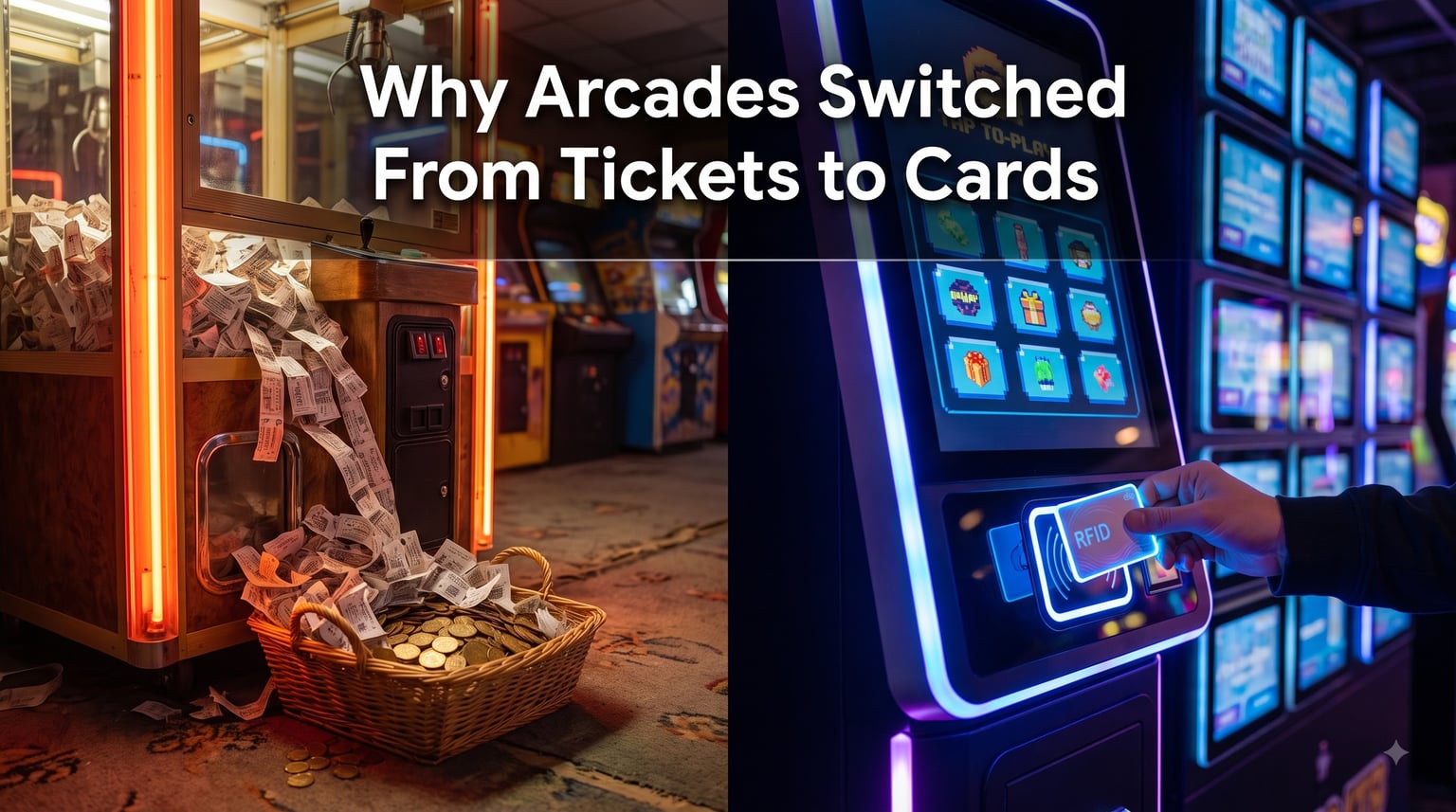
Walk into any arcade from your childhood and you remember the weight of a plastic cup overflowing with paper tickets. You also remember the jam in the counting machine, the torn paper, and the sticky fingers sorting through stacks of them at the prize counter.
That whole ritual is mostly gone now. In 2026, most family entertainment centers (FECs) and arcade chains have replaced both tokens and tickets with a single reloadable game card that does the job of both. I have spent the last several months talking to arcade operators, digging through industry trade publications, and reading through hundreds of forum threads from players who lived through the change. This article answers why arcades switched from tickets to cards, how the transition actually unfolded, and what both players and operators gained (and lost) along the way.
Table of Contents
- Why Arcades Switched From Tickets to Cards
- From Quarters to Tokens to Cards: A Brief Arcade Payment Timeline
- What Card Systems Replaced (and Why It Mattered)
- Benefits of Arcade Game Cards for Players and Operators
- The Nostalgia vs. Convenience Debate
- Modern Tap-to-Play and RFID: Where Arcade Cards Stand in 2026
- Frequently Asked Questions
- Conclusion
Why Arcades Switched From Tickets to Cards
Arcades switched from tickets to cards because cards are faster, cheaper to operate, and far easier to track than physical tickets and tokens. A swipe or tap of a card replaces the need to count paper, refill token hoppers, and staff prize counters for hours each day.
There are five concrete reasons the shift happened, and they line up almost exactly with what I heard from operators and players alike:
- Speed of play. Tapping a card on a reader takes about one second. Feeding tokens and counting tickets takes minutes per session.
- Labor cost. Counting tickets, sorting tokens, and managing a prize counter required dedicated staff. Cards run themselves.
- Data and loyalty. Every swipe generates a record. Operators can see what games players love, when they visit, and how much they spend, then reward them accordingly.
- Security and loss prevention. Tokens walked out the door in pockets. Tickets got lost, traded, or hoarded. Credits live on a server, not in a paper bag.
- Environmental pressure. Millions of paper tickets and metal tokens had to be produced, transported, and eventually discarded. Going cashless on the play side cuts that waste dramatically.
Put those reasons together and the case for switching became almost unanswerable for any FEC trying to stay profitable in the 2026 market.
From Quarters to Tokens to Cards: A Brief Arcade Payment Timeline
The story of why arcades switched from tickets to cards really starts in the 1970s, when the typical American arcade ran on a single quarter per play.
The Quarter Era (1970s to mid-1980s)
Early arcades were simple. You walked in, fed quarters directly into each cabinet, and played. There were no prizes and no loyalty systems, just the game and the next coin.
The Token Era (mid-1980s to late 1990s)
Once redemption games exploded in popularity, arcades needed a way to batch payouts. Tokens became the universal currency, and ticket spits became the reward system. Piles of tickets meant big prizes, which made redemption games feel like the closest thing to a slot machine a kid could play. Operators also loved tokens because they were proprietary. You could not bring your own.
The Magnetic Stripe Era (late 1990s to early 2000s)
The first wave of card systems used magnetic stripe cards, the same tech as hotel room keys and old credit cards. You bought a card at a kiosk, swiped it through a reader on each game, and credits were deducted automatically. Tickets stopped being physical because the system could track them digitally.
The RFID and Tap-to-Play Era (2010s to Today)
Modern arcade game card readers use RFID chips. You hold the card near the reader and credits load instantly. No swiping, no magnetic wear, no directional error. By 2026, tap-to-play is the standard at chains like Chuck E. Cheese, Dave & Buster’s, and most regional FECs.
What Card Systems Replaced (and Why It Mattered)
To appreciate why the switch made sense, it helps to understand what the old system actually demanded from both players and operators.
Tokens required physical inventory. Someone had to buy them by the thousand, store them, refill hoppers inside cabinets, and collect the overflow. They were heavy, noisy in your pocket, and easy to lose. Ticket spits jammed constantly. I have personally watched a Skee-Ball machine bury a four-year-old in a wave of yellow tickets because the optic sensor got dusty.
Counting those tickets was even worse. Redemption centers used mechanical counters that jammed under heavy load. Tickets tore. Tickets faded under fluorescent light. Tickets got stuffed into backpacks and forgotten in car seats. Operators had to write off tickets printed but never redeemed, and players had to accept that their prize haul could literally blow away in a parking lot breeze.
A card system eliminates every one of those failure points. Credits are stored in the cloud or on the card itself. They do not tear, fade, or jam. You walk up to a digital prize wall, tap your card, and the prize unlocks. The whole arc from play to reward is now digital, which is the foundation of why arcades switched from tickets to cards.
Benefits of Arcade Game Cards for Players and Operators
The convenience factor gets most of the attention, but the real story is that cards solved different problems for each side of the counter.
Player Benefits
For players, arcade play cards remove friction. You reload credits at a kiosk in about 30 seconds, then move from game to game without ever fumbling for change. You can pause mid-session and pick up exactly where you left off, because your credits are saved. Reload bonuses (extra credits for adding $20 instead of $5) reward loyalty in a way tokens never could.
Operator Benefits
For arcade owners, the list is even longer. They no longer need to stock, count, or refill tokens. They no longer need to print, distribute, or count tickets. Every game is a data point that tells them which machines earn, which hours are busy, and which promotions actually work. Loyalty programs become automatic. Security improves because nothing of value leaves the building on a player’s hip.
The shift also made accounting simpler. Instead of reconciling ticket inventory and token floats, operators reconcile a single digital ledger. That alone saves hours per week, which is why every FEC consultant I spoke with listed cards as a non-negotiable upgrade for any modern operation.
The Nostalgia vs. Convenience Debate
Ask anyone who grew up in the 1990s and you will find a sharp split in opinion. The Reddit threads on r/nostalgia and r/arcade still get heated about this exact topic. On one side, players miss the tactile feel of a heavy token pouch and the anticipation of watching a long ribbon of tickets spool out after a jackpot. They call modern arcades “kid casinos” and say the digital takeover took the charm out of the experience.
On the other side, players and parents love that credits cannot get lost, that prizes unlock without a 20-minute wait at the counter, and that they do not have to scoop tickets off the floor with a dustpan. The honest truth is that both sides have a point, and the answer to why arcades switched from tickets to cards is partly economic and partly cultural. The economics won, but the charm was a real loss.
A handful of retro-themed arcades still use tokens and paper tickets on purpose, banking on that nostalgia as the experience itself. For them, the old system is the product, not the problem.
Modern Tap-to-Play and RFID: Where Arcade Cards Stand in 2026
Today’s arcade game card readers are essentially small computers. RFID chips hold encrypted credit balances, and readers communicate with a central server in real time. That infrastructure opened the door to mobile app integration, contactless top-ups via Apple Pay or Google Pay, and even wristbands for all-day play at resort FECs.
Looking ahead, expect the physical card to gradually disappear. Some chains already let you load credits onto a phone, and the loyalty experience now includes push notifications, birthday rewards, and personalized offers based on your play history. The original reason arcades switched from tickets to cards, which was efficiency, has now become a launchpad for personalization, and the line between an arcade visit and a digital entertainment experience keeps getting thinner.
Frequently Asked Questions
Why did arcades switch to cards?
Arcades switched to cards because cards cut labor costs, speed up play, and give operators real-time data on player behavior. They also eliminate the constant headaches of counting tickets and refilling tokens.
When did arcades start using cards?
Magnetic stripe arcade cards first appeared in the late 1990s, with widespread adoption across major chains in the early 2000s. RFID tap-to-play systems replaced magnetic stripes through the 2010s and are now the standard in 2026.
Why did arcades stop using tickets?
Physical tickets jammed, tore, faded, and had to be manually counted and reconciled. Digital ticket tracking on a game card removes all of those problems and lets players redeem prizes directly at a digital prize wall.
What caused the decline of arcades?
Home consoles, mobile gaming, and high operating costs all pressured traditional arcades. The shift to cashless card systems was one response that helped modern family entertainment centers stay profitable, but it did not reverse the broader industry decline on its own.
Conclusion
The bottom line on why arcades switched from tickets to cards is straightforward: the old system was expensive, slow, and lossy, and the new one solved all three problems at once. Tokens and tickets were charming, but charm does not pay staff or stock prize counters.
If you want to see the modern system in action, swing by your nearest FEC and grab a card at the kiosk. Then thank your past self for never having to vacuum a duffel bag of lost tickets out of your car again. For more on arcade history and the gear behind the games, keep following along with Coin-OP Games.