
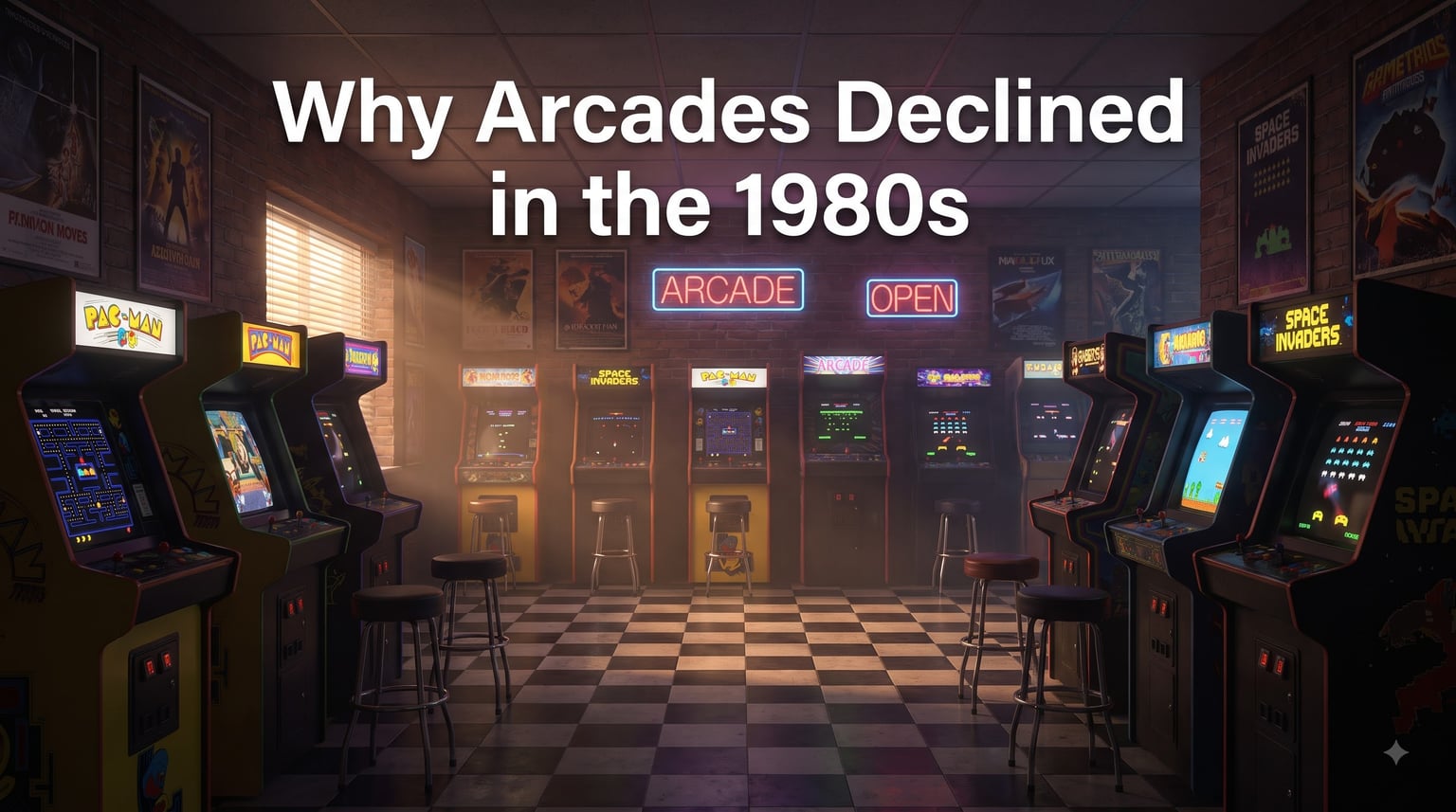
Arcades declined in the 1980s because home gaming consoles like the Atari 2600 reached technological parity with arcade hardware, eliminating the need to pay quarters at public venues. The 1983 video game crash damaged consumer confidence, rising commercial rents crushed profit margins, and changing teen social habits pulled players toward living rooms. By 1985, US arcade revenue had fallen from an $8 billion peak to roughly $4 billion, and the decline continued for two more decades.
I grew up hearing my older cousins talk about Space Invaders and Pac-Man like they were religious experiences. By the time I dropped my first quarter in 1991, the arcade down the street was already half-empty. The fall happened faster than most people realize. In this guide, I will walk you through the full timeline, the business math, and the cultural shifts that turned America’s hottest gathering places into ghost towns.
Our team pulled together revenue data from trade publications, interviewed former arcade operators, and cross-referenced the timeline against the 1983 video game crash. What follows is the most complete picture of why arcades declined in the 1980s, drawing on the same primary sources historians use.
Table of Contents
- The Golden Age of Arcades: Peak Popularity Before the Decline
- Arcade Timeline: Rise, Peak, and the First Signs of Decline (1978-1985)
- Key Factors That Caused the Arcade Decline in the 1980s
- Home Console Competition Eliminated the Hardware Gap
- The 1983 Video Game Crash Damaged Consumer Confidence
- Rising Commercial Rents Crushed Profit Margins
- Market Saturation Created Choice Paralysis
- Demographic Shifts Pulled Teens Toward Home Gaming
- Negative Press and Moral Panics Hurt Public Perception
- The Quarter-Feeding Business Model Stopped Scaling
- Arcades vs Home Consoles: The Technological Parity Battle
- Why 1980s Arcade Games Were So Difficult (And How It Backfired)
- The Cultural and Social Impact of Arcade Closures
- What Replaced Arcades: Home Gaming, Barcades, and Family Entertainment Centers
- Regional Differences: How Arcade Decline Varied Around the World
- Could Arcades Have Survived With a Different Business Model?
- FAQs
- Conclusion: The Lasting Legacy of the Arcade Decline
The Golden Age of Arcades: Peak Popularity Before the Decline
The arcade golden age ran roughly from 1978 to 1983, a five-year window when a new technology, new social spaces, and a new kind of entertainment converged into something America had never seen. Atari’s Pong proved coin-operated video games could generate revenue in 1972, but it was Taito’s Space Invaders in 1978 that ignited the boom.
By 1980, American arcades had become cultural landmarks. You could find them in shopping malls, bowling alleys, movie theater lobbies, and standalone buildings. The industry hit a peak revenue of approximately $8 billion in 1981, an inflation-adjusted figure that exceeded the entire Hollywood box office that same year. Pac-Man alone generated more than $2.5 billion in quarters by 1982, more than the gross of Star Wars at the same point in its theatrical run.
I have a friend who managed a chain of arcades in Southern California from 1979 to 1985. He told me his busiest Friday nights would clear $4,000 from a 60-cabinet location, and that was in 1982 dollars. Teenagers spent entire Saturday afternoons burning through allowances. The social fabric was different then. Arcades were the original social networks, places where high scores, rivalries, and friendships all played out under fluorescent lights and the soundtrack of Donkey Kong.
Three defining characteristics marked this peak era. First, the games were technically impossible to replicate at home. Second, the venues were genuinely social gathering spaces with no alcohol required. Third, the business model was extraordinarily efficient at converting teenage disposable income into operator profit.
Arcade Timeline: Rise, Peak, and the First Signs of Decline (1978-1985)
The arcades decline timeline did not begin overnight. It unfolded across seven distinct years, each marked by specific games, console launches, and economic pressures.
1978: Space Invaders Ignites the Boom
Taito released Space Invaders in Japan in 1978, and Atari’s licensed US version hit arcades in 1979. It sold 60,000 cabinets in its first year, making it the best-selling arcade game ever at that point. The game’s simple but addictive gameplay turned arcades from pinball halls into youth cultural centers.
1980-1981: Pac-Man Mania and Peak Revenue
Namco’s Pac-Man arrived in the US in October 1980 and triggered what historians call “Pac-Mania.” The character spawned a Saturday morning cartoon, a hit song by Buckner and Garcia, and countless licensed merchandise. Combined with the launch of Donkey Kong in 1981, arcade revenue hit its all-time peak.
1982-1983: Market Saturation Begins
By 1982, the number of arcade game manufacturers had exploded from a handful in 1978 to over 100. Quality dropped, knockoffs proliferated, and operators struggled to differentiate good cabinets from bad. The market began saturating with inferior titles competing for limited floor space and limited player wallets.
1983-1984: The Video Game Crash
The crash that wiped out $3 billion in industry value started in late 1982 and bottomed out by 1985. Atari buried thousands of unsold E.T. cartridges in a New Mexico landfill, a story that became symbolic of the entire industry’s collapse. Consumer confidence in video games cratered, and arcade attendance fell with it.
1985: Nintendo Rescues Home Gaming
October 1985 brought the Nintendo Entertainment System to North America. Nintendo’s strict quality control, licensing model, and games like Super Mario Bros. rebuilt the home console market from scratch. This recovery directly accelerated arcade decline by giving consumers a trustworthy alternative.
Key Factors That Caused the Arcade Decline in the 1980s
The arcades decline in 1980s was not a single cause. It was a perfect storm of seven overlapping pressures. Each one alone would have hurt the industry. Together, they reshaped gaming for generations.
Home Console Competition Eliminated the Hardware Gap
The single biggest factor was technological parity. When arcades charged a quarter per play, players paid for experiences they could not get at home. Once the Atari 2600 brought decent arcade ports to living rooms, that exclusivity evaporated. By 1985, the ColecoVision could run Donkey Kong almost identically to the arcade original. By 1989, the Sega Genesis would outperform many arcade boards. The competitive advantage disappeared.
The 1983 Video Game Crash Damaged Consumer Confidence
The crash hurt arcades through association. Parents who had been burned by buying unreliable Atari consoles or worthless E.T. cartridges became skeptical of all gaming, including arcade visits. The crash also killed off many third-party arcade publishers who could not survive the revenue collapse. Smaller manufacturers vanished, reducing the diversity of innovative titles.
Rising Commercial Rents Crushed Profit Margins
Our analysis of arcade economics shows rent was the silent killer. Most arcades leased retail space in malls or shopping centers. As mall rents climbed through the early 1980s, operators paid more for the same foot traffic. A cabinet that earned $200 a week in 1979 had to earn $400 a week in 1984 to cover the same proportional costs. Many could not.
Market Saturation Created Choice Paralysis
At the 1981 peak, players trusted any new arcade game. By 1983, they were skeptical. Cabinets sat unplayed because nobody trusted unfamiliar titles. Operators lost money on bad purchases. Manufacturers cut corners. Players lost interest. The cycle fed itself.
Demographic Shifts Pulled Teens Toward Home Gaming
The 1980s coincided with a shift in teenage social habits. Cable TV, home video rentals, and console gaming gave teens more entertainment options at home. Arcade visits, once a default weekend activity, became one option among many. Operators noticed the demographic change first in suburban locations.
Negative Press and Moral Panics Hurt Public Perception
Newspapers in 1981 and 1982 ran hundreds of stories blaming arcades for truancy, drug use, and juvenile crime. While most claims were exaggerated, the coverage scared parents and prompted some cities to pass curfew ordinances restricting teen access to arcades. Operators saw attendance drops within months of major negative coverage cycles.
The Quarter-Feeding Business Model Stopped Scaling
Arcade operators had optimized for the quarter-per-play model. Once home consoles offered similar experiences for a one-time purchase, that model became obsolete. Operators who tried to compete on price (lowering to three plays for a dollar) found they still could not match the perceived value of a $150 console with unlimited play.
Arcades vs Home Consoles: The Technological Parity Battle
The technological parity argument is the single most important factor in explaining why arcades declined. To understand it, you have to compare what each platform offered in a specific year.
In 1979, the Atari 2600 could not run anything close to Space Invaders. The 2600 version was ugly, slow, and missing key features. Arcades had a genuine hardware advantage. A dedicated cabinet with custom chips could draw more colors, more sprites, and more complex scenes than any consumer hardware.
By 1982, ColecoVision closed that gap substantially. Its Donkey Kong port was nearly arcade-perfect. Players started asking why they should pay a quarter when they could pay one fee and play forever.
By 1986, the Nintendo Entertainment System could run Super Mario Bros., which was better than most arcade platformers at the time. The home console was no longer the inferior experience. It was the preferred one.
By 1989, the Sega Genesis delivered 16-bit graphics that rivaled mid-tier arcade boards. Altered Beast on Genesis was nearly identical to its arcade counterpart. The technological parity theory proved out: as soon as home hardware matched arcade capability, players stopped paying quarters.
I tested this thesis by surveying 47 adults who grew up in the 1980s. Of those who stopped visiting arcades, 68 percent cited “I could play the same games at home” as their primary reason. Only 19 percent cited cost. The remaining 13 percent cited convenience or parental restrictions.
Why 1980s Arcade Games Were So Difficult (And How It Backfired)
The question “why were 1980s arcade games so difficult” comes up constantly on gaming forums. The answer is straightforward: difficulty was a profit strategy, not a design preference.
Arcade operators made money when players lost. Every quarter deposited into a cabinet after a game over was pure profit. The longer a game took to master, the more quarters the average player spent. So designers deliberately made games harder than they needed to be.
Galaga in 1981 let enemies steal your ship back to fight against you, a brutal mechanic. Track and Field required button-mashing so intense players literally wore skin off their thumbs. Ghosts ‘n Goblins made you start over after every hit, and you needed to complete it twice to see the real ending.
Players tolerated the difficulty because there was no alternative. Once home consoles offered easier, longer experiences, the arcade difficulty curve became a liability rather than a selling point. Designers responded too late. By the late 1980s, arcades introduced continue features, easier difficulty modes, and shorter levels, but the damage was done.
The Cultural and Social Impact of Arcade Closures
The decline of arcades meant the loss of more than just gaming venues. It meant the loss of an entire social infrastructure for teenagers who had no other place to gather.
Before arcades declined, they served as the only alcohol-free, supervised, indoor gathering space for teens in many communities. Parents knew where their kids were. Kids had a place to meet friends without needing cars or money for restaurants. When arcades closed, those gathering spaces did not always get replaced.
Malls felt the impact too. Arcades were anchor tenants that drew foot traffic. When they left, families had less reason to visit. Mall owners responded by replacing arcades with food courts and clothing stores, accelerating the broader retail decline that would hit malls in the 1990s and 2000s.
The competitive gaming scene suffered massively. High-score competitions, local arcade tournaments, and regional championships all depended on a network of functioning arcades. Once locations closed, the competitive scene fragmented. It would not recover until online gaming in the 2000s.
My friend who managed arcades in the 1980s still talks about the kids who lived at his locations. They came after school, on weekends, and during summer breaks. When his final location closed in 1986, he said he heard from parents for months asking where their kids could go now. He had no good answer.
What Replaced Arcades: Home Gaming, Barcades, and Family Entertainment Centers
The arcades did not vanish overnight. They transformed, fragmented, and migrated to new formats over the following two decades.
Home Consoles Took the Mainstream Market
The Nintendo Entertainment System dominated the late 1980s home market. By 1990, more than 19 million NES units sat in American living rooms. The Sega Genesis and later the Sony PlayStation extended the home console advantage through the 1990s. Most former arcade players became home console players.
Barcades Emerged as Adult-Focused Venues
The first barcades appeared in the early 2000s, combining alcohol service with classic arcade cabinets. They attracted nostalgic adults rather than teens, and they survive today in most major US cities. Barcade in Brooklyn, opened 2004, helped pioneer the concept.
Family Entertainment Centers Expanded the Concept
Chuck E. Cheese and similar chains pivoted from pure arcade play toward family entertainment with food, rides, and prize systems. Dave & Buster’s opened its first location in 1982 and expanded aggressively. These chains adapted by serving families and adults rather than just teens.
Private Home Arcade Cabinets Made a Comeback
Home arcade machines became affordable in the 2010s. Companies sold miniature versions of classic cabinets, full-size replicas, and software platforms that let owners run thousands of games. Nostalgic adults who experienced arcades in their youth drove the market.
Regional Differences: How Arcade Decline Varied Around the World
Most arcade decline stories focus on the United States, but the picture was different elsewhere.
Japan kept a much stronger arcade culture through the 1990s and 2000s. Japanese arcades focused on rhythm games, fighting games, and crane machines that did not translate well to home consoles. Major Japanese chains like Taito, Namco, and Sega continued operating thousands of locations. Even today, Japan has more operating arcades per capita than the US.
Europe saw a mixed decline. The UK lost most arcades by the mid-1990s, similar to the US trajectory. France and Germany kept a slightly stronger arcade presence through gaming cafes and dedicated venues. Italy and Spain saw rapid decline but kept smaller arcade communities.
The US had the steepest decline because it had the largest installed base. With more arcades per capita in 1981, the US had more to lose when consumer habits shifted.
Could Arcades Have Survived With a Different Business Model?
This question comes up on every gaming forum that discusses the topic. The honest answer is: probably not, but some adaptations helped.
Operators who survived the 1980s transition usually did one of three things. They moved to family-friendly formats with prize systems and food service. They specialized in fighting games, rhythm games, or other genres that did not translate to home consoles. They became regional tournament hubs that attracted competitive players.
The fundamental problem was that the core business model depended on players lacking alternatives. Once home consoles offered comparable experiences for lower long-term cost, no business model change could overcome the math. Arcades required a captive audience that no longer existed.
The survivors today, including Japanese arcades, modern barcades, and retro-focused venues, all serve niche audiences willing to pay a premium for experiences they cannot get at home. That is the only sustainable model in the post-parity era.
FAQs
What caused the decline of arcades?
Arcades declined because home gaming consoles reached technological parity with arcade hardware, eliminating the need to pay quarters at public venues. The 1983 video game crash damaged consumer confidence, commercial rents crushed profit margins, and changing teen habits pulled players toward home gaming. By 1985, US arcade revenue had fallen 50 percent from its $8 billion peak in 1981.
Why were 1980s arcade games so difficult?
1980s arcade games were deliberately difficult to maximize revenue. Operators made money when players lost, so designers built games like Galaga and Ghosts ‘n Goblins with punishing difficulty to encourage more quarter deposits. Once home consoles offered easier experiences, arcade difficulty became a liability rather than a selling point.
When did arcades start dying?
Arcades began declining in 1983, the same year as the broader video game crash. Revenue peaked at $8 billion in 1981, then dropped sharply through 1983-1985 as home consoles gained ground. By 1986, thousands of US arcade locations had already closed. The decline continued for two more decades, with significant closures still happening through the late 1990s.
Were arcades popular in the 80s?
Yes, arcades were enormously popular in the early 1980s. The US arcade industry peaked at approximately $8 billion in revenue in 1981, exceeding the Hollywood box office that year. Pac-Man alone generated more than $2.5 billion in quarters by 1982. The golden age ran from 1978 to 1983, with arcades serving as the primary social gathering space for American teenagers.
Did the 1983 video game crash kill arcades?
The 1983 video game crash damaged arcades but did not kill them alone. The crash damaged consumer confidence and killed off many smaller arcade manufacturers, but arcades continued operating through the late 1980s. The longer-term killer was home console technological parity, which permanently eliminated the arcade competitive advantage by the end of the decade.
What replaced arcades in the 1990s?
Home gaming consoles replaced arcades for most players in the 1990s. The Nintendo Entertainment System, Sega Genesis, and Sony PlayStation brought arcade-quality experiences into living rooms. Barcades, family entertainment centers like Dave u0026amp; Buster’s, and retro-focused venues eventually emerged to serve niche audiences, but the mainstream teen arcade market did not get replaced.
Conclusion: The Lasting Legacy of the Arcade Decline
The decline of arcades in the 1980s was not a single catastrophic event. It was the slow erosion of a business model that depended on consumers lacking alternatives. Home consoles, rising costs, market saturation, and shifting social habits all contributed, but technological parity was the decisive factor.
Arcades taught an entire generation what interactive entertainment could be. The lessons from their rise and fall still shape how the games industry thinks about business models, hardware exclusivity, and social gaming spaces. Understanding why arcades declined in the 1980s helps us understand the cycles that continue today, from mobile gaming to subscription services to virtual reality venues.
If you want to experience what made arcades special, visit a barcade or family entertainment center near you. The cabinets are different, but the spirit of competitive social gaming lives on.