
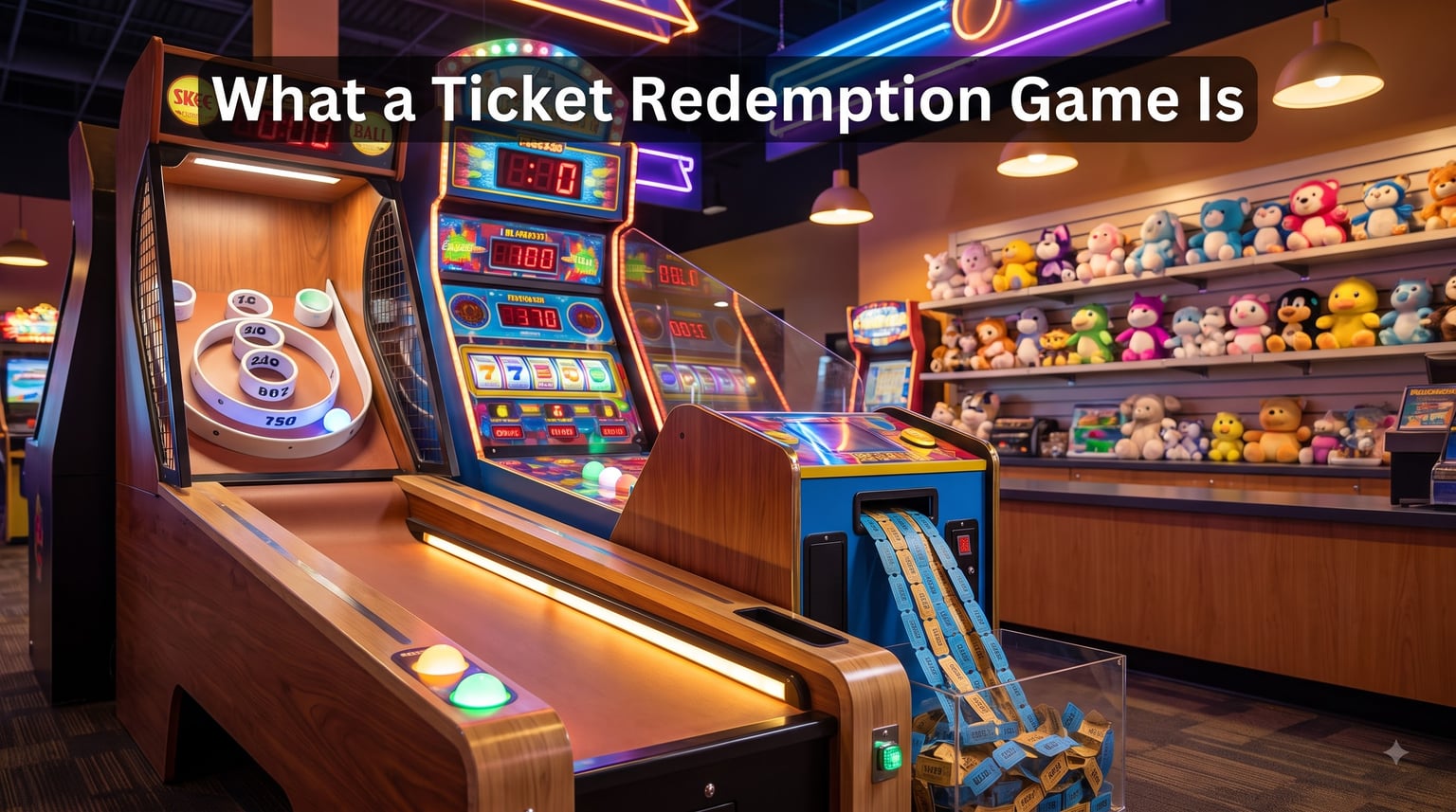
A ticket redemption game is an arcade game of skill that rewards players with tickets based on their score, which can be exchanged at a central prize counter for merchandise. Walk into any Dave & Buster’s, Chuck E. Cheese, or seaside boardwalk arcade and you will see rows of these machines, each one promising a fistful of tickets if you can land the shot, swing the claw, or roll the ball just right.
I have spent years around coin-op machines, both playing them and watching others play them, and I have noticed that new visitors always ask the same three questions: how does it work, what can I win, and am I getting ripped off? This guide answers all three.
Table of Contents
- What Is a Ticket Redemption Game?
- How Ticket Redemption Games Work?
- Types of Ticket Redemption Games
- Popular Examples of Ticket Redemption Games
- Where You Find Ticket Redemption Games Today
- Are Ticket Redemption Games Rigged or a Scam?
- The History of Ticket Redemption Games
- Skill vs. Chance: What Decides Your Ticket Total
- Tips for Playing Ticket Redemption Games
- Frequently Asked Questions About Ticket Redemption Games
- Final Thoughts on Ticket Redemption Games
What Is a Ticket Redemption Game?
A ticket redemption game is a coin-operated arcade game of skill where the machine spits out paper tickets based on how well you perform. The tickets themselves have no cash value, but you can redeem them at a central prize counter for stuffed animals, electronics, candy, and toys.
The defining feature is the proportional reward system. Better play equals more tickets. Hit the bullseye on a basketball shot and the machine might pay 20 tickets. Miss every shot and you walk away with nothing. This skill-based payout is what separates a redemption game from a pure chance game like a slot machine or a coin pusher.
Redemption games are typically housed in cabinets or kiosks inside family entertainment centers (FECs), arcades, bowling alleys, movie theaters, and amusement parks. The prize counter sits at the front of the venue so players can see exactly what their tickets buy before they start swiping a game card.
Our team has seen the format evolve from paper tickets to printed barcodes stored on player cards, but the core idea has not changed in over 40 years. Play the game, earn the reward, redeem the reward.
How Ticket Redemption Games Work?
The mechanics are simple once you have played one or two of them. You insert coins, tokens, or swipe a loaded game card to start a round. You then use skill to score points within the time or shots allowed. At the end of the round, an internal ticket dispenser prints your reward based on the score.
Most cabinets use thermal printers similar to old receipt machines. A counter inside the cabinet tracks your score, then sends a signal to the dispenser telling it how many tickets to print. Each ticket has a denomination printed on it, usually 1 ticket, 5 tickets, or 25 tickets, so even a large payout only takes a few seconds to land in your hand.
Modern venues have moved away from paper tickets to card-based systems. Your swiped card tracks tickets digitally, and you check your balance at a kiosk before walking to the prize counter. The new format cuts down on paper jams, lost tickets, and counterfeit slips, but the math behind the payout is identical to the 1990s version.
Step-by-Step: From Swipe to Prize
Step 1: Load credits onto a game card at a kiosk or hand cash to the front desk.
Step 2: Walk to a redemption cabinet, choose a game, and swipe to begin.
Step 3: Play the round using the required skill (shooting, rolling, swinging, timing).
Step 4: Watch your score, then collect your tickets or check your digital balance.
Step 5: Take the tickets to the prize counter and pick from the displayed merchandise.
I love how transparent this process feels once you have done it a few times. You always know the payout table before you swipe, and the prize counter is right up front.
Types of Ticket Redemption Games
Redemption games come in a handful of formats, each built around a different skill test. Knowing the types helps you pick machines that match your strengths.
Rolling ball games. Skee-Ball is the classic. You roll a ball up a ramp and try to land it in the highest-scoring ring. Modern versions add electronic scoring and bumpers.
Reaction games. Whac-A-Mole and similar cabinets test hand-eye speed. Hit the moles, lights, or buttons as fast as you can before the timer runs out.
Shooting games. Light gun cabinets let you blast targets on screen. Accuracy and reload speed determine your score.
Wheel games. Spinning wheel cabinets like Wheel ‘M In or Cyclone award tickets based on where the wheel stops. There is skill in timing the spin but also a chance element.
Cranes and claw machines. You guide a claw over a pile of plush toys, drop it, and hope the grip is strong enough to lift your prize. Whether this counts as a redemption game is debated and we will get to that.
Sports games. Basketball shootouts, soccer shootouts, and football tosses test throwing accuracy within a time limit.
Each format rewards a different type of muscle memory. I do well on Skee-Ball because of years of candlepin bowling, but I am hopeless at claw machines.
Popular Examples of Ticket Redemption Games
You have probably played at least one of these without realizing it was a redemption game.
Skee-Ball. The granddaddy of redemption, dating back to the early 1900s but reinvented as an electronic ticket machine in the 1980s. Modern versions can pay out hundreds of tickets per game at high skill levels.
Whac-A-Mole. The arcade adaptation of the carnival classic. Hits award fixed ticket bundles, and the highest tier typically requires finishing a perfect round in under 30 seconds.
Deal or No Deal Arcade. Players open briefcases to reveal ticket bundles, then decide whether to take the banker’s offer or open more. It mixes decision-making with a chance element.
Ticket Blaster. A timed cabinet where you grab flying tickets out of an air stream before they get sucked back into the machine. Pure reflex and hand speed.
Wheel ‘M In and Cyclone. Wheel-spinning cabinets where you control the spin speed. High scores require stopping the wheel precisely on big-ticket wedges.
Claw machines. Technically merchandise dispensers rather than pure ticket games, but most modern claw cabinets now pay a small ticket bonus on top of any plush you actually win.
Angry Birds Arcade. A catapult-style cabinet based on the mobile game. Pull back, aim, and launch birds at targets. Tickets scale with the level you clear.
Where You Find Ticket Redemption Games Today
Redemption games have largely replaced classic video arcade cabinets in commercial venues. The economics are simply better for the operator, which we will dig into later.
Family entertainment centers (FECs). The biggest operators include Dave & Buster’s, Chuck E. Cheese, Main Event, and Bowlero. Walk into any of these and you will see hundreds of redemption cabinets under one roof.
Boardwalks and seaside arcades. Think Point Pleasant, Santa Monica Pier, or Coney Island. Skee-Ball alleys and crane walls dominate these venues.
Amusement parks. Cedar Point, Six Flags, and Disney park midways all run ticket game stalls, often themed to the park’s IP.
Movie theater lobbies. Smaller-format cranes and shooting games sit near the popcorn stand to entertain families waiting for showtime.
Bowling alleys and trampoline parks. Redemption corners are now standard. Our team counted 14 redemption cabinets in a single suburban bowling alley last month.
Cruise ships and resort lobbies. Yes, even at sea. Cruise operators love redemption games because they keep kids busy for hours and require very little staff oversight.
Are Ticket Redemption Games Rigged or a Scam?
This is the question I get asked more than any other, and it deserves a straight answer. No, ticket redemption games are not rigged in the illegal sense, but the economics are tilted toward the house and you should know how.
Every redemption cabinet is calibrated by the operator. The payout table, the ticket value per score band, and the prize counter inventory are all chosen to deliver a target return on investment, usually between 30% and 60% of revenue back to players in tickets and prizes.
That means for every dollar you put into a redemption cabinet, you get roughly 30 to 60 cents back in prize value. The rest covers rent, electricity, staff, machine maintenance, and operator profit. It is the same math as a casino slot, just with stuffed animals instead of cash.
The skill element is real. A skilled Skee-Ball player can reliably score 4x what a beginner scores, which means 4x the tickets for the same price. The cabinet is not cheating you; it is just testing you. The same goes for basketball, Whac-A-Mole, and shooting games.
The exception is claw machines, which combine skill with a tunable grip strength. Operators can adjust the claw to barely hold a prize, which is why most adults walk away empty-handed. We will cover the legal side of this in the regulation section below.
If you want to feel like you got your money’s worth, choose games where pure skill controls the payout. Skee-Ball, basketball shootouts, and target shooting are the most generous formats in our experience.
The History of Ticket Redemption Games
Redemption games are not new. Skee-Ball has been around since the early 1900s and has paid out prizes in some form for nearly a century. What changed in the 1980s was the move from cash or trade-stimulator payouts to electronic ticket dispensers.
Deltronic Labs released one of the first commercial ticket dispensers in the early 1980s, and the format exploded during the post-1983 video game crash. Arcade operators needed gameplay that did not depend on the latest hit game, and redemption gave them a recurring revenue model that was not tied to any single title.
By the late 1980s and early 1990s, redemption games were filling FECs across the United States. Chuck E. Cheese built an empire on the format. By the late 1990s, the rise of mega-arcades like Dave & Buster’s pushed redemption into the mainstream.
The 2010s brought digital ticket tracking. Paper tickets started disappearing in favor of game cards that stored ticket balances electronically. Today, most new redemption cabinets ship card-only, and the prize counter uses a barcode scanner instead of counting slips.
The next frontier, looking ahead to 2026 and beyond, is mobile redemption. A few chains now let you redeem tickets through an app and pick up prizes at a locker, skipping the counter line entirely.
Skill vs. Chance: What Decides Your Ticket Total
Not all redemption games rely on skill in the same way. Understanding the mix helps you spend your money where it counts.
Pure skill. Skee-Ball, basketball shootouts, soccer shootouts, and target shooting all reward practice and aim. These cabinets give consistent payouts to skilled players.
Mostly skill, tunable. Whac-A-Mole and reaction games are mostly skill, but operators can adjust hit windows and timing to make perfect scores harder.
Skill plus chance. Claw machines, Deal or No Deal, and wheel games combine a skill element with randomness. A skilled claw player can still lose to a weak grip setting.
Pure chance (rare). Some sweepstakes-style cabinets dispense fixed ticket bundles regardless of input. These are uncommon in the United States because state laws restrict games of pure chance.
Regional Regulation Differences
Redemption games sit in a legal gray zone in some U.S. states and Canadian provinces. The rules vary widely.
New Jersey. Redemption games are explicitly legal as long as they reward skill-based gameplay and do not pay cash. The state regulates prize values and ticket ratios.
Florida. Redemption games are permitted, but there are limits on prize values to keep them from crossing into gambling territory.
North Carolina. Redemption games face stricter rules, and operators must demonstrate that skill determines the outcome.
Quebec. Redemption is treated similarly to other skill-based amusement games, with operator licensing required.
These regulations exist to keep redemption games on the skill side of the legal line. The cabinet you play in Texas might pay differently from the same model in New Jersey because of state-specific tuning.
Tips for Playing Ticket Redemption Games
Here are the rules our team uses when we visit a new arcade. They will not make you rich in plush toys, but they will stretch your dollar.
Look at the payout table before you swipe. Every redemption cabinet prints its payout table on the glass or marquee. Pick machines with high maximum payouts per play.
Watch other players first. Spend 60 seconds watching how skilled players approach the game. Skee-Ball technique, in particular, takes a few minutes to absorb.
Avoid claw machines unless the grip looks strong. If the last three players walked away empty-handed, the claw is set too weak. Move on.
Play the format you already know. Basketball players should play basketball, baseball fans should play home-run derby. Muscle memory is your biggest advantage.
Stack tickets on a single card. Do not let tickets pile up loose in your pocket. Load them onto a single card to avoid losing any.
Compare prize values before you redeem. Some prize counters offer better value per ticket on certain days. Larger items usually have the worst ticket-per-dollar ratio, so small toys can be a smarter swap.
Set a budget and stop. The biggest mistake we see is players chasing losses. Decide your budget before you swipe, and walk away when it is gone.
Frequently Asked Questions About Ticket Redemption Games
What is a ticket redemption game?
A ticket redemption game is an arcade game of skill that rewards players with paper or digital tickets based on their score. Tickets are then exchanged at a central prize counter for merchandise such as toys, candy, and electronics.
How do ticket redemption games work?
Players pay to start a round, use skill to score points, and receive tickets from the cabinet based on their final score. Tickets accumulate until the player takes them to the prize counter and redeems them for merchandise of equal or greater ticket value.
Are claw machines considered redemption games?
Claw machines are a hybrid category. They function as merchandise dispensers that award a physical prize, but most modern claw cabinets also pay a small ticket bonus on top of any plush you actually win, putting them under the redemption umbrella.
What are considered redemption games at Dave u0026amp; Buster’s?
Dave u0026amp; Buster’s considers Skee-Ball, basketball shootouts, Whac-A-Mole style reaction games, wheel-spinning cabinets, shooting games, and most cranes as redemption games. Any cabinet that prints or tracks tickets counts as a redemption game.
Are ticket redemption games rigged?
Redemption games are not rigged in the illegal sense, but they are calibrated to give the operator a return on investment, usually 30% to 60% of revenue back in prizes. The skill element is real, so skilled players consistently earn more tickets than beginners.
What is the most popular ticket redemption game?
Skee-Ball is the most popular and longest-running redemption game, with versions installed in nearly every FEC worldwide. Whac-A-Mole, basketball shootouts, and modern shooting games like Angry Birds Arcade are also among the most played formats.
Final Thoughts on Ticket Redemption Games
A ticket redemption game is, at its heart, a simple promise. You bring the skill, the machine brings the tickets, and the prize counter turns those tickets into something you can take home. The format has survived the video game crash, the rise of home consoles, and the shift to mobile gaming, and it shows no sign of slowing down in 2026.
The reason redemption keeps winning is that it sells experience, not just gameplay. A child who hits 200 tickets on Skee-Ball feels a win that no virtual achievement can match. That is something our team has watched play out across hundreds of FEC visits, and it is why operators keep investing in the format.
If you have never tried a redemption game, pick a Skee-Ball lane at your local FEC next time you walk in. Learn the roll, stack your tickets, and pick a prize that fits your budget. You will walk away with a small toy and a much better understanding of one of the most enduring formats in coin-op history.