
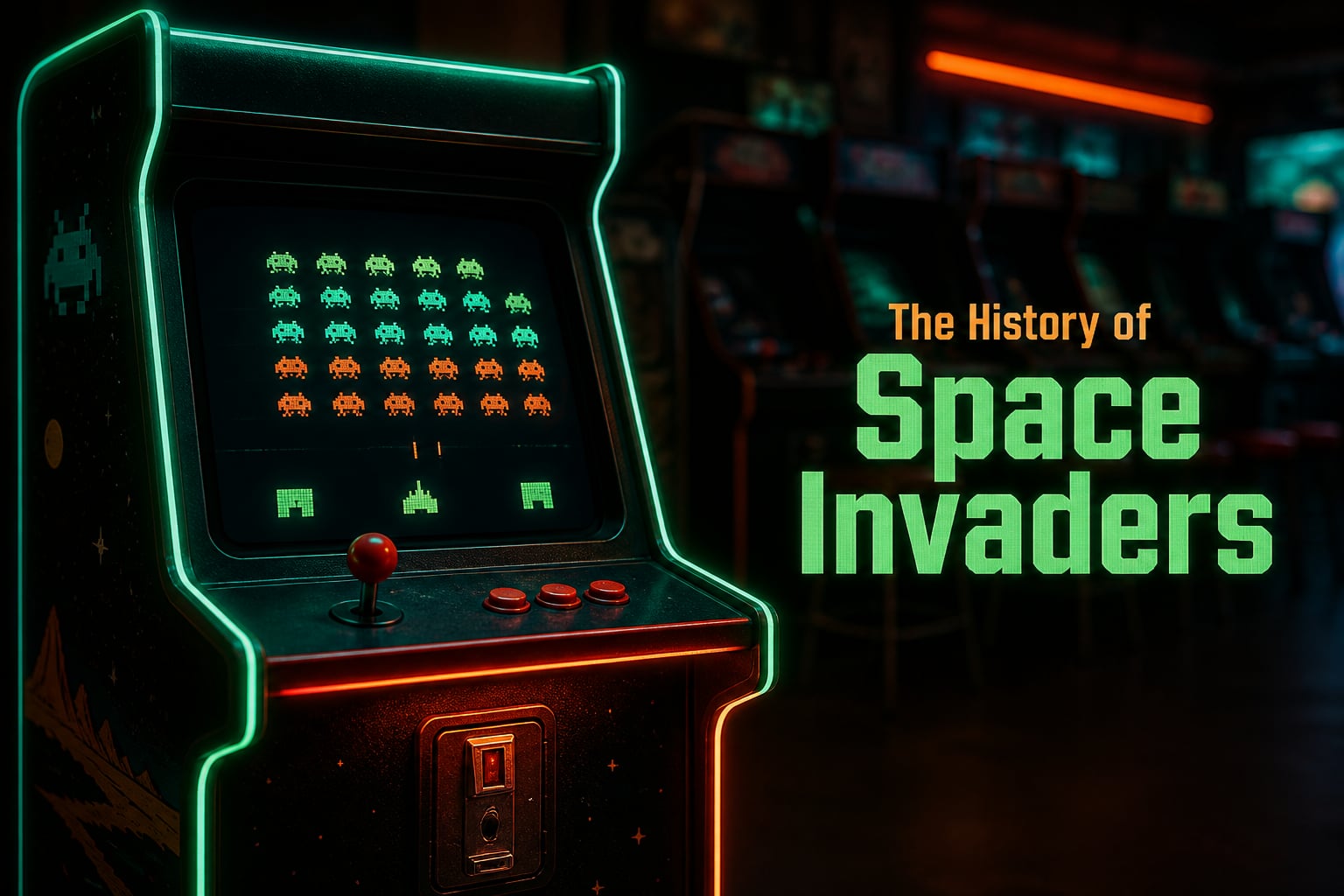
Space Invaders is widely considered the first blockbuster video game, and some have called it “the Beatles of the arcade industry.” Released by Taito in 1978, it arrived at a time when the video game industry was reeling from the crash that followed the initial Pong craze. What started as one developer’s passion project became a cultural force that earned billions and reshaped how the world thought about games.
When you look at the history of Space Invaders, you are really looking at the birth of modern gaming culture. Every shooting game, every high-score chase, and every arcade memory traces back to the moment those pixelated aliens started descending from the top of the screen. I have spent years researching arcade history, and few stories match what happened here.
This article walks through the complete history of Space Invaders, from its solo development by Tomohiro Nishikado to its lasting influence on every shooter that followed. We will cover the hardware built from scratch, the moral panic it sparked, and why this game still matters decades later.
Table of Contents
- The Origins: Who Created Space Invaders and Why
- Building the Machine: Hardware and Technical Development
- What Made Space Invaders Different: Game Design Innovation
- Release and Commercial Success: How Big Were Space Invaders
- Arcade Mania: Cultural Phenomenon and Moral Panic
- The Atari 2600 Port: The First Killer App
- Legacy: How Space Invaders Changed Gaming Forever
- FAQs
- Conclusion
The Origins: Who Created Space Invaders and Why
Space Invaders was created by Tomohiro Nishikado, an engineer at Taito who designed and programmed the entire game himself. He drew inspiration from Taito’s earlier electromechanical game Space Monsters, Atari’s Breakout, and the alien invasion themes of H.G. Wells’ The War of the Worlds. The combination of these influences drove him toward a shooting game where players defended Earth from waves of extraterrestrial attackers.
Nishikado originally wanted the enemies to be human soldiers. Taito rejected that idea, feeling that shooting people was inappropriate for arcades. That rejection pushed him toward alien designs, which he based on marine life. The squid, crab, and octopus alien shapes that became iconic were directly inspired by sea creatures. Nishikado has said this constraint ended up making the game more distinctive and universally appealing.
The development process was grueling. Nishikado worked alone, designing the hardware, writing the code, and building the custom microcomputer that ran the game. There were no off-the-shelf development tools or middleware. Every element, from the alien sprites to the sound effects, was hand-crafted by one person over roughly six months of intense work.
Building the Machine: Hardware and Technical Development
The hardware behind Space Invaders is a story of creative problem-solving under tight constraints. Nishikado built the game around the Intel 8080, an 8-bit microprocessor running at approximately 2 MHz. This was cutting-edge technology for a consumer product in the late 1970s, and it gave the game enough processing power to handle multiple moving objects simultaneously.
For sound, Nishikado used the Texas Instruments SN76477 sound chip, a versatile component that generated the game’s iconic audio. The famous heartbeat-style marching sound that speeds up as aliens get closer was not a deliberate artistic choice at first. It was a side effect of the processor freeing up resources as fewer aliens remained on screen, which naturally accelerated the audio playback rate.
That hardware limitation became one of the most celebrated design features in video game history. The accelerating tension created by the sound and the increasing speed of the remaining aliens produced a panic-inducing experience that players had never felt before. Forum communities and game design analysts still cite this as a masterclass in turning technical constraints into gameplay advantages.
What Made Space Invaders Different: Game Design Innovation
Space Invaders introduced several mechanics that no arcade game had combined before. It was the first fixed shooter, meaning the player’s laser cannon could only move horizontally along the bottom of the screen while enemies descended from above. This simple restriction focused the action and made the game instantly readable to anyone who walked up to a cabinet.
The game was also the first to feature endless gameplay. Unlike Pong, which had natural endpoints, Space Invaders simply kept ramping up the difficulty with each successive wave. Aliens started lower on the screen in later levels, giving players less time to react. This created a natural score-chasing loop that kept people inserting coins for hours.
High score tracking was another innovation. Space Invaders was the first arcade game to save and display high scores, which turned solitary play into a competitive social experience. Players would return day after day to defend their initials on the leaderboard. The three destructible shields added a layer of strategy, since players had to balance offensive shooting with protecting their cover.
Release and Commercial Success: How Big Were Space Invaders
Space Invaders was released in Japan in 1978 and became an immediate sensation. Taito sold approximately 300,000 arcade cabinets in Japan within the first year. When the game reached North America through Midway Manufacturing (later Bally Midway), it sold an additional 60,000 units. By 1982, the game had grossed an estimated $3.8 billion in revenue, which adjusts to roughly $10 billion when accounting for inflation.
A popular story claims that Space Invaders caused a shortage of 100-yen coins in Japan because players were feeding so many into the machines. This has been widely debunked by historians. The yen shortage claim originated from exaggerated press reports and was never substantiated by actual mint data. What is undeniable, however, is that the game generated extraordinary coin drop revenue across Japanese arcades, bars, and convenience stores.
The global spread was rapid. Cabinets appeared in pubs across the United Kingdom, diners in the United States, and shopping centers throughout Europe and Australia. Space Invaders became the first arcade game to achieve truly worldwide commercial penetration, reaching audiences that had never considered playing a video game before.
Arcade Mania: Cultural Phenomenon and Moral Panic
The popularity of Space Invaders triggered a wave of cultural reactions that went far beyond the arcade. In Britain, the game became so pervasive that Member of Parliament George Foulkes introduced the “Control of Space Invaders (and Other Electronic Games) Bill” in 1981. The bill sought to regulate arcade gaming through local council licensing. It passed its first reading but ultimately failed to become law, though it reflected genuine public anxiety about the arcade boom.
The game also spawned a reported medical condition called “Space Invaders wrist,” a repetitive strain injury attributed to the rapid button-mashing the game demanded. British newspapers covered cases of players experiencing pain and inflammation in their hands and forearms. While the condition was real for some players, media coverage amplified it into a national health scare that mirrored broader concerns about sedentary entertainment.
Space Invaders also became a merchandising juggernaut. Heinz produced Space Invaders-branded pasta and ketchup. A board game adaptation was released. The Space Invaders Annual 1983 was published as a children’s activity book. The alien sprite became so recognizable that it functioned as a visual shorthand for “video game” across all media. Even today, the alien monster emoji used in digital communication is widely understood as a Space Invader.
The game’s influence reached music as well. “Player One,” a disco track by Uncle Vic built around Space Invaders sound effects, became a hit in Australia. The Clash sampled Space Invaders sounds on their album Sandinista!. The game had crossed from a novelty into a genuine cultural touchstone.
The Atari 2600 Port: The First Killer App
In 1980, Atari released a port of Space Invaders for its Atari 2600 home console. The results were transformative. The Atari 2600 version became the console’s best-selling title and effectively quadrupled hardware sales. Consumers bought an Atari 2600 specifically to play Space Invaders at home, making it the first true killer app in video game history.
This port demonstrated that arcade experiences could translate to living rooms, which fundamentally shifted the economics of the video game industry. Atari reportedly paid Taito between $50,000 and $100,000 for the licensing rights, a deal that proved to be worth tens of millions in revenue. The success of the Space Invaders port helped end the home video game crash of the late 1970s and set the stage for the console boom that defined the following decade.
Legacy: How Space Invaders Changed Gaming Forever
The legacy of Space Invaders is impossible to overstate. It effectively launched the golden age of arcade gaming, a period from 1978 through the mid-1980s when arcades became cultural hubs and video games became a mainstream entertainment medium. The shoot ’em up genre, from Galaga to Ikaruga, traces its lineage directly back to Nishikado’s design template.
Some of the most influential developers in gaming history cite Space Invaders as their entry point. John Romero and John Carmack, the creators of Doom, both credit Space Invaders as one of the first games that made them want to build their own. Shigeru Miyamoto, the designer behind Super Mario Bros. and The Legend of Zelda, has spoken about how Space Invaders inspired him to enter the video game industry.
The game has been re-released on virtually every gaming platform created since 1978. Modern collections, mobile versions, and retro mini-cabinets keep the game accessible to new generations. Collectors still hunt for original 1978 arcade cabinets, with Reddit users reporting finds ranging from $100 for a cocktail table to thousands for a fully restored upright. The community around original hardware remains passionate about authenticity, valuing the exact feel of the arcade original over modern ports.
FAQs
What is the story behind Space Invaders?
Space Invaders was created in 1978 by Japanese engineer Tomohiro Nishikado, who developed the entire game solo while working at Taito. Inspired by Breakout and H.G. Wells’ War of the Worlds, he designed it as a fixed shooter where players defend Earth from descending alien waves. Taito rejected his original idea of human enemies, pushing him toward the marine-life-inspired alien designs that became iconic.
Are Space Invaders historically significant?
Yes. Space Invaders is historically significant because it was the first video game blockbuster, ending the 1970s video game crash and launching the golden age of arcade gaming. It introduced the fixed-shooter genre, pioneered high-score tracking and endless gameplay, and its Atari 2600 port became the first killer app for home consoles, quadrupling hardware sales.
What is a fun fact about Space Invaders?
Several fun facts stand out: the famous accelerating heartbeat sound was an unintended side effect of processor load, the alien designs were inspired by squid, crabs, and octopuses, the game reportedly inspired a British Parliament bill to regulate arcades, and the alien monster emoji in digital communication is widely recognized as a Space Invader.
How big were Space Invaders?
Space Invaders sold approximately 300,000 arcade cabinets in Japan within its first year and another 60,000 in North America. By 1982, it had grossed an estimated $3.8 billion in revenue, roughly $10 billion adjusted for inflation. Its Atari 2600 port quadrupled console sales and became the system’s best-selling game.
Conclusion
The history of Space Invaders is really the history of video games becoming a permanent part of our culture. One engineer, working alone with a custom-built microcomputer and a Texas Instruments sound chip, created a template that every shooter since has borrowed from. The game generated billions in revenue, triggered moral panics, spawned merchandise empires, and inspired the developers who would go on to build the games we play today.
If you want to experience what started it all, original arcade cabinets still circulate through collector markets, and faithful re-releases are available on nearly every modern platform. The aliens keep descending, the sound keeps accelerating, and the history of Space Invaders keeps reminding us how a single game can change everything.