
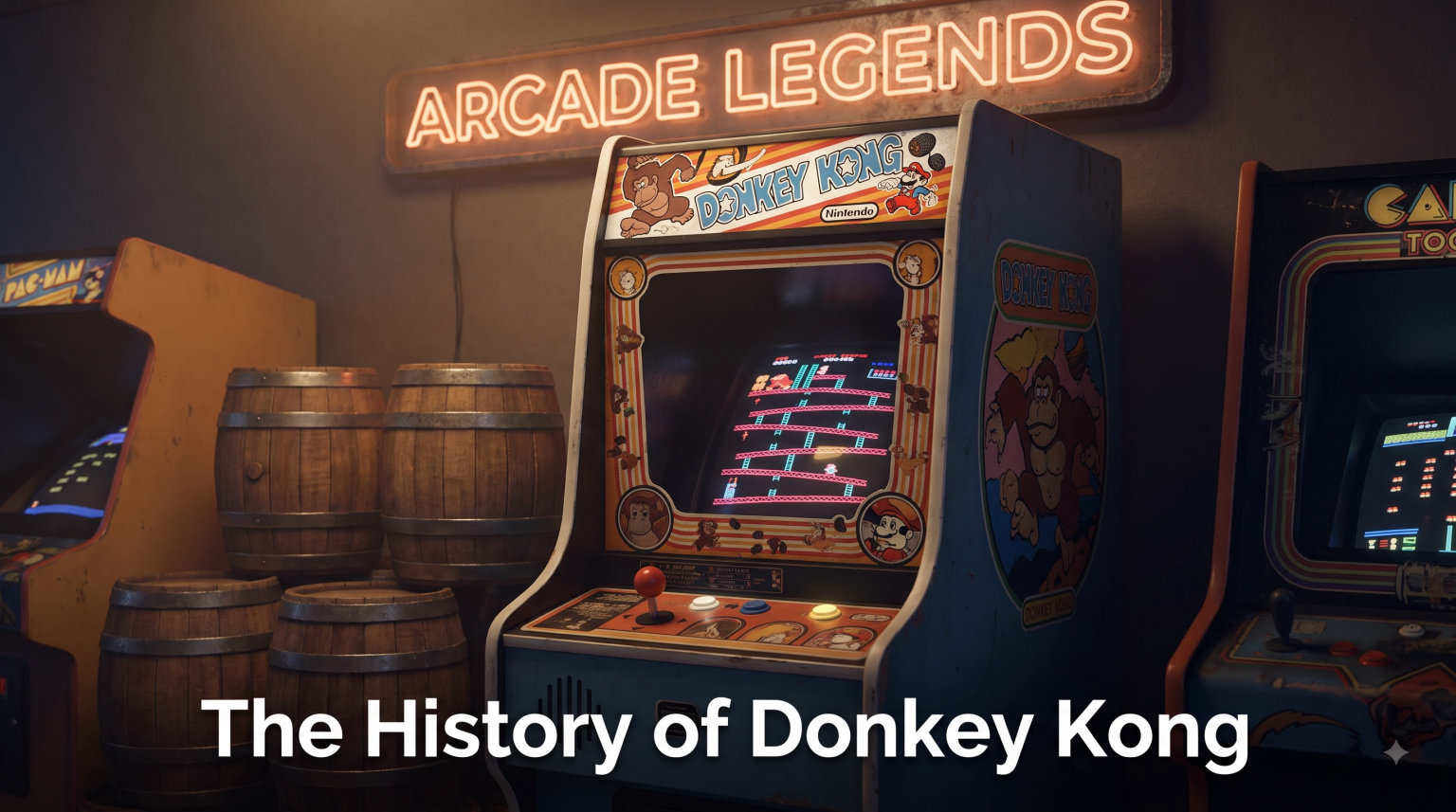
Back in the summer of 1981, a young artist at Nintendo named Shigeru Miyamoto sat down to turn a pile of unsold arcade parts into a game. What came out of that session reshaped the video game industry forever. This is the complete history of Donkey Kong, told from the perspective of someone who grew up pumping quarters into those early cabinets.
The history of Donkey Kong is really a story about creative problem solving under pressure. Nintendo had thousands of Radar Scope circuit boards gathering dust in a Seattle warehouse. They needed a hit, fast. Miyamoto delivered more than a hit. He created one of the most enduring franchises in entertainment.
Table of Contents
- The Arcade Origins of Donkey Kong (1981)
- Why Is It Called Donkey Kong? The Name Mystery
- Donkey Kong Gameplay and the Birth of the Platformer
- From Jumpman to Mario: The Character Evolution
- The Sequel Era: Donkey Kong Jr. and Donkey Kong 3
- The Universal Studios Lawsuit
- The Rare Partnership and Donkey Kong Country (1994)
- The Kong Family: Cranky, Diddy, Dixie, and Friends
- Handheld Adventures and Spin-offs
- The Modern Era: Country Returns and Tropical Freeze
- Cultural Impact and Speedrunning Legacy
- Is Donkey Kong Good or Evil?
- Frequently Asked Questions
- The History of Donkey Kong: Final Thoughts
The Arcade Origins of Donkey Kong (1981)
The history of Donkey Kong begins with a crisis. In 1980, Nintendo of America president Minoru Arakawa had ordered 3,000 Radar Scope cabinets based on optimistic sales projections. They sold poorly. Thousands of unsold circuit boards sat in storage, and Arakawa needed a new game to make those cabinets profitable.
Miyamoto, then 28 years old, had joined Nintendo in 1977 as a staff artist. His first major project was supposed to be a Popeye game, featuring the sailor man and his rivals Bluto and Olive Oyl. King Features Syndicate refused to license the characters at the last moment. Miyamoto had to invent new characters from scratch.
He created three figures: a small carpenter named Jumpman, his lady friend Pauline, and a giant ape called Donkey Kong. The premise was simple. A jealous ape kidnaps the woman, and the carpenter must climb girders and dodge barrels to rescue her. Four stages made up the game: 25m, 50m, 75m, and 100m, each progressively harder.
Nintendo released Donkey Kong in arcades on July 31, 1981 in North America. It became Nintendo’s first major arcade hit in the West, selling 65,000 cabinets in the United States alone. For a company that had been known primarily for playing cards and toys in Japan, this was a breakthrough.
Why Is It Called Donkey Kong? The Name Mystery
The name Donkey Kong sounds strange until you understand the logic. Miyamoto has explained the name several times in interviews. He wanted a name that conveyed stubbornness and strength. In English slang, calling someone a donkey means they are stubborn. Kong was borrowed from the iconic movie monster King Kong, which Miyamoto had seen.
So Donkey Kong means something like “stubborn gorilla” or “obstinate ape.” Miyamoto later admitted he picked the English words because they sounded funny to a Japanese speaker. He did not fully understand all the connotations. The name stuck, and it has worked for over four decades.
The character was originally designed as a clear villain. He was the antagonist, not a hero. He kidnapped a woman and threw barrels at the player. That single decision, whether to make the ape good or bad, would define his entire story arc over the next 45 years.
Donkey Kong Gameplay and the Birth of the Platformer
Donkey Kong did not invent the platform game, but it established the template. Jumpman had to climb ladders, jump over gaps, and avoid falling objects. The four unique stages introduced concepts that still appear in platformers today. The 25m stage featured conveyor belts and rising lava. The 50m stage introduced elevators. The 75m stage required players to grab a moving hook. The 100m stage introduced rivets that had to be removed to drop the entire structure.
The barrels, fireballs, and springs became standard platformer enemies. Players learned to time jumps and read patterns. High scores became a measure of skill. This was one of the first arcade games with a clear narrative goal rather than just an abstract objective like defending territory.
The original arcade hardware used Intel 8080 CPU architecture and custom graphics hardware. Miyamoto and his team pushed the hardware to its limits. The sprite animations were detailed for the time, and the colorful girders created an industrial atmosphere that made the action feel grounded.
From Jumpman to Mario: The Character Evolution
The carpenter known as Jumpman needed a real name. Nintendo’s American warehouse landlord in 1981 was Mario Segale. When Nintendo of America staff asked him to settle an overdue bill, someone joked that the character looked like him. The name stuck. Jumpman became Mario, though Miyamoto did not officially confirm the origin story until years later.
The 1982 arcade sequel Donkey Kong Jr. reversed the roles. Players now controlled the ape’s son, trying to rescue Donkey Kong from Mario. It was a strange narrative twist that swapped hero and villain. Donkey Kong Jr. proved popular in its own right, with over 150,000 arcade units sold.
The 1983 arcade release Donkey Kong 3 shifted genres entirely. Players controlled Stanley the exterminator, trying to spray a Donkey Kong who had escaped into a greenhouse. It played more like a fixed shooter than a platformer. The Mario connection was loose at best, but the franchise kept producing games through the early 1980s.
The Sequel Era: Donkey Kong Jr. and Donkey Kong 3
The history of Donkey Kong after 1983 went quiet for a while. Nintendo focused on the Famicom home console and its Western equivalent, the Nintendo Entertainment System. The original Donkey Kong was ported to home systems and bundled with early NES consoles. Millions of players met the ape for the first time in their living rooms.
Donkey Kong Jr. received similar treatment on the NES and later the Game Boy. A 1994 Game Boy version of Donkey Kong included both the original arcade game and a new Mario vs. Donkey Kong mode. The Game & Watch line also featured Donkey Kong themed handheld units, keeping the character visible through the late 1980s and early 1990s.
For about a decade, the franchise existed mostly as ports and re-releases. That changed dramatically in 1994 when Nintendo partnered with a British developer named Rare.
The Universal Studios Lawsuit
You cannot tell the history of Donkey Kong without mentioning Universal City Studios. In 1982, Universal sued Nintendo, claiming Donkey Kong infringed on the King Kong copyright. Universal had purchased the rights to King Kong from RKO Pictures.
The case went all the way to the Second Circuit Court of Appeals. Nintendo won decisively. The court ruled that King Kong was already in the public domain when Universal claimed ownership, and that Donkey Kong was not substantially similar to King Kong anyway. The judge noted that one character was a villain while the other was a hero, among other distinguishing features.
This legal victory was crucial for Nintendo. It cleared the way for the company to keep using ape characters without fear of further litigation. The precedent still influences how courts handle intellectual property claims involving public domain characters today.
The Rare Partnership and Donkey Kong Country (1994)
In 1994, Nintendo took a gamble on a British studio called Rare. The team was led by Tim Stamper, who had built a reputation on NES games like Wizards & Warriors. Rare’s challenge was to bring Donkey Kong back to relevance using the Super Nintendo hardware.
What made Donkey Kong Country revolutionary was its use of pre-rendered 3D graphics. Rare used a technique called Advanced Computer Modelling (ACM) to create sprites from 3D models. This gave the game a level of visual depth that was stunning on the SNES. Critics called it the best-looking 16-bit game ever made.
The game also reinvented Donkey Kong himself. Instead of being the villain, he was now the hero. His enemy was King K. Rool, a crocodile pirate who had stolen Donkey Kong’s banana hoard. To help retrieve the bananas, DK was joined by his small monkey nephew Diddy Kong. The Kong family was born.
Donkey Kong Country sold over 9 million copies, becoming one of the best-selling SNES games of all time. It established a new creative direction for the franchise that continues today. The character shift from villain to hero was permanent.
The Kong Family: Cranky, Diddy, Dixie, and Friends
The 1996 sequel Donkey Kong Country 2: Diddy’s Kong Quest elevated Diddy Kong to co-star status. He was joined by Dixie Kong, his pink-hooded girlfriend. The game moved away from the DK Island setting to Crocodile Isle, King K. Rool’s stronghold.
One of the most clever reveals in the series came in the 1997 Donkey Kong Country 3: Dixie Kong’s Double Trouble. Cranky Kong, the grumpy old ape who sat around criticizing the gameplay, was revealed to be the original arcade Donkey Kong. He had been the villain in the 1981 arcade game, and the modern Donkey Kong is his grandson.
That single piece of continuity tied 16 years of game history together. Kiddy Kong, Dixie’s cousin, joined the family in DKC3. The Kong family tree now includes Cranky, Donkey Kong, Diddy, Dixie, Kiddy, Wrinkly, Swanky, Candy, and Funky. Each has a distinct personality and gameplay function.
Handheld Adventures and Spin-offs
While the Country series dominated home consoles, Rare also brought Donkey Kong to handheld systems. Donkey Kong Land (1994), Donkey Kong Land 2 (1996), and Donkey Kong Land III (1997) brought the Kong family to the Game Boy with scaled-down graphics and gameplay.
The mid-2000s saw an explosion of spin-off genres. Donkey Konga (2003) was a rhythm game played with a DK bongo controller. Donkey Kong: Jungle Beat (2004) used the same bongos as a controller for a GameCube platformer. DK King of Swing (2005) and Donkey Kong Barrel Blast (2007) experimented with GBA and Wii control schemes.
The Mario vs. Donkey Kong series, starting in 2004 on Game Boy Advance, flipped the original arcade premise into a puzzle platformer. Players control miniature Mario robots trying to retrieve toys stolen by a jealous Donkey Kong. The series continues today on Nintendo Switch.
The Modern Era: Country Returns and Tropical Freeze
After Nintendo purchased Rare in 2002, the studio eventually stopped making Donkey Kong games. The franchise went dormant until Retro Studios, the Texas-based team behind Metroid Prime, took over development.
Donkey Kong Country Returns (2010) was a return to 2D platforming after the experimental 3D Donkey Kong: Barrel Blast. The Wii game was well received for its tight controls and challenging level design. A 3DS version followed in 2013.
Donkey Kong Country: Tropical Freeze (2014) raised the bar further. The Wii U game introduced new playable characters including Dixie Kong and Cranky Kong. Critics praised its gorgeous visuals and orchestral soundtrack. The game was later ported to Nintendo Switch in 2018, becoming one of the best-selling Switch titles.
In 2026, Donkey Kong remains a Nintendo flagship character. The franchise continues to appear in Super Smash Bros., Mario Kart, and other crossover titles. A new Donkey Kong adventure is reportedly in development at Nintendo EPD.
Cultural Impact and Speedrunning Legacy
No history of Donkey Kong would be complete without acknowledging its competitive scene. The original arcade game became a tournament staple in the 1980s. Billy Mitchell set the first widely recognized world record of 874,300 points in 1982. That record stood for decades.
The speedrunning community has kept the original Donkey Kong alive for over 40 years. Top players use specific strategies including kill screens, board climbing, and precise timing. The current world record sits above 1.5 million points, requiring runs that can exceed 90 minutes of perfect play.
Beyond gaming, Donkey Kong influenced the broader entertainment industry. The 1983 Coleco tabletop version brought the character to living rooms. Saturday morning cartoons and comic books expanded the universe. The character has appeared in merchandise ranging from lunchboxes to clothing. Universal Studios even named a roller coaster after the character, and Dwayne Johnson starred in a Super Nintendo themed movie in 2025.
Is Donkey Kong Good or Evil?
This is one of the most common questions fans ask about the franchise. The honest answer is that Donkey Kong has been both, depending on the era.
In the 1981 arcade original, Donkey Kong was a clear villain. He kidnapped Pauline and threw barrels at Jumpman. In the 1982 sequel Donkey Kong Jr., he was the helpless captive, not really evil, just imprisoned.
From 1994 onward, Donkey Kong has been portrayed as a hero. He protects his banana hoard from King K. Rool and helps his family defend DK Island. He appears as a good guy in Super Smash Bros., Mario Kart, and Mario Party.
So depending on which game you played first, Donkey Kong might be either the bad guy or the good guy. Both versions are canonical. Nintendo has officially retconned the original arcade villain into Cranky Kong, the modern DK’s grandfather.
Frequently Asked Questions
What is the original story of Donkey Kong?
The original 1981 Donkey Kong arcade game tells the story of a giant ape who kidnaps a woman named Pauline. The player controls Jumpman (later known as Mario), her carpenter boyfriend, who must climb girders and avoid barrels to rescue her. It was one of the first arcade games with a clear narrative goal.
Is Donkey Kong good or evil?
Donkey Kong has been both across the franchise’s history. In the 1981 arcade original and Donkey Kong Jr. (1982), he was a villain or captive. From Donkey Kong Country (1994) onward, he has been portrayed as a hero who protects his banana hoard from King K. Rool.
Why is it Donkey Kong if he is a gorilla?
Shigeru Miyamoto chose the name because donkey means stubborn in English slang, and Kong referenced King Kong. So Donkey Kong essentially means stubborn gorilla. Miyamoto picked the English words because they sounded amusing to a Japanese speaker at the time.
When was Donkey Kong originally released?
Donkey Kong was first released in arcades in North America on July 31, 1981. It became Nintendo’s first major arcade hit in the West and laid the foundation for the modern video game industry.
Who invented Donkey Kong?
Donkey Kong was created by Shigeru Miyamoto at Nintendo in 1981. He designed the game to repurpose unsold Radar Scope arcade cabinets and originally intended to use Popeye characters before the licensing deal fell through.
The History of Donkey Kong: Final Thoughts
The history of Donkey Kong is a story of creative persistence. Shigeru Miyamoto turned unsold hardware into one of the most important games ever made. He invented Mario along the way. He created a character who has swung across our screens for over four decades.
From the 1981 arcade cabinet to the Nintendo Switch, Donkey Kong has grown from a simple villain into a Nintendo mascot. His family has expanded to include a dozen memorable characters. His games have sold tens of millions of copies worldwide.
Next time you fire up Donkey Kong Country: Tropical Freeze or watch a speedrun of the original arcade game, remember that you are experiencing a piece of gaming history that started with one man’s refusal to waste perfectly good circuit boards.