
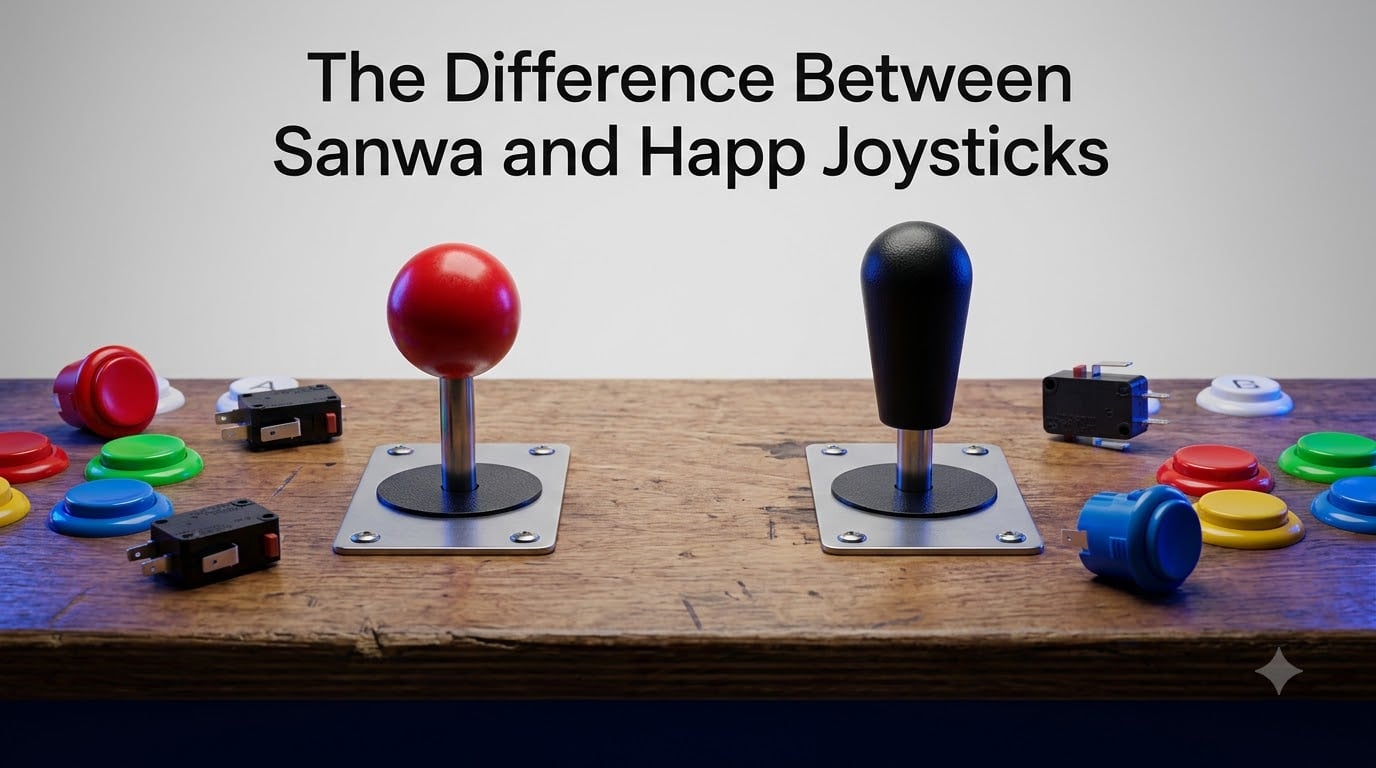
If you are building or upgrading an arcade cabinet, the Sanwa vs Happ joysticks debate is one of the first decisions you will face. These two brands represent fundamentally different approaches to arcade control design, and the choice changes how every game feels under your hands.
I have spent years swapping parts in fight sticks, MAME cabinets, and Arcade1Up mods. After testing both Sanwa and Happ hardware across dozens of builds, I can tell you that the differences go far beyond simple brand preference. Handle shape, spring tension, return speed, button feel, and even sound profiles all set these two apart.
This guide breaks down every meaningful difference between Sanwa and Happ joysticks so you can make the right call for your specific setup and play style.
Table of Contents
- What Is a Sanwa Joystick?
- What Is a Happ Joystick?
- Sanwa vs Happ: Joystick Design Differences
- Button Differences: Convex vs Concave
- Feel and Sound: Clicky vs Smooth
- 4-Way vs 8-Way: Restrictor Gates Explained
- Which Joystick Suits Your Game Type?
- Durability and Longevity Comparison
- How to Choose Between Sanwa and Happ
- FAQs
- Conclusion
What Is a Sanwa Joystick?
Sanwa Denshi is a Japanese manufacturer that has been producing arcade parts since the 1940s. Their hardware defines the Japanese arcade standard and shows up in virtually every competitive fighting game tournament worldwide.
The flagship model most people encounter is the Sanwa JLF series, specifically the JLF-TP-8YT. It features a ball-shaped handle top, a relatively loose spring, and a deliberate clicky motion as you engage each direction. The JLF uses a square restrictor gate by default, which gives you clear physical boundaries between directions.
Sanwa parts dominate the fight stick market. Brands like Hori, Qanba, and Razer build their premium controllers around Sanwa JLF sticks and OBSF buttons. If you have played in an arcade in Japan or at a major fighting game event, you have used Sanwa hardware.
What Is a Happ Joystick?
A Happ joystick is an American-style arcade control known for its bat-top handle, tight spring tension, smooth 360-degree motion, and fast return to center. Happ controls are the standard for American arcade cabinets, powering classic games like Mortal Kombat, NBA Jam, and Pac-Man.
The company originally operated as Happ Controls, later becoming Suzo-Happ after a merger. Their Competition Pro joystick is the model most builders recognize. It uses a heavier spring than Sanwa, a circular motion pattern, and microswitches that produce a satisfying but less clicky activation than the JLF.
For anyone building an authentic American arcade experience, Happ is the natural choice. The bat-top shape feels like the arcade cabinets many of us grew up feeding quarters into.
Sanwa vs Happ: Joystick Design Differences
The physical design differences between Sanwa and Happ joysticks affect everything from how the stick sits in your hand to how quickly it snaps back to neutral.
Handle Shape: Ball Top vs Bat Top
Sanwa joysticks use a spherical ball top that sits roughly 35mm in diameter. The ball shape allows for a relaxed grip and works well with both palm-down and claw grip styles. Many players find the ball top more comfortable during long sessions because it distributes pressure evenly across the hand.
Happ joysticks use a bat-top handle, shaped like a small baseball bat standing upright. The bat top is taller and narrower, which some players prefer for grip stability during aggressive movements. The shape also feels more natural if you are used to thumb-and-finger grips common in American arcades.
Spring Tension and Resistance
This is where the two brands diverge most noticeably. Sanwa uses a lighter spring that makes the joystick feel loose and fluid. The stick moves with minimal resistance, which fighting game players love because it enables quick directional changes and smooth circular motions.
Happ uses a noticeably tighter spring. The added resistance gives you more physical feedback as you move the stick, and the heavier feel suits games that demand deliberate inputs rather than rapid-fire direction changes. Some players find the Happ spring more fatiguing over time, while others appreciate the extra control it provides.
Return to Center Speed
Because of the tighter spring, Happ joysticks snap back to center faster than Sanwa sticks. That quick return is one reason Happ hardware feels so responsive in classic American arcade games where neutral positioning between moves is critical.
Sanwa sticks return to center more slowly due to the lighter spring. This deliberate return is actually a feature, not a flaw. Competitive fighting game players rely on the slower return to maintain fluid motion during complex inputs like quarter-circle and dragon-punch motions.
Microswitch Feel and Activation
Both Sanwa and Happ use microswitches for input detection, but the activation feel differs. Sanwa microswitches click sharply when engaged, giving you an audible and tactile confirmation that a direction registered. The JLF uses Omron switches that are known for their crisp, clicky response.
Happ microswitches feel smoother on engagement. The activation is still detectable, but it has a more rounded feel rather than a sharp snap. Some players describe Happ switches as buttery, while others find them less precise for inputs that require exact timing.
Pivot and Actuator Design
Sanwa uses a nylon pivot at the base of the shaft that creates a smooth, consistent rotation point. The actuator sits above the pivot and engages the microswitches as the shaft tilts. This design produces the fluid motion Sanwa is known for.
Happ uses a different pivot assembly with a heavier shaft and larger actuator. The heavier components contribute to the more substantial feel, and the larger actuator engages switches with a broader contact area. Over time, the Happ pivot can develop a slightly grindy feel if the pivot wears unevenly, which some forum users report after heavy use.
Button Differences: Convex vs Concave
Sanwa and Happ take opposite approaches to button design, and the differences are immediately noticeable when you press them.
Button Shape
Sanwa buttons are convex, meaning the button surface curves outward like a shallow dome. Your fingers rest on a raised center that makes rapid tapping easier and reduces finger fatigue. The convex shape also prevents accidental presses because your fingers naturally center on the button.
Happ buttons are concave, with a dip in the center. Your fingers settle into the indentation, which many players find more comfortable for games that require pressing fewer buttons with deliberate force. The concave shape is iconic to the American arcade experience.
Travel Distance and Activation
Sanwa buttons have a shorter travel distance and lighter activation force. The OBSF-30 button, Sanwa’s most popular model, activates with a gentle press and returns quickly. This responsiveness is ideal for fighting games where you need to chain attacks and combos at high speed.
Happ Competition buttons require more travel and a firmer press to activate. The extra depth provides more physical feedback, which works well for games where you want to feel each button commitment. The tradeoff is that rapid-fire inputs require more finger effort.
Sound Profile
Sanwa buttons produce a sharper, snappier click when activated. Happ buttons have a deeper, more muted sound. In a quiet room, the difference is obvious. In a loud arcade environment, both blend into the ambient noise, but for home builds the Sanwa click is something to consider if noise matters.
Feel and Sound: Clicky vs Smooth
If I had to summarize the entire Sanwa vs Happ debate in one sentence, it would be this: Sanwa feels clicky and deliberate, while Happ feels smooth and forceful.
The clicky nature of Sanwa hardware gives you constant sensory feedback. Every direction you press and every button you tap announces itself with a satisfying click. For players who rely on audio and tactile cues to confirm inputs, Sanwa is hard to beat.
Happ provides a more muted, flowing experience. The stick glides through directions without the sharp clicks, and the buttons compress with a deeper feel. Many players describe Happ as feeling more like a traditional machine, while Sanwa feels more like a precision instrument.
One thing our team noticed after extended testing: switching between the two takes an adjustment period. If you have played on Happ for months and switch to Sanwa, the lighter spring and shorter throw feel almost too sensitive at first. The reverse is also true. Give yourself a few days to recalibrate whenever you switch.
4-Way vs 8-Way: Restrictor Gates Explained
One topic most comparison articles skip is restrictor gates, but understanding them is essential for choosing the right joystick for your games.
What Is a Restrictor Gate?
A restrictor gate is the plate at the bottom of the joystick that limits how far the shaft can travel. It shapes the movement pattern and determines whether your stick operates in 4-way, 8-way, or another mode.
Sanwa Square Gate
Sanwa JLF sticks ship with a square restrictor gate by default. The square shape creates clear notches at each of the eight primary directions, giving you distinct physical feedback when you hit up, down, left, right, or any diagonal. Many fighting game players prefer this because the notches help confirm diagonal inputs required for special moves.
Sanwa also offers octagonal and circular restrictor gates as replacements. Swapping gates takes about five minutes and requires no tools beyond a screwdriver, which makes the JLF highly customizable.
Happ Circular Restrictor
Happ Competition sticks use a circular restrictor that allows smooth 360-degree rotation without distinct notches. The circular motion feels natural for games that involve sweeping movements or rotational inputs. There is no hard stop between directions, which some players prefer and others find disorienting.
For 4-way games like Pac-Man and Donkey Kong, neither the default Sanwa square gate nor the Happ circular restrictor is ideal. You would want a dedicated 4-way restrictor or a specialized 4-way joystick for those classic titles. Sanwa makes this easier with swappable gates, while Happ typically requires a different stick model entirely.
Which Joystick Suits Your Game Type?
The right joystick depends heavily on what you play. Here is how Sanwa and Happ stack up across common game categories.
Fighting Games
Sanwa is the clear winner for fighting games. Games like Street Fighter, Tekken, Guilty Gear, and BlazBlue require precise quarter-circle motions, dragon-punch inputs, and rapid button combinations. The lighter spring, square gate notches, and short-throw buttons of Sanwa hardware are designed specifically for this type of gameplay. Nearly every tournament-grade fight stick uses Sanwa parts for a reason.
Classic American Arcade Games
Happ is the authentic choice for games like Mortal Kombat, NBA Jam, Smash TV, and other American arcade titles. These games were designed around Happ hardware, and playing them with Sanwa parts can feel off. The tighter spring and bat-top handle recreate the experience of standing at an actual American arcade cabinet.
MAME Cabinets
For MAME builds running a mix of everything, the decision comes down to what you play most. If your library leans toward fighters and Japanese shooters, go Sanwa. If you are reliving classic American arcade days, Happ fits better. Many MAME builders end up with two-player panels using Sanwa on one side and Happ on the other to cover both bases.
Shoot-em-ups and Precision Games
For bullet-hell shooters and precision platformers, Sanwa is generally preferred. The lighter spring reduces hand fatigue during extended sessions, and the precise directional notches help with micro-movements needed to navigate dense bullet patterns. Some players prefer Seimitsu sticks for shmups specifically, which sit between Sanwa and Happ in terms of spring tension.
Arcade1Up Upgrades
If you are upgrading an Arcade1Up cabinet, check what panel size and mounting holes you have before buying. Many Arcade1Up owners report that Sanwa parts require less drilling and modification than Happ parts, since the smaller Sanwa mounting footprint is closer to the stock Arcade1Up dimensions.
Durability and Longevity Comparison
Both Sanwa and Happ build hardware meant to survive commercial arcade environments, so either will outlast typical home use. But there are differences worth noting.
Sanwa JLF sticks are known for consistent performance over time. The Omron microswitches are rated for millions of activations, and the nylon pivot resists wear well. The most common maintenance issue is the spring loosening slightly after years of use, which is fixed with a cheap replacement spring.
Happ Competition sticks are built more ruggedly with heavier components. The metal shaft and larger body can take serious abuse, which is why so many survive decades in commercial cabinets. The known issue is the pivot assembly, which can develop a grindy feel over time if dust accumulates or the pivot wears unevenly. Regular cleaning and lubrication keeps Happ sticks performing like new.
How to Choose Between Sanwa and Happ
Choosing between Sanwa and Happ comes down to three factors: what you play, what feels right in your hands, and what fits your build.
Go With Sanwa If
You primarily play fighting games, Japanese shooters, or precision-based titles. You prefer lighter spring tension and a more fluid, deliberate motion. You are building a fight stick or a cabinet centered around competitive play. You want the standard hardware used at tournaments worldwide.
Go With Happ If
You want an authentic American arcade experience. You play classic American titles like Mortal Kombat and NBA Jam. You prefer a tighter spring with more physical feedback. You are building a cabinet that recreates the feel of standing at an arcade in the 1990s.
Modding and Compatibility Notes
Sanwa and Happ parts are not directly interchangeable without modification. The mounting hole sizes differ, the button diameters are different (30mm Sanwa vs roughly 28mm Happ), and the wiring connectors vary. If you are converting from one to the other, expect some drilling or panel work.
For new builds, pick one brand and stick with it throughout the panel to avoid compatibility headaches. Mixing brands on the same panel is possible but requires careful planning.
Seimitsu as a Third Option
If neither Sanwa nor Happ feels quite right, consider Seimitsu. Seimitsu sits between the two in almost every way. Their sticks use a medium-tension spring, shorter throw than Happ but longer than Sanwa, and their buttons have a slightly firmer activation than Sanwa OBSF buttons. Many players who find Sanwa too loose and Happ too stiff land on Seimitsu as the perfect middle ground.
The Seimitsu LS-32 is particularly popular among shoot-em-up players who want more precision than Sanwa offers without the heavy resistance of Happ. It is worth testing if you have the chance.
FAQs
Are Sanwa buttons better?
Sanwa buttons are generally considered better for fighting games and fast-paced play because of their convex shape, shorter travel distance, and lighter activation force. Happ buttons are better for classic American arcade games where a firmer, more deliberate press feels authentic. Neither is universally better; it depends on your game type and personal preference.
What are the two types of joysticks?
The two main types of arcade joysticks are Japanese-style (represented by Sanwa) and American-style (represented by Happ). Japanese joysticks feature ball-top handles, lighter springs, and square restrictor gates. American joysticks feature bat-top handles, tighter springs, and circular restrictors.
What is the difference between Sanwa and Seimitsu joysticks?
Seimitsu joysticks have a stiffer spring and shorter throw than Sanwa, making them feel more precise but less fluid. Sanwa uses lighter springs with a looser feel preferred for fighting games, while Seimitsu is popular among shoot-em-up players who want more directional control. Both are Japanese brands but target slightly different play styles.
What is a Happ joystick?
A Happ joystick is an American-style arcade control known for its bat-top handle, tight spring tension, smooth circular motion, and fast return to center. It is the standard joystick for American arcade cabinets and is commonly found in games like Mortal Kombat, NBA Jam, and Pac-Man.
Conclusion
The Sanwa vs Happ joysticks debate does not have a single winner because the two brands serve different purposes. Sanwa delivers the clicky, fluid, precise feel that fighting game players and competitive communities rely on. Happ provides the rugged, smooth, forceful experience that defines American arcade nostalgia.
Your choice should come down to the games you play most, the feel you prefer in your hands, and what fits your cabinet build. Whichever you pick, both brands have earned their reputations through decades of arcade proven performance. And if neither feels right, Seimitsu offers a compelling middle ground worth exploring.