
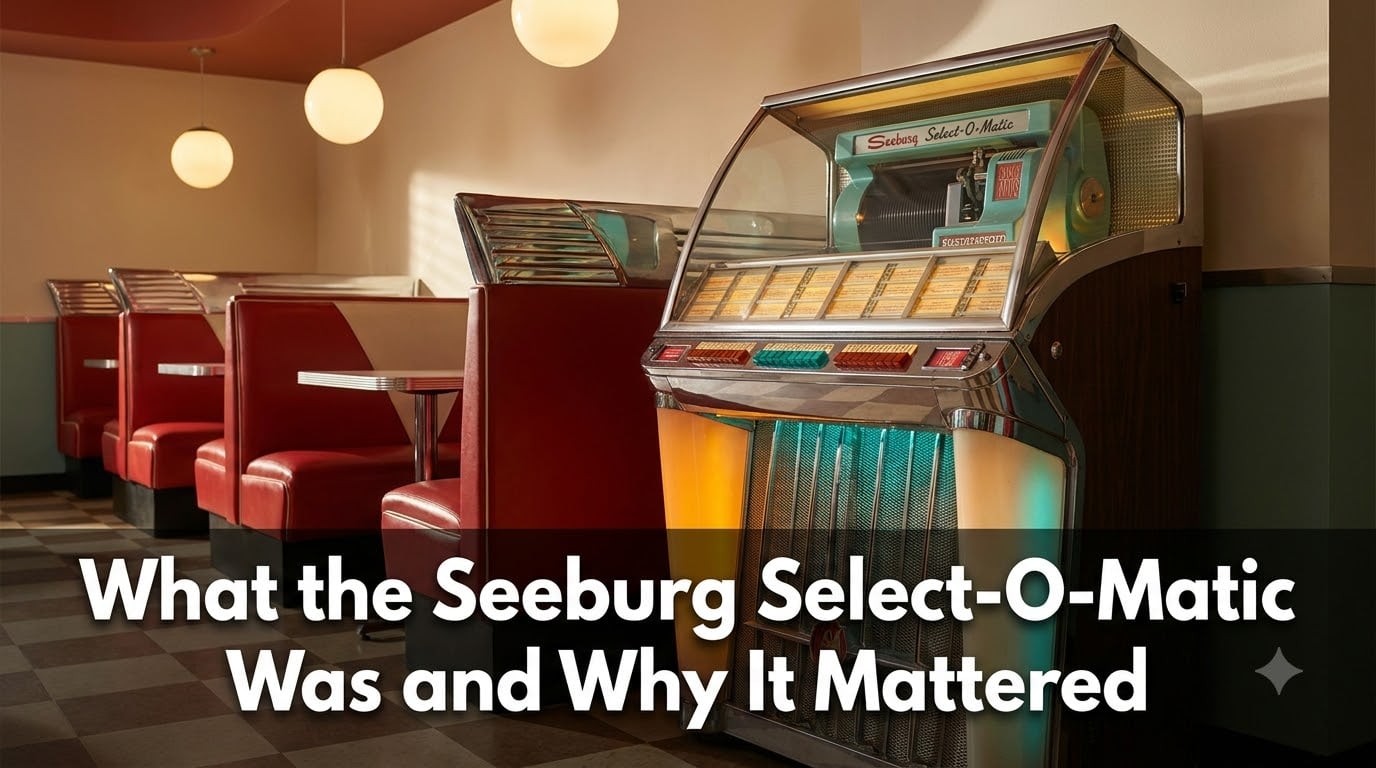
If you have ever pictured a classic American jukebox, the machine in your mind probably traces back to one invention. The Seeburg Select-O-Matic, introduced in 1950, was the first commercially successful jukebox mechanism built specifically to play 45 RPM records, and it doubled the number of song selections available in any public music machine.
That single engineering decision reshaped the entire coin-operated music industry. Before the Select-O-Matic, a jukebox could hold around 24 records, giving you roughly 48 selections. Seeburg’s new design packed in 50 records played on both sides, delivering 100 selections, and later 200, in the same footprint.
For the next three decades, Seeburg dominated the jukebox market on the strength of this mechanism. The Select-O-Matic became so influential that it effectively standardized the 45 RPM record format across the jukebox industry and forced competitors like Wurlitzer and AMI to follow Seeburg’s lead or fall behind.
In this article, I will walk you through what the Seeburg Select-O-Matic was, how its mechanism worked, the key models that defined its run, and why it mattered so deeply to American music and culture.
Table of Contents
- Quick Summary: The Select-O-Matic at a Glance
- What Was the Seeburg Select-O-Matic?
- A Brief History of Seeburg and the 45 RPM Revolution
- Key Select-O-Matic Models: M100A, M100B, V200, and More
- How the Select-O-Matic Mechanism Worked?
- Why the Select-O-Matic Mattered?
- Collecting and Value: What to Know in 2026
- The End of the Select-O-Matic Era
- FAQs
- Conclusion: A Machine That Defined an Era
Quick Summary: The Select-O-Matic at a Glance
Here are the core facts you need to understand about the Seeburg Select-O-Matic before diving into the details.
What it was: A record-changing mechanism for jukeboxes, introduced by JP Seeburg and Company in 1950, designed from the ground up for the new 45 RPM vinyl format.
Why it was revolutionary: It doubled selection capacity from about 48 songs to 100, then later to 200, by using a compact carousel that held 50 or 100 records played on both sides.
Iconic models: The M100A (1950, first 100-selection jukebox), M100B (1951), HF100R (1954, collector favorite), V200 (1955, first 200-selection machine), and the model 222 (1958, first stereo jukebox).
Cultural significance: The Select-O-Matic standardized the 45 RPM format in public music, powered the 1950s diner and rock-and-roll era, and defined the chrome-and-tail-fin jukebox look that still defines the image of a jukebox today.
End of the line: Seeburg closed in 1996 after a transition through solid-state electronics and the CD era, but Select-O-Matic machines remain prized by collectors and can sell for anywhere from $3,200 to over $15,000 fully restored.
What Was the Seeburg Select-O-Matic?
The Seeburg Select-O-Matic was a mechanical record-selection and playback system for coin-operated jukeboxes. It used a rotating carriage that held records vertically in slots, could find any selected record within seconds, and played both sides of every disc.
That last point is what set the Select-O-Matic apart from every mechanism that came before it. Older jukeboxes played records flat on a turntable and could only access one side at a time without manual flipping. The Select-O-Matic gripped the record by its edge, lifted it horizontally from its slot, carried it to a vertically mounted turntable, and played either side automatically.
This engineering feat meant Seeburg could build machines holding 50 records and delivering 100 distinct song selections. When the V200 arrived in 1955, that number jumped to 200 selections from 100 records. No competing system came close to that capacity in the early 1950s.
The Select-O-Matic was also designed specifically for the 45 RPM record, the format that RCA introduced in 1949. This was a bold bet by Seeburg. At the time, Columbia’s 33 RPM LP and the older 78 RPM shellac discs were still common, and many in the industry were not sure the 45 would survive as a format.
Seeburg committed fully to the 45 RPM standard. Every Select-O-Matic mechanism was built around the 7-inch, large-center-hole 45 RPM record. This commitment helped push the 45 RPM format into widespread adoption, because jukebox play was a primary way Americans discovered and consumed music in the 1950s.
The mechanism went through several generations over its production life. Early models used vacuum tube amplifiers and purely mechanical selection systems. Later versions introduced the Tormat memory system in 1955, which used magnetic-core memory to store selections electronically, a remarkable innovation borrowed from early computer technology.
In the 1960s, Seeburg transitioned to solid-state electronics, replacing vacuum tubes with transistors. The core Select-O-Matic principle, a rotating carousel selecting records for playback, remained the same even as the surrounding electronics evolved.
A Brief History of Seeburg and the 45 RPM Revolution
To understand why the Select-O-Matic was such a turning point, you need to understand the company and the market it entered. Seeburg’s story is one of betting big on a new format and winning.
JP Seeburg and Company was founded in Chicago by Justus P. Seeburg, a Swedish immigrant who had been building coin-operated pianos and orchestrions since the early 1900s. By the late 1920s, the company had moved into the jukebox market with its first electric phonograph, the Symphonola, which played 78 RPM shellac records.
Through the 1930s and 1940s, Seeburg built respectable machines but was not the market leader. Wurlitzer held that crown with its stylish models, and AMI was also a strong competitor. The industry standard during this era was the 78 RPM record, which was heavy, brittle, and limited jukeboxes to about 20 to 24 discs.
Everything changed in 1948 and 1949. Columbia introduced the 33 RPM long-playing record in 1948, and RCA countered with the 45 RPM record in 1949. The 45 was smaller, lighter, more durable, and had a larger center hole designed for easy stacking on automatic changers. It was a perfect format for jukeboxes, but the industry was slow to adopt it.
Seeburg saw the opportunity before anyone else. Here is a timeline of the key milestones that defined the company and the Select-O-Matic era:
1928: Seeburg introduces its first electric phonograph jukebox, the Symphonola, playing 78 RPM records.
1948-1949: Columbia launches the 33 RPM LP and RCA launches the 45 RPM record, sparking the “War of the Speeds.”
1950: Seeburg releases the M100A, the first jukebox designed exclusively for 45 RPM records and the first to offer 100 selections.
1951: The M100B debuts, refining the Select-O-Matic mechanism and cementing Seeburg’s reputation as the industry leader.
1954: The HF100R arrives, one of the most sought-after jukeboxes among collectors today.
1955: The V200 introduces 200 selections and the Tormat magnetic memory system, borrowed from early computer technology.
1958: Seeburg releases the model 222, the world’s first stereophonic jukebox, bringing hi-fi stereo sound to coin-operated music.
1962: The DS160 becomes the last Seeburg model with a visible record-changing mechanism, ending the “Silver Age” of jukebox design.
1986: Seeburg introduces the SCD-1, the world’s first commercial CD jukebox.
1996: Seeburg closes its doors after nearly a century in the coin-operated music business.
Seeburg’s decision to go all-in on the 45 RPM format was the pivot point. While Wurlitzer and AMI hedged their bets with machines that could play multiple formats, Seeburg built exclusively for the 45. That focus let them optimize the Select-O-Matic mechanism for the format’s specific advantages, and it paid off enormously.
By the mid-1950s, Seeburg had overtaken Wurlitzer as the top-selling jukebox brand in America. The Select-O-Matic mechanism was the engine of that dominance.
Key Select-O-Matic Models: M100A, M100B, V200, and More
The Select-O-Matic was not a single machine but a family of models that evolved over more than a decade. Each one pushed the format forward. Here are the models that matter most.
M100A (1950): The First 100-Selection Jukebox
The M100A was the machine that started the Select-O-Matic revolution. Released in 1950, it was the first jukebox in the world designed exclusively for 45 RPM records and the first to offer 100 song selections from 50 records.
It was a radical departure from the 78 RPM machines that preceded it. The M100A held nearly twice as many songs as competing machines and could find any one of them in seconds. The cabinet was relatively plain compared to what came later, but the mechanism inside was a genuine engineering breakthrough.
Collectors consider the M100A historically significant as the machine that proved the 45 RPM format could work in commercial jukeboxes. Values for well-preserved examples reflect that significance.
M100B (1951): The Refined Workhorse
The M100B arrived in 1951 and refined the M100A’s design. It used the same 50-record, 100-selection Select-O-Matic mechanism but featured an updated cabinet with more chrome detailing and improved sound quality through a better amplifier design.
The M100B and its variant, the M100BL (which added visible record-changing action behind glass), are considered part of the “Silver Age” of jukeboxes. This era marked the industry’s shift toward smaller, 45 RPM-based machines with higher selection counts.
If you are looking for a classic Select-O-Matic that captures the 1950s jukebox aesthetic, the M100B is one of the most iconic examples. It is also one of the more commonly encountered models on the collector market, since Seeburg produced them in large numbers.
HF100R (1954): The Collector’s Holy Grail
The HF100R, released in 1954, is widely considered one of the most desirable Seeburg jukeboxes ever made. The “HF” stood for high fidelity, reflecting Seeburg’s push toward better sound reproduction with an upgraded amplifier and a five-speaker system.
The “R” designation indicated that this was a radio-phonograph combination model, meaning it could receive broadcast radio in addition to playing records. The cabinet featured rich chrome accents, a wrap-around glass dome, and the visible Select-O-Matic mechanism that let customers watch the record changer in action.
Among Seeburg enthusiasts, the HF100R consistently tops lists of the most sought-after models. Its combination of sound quality, iconic styling, and historical importance makes it a centerpiece of any serious jukebox collection.
V200 (1955): The First 200-Selection Machine
The V200, introduced in 1955, doubled the Select-O-Matic’s capacity again. It held 100 records and delivered 200 song selections, a number that was unheard of at the time. The cabinet design drew inspiration from 1950s American automobiles, with sweeping lines, chrome tail-fin styling, and a commanding presence.
The V200 was also the first Seeburg to use the Tormat memory system. Tormat replaced mechanical selection buttons with an electronic memory bank using magnetic-core technology. Customers could queue multiple selections, and the machine would remember and play them in order.
This was a significant leap forward. Tormat memory was essentially a small computer built into a jukebox, years before microprocessors became common. It gave the V200 a responsiveness and reliability that mechanical systems could not match.
Model 222 (1958): The First Stereo Jukebox
In 1958, Seeburg released the model 222, the first jukebox to offer stereophonic sound. Stereo was still a novelty in home audio at the time, and Seeburg brought it to public coin-operated music before most people had ever heard a stereo recording.
The model 222 featured a redesigned multi-speaker system that separated left and right channels to create a genuine stereo image. It was a showcase piece for Seeburg’s engineering ambition and remains one of the most historically important jukeboxes ever produced.
DS160 and Later Models (1960s)
By the early 1960s, Seeburg began moving toward solid-state electronics, replacing vacuum tube amplifiers with transistorized circuits. The DS160, released in 1962, was the last Seeburg model to feature a visible record-changing mechanism.
After the DS160, Seeburg cabinet designs shifted away from the transparent, mechanism-on-display aesthetic that defined the Silver Age. Later models became more functional in appearance, prioritizing reliability and capacity over visual spectacle.
How the Select-O-Matic Mechanism Worked?
The Select-O-Matic mechanism was a mechanical marvel that combined a rotating record carousel, a precision transfer arm, and, in later models, an electronic memory system. Here is how it worked in plain English.
At its core, the mechanism consisted of a large circular carriage that held records standing on edge in individual slots. The carriage could rotate in either direction to bring any record to the playback position. A motor drove the rotation, and a selection system told the carriage which record to find.
Here is the step-by-step process of how a song was selected and played:
Customer makes a selection. Using buttons on the front of the jukebox, the customer entered a letter-number code corresponding to a specific record and side (for example, A-14 for side A of record 14).
The memory system records the selection. On pre-1955 models, this was a mechanical system of levers and contacts. On models with Tormat memory, an electronic magnetic-core register stored the selection digitally.
The carousel rotates to the correct position. A motor turned the record carriage until the selected record’s slot aligned with the transfer arm.
The transfer arm grips the record. A mechanical arm reached into the slot, gripped the record by its outer edge, and lifted it horizontally out of the carousel.
The record is placed on the turntable. The arm carried the record to a vertically mounted turntable, placed it on the platter, and the appropriate side faced the tonearm for playback.
The tonearm plays the record. The tonearm lowered onto the groove, and the record played through the jukebox’s amplifier and speaker system.
The record is returned. After playback, the process reversed. The arm lifted the record off the turntable, carried it back to its slot, and the machine moved on to the next queued selection.
The entire cycle took only a few seconds. Customers could queue multiple selections, and the machine would work through them one at a time. On Tormat-equipped models, the electronic memory ensured selections were never lost, even if the queue was long.
One of the most impressive aspects of the Select-O-Matic was its reliability. The mechanism was built to operate thousands of times per week in bars, diners, and lounges, often for decades with minimal maintenance. Many Select-O-Matic machines built in the 1950s are still operational today, which is a testament to the quality of the engineering.
The visible version of the mechanism was a selling point in itself. Models like the M100BL, HF100R, and V200 featured glass panels that let customers watch the record changer in action. The mechanical ballet of a record being lifted, carried, placed, and played was genuinely mesmerizing, and it turned choosing a song into a visual experience.
Why the Select-O-Matic Mattered?
The Seeburg Select-O-Matic mattered for three major reasons that went far beyond its engineering. It standardized a music format, defined an era of industrial design, and became a cultural touchstone of post-war America.
Standardized the 45 RPM Format
Before the Select-O-Matic, the jukebox industry was split across 78 RPM, 33 RPM, and 45 RPM formats. No single format had a clear advantage, and manufacturers were hesitant to commit to one.
Seeburg’s exclusive adoption of the 45 RPM format changed that. Because Seeburg machines were so popular and so widely distributed, record labels began pressing more 45 RPM singles to ensure their songs would get jukebox play. The 45 RPM single became the default format for pop music distribution, and it held that position for decades.
This was not a minor shift. In the 1950s, jukebox play was one of the primary ways Americans heard new music. Radio and jukeboxes were the two main discovery channels, and getting into jukeboxes could make or break a song. By standardizing the 45 RPM format in jukeboxes, Seeburg influenced the entire structure of the music industry.
The 45 RPM single was ideally suited to the way people consumed music in the 1950s and 1960s. It was affordable, easy to manufacture, and carried one song per side. The format helped drive the rise of the single as the primary unit of pop music, which in turn shaped how songs were written, produced, and marketed during the rock and roll era.
Defined the Silver Age of Jukebox Design
The Select-O-Matic era coincided with one of the most distinctive periods of American industrial design. Seeburg’s machines from the early to mid-1950s are now categorized by collectors and historians as the “Silver Age” of jukebox design.
These machines embodied the mid-century modern aesthetic. They featured chrome accents, sweeping lines, tail-fin styling borrowed from the automobile industry, and illuminated plastic panels that glowed in warm colors. The visual record-changing mechanism behind glass was the centerpiece, turning each song selection into a small spectacle.
The image that most people conjure when they hear the word “jukebox” is a Seeburg Select-O-Matic from this era. That chrome-and-glow aesthetic became the defining look of the jukebox as a cultural object, and it persists in popular imagination to this day.
Seeburg did not just build machines that played music. They built machines that looked like the future. The Select-O-Matic’s design language spoke to post-war American optimism, technological progress, and the conviction that the future would be more convenient and more exciting than the past.
Became a Cultural Touchstone of Post-War America
The Select-O-Matic arrived at the exact moment when American culture was transforming. The post-war economic boom, the rise of teenager as a consumer demographic, the birth of rock and roll, and the spread of diner culture all converged in the 1950s, and the jukebox sat at the center of all of it.
In diners, bars, drive-ins, and lounges across the country, the Select-O-Matic was the device that brought music to public spaces. Teenagers fed coins into Seeburg machines to hear Elvis Presley, Chuck Berry, and Buddy Holly. Couples selected slow dances. Friends gathered around the glowing cabinet to choose the soundtrack of their evening.
The 100-selection capacity of the Select-O-Matic was culturally significant. With 100 songs available, a jukebox could offer real variety, covering multiple genres and artists. This made the jukebox a genuine music discovery tool, not just a playback device. People heard songs on the Seeburg that they had never heard on the radio.
Rock and roll’s rise was intertwined with the jukebox. Many early rock and roll records reached audiences through jukebox play before they got radio airtime, because radio stations were initially reluctant to play the new genre. The Select-O-Matic was literally the machine that helped introduce America to rock and roll.
Select-O-Matic vs. Wurlitzer and AMI
The Select-O-Matic did not exist in a vacuum. Wurlitzer and AMI were Seeburg’s primary competitors, and each took a different approach to the post-78 RPM transition.
Wurlitzer was the style leader of the 1940s. The Wurlitzer 1015, with its bubble tubes and rounded wood cabinet, is arguably the most famous jukebox ever made. But Wurlitzer was slow to adopt the 45 RPM format. Their early 1950s machines still used older mechanisms, and by the time they caught up, Seeburg had already captured the market.
AMI (Automatic Musical Instruments) took a middle path. They built solid machines and adopted the 45 RPM format, but their Select-O-Matic equivalent never matched Seeburg’s selection capacity or mechanical refinement. AMI machines were known for durability but lacked the visible-record spectacle that made Seeburg machines so compelling.
Seeburg won because they committed fully to the 45 RPM format first, engineered the most capable mechanism, and wrapped it in the most compelling cabinet designs. By the mid-1950s, Seeburg was selling more jukeboxes in America than any other manufacturer, a position they held through the 1960s and into the 1970s.
Collecting and Value: What to Know in 2026
Select-O-Matic jukeboxes are actively collected and traded today, and the market is healthy. Here is what you need to know about values and what to look for.
Working 1950s Seeburg Select-O-Matic jukeboxes typically sell for $3,200 to $8,000 depending on model, condition, and rarity. Fully restored M100B and V200 models can reach $8,000 to $15,000. Non-working parts machines sell for $500 to $2,000.
The most sought-after models are the HF100R (1954), the M100B and M100BL (1951), and the model 222 (1958, first stereo). The V200 is also highly prized for its 200-selection capacity and dramatic tail-fin styling. Among all vintage jukeboxes, the Seeburg HF100R and model 222 consistently rank near the top of collector want lists, alongside the Wurlitzer 1015.
If you are considering a purchase, condition is everything. Look for machines with original cabinets, intact chrome, functioning mechanisms, and original amplifiers. Refurbished electronics are acceptable and often desirable, but a machine that has been heavily modified or stripped of original parts will be worth significantly less.
You can identify a Seeburg model and its approximate production date by the serial number, usually found on a metal plate inside the cabinet. Serial number lookup resources are available online through collector communities and reference sites, and they can tell you the exact model year and production run of your machine.
The End of the Select-O-Matic Era
The Select-O-Matic mechanism remained in production through the 1970s and into the 1980s, but the world was changing around it. Solid-state electronics replaced vacuum tubes. Microprocessor-controlled selection systems replaced Tormat memory. The fundamental carousel design persisted, but the machines became less visually distinctive.
In 1986, Seeburg introduced the SCD-1, the world’s first commercial CD jukebox. This marked the beginning of the end for the vinyl Select-O-Matic. CD jukeboxes offered even greater capacity, better sound, and no physical wear on media. The transition was gradual, but it was irreversible.
Seeburg never fully recovered from the industry’s shift away from vinyl. The company changed hands several times, was acquired by Stern, and eventually ceased operations in 1996. By that point, the classic Select-O-Matic era had been over for years, but the closure marked the final end of the company that had defined the jukebox for nearly half a century.
FAQs
What is the most sought after Seeburg jukebox?
The most sought-after Seeburg jukeboxes are the 1950s Silver Age models, particularly the HF100R (1954), the M100B and M100BL (1951), and the 1958 model 222, which was the first stereo jukebox. The V200 (1955), with its 200-selection capacity and dramatic tail-fin styling, also commands significant collector interest. Among all of these, the HF100R is widely considered the holy grail of Seeburg collecting.
How much is a Seeburg jukebox worth?
Working 1950s Seeburg Select-O-Matic jukeboxes typically sell for $3,200 to $8,000 depending on model, condition, and rarity. Fully restored M100B and V200 models can reach $8,000 to $15,000. Non-working parts machines sell for $500 to $2,000. CD-era models like the SCD-1 are less valuable, typically $1,000 to $3,000.
What is the history of Seeburg jukebox?
Seeburg was founded by JP Seeburg and Company in Chicago and became the dominant jukebox manufacturer from the 1950s through the 1970s. Key milestones include the 1928 first 78 RPM jukebox (Symphonola), the 1950 M100A (first 100-selection 45 RPM jukebox), the 1955 V200 (first 200-selection machine with Tormat memory), the 1958 model 222 (first stereo jukebox), the 1962 DS160 (last visible-mechanism model), the 1986 SCD-1 (first commercial CD jukebox), and the 1996 company closure.
What is the most sought after jukebox?
Among all vintage jukeboxes, the most sought-after models are the Wurlitzer 1015 (1946, famous for its bubble tubes), the Seeburg Select-O-Matic HF100R (1954) and model 222 (1958, first stereo), and the Rock-Ola Bubbler series. Seeburg’s Silver Age models from the early to mid-1950s consistently rank at or near the top of collector want lists worldwide.
Conclusion: A Machine That Defined an Era
The Seeburg Select-O-Matic was more than a jukebox mechanism. It was the invention that standardized the 45 RPM record format in public music, doubled and then quadrupled the number of songs a single machine could offer, and defined the chrome-and-glow aesthetic that still represents the word “jukebox” in popular imagination.
Its impact ran from the engineering lab to the neighborhood diner. By committing to the 45 RPM format before its competitors, Seeburg shaped how the music industry manufactured and distributed records. By wrapping a brilliant mechanism in mid-century modern cabinetry, they created an object that captured the optimism and energy of post-war America. And by placing 100 songs within arm’s reach of a coin slot, they helped soundtrack the birth of rock and roll.
If you want to experience this history firsthand, look for a working Select-O-Matic at a vintage arcade, a retro diner, or a collector show. Watching that mechanism pull a record from its slot and lower it onto the turntable is like watching a piece of American ingenuity still doing exactly what it was built to do, more than 70 years later.