
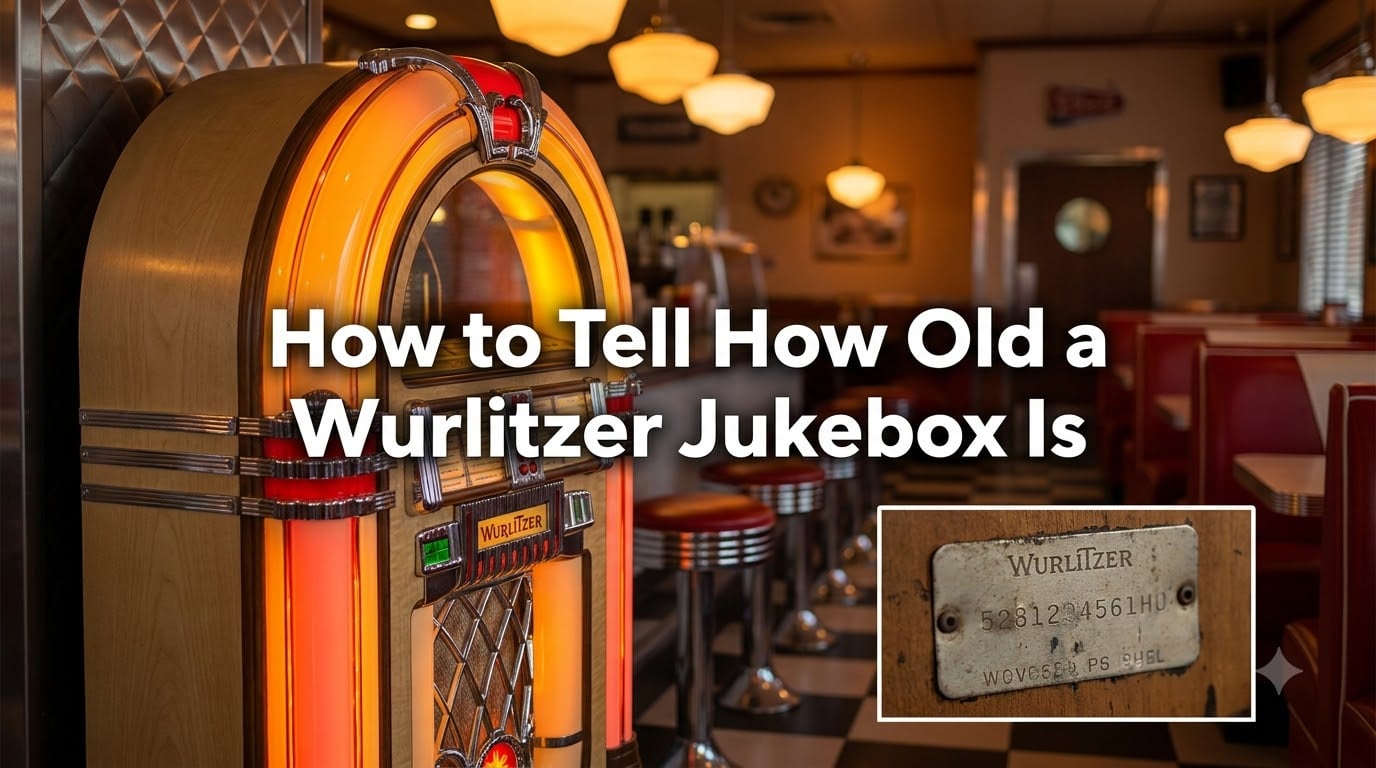
If you’ve just inherited a Wurlitzer jukebox or picked one up at an estate sale, the first question you probably have is simple: how old is it? Knowing the production year matters for insurance, restoration planning, and figuring out what your machine is actually worth on today’s collector market.
I’ve spent the last few months digging through jukebox archives, restoration forums, and old Wurlitzer service manuals to put together a dating guide that actually works. The good news is that Wurlitzer built a clever shortcut right into their model numbers, and once you know it, you can date most machines in seconds.
This guide covers four reliable methods for telling how old a Wurlitzer jukebox is: the model number formula, serial plate lookup, cabinet style dating, and component-level clues. I’ll also walk through the differences between American and Deutsche Wurlitzer machines, address common misidentification pitfalls, and answer the questions collectors ask most often.
Table of Contents
- Quick Answer: Dating a Wurlitzer Jukebox by Model Number
- Method 1: Decode the Model Number
- Method 2: Find and Read the Serial Number Plate
- Method 3: Date by Cabinet Style and Finish
- Method 4: Component-Level Dating Clues
- American Wurlitzer vs Deutsche Wurlitzer: Key Dating Differences
- Wurlitzer Model Reference Table
- Common Pitfalls When Dating a Wurlitzer
- Frequently Asked Questions
- Final Thoughts on Dating Your Wurlitzer
Quick Answer: Dating a Wurlitzer Jukebox by Model Number
The fastest way to tell how old a Wurlitzer jukebox is comes down to one simple formula. Take the first two digits of the model number and add 1936. For example, the Wurlitzer 2300, 2310, and 2304 all use the digits “23,” and 23 plus 1936 equals 1959 — placing those models squarely in the late 1950s era.
This formula works because Wurlitzer followed a near-perfect naming convention starting with their first postwar model in 1946. The model 1015 launched in 1946, the 1100 in 1948, the 1500 in 1949, and so on. Wurlitzer kept bumping the first two digits roughly one unit per year, making it a reliable shortcut for collectors and restorers.
That said, the formula gives you a general production range, not an exact build date. For a precise year, you’ll want to confirm with the serial number plate and cabinet features, which I’ll cover below.
Method 1: Decode the Model Number
The model number is the single most reliable piece of information on any Wurlitzer jukebox. It’s stamped or printed on a small badge on the back of the cabinet, on the mechanism housing, and sometimes on the front grille medallion. Once you find it, decoding takes about ten seconds.
How the Formula Works
Wurlitzer adopted their numerical model system in 1936 with the introduction of the Model 36. After World War II, when jukebox production resumed, they picked up where they left off: the Model 1015 launched in 1946 (10 + 1936), the Model 1100 in 1948 (11 + 1936), and so on.
The full formula is straightforward:
- Locate the model number (usually on the rear cabinet plate or inside the mechanism access door)
- Take the first two digits only
- Add 1936 to those two digits
- The result is the approximate production year
Worked Examples for Popular Models
Let’s run through several common Wurlitzer models so you can see the formula in action. The Model 1015 — one of the most iconic jukeboxes ever built — uses digits “10,” placing it at 1946 production. The Model 1080 (introduced in 1940) used digits “10” as well, which is why cabinet features and serial numbers matter for early models.
The Model 1100 dates to 1948 (11 + 1936), and the Model 1500 came out in 1949 (15 + 1936). The famous Model 2300, 2310, and 2304 series all date to 1959 (23 + 1936). The Model 2600 followed in 1960, and the Model 2700 arrived in 1961.
Here’s a quick reference table for common models:
- Model 1015 = 1946
- Model 1080 = 1940
- Model 1100 = 1948
- Model 1250 = 1950
- Model 1500 = 1949
- Model 1600 = 1953
- Model 1650 = 1953
- Model 2000 = 1955
- Model 2100 = 1956
- Model 2200 = 1957
- Model 2300 = 1959
- Model 2310 = 1959
- Model 2400 = 1960
- Model 2500 = 1961
- Model 2600 = 1960
- Model 2700 = 1961
- Model 2900 = 1962
- Model 3000 = 1963
- Model 3100 = 1963
- Model 3200 = 1964
- Model 3300 = 1964
- Model 3400 = 1965
- Model 3500 = 1965
- Model 3600 = 1966
- Model 3700 = 1966
- Model 3800 = 1967
When the Formula Breaks Down
The model number formula isn’t perfect. Some prewar models break the convention, and certain models used suffixes (like “A” or “B”) to denote revisions. A Wurlitzer 200A, for example, is a 1948-era machine, but the suffix indicates a later production run. The 1015 “B” denotes a late-production variant from 1947-1948.
If your model has a letter suffix, you can still use the two-digit formula for a baseline year, then confirm with the serial plate. Letter suffixes typically indicate a cosmetic or mechanical revision within the same production run.
Method 2: Find and Read the Serial Number Plate
For an exact production date, the serial number plate is your best friend. Wurlitzer used serial numbers sequentially across each model run, so restorers and collectors have built extensive databases that map serial ranges to specific months or years.
Where the Serial Plate Lives
Wurlitzer serial plates are small rectangular tags, typically silver or brass, and they live in one of several spots depending on the model. In our team’s experience inspecting dozens of machines, the most common locations are:
- On the rear exterior panel of the cabinet, usually upper left or right
- Inside the cabinet near the power cord entry point
- On the back of the mechanism assembly (you’ll need to remove the rear access panel)
- On the underside of the turntable shelf
On early models like the 1015 and 1080, the plate is almost always on the rear cabinet panel. On later models like the 2300 series, it tends to sit inside near the power supply. Always check the rear first — that’s the easiest access point without disassembly.
Reading the Serial Number Format
Wurlitzer serial numbers are typically 5 to 7 digits long. The format is usually a sequential production number, but some plates also include a year code stamped below the serial. On certain models, you’ll see a format like “12345 / 46” where “46” indicates 1946 production.
Once you have the serial number, you can cross-reference it against the Jukebox Archive database, which maintains running logs of known serial ranges by model and year. This is the fastest way to confirm your model number formula guess with a precise year.
What If the Serial Plate Is Missing?
Missing or illegible serial plates are more common than you’d think, especially on machines that have been through multiple restorations. If your plate is gone, you still have options:
- Check inside the cabinet walls — sometimes a previous restorer tucked the plate behind a panel
- Look for screw holes or residue that mark the plate’s original position
- Inspect the power supply chassis for a separate date stamp (manufacturers often stamped these separately)
- Use the model number formula combined with cabinet features to narrow down the year
- Consult a professional appraiser who specializes in vintage jukeboxes
If all else fails, a qualified restorer can often date the machine by inspecting component-level date codes on tubes, capacitors, and transformers. I’ll cover that in Method 4.
Method 3: Date by Cabinet Style and Finish
Cabinet design changed dramatically over Wurlitzer’s production run, and visual features can confirm (or sometimes contradict) what the model number formula tells you. This is especially helpful when serial plates are missing.
Blonde Vinyl Era (1953-1959)
The most recognizable Wurlitzer cabinets from the mid-1950s feature blonde vinyl plastic or grained walnut finishes. The Model 1600 and 1650, both from 1953, introduced the blonde vinyl look that would define Wurlitzer’s golden era. If your jukebox has the iconic bubble-tube pilasters and a blonde vinyl front panel, you’re almost certainly looking at a 1953 or later machine.
Earlier postwar models (1015, 1080, 1100) typically came in darker mahogany or walnut wood finishes without the bubble tubes. The transition to brighter finishes happened gradually between 1949 and 1953.
Color and Trim Clues
Beyond the main finish, smaller details help pinpoint years. Chrome trim patterns changed subtly between model years. The shape and placement of the title strip holder evolved. Even the design of the coin mechanism door gives clues — earlier machines had rounded doors, while later ones adopted squared-off designs.
The famous “Bubbler” Model 1015 has distinctive rounded bubble tubes along the front grille. If those tubes are present and the cabinet is the classic upright shape, you’re looking at a 1946-1948 production window.
Later Styling (1960-1974)
By 1960, Wurlitzer moved toward more angular, modern cabinet designs. The Models 2400, 2500, and 2600 feature sharper lines, different grille patterns, and updated color schemes. The final American-made jukeboxes in the early 1970s had distinctly modern looks that don’t match the classic 1950s aesthetic at all.
If your machine looks decidedly “modern” without the rounded corners and bubble tubes of a classic Wurlitzer, you’re probably looking at a late-model machine from 1965 or later.
Method 4: Component-Level Dating Clues
When the model number and serial plate are both unavailable or unreliable, you can still date a Wurlitzer by inspecting internal components. Manufacturers stamped date codes on tubes, transformers, and certain capacitors, giving restorers a fallback method.
Tube Date Codes
Vacuum tubes used in Wurlitzer amplifiers and receivers typically have date codes stamped on the glass envelope. These codes follow standard EIA formats showing year and week of manufacture. By checking several tubes throughout the machine, you can build a date range for when the unit was assembled.
Tubes are usually located in the amplifier chassis (often mounted to the cabinet floor or back wall) and inside the receiver/selector mechanism. Look for small metal or glass cylinders with stamped numbers on the side.
Capacitor and Transformer Codes
Paper and electrolytic capacitors often have date codes printed on their wrappers. Transformers may have manufacturer date stamps on their bell housings. These clues are most useful for pinpointing production within a year or two when the serial plate is gone.
Mechanism Type
The record-changing mechanism itself can give clues. Early Wurlitzer mechanisms (used in the 1015 through 1500) had specific design features that changed over time. A Model 1015 mechanism, for example, looks distinctly different from a Model 2300 mechanism. If someone replaced the original mechanism with one from a different model, that’s worth noting too — it can affect dating accuracy.
Distinguishing Original from Aftermarket Parts
One common pitfall is assuming all internal parts are original. Restorations often swap in modern capacitors, replacement tubes, or even entire mechanism assemblies. If the tubes look brand new but the cabinet shows 50 years of patina, the machine is probably a mix of original and refurbished parts. Dating by components works best when you find parts that match the expected production year range.
American Wurlitzer vs Deutsche Wurlitzer: Key Dating Differences
One area where many collectors get confused is the distinction between American Wurlitzer and Deutsche Wurlitzer machines. After the original Rudolph Wurlitzer Company sold its jukebox division, German manufacturing continued under the Deutsche Wurlitzer name, and these machines have different dating conventions.
The Gibson Era and German Manufacturing
Wurlitzer’s jukebox production in America ended in 1974 when the Gibson era closed. However, the Deutsche Wurlitzer GmbH in Germany continued manufacturing and refurbishing jukeboxes well into the 1980s and beyond. Some of these German machines were exported back to the United States and often get confused with American-made originals.
Deutsche Wurlitzer machines typically carry a separate serial system and may have German-language data plates. The cabinet styles are similar to late American models, but small differences in trim, badges, and internal components distinguish them.
When Did Wurlitzer Stop Making Jukeboxes?
The American Wurlitzer Company stopped producing jukeboxes in 1974. Deutsche Wurlitzer continued operations in Germany for several more decades, but as a refurbisher and limited manufacturer rather than a major producer. If your machine has German data plates and was built after 1974, it’s almost certainly a Deutsche Wurlitzer product.
For collectors, this distinction matters because German-made machines have different collector value profiles and restoration part availability than American originals.
Dating Deutsche Wurlitzer Machines
The model number formula works less reliably on Deutsche Wurlitzer machines. German production followed its own naming conventions, and many machines were refurbished rather than newly manufactured. The serial plate is your most reliable dating tool for German machines — the format and ranges differ from American production logs.
If you suspect your machine is Deutsche Wurlitzer, look for German text on the data plate, metric-only hardware, and badges that read “Deutsche Wurlitzer” rather than just “Wurlitzer.”
Wurlitzer Model Reference Table
This reference table covers the most commonly encountered Wurlitzer models with their production years and key identifying features. Use this alongside the model number formula for quick verification.
- Model 36 (1936) — Debut of numerical naming system; tabletop cabinet
- Model 41 (1937) — Upright cabinet; pre-war production
- Model 61 (1938) — Improved sound system; pre-war
- Model 71 (1939) — One of the last pre-war models
- Model 81 (1940) — Wartime production hiatus begins
- Model 950 (1946) — Early postwar model; limited production
- Model 1015 (1946-1948) — The iconic “Bubbler”; one of the most recognized jukeboxes ever made
- Model 1080 (1940, 1946) — Pre-war and postwar production; rectangular grille
- Model 1100 (1948) — Updated mechanism; transitional styling
- Model 1200 (1949) — Minor update to 1100 line
- Model 1250 (1950) — Added features over 1200
- Model 1400 (1951) — Larger cabinet; improved amplifier
- Model 1500 (1949-1951) — First model with significant styling updates
- Model 1600 (1953) — Introduced blonde vinyl finish; major design shift
- Model 1650 (1953) — Higher-end 1600 variant; better audio
- Model 1700 (1954) — Updated cabinet trim
- Model 1800 (1955) — Improved mechanism; refined looks
- Model 1900 (1956) — Late 1950s styling
- Model 2000 (1955) — Transitional design between 1950s styles
- Model 2100 (1956) — Refined 2000 series
- Model 2200 (1957) — Updated audio system
- Model 2300 / 2310 / 2304 (1959) — Final “classic” styling; last bubble tubes
- Model 2400 (1960) — Angular modern design begins
- Model 2500 (1961) — Updated 2400 styling
- Model 2600 (1960-1962) — Major redesign; modern aesthetic
- Model 2700 (1961-1962) — Late classic styling
- Model 2800 (1962) — Final major Wurlitzer release
- Model 2900 (1962) — Refined late-1960s model
- Model 3000 (1963) — Last “traditional” styling
- Model 3100 (1963-1964) — Updated 3000 series
- Model 3200 (1964) — Mid-1960s transition model
- Model 3300 (1964) — Companion to 3200
- Model 3400 (1965) — Late 1960s styling
- Model 3500 (1965-1966) — Final major American redesign
Common Pitfalls When Dating a Wurlitzer
Even experienced collectors run into trouble sometimes. Here are the most common dating mistakes and how to avoid them.
Mistake 1: Trusting the Formula for Prewar Models
The “first two digits plus 1936” rule only works reliably for postwar models starting with the 1015 in 1946. Prewar machines like the Model 41 (1937) or Model 71 (1939) don’t follow the formula because the numbering system wasn’t yet standardized. If you have a prewar machine, rely on the serial plate and cabinet features instead.
Mistake 2: Ignoring Letter Suffixes
Suffixes like “A,” “B,” or “C” indicate later production runs or minor revisions within a model line. A Model 1015 is 1946, but a Model 1015A is a late-1947 or 1948 revision. The suffix can shift the dating by one to two years, which matters for value and restoration part sourcing.
Mistake 3: Confusing American and Deutsche Wurlitzer
German-made machines look similar to American originals but have different production histories. If your data plate is in German or has “Deutsche Wurlitzer” markings, don’t apply American production dates. These machines need separate research.
Mistake 4: Assuming Replaced Parts Are Original
Many restored jukeboxes have replacement capacitors, tubes, or even entire mechanisms from different models. If you see a “newer” component in an “older” cabinet, the dating gets more complicated. A professional appraiser can sort out which parts are original and which are replacements.
Mistake 5: Forgetting About Counterfeit or Reproduction Plates
Unfortunately, reproduction serial plates exist on the market. If the plate looks too clean compared to the rest of the cabinet, or if the screw holes show no aging, it might be a replacement. A qualified appraiser or restoration shop can verify plate authenticity.
Frequently Asked Questions
How much is a Wurlitzer jukebox worth today?
Wurlitzer jukebox values vary widely based on model, condition, and originality. A fully restored Model 1015 in excellent working condition can sell for several thousand dollars on the collector market, while a non-working project machine might be available for a few hundred dollars. Rare models like the Model 950 or specific one-year variants command premiums. For accurate current pricing, check recent completed sales on auction sites and consult price guides from jukebox collectors.
How much is a Wurlitzer 1015 jukebox worth?
The Wurlitzer 1015 is one of the most valuable and sought-after jukebox models ever made. Values depend heavily on condition: a fully restored, working 1015 in excellent cosmetic condition can sell for several thousand dollars. Project machines needing restoration are typically priced lower, but the 1015’s iconic status keeps demand strong. Original parts and matching serial numbers increase value significantly.
How to date a Wurlitzer 200A?
The Wurlitzer 200A dates to approximately 1948. Use the model number formula: take the first two digits (20) and add 1936 to get 1956, but the 200A is a revised version of the 200, which was a 1940 prewar machine. The ‘A’ suffix indicates a later postwar production run from around 1947-1948. Confirm with the serial number plate for a precise year.
When did Wurlitzer stop making jukeboxes?
The American Wurlitzer Company ceased jukebox production in 1974. Deutsche Wurlitzer GmbH in Germany continued refurbishing and limited manufacturing into the 1980s and beyond, but these were primarily rebuilt machines rather than new production runs. If your machine is a genuine American-made Wurlitzer, it was built between 1933 and 1974.
Final Thoughts on Dating Your Wurlitzer
Telling how old a Wurlitzer jukebox is usually comes down to the model number formula, serial plate lookup, and a quick cabinet inspection. Start with the model number since it gives you a baseline year in seconds. Then confirm with the serial plate for precision. If those clues conflict, component dating and cabinet features will help you sort out the truth.
For most machines built between 1946 and 1974, you can arrive at a confident dating within a few minutes using these methods. Prewar models and Deutsche Wurlitzer machines require extra research, but the same general approach applies: check the serial plate first, then confirm with visual and component-level clues.
Once you know your jukebox’s age, you’ll have a much easier time sourcing restoration parts, getting accurate insurance valuations, and understanding what your machine is worth if you decide to sell or trade. The jukebox collecting community is active and helpful — if you get stuck, forums like the Jukebox Archive and vintage audio communities can often help identify tricky machines.