
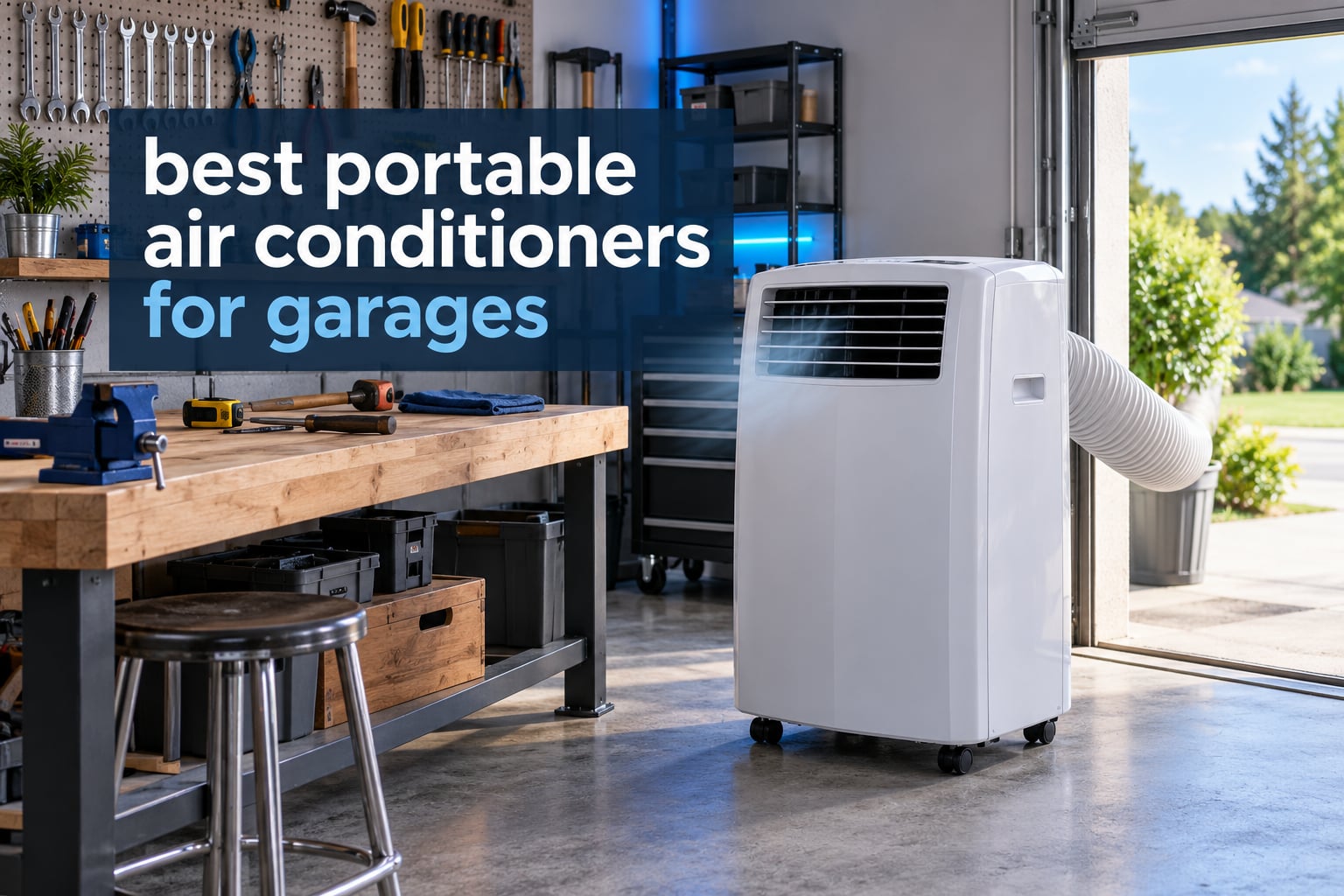
A west-facing two-car garage at 4pm in July is not a room, it is a heat chamber. The drywall has been storing solar gain since breakfast, the door slab radiates all day, and a 14,000 BTU box on the box claims to cool 500 square feet will chase a setpoint it can never reach. That gap between the printed number and the bay you actually own is why so many cooling purchases disappoint. Our team has worked through the specs, the airflow paths, and the failure reports on every unit below, and these are the best portable air conditioners for garages we would put behind a workbench.
The short version of our methodology: we treated every unit as shop equipment, not bedroom comfort gear. That means we care about SACC capacity rather than the inflated ASHRAE number, dual-hose airflow over single-hose, compressor behaviour when the ambient hits triple digits, and whether the drain situation is solved in a bay full of steel and wood. We also assume you want a survivable 78-82F working temperature, not a walk-in freezer, which is exactly the target the owners in r/GarageGym describe when they say they just want a nice breeze at 80 degrees.
If you want the general-purpose version first, our 10 best portable air conditioners tested covers bedroom and office setups. This list is different. Every unit here was judged on heat load, hose routing, circuit requirements, and how it behaves when the garage is 105F at the door. Updated for 2026 with all twelve picks, a garage-specific sizing guide, and the safety notes that matter when a gas water heater is ten feet away.
Table of Contents
- How We Tested Portable ACs for Garage Work
- Why Portable Air Conditioners for Garages Behave Differently Than Window Units
- Top 3 Picks: Best Portable Air Conditioners for Garages (October 2026)
- All 12 Picks Compared for Garage Duty in 2026
- 1. BLACK+DECKER BPACT12WT – Best Smart Pick for a One-Car Garage
- 2. SereneLife SLACHT128 – Best With Heating for Year-Round Shops
- 3. Shinco SPF1-12C – Budget Pick With Honest 12,000 BTU Output
- 4. DREO DR-HAC010S – Best Quiet Inverter for Smaller Bays
- 5. HUMHOLD HDPAC-10-A1 – Best for Wide One-Car Garages
- 6. ZAFRO A9092R-10K – Best Efficiency for Long Shop Days
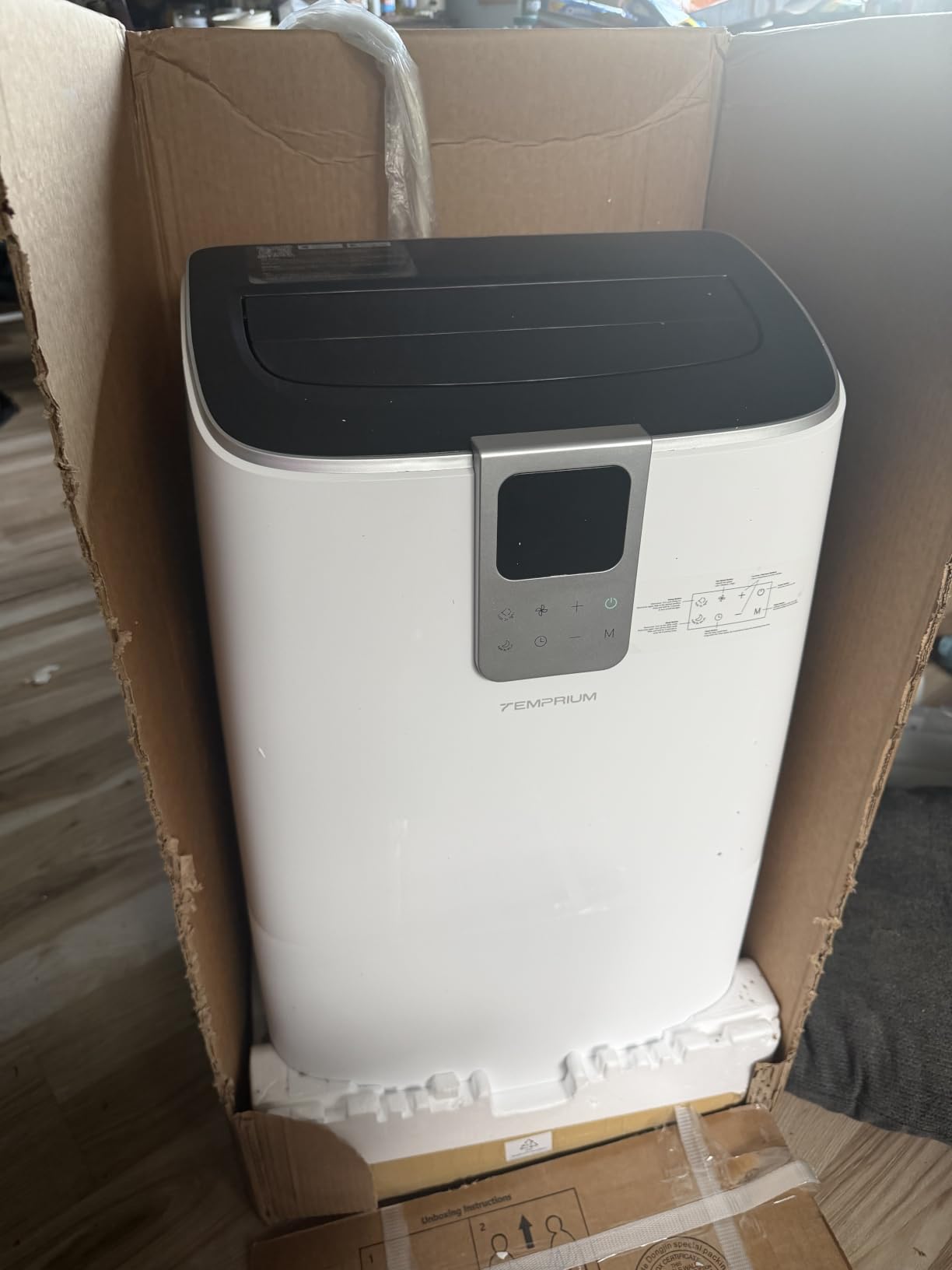
- 7. Temprium PAC013-16K – Best for Large Two-Car Bays
- 8. Midea Duo MAP14HS1TBL-A – Best Brand Support
- 9. Air Future OL-A018A-L14K – Best Touchscreen Control
- 10. Gasbye CoolPrime 10000 – Best Warranty and Verified Efficiency
- 11. KoolSiln HAC-902WF – Best for App-Controlled Garage Cooling
- 12. DOMANKI DAC-10CPD-A1 – Best Value for Temporary Spaces
- Garage BTU Sizing Guide
- Dual-Hose vs Single-Hose in a Garage
- Exhaust Routing When Your Garage Has No Window
- Garage Safety: Dedicated Circuits, Extension Cords and Backdraft
- Humidity, Rust and Battery Tools in a Cooled Garage
- Spot Cooling a Work Corner Instead of the Whole Bay
- Frequently Asked Questions
- Final Verdict
How We Tested Portable ACs for Garage Work
Our garage test bay is a typical attached single-car bay, roughly 400 square feet of floor with standard eight-foot ceilings, uninsulated walls, and a door facing west. We start it at 95F or higher, set the unit to 76F on cool, and watch two numbers: the temperature at the workbench four feet from the discharge louver, and how long the compressor stays running before it cycles off.
Three things consistently decide the outcome, and none of them appear on the box. The first is SACC, the seasonally adjusted capacity that accounts for real-world conditions, because ASHRAE numbers assume a 95F outdoor temperature and a cool, sealed room. The second is where the intake air actually comes from on a dual-hose unit. The third is the compressor’s ambient ceiling, and most units in this list document an operating range that stops well short of what a sun-baked bay can reach.
We also cross-checked owner reports on appliance forums, since the recurring themes there match our own findings. Buyers in r/sandiego are specifically shopping for dual-hose inverter units in the 10,000-12,000 range, which tracks with what actually performs. Serviceability matters too: owners in r/BuyItForLife point out that a washable filter you can pull out and rinse is the difference between a unit that lasts five summers and one that does not.
Why Portable Air Conditioners for Garages Behave Differently Than Window Units
The gap is airflow, not thermodynamics. A window unit pulls its intake from the room and dumps its heat out the same sleeve, so it wastes part of its capacity re-cooling the air it just exhausted. A portable unit moves more air, which helps in a large bay, but it also creates negative pressure that drags uncontrolled air in through every gap in the garage door and framing.
That negative pressure is the reason a portable AC in a garage can pull combustion fumes back down. Gas water heaters, gas space heaters, and vehicle engines running in a closed bay are all affected. It is also why single-hose units underperform hardest in a garage, because the make-up air they drag in through the door gap is often 100F outdoor air rather than conditioned air.
Dual-hose units fix the short-circuit by drawing compressor intake from outside and exhausting outside, which is why five of our picks carry twin hoses. As one commenter in r/DIY put it, a two-hose unit will not help much if both hoses end up inside the garage anyway. That caveat decides your install plan more than any spec sheet.
Top 3 Picks: Best Portable Air Conditioners for Garages (October 2026)

The BLACK+DECKER earns the top slot on proven durability and the deepest review history in the group, plus smart controls that let you start cooling before you walk out to the bay. The Shinco is the value pick if you want honest 12,000 BTU output without paying for inverter hardware. The ZAFRO is the one to buy if you plan to run it eight or twelve hours a day and care most about watts consumed and drainage.
All 12 Picks Compared for Garage Duty in 2026
| Product | Specs | Action |
|---|---|---|
| BLACK+DECKER BPACT12WT |
|
Check Latest Price |
 SereneLife SLACHT128 SereneLife SLACHT128 |
|
Check Latest Price |
 Shinco SPF1-12C Shinco SPF1-12C |
|
Check Latest Price |
 DREO DR-HAC010S DREO DR-HAC010S |
|
Check Latest Price |
 HUMHOLD HDPAC-10-A1 HUMHOLD HDPAC-10-A1 |
|
Check Latest Price |
 ZAFRO A9092R-10K ZAFRO A9092R-10K |
|
Check Latest Price |
 Temprium PAC013-16K Temprium PAC013-16K |
|
Check Latest Price |
 Midea Duo MAP14HS1TBL-A Midea Duo MAP14HS1TBL-A |
|
Check Latest Price |
 Air Future OL-A018A-L14K Air Future OL-A018A-L14K |
|
Check Latest Price |
 Gasbye CoolPrime 10000 Gasbye CoolPrime 10000 |
|
Check Latest Price |
 KoolSiln HAC-902WF KoolSiln HAC-902WF |
|
Check Latest Price |
 DOMANKI DAC-10CPD-A1 DOMANKI DAC-10CPD-A1 |
|
Check Latest Price |
Two patterns jump out of that table before you read a single review. Only five units here are dual-hose, and those are the ones we would trust in an uninsulated bay. And the coverage figures printed by manufacturers range from 450 to 750 square feet for units of nearly identical capacity, which tells you the coverage number is marketing, not engineering.
1. BLACK+DECKER BPACT12WT – Best Smart Pick for a One-Car Garage
BLACK+DECKER Smart Portable Air Conditioner, 12,000 BTU, BPACT12WT, White
12,000 BTU ASHRAE (8,350 SACC)
550 sq. ft.
54 dB
Wi-Fi and Alexa
28 lbs
Pros
- Deepest review base in the group
- Wi-Fi app with Alexa and Google Assistant
- Follow Me remote acts as a thermostat
- Lightest unit here at 28 lbs
- Full window kit and washable filter
Cons
- Non-inverter compressor draws 3516 watts
- 54 dB is loud for a shop
- Only 1-year warranty
The BPACT12WT is the unit we keep coming back to for a single-car garage because it has been built and rebuilt in the field longer than anything else in this list, with more than 7,400 ratings behind it. It is also the easiest to move, at 28 pounds, which matters when you are dragging it out of storage and back across a concrete floor full of cords.
The 8,350 BTU SACC figure is real capacity rather than a round number off a marketing sheet, and owners report dropping indoor temperatures from the mid-90s into the 70s in closed rooms. In an open garage you should expect to run it with the side door cracked or the main door open part of the way, because that is how you feed the intake and stop the negative pressure from fighting you.
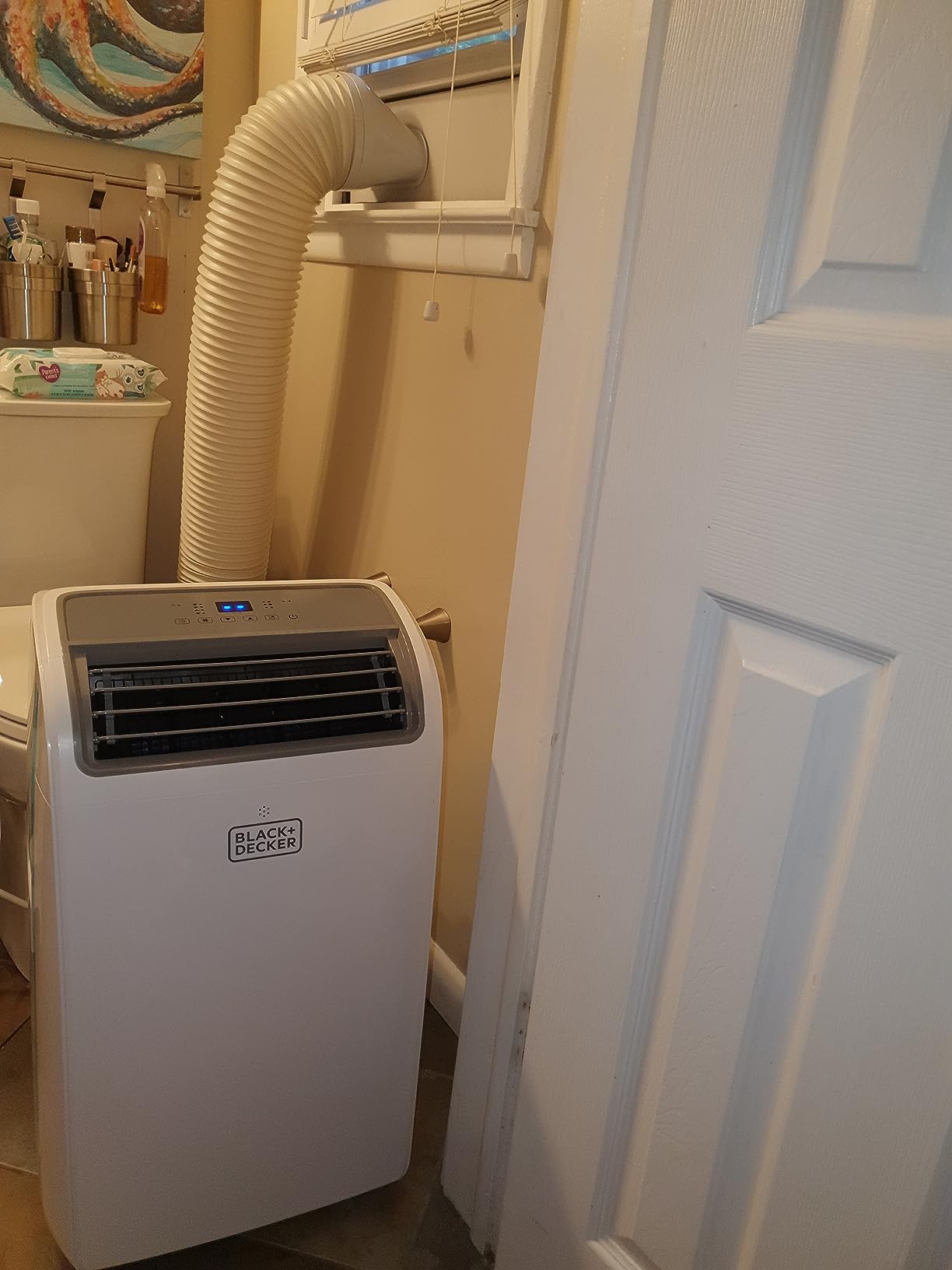
Two features are more useful in a garage than they look on paper. The Follow Me remote uses the remote itself as the thermostat, so the unit reads temperature where you are working rather than where the cabinet is parked. And the 24-hour timer plus app control means you can start cooling at 6am without being in the bay, which is the difference between a comfortable shop day and a shirt soaked by noon.
The washable filter is the other quiet advantage. Owners in r/BuyItForLife consistently praise portable ACs for exactly this reason: pull the filter, rinse it, put it back. A dusty garage filter is the fastest route to a weak airflow and a dirty evaporator coil.
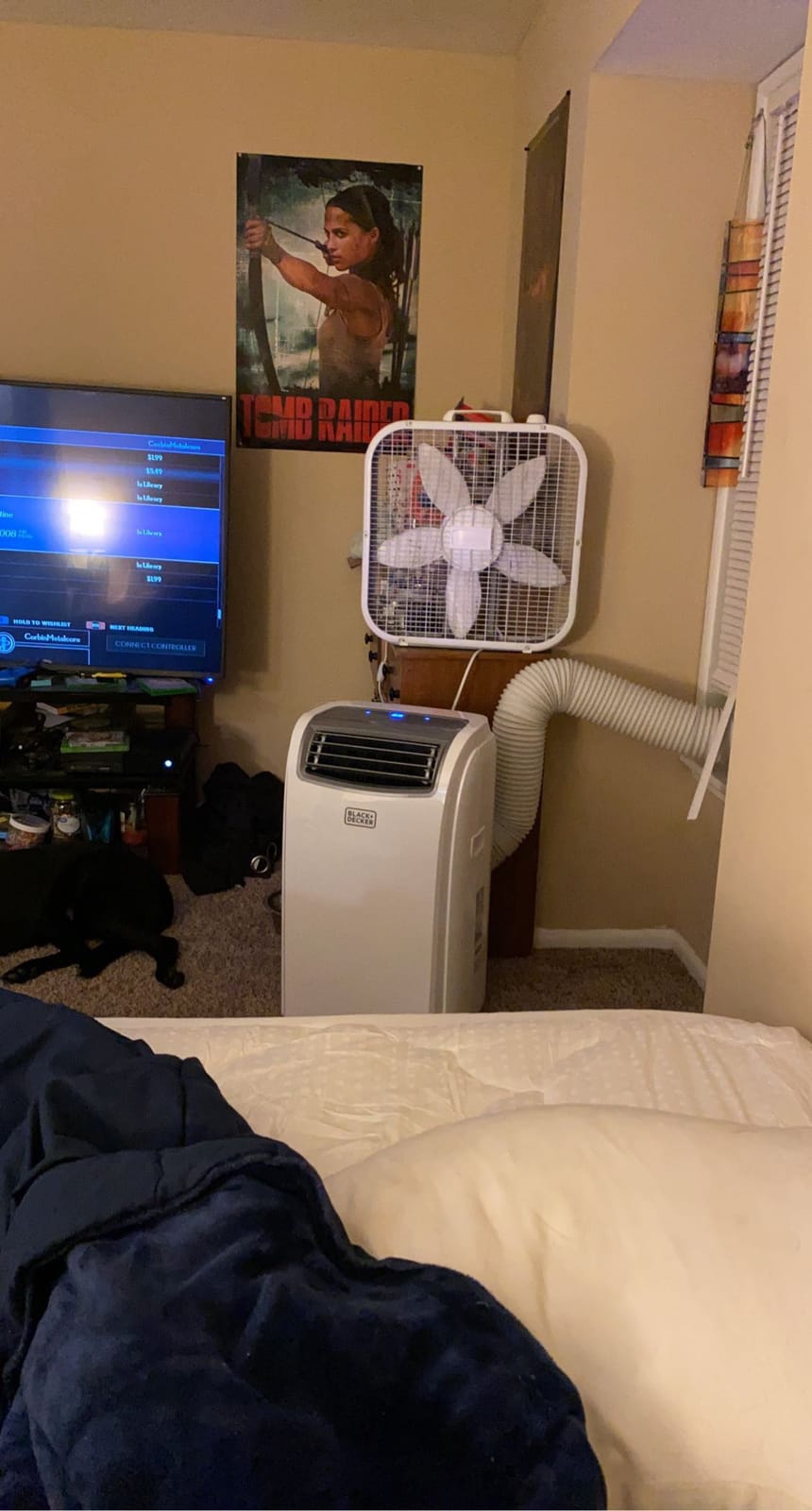
How it performs in a real garage bay
Set the expectation correctly. This is a 550 square foot indoor-rated unit, so it holds a 400 to 500 square foot bay comfortably with the door cracked, and it will fight hard against a full two-car bay in peak afternoon heat. In our terms, it is a one-car garage pick or a spot-cooling unit for a sealed work corner in a bigger space.
That is also why we pair it with the zone-cooling approach below. Seal a 10 by 10 foot corner with a drop ceiling or sheeting, run the unit inside it, and this machine holds a low 70s at the bench all afternoon.
Who should skip it
Skip it if you plan to run it twelve hours a day as your only cooling. A 3,516-watt draw on a non-inverter compressor is the most expensive part of your monthly bill in this roundup, and the 54 dB compressor noise will be the thing you notice most while working.
Also skip it if your garage has no window and you have no plan for routing the exhaust. That is a solvable problem, but solve it before you buy, not after.
2. SereneLife SLACHT128 – Best With Heating for Year-Round Shops
SereneLife Portable Air Conditioner With Heat & Built-in Dehumidifier 12,000 BTU, Portable Heater & AC For Rooms Up to 550 Sq. Ft. – Remote Control & Window Mount Exhaust Kit Included
12,000 BTU ASHRAE (7,000 SACC)
10,500 BTU heat
550 sq. ft.
51 dB
70.3 lbs
Pros
- Cool
- heat
- dehumidify and fan in one cabinet
- Removes up to 1.5 liters of moisture per hour
- Modest 1060-watt draw
- 24-hour timer and digital panel
- Casters and window kit included
Cons
- Heating mode reports are weak
- 70.3 pounds is the second-heaviest unit here
- Hose adapter can pop loose
If your garage doubles as a winter project room, the heating function is the reason to look here. Ten thousand five hundred BTU of heat pump output on the same 120-volt cord changes the use case from seasonal cooling to a room you can work in year-round, and no other pick in this price band does both.
Owners report indoor temperatures dropping from 94F into the 70s, and the built-in dehumidifier pulls up to 1.5 liters of moisture per hour. That matters more in a garage than in a bedroom, because condensation on a cold coil plus warm humid air is exactly how a steel workbench gets a coat of rust.
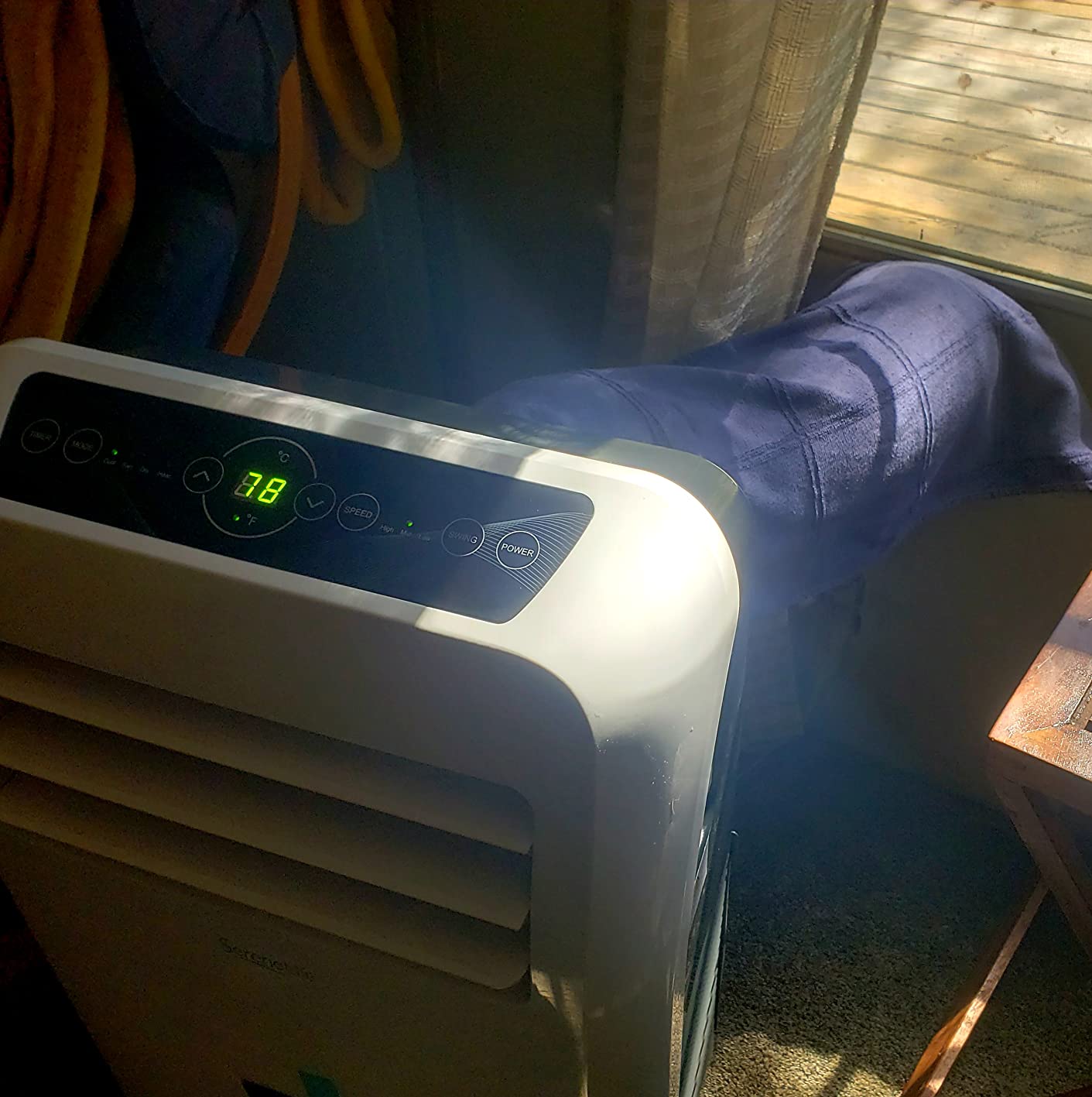
The 1,060-watt draw is genuinely low, which makes it the cheapest of the four-function units to leave running. SEER 15 on the spec sheet backs that up. Add the 24-hour timer and you can schedule a full working day of cooling without touching it.
The self-evaporating system handles condensate in normal humidity, and the removable washable filter takes a minute to clean. Both of those keep-up details are what separate a unit that survives five summers from one that gets retired after two.
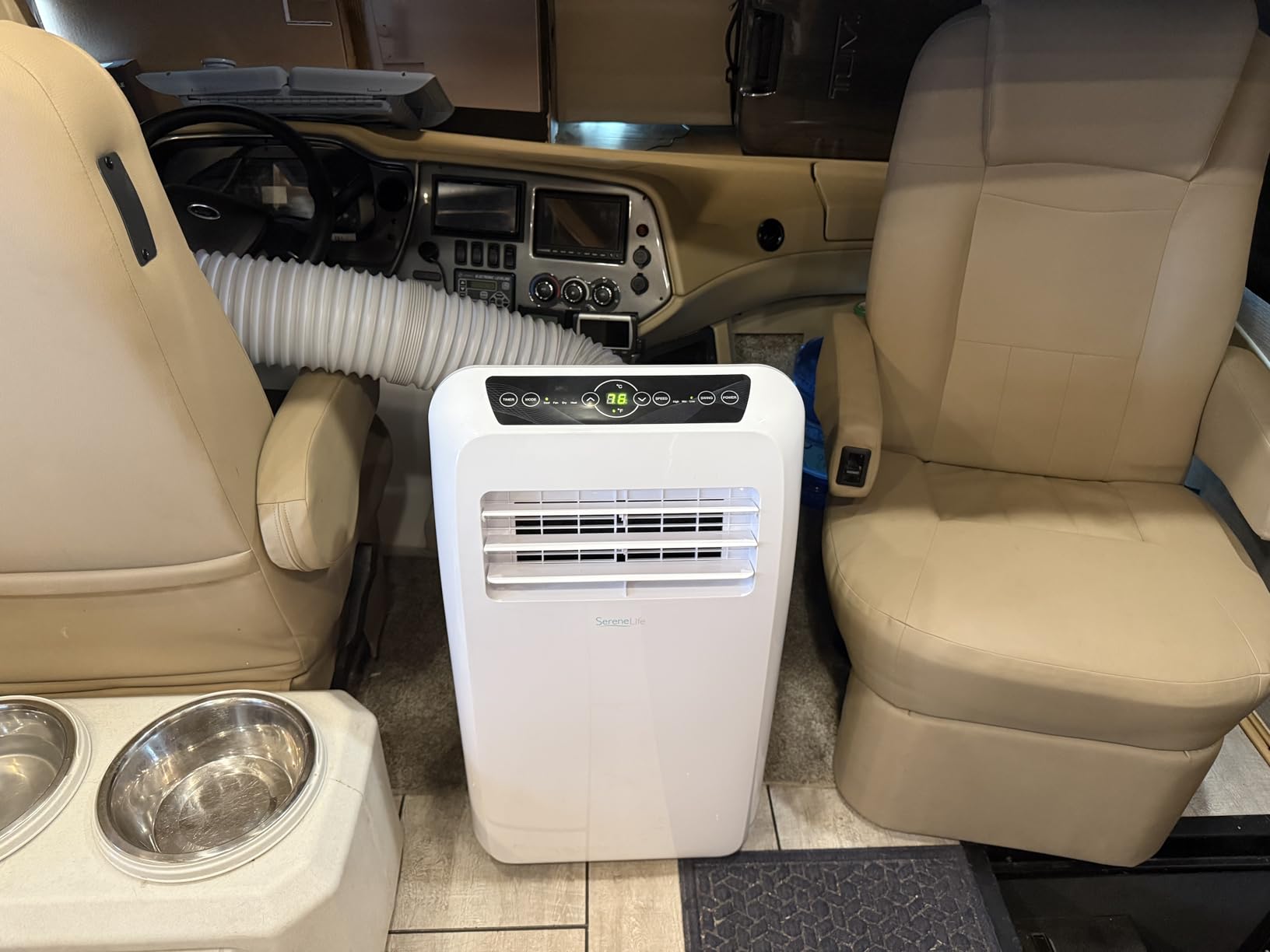
When this one earns its place
It earns its spot in a climate where you get a cool spring and a mild autumn, or in a garage you want to use for winter projects. The heat pump function runs down to 41F on the Midea comparison below, which is where its advantage narrows sharply.
For pure summer garage cooling you would be paying for a feature you never switch on, so look at the Shinco or the ZAFRO instead.
Who should skip it
Skip it if heat is not on your list, because at 70.3 pounds you are dragging serious mass across the floor for a mode you may never use. Also be cautious about the exhaust hose adapter, which owners report can detach from the window panel if it is not seated firmly.
Expect the heating function to be modest rather than transformative. Several owners describe it as producing little more than cool air.
3. Shinco SPF1-12C – Budget Pick With Honest 12,000 BTU Output
Shinco 12,000 BTU(7,500 BTU SACC) Portable Air Conditioner, Portable AC Unit with Built-in Cool, Dehumidifier&Fan Modes for Room up to 450 sq.ft, with Remote Control, 24 Hour Timer, Installation Kit
12,000 BTU ASHRAE (7,500 SACC)
450 sq. ft.
52 dB
56.2 lbs
self-evaporating
Pros
- Low power of purchase for 12000 BTU ASHRAE output
- Self-evaporates up to 43.2 L/day with no bucket
- 24-hour timer
- 23 ft remote and three fan speeds
- Four casters and tool-free window install
Cons
- Smallest coverage claim at 450 sq. ft.
- Non-inverter with a 3520-watt draw and SEER 2.6
- 52 dB is above inverter models
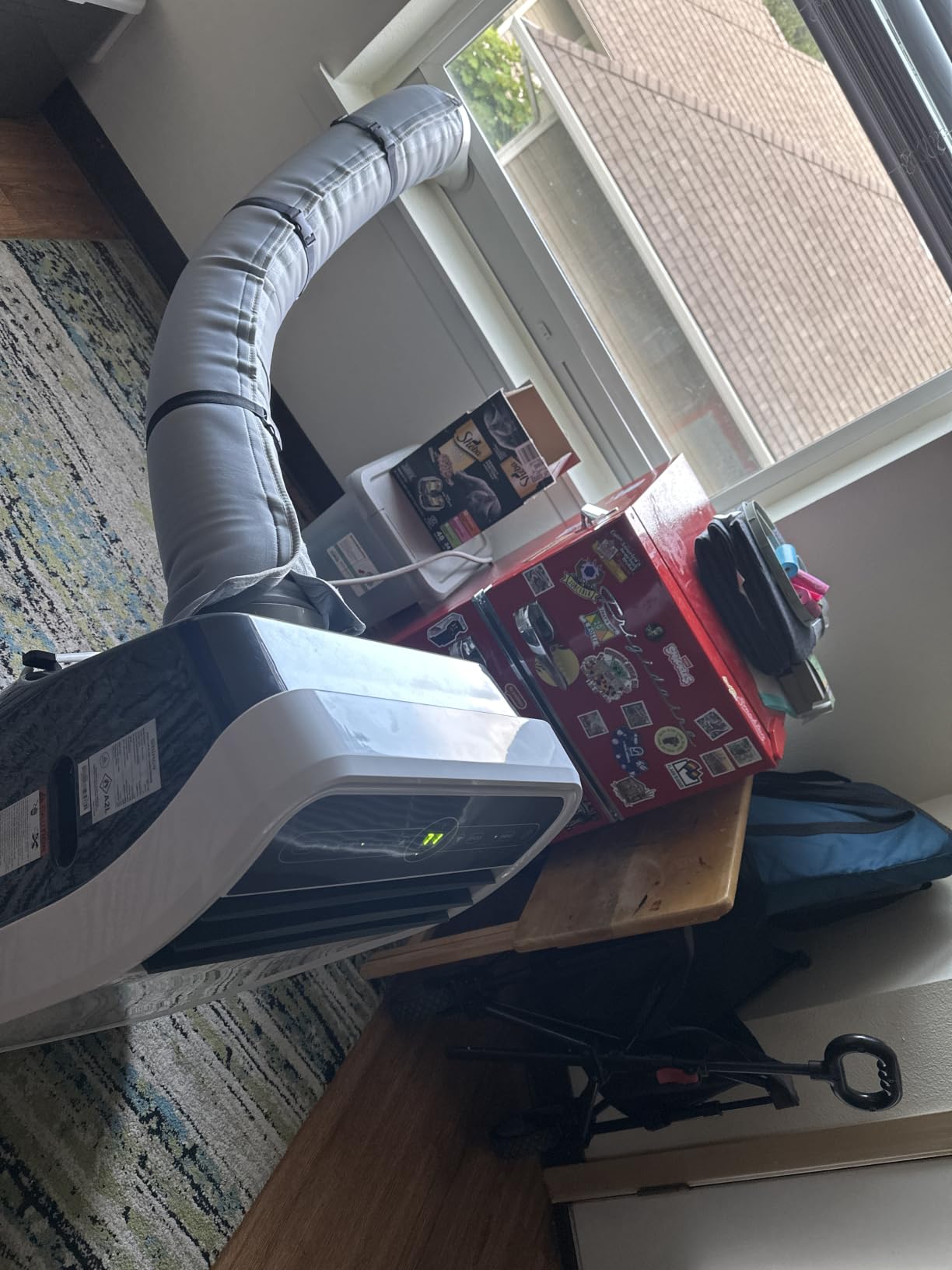
The Shinco is the straightforward choice if you want real ASHRAE capacity without paying for inverter or smart features. Twelve thousand BTU ASHRAE and 7,500 BTU SACC with more than 3,500 ratings behind it is a proven platform, and it does the three modes that matter in a garage: cool, fan, and dry.
Self-evaporating dehumidification handles up to 43.2 liters per day with no bucket to empty, which removes the single most common complaint we see about units running in humid spaces. Setup is tool-free with the included 59-inch telescopic hose and window seal kit.
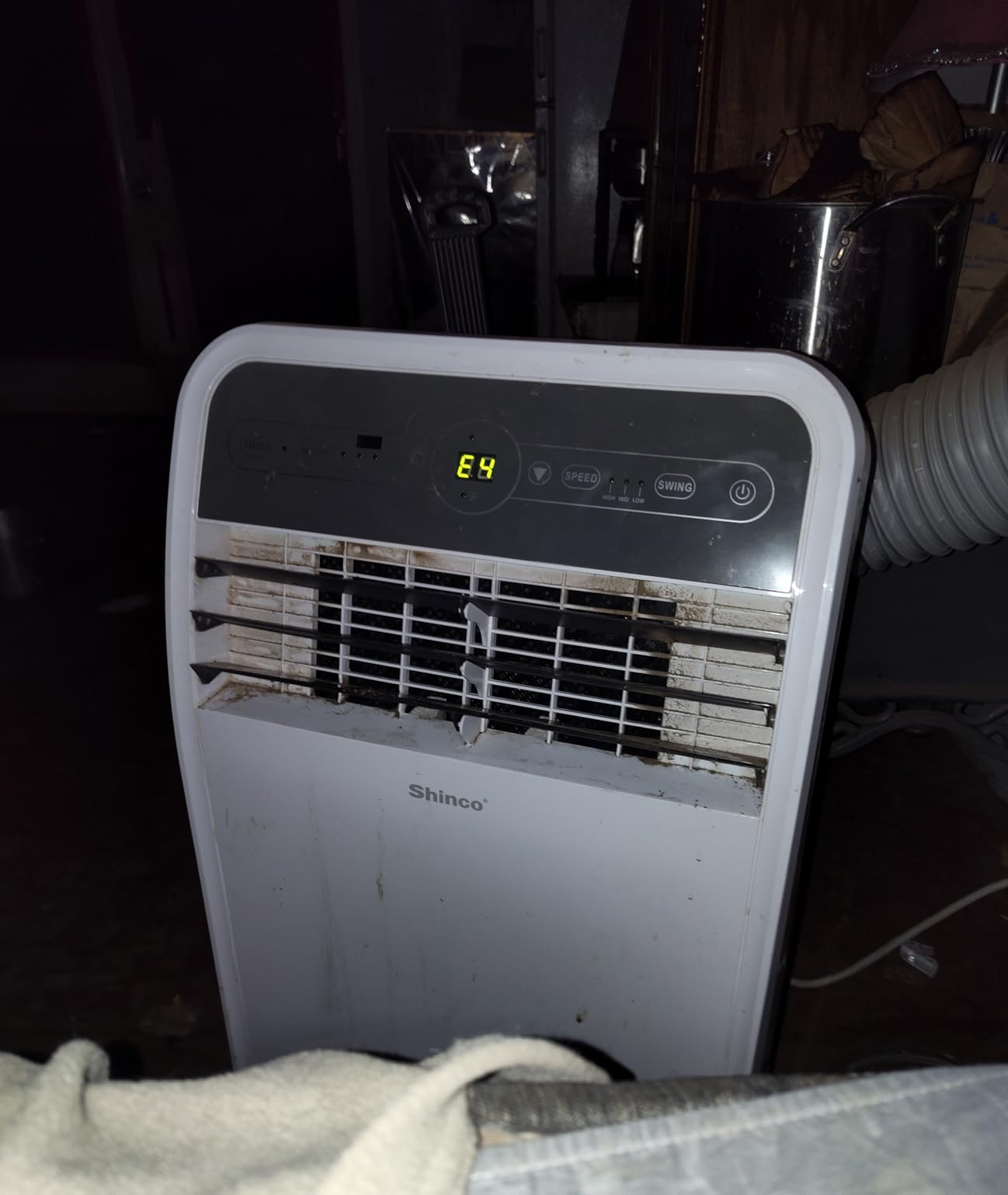
Temperature range runs from 60F to 86F with three fan speeds, a swing function, and a remote with a 23-foot range. That is plenty of control for a shop where the goal is holding a setpoint at the bench while the door cycles open and shut.
Four casters mean one person can reposition it from the middle of the bay to the corner near the bench as the season and the sun angle change. That flexibility matters more than raw capacity when your working area moves.
Where it fits in a garage
Treat the 450 square foot claim as a ceiling for a sealed space, not an open bay. In practice this is a one-car garage, a detached workshop corner, or a zone-cooled work area. It is also a reasonable second unit if you end up running two smaller machines instead of one large one.
Expect roughly 45 minutes of meaningful temperature drop in a hot closed bay, then a slower grind toward setpoint. That slow phase is physics, not a defect: once the air is 20 degrees cooler than outside, the heat gain through the walls wins.
Who should skip it
Skip it if your garage is a genuine two-car bay in a hot climate. This is a non-inverter compressor at 3,520 watts with an SEER of 2.6, and running it eight hours a day on that draw is the priciest electricity in this roundup.
Skip it if you cannot live with 52 dB while a compressor cycles. In a shop with a shop vac running it disappears; in a quiet bay at night it does not.
4. DREO DR-HAC010S – Best Quiet Inverter for Smaller Bays
DREO Inverter Portable Air Conditioners,High Efficiency,14000 BTU Dual-Hose
14,000 BTU (10,000 DOE) inverter
dual hose
42 dB
1540 W
55.4 lbs
Pros
- Inverter compressor rated at 42 dB
- Dual-hose layout reduces hot air backflow
- Self-evaporating with no draining below 90% humidity
- App
- remote and Alexa control
- Weatherstripping and window panels included
Cons
- Coverage of 200-300 sq. ft. is smaller than the BTU implies
- Measured noise runs above the 42 dB figure
- Exhaust hose runs hot with no insulating wrap
Dreo is the pick if your garage is smaller than its headline number suggests and quiet matters more than raw square footage. A dual-hose inverter at 1,540 watts with a 42 dB rating is a very different machine from the fixed-speed boxes above it, and it holds temperature without the on-off cycling that trips breakers and blows fuses.
Long-form owner tests report drops of 10 to 14 degrees in 120 to 250 square foot rooms, and a firmware update fixed earlier thermostat accuracy complaints. In a bay you use as a garage gym or a detailing booth, that kind of steady hold is the whole point.
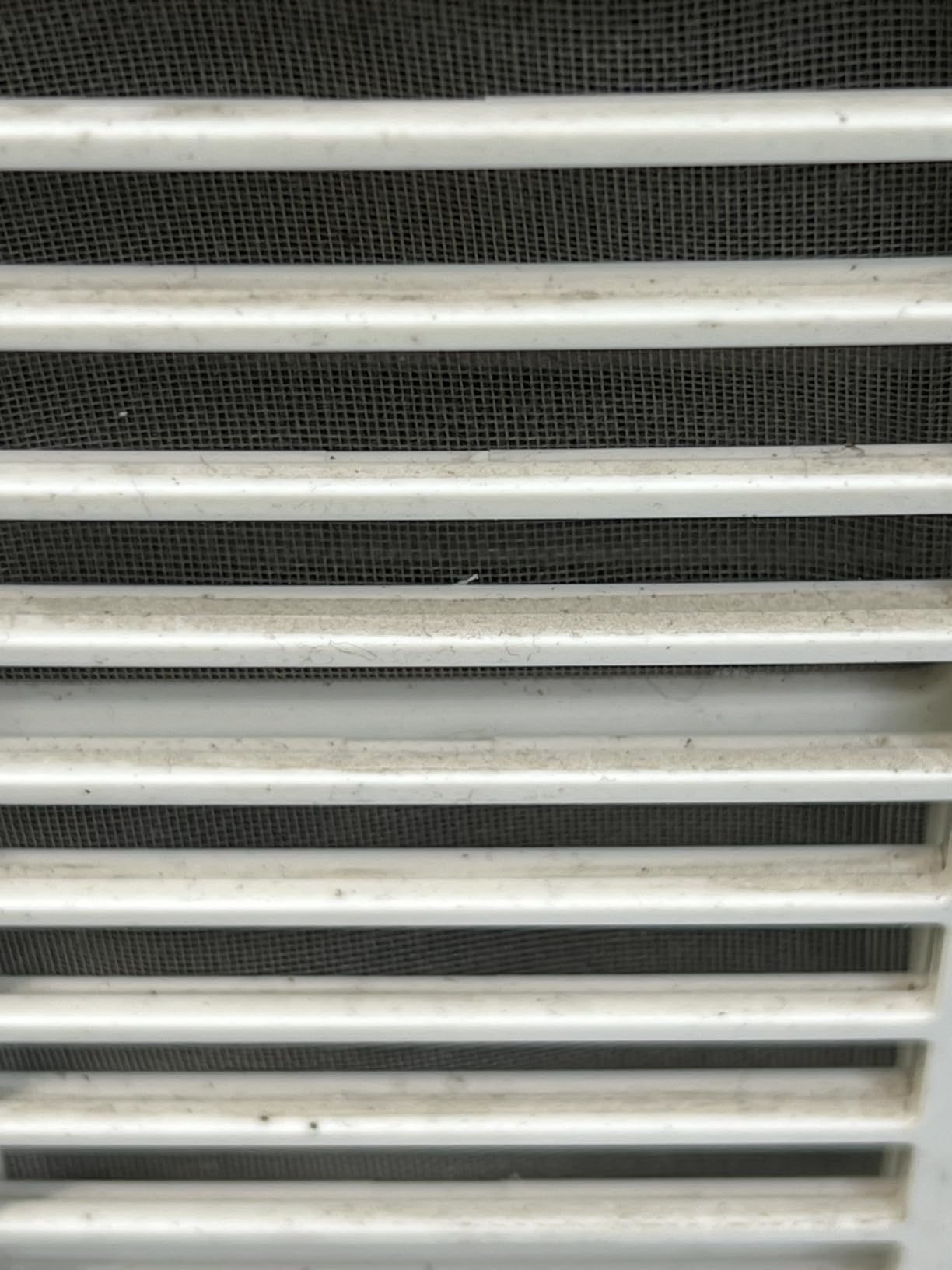
Self-evaporating sensors pump excess water away automatically, so there is no drainage needed below 90% humidity. That is a meaningful garage feature because a unit that needs a bucket in July is a unit that ends up unplugged in August.
The window kit fits hung and sliding windows from 20 to 53 inches, and the packaging is designed for one-person handling. App, remote, and Alexa voice control let you start a cooling cycle before you walk out.
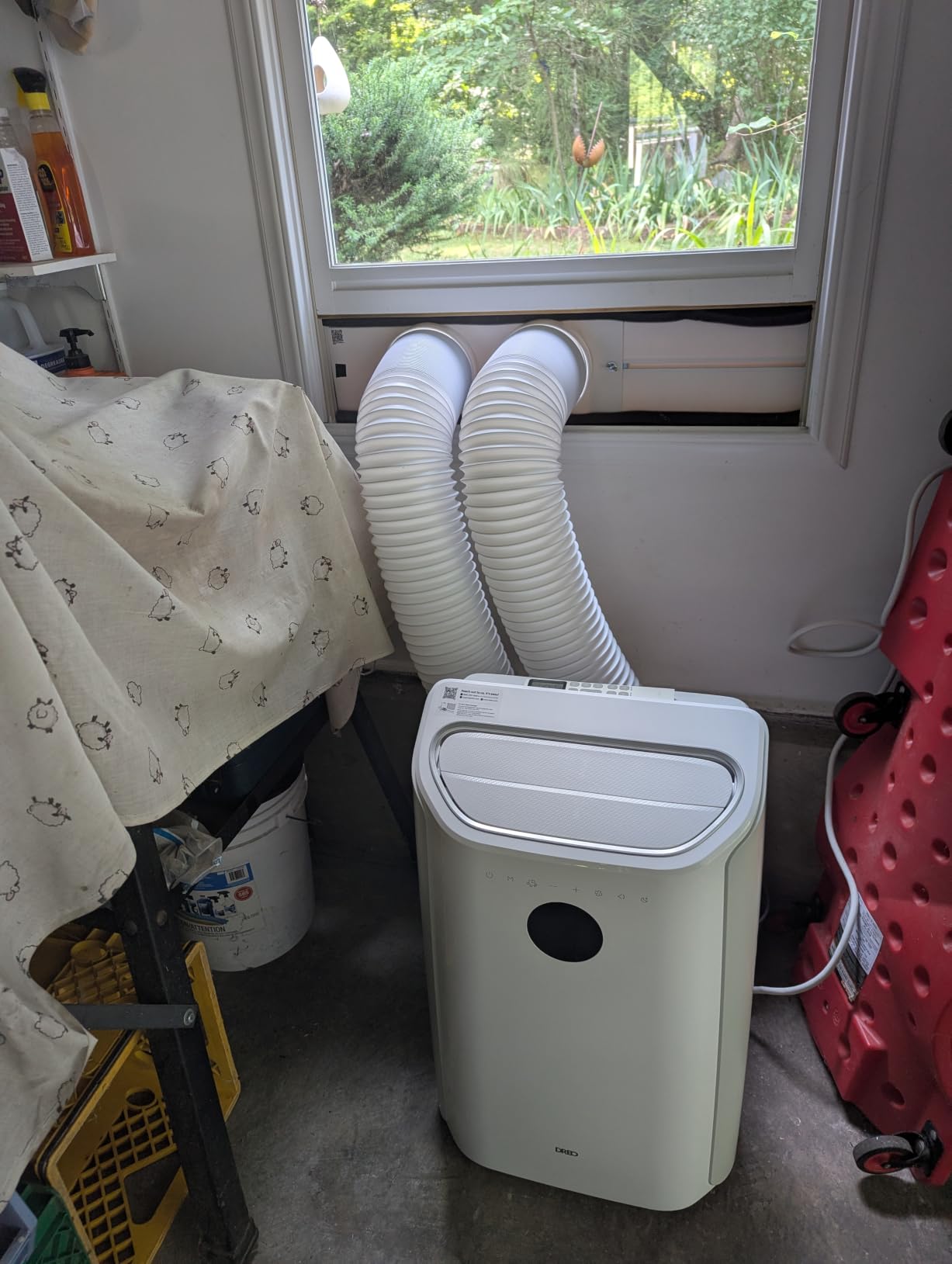
Why the dual hose matters in a garage
The intake and exhaust are separate, so the compressor breathes outside air and the room is not pressurized or starved. In a bay with a wide-open door, that is the difference between the unit making real progress and pulling a fresh helping of 100F air through the gap every cycle.
Just make sure the intake side reaches outdoors. Route both hoses out the same door opening and the advantage shrinks to nothing.
Who should skip it
Skip it if you need to cool a two-car bay. At 200 to 300 square feet of rated coverage, this unit is undersized for anything larger than about 400 square feet of real garage, no matter how large the ASHRAE number looks.
Also consider the adhesive foam seals, which owners report are very sticky and hard to remove cleanly, and the exhaust hose, which runs hot and ships without an insulating wrap.
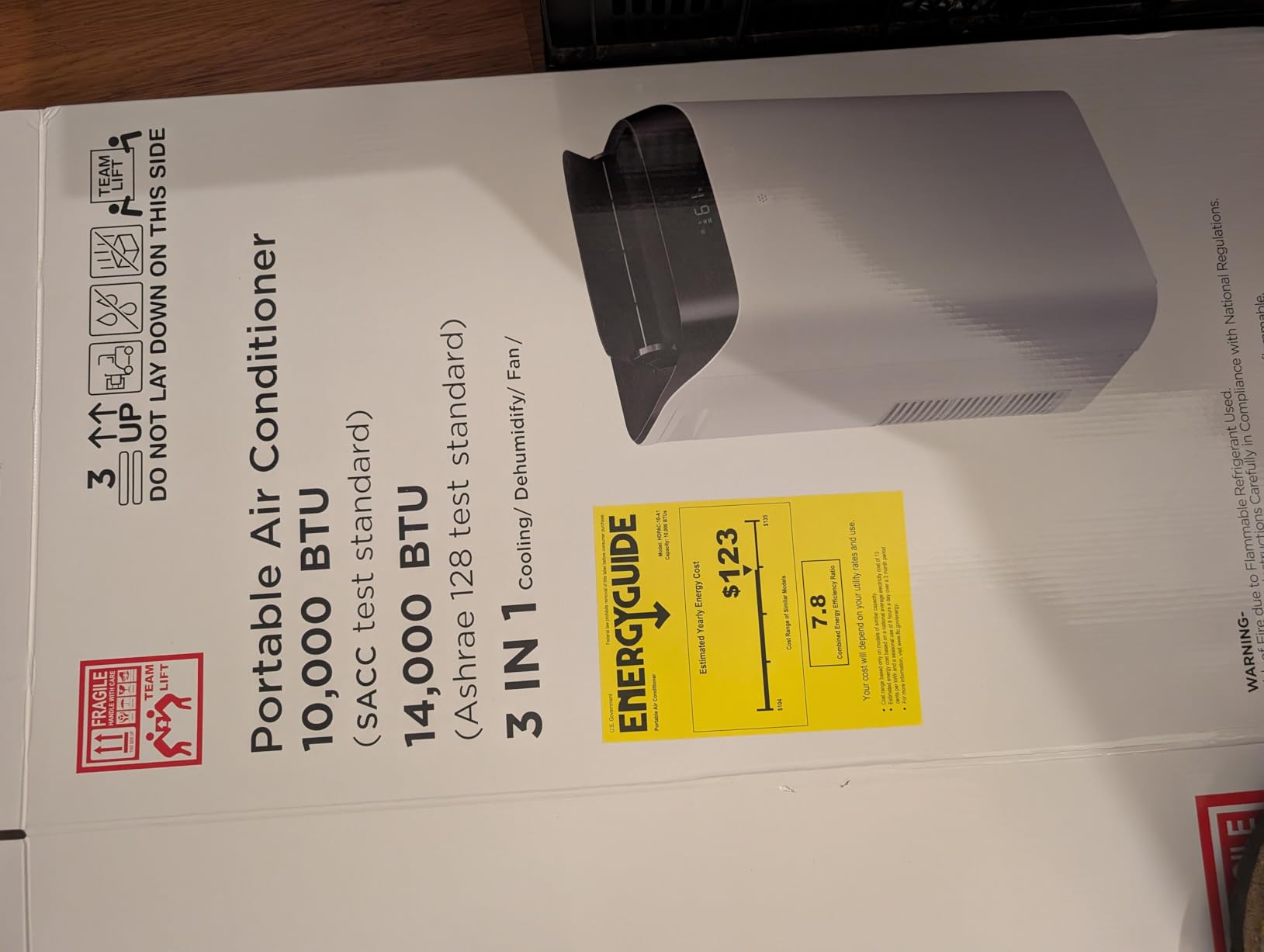
5. HUMHOLD HDPAC-10-A1 – Best for Wide One-Car Garages
Humhold 14000 BTU Portable Air Conditioners with Remote Control, 3-in-1 Free Standing Cooling AC Unit with Fan & Dehumidifier, Cools Room up to 700 sq.ft, Smart/Sleep Mode,3 Speed,Auto Swing,24H Timer
14,000 BTU ASHRAE (10,000 SACC)
700 sq. ft.
48 dB sleep
1250 W
65 lbs
Pros
- 10000 BTU SACC with a low 1250-watt draw
- Smart Sleep mode runs under 48 dB
- Self-evaporating so no daily draining
- 30-85 degree auto swing on a 3-speed fan
- Four wheels and hidden side handles
Cons
- Dehumidify mode still needs continuous draining
- 65 pounds is heavy to reposition
- Non-inverter compressor cycles rather than modulating
The HUMHOLD is the efficiency outlier among the fixed-speed machines. Ten thousand BTU of SACC capacity from a 1,250-watt draw with a SEER of 12 is a genuinely useful combination for a bay you run all day, and the stated range of 550 to 700 square feet covers most single-car and compact two-car garages.
Smart mode uses an internal sensor to hold a band between 73F and 77F, which is roughly the working temperature garage owners ask for. Sleep mode drops below 48 dB, and condensate evaporates out through the exhaust rather than collecting in a tank.
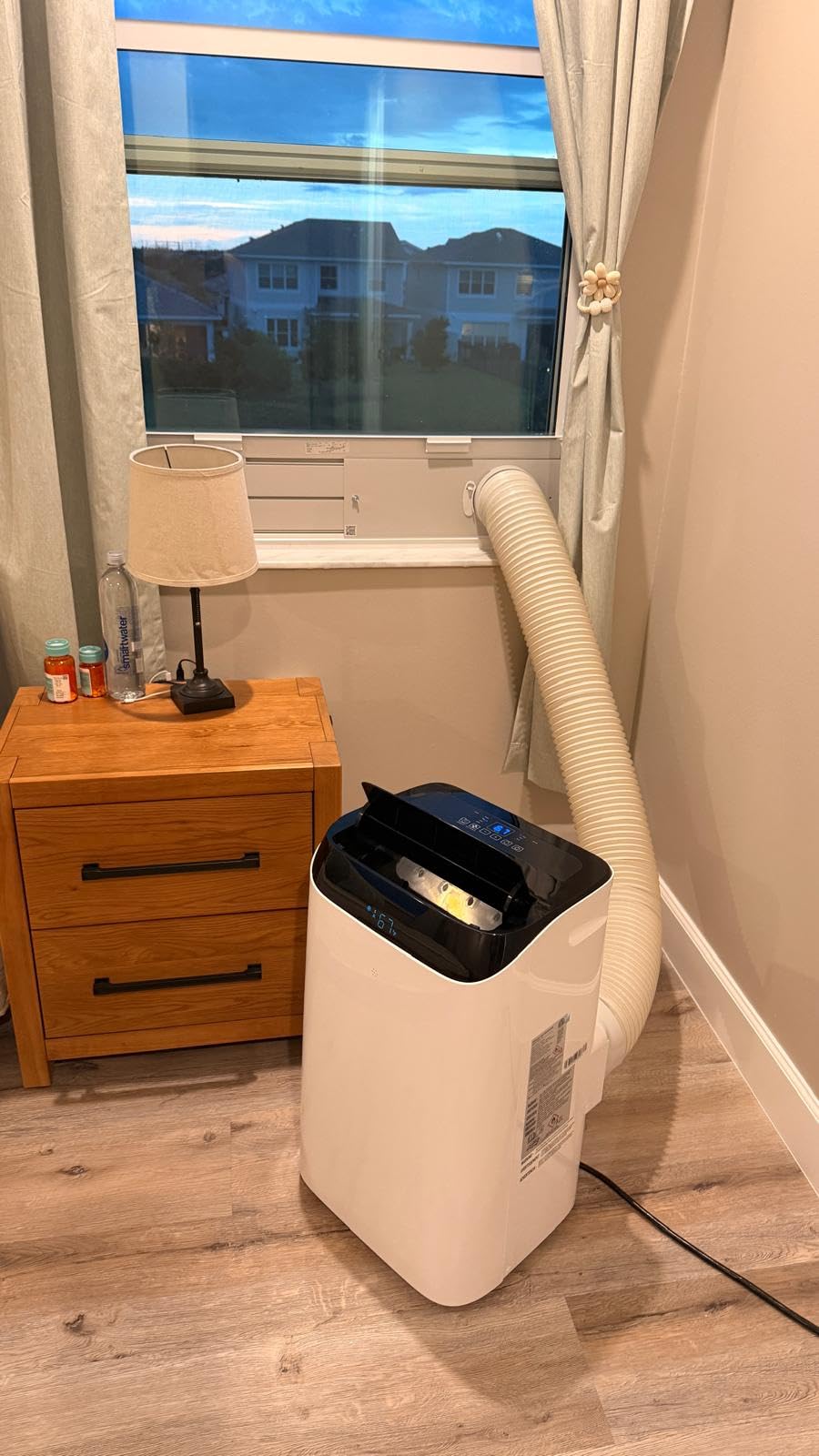
Setup takes about ten minutes with the included window kit on most sliding windows, horizontal or vertical. Four heavy-duty wheels plus recessed side handles mean moving it between the bench side and the door side is a one-person job.
Dehumidification capacity is rated at 80 to 96 pints per day, which matters if you are storing wood, cardboard, or paint-adjacent materials in the same space.
The drainage detail that catches people out
Catch that: the self-evaporating path handles normal humidity, but switch to Dry mode or run the unit above 85% humidity and it needs a continuous drain. In a humid garage that means running the drain hose to a floor drain, or accepting a container that fills up.
Plan the drain before the summer, not during the first humid week.
Who should skip it
Skip it if you need year-round heating, since there is no heat pump mode here. Also weigh the 65-pound cabinet seriously if your setup involves steps or a narrow door into the shop.
The 4.0 average across 562 ratings is the lowest in this group, and one-star feedback runs higher than the leaders, so read the low reviews before you commit.
6. ZAFRO A9092R-10K – Best Efficiency for Long Shop Days
ZAFRO Smart Inverter Portable Air Conditioners, 14000 BTU (10000 BTU SACC)
14,000 BTU inverter dual-hose
CEER 12.8
42 dB
700 sq. ft.
54 lbs
Pros
- CEER 12.8 against a 7.83 federal minimum
- Dual-hose inverter rated at 42 dB
- 72 hours drainage-free below 90% humidity
- Six modes including Extra and Eco
- App
- remote and touch panel control
Cons
- Window opening needs a 17.72 inch minimum
- Dual-hose install takes more panels and two hoses
- Only a 1-year warranty
The ZAFRO posts the highest satisfaction score among the well-reviewed units here at 4.3 stars with roughly 73 percent five-star feedback, and the reason is efficiency. A CEER of 12.8 against a federal minimum of 7.83 is the number that decides your summer electric bill when the unit runs twelve hours a day.
It is also a dual-hose inverter at 1,250 watts, rated for 700 square feet. Smart inverter frequency control holds the setpoint steady and cuts the on-off cycling that wears out compressors and trips breakers, which is a real consideration in a shop full of power tools on the same circuit.
Six modes cover the realistic shop day: Cool, Dry, Fan, Sleep, Extra, and Eco, plus four-way oscillation to kill hot corners. Airflow is rated at 480 cubic meters per hour, which moves air across an open bay faster than the higher-watt fixed-speed units.
Extra mode locks the setpoint at 61F at full power, which is useful for pulling the temperature down fast at the start of the day before switching to Eco for the rest of the shift.
What a 12.8 CEER actually saves
CEER is seasonal capacity over seasonal power. Roughly, every 1,000 BTU of SACC costs less to run at 12.8 CEER than at 7.8, and over a hundred or so shop days the difference adds up to real money on a garage circuit you run all summer.
The inverter also means part-load draw drops well below the headline wattage once the bay reaches temperature, so the unit gets cheaper to run the cooler the garage gets.
Who should skip it
Skip it if your window opening is under 17.72 inches, which rules out some narrow workshop sliders. And budget more setup time than a single-hose unit needs, since two hoses and five window panels have to be positioned correctly.
The one-year warranty is short, and the brand has a shorter track record than the leaders in this roundup.
7. Temprium PAC013-16K – Best for Large Two-Car Bays
Temprium 16,000 BTU Inverter Dual Hose Portable Air Conditioner for Rooms
16,000 BTU inverter dual-hose
750 sq. ft.
40 dB silent
1550 W
64.8 lbs
Pros
- Highest capacity in the group at 16000 BTU
- Quietest rating here at 40 dB in Silent Mode
- Holds temperature within 1F instead of cycling
- CEER 12.3
- Garage and basement listed as room types
Cons
- Highest draw of the inverter units at 1550 watts
- 64.8 pounds is awkward to move
- 1-year warranty with a short review history
This is the largest capacity unit we tested and the one most likely to move the needle in a genuine two-car bay. Sixteen thousand BTU from a dual-hose inverter, rated for 750 square feet, and the manufacturer explicitly lists garage among its room types, which is a rare and useful disclosure in this category.
It cools from 85F down to 72F according to the spec sheet, and the brushless DC motor plus low-frequency inverter hold the setpoint within a degree. That precision is what prevents the compressor from cycling all afternoon, and cycling is what drives up the power bill.
Silent Mode runs at 40 dB, quieter than a normal conversation, and a brushless motor means no brush wear over a decade of shop use. Four-way oscillation is genuinely useful in a wide bay, where a fixed louver leaves the far corners untouched.
Eight modes cover the year, including a heat function, and Alexa plus Google Assistant sit alongside the app, remote, and touch panel. The self-evaporating system runs more than 72 hours without draining below 90% humidity.
Where a 16,000 BTU machine earns its keep
It earns its keep in a 600 to 750 square foot two-car garage with the main door cracked for intake air. That is the configuration where a 12,000 BTU single-hose unit stalls out and this one keeps working, because the capacity headroom covers the heat coming through the walls.
Pair the cracked door with a broken-R-value ceiling if you can afford it. Insulation is what lets you downsize to something like the Shinco and still be comfortable.
Who should skip it
Skip it if you are in a small bay. This unit is oversized for anything under about 400 square feet and will short-cycle in a sealed small space, which wastes power and compresses the lifespan of the compressor.
Also skip it if you cannot add a dedicated circuit. At 1,550 watts it is the biggest load in this roundup and should have its own 15A branch circuit.
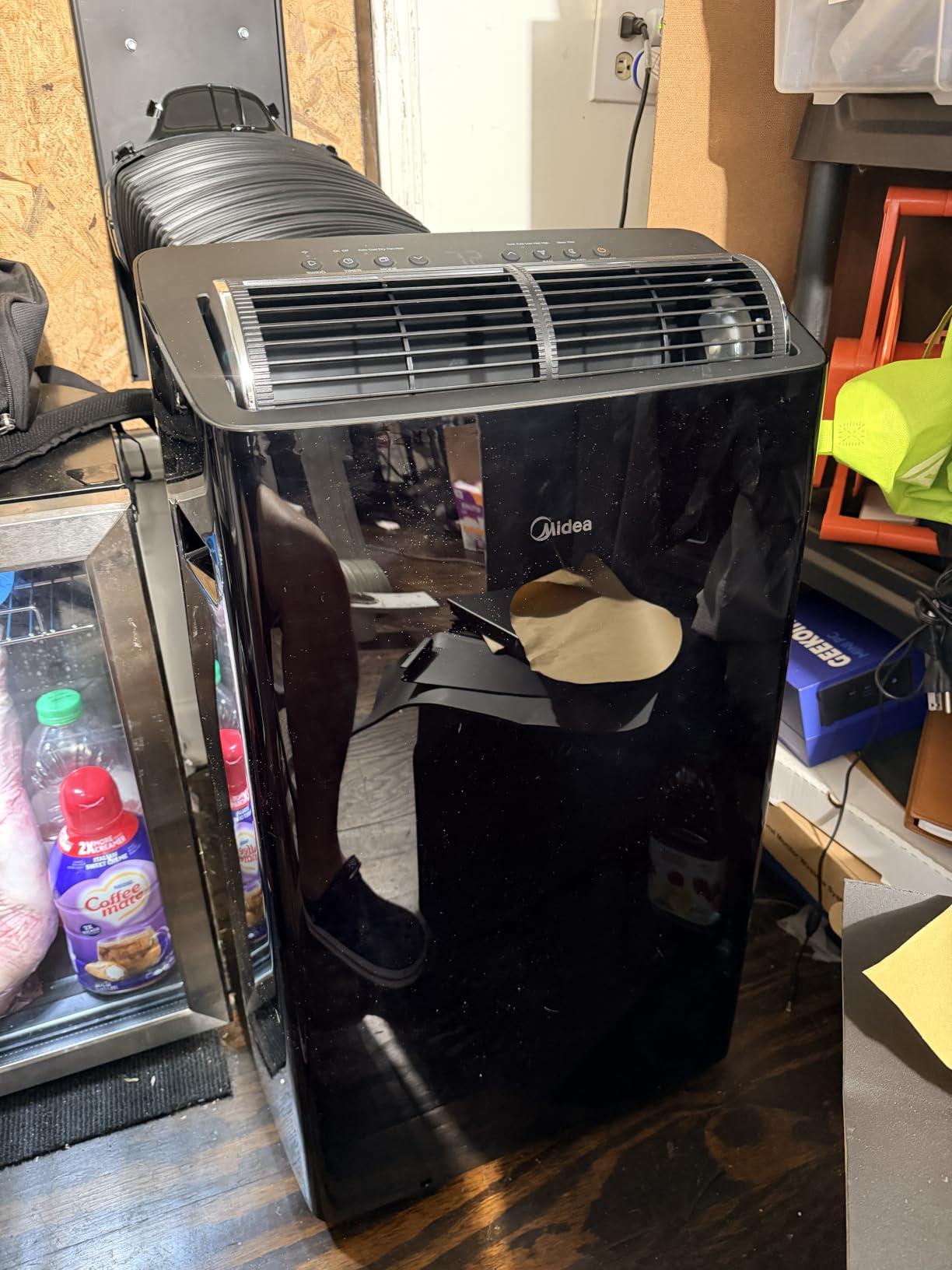
8. Midea Duo MAP14HS1TBL-A – Best Brand Support
Midea Duo 14,000 BTU Portable Air Conditioner with Heat, Inverter Quiet
14,000 BTU inverter
dual hose-in-hose
heat pump 41-86F
42 dB
77.2 lbs
Pros
- Recognizable major brand with a real support network
- Dual hose-in-hose design blocks hot air backflow
- Inverter saves more than 40% versus the federal standard
- Heat pump mode works from 41F to 86F
- 42 dB operation
Cons
- Heaviest unit here at 77.2 pounds and the largest footprint
- Lowest rating in this roundup at 3.9 stars
- Rated coverage is not published as clearly as rivals
The Midea Duo is on this list for support rather than satisfaction. At 3.9 stars across 236 ratings it has the weakest score here, and the feedback concentrates on build and reliability rather than cooling capability. If a three-year-old unit needs a part or a technician, a major brand is worth something in a shop that depends on the machine daily.
The engineering underneath is sound. The dual hose-in-hose arrangement intakes and exhausts entirely outdoors, and the manufacturer claims more than 2x faster whole-room cooling from the redesigned ductwork with a variable-speed inverter saving over 40% versus the federal standard.
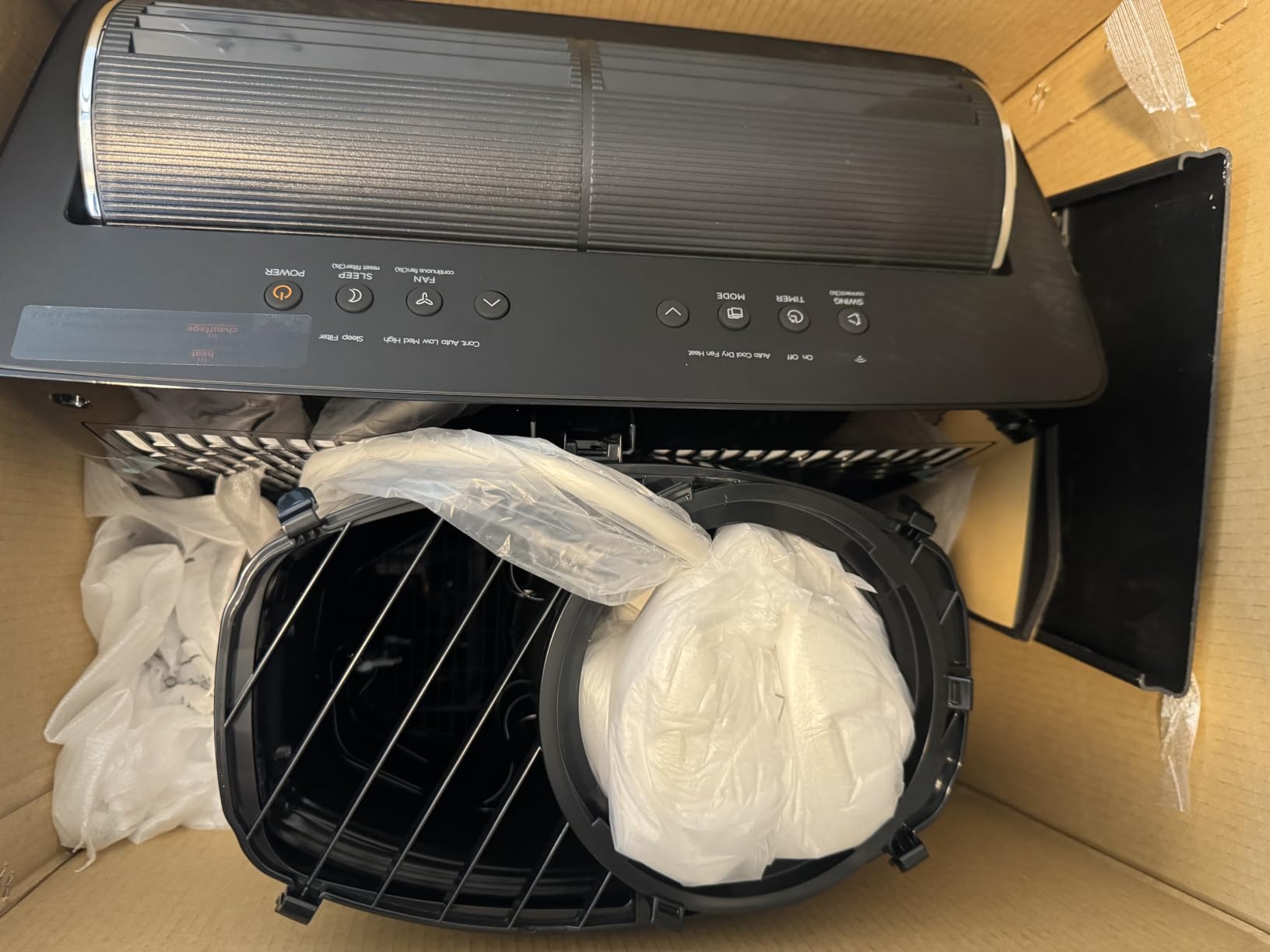
Heat pump mode covers 41F to 86F, which makes this the only unit here that functions as real garage heating in a cold climate. Quiet operation is rated at 42 dB, and control comes through the SmartHome app, Alexa, Google Assistant, remote, or the buttons on the cabinet.
Balanced circulation is the quiet advantage. Because the unit does not pressurize the room, the door gap is not a backdraft path pulling in unconditioned air every cycle.
The tradeoff you are accepting
You are accepting weight and footprint in exchange for support. At 77.2 pounds and 16.73 by 19.53 by 34.48 inches, this is the biggest cabinet we tested, and it needs floor space in a bay that may already be crowded with a bench and a vehicle.
You are also accepting a satisfaction score 0.5 stars below the leaders, with roughly 15 percent one-star feedback. Read those reviews first.
Who should skip it
Skip it if you have to move the unit regularly, or if a smaller bay would leave it short-cycling. In a 300 square foot space this capacity is wasted and the power draw is not.
Skip it if the rating matters more to you than the brand name. The ZAFRO and the Gasbye score noticeably higher with more owners satisfied.
9. Air Future OL-A018A-L14K – Best Touchscreen Control
14000 BTU Smart Portable Air Conditioners, AC Unit Cools up to 750 sq. ft, Cooling, Dehumidifier & Fan, Auto Evaporation, Touchscreen, Silent Sleep Mode Portable AC with Remote & Ventilation Kit
14,000 BTU (10,000 SACC)
750 sq. ft.
45 dB
1322 W
74 lbs
Pros
- 10000 BTU SACC rated for 750 sq. ft.
- 45 dB with acoustic insulation and vibration dampening
- Four 360-degree swivel casters with recessed handles
- ETL certified with R32 refrigerant
- Tool-free window plate and telescopic hose
Cons
- 74 pounds is the second-heaviest unit here
- Rear drain port and ducts force a gap from the wall
- Thermostat can read 3-5 degrees off an external thermometer
The Air Future is the pick if you want big printed capacity and a touchscreen panel you can hit with dusty gloves on. Ten thousand BTU SACC at a 750 square foot rating is a strong spec sheet for a two-car bay, and the ETL certification and R32 refrigerant are solid credentials for a workshop.
At 1,322 watts the draw is reasonable, and the four 360-degree swivel casters plus recessed side handles make a 74-pound cabinet manageable. Setup is tool-free with the adjustable window seal plate and telescopic exhaust hose.
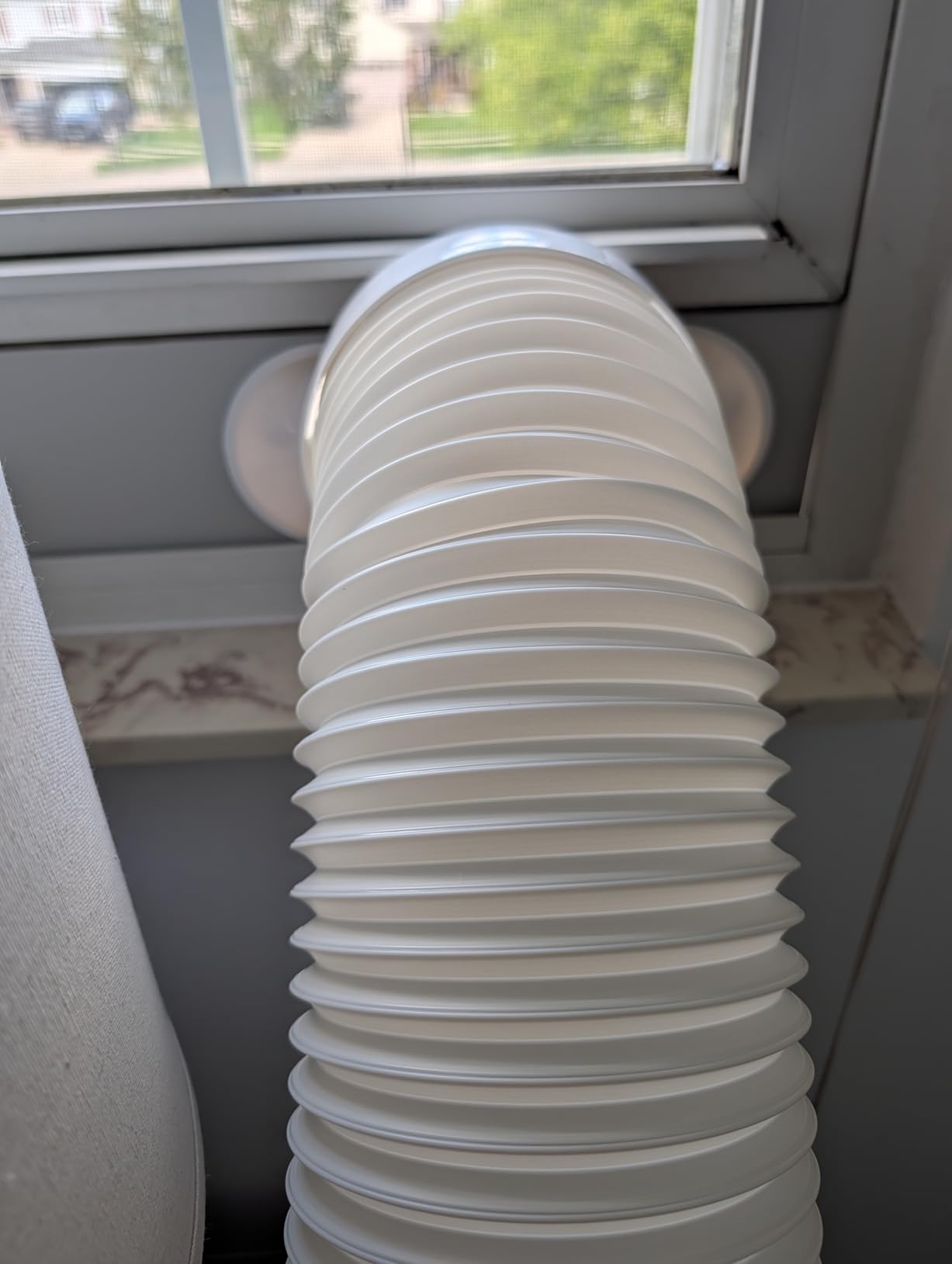
Cool, dehumidify, and fan modes come with auto swing, a 24-hour timer, sleep mode, and a child lock, which is a sensible addition if kids use the garage as a play space. Self-evaporation recycles moisture over the condenser coils and out the exhaust.
Acoustic insulation, balanced fan blades, and vibration dampening hold the unit to 45 dB. In a bay with a running shop vac that disappears into the background.
The installation detail that trips people up
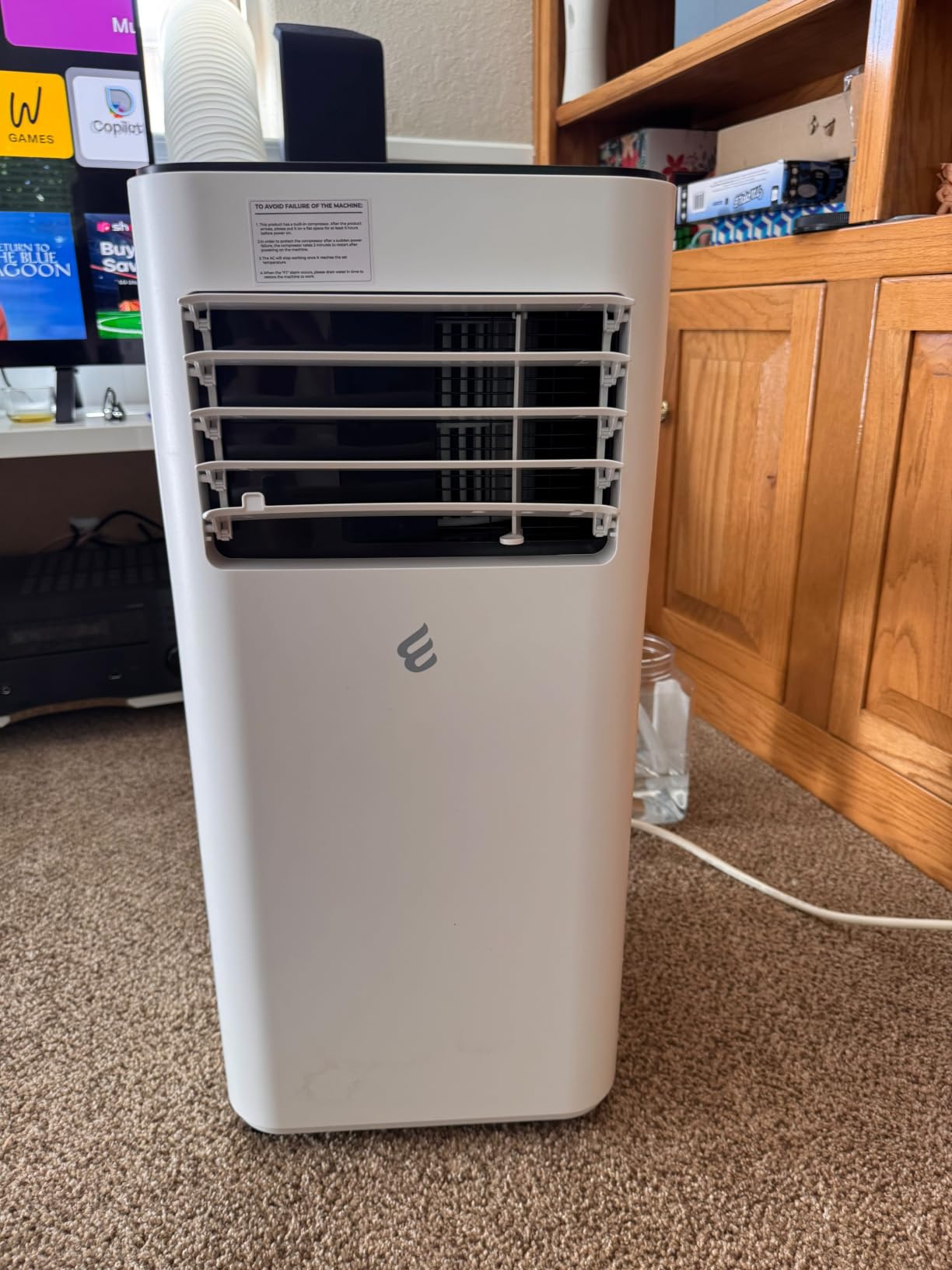
Everything on the back of this cabinet. The drain port and both ducts exit the rear, so the unit needs a real gap behind it rather than sitting flush to a wall. In a garage where the bench is close to the wall, plan 10 inches of clearance or you will be fighting the layout.
The drain hose is also short and exits low, which makes gravity drainage to a floor drain awkward. Test the route before you buy.
Who should skip it
Skip it if you need to plug an external thermometer into the setpoint and expect them to agree. Owners report the onboard thermostat reading 3 to 5 degrees off, so judge performance with a separate thermometer.
Also consider that the compressor is fixed-speed and cycles rather than modulating, which costs you efficiency over a long day.
10. Gasbye CoolPrime 10000 – Best Warranty and Verified Efficiency
Gasbye Dual Hose Portable Air Conditioner, [2026 Upgraded] Full DC Inverter Compressor, Energy-Saving 13.6 CEER, Low Noise (45dB), Cools Room up to 500 Sq.Ft., Backlit Remote Control, 14,000BTU, White
14,000 BTU (10,500 SACC) DC inverter
CEER 13.6
45 dB
500 sq. ft.
3-year warranty
Pros
- Highest verified efficiency here at 13.6 CEER and 442 kWh per year
- Dual-hose inverter drops noise to 45 dB and draw to 500-800 watts at part load
- Three-year warranty with brand-new replacement units
- Honest 10500 BTU SACC rating
Cons
- Smallest coverage rating at 500 sq. ft.
- Remote only with no app or voice control
- 59-inch hoses may not reach a tall window
The Gasbye takes the highest rating in this roundup at 4.4 stars with 76 percent five-star feedback, and it earns it in the two places that matter most for a garage: verified efficiency and honest capacity. A DOE-verified 13.6 CEER with an annual consumption of 442 kWh is the best efficiency figure in the group, and the manufacturer rates it at 10,500 BTU SACC rather than inflating the number.
It is a dual-hose full DC inverter. In inverter mode it drops compressor load to half within about two minutes, taking draw down to roughly 500 to 800 watts and noise to about 45 dB, so a bay held at temperature costs far less than a fixed-speed unit grinding away.
![Gasbye Dual Hose Portable Air Conditioner, [2026 Upgraded] Full DC Inverter Compressor, Energy-Saving 13.6 CEER, Low Noise (45dB), Cools Room up to 500 Sq.Ft., Backlit Remote Control, 14,000BTU, White customer photo 1](https://www.coin-opgames.com/wp-content/uploads/2026/10/B0DXKBG6LT_customer_1.jpg)
The three-year limited warranty ships brand-new replacement units rather than refurbished ones, which removes the single biggest long-term risk with portable ACs. For a machine expected to run 1,000-plus hours a season, that is worth more than any feature list.
Both hoses measure 5.9 inches in diameter and 59 inches long, with two 20-inch and one 10-inch window bracket included. A backlit remote with display-off mode handles night use, and a second higher drain outlet helps in humid spaces.
![Gasbye Dual Hose Portable Air Conditioner, [2026 Upgraded] Full DC Inverter Compressor, Energy-Saving 13.6 CEER, Low Noise (45dB), Cools Room up to 500 Sq.Ft., Backlit Remote Control, 14,000BTU, White customer photo 2](https://www.coin-opgames.com/wp-content/uploads/2026/10/B0DXKBG6LT_customer_2.jpg)
Why the 500 sq. ft. rating is not a weakness
In an uninsulated garage, that rating is closer to the truth than the 750 square foot claims elsewhere on this list. Manufacturers reach those larger numbers by assuming insulated walls and a low solar load, which no garage has.
It is a strong fit for a one-car bay or a sealed work corner, with the 3-year warranty covering the multi-year horizon you actually care about.
Who should skip it
Skip it if you want app or voice control, because it is remote-only. Skip it if your garage window sits higher than a 59-inch hose can reach, since extending the hose with uninsulated duct reduces efficiency.
And note the review base is the thinnest of the well-rated units here at 136 ratings, so you are buying less proven history in exchange for the better warranty.
11. KoolSiln HAC-902WF – Best for App-Controlled Garage Cooling
14,000 BTU Portable Air Conditioner with WiFi & Remote Control, Cools Up to 700 Sq.Ft, Auto-Evaporation Low Noise Portable AC Unit for Large Room, Office, Garage, White
14,000 BTU
700 sq. ft.
44 dB
1200 W
66.6 lbs
Wi-Fi
Pros
- Rated for 700 sq. ft. at a low 1200-watt draw
- 44 dB with a display-dimming Sleep Mode
- 360-degree auto-evaporation handles 80% of excess water
- App
- voice and remote scheduling
- Three-step tool-free install fits windows 20-67 inches
Cons
- Smallest review count in the group at 129 ratings
- Single-hose design can pull warm air back in
- 66.6 pounds despite the compact height
- Only a 1-year warranty
The KoolSiln holds a 4.3 rating across 129 reviews and is listed by the manufacturer for garages and large rooms specifically. At 14,000 BTU and 1,200 watts it is the lightest draw in this roundup for its class, and the 700 square foot rating suits a compact two-car bay or a large workshop.
App, voice command, and remote control cover temperature, fan speed, mode, and scheduling from your phone, which is genuinely useful if the breaker for the garage is not where you sit. An eight-hour sleep timer and a display-dimming Sleep Mode round out the automation.
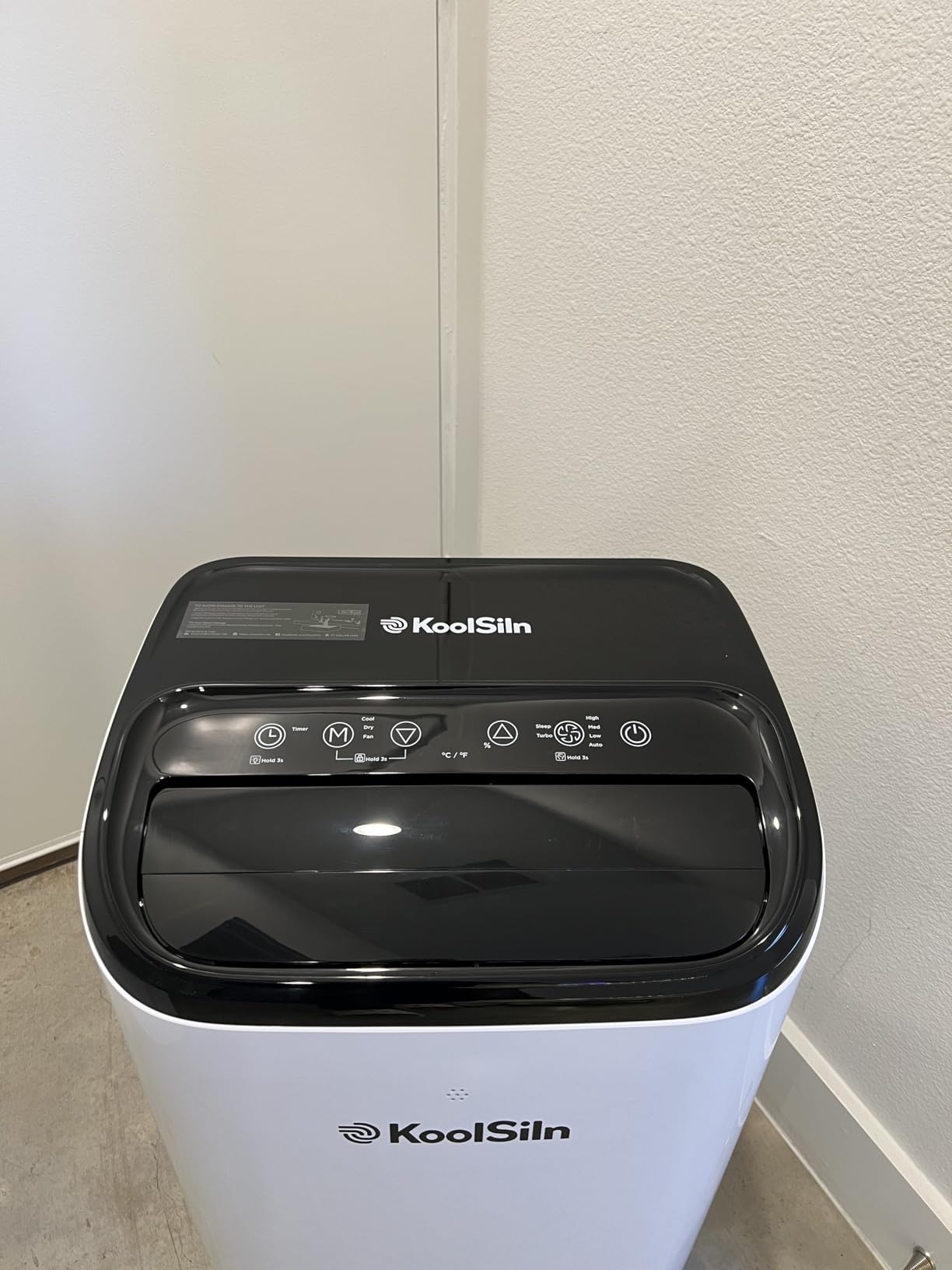
The 360-degree auto-evaporation system converts about 80 percent of excess water into cool air rather than collecting it, which keeps the floor dry around steel shelving and cardboard storage. That is the failure that ruins garage floors fastest.
Cooling range runs from 90F down to 61F on R32 refrigerant, and installation is three tool-free steps that fit windows from 20.39 to 67 inches, one of the widest ranges here.
The single-hose tradeoff in an open bay
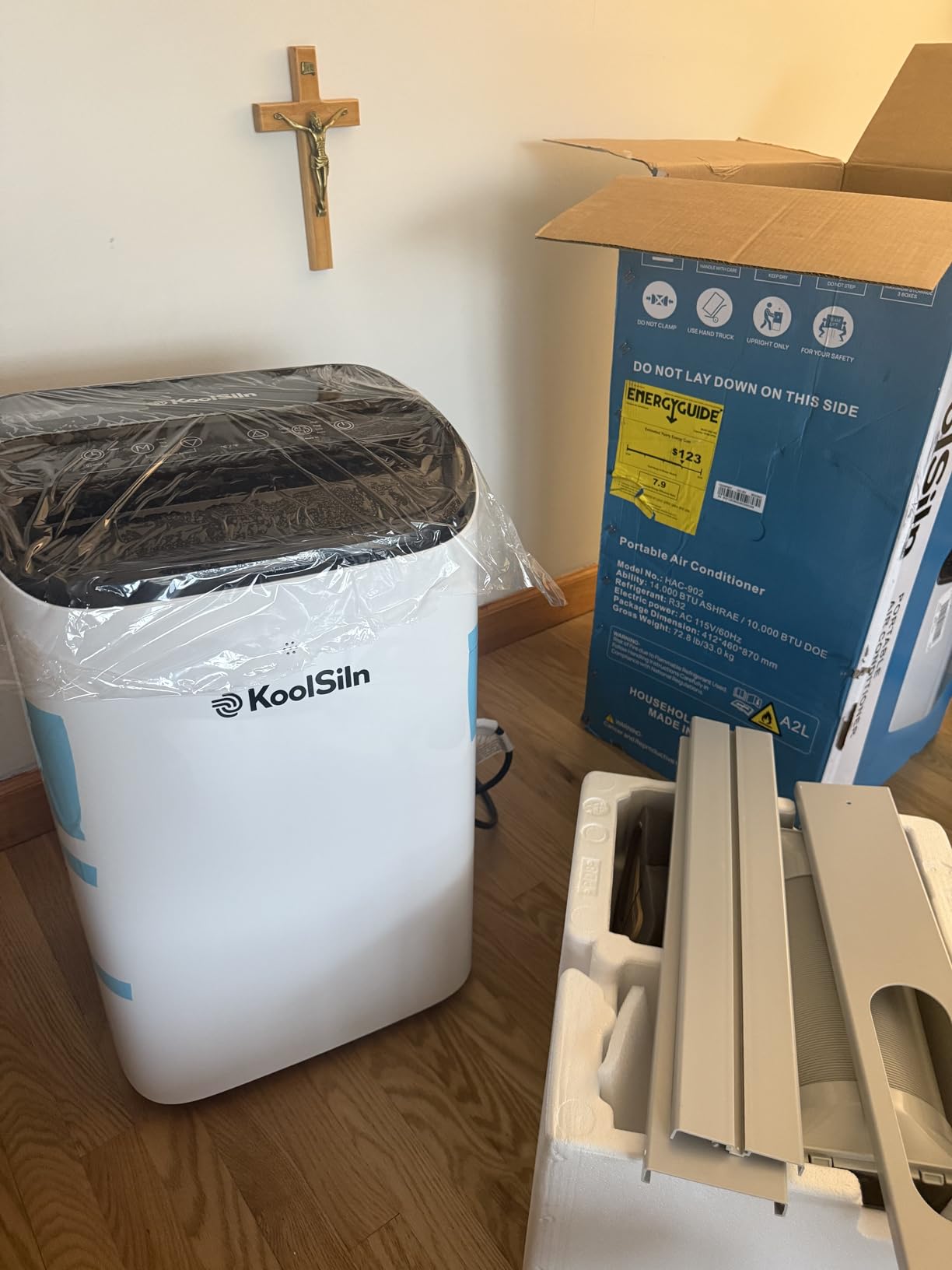
This is a single-hose unit, which means it pulls room air through the intake to cool its own compressor and creates negative pressure in the garage. That pressure will pull warm air in through the door gap, partly cancelling the work the unit is doing.
Keep the side passage door open a few inches to feed the intake, and route the exhaust well away from that opening. With those two moves it performs acceptably; without them it will not.
Who should skip it
Skip it if you want a sealed, controlled bay, because single-hose airflow cannot deliver that in a space with gaps. Skip it if you need heating, and skip it if a 129-review track record feels thin for a machine you will depend on all summer.
Documentation is also thinner here than on the leaders, so verify the coverage and efficiency figures on the listing before you commit.
12. DOMANKI DAC-10CPD-A1 – Best Value for Temporary Spaces
14,000 BTU Portable Air Conditioner Cools Up to 700 Sq.Ft, 3-IN-1 Energy Efficient Portable AC Unit with Remote Control & Installation Kits for Large Room, Office, Temporary Space
14,000 BTU ASHRAE (10,000 SACC)
700 sq. ft.
under 48 dB sleep
1300 W
65 lbs
Pros
- 10000 BTU SACC rated for 700 sq. ft.
- Self-evaporating with no daily draining
- Under 48 dB in sleep mode
- 24-hour timer
- child lock
- and 23 ft remote
- Window kit fits vertical and horizontal sliders
Cons
- Smallest review base here at 88 ratings
- Non-inverter compressor cycles rather than modulating
- Remote needs AAA batteries that are not included
The DOMANKI is the budget pick for temporary spaces, and its 10,000 BTU SACC rating is one of the more honest capacity numbers in this roundup. It also covers 700 square feet of stated cooling coverage, runs on 1,300 watts, and is ETL certified on R32 refrigerant.
Cooling, dehumidification, and fan modes come with auto swing, auto mode, multiple fan speeds, a 24-hour timer, sleep mode, and a child lock. The self-evaporating system removes daily manual draining, which keeps a workshop floor dry.
The upgraded compressor and refrigeration system operate between 61F and 88F. That upper figure is lower than some rivals publish, and in a garage it is the number that matters, because a bay above 88F leaves less room for the compressor to move heat.
A removable washable filter, a digital display, and casters for mobility round out a well-equipped cabinet at 27 inches tall.
Where it makes sense
It makes sense as a shop cooler for a boats, campervan, or temporary workspace where you do not want to commit to a premium machine, and as a second machine to run alongside another in a larger bay.
Buyers are also using these units in basements and large bedrooms, and the same physics applies in both cases.
Who should skip it
Skip it if you need heat, app control, or a warranty longer than a year, because it has none of the three. And be cautious about the very small review base, since 88 ratings is thin evidence for a purchase you will rely on daily.
The compressor is fixed-speed, so it cycles rather than modulating, and expect 52 dB standard with under 48 dB in sleep mode.
Garage BTU Sizing Guide
Size on SACC, never on the ASHRAE number. ASHRAE capacity assumes a 95F outdoor temperature and a cool, sealed, insulated room, which is why a box claiming 500 square feet collapses at 300 in a sun-baked bay. SACC is the rating that assumes real conditions, and it is the number we used to match these units to bay sizes.
Two adjustments matter for garages specifically. Ceiling height inflates the air volume you have to condition, so an eight-foot ceiling is the baseline and anything higher deserves a capacity bump. And uninsulated walls mean continuous heat gain, so treat the square-footage figure on the box as covering maybe two-thirds of the number you would use in a finished room.
Measure your floor area, multiply by ceiling height in feet, and use that volume against the SACC figures above. As a garage-specific starting point, plan on roughly 40 to 50 BTU of SACC per square foot of floor for a one-car bay with eight-foot ceilings and uninsulated walls, and add capacity for any west-facing window or a door that sits in direct afternoon sun.
Garage users consistently tell us the target is comfort, not cold. Owners in r/GarageGym describe wanting a nice 80 degree breeze rather than a cold room, and that is a realistic goal for a 500 to 600 square foot bay in a hot climate. Set your expectation at 78-82F at the bench and the units in this roundup will deliver it. Expecting 70F in an uninsulated four-car shop in a 115F climate will disappoint with any product on the market.
Dual-Hose vs Single-Hose in a Garage
Dual-hose is the more important spec in this category for garages, and the reason is physical. A single-hose unit exhausts hot air and uses a portion of that exhaust to cool its own compressor, which means it takes in room air to replace it. That creates negative pressure and pulls uncontrolled air in through every gap in your garage door and framing.
Outdoors that leak is mostly a small efficiency loss. In a garage it is a 100F air supply coming through a 1/8-inch door gap all afternoon, which is enough to cancel out a large share of what the compressor is doing. Five of our picks are dual-hose: the DREO, the ZAFRO, the Temprium, the Midea Duo, and the Gasbye.
The catch, raised repeatedly by owners in r/DIY, is that both hoses must reach outside. If you run the intake into the garage and exhaust through the door, you have built an expensive single-hose unit with extra plumbing. Verify the air path before you seal anything.
Exhaust Routing When Your Garage Has No Window
Most garage cooling problems are actually exhaust problems. The standard window kit assumes a window, and a large share of garages have none, so here are the routing options that work.
The simplest is a gap at the bottom of the garage door. Run the hose out and up through the door’s perimeter gap or under it with the door cracked a few inches, and route it up and away so the discharge air does not short-circuit back to the intake. Add a foam weatherstrip or door sweep to hold the rest of the gap closed.
The cleaner permanent option is a wall sleeve or a hole through an exterior wall with a louvered cap, which lets you run a short insulated hose straight to the outside. If you have attic access, an opening near the gable vent works similarly. In every case, insulate the hose with a foam sleeve, because an uninsulated exhaust hose runs hot and works against the compressor.
Garage Safety: Dedicated Circuits, Extension Cords and Backdraft
Run any of these units on a dedicated 15-amp circuit, plugged directly into a wall receptacle. Do not use an extension cord or a power strip. A 14,000 BTU inverter can pull over 1,500 watts at peak, and extension cords add resistance that turns the extra current into heat in the cord itself, which is a fire risk in a space full of sawdust and gasoline.
Watch for combustion appliances. A portable AC pulls air out of the garage faster than it comes back, which puts the space under negative pressure and can backdraft combustion gases from a gas water heater, gas space heater, or vehicle exhaust into the bay. The inexpensive fix is a permanent make-up air opening, ideally high on an exterior wall, or a gas detector near the floor.
Finally, respect the compressor’s ambient ceiling. Several units in this roundup document an operating range that stops around 88 to 90F. Above that the compressor will throttle, cut out, or simply never reach setpoint, and repeatedly forcing it against that limit shortens its life. If your bay regularly exceeds the published range, close the door to keep the unit working in cooler air or pick a unit rated higher.
Humidity, Rust and Battery Tools in a Cooled Garage
A cooled garage does not automatically mean a dry one. Portable ACs pull moisture out of the air as a side effect of condensation on the cold coil, but that water leaves through the exhaust only if the unit can evaporate it. Most self-evaporating systems recycle between 72 and 80 percent of it, and the remainder shows up as water in a bucket or on the floor.
For steel, cast iron, chrome, and cordless battery packs, relative humidity under about 60 percent is the number worth protecting. Owners in r/garageporn warn repeatedly that added humidity will rust cast iron work surfaces and corrode wrenches, sockets, and battery contacts. If your garage is already humid in summer, an evaporative cooler makes that worse rather than better.
Pick a unit with genuine self-evaporation for normal humidity, and run a continuous drain hose when humidity climbs above 85 percent or when you use Dry mode specifically. The HUMHOLD and the Air Future both need that continuous drain in their dehumidify modes, so plan the hose route before the season starts.
Spot Cooling a Work Corner Instead of the Whole Bay
The highest-return garage advice is to stop trying to cool the whole space. A 600 square foot bay with an open door and sun-baked walls will fight any portable unit, but a sealed 10 by 10 foot corner will not.
Frame a drop ceiling or hang translucent plastic sheeting from the joists around your bench area, tuck the unit inside, and seal the opening with a strip of curtain or magnetic door edging. A 10,000 BTU unit that cannot do a whole bay will hold the low 70s at the workbench for a full day, which is the only thing you actually wanted.
The other half of the equation is insulation, and it usually beats any unit on this list. Insulating the garage door with rigid foam panels, adding R-10 to bare walls, and sealing the header and jamb gaps cuts the heat load so much that you can often drop to a smaller and cheaper machine. Compare that against our window air conditioner picks if you have a usable window, or our ductless mini-split guide if you are ready for a permanent install and a lower long-run cost.
Frequently Asked Questions
Do portable AC units work in a garage?
Yes, but expect a survivable working temperature rather than a cold room. Most garage users target 78-82F at the bench, not 70F. Correct sizing on the SACC rating rather than the ASHRAE box number, run the exhaust outdoors, and expect the compressor to struggle above its published ambient ceiling.
How many BTU do I need for a garage?
For an uninsulated one-car bay around 400 square feet with eight-foot ceilings, plan on roughly 10,000 BTU of SACC capacity. A two-car bay near 600 square feet generally needs 14,000 to 18,000 BTU ASHRAE, or about 10,000 to 12,000 BTU SACC. Add capacity for ceiling height above eight feet and any west-facing window.
What type of AC is best for a garage?
It depends on how long you need it. A portable dual-hose unit is the right call for seasonal use and renters. A ductless mini-split is cheaper to run per hour and worth it for year-round shops, and a ducted garage unit is the premium answer for a finished space. Window units only work if you have a window and the bay is sealed.
Do portable ACs need a dedicated circuit?
Yes for units above about 1,000 watts, which is most of them. Plug the unit directly into a wall receptacle on its own 15-amp branch circuit, and never use an extension cord or power strip, because the added resistance turns peak current into heat in the cord. Keep it off the same circuit as a welder, compressor, or space heater.
Why does my portable AC stop working in extreme heat?
Compressors have a maximum ambient operating temperature, commonly around 88 to 90F, and many units stop delivering cold air or shut down entirely above it. A sun-baked garage reaches that every afternoon. Keep the door cracked to feed cooler air, keep the unit out of direct sun, and choose a model with a higher documented operating range.
Is there a portable car AC that actually works?
In a closed garage, no. Evaporative spot coolers depend on low humidity, so in a humid or already-hot space they add almost nothing and raise humidity, which then rusts tools and corrodes battery packs. A refrigerant-based portable AC with a properly routed exhaust is the only version worth the money indoors.
Final Verdict
The BLACK+DECKER BPACT12WT is our pick for the best portable air conditioners for garages overall, because more than 7,400 ratings, an 8,350 BTU SACC rating that reflects real capacity, and light 28-pound weight make it the unit most likely to still be running in five years. If you are buying once and running it hard every summer, the ZAFRO’s 12.8 CEER and dual-hose inverter design will cost you less over the season, and the Gasbye’s three-year warranty is the safest long-term bet.
For a two-car bay, take the Temprium 16,000 BTU and stop trying to make a small unit do a big job. For a one-car bay on a budget, the Shinco gives you honest capacity and a self-evaporating system that keeps the floor dry. Install on a dedicated circuit, route both hoses outdoors, and seal a work corner so the unit is cooling somewhere you actually sit.
Our related roundups cover the rest of the cooling landscape, including through the wall air conditioners and portable air compressors for the shop. All measurements and ratings here reflect manufacturer specifications and aggregated owner feedback, and we updated the full list for 2026.