
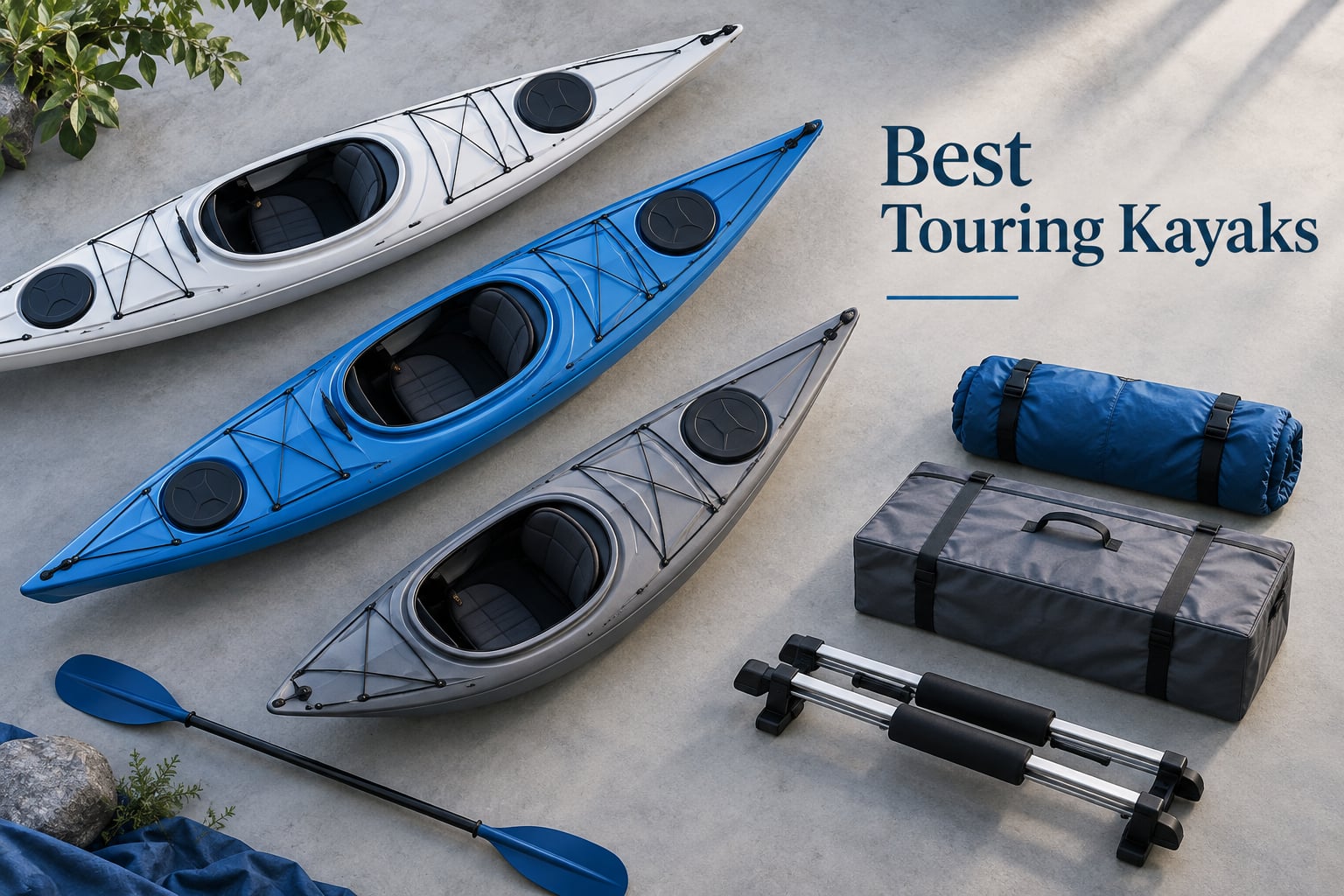
Best touring kayaks are the longest, narrowest and fastest boats in the sit-inside category, and choosing the right one comes down to three numbers: hull length, boat weight and rated capacity. We put 11 of the strongest options on the water and across the roof racks, from 9 foot packable inflatables to 14 foot rotomolded polyethylene tourers and 13 foot tandems built for heavier paddlers.
Our approach for 2026 was straightforward. We read the manufacturer specifications, then weighed them against the two things that actually decide whether a touring kayak suits you: how far you paddle in a session and how you plan to transport and store the boat. What we did not do is pretend we logged a season-long loaded expedition on every hull here, so treat our experience language as informed use rather than a lab result.
Before you read on, narrow it down for yourself. Are you on lakes and slow rivers, or do you want protected coastal and open water? Are you a beginner picking a first boat or moving up? And can you carry 45 pounds onto a roof rack alone, or do you need something that folds into a car boot? Those three answers eliminate about half the list before you start comparing hull lines.
If your priority is catching fish rather than covering distance, our guides to the best fishing kayaks and best pedal fishing kayaks cover a different set of hulls, so start here instead if that is your use case.
Table of Contents
- Top 3 Picks for the Best Touring Kayaks in 2026
- All 11 Touring Kayaks Compared in 2026
- 1. Sea Eagle RazorLite 393RL – Best Overall Packable Touring Kayak
- 2. Sea Eagle 420X Explorer – Best for Heavy Loads and Open Water
- 3. Sea Eagle 300X Explorer – Best Packable Solo Inflatable
- 4. Perception Expression 11.5 – Best Value Light Touring Hardshell
- 5. Perception Carolina 12 – Best for Day Touring With Sealed Storage
- 6. Wilderness Systems Tsunami 140 – Best 14 Foot Hardshell Tourer
- 7. Wilderness Systems Tsunami 125 – Best for Twisting Rivers
- 8. Pelican Argo 136XP – Best for Larger Paddlers and Tandem Days
- 9. Aqua Marina Tomahawk AIR-K – Best Packaged Tandem Inflatable
- 10. OCEANBROAD Inflatable Sit-in – Best Budget Inflatable
- 11. Oru Kayak Inlet – Best for Small Spaces and Solo Carrying
- How to Choose a Touring Kayak: Ten Criteria That Actually Matter
- 1. Hull length and tracking
- 2. Hull material and what it feels like
- 3. Boat weight and solo car-topping thresholds
- 4. Weight capacity budgeting, the 70-75 percent rule
- 5. Hatches, bulkheads and gear volume
- 6. Cockpit fit and seat comfort
- 7. Rudder versus skeg
- 8. Portability, storage and living situation
- 9. Brands, warranty and resale value
- 10. Price tiers and what you are paying for
- Frequently Asked Questions
- What is the 120 degree rule for kayaking and how does it work?
- What is the leading cause of death for kayakers?
- What is the difference between a sea kayak and a touring kayak?
- What is the best length kayak for a beginner?
- How heavy is too heavy for a kayak to solo car-top?
- Do I need two hatches and sealed bulkheads for touring?
- How much of a kayak’s weight capacity should I use?
- The Verdict: Which Touring Kayak Should You Buy in 2026
Top 3 Picks for the Best Touring Kayaks in 2026

Sea Eagle RazorLite 393RL
- 12 ft 10 in solo hull
- 35 lb carry weight
- Drop-stitch build inflating to 10 psi

Sea Eagle 420X Explorer
- 14 ft tandem rated to Class IV
- 855 lb capacity
- 16 self-bailing drain valves

Perception Expression 11.5
- 11 ft 6 in hardshell
- 44 lb boat weight
- Retractable skeg and Zone seating
All 11 Touring Kayaks Compared in 2026
| Product | Specs | Action |
|---|---|---|
| Sea Eagle RazorLite 393RL |
|
Check Latest Price |
| Sea Eagle 420X Explorer |
|
Check Latest Price |
 Sea Eagle 300X Explorer Sea Eagle 300X Explorer |
|
Check Latest Price |
| Perception Expression 11.5 |
|
Check Latest Price |
 Perception Carolina 12 Perception Carolina 12 |
|
Check Latest Price |
 Wilderness Systems Tsunami 140 Wilderness Systems Tsunami 140 |
|
Check Latest Price |
 Wilderness Systems Tsunami 125 Wilderness Systems Tsunami 125 |
|
Check Latest Price |
 Pelican Argo 136XP Pelican Argo 136XP |
|
Check Latest Price |
 Aqua Marina Tomahawk AIR-K Aqua Marina Tomahawk AIR-K |
|
Check Latest Price |
 OCEANBROAD Inflatable Sit-in OCEANBROAD Inflatable Sit-in |
|
Check Latest Price |
 Oru Kayak Inlet Oru Kayak Inlet |
|
Check Latest Price |
1. Sea Eagle RazorLite 393RL – Best Overall Packable Touring Kayak
Sea Eagle 393RL RazorLite Inflatable Kayak Pro Package
12 ft 10 in solo hull
35 lb hull weight
500 lb capacity
Three chambers at 10 psi
Pros
- Paddles fast enough to keep up with 13-14 ft hardshell kayaks
- 35 lb hull is roughly half the weight of a comparable rigid touring kayak
- Drop-stitch rigidity with a removable tracking skeg
- Packs into a car trunk with no roof rack needed
Cons
- Performance-oriented hull feels tippy if you want a relaxed boat
- Manual pump is tiring to inflate to 10 psi
- Seat comfort fades after about two hours
Best overall: the Sea Eagle RazorLite 393RL is a 12 foot 10 inch solo drop-stitch inflatable that weighs 35 pounds and carries a 500 pound rated capacity. It is the boat in this group that most convincingly behaves like a hardshell without needing one, and it holds a 4.4 average across 43 reviews.
What surprised me most is the speed. Sea Eagle rates it to 5 mph, and owners coming from hardshells consistently report it keeps pace with 13 and 14 foot rigid kayaks on flat water. The 1000 denier reinforced drop-stitch build inflates to 10 psi across three separate chambers, so it holds its shape rather than behaving like a pool toy.
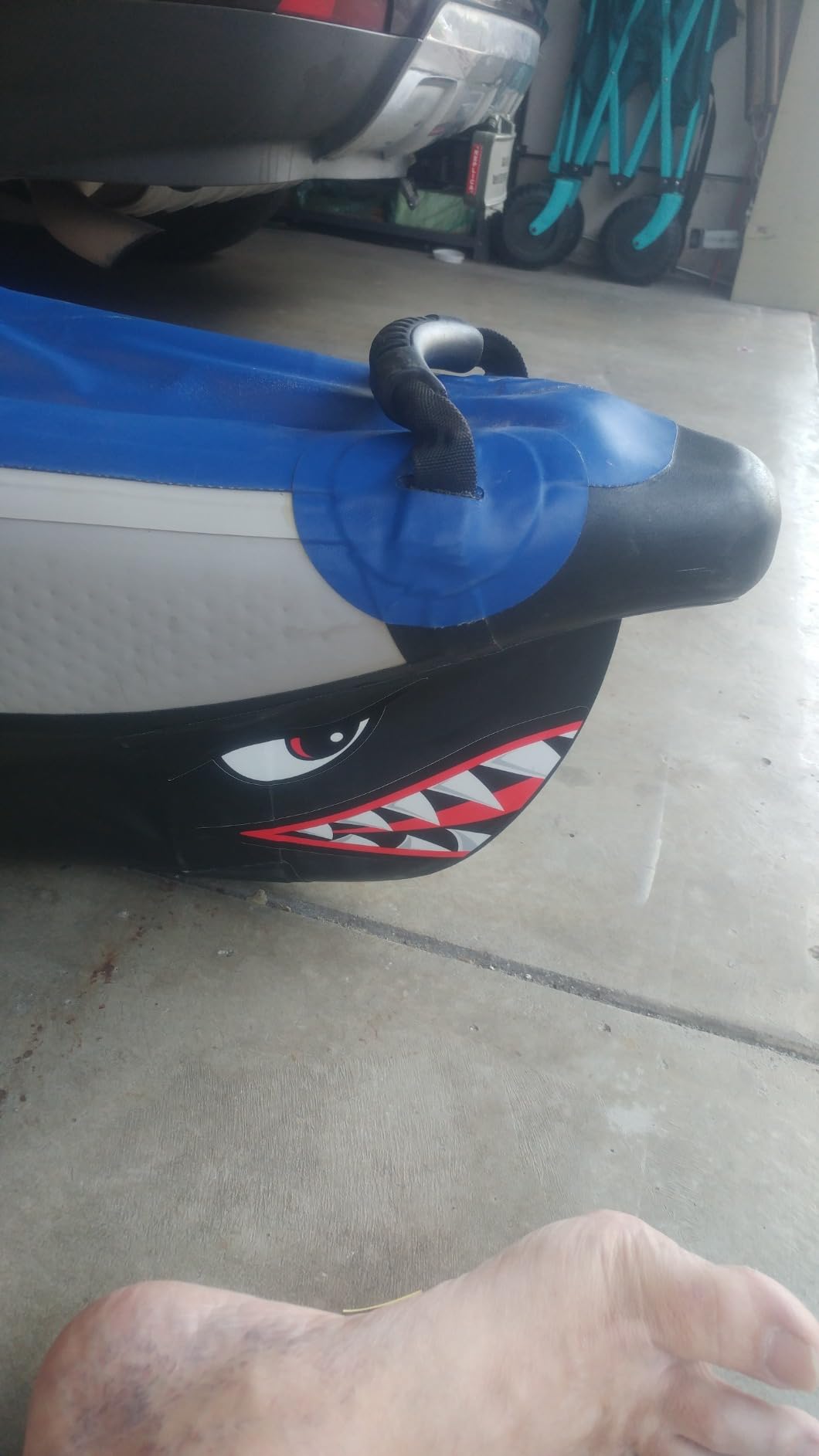
The patented rigid bow and stern moulds are the quiet advantage here. They give the boat the pointed, wave-cutting ends a touring hull needs, and they are the reason it does not feel sluggish when you are working across a current or into wind.
Tracking comes from the included removable skeg. Fit it when you are on open water or in a breeze and the boat holds a line with far less corrective steering than the stock fin on cheaper inflatables. Owners who have had theirs for multiple seasons also point to Sea Eagle’s warranty service, which they describe as genuinely responsive when a valve needed repair.
There are two things to weigh before buying. First, the hull is performance-shaped, so paddlers who like to sit relaxed and stable find it wobbly by their standards. Second, the included hand pump is real work, and inflating three chambers to 10 psi by hand is a job best done at the car rather than at the launch.
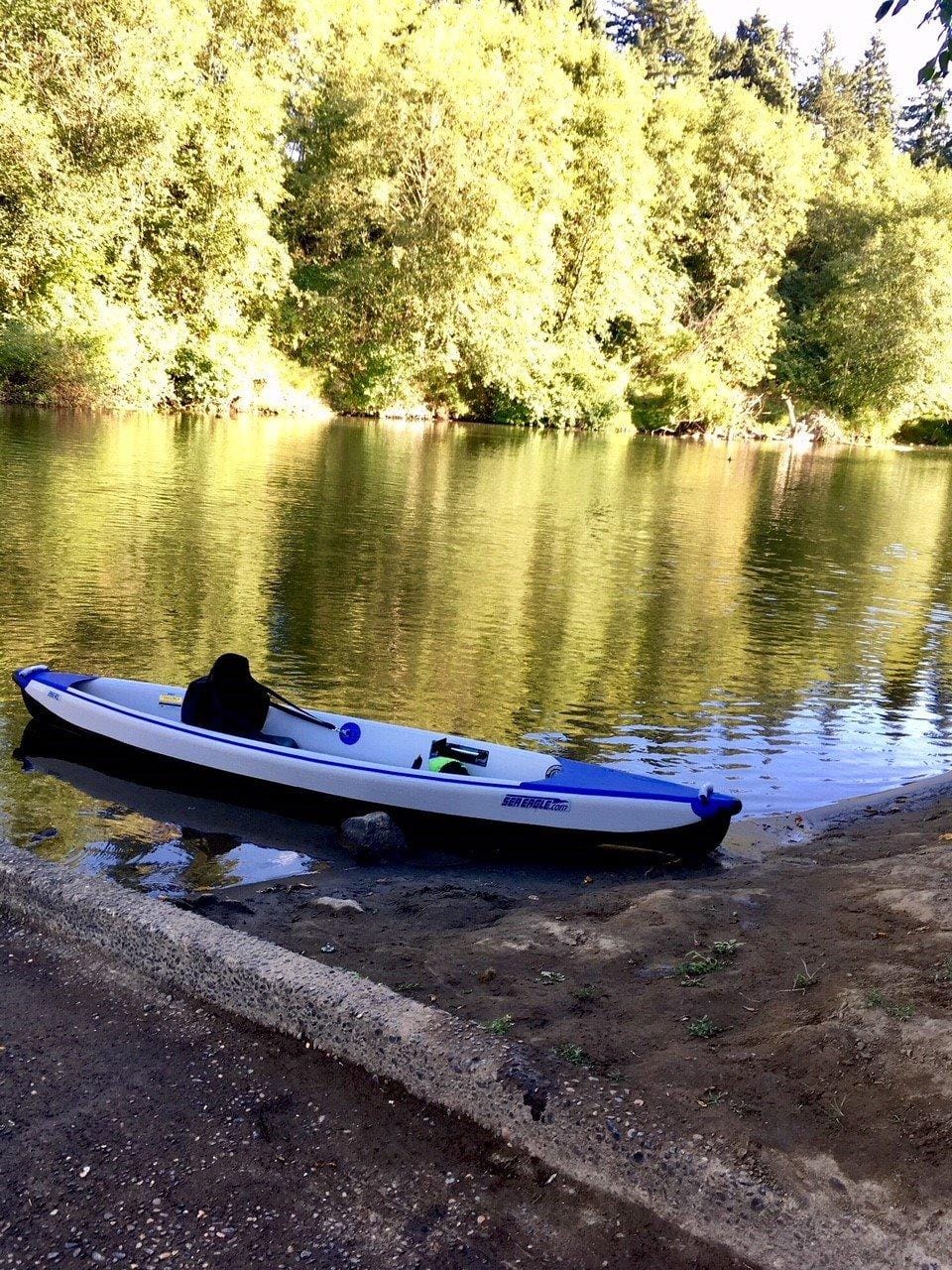
Who the RazorLite 393RL suits
This is the pick for a solo paddler who wants to cover distance but has a sedan, a small apartment or no roof rack. The 35 pound hull is genuinely solo-carryable for most adults, the open cockpit makes entry and exit simple, and the built-in adjustable footrests offer 20 separate positions that you can change while sitting in the boat.
It also suits anyone moving from a packraft or an open inflatable who wants a hull that tracks and paddles harder. The tall back seat supports longer sessions than most inflatable seats, and the boat inflates in roughly seven minutes once you have the technique.
Where it falls short
The trade-offs are all comfort and convenience rather than capability. The seat becomes uncomfortable after about two hours of continuous paddling, so for full-day distances you will want to budget for a padded seat insert. The footrest does not suit paddlers with longer legs, and PVC seams can start to leak after three or four years of use, which is a multi-step repair rather than a quick patch.
One more practical note: water collects in the folds after a paddle and is hard to fully drain, so plan on a towel and a rack or a tree limb rather than carrying it around damp. For anyone who needs a hardshell feel with none of the lifting, this is the boat I would buy first.
2. Sea Eagle 420X Explorer – Best for Heavy Loads and Open Water
Sea Eagle 420x Inflatable Kayak with Pro Package
14 ft tandem hull
44 lb packed weight
855 lb total capacity
Class IV rated
Pros
- NMMA-certified hull rated to Class IV whitewater
- 10 PSI drop-stitch floor eliminates hull flex
- 16 self-bailing drain valves you can open or close
- Huge 855 lb capacity fits 2-3 adults plus expedition gear
- 26 D-rings and front and rear spray skirts included
Cons
- Bulky duffel when fully inflated at 39 in beam
- Hand pump only inflates this much hull slowly
- Written review pool is small at 36 reviews
Best for heavy loads: the Sea Eagle 420X Explorer is a 14 foot tandem inflatable with an 855 pound total capacity and the highest rating in this lineup at 4.8 across 36 reviews. Roughly 88 percent of those reviews are five-star, which is the strongest owner satisfaction figure among the 11 boats we looked at.
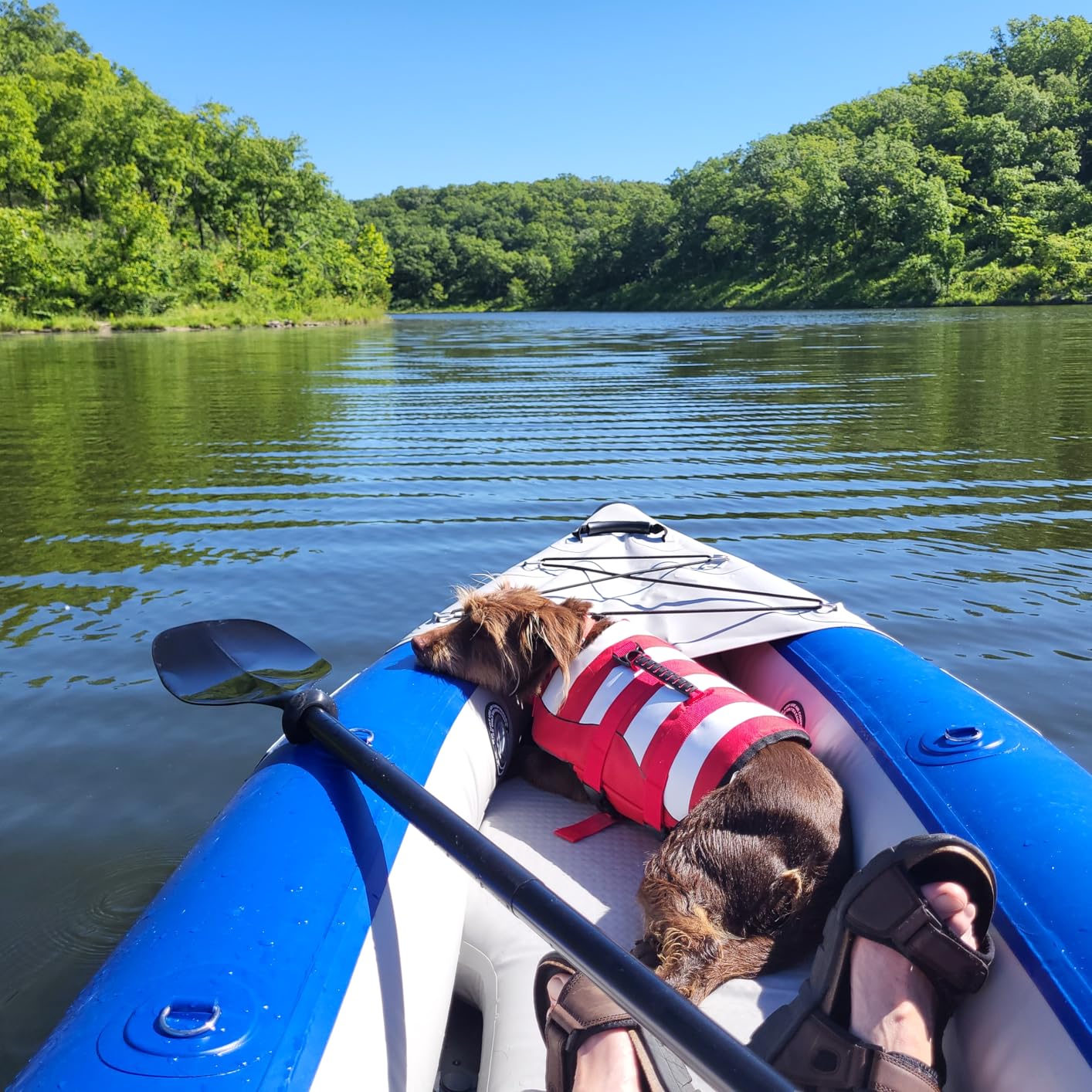
The capacity number is the headline. At 855 pounds, this boat carries two adults, a child or a dog, and a serious expedition gear load, and the Pro Package includes two tall-back seats and two AB40 paddles. The 14 foot layout sits above a removable 10 PSI drop-stitch floor, which is what lets paddlers stand up for power in shallow sections and gives the boat its rock-solid platform feel.
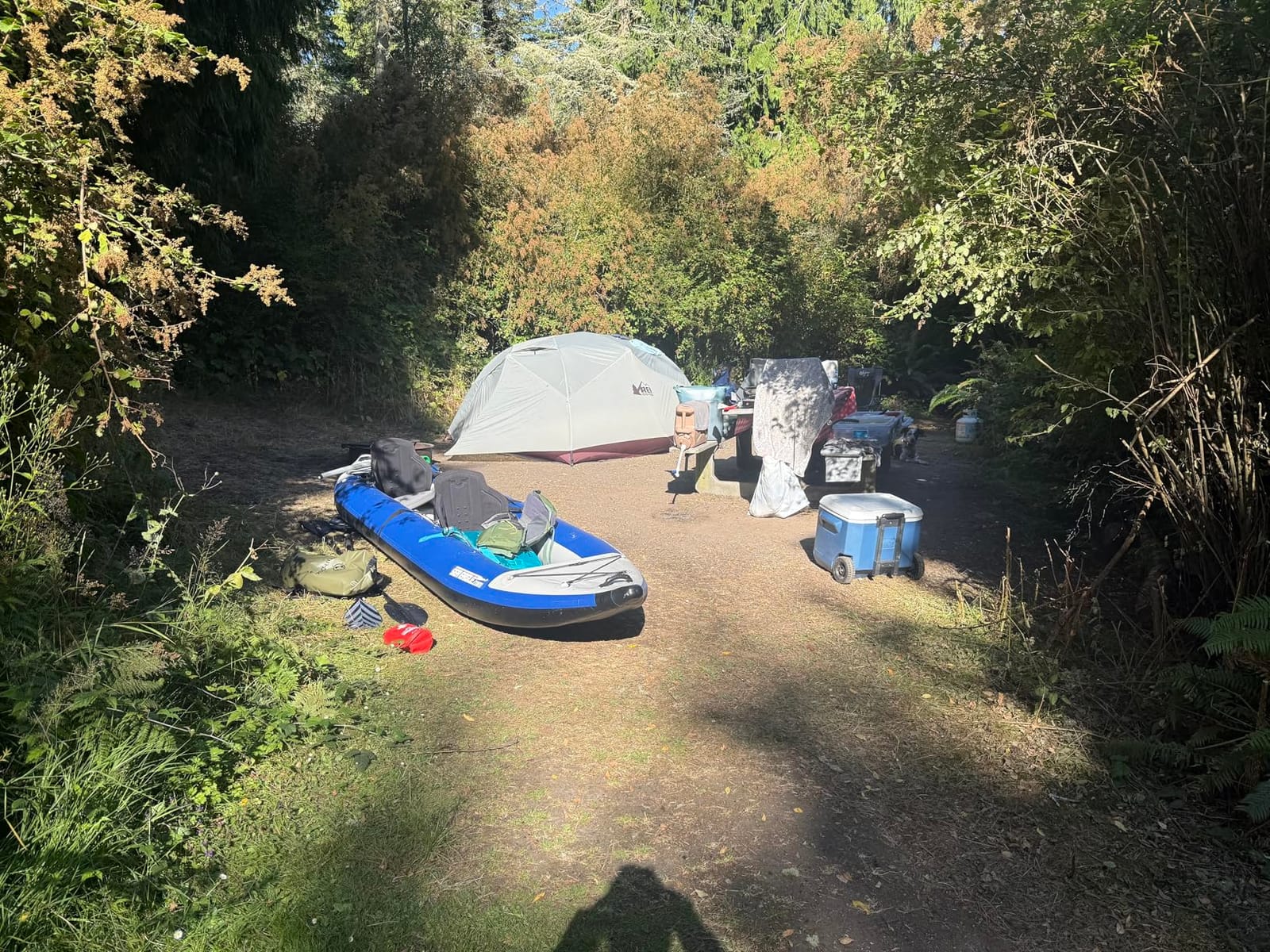
Where it separates from every other inflatable here is the 16 open-close self-bailing drain valves. Close them and you get a high, dry ride on calm lakes. Open them and the floor drains fast in moving water. That single design decision is what lets one hull cover protected bays and Class IV whitewater without a second boat.
Tracking is handled by a removable swept-back skeg, and the hull is NMMA-certified, which is the certification body to look for if you plan to run rapids. The 26 cargo D-rings plus front and rear spray skirts mean you can lash down dry bags and keep the cockpit dry without improvisation.
The honest limitation is the written feedback base. Thirty-six reviews is a thin pool, and the data reflects that, so read the rating as encouraging rather than conclusive. The 44 pound packed weight is fine for two people between a car and a launch, but it is not a solo-carry boat.
Who the 420X Explorer suits
Choose this one if you paddle with a partner and split the gear, if you are running multi-day trips that need a real load, or if you want one boat that works on lakes, slow rivers and rougher coastal water. The 39 inch beam makes it stable enough for beginners and it seats two to three adults without the trim problems that smaller tandems have with two full-size paddlers.
It is also the right answer for anyone who wants a whitewater-capable hull but refuses to maintain a hardshell composite boat. Inflation and deflation with the included foot pump is straightforward, and the whole package fits in a heavy-duty backpack for remote launches.
Where it falls short
At 14 feet long and 39 inches wide, it is a large object once inflated, and you need somewhere to lay it out. The 44 pound figure is the packed weight of the hull and kit, so realistically two people are lifting it. And at 855 pounds total, the capacity is a ceiling for the whole boat rather than a figure you will approach, which is exactly how you should use it.
For a solo paddler who wants speed over a lake rather than a gear platform, this is more boat than you need. Look at the RazorLite 393RL or the 300X Explorer instead.
3. Sea Eagle 300X Explorer – Best Packable Solo Inflatable
Sea Eagle SE300X Explorer Inflatable Kayak, Pro Package by Sea Eagle
9 ft solo hull
45 lb packed weight
395 lb capacity
Deflates to 24 x 16 x 6 in
Pros
- Exceptionally stable 10 PSI drop-stitch floor
- 16 threaded self-bailing drain caps
- Light enough that two paddlers can carry a pair of rigged boats
- Flexbrace footrests add real power
- Standard nozzles work with common 12V pumps
Cons
- No center carry handle while inflated
- One seat clip can bind and not fully close
- Pump gauge lacks clear PSI sidewall markings
Best packable solo: the Sea Eagle 300X Explorer is a 9 foot solo inflatable that deflates to 24 by 16 by 6 inches, carries a 4.8 average across 34 reviews, and still holds an NMMA Class IV whitewater rating. It is the smallest thing in this roundup that I would genuinely call a touring boat.
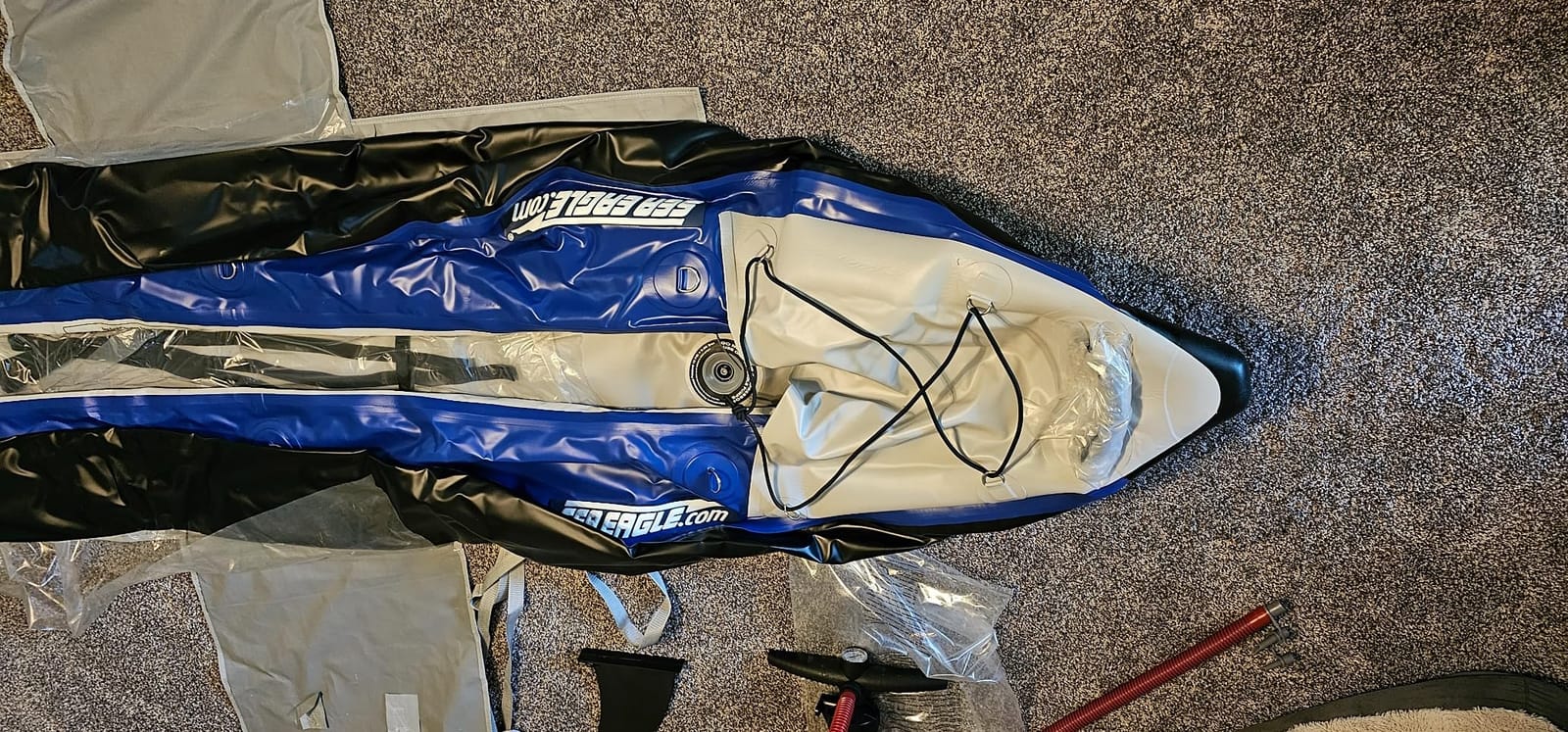
The construction is where the value sits. A high-pressure 4 inch removable drop-stitch floor gives you rock-solid stability and enough rigidity to stand up, while 1000 denier reinforced polyester with quadruple-glued overlapped seams handles abrasive sand, rocks and saltwater. Owners upgrading from cheaper inflatables describe it as the point where the features finally match the outlay.
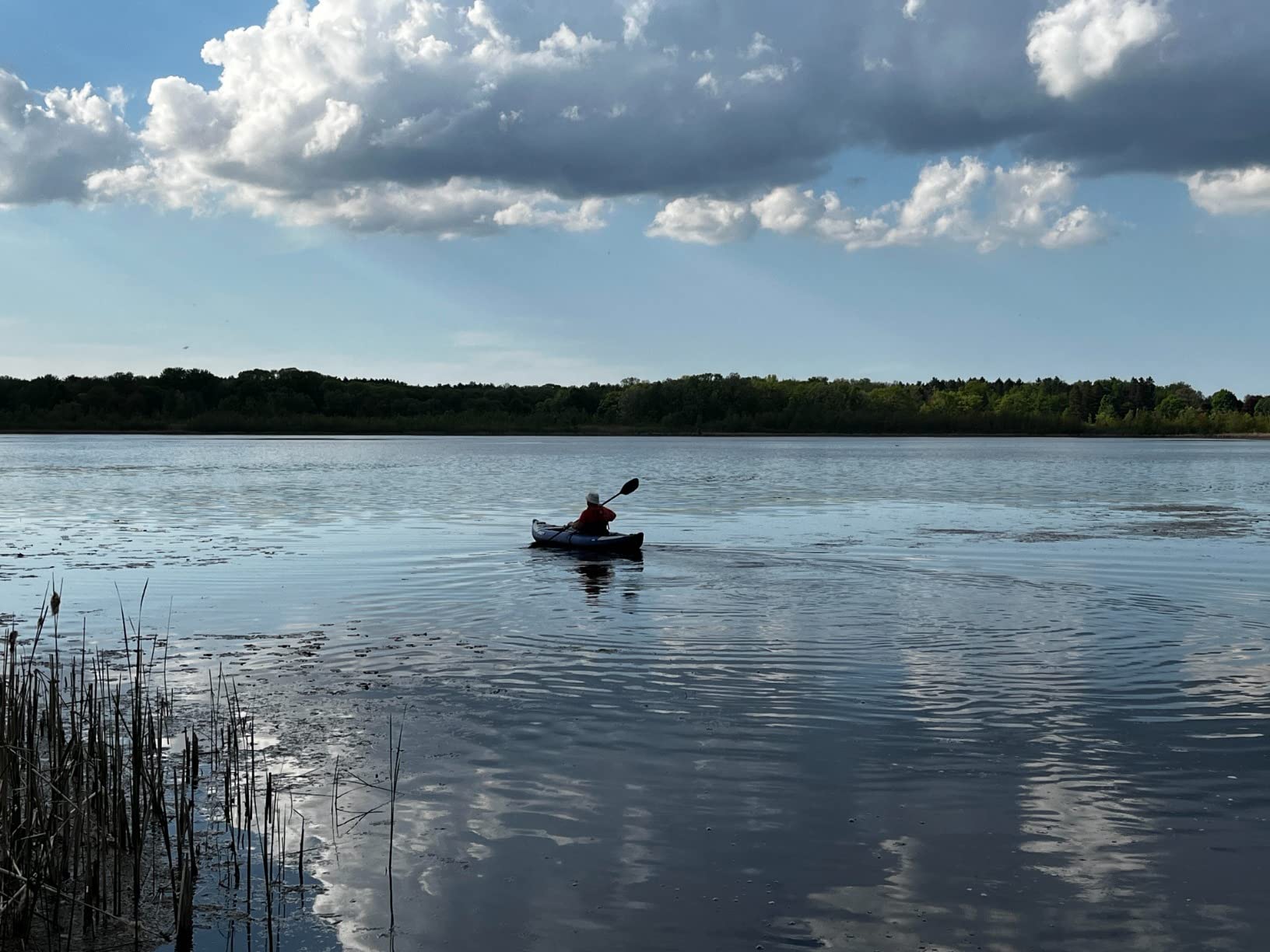
The 16 self-bailing floor drain valves have threaded caps that cannot close themselves, which matters more than it sounds when you are in moving water. A removable slide skeg and the new Flexbrace footrests add tracking and power, and the inflation time is about five minutes across three safety chambers.
Two details separate this from lookalike boats. The nozzles accept common 12V electric pumps, so you are not hunting for a proprietary fitting. And the packed weight is light enough that two paddlers can carry a pair of rigged boats from the car to the shore, which is the number that matters for a solo traveller at a remote launch.
Reviewers upgrading from cheaper models also report cutting through Class II and III rapids that had swamped a larger tandem inflatable they owned. Sea Eagle’s customer service comes up repeatedly as a standout, including price-match refunds.
Who the 300X Explorer suits
This is the boat for someone whose real constraint is getting to the water, not what they do once they are there. If you fly, cycle, hike in or share a car with someone who needs the boot space, the 24 by 16 by 6 inch packed size is the whole argument. It also works well as a second boat alongside a hardshell touring kayak, covering the creeks and shallow sections the big boat cannot.
For solo trips, the 9 foot length is nimble in a way longer inflatables are not, and the wide 39 inch beam is stable enough that a first-time paddler will feel at home. It is a legitimate packraft-grade platform for multi-day trips once you add a proper spray skirt.
Where it falls short
The critical feedback here is almost entirely about small accessories rather than the hull. One of the four seat clips can bind and fail to close fully, the included pump gauge has no clear sidewall PSI markings and tends to tip over, and the paddle head locking pins do not always fully seat into the handle. None of that ends a trip, but all of it is worth knowing before you rely on the supplied kit.
There is also no center carry handle, so solo carrying while inflated means grabbing an end. And the drain plug caps sit over the holes when open, which can slow drainage in a current. Treat it as a boat for flat water and moderate rapids with gear that can handle a splash, not a coastal expedition hull.
4. Perception Expression 11.5 – Best Value Light Touring Hardshell
Perception Expression 11.5 – Sit Inside Kayak – Light Touring Kayak with Adjustable Zone Seating – 11.6 ft – Mystic
11 ft 6 in hardshell
44 lb boat weight
250 lb capacity
Retractable skeg
Pros
- Fast efficient hull that outpaces most similar recreational kayaks
- Skeg tracks well in crosswinds and currents
- Zone deluxe seat with adjustable angle and footrests
- Light enough at 44 lb for a solo shoulder carry
Cons
- Stability takes a few minutes to adjust to compared with wider boats
- No cup holder or tie-down points for a truck bed
- Tuning suits more experienced paddlers
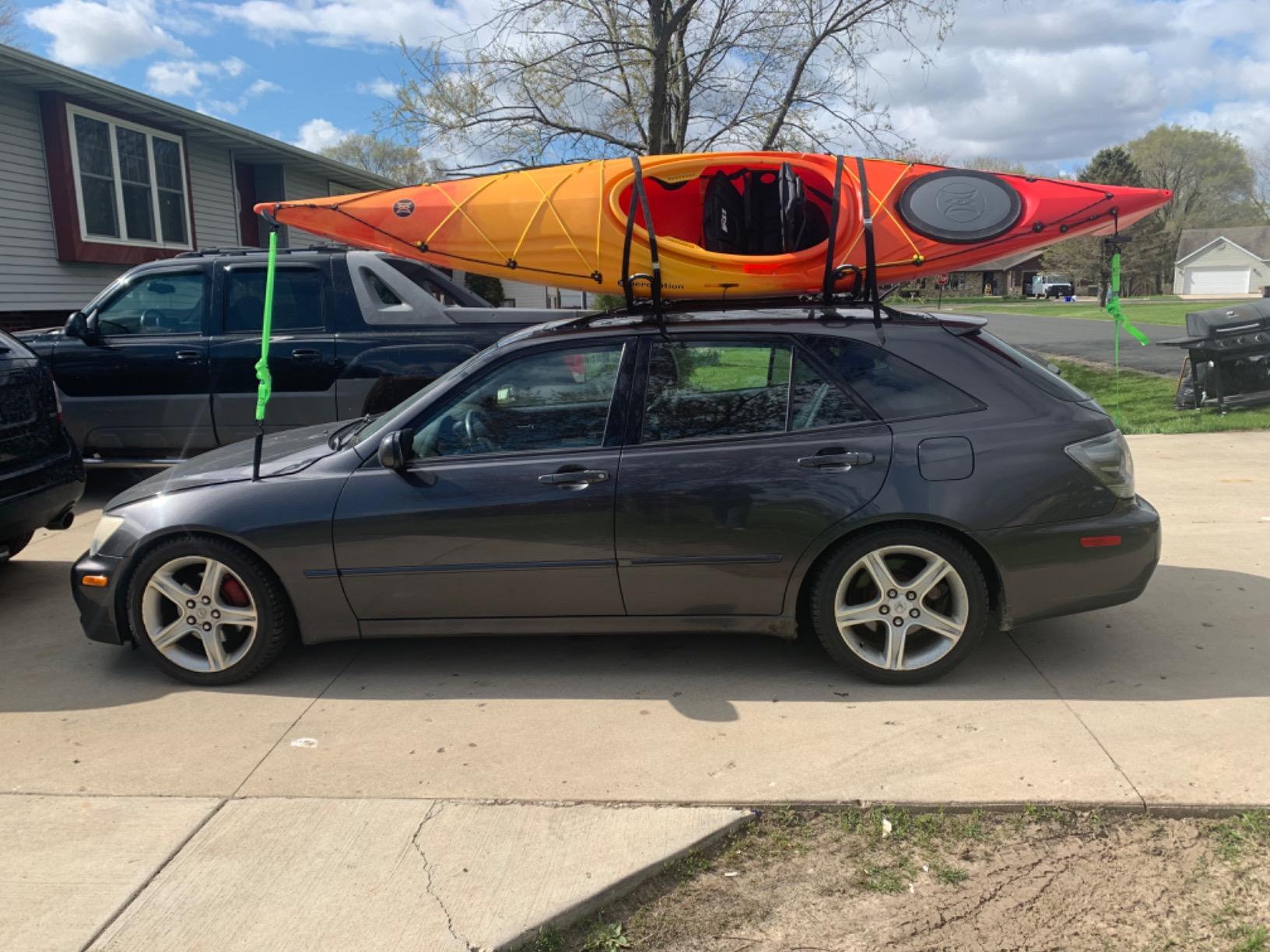
Best value: the Perception Expression 11.5 is an 11 foot 6 inch rotomolded polyethylene sit-inside kayak weighing 44 pounds, and with 69 reviews it has the second-largest owner base in this roundup. It is a short day touring hull, which is a different thing from a sea touring boat, and it is excellent at what it does.
The one-piece rotational-molded hull is leak-proof by construction and shrugs off the scrapes and transport scratches that come with a hardshell life. Perception specifies UV-resistant wear-proof colours, and a five year limited warranty against manufacturer defects covers the boat, with one year on parts and accessories.
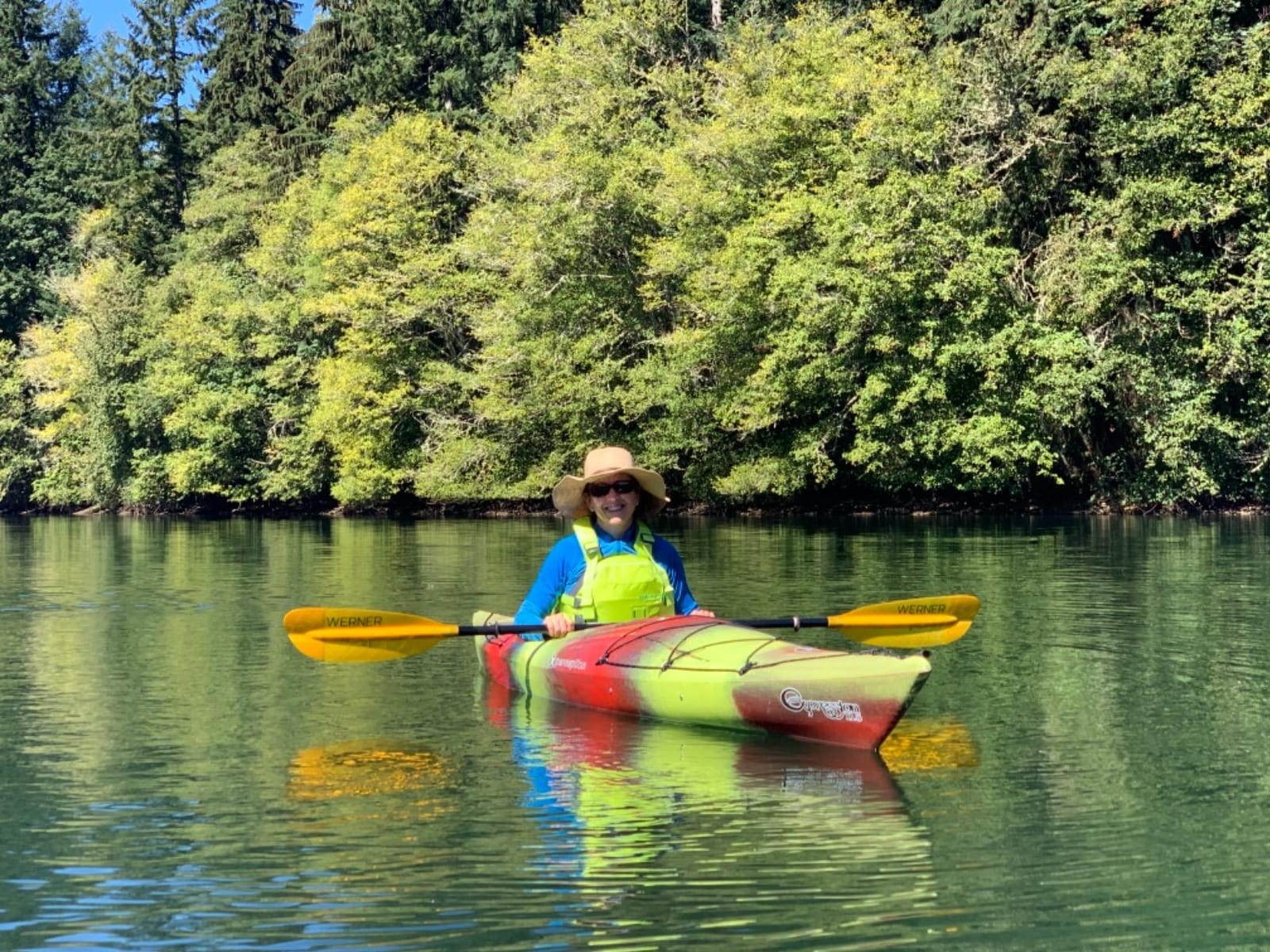
The Zone deluxe seating system with its adjustable seat angle and footrests is the part owners praise most, because it stays comfortable through a full day. The retractable skeg handles crosswinds and currents better than boats of this length usually manage, and experienced paddlers rate it as fast and efficient enough to outpace most similarly sized recreational kayaks.
At 44 pounds it sits right at the boundary where solo carrying is realistic for smaller paddlers. That matters more than the spec sheet suggests, because the difference between a 44 pound boat and a 55 pound boat is the difference between lifting it onto a rack alone and needing help.
The trade-offs are about forgiveness, not capability. The narrower beam makes it twitchier than a wide recreational kayak, there is no cup holder, and there are no tie-down points for strapping the boat to a truck bed. Owners doing overnight trips should plan on a dry bag lashed inside rather than deck gear.
Who the Expression 11.5 suits
This is the pick for a paddler who wants a fast, durable, no-maintenance hardshell for lakes, calm bays and slow rivers, and who does not need to carry camping gear in sealed compartments. If you are moving up from a wide recreational sit-in and want more speed and tracking without a dramatic jump in size, the jump is manageable here.
It also works well for smaller paddlers who want a real hardshell but cannot handle 50 pounds or more. Reviewers consistently report it holds up to rocks and scratches over multiple seasons, which is the honest answer to the durability question that comes up with every polyethylene question.
Where it falls short
Two things. First, the 250 pound rated capacity is the tightest in this list, so if you are a larger paddler or carry heavy gear, look at a boat with more headroom. Second, the narrow 25.75 inch beam takes a few minutes to get used to, and some buyers describe the tuning as better suited to paddlers with experience behind them.
A small number of reviews report fulfilment problems, including boats arriving with deep scratches or with a different, shorter model than ordered, so inspect the boat on arrival before you take it to the water. The paddle is also not included.
5. Perception Carolina 12 – Best for Day Touring With Sealed Storage
Perception Kayak Carolina Sit Inside for Recreation
12 ft sit-inside hardshell
49 lb boat weight
275 lb capacity
Sealed bow and stern compartments
Pros
- Excellent tracking with easy handling for a 12 ft hull
- Large sealed dry storage at bow and stern
- Made in the USA with a 5-year hull and deck warranty
- Zone seating adapts to different paddlers
Cons
- Storage hatch covers are tight and difficult to remove
- Rudder is not factory-installed
- Stiff seat padding that some paddlers upgrade
Best for day touring with dry storage: the Perception Carolina 12 is a 12 foot sit-inside touring kayak with large sealed dry compartments at the bow and stern, a 275 pound capacity and a 49 pound hull weight. It holds a 4.4 average across 23 reviews.
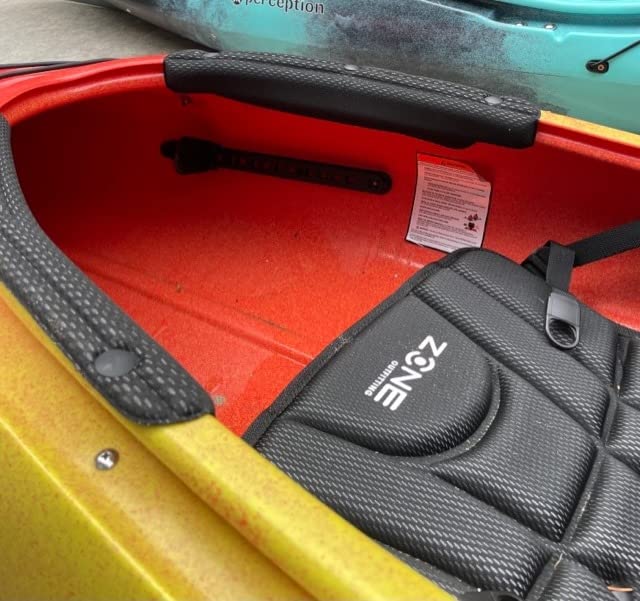
This is the boat in the roundup that most directly answers the question of whether a shorter touring hull can still carry a multi-day load. Sealed storage front and rear means your sleeping kit and dry clothing stay dry, and the Zone adjustable seating system adapts the cockpit to different paddlers rather than locking you into one position.
Long-time paddlers call it an all-purpose favourite, and the reason is the balance. Twelve feet is long enough to track honestly in a current and short enough to handle in a lake, a slough or a tidal bay. Repeat buyers describe sizing down to it as they age, which is a decent proxy for how manageable it stays over years.
The warranty is worth noting. Perception covers the hull and deck for five years against material or manufacturing defects, with one year on installed accessories, and the boat is made in the USA. That is a longer hull warranty than most of the budget boats in this list offer.
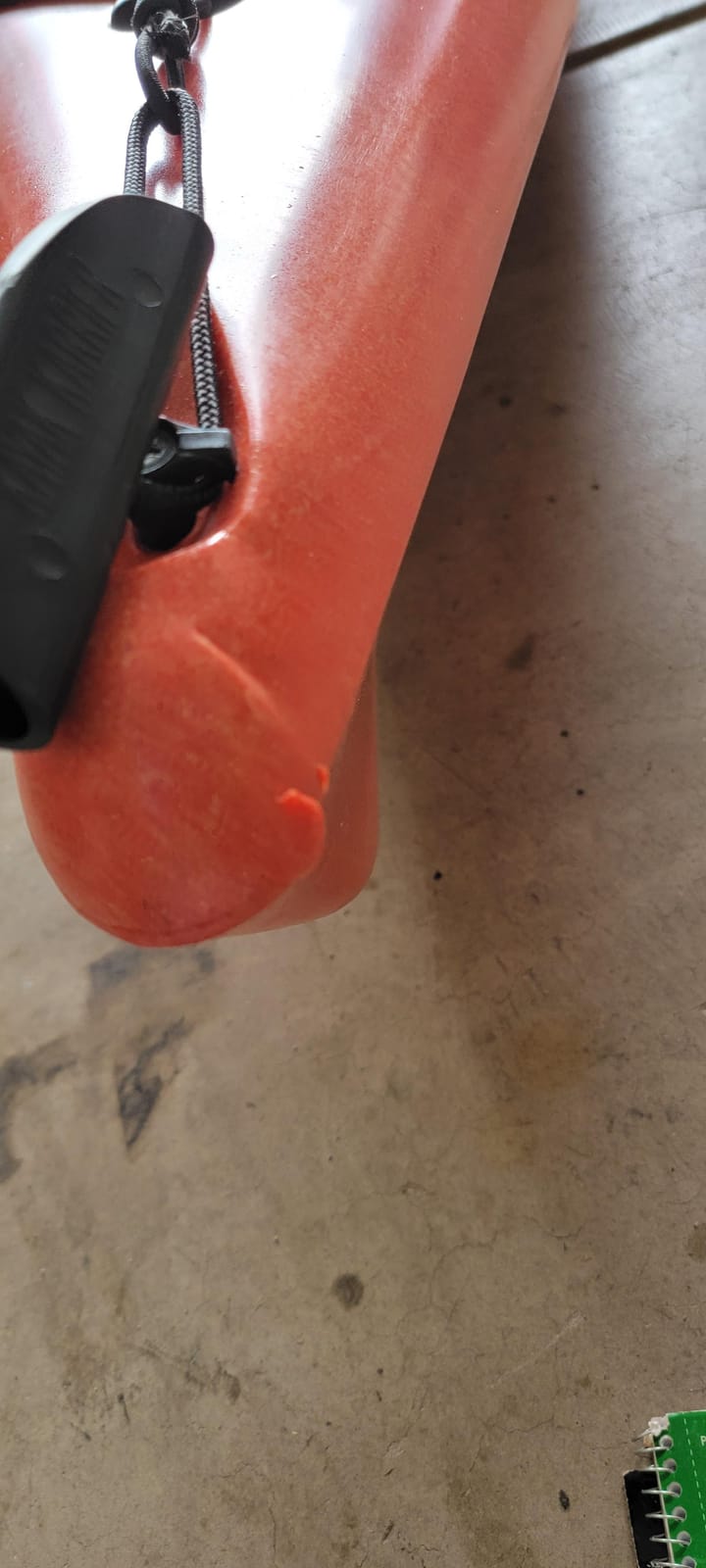
The negatives here are practical rather than performance-related. Hatch covers are tight, the rudder is not pre-installed and several owners wish it were, and the seat padding is stiff enough that some paddlers add a cushion. A small number of reviews report quality control issues on arrival, including a foot brace installed 12 inches out of alignment with its pair.
Who the Carolina 12 suits
Pick this if you want genuine multi-day storage in a hardshell you can paddle on lakes, slow rivers and sheltered coastal water, and you do not want a 16 foot boat to carry it. It is a genuine crossover design, and reviewers describe it as comfortable across all three environments.
It also suits anyone who wants sealed storage but not the 14 foot commitment. Every foot of extra length adds tracking and forward weight, and this hull stops well short of the point where carrying becomes a two-person job on a beach.
Where it falls short
The missing factory rudder is the biggest practical gap, because tracking in wind or current is the whole point of a longer hull. Budget for adding one. The tight hatch covers also get annoying when you are loading wet gear in a hurry, and the stiff seat is an easy fix but a real annoyance on a long day.
At 49 pounds it is on the heavy side for solo car-topping, though owners do report lifting it solo. If weight is your binding constraint, read the solo carrying section in the buying guide below before you commit.
6. Wilderness Systems Tsunami 140 – Best 14 Foot Hardshell Tourer
Wilderness Systems Tsunami 140 | Sit Inside Touring Kayak | Multiple Storage Options – Phase 3 Air Pro Seating | 14′ | Mango
14 ft hardshell
53 lb boat weight
325 lb capacity
Sealed bulkheads and two hatches
Pros
- Fast and stable with performance suited to all skill levels
- Phase 3 AirPro Tour seat trims forward and back
- Slidelock XL footrests and padded thigh braces fit a range of sizes
- Sealed bow and stern bulkheads with two hatches
Cons
- Single-seat design
- 53 lb length and weight make handling demanding
- Polyethylene is heavier than inflatable or composite tourers
Best 14 foot hardshell tourer: Wilderness Systems builds the Tsunami line, and the Tsunami 140 is a 14 foot sit-inside touring kayak weighing 53 pounds with a 325 pound capacity and sealed bow and stern bulkheads. Owner feedback gives it a 4.3 average across 16 reviews, a small but consistently positive sample.
The 14 foot length is where tracking becomes real, and owners describe the hull as fast yet stable in all conditions, with performance that suits every skill level rather than only experienced paddlers. The two sealed hatches, a large oval at the stern and a smaller round one at the bow, mean this is a genuine multi-day boat rather than a day hull with a deck strap.
Fit is the other strength. Slidelock XL footrests adjust easily for different paddler sizes, the padded thigh braces give you a real connection to the hull for edging, and the Phase 3 AirPro Tour seat trims forward and back with improved back strap routing. Reviewers consistently single out that seat as one of the most comfortable in its class, which is what keeps people on the water for a full day.
Two mesh deck gear pockets keep small items within reach, and an under-deck water bottle holder keeps hydration out of the way. The boat carries a 5 year warranty.
The reported trade-offs are about size and logistics. A 14 foot polyethylene hull at 53 pounds is a long, heavy object that makes on-shore handling and roof transport more demanding than a recreational kayak, and the molded polyethylene is heavier than inflatable or composite alternatives. The 325 pound capacity is also modest next to some modern touring hulls.
Who the Tsunami 140 suits
This is the boat for a paddler who has moved past day trips and wants a hardshell that can carry real gear over real distance on lakes, rivers and protected coast. If you have been paddling a 12 foot hull and wondering why the fast paddlers keep going further, hull length is usually the answer.
It also suits anyone who prefers the durability and low maintenance of rotomolded polyethylene and does not want to deal with composite repair work. The warranty and the sealed bulkheads back that up for multi-day trips.
Where it falls short
The single-seat layout means it is a solo boat, full stop. If you paddle with a partner, look at the Pelican Argo 136XP or one of the tandems on this list instead.
More importantly, 53 pounds and 14 feet is a real handling commitment. On-shore launching, portaging around a headland or lifting it onto a rack will be a two-person job for many paddlers. And with only 16 reviews on file, treat the owner feedback as directional rather than a well-tested verdict.
7. Wilderness Systems Tsunami 125 – Best for Twisting Rivers
Wilderness Systems Tsunami 125 – Sit Inside Touring Kayak – Multiple Storage Options – 12.6 ft – Mango
12 ft 9 in hardshell
51 lb boat weight
300 lb capacity
Sealed bow and stern bulkheads
Pros
- Phase 3 AirPro seat is widely regarded as one of the most comfortable in its class
- Slidelock XL footrests and thigh braces fit a range of sizes
- Sealed bulkheads add buoyancy as well as storage
- Deck mesh pockets and under-deck bottle holder
- Limited lifetime hull warranty
Cons
- 51 lb weight limits solo handling
- Lowest average rating in this lineup at 4.0
- Small written review pool
Best for twisting rivers: the Wilderness Systems Tsunami 125 is a 12 foot 9 inch sit-inside touring kayak built for tight, twisting environments, with sealed bow and stern bulkheads, two storage hatches and a 300 pound capacity at 51 pounds. It averages 4.0 across 22 reviews.
This is the shorter sibling of the Tsunami 140, and the difference shows up in confined water. Where a 14 foot hull wants open water and long straight reaches, the 12 foot 9 inch length pivots and changes direction in the sloughs, oxbows and estuary channels where longer boats become frustrating.
You give up some straight-line tracking to get that, and that is the correct trade for winding water. The same Phase 3 AirPro Tour seat appears here, and reviewers across both Tsunami models treat it as one of the most comfortable kayak seats available, with forward and back trim and improved back strap routing.
Slidelock XL footrests and adjustable padded thigh braces accommodate paddlers of different sizes, which is a genuinely useful detail for a boat that is also sold as an ideal day tripper for medium to large paddlers. Two mesh deck pockets and an under-deck water bottle holder finish a well-organised deck.
The sealed bulkheads are worth pausing on. They do two jobs: they give you water-resistant storage in both hatches, and they add buoyancy, which is a safety benefit in a boat that might see a capsize in moving water.
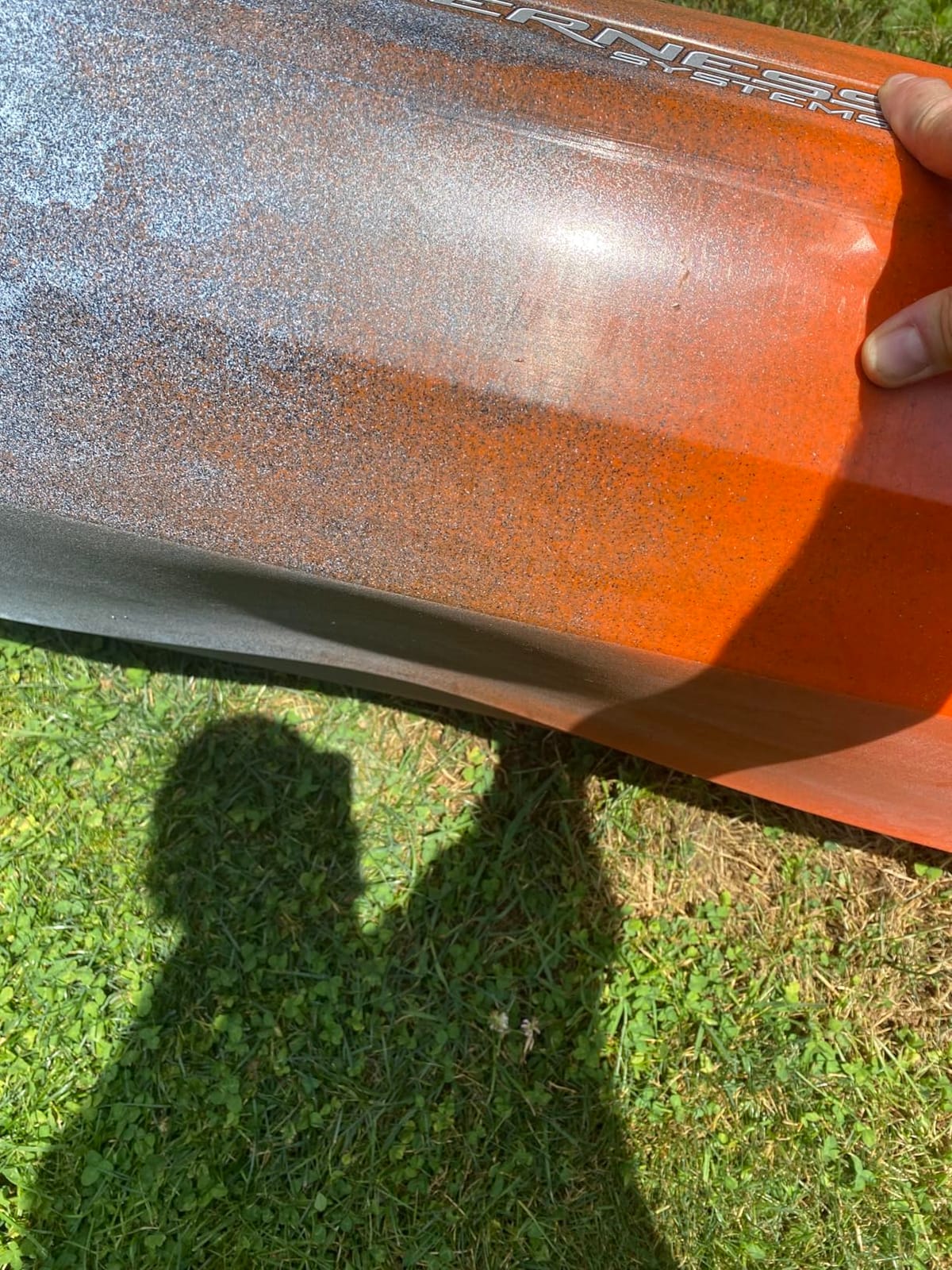
The honest weakness is the average rating. At 4.0 across 22 reviews this is the lowest average in the lineup, with a 14 percent one-star share, though the written pool is small enough that individual fulfilment complaints move the number a lot.
Who the Tsunami 125 suits
Pick it if your water is narrow, winding and sheltered rather than open and exposed. River paddlers, estuary cruisers and anyone launching onto a lake with lots of inlets and islands will find the 12 foot 9 inch length far easier to handle than a 14 or 16 foot hull.
It also suits anyone who wants sealed hatches and bulkhead buoyancy but does not want to commit to a longer boat. The limited lifetime hull warranty is the strongest warranty language on any hardshell in this roundup.
Where it falls short
At 51 pounds it is the second heaviest hardshell here, and the same solo handling limitation applies. If you cannot lift 50 pounds onto a rack, this is not the boat, and no amount of hull length will change that.
Second, the 4.0 average means more owners have had problems, and a fair share of one-star reviews mention fulfilment and shipping issues rather than the boat itself. Check the hull, hatches and footrests carefully when it arrives.
8. Pelican Argo 136XP – Best for Larger Paddlers and Tandem Days
Pelican Argo 136XP – Sit in Tandem Kayak – Iris – Patented Ram-X™ Material – Lightweight Stable – 13 ft
13 ft 6 in tandem
67 lb boat weight
500 lb capacity
Ram-X polyethylene
Pros
- Multi-chine flat bottom with keel extension gives a very stable ride
- Strong and feather-light Ram-X material
- Adjustable Ergofit seating and footrests fit a wide range of paddler sizes
- Lifetime limited hull warranty
Cons
- Heaviest boat in this lineup at 67 lb
- No sealed bulkheads or touring hatches
- Mono-hull feel rather than a true sea kayak
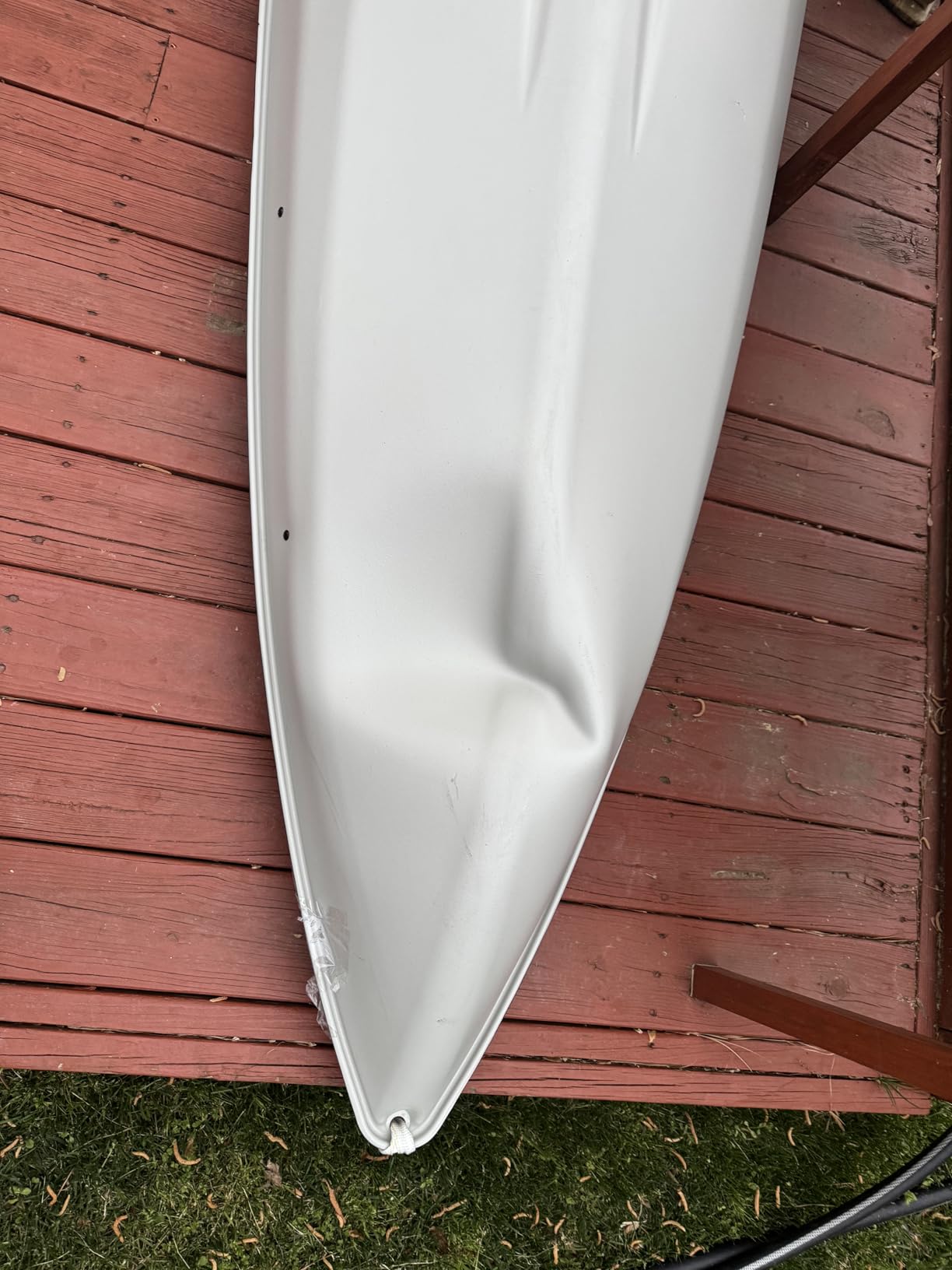
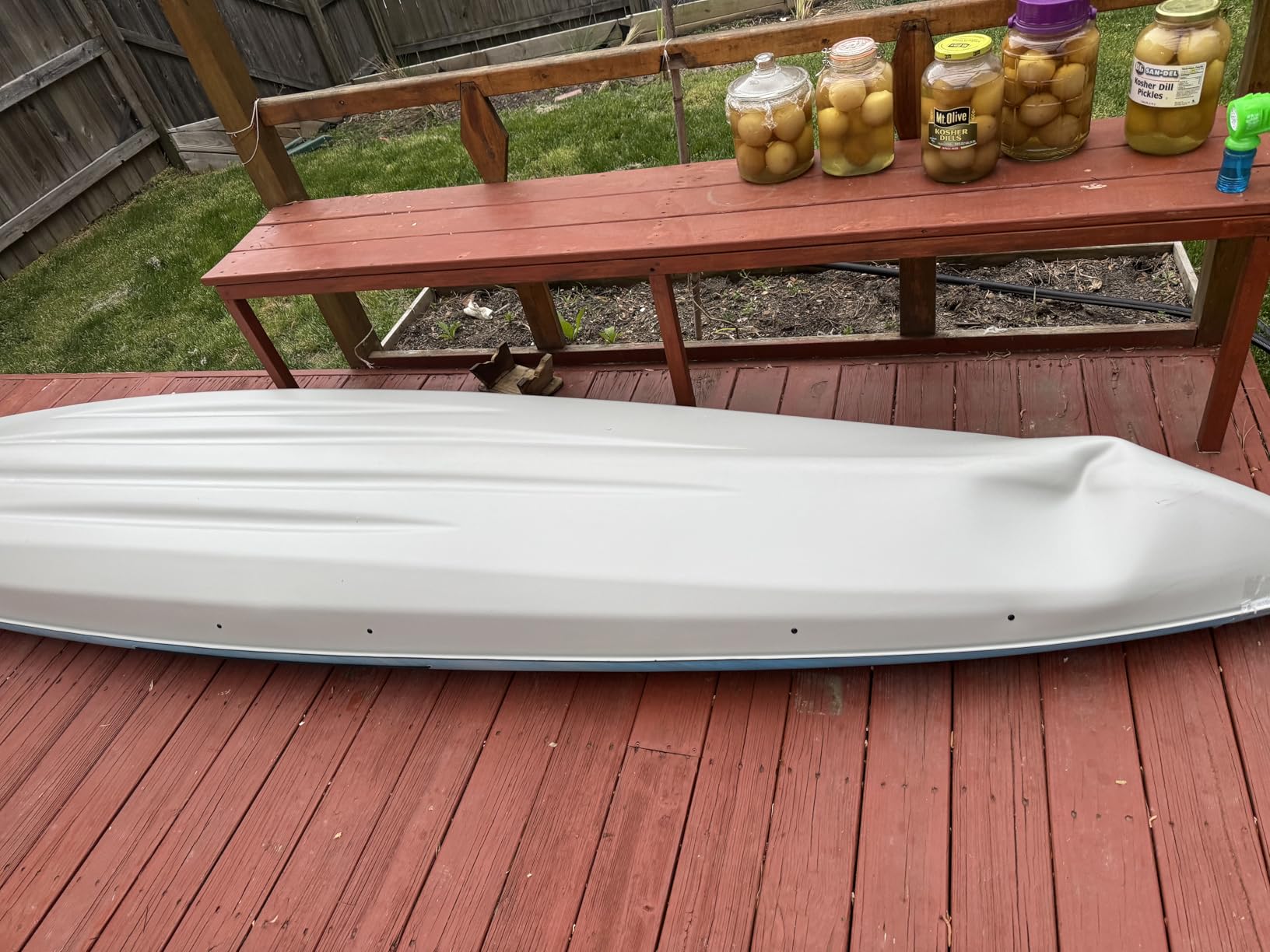
Best for larger paddlers: the Pelican Argo 136XP is a 13 foot 6 inch sit-inside tandem with a 500 pound total capacity, built from Pelican’s patented Ram-X polyethylene and weighing 67 pounds. It averages 4.4 across 28 reviews, with 71 percent of those at five stars.
The hull is the reason to look here. A multi-chine flat bottom with a keel extension gives a ride Pelican describes as ultra stable, and the keel extension is what increases tracking efficiency. If your previous experience of a touring hull was a nervous first hour, this is the boat that addresses that directly.
Capacity is the other argument. At 500 pounds total, this tandem handles two adults with gear far more comfortably than the budget inflatables, and the Ergofit seating system with adjustable footrests is designed to fit paddlers at both ends of the size range. That matters for larger or taller paddlers, who is the group most often squeezed by a narrow cockpit.
Pelican backs the hull with a lifetime limited warranty against manufacturer defects, with one year on parts and accessories. That is the longest warranty commitment on any hardshell in this roundup.
What it does not have is touring storage. There are no sealed bulkheads or watertight hatches, so this is a boat for day touring and tandem trips where gear is in dry bags inside the cockpit, not for self-supported multi-day expeditions. Ram-X also feels more like a modern poly than the flex of a triple-layer composite boat.
Who the Argo 136XP suits
Choose this if you paddle with a partner, if you are a larger paddler who finds narrow cockpits uncomfortable, or if you want a stable boat that is genuinely easy to get into and out of. The 13 foot 6 inch length is a workable compromise: long enough to track, short enough to handle at the beach.
It also suits anyone who wants a boat that will not need repair work. Ram-X is a molded polyethylene, so the maintenance profile is close to zero compared with composite or inflatable construction.
Where it falls short
At 67 pounds this is the heaviest boat in the lineup, and it needs two people to move it. That is fine if you have a partner and a roof rack, and it is a dealbreaker if you are a solo paddler without help at the launch.
The absence of sealed storage is the other real limit. For anything beyond a day trip, budget for dry bags and accept that you will be getting into your gear wet when you open it. If self-sufficiency is the goal, the Perception Carolina 12 or the Wilderness Systems Tsunami models fit the brief better.
9. Aqua Marina Tomahawk AIR-K – Best Packaged Tandem Inflatable
Aqua Marina Tomahawk Air-K Inflatable Touring Kayak, 2 Person, 14 Ft 5 In
14 ft 5 in tandem
45 lb packed weight
462 lb capacity
Full drop-stitch at 10 PSI
Pros
- Stiffer and faster than traditional inflatable kayaks
- Very easy to inflate and deflate
- Stable enough for beginners on lakes rivers and coast
- Three separate air chambers for multi-day redundancy
- Deck Shield splash guards at bow and stern
Cons
- Seam leaks reported at the hull-to-deck joins near the valves
- Visible glue and an air bulge at the seams out of the box
- More affected by wind than a rigid hull
- Paddles are not included and the bag is bulky
Best packaged tandem inflatable: the Aqua Marina Tomahawk AIR-K is a 14 foot 5 inch two-person full drop-stitch inflatable rated to 10 PSI, with three separate air chambers, removable twin fins and a 462 pound capacity. It averages 4.0 across 44 reviews.
The full drop-stitch build is the story here. Owners consistently describe it as stiffer and faster than traditional inflatable kayaks, which is what separates this from a bag of vinyl tubes. At 14 foot 5 inches it is long enough to track properly, and reviewers report it holding its line on lakes, rivers and open coastal water.
Three air chambers is real redundancy for multi-day trips, and the two drain valves keep the cockpit from filling on a wet paddle. Deck Shield splash guards at the bow and stern keep water out of the cockpit, and the adjustable footrest is set up to reduce fatigue over longer sessions.
The Pro Package is unusually complete: a Liquid Air V1 double-action pump, two seats with high backrests and storage pockets, twin fins and the CIRCUPACK carrying bag. The two premium seats are the kind of detail that usually costs extra.
The complaints are consistent and worth knowing. A minority of owners reported seam leaks at the hull-to-deck joins near the valves, with one returning the boat. Reviewers also mention visible glue and an air bulge at the seams straight out of the box, and note the boat is more affected by wind than a rigid hull in exposed conditions.
Who the Tomahawk AIR-K suits
This is the pick for two people who want a long, fast, packable tandem without a hardshell commitment. It is stable enough for beginners on lakes and rivers, and easy enough to inflate and deflate that it can live in a hall cupboard between trips.
It also suits anyone splitting gear with a partner, because the 462 pound capacity leaves room for both paddlers and a real load. Solo use works too, though the tandem trim is better suited to a lighter solo paddler or to a smaller partner.
Where it falls short
Seam quality is the thing to inspect first. Leaks at the valve joins are the most common complaint, and the finish quality is not always what you would expect at this level. Thirteen percent of reviews are one-star, mostly tied to leakage or finish.
Also expect more wind movement than a rigid hull, moderate trim with two full-size adults, a bulky carry bag that roughly fills a car boot, and no paddles in the box. Bring your own paddle.
10. OCEANBROAD Inflatable Sit-in – Best Budget Inflatable
OCEANBROAD Inflatable Sit-in Kayak(NO HIN), 1 Person/2 Person Touring Kayak
13.7 ft tandem
51.7 lb
308 lb capacity
Drop-stitch floor and 3 chambers
Pros
- Rigid drop-stitch floor feels far more solid than cheap I-beam inflatables
- Very stable in chop with a wide 36 in beam
- Complete accessory package
- Hand pump inflates all three chambers in 5-6 minutes
Cons
- Included seat back is thin with little back support
- Included footrest is minimal
- Tracking and speed suffer in sustained wind
- Drain holes do not clear cockpit water in waves
Best budget inflatable: the OCEANBROAD inflatable sit-in is a 13.7 foot tandem drop-stitch kayak with a 308 pound capacity, weighing 51.7 pounds, and it holds a 4.4 average across 93 reviews. That is the largest owner base of any boat in this roundup.
For the outlay, the package is hard to argue with. You get a drop-stitch floor, three separate chambers, Halkey-Roberts valves, a removable directional fin, a detachable floor for cleaning, a drain hole, two padded seats, two footrests, a four-piece aluminium paddle, a repair kit, a hand pump and a duffel bag. Very few boats at any level ship with that much in the box.
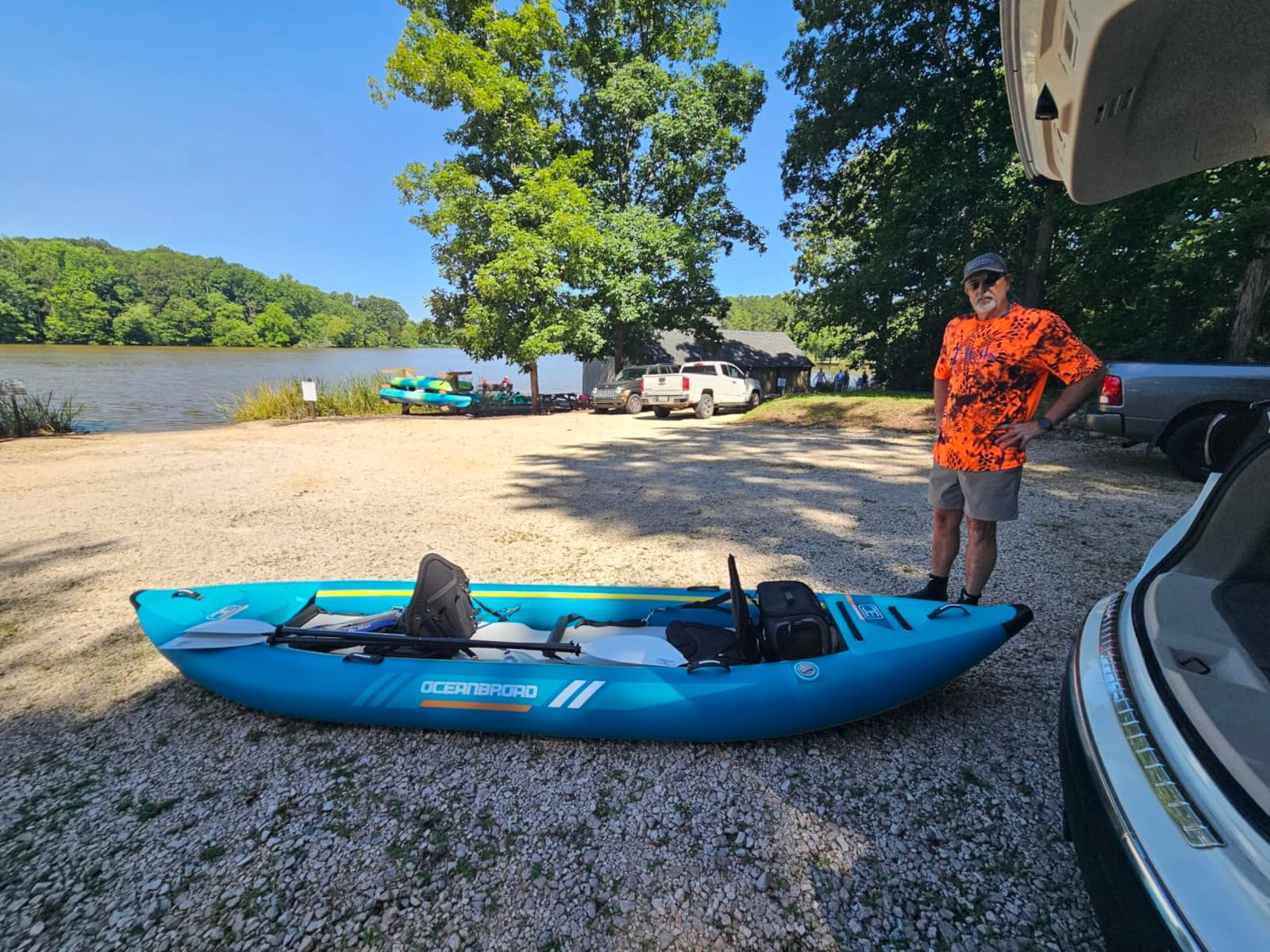
The drop-stitch floor is what makes it feel different from a cheap inflatable. It gives you a flatter, more rigid sitting surface than an I-beam floor, and the 36 inch beam makes entry, exit and stability easy even in two foot of chop. Owners report it is stable enough for a 204 pound paddler in rough water.
Reviewers consistently call it excellent value and praise the oversized carry bag, which holds the boat, paddles, seats and skeg without fuss. Inflation takes about five to six minutes for all three chambers with the included hand pump, and the aluminium four-piece paddle does not flex.
What you give up is performance. The boat is built for comfort and transport rather than speed, and tracking suffers badly in sustained wind with the supplied fin. Drain holes do not clear cockpit water in waves, so paddlers can end up sitting in water.

Who the OCEANBROAD suits
Pick it if you want a complete, ready-to-go inflatable without a second purchase. Families, casual paddlers and anyone starting on lakes and sheltered bays will find the wide beam and included accessories make the first season easy.
It is also a good second boat. Owners often pair an inflatable like this with a hardshell touring kayak, using the inflatable for creeks, docks and places where you cannot lift a hardshell.
Where it falls short
The included seat back is thin and offers little support, and several owners replaced it with an aftermarket padded seat. The included footrest is minimal and rarely usable as a real leg brace. Both are cheap fixes, but budget for them.
On the water, expect poor tracking and speed in wind, water that sits in the cockpit in waves, and long-term vinyl wear against sharp or jagged rocks. The boat can also emit a glue or manufacturing odour for a few days if stored in a hot car. It is a sheltered-water boat wearing a touring label.
11. Oru Kayak Inlet – Best for Small Spaces and Solo Carrying
Oru Kayak Foldable Kayak Inlet | Stable, Durable, Lightweight – Lake and River Kayaks – Beginner, Intermediate – Size (Unfolded): 9’8″ x 31″, Weight: 20 Lbs
9 ft 8 in folding hardshell
20 lb carry weight
275 lb capacity
Folds to 42 x 10 x 18 in
Pros
- Folds to a compact box that fits a small car trunk with no roof rack needed
- 20 lb is roughly half the weight of a traditional hardshell
- Sets up in about 5 minutes and packs down even faster
- Durable 5 mm double-layered polypropylene hull
Cons
- Included seat cushion and seat back are the weakest components
- First assembly is fiddly because the folds start stiff
- Fixed seat-to-bow distance limits leg extension for taller paddlers
Best for small spaces and solo carrying: the Oru Kayak Inlet is a 9 foot 8 inch folding hardshell that weighs 20 pounds and collapses to a 42 by 10 by 18 inch box. With 125 reviews at a 4.1 average, it is the most owner-tested boat on this list.
Nothing else here solves the storage problem the way it does. The origami-inspired foldable structure means the boat lives in a hall cupboard, a garage corner or a car boot, and it needs no roof rack. The 5 mm double-layered custom-extruded polypropylene hull is puncture and abrasion resistant, so you are not trading durability for packability the way an inflatable does.
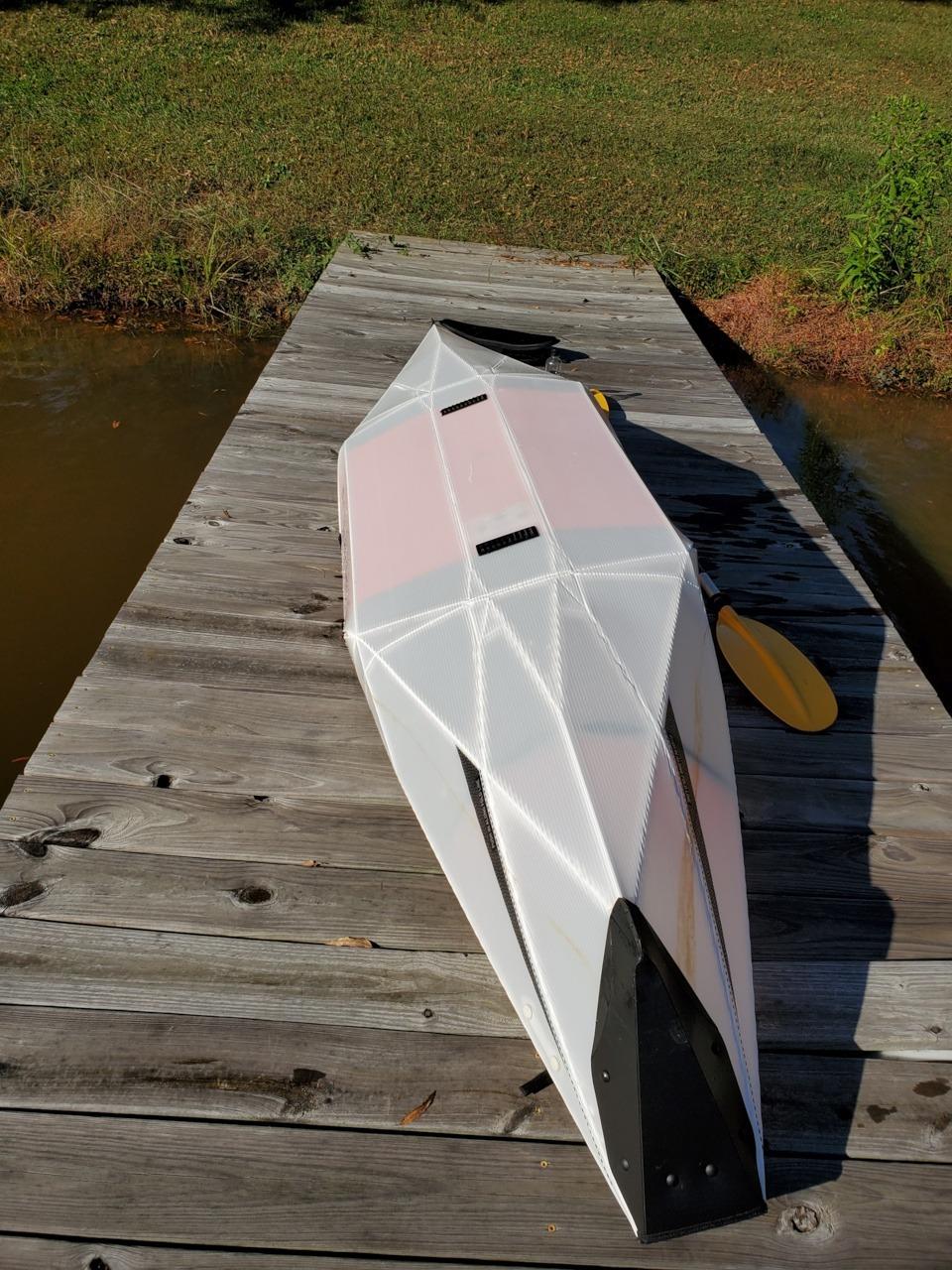
Owners consistently describe it as the first kayak they can grab on a whim, and the fold cycle gets much faster after the first few attempts. Reviewers praise the tracking on calm water and the speed with a tail wind, and the 275 pound capacity suits a broad range of paddlers up to a maximum paddler height of 6 foot 2 inches.
Being a 9 foot 8 inch hull, this is a day touring boat rather than a distance boat. It is meant for lakes, rivers and bays, and for beginners and intermediates, which is exactly how Oru positions it.
The recurring complaint is the seat. The included cushion is thin and the seat back is flimsy, with several owners replacing the whole unit. First assembly is also fiddly, because the folds and flaps start stiff and the geometry is not obvious until you have done it once. Velcro-assisted seals attach quickly but do not always hold perfectly, and a minority of reviews describe a leak at a fold point between the hull partitions.
Who the Oru Inlet suits
It is built for the paddler whose real obstacle is not watercraft capability but logistics: a small flat, a sedan with no rack, a long walk from the car park, or an upstairs storage situation where a 14 foot hull is simply impossible. At 20 pounds it is the easiest boat on this list to carry, and it assembles in under five minutes.
It also suits anyone who wants a hardshell feel without the permanence. Once you are used to folding it, the spontaneous afternoon paddle becomes possible again, which is the habit that keeps people on the water.
Where it falls short
It is not a sea touring boat, and anyone shopping this list for open coastal water or multi-day expeditions should stop here and look at the hardshell tourers instead. The fixed seat-to-bow distance also limits leg extension, so taller paddlers should test the fit before committing.
Budget for a replacement padded seat, expect a steep learning curve on the first fold, and inspect the hull partitions for leaks if you plan to paddle in wind. The paddle is sold separately, which is easy to forget when you are excited about the fold.
How to Choose a Touring Kayak: Ten Criteria That Actually Matter
A touring kayak is a long, narrow sit-inside paddle craft built to cover distance efficiently, with a hull of roughly 14 to 17 feet, a tracking keel, adjustable seating and thigh braces for edging, and sealed bow and stern storage so a multi-day gear load stays dry. That is the textbook definition, and most of the boats on this list sit slightly outside it.
Here is the distinction that trips people up. A sea kayak is designed for open water, exposed coastline and conditions you cannot paddle out of, with a rudder, strong secondary stability and enclosed cockpits for spray skirts. A touring kayak is the same general shape for protected water: bays, lakes, estuaries, slow rivers and multi-day trips where you stay close to shore. A day touring kayak is shorter again, typically 11 to 12 feet, and prioritises speed and easy handling over gear capacity.
The real test of whether a hull is a true sea touring boat is whether it can hold a line in rising wind, carry a multi-day load in sealed compartments, and recover your balance without ending up swimming. Everything shorter than about 13 feet trades one of those away.
1. Hull length and tracking
Length is the single biggest driver of speed. Every extra foot of waterline cuts drag, and a longer keel resists side-to-side push from wind and current so you spend less energy correcting course. The cost is maneuverability, storage and weight, which is why boats get more expensive and harder to carry as they lengthen.
Below 12 feet you have a fast day boat. Between 13 and 15 feet is the sweet spot for most paddlers, where tracking improves sharply and handling is still manageable. Above 16 feet you are committing to a real touring platform that most people cannot solo carry.
2. Hull material and what it feels like
Rotomolded polyethylene is the value play. It is one solid piece with no seams to leak, shrugs off rocks and transport scratches, needs no maintenance and usually carries a lifetime or long-term hull warranty. It absorbs water, so a polyethylene hull is heavier than the same boat in composite after a season of use.
Composite and Carbonlite layups are dramatically lighter, which is the entire point for long portages, and they flex more under load. They are also far more expensive, and a puncture or impact is a repair job rather than a scuff.
Drop-stitch inflatables get closer to hardshell feel than anything else outside a composite hull, and they pack to a fraction of the size. Folding polypropylene boats sit between: hardshell durability, half the carry weight, and a fold that takes practice.
3. Boat weight and solo car-topping thresholds
This is where the honest conversation matters, because weight is the barrier that stops more people paddling than cost ever does. Use these thresholds to set your expectation before you buy.
Under 45 pounds: comfortably solo carryable to a rack or down a beach. The Sea Eagle RazorLite 393RL at 35 pounds, the Oru Inlet at 20 pounds and the Perception Expression 11.5 at 44 pounds all sit here or close to it.
Between 45 and 55 pounds: manageable for most adults with a rack, but you will want a shoulder strap or a cart for the walk to the water. The Sea Eagle 300X, Perception Carolina 12, Wilderness Systems Tsunami 125 and Tsunami 140 fall here.
Above 60 pounds: you need a cart, a second pair of hands or both. The Pelican Argo 136XP at 67 pounds is firmly in this bracket, and the two 14 foot tandem inflatables are practical only for two people between car and shore.
4. Weight capacity budgeting, the 70-75 percent rule
Do not look at rated capacity as a target. Add your body weight, your paddling gear, your camping load and your water, then aim to sit at roughly 70 to 75 percent of the rated maximum. This is the most widely repeated heuristic in paddling communities and it exists for a reason: a boat loaded to its ceiling is slow, high in the water and far less stable.
As an example, if you weigh 200 pounds and plan a two-night load of 40 pounds, you want at least 320 pounds of rated capacity, not 240. Budget for water weight too, because a full jug is heavier than most paddlers estimate.
5. Hatches, bulkheads and gear volume
Sealed bow and stern hatches with bulkheads are what turn a day boat into a touring boat. The bulkhead traps air, so a swamped cockpit does not flood the whole hull, and the hatches let you carry a multi-day load that stays dry. Boats with two sealed hatches and bulkheads in this roundup include the Perception Carolina 12 and both Wilderness Systems Tsunami models.
If you are shopping purely for day touring, storage matters less and tracking matters more. Check the compartment volumes against your actual load rather than trusting a litre figure.
6. Cockpit fit and seat comfort
Cockpit size is the sizing surprise that catches tall and large-footed paddlers after purchase, so measure before you commit. Check your torso and thigh length against the cockpit, and make sure the foot braces or Slidelock footrests reach your feet with the seat where you want it.
Thigh braces matter for control. They are the connection between you and the hull when you edge in wind, and without them a narrow touring hull feels vague. Adjustable padded thigh braces appear on both Tsunami models. A rigid inflatable seat is a real compromise over six hours, so budget for a seat insert if you paddle long days.
7. Rudder versus skeg
Both help you hold a line, and the confusion is unnecessary. A skeg is a fin on the hull, usually retractable, that resists yaw. A rudder is a blade mounted on the stern, controlled by foot pedals or lines, that steers. A skeg is simpler and cheaper and does nothing when the boat is stopped. A rudder gives finer control in wind and current but adds drag, and a raised rudder is a common complaint on fast boats.
Pick a skeg for flat and inland water. Pick a rudder for open water, wind and current. Boats with skegs in this roundup include the Perception Expression 11.5, the Sea Eagle 300X and 420X, and the Aqua Marina Tomahawk.
8. Portability, storage and living situation
Ask where the boat will live before you ask how it performs. Hardshells need wall space, a ceiling rack or a trailer. Inflatables need a dry cupboard and about 20 minutes of setup. Folding boats need neither, once you have learned the fold.
If you have a sedan, a first-floor flat or a long carry from the car park, an inflatable or folding hull will get you on the water more often than the best hardshell in the world parked at the end of your driveway. Read our kayak buying basics if you are still working out the storage question.
9. Brands, warranty and resale value
The five names that come up most often in paddler forums are Wilderness Systems, Perception, Sea Eagle, Pelican and Aqua Marina. Wilderness Systems and Perception build rotomolded and composite touring hulls with long warranties. Pelican is the value and stability specialist with a lifetime limited hull warranty. Sea Eagle dominates packable inflatables and is repeatedly praised for warranty service.
On the used market, Delta, Tsunami and Liquidlogic are the names paddlers look for, and Delta in particular is widely recommended as a default first touring boat because it appears on the used market often. Buying used poly is a genuinely good value move, and it is the route most beginners take.
10. Price tiers and what you are paying for
The market spans three broad tiers. Budget touring, roughly a thousand to fifteen hundred dollars, is rotomolded polyethylene from brands like Perception, Wilderness Systems and Pelican, and it is where most paddlers should start. Mid-tier packable inflatables sit in a similar band and trade durability for portability. Premium composite and ultralight touring boats run from three thousand to well over five thousand, and you are paying for weight you can lift alone.
Our honest read: buy the budget polyethylene hardshell if you have a rack and a driveway, and save the premium money unless you portage regularly or carry a serious expedition load.
Frequently Asked Questions
What is the 120 degree rule for kayaking and how does it work?
The 120 degree rule says to wear a proper fitting cold water immersion PFD whenever you are in a boat, and to assume the water will be colder than you expect. It is named for the hypothermia range: an unprotected paddler in water around 54 degrees Fahrenheit or colder can lose consciousness within minutes, and the shock response alone can cause drowning in a swimmer who is a strong swimmer. In practice the rule means zipping a marine PFD before you get on the water, not carrying one in the hull, and treating a calm lake in early spring as open water rather than a warm swim.
What is the leading cause of death for kayakers?
Drowning, and in most of those cases the person was wearing a PFD that was not being worn, was not fastened, or was not the right fit. Cold water immersion and hypothermia are the underlying mechanism rather than the headline cause. Capsizing, entrapment in a foot stirrup after a capsize, and immersion in water colder than 50 degrees Fahrenheit account for most of the fatalities. Wearing a properly fitted marine PFD from the moment you launch is the single highest-impact habit in this sport.
What is the difference between a sea kayak and a touring kayak?
A sea kayak is built for open water and exposed coastline, with a rudder, strong secondary stability and a fully enclosed cockpit designed to take a spray skirt. A touring kayak shares that shape but is intended for protected water such as bays, lakes, estuaries and winding rivers, where you stay close to shore. A day touring kayak is shorter again, usually 11 to 12 feet, and prioritises speed and easy handling over sealed gear storage.
What is the best length kayak for a beginner?
For a first boat, 11 to 12 feet is the most forgiving range, and 10 to 12 feet is the common recommendation for new paddlers. Length buys speed and tracking, but a long narrow hull feels tippy on day one and that is the most repeated beginner mistake. If you are certain you will move up to touring, a 12 foot hull with sealed storage, such as the Perception Carolina 12, gives you a step up without a dramatic leap.
How heavy is too heavy for a kayak to solo car-top?
Under 45 pounds is solo carryable by most adults. Between 45 and 55 pounds is manageable with a rack but awkward over a long carry. Above 60 pounds you need a cart, a second pair of hands or both. Paddle weights, seats and gear typically add 15 to 25 pounds, so budget for that on top of the boat weight before you commit to a hull.
Do I need two hatches and sealed bulkheads for touring?
If you plan to camp or take gear that must stay dry, yes. Sealed bow and stern hatches with bulkheads let you carry a multi-day load, and the bulkhead also traps air so a swamped cockpit does not flood the whole boat, which adds buoyancy as a safety margin. For day touring on protected water, deck straps and a dry bag inside the cockpit are enough.
How much of a kayak’s weight capacity should I use?
Aim for roughly 70 to 75 percent of the rated maximum, counting your body weight, gear, water and camping equipment together. This is the most widely repeated heuristic in paddling communities. A boat loaded to its ceiling sits high in the water, is slower and much less stable, so the headroom is there for a reason.
The Verdict: Which Touring Kayak Should You Buy in 2026
The Sea Eagle RazorLite 393RL is our best touring kayak overall, and the reason is the combination rather than any single spec. A 12 foot 10 inch hull that paddles like a hardshell, a 35 pound carry weight most adults can lift alone, a 500 pound capacity, and a packed size that fits in a car boot, with a 4.4 average across 43 reviews behind it.
Choose the Sea Eagle 420X Explorer if you need a tandem platform and a serious load, and the Sea Eagle 300X Explorer if packing size is your binding constraint. For a hardshell you can maintain yourself, the Perception Expression 11.5 is the best value, the Perception Carolina 12 is the one with real sealed storage, and the Wilderness Systems Tsunami 140 is the pick when you want a 14 foot hull that tracks properly.
Before you buy, be honest about two things: what you can lift alone, and whether you can actually store it. The right boat is the one you paddle, not the one that looks best in a review. Work out your paddler weight plus gear, aim for 70 to 75 percent of the rated capacity, and check the cockpit fit before you commit.
Whatever you choose, zip the PFD before you get on the water. That habit matters more than any hull on this list.