
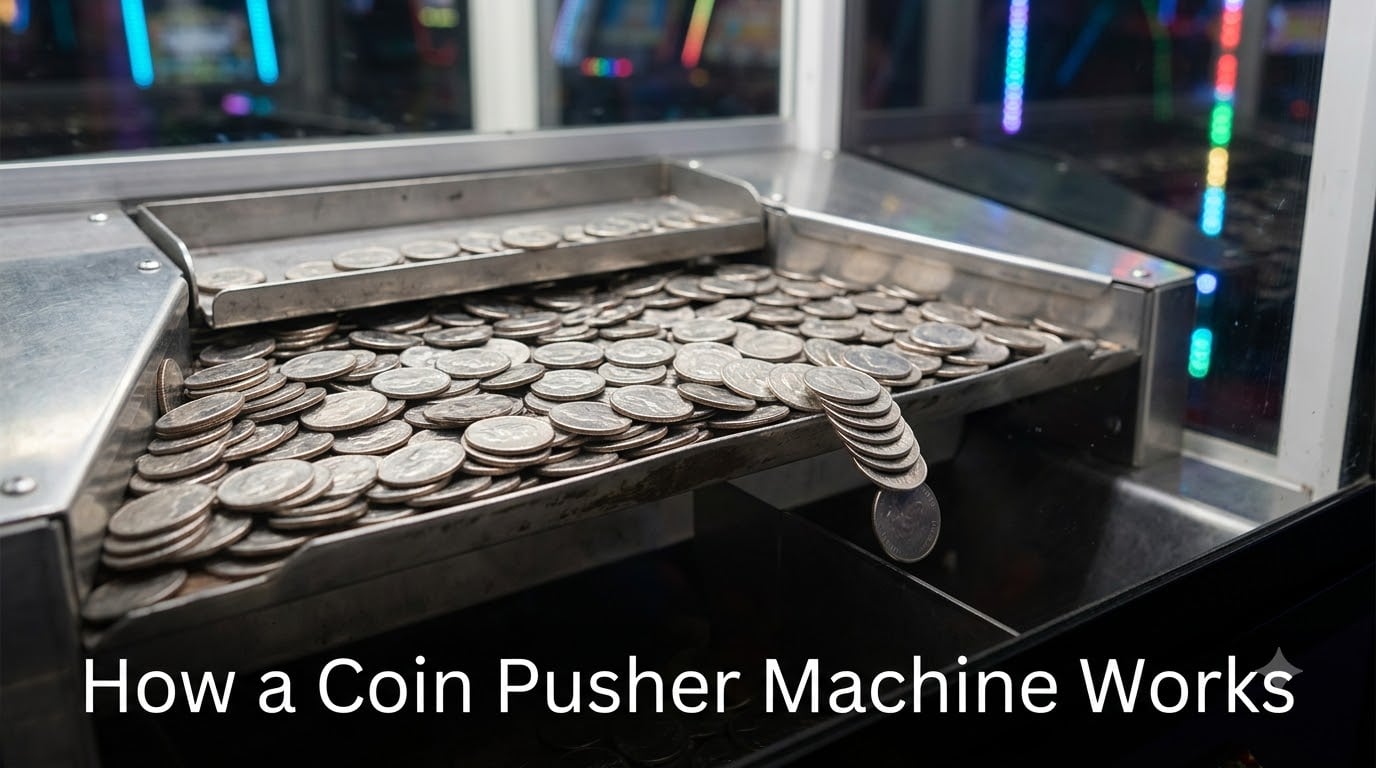
Walk into any arcade, family entertainment center, or cruise ship game room and you’ll hear the same hypnotic sound: a slow mechanical push, a soft clatter of metal, and the unmistakable cheer of someone who just nudged a tower of coins over the edge. That is the magic of a coin pusher machine, and I have spent more time than I care to admit watching them in action.
In this guide, I will walk you through exactly how a coin pusher machine works. We will cover the basic mechanism, the key components, the physics that decide whether your coins fall or stay put, the difference between open loop and closed loop machines, the strategies real players swear by, and the legality questions that come up most often. By the end, you will understand these machines better than most casual players do.
Table of Contents
- What Is a Coin Pusher Machine?
- The Basic Mechanism: How Coins Actually Move
- Key Components of a Coin Pusher Machine
- The Physics Behind the Push: Gravity, Friction, and Momentum
- Open Loop vs Closed Loop Coin Pushers
- A Brief History: From Penny Falls to Modern Arcades
- Player Strategies That Actually Work
- Understanding the Odds and the House Edge
- Are Coin Pushers Legal? A Quick Legality Overview
- Frequently Asked Questions
- Final Thoughts on How a Coin Pusher Machine Works
What Is a Coin Pusher Machine?
A coin pusher is an arcade game where players drop coins, tokens, or chips onto a moving playfield, hoping to push other coins off the edge and into a payout slot. The playfield is a flat platform that slides forward and backward in slow, repeated strokes, and a raised pusher shelf rides on top of it to nudge the pile of coins toward the edge.
At its core, a coin pusher machine works on a simple physical principle: enough accumulated force from repeated pushes will eventually cause coins to spill over a barricade and fall into the prize chute. Whether those prizes are real coins, tickets, or novelty items depends on the machine type. The skill, the suspense, and the visual drama come from watching whether a single dropped coin will trigger a cascade.
The Basic Mechanism: How Coins Actually Move
Every coin pusher follows the same basic cycle. Here is what happens from the moment you drop a coin to the moment coins tumble into the payout tray.
Step 1: Coin insertion. You feed a coin, token, or in modern machines, a tap-to-pay credit, into the acceptor slot at the front of the cabinet. The machine validates the input and releases one or more coins onto the playfield.
Step 2: Coin lands on the pile. The dropped coin falls onto the existing stack of coins resting on the playfield. The exact landing spot matters more than most players realize. A coin that lands near the back has a long way to travel. A coin that lands near the front edge has a much shorter path to the payout slot.
Step 3: Pusher shelf advances. A motorized pusher shelf slides forward, dragging the top layer of coins toward the barricade at the front edge of the playfield. The motion is slow, usually around 1 to 2 inches per stroke, and the cycle repeats every few seconds.
Step 4: Pressure builds. As coins collect, the pusher shelf has to push against an increasingly heavy pile. Static friction between the coins and the playfield, plus friction between coins stacked on top of each other, resists the motion. Once that resistance breaks, you get small avalanches.
Step 5: Coins spill over. When the pile gets tall enough, or when a single drop lands in the right spot, coins start sliding over the barricade. They fall into the payout slot, where they collect in a tray the player can retrieve.
That is the entire game loop. The genius is that it is simple to understand but hard to predict, which keeps players coming back.
Key Components of a Coin Pusher Machine
Underneath the flashing lights and the glass case, every coin pusher machine works because of a handful of mechanical parts working in sync. Here is what you are looking at when you peer through the glass.
The playfield. This is the flat, usually slightly angled platform where coins pile up. It is wide enough to hold a substantial stack but narrow enough that coins cannot simply spread sideways. Optical sensors sometimes live beneath or beside it to detect play activity.
The pusher shelf. Mounted on top of the playfield, the pusher shelf is the moving arm that actually does the pushing. It is driven by a high-torque motor and rides on linear rails or a cam mechanism so the motion stays smooth and consistent across thousands of cycles.
The barricade. This is the stationary lip at the front edge of the playfield. Its height is critical. Too low and coins fall too easily, draining the machine. Too high and the game feels rigged because nothing ever spills. Manufacturers tune barricade height to hit a target payout rate.
The payout slot. Below the barricade sits the chute that funnels spilled coins into a collection tray. In closed loop machines, the payout slot leads back into a reservoir that feeds the coin dispenser. In open loop machines, it leads directly into the player’s tray.
The coin acceptor and dispenser. A mechanical or electronic acceptor validates incoming coins, while the dispenser releases them onto the playfield. Modern machines often accept bills, RFID payments, or mobile wallet taps in addition to coins.
The control board. Behind the scenes, a control board manages motor timing, sensor input, lighting effects, sound, and optional features like bonus rounds or ticket dispensing.
The Physics Behind the Push: Gravity, Friction, and Momentum
This is where most casual explanations of how a coin pusher machine works stop, and where the really interesting part begins. The reason some coin drops lead to a satisfying avalanche while others do nothing comes down to three physical forces: gravity, friction, and momentum.
Gravity. Gravity is the silent partner in every coin pusher. The playfield is usually tilted very slightly toward the player, just enough that gravity slowly pulls the top layer of coins toward the barricade between pusher strokes. The angle is small, often only a few degrees, but it is the difference between a coin pile that sits still and one that constantly creeps forward.
Friction. This is the biggest factor most players underestimate. There are two kinds of friction at work in a coin pusher. Static friction is what holds a stationary coin in place against the playfield. Dynamic friction is what slows a coin that is already sliding. Coins on a smooth metal or plastic surface have a low coefficient of friction, which is why they slide so easily once they start moving. Stacked coins have higher friction between them, which is why a tall stack tends to hold together until something disturbs the bottom layer.
Momentum. When you drop a coin onto a pile, it carries momentum. If that momentum transfers to the bottom layer of the pile, it can break static friction across the whole stack at once. That is the “chain reaction” you see when one coin triggers a five-coin cascade. Drop the same coin onto a flat, settled pile and it might just sit there doing nothing.
Here is the practical takeaway from all this physics. The most effective coin drops are the ones that land with enough downward force to disturb the bottom layer of the pile, ideally near the back where the pile is tallest. The least effective drops land on top of an already-stable pile where the friction gradient is too strong to overcome.
Open Loop vs Closed Loop Coin Pushers
Not all coin pushers pay out the same way. There are two main types, and understanding the difference is critical if you care about real prizes.
Open loop coin pushers. These are the classic machines where you insert actual coins and, when coins spill off the edge, they fall directly into a tray you can take home. The coins are real currency or legal-tender tokens. Open loop machines were the standard in arcades and casinos for decades. They are also the most heavily regulated, and in some U.S. states they are restricted or outright banned because of concerns about gambling classification.
Closed loop coin pushers. These machines use tokens, chips, or tickets that cannot be exchanged for legal currency directly from the machine. Spilled coins or tokens fall back into an internal reservoir that feeds the dispenser, so the same money keeps cycling through the machine. Prizes come through a separate redemption counter where players trade accumulated tickets or tokens for merchandise, gift cards, or other non-cash items.
The closed loop design is what most modern arcades use, including major chains. It sidesteps most gambling regulations because the machine itself never pays out cash. Players redeem prizes through a separate process that the operator controls. This is also why closed loop machines dominate family entertainment centers and cruise ship arcades.
From the player’s perspective, the gameplay feels identical. The difference shows up at the payout counter.
A Brief History: From Penny Falls to Modern Arcades
The coin pusher concept dates back to the late 19th century, when penny machines called “Penny Falls” appeared in pubs and fairgrounds. Players dropped a penny onto a tray of coins, and a mechanical arm pushed the pile forward. Any pennies that fell off the edge were the player’s to keep.
The format made its way into amusement arcades in the early 20th century, and by the 1960s and 1970s, manufacturers like SEGA were producing electromechanical coin pushers with themed artwork, lights, and sound effects. These machines became a fixture of penny arcades in seaside resorts and amusement parks.
The biggest shift came in the 1990s and 2000s with the rise of the redemption arcade. Operators replaced cash payouts with ticket payouts to avoid gambling regulations, which is when closed loop systems became standard. Today’s machines add LED lighting, licensed themes, bonus wheels, RFID payments, and even IoT monitoring that lets operators track play data and payout rates remotely.
Player Strategies That Actually Work
There is no guaranteed way to win at a coin pusher, but there are strategies that improve your odds based on the physics we covered earlier. Forum users and longtime players consistently point to the same handful of techniques.
Time your drops with the pusher stroke. Drop a coin just as the pusher shelf begins moving backward. Your coin lands on top of a pile that has just been disturbed, which lowers the friction between coins and makes a small avalanche more likely.
Aim for the back of the pile. Coins that land near the front barricade tend to fall off immediately, often into the side gutters where you never see them again. Coins that land near the back have to travel farther, and they tend to push more coins with them when they move.
Watch for “dead zones.” Some areas of the playfield have uneven coin distribution because of the way the machine is loaded. If you see a spot where coins never seem to move, that is usually a low spot in the playfield or a spot where the angle is too steep. Drop there and you are feeding the operator’s collection tray.
Use the waterfall technique. When you have a clear view of the pile, wait for a moment when the front row of coins looks unstable, then drop several coins in quick succession. The combined momentum often triggers a cascade you would not get from a single drop.
Practice the sweep method. Walk around the machine and look at the pile from different angles. Many players on coin pusher forums report better results when they identify the tallest, most unstable column and target that section.
None of these guarantee a win. They improve your expected return slightly, and that is the most you can hope for in a game that is mostly physics and patience.
Understanding the Odds and the House Edge
Coin pushers are designed with a built-in house edge, just like slot machines or any other casino-style game. The barricade height, playfield angle, and stroke distance are all calibrated so that, on average, the machine retains a percentage of every coin inserted over a long session.
Typical coin pushers retain anywhere from 8% to 25% of all coins played, depending on the operator’s settings and the machine type. That is the house edge. In practical terms, if you put $100 through a coin pusher over an evening, you can expect to walk away with somewhere between $75 and $92 in coins or tickets.
Short-term results vary wildly. Some players walk away with double their money. Many walk away with nothing. The variance is high because the game is built around the drama of occasional big cascades, not steady small wins.
This is also why so many players feel that coin pushers “really do pay out.” They do, but on average, the operator comes out ahead. That is how the business model works.
Are Coin Pushers Legal? A Quick Legality Overview
Coin pushers exist in a legal gray zone that varies dramatically by country and even by U.S. state. The core legal question is whether a coin pusher counts as a gambling device.
In the United States, individual states decide. Some states allow open loop coin pushers in casinos and licensed arcades. Others ban them outright or restrict them to closed loop redemption setups. State gambling commissions and gaming control boards are the authorities that determine what is allowed.
Countries like the United Kingdom, Australia, and most of Europe allow coin pushers in arcades, amusement parks, and family entertainment centers, usually under amusement machine licensing. In some jurisdictions, machines that pay out cash are treated as gaming machines and require additional licensing.
For most players, the legality question is simple: if the machine is in a legitimate arcade or FEC, it is legal to play. If you encounter a coin pusher in a less regulated setting, especially one offering cash payouts directly, that is where legal risk starts to appear.
Frequently Asked Questions
What is the trick to coin pusher?
The most effective trick is timing your drops to land just as the pusher shelf moves backward, aiming near the back of the pile where coins are tallest. Drop several coins in quick succession when the front row looks unstable to trigger a cascade. Patience matters more than rapid play because the machine rewards well-timed drops, not constant feeding.
Does coin pusher really pay out?
Yes, coin pushers really do pay out, but on average the operator retains 8% to 25% of every coin played over the long run. Short sessions can produce big wins or total losses because the variance is high. Closed loop machines pay out in tickets or tokens redeemable at the counter, while open loop machines pay out in coins or cash.
Why are coin pushers illegal?
Coin pushers are not universally illegal, but some jurisdictions restrict or ban them because gambling regulators classify cash-payout machines as gambling devices. States and countries that ban them usually cite concerns about unregulated cash payouts and the lack of a clear skill element. Closed loop redemption machines sidestep these rules by never paying cash directly.
What are the odds of winning on a coin pusher machine?
Odds vary by machine and by session, but the house edge typically runs between 8% and 25%. That means for every $100 played, the average player receives about $75 to $92 back over a long period. Individual sessions can swing wildly in either direction because the game is built around occasional big cascades rather than steady payouts.
Final Thoughts on How a Coin Pusher Machine Works
Understanding how a coin pusher machine works turns what looks like a simple game of chance into a clearer picture of physics, design, and patience. The playfield, pusher shelf, barricade, and payout slot work together to create just enough tension between skill and randomness to keep players engaged.
Next time you walk past a coin pusher, take a minute to watch the pile before you drop your first coin. Look for the tall columns, the unstable rows, and the timing of the pusher stroke. That is the difference between feeding the machine and actually playing it.