
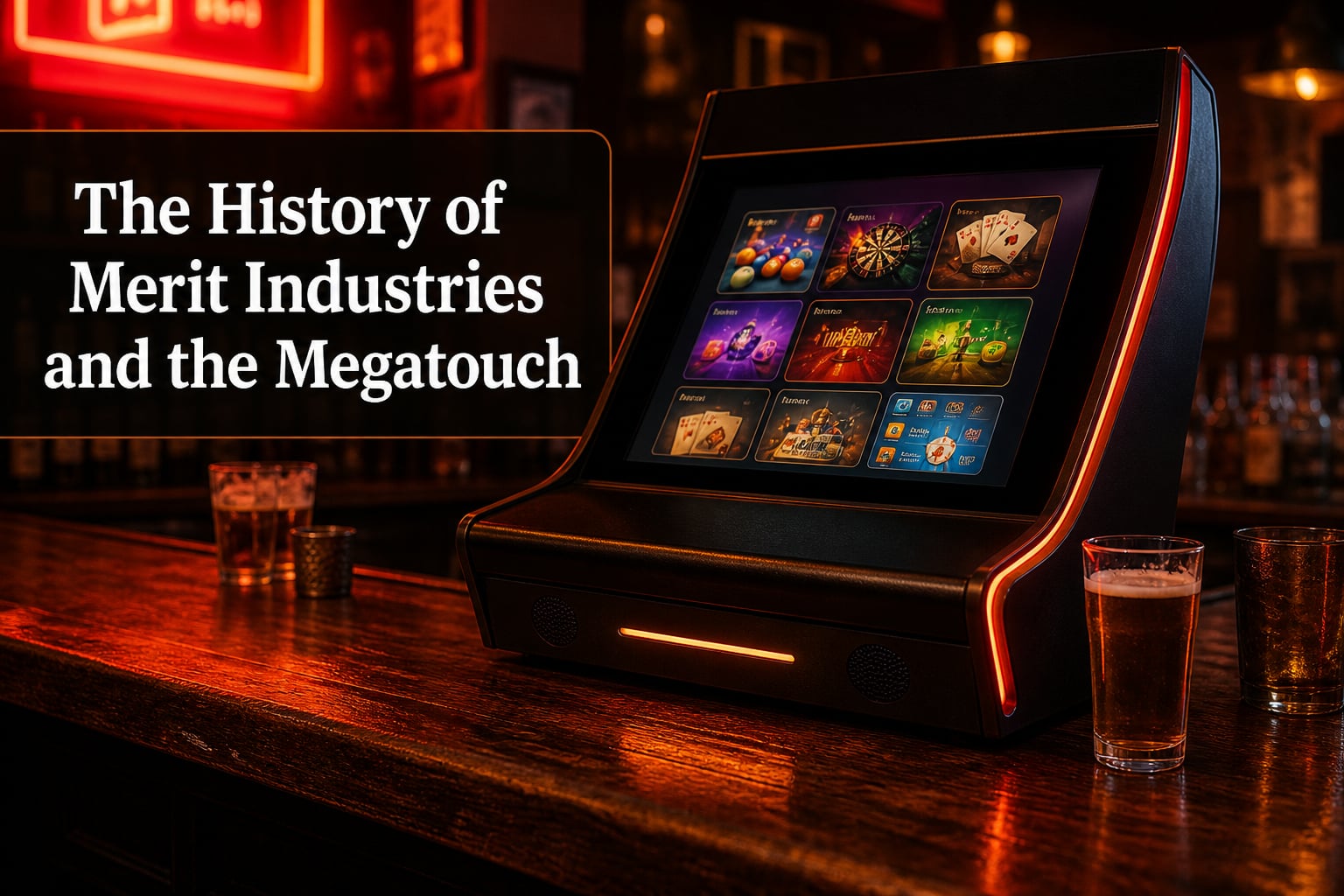
If you ever sank a quarter into a bartop arcade machine in the late 1990s or 2000s, chances are you were looking at a Megatouch. For nearly two decades, the touchscreen countertop arcade was the social heartbeat of thousands of bars, taverns, and restaurants across North America. The history of Merit Industries and the Megatouch is really a story about how one Pennsylvania company defined, and was eventually undone by, the very culture it helped create.
I grew up watching these machines in family restaurants, and I still remember the beep of Photo Hunt and the chaos of multiplayer trivia. In this guide, I will walk you through Merit Industries’ founding, the rise of the Megatouch product line, the hardware generations that kept the concept alive, and the decline that led to bankruptcy in 2014. We will also look at what bar owners and collectors are doing with these machines today, and whether there is any true successor to the Megatouch experience.
Table of Contents
- The History of Merit Industries and the Megatouch
- What Was Merit Industries?
- The Birth of the Megatouch
- Megatouch Hardware Generations: A Complete Timeline
- The Games That Defined Megatouch
- How the Security Key and Upgrade System Worked?
- Rise to Dominance: Megatouch in Bar Culture
- Competitors and the Broader Touchscreen Arcade Market
- The Decline: What Happened to Megatouch and Merit Industries
- The Megatouch Legacy: Collectors, Repair, and Preservation
- FAQs
- Conclusion
The History of Merit Industries and the Megatouch
What Was Merit Industries?
Merit Industries was a Bensalem, Pennsylvania company that became the most recognized name in bar-top touchscreen amusement in North America. The company was established in the mid-1970s and built its early reputation on coin-operated trivia and quiz machines that were staples in pizza parlors, family restaurants, and neighborhood taverns.
Long before the Megatouch existed, Merit was known for products like Trivia Whiz and other counter-top quiz games. According to the Museum of the Game database, Merit Industries released 82 machines under its trade name starting in 1980. These early products were often based on trivia, casino-style redemption, and reflex games that earned a few cents per play and added up through volume.
By the late 1980s, Merit had settled into a clear niche: affordable, reliable, route-friendly coin-operated amusement machines. That niche positioned the company perfectly when touchscreen technology finally became cheap enough to put in a bar cabinet. The Megatouch would not arrive until 1997, but the business model, the route operator relationships, and the bar-friendly footprint were already there.
Why Bensalem, Pennsylvania Mattered
Merit stayed headquartered in the greater Philadelphia area, with operations split between Bensalem and Lansdale at different points. That location put the company within a day’s drive of a huge chunk of the eastern U.S. bar and amusement market, and it gave them access to a deep bench of technicians, cabinet makers, and electronics suppliers. Proximity mattered because route operators expected fast turnarounds on broken units, and Merit’s local supply chain gave them a real edge over out-of-state competitors.
The Birth of the Megatouch
The Megatouch was the first major product to put a touchscreen in a countertop cabinet aimed at the bar market. Released in 1997 under the name Megatouch Video, the machine combined a 13-inch CRT touchscreen with a curated library of casual multiplayer games. Players would swipe a card, drop a coin, or in some cases insert a bill, then compete on games like Photo Hunt, trivia quizzes, and card games.
Merit was not the first company to try a touchscreen amusement concept, but it was the first to package it for the route operator market at the right price point. Earlier touch experiments existed in arcades and casinos, but they were too expensive, too fragile, or too niche for the average bar. Megatouch hit a sweet spot where the hardware cost was recoverable within a reasonable payback period for operators.
The Countertop Cabinet Design
The classic Megatouch cabinet was a compact countertop unit about two feet wide and weighing roughly 75 to 90 pounds. That size made it easy to place on a bar back, on a hostess stand, or on a tabletop against a wall. It also meant a single bartender could monitor four to six machines during a shift without leaving the bar.
The cabinet design changed modestly across generations but kept the same basic formula: a tilting display, a row of coin and bill acceptors, a sturdy metal housing, and a clear glass top that protected the screen from spills. That durability became one of the brand’s quiet advantages. I have personally seen Megatouch cabinets from the late 1990s still running in 2026, with original screens, original buttons, and software that boots reliably every time.
Megatouch Hardware Generations: A Complete Timeline
Megatouch hardware evolved steadily from 1997 through the mid-2010s, with each generation adding better screens, faster processors, and larger game libraries. Below is a condensed timeline of the major Megatouch models and their rough release periods, drawn from preservation wikis, museum databases, and operator community archives.
| Generation | Approximate Years | Key Hardware Notes |
|---|---|---|
| Megatouch Video (original) | 1997-1999 | 13-inch CRT touchscreen, early game library |
| Megatouch I | 1999-2000 | Refined CRT cabinet, expanded trivia lineup |
| Megatouch II | 2000-2001 | Faster processor, new card and puzzle games |
| Megatouch III | 2001-2002 | Improved graphics, Photo Hunt rises in popularity |
| Megatouch IV / Gold | 2002-2005 | Higher-resolution CRT, larger game library, multiplayer focus |
| Megatouch MAXX (Ruby, Sapphire, Diamond) | 2005-2008 | LCD upgrade, MAXX-specific software, security key changes |
| Megatouch Force | 2008-2011 | New motherboard, network-friendly features |
| Megatouch Force ION | 2011-2013 | ION platform, faster load times, updated UI |
| Megatouch Evo | 2013-2014 | Final generation, touch refinements, largest game set |
This timeline is not exact to the month for every model, because Merit staggered releases and ran regional variants, but it captures the broad sweep of how the line evolved. The jump from CRT to LCD between Megatouch Gold and Megatouch MAXX was the single biggest visual upgrade the platform ever received.
Why the MAXX and Force Eras Defined a Generation
The MAXX series, especially the Sapphire and Diamond variants, is widely considered the high-water mark for the brand. These machines introduced a 22-inch LCD panel, brighter colors, and a software architecture that finally let route operators push content updates over broadband rather than shipping discs around the country. Many of the most beloved Megatouch games, including the polished Photo Hunt variants and several trivia packs, debuted on MAXX hardware.
The Megatouch Force and Force ION that followed doubled down on network connectivity and reliability. According to the Touchscreen Arcade Preservation Project wiki, Merit shifted its upgrade kit model during this period to make it easier for operators to mix and match cabinets, security keys, and software revisions. By the time the Evo arrived in 2013, Megatouch machines had become more like thin arcade PCs than traditional cabinets, and the writing was already on the wall for a company built around proprietary cartridges and security keys.
The Games That Defined Megatouch
No discussion of Megatouch history is complete without talking about the games. The line’s library was diverse on paper, but a handful of titles carried the brand. Photo Hunt, in particular, became so iconic that it showed up in bar scenes in multiple movies and TV shows throughout the 2000s.
Photo Hunt
Photo Hunt is the game most casual fans remember. Two players were shown the same photograph with a handful of small differences, and the first to tap the differences won. It was fast, visual, and easy enough to explain to a stranger who had never seen the machine before. It also rewarded repeat play, because every photo was new and the timer kept matches short enough for back-to-back rounds.
Trivia, Poker, and Card Games
Merit’s trivia roots never really left the product. Every Megatouch generation included several trivia packs covering pop culture, sports, and general knowledge, often updated quarterly. Card games like solitaire, poker, and blackjack filled out the catalog and gave solo players something to do while waiting for a multiplayer match.
Operators consistently told me that trivia and Photo Hunt together accounted for the majority of plays on any given machine, with poker close behind. That mix of quick reflex games, knowledge games, and card games is part of why Megatouch worked so well in bars: it appealed to nearly every customer, even the ones who did not think of themselves as gamers.
Multiplayer and Tournament Modes
As the hardware generations progressed, Merit leaned harder into multiplayer and tournament features. Later Megatouch Force and Evo machines supported linked play across cabinets in the same venue, leaderboards, and seasonal tournaments that let bars run their own competitions. These features are widely cited as a major reason Megatouch held onto route operators even as cheaper home entertainment options emerged.
How the Security Key and Upgrade System Worked?
If you ever wondered why used Megatouch machines are so tricky to keep running, the answer is the security key system. Every Megatouch machine from the late 1990s onward shipped with a small USB-style hardware key, often called a “dongle” or “security key,” that had to be present for the machine to boot. Without that key, the cabinet was an expensive metal box.
The security key contained a battery and a small circuit that authenticated the software. When the battery died, the key stopped working, and the machine refused to load games. This was originally a piracy protection measure, but in practice it became a recurring revenue stream and a maintenance headache for operators and collectors alike.
Software DVDs and Upgrade Kits
Merit sold upgrades in kit form. A typical upgrade kit included a software DVD (or later, a USB drive), a new security key, and printed instructions for the operator. Installing an upgrade meant opening the cabinet, swapping the key, loading the disc, and rebooting. Some kits also included new bezels, button overlays, or hardware tweaks.
Operators I have spoken with describe the upgrade cycle as smooth when it worked and miserable when it didn’t. A failed upgrade could leave a machine dead until a technician made a service call. That fragility is one of the reasons the post-2014 collector community has focused so heavily on preserving working security keys and archived software.
Why the Key System Matters for Collectors
Today, the security key is the single biggest pain point for anyone trying to restore a Megatouch. Keys are no longer manufactured, working batteries are scarce, and the original software libraries are scattered across forum archives and private collections. The Touchscreen Arcade Preservation Project and a handful of private collectors have been working to document which keys work with which cabinets, but a full repair often still requires hunting down a working key from another machine.
Rise to Dominance: Megatouch in Bar Culture
By the early 2000s, Megatouch had become the default bar amusement in much of the United States. Industry estimates from the period suggest tens of thousands of machines were deployed nationwide, with particularly heavy concentration in the Midwest, Northeast, and Texas. The brand was so common that the phrase “Megatouch machine” was almost interchangeable with “that touchscreen game on the bar.”
Route operators were the engine behind that dominance. A typical route operator would place machines in dozens or hundreds of bars under revenue-share agreements, service them on a regular schedule, and handle the paperwork around licensing and cash collection. For bars, Megatouch offered a low-effort way to add an entertainment draw without managing inventory or staff training.
The Social Game That Wasn’t on a Phone
The reason Megatouch became a cultural fixture, not just a business success, was that it offered a social experience smartphones could not. Two strangers could compete across the same screen, then order another round while arguing about a trivia answer. That communal, in-person dynamic was a huge part of why bar owners kept the machines even when revenue per play was modest.
Competitors and the Broader Touchscreen Arcade Market
Merit did not own the touchscreen amusement market alone. JVL, AMI Entertainment, and a handful of smaller brands built competing countertop touchscreen cabinets during the same era. JVL, a Canadian company, focused heavily on hardware reliability and was widely respected in route operator circles for rugged cabinets and flexible software partnerships.
AMI Entertainment took a different approach, leaning into redemption-style games and licensing deals with major entertainment brands. Both companies survived Megatouch’s collapse and continue to serve the bar amusement market today. Their persistence is part of why the post-2014 market looks the way it does: when Merit disappeared, the existing competitors simply absorbed a portion of Merit’s operator base rather than disappearing themselves.
JVL’s connection to Merit is a frequent question in enthusiast forums, but the two companies were independent. There was no corporate merger or ownership overlap. What JVL did have, after Merit closed, was a decade of accumulated touchscreen engineering and a willingness to keep supporting operators who needed new hardware.
The Decline: What Happened to Megatouch and Merit Industries
Merit Industries’ decline came in two overlapping waves: a financial squeeze that started with the 2008 recession, and a long, slow erosion of demand as smartphones absorbed the casual gaming audience. Both forces hit the bar amusement business at the same time.
The 2008 Recession Hit Routes Hard
When the 2008 financial crisis hit, bars and restaurants saw fewer customers and tighter margins. Route operators responded by pulling machines from slow locations, consolidating routes, and delaying upgrades. For Merit, that meant fewer new machine sales and lower software revenue. The company had already been running lean after the MAXX generation, and the recession pushed it firmly into cost-cutting mode.
Smartphones Pulled Eyes Away From Screens
At the same time, the iPhone had arrived in 2007 and Android was exploding. By 2010, every bar patron had a personal touchscreen in their pocket with free casual games, music, and social apps. The Megatouch’s monopoly on casual touchscreen entertainment was gone overnight. The communal multiplayer experience kept some machines busy, especially on weekends, but average revenue per location started trending downward and never recovered.
Bankruptcy and Closure in 2014
The combined pressure proved too much. Merit Industries ceased operations entirely in 2014, leaving the installed base of Megatouch machines without manufacturer support, replacement parts, or new software. The closure was effectively a Chapter 7-style shutdown rather than a sale or merger; no successor company took over the brand.
For operators, the closure meant no more upgrade kits, no more factory service, and no clear path to add new games. Some operators kept their existing machines running on old software for years. Others pulled Megatouch cabinets entirely and replaced them with hardware from JVL or AMI.
The Megatouch Legacy: Collectors, Repair, and Preservation
More than a decade after Merit closed, the Megatouch community is small but remarkably active. Subreddits, Facebook groups, and a handful of forums are full of hobbyists swapping security keys, sharing software dumps, and documenting repair procedures for specific model years.
The Touchscreen Arcade Preservation Project, sometimes called the Megatouch Longevity Project, is the best-known effort in this space. It catalogs which games run on which cabinets, which security keys are still functional, and which boards are easiest to restore. Operators and home users both rely on these documentation efforts to keep machines alive.
What a Modern Replacement Looks Like
For bar owners who still want the Megatouch experience, the closest functional successor available today is the JVL ECHO HD3. It is a modern countertop touchscreen with a curated library of similar casual games, active manufacturer support, and a one-year warranty. JVL’s documentation explicitly markets it as the Megatouch replacement for venues that do not want to gamble on a 15-year-old used cabinet.
For collectors and hobbyists, however, nothing fully replaces an actual Megatouch. The original Photo Hunt, the trivia packs from 2003, and the look of the classic Gold-era cabinet all carry a nostalgic weight that no modern alternative has fully captured.
Can You Still Buy a Used Megatouch Machine?
Yes, used Megatouch machines still appear on auction sites and in route operator liquidation sales. Prices vary widely based on model, condition, and whether the security key still works. Buyers should expect to pay more for MAXX and Force hardware than for earlier CRT models, and should treat any machine without a confirmed working security key as a parts unit rather than a turnkey cabinet.
FAQs
What happened to Megatouch and Merit Industries?
Merit Industries, the Pennsylvania-based maker of Megatouch touchscreen arcade machines, ceased operations entirely in 2014. A combination of the 2008 recession, shrinking route revenue, and smartphone competition made the business unsustainable. No successor company took over the brand, so used machines are now supported only by hobbyists and preservation communities.
Is there a direct replacement for Megatouch?
There is no direct replacement carrying the Megatouch name, but JVL’s ECHO HD3 is widely regarded as the closest functional successor. It offers a similar countertop touchscreen format, a comparable casual game library, and active manufacturer support with a one-year warranty, which is exactly what Merit stopped providing after 2014.
Can I still buy a used Megatouch machine?
Yes, used Megatouch machines still show up on auction sites and in route operator liquidation sales. Expect to pay a premium for MAXX, Force, and Evo hardware with working security keys, and treat any listing without a confirmed key as a parts cabinet rather than a playable unit.
Why are bar owners switching from Megatouch?
Most bar owners who switch do so because their old Megatouch hardware is failing, the security key is dead, and there is no manufacturer support. Replacement hardware from JVL or AMI offers modern displays, fresh software, and warranty coverage, which is far easier than restoring a 15-year-old cabinet.
Was JVL connected to Merit Industries?
No. JVL and Merit Industries were independent competitors in the touchscreen amusement market. JVL did not acquire Merit when Merit closed in 2014, but JVL’s hardware became the natural choice for operators who needed replacement cabinets after Merit’s shutdown.
What was the most popular Megatouch game?
Photo Hunt was the most popular and recognizable Megatouch game, with trivia packs a close second. Both appeared on multiple hardware generations and were the two titles operators most often cited when explaining why a given cabinet earned steady revenue.
Conclusion
The history of Merit Industries and the Megatouch is a reminder of how quickly a category-defining product can rise, peak, and disappear. Merit built the touchscreen bar arcade from scratch in 1997, scaled it across North America through nearly a dozen hardware generations, and then watched the smartphone erase the casual gaming monopoly that made the model work.
If you are researching Megatouch history for a restoration project, a bar upgrade, or simply nostalgia, the key takeaways are these: Merit closed in 2014, no successor owns the brand, working security keys are the make-or-break detail for any used cabinet, and modern alternatives like JVL’s ECHO line exist for venues that need active manufacturer support. The full story of Merit Industries and the Megatouch lives on in the machines still running in basements, bars, and collectors’ workshops today.