
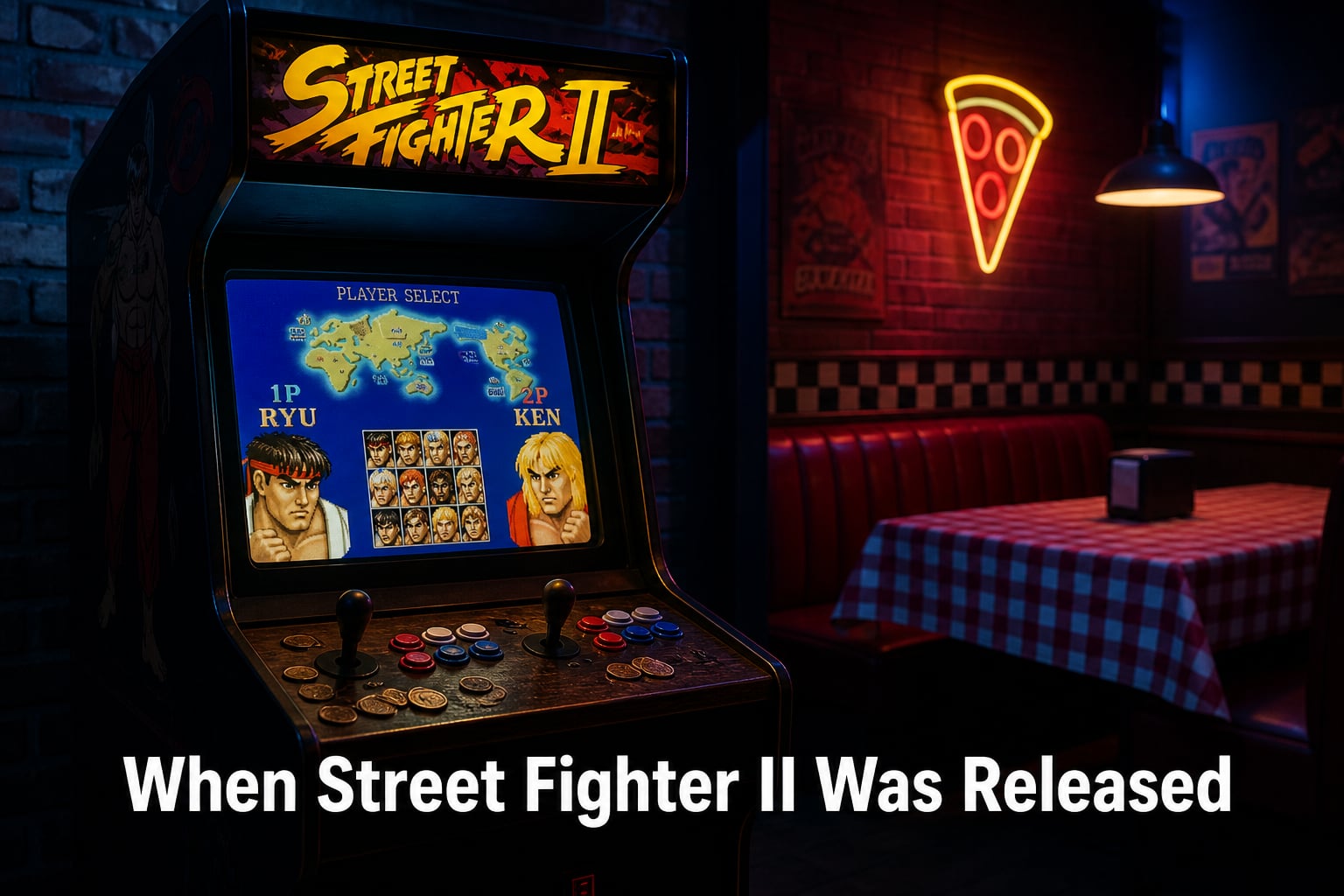
Street Fighter II was released on March 7, 1991 in Japan and February 6, 1991 in North America as an arcade game developed and published by Capcom. I still remember the first time I saw a cabinet glowing in a pizzeria corner, the screen pulling quarters out of my pocket like a coin-eating dragon. That single arcade release kicked off the fighting game boom of the early 1990s and reshaped what players expected from one-on-one combat games.
Over the next three decades, Capcom released more than a dozen updated versions and home console ports of Street Fighter II. In this guide, I will walk you through every major release date, from the original arcade debut in 1991 all the way through the 30th Anniversary Collection in 2018. You will get the exact dates, the regional differences, and the historical context that made this game one of the most influential titles ever made.
Table of Contents
- When Was Street Fighter II Released? The Exact Dates
- Street Fighter II: The World Warrior (1991) – The Original Release
- Street Fighter II Version Timeline – Every Release From 1991 to 2017
- Street Fighter II: Champion Edition (March 1992)
- Street Fighter II Turbo: Hyper Fighting (December 1992)
- Super Street Fighter II: The New Challengers (March 1993)
- Super Street Fighter II Turbo (January 1994)
- Hyper Street Fighter II: The Anniversary Edition (February 2003)
- Ultra Street Fighter II: The Final Challengers (May 2017)
- Street Fighter 30th Anniversary Collection (May 2018)
- SNES and Home Console Ports of Street Fighter II
- World Warriors, Bosses, and the Mechanics That Changed Fighting Games
- How Street Fighter II Sparked the Fighting Game Boom
- Where to Play Street Fighter II Today
- Frequently Asked Questions About Street Fighter II’s Release
- The Lasting Legacy of Street Fighter II
When Was Street Fighter II Released? The Exact Dates
Street Fighter II: The World Warrior hit Japanese arcades on March 7, 1991, while North American arcades received the game slightly earlier, on February 6, 1991. That ordering surprises many people, but it reflects how Capcom staggered arcade distribution across regions at the time. The US launch came first, and Japan followed roughly five weeks later.
According to Capcom’s official 35th Anniversary history page, the studio lists March 7, 1991 as the canonical Street Fighter II release date, because that is when the game rolled out widely across Japanese arcades. Wikipedia and Super Jump Magazine both confirm the dual-date pattern. If you are searching for a single answer, the safest phrasing is: Street Fighter II was released in February 1991 in arcades in the US, and in March 1991 in arcades in Japan.
Here is the key fact for the snippet box: Street Fighter II: The World Warrior is a 1991 arcade fighting game. There was no simultaneous worldwide launch. The North American arcade release came first in February 1991, and the Japanese arcade release followed on March 7, 1991.
Street Fighter II: The World Warrior (1991) – The Original Release
Street Fighter II: The World Warrior was the first true sequel to the original 1987 Street Fighter arcade game. Capcom’s internal team, led by planners Akira Nishitani and Akira Yasuda, designed the game as a head-to-head fighter built around eight playable characters drawn from around the world. The team called them the “World Warriors,” and that subtitle stuck.
The game ran on Capcom’s CPS-1 arcade hardware, which let the artists push larger sprites, more colors, and smoother animation than the original 1987 board could handle. Six attack buttons (three punches, three kicks) replaced the original’s pressure-sensitive pad, and the special move command system (quarter-circle forward plus punch for a Hadouken) gave players a vocabulary of moves they could chain together. That combination of hardware, art, and mechanics made Street Fighter II feel like nothing else in arcades in early 1991.
The game was an immediate hit. Operators reported lines forming at cabinets, and Capcom could not keep up with demand for the first several months. Within a year, Street Fighter II moved from niche curiosity to mainstream arcade phenomenon, paving the way for the franchise and the entire fighting game genre.
Street Fighter II Version Timeline – Every Release From 1991 to 2017
Capcom released six major arcade versions of Street Fighter II between 1991 and 1994, then followed up with anniversary editions over the next two decades. Each version added characters, balanced mechanics, or new features. Here is the full timeline based on Capcom’s official release history.
Street Fighter II: Champion Edition (March 1992)
Champion Edition launched in Japanese arcades in March 1992 and arrived in North America shortly after. This was the first major balance overhaul. It introduced the ability to play as the four boss characters (Balrog, Vega, Sagat, and M. Bison) and added mirror matches where both players could pick the same fighter. The control scheme also got a refinement, giving players access to new special move variations.
Street Fighter II Turbo: Hyper Fighting (December 1992)
Hyper Fighting arrived in Japanese arcades in December 1992. Capcom added a Turbo speed setting that ran the game at roughly 1.5x normal speed, plus a handful of new special moves and tweaks to existing characters. This version became the competitive standard for arcades in 1993 and remains the favorite of many old-school players.
Super Street Fighter II: The New Challengers (March 1993)
The New Challengers hit Japanese arcades in March 1993 and brought the roster from eight playable fighters up to twelve. The four new characters were T. Hawk, Cammy, Fei Long, and Dee Jay. The sprite art was redrawn from scratch, and the game ran on the upgraded CPS-1 hardware revision. This version was the first to be released simultaneously across home consoles in the US, Japan, and Europe later that year.
Super Street Fighter II Turbo (January 1994)
Super Turbo launched in Japanese arcades in late January 1994 and brought the Super Combo system into the game for the first time. Players could build a Super meter by performing specific actions, then unleash a multi-hit Super Combo attack. The game also added the aerial combo chain and refined the Turbo speed setting. This version is widely considered the peak of 2D Street Fighter and is still played in tournaments today.
Hyper Street Fighter II: The Anniversary Edition (February 2003)
Capcom released Hyper Street Fighter II in February 2003 in Japan on PlayStation 2 to celebrate the franchise’s 15th anniversary. This version allowed players to mix and match versions of the same character, including World Warrior Ryu versus Turbo Ryu, on the same screen. It was re-released as part of the Street Fighter 30th Anniversary Collection in 2018.
Ultra Street Fighter II: The Final Challengers (May 2017)
The Final Challengers launched worldwide on Nintendo Switch in May 2017. It was the first Street Fighter II release in over a decade and added Evil Ryu and Violent Sakura as new playable characters. The Switch version also included a “Way of the Hado” first-person mode that used motion controls. Many retro fans picked this up just to have a portable version of the classic on the Switch.
Street Fighter 30th Anniversary Collection (May 2018)
The 30th Anniversary Collection arrived on PS4, Xbox One, Switch, and PC in May 2018. It bundled 12 Street Fighter games into one package, including every major Street Fighter II arcade version. This is the easiest way to play through the full Street Fighter II release timeline today without hunting down original arcade boards.
SNES and Home Console Ports of Street Fighter II
Street Fighter II came to the Super Nintendo Entertainment System on July 15, 1992 in Japan, with North American and European releases following in August and September 1992. The SNES port was not a direct arcade port. It ran on a custom graphics chip that reproduced the CPS-1 look as faithfully as possible, but load times were longer and some animation frames were reduced. It still sold over 6 million copies in North America alone, making it the best-selling SNES cartridge of its era.
Other home console ports followed quickly. Street Fighter II: Champion Edition hit the SNES in 1993 as a separate release. The Sega Genesis and Sega Master System received scaled-down 8-bit ports in 1993 as well. The Game Boy got a black-and-white port in 1995, and the original PlayStation saw a Japan-only release of Super Street Fighter II Turbo in 1996. The 3DO and Sega Saturn received ports in 1995 and 1996, though these were Japan and Asia exclusives in some cases.
For the deepest US console catalog, the SNES still hosts the most versions: the original Street Fighter II, Champion Edition, Turbo, Super Street Fighter II, and Super Street Fighter II Turbo all received dedicated SNES cartridges between 1992 and 1994. If you owned a Super Nintendo in the 1990s, you almost certainly owned at least one of them.
World Warriors, Bosses, and the Mechanics That Changed Fighting Games
The original Street Fighter II roster of eight World Warriors has become the template for nearly every fighting game made since. Ryu and Ken are the Japanese/American karate fighters. Chun-Li is the Chinese Interpol officer. E. Honda is the Japanese sumo wrestler. Blanka is the Brazilian beast-man. Guile is the American Air Force colonel. Zangief is the Soviet wrestler. And Dhalsim is the Indian yoga master. Each character had a unique fighting style and a signature special move that defined their identity.
Bossing the game unlocked the four boss characters known as the Four Kings. Balrog (M. Bison in Japan) is the American boxer. Vega (Balrog in Japan) is the Spanish cage fighter. Sagat is the Thai Muay Thai champion. And M. Bison (Vega in Japan) is the dictatorial leader of the criminal syndicate Shadaloo. The regional name swap still trips people up today, but the characters themselves are the same.
The mechanics behind those characters changed fighting games forever. The six-button control scheme (three punch strengths, three kick strengths) gave players options for close, medium, and far-range attacks. The special move command system, including the Hadouken (fireball), Shoryuken (dragon punch), and Tatsumaki Senpukyaku (hurricane kick), rewarded players who could memorize inputs and execute them quickly. The Super Combo system, added in Super Turbo, gave players a way to spend meter for big damage, setting up the resource-driven combat style that defines modern fighters.
How Street Fighter II Sparked the Fighting Game Boom
Street Fighter II was not just a successful arcade game. It launched a genre. Sales figures from Capcom and reporting from outlets like ESPN and IGN suggest the Street Fighter II franchise has sold over 13 million arcade units and tens of millions more across home consoles. The original arcade version alone moved more than 140,000 dedicated cabinets worldwide, an extraordinary number for any arcade game, let alone a fighting game.
The release of Street Fighter II in 1991 triggered what historians now call the fighting game boom of the early-to-mid 1990s. Within three years, Mortal Kombat, King of Fighters, Fatal Fury, Virtua Fighter, Killer Instinct, and dozens of other fighting games had flooded arcades and home consoles. Most of them borrowed directly from Street Fighter II’s control scheme, round structure, and special move vocabulary. The genre has never been the same since, and any modern fighting game still owes something to that 1991 arcade release.
The competitive scene that followed is just as important. The first Evolution Championship Series (EVO) was held in 1996, originally as a Street Fighter competition. Players like Alex Valle, Daigo Umehara, and Justin Wong built their reputations on Street Fighter II (and later Street Fighter III and IV) long before Twitch streams and esports sponsorships. The tournament infrastructure for fighting games today is a direct descendant of those early Street Fighter II sessions.
Where to Play Street Fighter II Today
If you want to play Street Fighter II today, the fastest path is the Street Fighter 30th Anniversary Collection (2018), which packs every major arcade version onto modern consoles and PC. The collection includes the original World Warrior, Champion Edition, Turbo, Super, and Super Turbo, plus the rest of the 30-year franchise.
For Nintendo Switch owners, Ultra Street Fighter II: The Final Challengers (2017) is still available as a digital download and includes the first-person Way of the Hado mode. Original arcade cabinets still exist in dedicated arcade venues in Japan, the US, and a handful of European cities, and you can still find them in retro arcade bars. Emulation is also an option for players who want to experience the exact arcade versions on modern hardware.
Frequently Asked Questions About Street Fighter II’s Release
When did Street Fighter 2 come out in the US?
Street Fighter II: The World Warrior launched in North American arcades on February 6, 1991. The US release came slightly before the Japanese release, which followed on March 7, 1991. The first home console port arrived on the Super Nintendo in Japan on July 15, 1992.
Was Street Fighter 2 a success?
Street Fighter II was a massive commercial success. The original arcade version sold more than 140,000 dedicated cabinets worldwide, and the SNES port sold over 6 million copies in North America alone. The franchise has gone on to sell tens of millions of copies across home consoles and is credited with launching the fighting game boom of the 1990s.
Is Street Fighter 2 still played?
Yes, Street Fighter II is still played competitively and casually. The Street Fighter 30th Anniversary Collection released in 2018 put the original arcade versions on modern consoles, and Super Street Fighter II Turbo is still played at fighting game tournaments. Dedicated arcade cabinets remain in operation in Japan and a handful of retro gaming venues worldwide.
How many versions of Street Fighter II are there?
There are six major arcade versions of Street Fighter II: The World Warrior (1991), Champion Edition (1992), Turbo: Hyper Fighting (1992), Super Street Fighter II: The New Challengers (1993), Super Street Fighter II Turbo (1994), and the Japan-only arcade update. Capcom has also released anniversary editions, the most recent being Ultra Street Fighter II: The Final Challengers in 2017 for Nintendo Switch.
When was Street Fighter II released in Japan?
Street Fighter II: The World Warrior released in Japanese arcades on March 7, 1991. The Japanese home console release on the Super Famicom (SNES) followed on July 15, 1992. Champion Edition launched in Japanese arcades in March 1992, and subsequent versions followed consistent six-to-twelve-month gaps between updates.
When was Super Street Fighter II released?
Super Street Fighter II: The New Challengers released in Japanese arcades in March 1993 and reached North America by mid-1993. The SNES port launched in late 1993. Super Street Fighter II Turbo followed in late January 1994 in Japanese arcades and added the Super Combo system that defined the genre going forward.
The Lasting Legacy of Street Fighter II
Street Fighter II’s release in 1991 changed the trajectory of video games. It turned the fighting game genre from a niche sideline into a mainstream obsession, established the six-button control scheme that still defines 2D fighters, and built the competitive scene that grew into the modern FGC and esports. When you ask when Street Fighter II was released, the simple answer is February 1991 in the US and March 1991 in Japan, but the real answer is that it kicked off three decades of one-on-one combat games that are still going strong today.
If you are chasing the original experience, the Street Fighter 30th Anniversary Collection is the easiest entry point in 2026. If you want the original arcade hardware, you can still find refurbished cabinets in retro arcade venues. Either way, the game that started in a Capcom arcade in 1991 is still worth your time more than three decades later.