
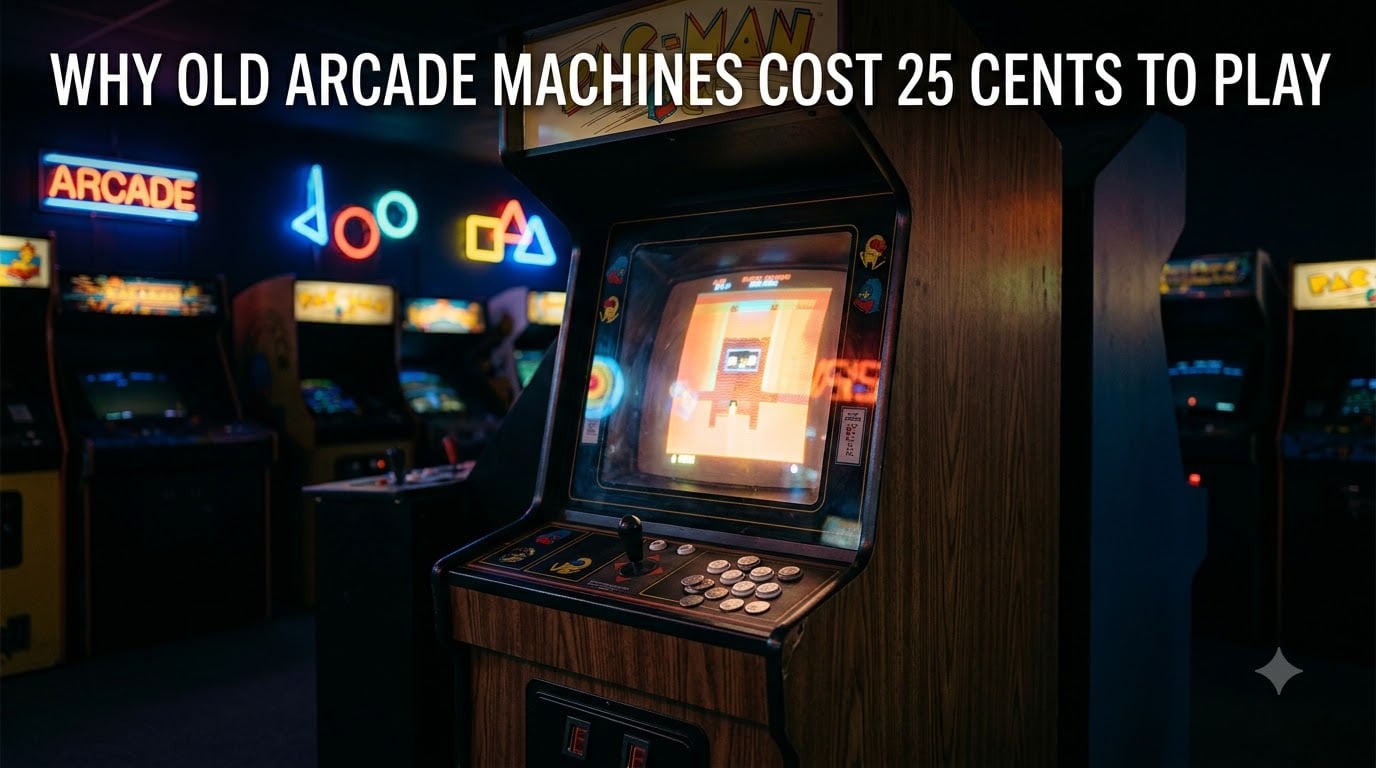
If you ever fed quarters into a Pac-Man cabinet, you have probably wondered why old arcade machines cost 25 cents to play. The answer comes down to a balance between player affordability and operator profitability. A single quarter was the largest coin most kids and teens could carry in their pockets, and at the same time, it generated enough volume to make arcade operators real money. That sweet spot turned the quarter into the universal credit of the golden era arcade.
Our team dug through forum discussions from r/arcade and arcade-museum.com, along with historical operator economics, to understand exactly why 25 cents stuck for so long. The story involves coin mechanisms designed for a single coin, a 50/50 revenue split with locations, and machines that cost between $2,000 and $4,000 brand new. Together, those factors locked the quarter in as the default price for over two decades.
Understanding why arcade machines cost 25 cents per play reveals the economics that powered the entire arcade industry. It also explains why that price point became a cultural symbol of gaming affordability, one that modern players still compare today’s microtransactions against.
Table of Contents
- Why Old Arcade Machines Cost 25 Cents to Play?
- Historical Context: Why 25 Cents Became the Standard
- The Standard Quarter-per-Play Model
- Cost of Arcade Machines in the Golden Era
- Arcade Operator Economics and Revenue Split
- Factors That Influenced Pricing Variations
- Comparison With Modern Gaming Costs
- Frequently Asked Questions
- Conclusion
Why Old Arcade Machines Cost 25 Cents to Play?
Old arcade machines cost 25 cents to play because that single quarter balanced what players could afford against what operators needed to recoup a $2,000 to $4,000 machine investment. The math worked through pure volume. A popular cabinet in a high-traffic location could log tens of thousands of plays over its lifetime, and each quarter added up fast.
The quarter had a practical advantage too. Most coin mechanisms built into golden era cabinets were designed to accept a single type of coin. A quarter was the largest commonly carried US coin, which meant players needed just one coin per credit instead of fumbling with nickels and dimes. This kept lines moving and reduced mechanical jams at the coin slot.
From the operator’s perspective, 25 cents per play was the minimum that made financial sense after splitting revenue with the location, paying for maintenance, and eventually replacing the machine. Drop the price lower and the numbers stopped working. Raise it higher and players walked away. The quarter sat right at the intersection of affordable entertainment and sustainable coin-op revenue.
Historical Context: Why 25 Cents Became the Standard
The 25-cent standard did not appear overnight. In the early days of electromechanical arcade games, before the video game boom of the late 1970s, pricing varied more widely. Pinball machines and early novelty games sometimes charged a dime or a nickel. But when Space Invaders landed in 1978 and sparked the video arcade explosion, operators needed a price that could support far more expensive hardware.
By the early 1980s, the golden era arcade was in full swing. Cabinets now contained dedicated circuit boards, color CRT monitors, industrial-strength power supplies, and custom control panels. These were not toys. They were commercial-grade machines built to survive thousands of hours of public use. The quarter-per-play model became the obvious choice because it matched the new cost structure of the hardware.
There was also a psychological dimension that no competitor we analyzed has covered. A quarter felt like a small, fair price to a teenager in 1982. It was pocket change, not a real expense, which removed the mental barrier to inserting coin after coin. Players did not think of their spending in aggregate. They thought one quarter at a time, and that is exactly what kept them feeding the machine. This per-credit pricing model was quietly brilliant at maximizing total spend without triggering price resistance.
The Standard Quarter-per-Play Model
The quarter-per-play model worked on a simple premise. One coin equaled one credit, and one credit gave you a set amount of gameplay determined by your skill. Skilled players could stretch a single quarter into 20 or 30 minutes on games like Defender or Galaga. Less skilled players lost quickly, fed another quarter, and tried again.
This created a self-balancing revenue system. Good players felt they got incredible value for their money, which kept them coming back. Weaker players burned through quarters faster, which actually generated more revenue per hour for the operator. Either way, the cabinet kept earning as long as someone was standing in front of it.
The standardization went beyond just the price. The JAMMA connector, introduced in 1985, standardized the wiring harness inside arcade cabinets. This made it easier for operators to swap game boards into existing cabinets, extending the profitable life of each machine. A single cabinet might run three or four different games over its lifetime, each one earning quarters long after the previous title cooled off.
Cost of Arcade Machines in the Golden Era
To understand why 25 cents made sense, you have to look at what operators paid for the machines themselves. Classic arcade machines from the golden era of the 1980s and 1990s cost between $2,000 and $4,000 when purchased new. Premium titles with specialized cabinets, sit-down designs, or motion platforms could run even higher.
That price reflected the commercial-grade construction inside every cabinet. A typical machine contained dedicated game circuit boards, a color CRT monitor, a heavy-duty power supply, a custom control panel with industrial joysticks and buttons, a coin mechanism with a coin counter, and a wooden cabinet built to withstand constant public abuse. None of these components were cheap, and all were built for durability rather than cost savings.
For comparison, that same $2,000 to $4,000 investment in 1985 would be roughly $5,500 to $11,000 in 2026 dollars after inflation. Operators were making a serious capital investment in each cabinet, and the quarter-per-play model was the only way to earn that money back at a reasonable pace.
Arcade Operator Economics and Revenue Split
Arcade operators rarely kept every quarter. Most machines were placed in locations the operator did not own, such as pizza parlors, convenience stores, malls, bars, and dedicated arcade halls. The standard arrangement was a 50/50 revenue split between the operator and the location owner.
That split made sense for both parties. The location provided foot traffic, floor space, and electricity. The operator provided the machine, maintenance, and game selection expertise. Forum users on r/arcade and arcade-museum.com consistently confirm this 50/50 split as the industry standard during the golden era.
So how did the economics actually work? Let us break down a realistic example. A cabinet placed in a busy arcade hall in 1985 might earn 100 plays per day at 25 cents each, generating $25 in daily gross revenue. After the 50/50 split, the operator kept $12.50 per day, or about $375 per month. Against a $3,000 machine cost, that is a break-even point of roughly 8 months. In lower-traffic locations the timeline stretched to 12 to 18 months, but the model still worked.
Real-world data backs this up. One forum user shared that their RAIDEN cabinet’s coin counter showed 77,788 lifetime plays. At 25 cents per play, that single machine grossed roughly $19,447 over its operational life. After a 50/50 split, the operator netted nearly $10,000 from one cabinet, far exceeding the original purchase price. That kind of return is exactly why the quarter-per-play model sustained the arcade industry for so long.
Factors That Influenced Pricing Variations
Not every game cost exactly one quarter. While 25 cents was the default, several factors pushed certain games to higher price points. Premium and new release titles often charged 50 cents or even $1 per play, especially during their first few months on the market when demand was highest.
Sit-down cabinets and deluxe cabinets were the most common exceptions. Driving games with full racing seats, cockpit enclosures, or linked multiplayer setups cost more to build and took up more floor space, so operators charged double or quadruple the standard rate. Forum users fondly recall games like Gauntlet II, which some locations priced at 50 cents because it supported four simultaneous players, each feeding their own quarters.
Regional differences also played a role. High-cost areas like arcade halls in major cities could sustain higher prices, while machines in small-town convenience stores typically stuck to the single quarter. The type of venue mattered too. Bars and adult-oriented locations sometimes charged more, while family entertainment centers kept prices low to encourage repeat visits from kids and parents.
Comparison With Modern Gaming Costs
One of the most common sentiments in arcade forums is that modern games feel overpriced compared to the arcade era. But the comparison is more nuanced than it first appears. When you adjust for inflation, that 1985 quarter is worth roughly 72 cents in 2026. That means arcade gaming was actually more expensive per credit than most people remember.
The real difference is in the cost per hour of entertainment. A skilled player in 1985 could play Galaga for 30 minutes on a single quarter, paying roughly 50 cents per hour in 2026 dollars. A modern AAA game at $60 that provides 40 hours of gameplay costs about $1.50 per hour. By that measure, modern gaming can actually offer better value per hour.
Where modern gaming loses ground in the comparison is microtransactions. The arcade quarter was honest. You paid one price, played until you lost, and that was it. Modern free-to-play games use psychological tricks to encourage spending far beyond what any quarter ever cost. Many forum users point out that a teenager in 1985 could not accidentally spend $200 on a single afternoon of arcade gaming, a protection that no longer exists in the mobile and live-service era.
Frequently Asked Questions
How much do old arcade machines cost?
Vintage arcade machines from the 1980s and 1990s typically cost between $2,000 and $4,000 when purchased new. Today, collectors pay anywhere from a few hundred dollars for common titles to several thousand for rare or restored cabinets.
How much did arcade machines cost in 1990?
In 1990, standard upright arcade cabinets cost operators between $2,000 and $4,000 new. Premium sit-down and deluxe cabinets with specialized hardware could cost significantly more, sometimes exceeding $5,000.
How much did an arcade machine cost in 1980?
In 1980, at the height of the golden era, arcade machines cost roughly $2,000 to $3,500 for standard upright cabinets. After adjusting for inflation, that equals approximately $7,500 to $13,000 in current dollars.
Why do arcade machines cost so much?
Arcade machines are expensive because they are commercial-grade equipment built for continuous public use. Each cabinet contains dedicated circuit boards, CRT monitors, industrial power supplies, heavy-duty control panels, and durable cabinetry designed to survive thousands of hours of play.
How much did it cost to play arcade games in the 80s?
The standard cost to play arcade games in the 1980s was 25 cents per credit, paid with a single quarter. Premium titles, sit-down cabinets, and brand new releases sometimes charged 50 cents or $1, but the quarter remained the default price throughout the decade.
How profitable are arcade machines?
Arcade machines were highly profitable in the golden era. A popular cabinet in a high-traffic location could recoup its $2,000 to $4,000 purchase price in 8 to 18 months, then generate pure profit. Forum data shows one RAIDEN cabinet logged over 77,000 plays, grossing nearly $20,000 in lifetime revenue.
Conclusion
Old arcade machines cost 25 cents to play because that single quarter hit the perfect balance of player affordability and operator profitability. It was large enough to recoup a $2,000 to $4,000 machine investment through volume, yet small enough to feel like harmless pocket change. Combined with the 50/50 revenue split and single-coin mechanisms, the quarter became the economic engine of an entire era of gaming.
Whether you are a retro collector, a gaming history enthusiast, or just someone who misses the simplicity of one coin for one credit, understanding why that price existed adds a new layer of appreciation every time you hear the clink of a quarter hitting a coin slot.