
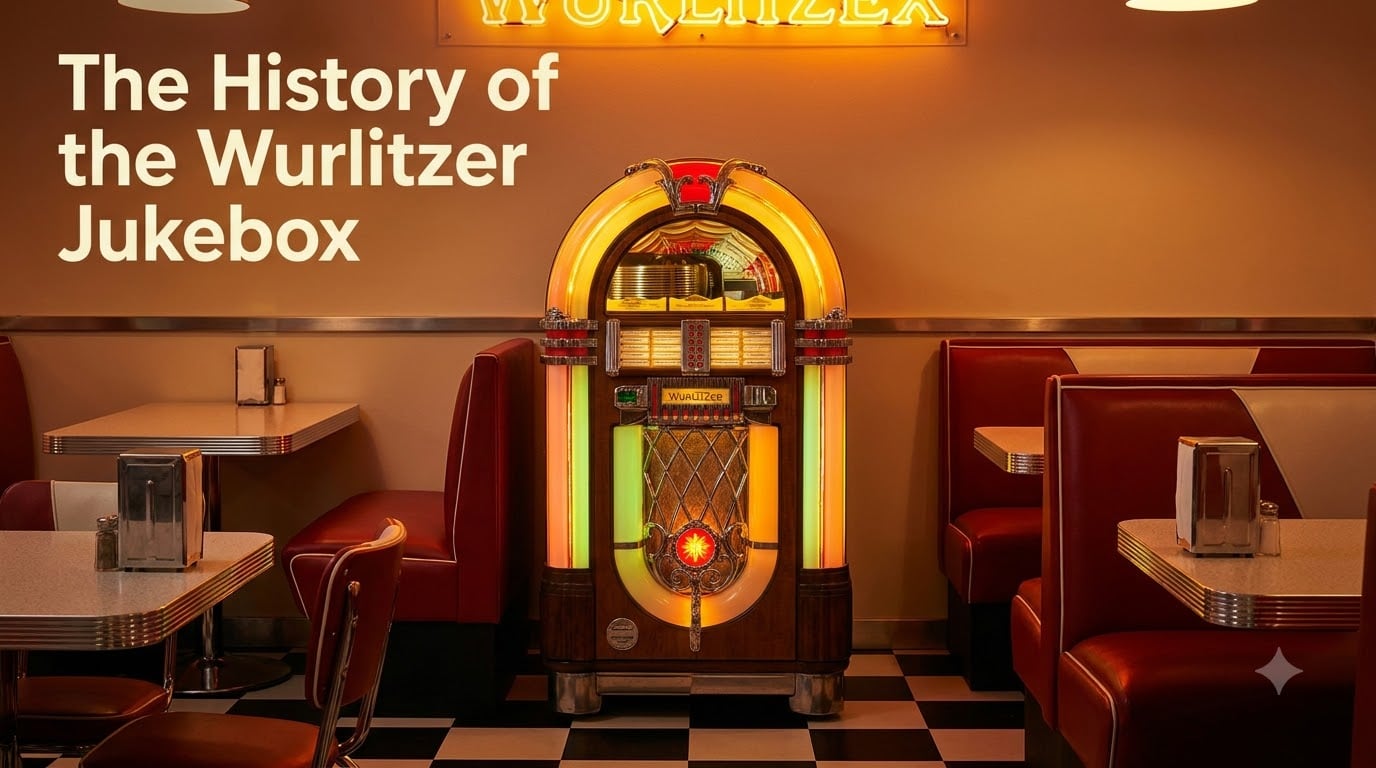
Picture a 1950s diner. Red vinyl booths, checkered floors, and the warm amber glow of a machine in the corner pulling a record from its rack, dropping it onto a turntable, and filling the room with Elvis. That machine was almost certainly a Wurlitzer jukebox, and the history behind it stretches back over three centuries to a workshop in Saxony.
Wurlitzer jukebox history is really the story of how one family business evolved from selling woodwind instruments in 17th-century Germany to defining the sound and look of mid-century America. The company built machines that became the visual shorthand for an entire era, and the 1946 Model 1015 alone sold over 56,000 units in less than two years.
I have spent years researching vintage coin-operated machines, talking to collectors, and tracing the paper trail of company records from North Tonawanda to Hullhorst, Germany. What follows is a comprehensive look at the history of the Wurlitzer jukebox, from the family’s earliest days through the golden age and into the modern collector market.
Whether you are a collector hunting for a Model 1015, a history buff curious about coin-operated music, or someone who just walked past a glowing jukebox in a bar and wondered where it came from, this guide covers the full arc of Wurlitzer’s jukebox legacy.
Table of Contents
- Wurlitzer Jukebox Quick Facts
- From Saxony to America: The Wurlitzer Family Origins
- The Pivot to Coin-Operated Music
- The Golden Age: Wurlitzer Jukeboxes 1946 to 1965
- Bubble Tubes, Neon, and Rock and Roll: Design and Cultural Impact
- The Decline: When Wurlitzer Stopped Making Jukeboxes in America
- Legacy and Collectibility: Wurlitzer in the Modern Era
- Frequently Asked Questions About Wurlitzer Jukebox History
- How much is a Wurlitzer jukebox worth today?
- What is the most sought after jukebox?
- When did Wurlitzer stop making jukeboxes?
- How much is a Wurlitzer 1015 jukebox worth?
- What year did Wurlitzer introduce the 1015?
- Are Wurlitzer jukeboxes still being made?
- How many Wurlitzer 1015s were made?
- Where were Wurlitzer jukeboxes manufactured?
- The Enduring Legacy of the Wurlitzer Jukebox
Wurlitzer Jukebox Quick Facts
Before diving into the full story, here are the essential facts about Wurlitzer jukebox history at a glance:
- Family origins: The Wurlitzer family began trading musical instruments in Saxony as far back as 1659.
- Arrival in America: Rudolph Wurlitzer immigrated to the United States in 1853 and founded The Rudolph Wurlitzer Company.
- First jukebox: Farny Wurlitzer purchased a patented coin-operated phonograph mechanism in 1933, launching the company into jukebox manufacturing.
- Most iconic model: The Wurlitzer Model 1015, introduced in 1946, sold over 56,000 units in under two years, a record that still stands.
- Peak production: At its height, Wurlitzer was producing more than 45,000 jukeboxes per year.
- Decline in America: US jukebox production wound down by the mid-1980s as the market shifted.
- German operations: Deutsche Wurlitzer, founded in Hullhorst, Germany in 1960, continued manufacturing jukeboxes into the 2010s.
- Collectible value: A pristine Model 1015 can command $20,000 or more from collectors today.
From Saxony to America: The Wurlitzer Family Origins
The story of the Wurlitzer jukebox does not begin in a 1950s American diner. It begins in 1659 in the region of Saxony, Germany, where the Wurlitzer family started buying and selling musical instruments. For nearly two centuries before anyone had heard of recorded sound, let alone coin-operated music, the family built a reputation as musical instrument merchants in central Europe.
This long heritage matters because it explains how Wurlitzer eventually became a jukebox manufacturer. The company did not start as a technology firm or a novelty business. It was a music company, deeply rooted in the trade of instruments, and that foundation shaped every decision that followed.
Rudolph Wurlitzer Crosses the Atlantic
In 1853, a young Rudolph Wurlitzer left Saxony and immigrated to the United States. He brought with him the family’s accumulated expertise in musical instruments and a commercial instinct honed over generations. Shortly after arriving, he established The Rudolph Wurlitzer Company, initially focusing on importing and selling instruments from Europe.
Rudolph set up operations in Cincinnati, Ohio, which became the company’s long-time headquarters. The business grew steadily by supplying instruments to retailers, military bands, and individual musicians across the growing nation. By the late 1800s, Wurlitzer had expanded from importing into manufacturing, building pianos, organs, and other instruments at its own facilities.
The Move to North Tonawanda and Organ Manufacturing
A critical chapter in Wurlitzer jukebox history came with the company’s expansion into North Tonawanda, New York. Wurlitzer acquired the North Tonawanda Musical Instrument Works, which produced band organs and mechanical music machines. These large, self-playing organs were used in carousels, skating rinks, and theaters, and they represented the company’s first serious foray into automatically played music.
This experience with mechanical music proved essential. Wurlitzer engineers learned how to automate sound reproduction using pneumatics, paper rolls, and later electrical systems. When coin-operated phonographs appeared decades later, the company already had decades of institutional knowledge about mechanically played music.
The Wurlitzer name became synonymous with theater organs in the 1920s. The “Mighty Wurlitzer” theater organ, with its rich sound and dramatic capabilities, was installed in movie palaces across the country. These organs accompanied silent films and helped establish Wurlitzer as a brand associated with entertainment technology, not just instrument sales.
By the early 1930s, the company was a well-established force in American music manufacturing. It produced pianos, organs, and mechanical music devices. But the entertainment landscape was shifting rapidly, and the next pivot would define the company’s legacy for generations.
The Pivot to Coin-Operated Music
The history of the Wurlitzer jukebox turns on a single decision made in 1933. That year, Farny Wurlitzer, who had taken over leadership of the company from his father, purchased a patented coin-operated phonograph mechanism from an inventor named Homer Capehart. This acquisition gave Wurlitzer the technical foundation to enter the jukebox market.
The timing was not obvious. America was in the depths of the Great Depression, and spending money on entertainment seemed like a luxury few could afford. But Farny Wurlitzer recognized something that others missed: people would pay small amounts, coin by coin, for music in public spaces even when they could not afford to buy records or radios for their homes.
The Early Models (1933-1942)
Wurlitzer’s first jukeboxes were relatively plain wooden cabinets compared to the glittering machines that would follow. The earliest models played 78 rpm records and offered a limited number of selections. They were functional, reliable machines designed for bars, restaurants, and social clubs where people gathered.
The company refined its designs rapidly through the late 1930s. Wurlitzer engineers improved the record-changing mechanisms, upgraded the amplifiers for better sound, and began experimenting with visual elements that would attract attention in a crowded room. The concept of the jukebox as a piece of visual theater, not just a music player, started to take shape during this period.
Production numbers grew steadily. Wurlitzer was not the only company making coin-operated phonographs, but its combination of engineering quality and showmanship began to set it apart from competitors like AMI and Seeburg. By the early 1940s, Wurlitzer was a serious player in the jukebox industry.
World War II Interruption
Like nearly every American manufacturer, Wurlitzer halted consumer production during World War II. The company’s factories shifted to war-related work, producing precision components and electronic equipment for the military. This interruption lasted from roughly 1942 to 1945.
But the wartime pause created enormous pent-up demand. When production resumed after the war, the American public was ready to celebrate, and Wurlitzer was ready to supply the soundtrack. The post-war period would become the golden age of the jukebox, and Wurlitzer was positioned to dominate it.
The Golden Age: Wurlitzer Jukeboxes 1946 to 1965
The period from 1946 to 1965 represents the peak of Wurlitzer jukebox history. This is when the company produced the models that defined what a jukebox should look like and sound like. The machines from this era are the ones that collectors chase, that museums display, and that appear in every film and television show set in mid-century America.
Several forces converged to create this golden age. Post-war prosperity gave Americans disposable income for the first time in over a decade. The recording industry was booming, with new labels and artists emerging constantly. And the 45 rpm record, introduced in 1949, would transform jukebox technology within a few short years.
At its peak, Wurlitzer was producing over 45,000 jukeboxes per year. The company’s North Tonawanda factory hummed with activity, and the Wurlitzer name became virtually synonymous with the word “jukebox” in the American consciousness.
The Legendary Model 1015 (1946)
The Wurlitzer Model 1015 is the single most important machine in jukebox history. Introduced in 1946, it became an instant sensation and remains the most recognizable jukebox design ever created. The 1015 sold over 56,000 units in less than two years, a sales record in the jukebox industry that has never been broken.
What made the 1015 so extraordinary was its visual design. The machine featured vertically arranged bubble tubes filled with liquid that bubbled and cascaded when the jukebox was in operation. Rows of these tubes flanked the central record mechanism, creating a mesmerizing animated display that drew people across a crowded room just to watch.
The 1015 played 24 selections on 78 rpm records, which was a solid capacity for its time. But it was the design language that made it immortal. The combination of rounded wood cabinet, glowing bubble tubes, chrome trim, and warm lighting created an aesthetic that captured the optimism of post-war America. The 1015 looked like the future, and that future was fun.
Even today, when most people picture a “classic jukebox” in their mind, they are picturing the Wurlitzer 1015. Its silhouette has been reproduced on everything from diner signage to retro radios to kitchen appliances. The design became the universal symbol for jukebox culture, and that cultural penetration is a major reason the 1015 remains the most sought-after vintage jukebox among collectors.
Model 1800 and the 45 RPM Revolution
The introduction of the 45 rpm record in 1949 changed the jukebox industry forever. The 45 was smaller, lighter, and more durable than the old 78s, and it allowed jukeboxes to hold significantly more records in the same physical space. Wurlitzer adapted to this shift, and the Model 1800 series became one of the company’s first major platforms built around 45 rpm technology.
The Wurlitzer 1800, introduced in the mid-1950s, could hold 52 records and offer 104 selections, doubling the capacity of earlier machines. At roughly 140 kilograms, it was a substantial piece of equipment. The 104-selection capacity meant that a single jukebox could offer a remarkably diverse playlist, covering multiple genres and artists in one machine.
The 45 rpm transition also improved sound quality and reliability. The smaller records were less prone to breaking during the mechanical changing process, and the grooves produced cleaner audio through the tube amplifier systems. Wurlitzer’s AMC amplifier designs, paired with crystal speakers, delivered warm, rich sound that filled a room without distortion.
The Model 1800 represented a maturation of Wurlitzer’s engineering. The company had moved beyond the novelty of automatic record changing and was now building sophisticated systems designed for heavy daily use in commercial environments. Operators who maintained routes of jukeboxes in bars and diners appreciated the 1800’s reliability and serviceability.
Model 2000 and Late Golden Age Designs
As the 1950s turned into the 1960s, Wurlitzer continued to push capacity and design forward. The Model 2000 series and its contemporaries offered even larger record capacities and updated visual aesthetics. These late golden age machines began to move away from the rounded wooden cabinet style of the 1015 toward sleeker, more modern designs that reflected changing tastes.
The late 1950s models featured more glass, more chrome, and more elaborate animated displays. Neon jukebox designs became prominent, with colorful tube lighting that made the machines glow brilliantly in dimly lit bars and nightclubs. The visual competition between Wurlitzer, Seeburg, and AMI during this period drove rapid innovation in cabinet design.
However, the golden age was beginning to wane by the early 1960s. The jukebox market was contracting as transistor radios and home stereos became affordable for the average family. People no longer needed to go to a diner to hear their favorite music. They could listen at home, in the car, or walking down the street with a portable radio.
Wurlitzer vs AMI vs Seeburg: The 1950s Jukebox Wars
Wurlitzer did not dominate the golden age unchallenged. Two other manufacturers were fierce competitors throughout the 1950s and 1960s. AMI (Automatic Musical Instruments) was known for building durable, high-capacity machines that appealed to route operators. Seeburg pioneered the 100-select mechanism and introduced wallbox remote selectors that let customers order songs from their booths.
Each company had its strengths. Wurlitzer led on design and brand recognition. Seeburg led on technical innovation and capacity. AMI led on build quality and operator loyalty. The competition pushed all three companies to produce better machines throughout the decade, and the surviving models from this era represent some of the finest coin-operated engineering ever produced.
Bubble Tubes, Neon, and Rock and Roll: Design and Cultural Impact
The technical specifications of Wurlitzer jukeboxes tell only part of the story. The real magic was in the design. Wurlitzer machines were not just music players. They were pieces of animated art that commanded attention and created an atmosphere. Understanding the design history of the Wurlitzer jukebox is essential to understanding its cultural impact.
Bubble Tubes and Visual Theater
The signature feature of the classic Wurlitzer jukebox was the bubble tube. These were sealed glass columns filled with a specially formulated liquid. When the jukebox was powered on, a small heating element at the base of each tube warmed the liquid, causing it to bubble and rise in a continuous, hypnotic cycle.
Bubble tubes were purely decorative. They served no functional purpose in the music playback system. But they were genius. In a dimly lit bar or a neon-soaked diner, the sight of those bubbling columns drew people in like moths to a flame. The bubble tube became the defining visual element of the Wurlitzer brand, and it remains the most instantly recognizable feature of any vintage jukebox.
Wurlitzer paired the bubble tubes with colored plastics, etched mirrors, and elaborate lighting schemes. When a record was selected, the machine came alive: lights shifted, mechanisms moved, and the bubble tubes accelerated their rhythmic cascading. The whole experience was a miniature light show paired with the click and whir of the record-changing mechanism.
Neon, Chrome, and Art Deco
Beyond bubble tubes, Wurlitzer jukeboxes incorporated neon lighting, chrome-plated trim, and art deco styling cues that made each machine a statement piece. The wood cabinets were crafted from quality materials and finished in rich colors. Grille cloth patterns, pilaster designs, and illuminated plastics all contributed to a cohesive aesthetic that evolved across model generations.
The design philosophy was straightforward: a jukebox should be the most beautiful object in the room. In most cases, it was. Bar and diner owners knew that a Wurlitzer jukebox attracted customers, kept them in their seats longer, and encouraged them to spend money on songs and refreshments. The machines paid for themselves through increased foot traffic and dwell time.
Rock, Roll, and the Soundtrack of Youth Culture
The cultural impact of the Wurlitzer jukebox reached its peak during the rock and roll explosion of the 1950s. When Elvis Presley, Chuck Berry, and Buddy Holly hit the airwaves, teenagers flocked to diners, drive-in restaurants, and roadhouses where jukeboxes gave them control over the music for a nickel a song.
The jukebox became a social hub and a symbol of youthful independence. For the first time, young people could choose their own music in a public space without relying on a radio DJ or an adult’s record collection. Drop in a coin, press a button, and your song filled the room. This sense of musical autonomy was genuinely revolutionary in the 1950s.
Wurlitzer jukeboxes appeared in soda fountains, drive-in theaters, roller rinks, and bowling alleys. They became fixtures of fifties Americana, embedded in the visual and social fabric of post-war suburban life. The machines were so closely associated with this era that even today, a Wurlitzer-style jukebox instantly evokes the feeling of 1950s America, regardless of the actual decade.
The connection between jukeboxes and the civil rights movement is also worth noting. Jukeboxes in juke joints across the American South helped spread rhythm and blues, and later soul music, to audiences that mainstream radio often ignored. The coin-operated format allowed musical trends to bubble up from communities rather than being dictated from the top down by record labels and radio executives.
The Decline: When Wurlitzer Stopped Making Jukeboxes in America
The golden age could not last forever. By the mid-1960s, the forces that had fueled the jukebox boom were reversing. Home entertainment options multiplied, the demographics of jukebox users shifted, and the economics of operating jukebox routes became less attractive. Wurlitzer jukebox history took a decisive turn toward decline.
The Market Shifts
Several factors contributed to the decline of the jukebox industry. The transistor radio, introduced in 1954, became cheap and ubiquitous by the 1960s. Portable radios let people carry music anywhere. Home stereo systems improved dramatically in quality and dropped in price, giving families a compelling reason to listen at home rather than feeding coins into a public machine.
The music itself was also changing. The rise of album-oriented rock in the late 1960s favored longer listening sessions at home over the single-song format of the jukebox. FM radio, with its better sound quality and album-focused programming, drew listeners away from the AM hits that jukeboxes typically featured.
For route operators who maintained jukeboxes across multiple locations, the economics deteriorated. Revenue per machine fell while maintenance costs rose. Many operators pulled machines from marginal locations and concentrated on their best-performing spots. The total number of jukeboxes in service across America began a steady decline.
The Sale to Germany in 1973
The pivotal moment in the decline came in 1973, when Wurlitzer sold its jukebox operations and moved production to Germany. The company had actually established a German subsidiary, Deutsche Wurlitzer, in Hullhorst in 1960, and this facility had been building Wurlitzer jukeboxes for the European market. After the 1973 sale, the German operation became the center of Wurlitzer jukebox manufacturing.
This sale marked the end of an era. American production of Wurlitzer jukeboxes wound down through the 1970s and into the mid-1980s, when the last machines rolled off American lines. The North Tonawanda factory that had produced tens of thousands of golden age jukeboxes fell silent.
The sale to Germany was not a failure so much as a recognition of changing realities. The American jukebox market was contracting, while Europe still had a viable coin-operated music culture. Deutsche Wurlitzer continued to build machines for a global market, carrying the Wurlitzer name forward even as the American operation shifted focus to other products.
Legacy and Collectibility: Wurlitzer in the Modern Era
The production history of Wurlitzer jukeboxes eventually came to an end, but the cultural legacy only grew. Today, Wurlitzer jukeboxes are among the most collectible vintage machines in the world, and the brand name carries a mystique that transcends its commercial origins.
Deutsche Wurlitzer and the Final Chapter
Deutsche Wurlitzer continued manufacturing jukeboxes in Germany well after American production ceased. The company produced CD-based jukeboxes, digital download jukeboxes, and replica models that captured the visual style of the classic 1950s machines for a new generation of buyers.
The German operation kept the Wurlitzer jukebox tradition alive into the 2010s. While the machines evolved technically, the design DNA of the golden age models remained visible in the product line. Deutsche Wurlitzer understood that the visual appeal of a Wurlitzer jukebox was inseparable from its identity.
Today, the Wurlitzer brand exists within a larger corporate structure, having passed through several ownership changes. The name still appears on replica jukeboxes and novelty audio products, but the era of Wurlitzer as a major jukebox manufacturer is part of history.
The Collector Market
For collectors, the Wurlitzer jukebox represents the pinnacle of coin-operated music history. The Model 1015 is the holy grail, widely considered the most sought-after jukebox ever made. Pristine, fully restored examples of the 1015 can command prices of $20,000 or more, and even project-condition machines that need complete restoration typically sell for several thousand dollars.
Value depends heavily on condition, originality, and model rarity. A fully original 1015 with matching serial numbers, working bubble tubes, and an intact cabinet will always command a premium. Machines that have been poorly modified or stripped of original parts are worth significantly less, even if they look good on the surface.
Other golden age models also hold strong value. The Model 1800, with its 104-selection capacity and 45 rpm system, is prized by collectors who want a playable daily machine rather than a display piece. Earlier pre-war models are rarer and appeal to specialist collectors focused on the mechanical era of coin-operated music.
Restoration and the Modern Enthusiast Community
Jukebox restoration is a thriving hobby. Enthusiasts around the world rebuild Wurlitzer machines, sourcing NOS (new old stock) parts, fabricating replacement components, and bringing decades-old machines back to life. The restoration community shares knowledge through forums, clubs, and annual gatherings where collectors display their machines and trade expertise.
Restoring a Wurlitzer jukebox requires a blend of skills. Mechanical work is needed for the record-changing system and selection mechanism. Electronic knowledge is essential for rebuilding tube amplifiers. Cosmetic skills come into play for refinishing wood cabinets, replating chrome, and restoring bubble tubes. It is a demanding but deeply rewarding hobby.
The Wurlitzer electric piano connection is an interesting footnote in the company’s broader legacy. Wurlitzer also produced electric pianos, most famously the 120-series and later models, which became iconic instruments in their own right. The same engineering culture that built jukeboxes produced instruments that shaped popular music for decades.
For modern buyers who want the Wurlitzer look without the maintenance demands of a 70-year-old machine, several companies produce replica jukeboxes styled after the classic 1015. These modern machines typically use CD players or digital storage rather than vinyl records, but they capture the visual magic of the original design.
Frequently Asked Questions About Wurlitzer Jukebox History
How much is a Wurlitzer jukebox worth today?
Wurlitzer jukebox values range widely depending on model, condition, and originality. Project-condition machines needing full restoration can sell for around $1,500, while pristine, fully restored Model 1015 units regularly command $20,000 or more. The 1015 is the most valuable model, followed by other golden age machines from 1946 to 1965.
What is the most sought after jukebox?
The 1946 Wurlitzer Model 1015 is universally considered the most sought-after jukebox ever made. It sold over 56,000 units in less than two years, a record that still stands, and its bubble tube design became the iconic image of the classic jukebox. Collectors and museums prize the 1015 above all other coin-operated music machines.
When did Wurlitzer stop making jukeboxes?
American Wurlitzer jukebox production wound down through the 1970s and ended in the mid-1980s. The company sold its jukebox operations to Germany in 1973, and Deutsche Wurlitzer continued building jukeboxes in Hullhorst, Germany into the 2010s before eventually ceasing production.
How much is a Wurlitzer 1015 jukebox worth?
A Wurlitzer Model 1015 in pristine, fully restored condition typically sells for $20,000 or more. Machines in good working condition with some cosmetic wear usually trade in the $8,000 to $15,000 range. Project units needing significant restoration can be found for $3,000 to $6,000, depending on completeness and originality.
What year did Wurlitzer introduce the 1015?
Wurlitzer introduced the Model 1015 in 1946, immediately following the end of World War II. The machine was an instant success and went on to become the best-selling jukebox of all time, with over 56,000 units sold in less than two years of production.
Are Wurlitzer jukeboxes still being made?
Original Wurlitzer jukeboxes are no longer in production. Deutsche Wurlitzer, the German subsidiary that continued manufacturing after the 1973 sale of operations, produced jukeboxes into the 2010s. Today, replica jukeboxes bearing the Wurlitzer name are available from licensees, but these are modern digital or CD-based machines styled after classic designs.
How many Wurlitzer 1015s were made?
Over 56,000 Wurlitzer Model 1015 jukeboxes were produced in less than two years between 1946 and 1947. This production run set a sales record in the jukebox industry that has never been broken, making the 1015 both the highest-selling and most widely distributed coin-operated phonograph of the golden age.
Where were Wurlitzer jukeboxes manufactured?
Wurlitzer jukeboxes were primarily manufactured at the company’s facility in North Tonawanda, New York, during the golden age from 1946 through the 1960s. After the 1973 sale of jukebox operations, production shifted to Deutsche Wurlitzer in Hullhorst, Germany, which continued building machines for the European and global markets.
The Enduring Legacy of the Wurlitzer Jukebox
The history of the Wurlitzer jukebox spans over a century of innovation, from a family of instrument merchants in 17th-century Saxony to the glittering machines that defined the sound of post-war America. Wurlitzer built more than coin-operated phonographs. They built cultural icons whose visual language, the bubble tubes, the neon glow, the warm wood cabinets, still instantly signals an entire era of American life.
The numbers tell part of the story: 56,000 Model 1015s sold in under two years, 45,000 jukeboxes produced annually at peak capacity, and a collector market where pristine machines command prices upward of $20,000. But the deeper story is about how a company rooted in musical instrument craftsmanship recognized an opportunity in coin-operated entertainment and turned it into an enduring symbol of popular culture.
Whether you encounter a Wurlitzer jukebox in a collector’s showroom, a retro-themed bar, or a museum display, you are looking at a machine that changed how Americans experienced music in public spaces. That legacy, from Rudolph Wurlitzer’s arrival in 1853 to the last machines off the German line, is what makes Wurlitzer jukebox history a story worth telling and remembering.