
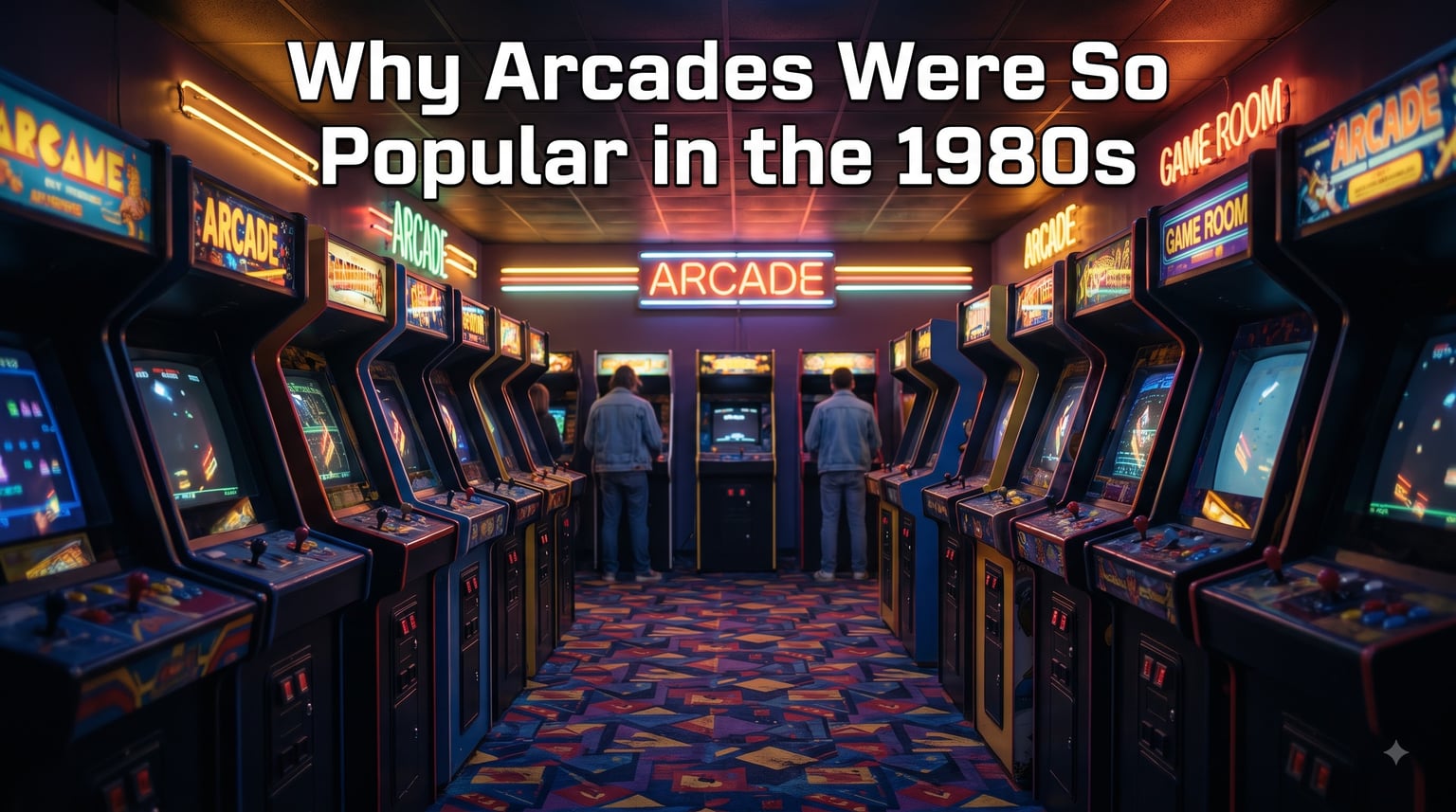
If you were a kid or teenager in the early 1980s, the arcade was the center of your social universe. The moment you walked through those doors, you were hit with a wall of sound, flashing lights, and the unmistakable clatter of quarters dropping into coin slots. Nothing else felt like it.
Arcades generated billions of dollars in revenue at their peak. In 1981 alone, the arcade industry pulled in more than $5 billion. That is more than what the American music industry and Hollywood box office combined earned that year. These were not just game rooms. They were cultural institutions.
Understanding why arcades were so popular in the 1980s means looking at several forces working together. The technology, the social dynamics, the economics, and the timing all lined up perfectly to create something that has never been replicated since. Let me walk you through exactly what happened and why it mattered.
Table of Contents
- What Was the Arcade Golden Age?
- The Timeline: When Arcades Ruled the 1980s
- The Games That Made Arcades Unstoppable
- Why Were Arcades So Popular in the 1980s? The Real Reasons
- Inside the 1980s Arcade Experience
- Arcade Gaming vs Home Consoles in the 1980s
- The Psychology Behind Arcade Addiction
- Why Did Arcades Decline in the 1990s?
- The Modern Arcade Revival: Why Gen Z Loves 80s Arcades
- FAQs
- The Arcade Legacy Lives On
What Was the Arcade Golden Age?
The arcade golden age refers to the roughly six-year period from 1978 to 1984 when arcade video games dominated popular entertainment. During this window, arcades went from a niche curiosity to a massive cultural force that shaped an entire generation.
The term “golden age” is not just nostalgia talking. Industry data backs it up. By 1982, arcade games were generating more revenue than both the American music industry and the North American box office combined. Arcade cabinets were everywhere. You could find them in dedicated arcades, shopping malls, bowling alleys, movie theater lobbies, pizza restaurants, convenience stores, and laundromats.
What defined this era was the gap between arcade technology and everything else available. Arcade cabinets ran on custom hardware with dedicated processors and graphics chips that home systems simply could not match. When you played Pac-Man in an arcade, you were experiencing cutting-edge visual and audio technology that was years ahead of what you could get on an Atari 2600 at home.
This technology gap was the engine of the golden age. It gave people a reason to leave their houses, gather in a shared space, and pay money one quarter at a time to experience something they could not get anywhere else.
The Timeline: When Arcades Ruled the 1980s
The arcade phenomenon did not happen overnight. It built in waves, each driven by a specific game that pushed the industry to new heights. Here is how the timeline unfolded.
1978: Taito released Space Invaders in Japan, and it caused a national sensation. The game was so popular that it allegedly caused a shortage of yen coins in Japan. When it arrived in North America, it sold over 60,000 cabinets and proved that a single arcade game could generate hundreds of millions of dollars. Space Invaders is widely credited with launching the arcade golden age.
1979: Atari released Asteroids, which became their best-selling arcade game of all time with over 70,000 units sold. Vector graphics gave it a crisp, distinctive look that set it apart from everything else on the market. The same year, Galaxian arrived and introduced color graphics to the space shooter formula.
1980: This was the year everything exploded. Namco released Pac-Man, and it became the first true gaming mascot and pop culture icon. Pac-Man merchandise filled store shelves. A animated cartoon aired on television. The song “Pac-Man Fever” reached number nine on the Billboard Hot 100. Pac-Man went on to sell over 400,000 arcade cabinets worldwide.
1981: This was peak arcade. Donkey Kong arrived and introduced the world to a character named Jumpman, who would soon be renamed Mario. Nintendo entered the arcade market with a smash hit. Defender, Frogger, Galaga, and Centipede all hit arcades this year. The industry was generating coin revenue at a staggering pace.
1982: The golden age reached its absolute commercial peak. Arcade revenue in the United States hit roughly $8 billion. To put that in perspective, adjusted for inflation, that is over $23 billion in today’s money. Games like Tron, Dig Dug, and Qbert kept players pumping in quarters.
1983 to 1984: The decline began. The video game crash of 1983, fueled by a flood of low-quality home console games, shook consumer confidence in gaming as a whole. Arcades felt the ripple effect. Market saturation also played a role. Too many cabinets chasing too few players started to eat into arcade profitability.
The Games That Made Arcades Unstoppable
You cannot talk about arcade popularity without talking about the games themselves. These were not just entertainment. They were shared cultural experiences that everyone in a generation played and talked about.
Space Invaders (1978) was the catalyst. Before Space Invaders, arcade games were mostly simple diversions like Pong. Space Invaders introduced escalating difficulty, a persistent high score system, and sound effects that created real tension. Players lined up to play it. It proved that an arcade game could be genuinely compelling, not just a novelty.
Pac-Man (1980) changed everything about who played arcade games. Before Pac-Man, arcade games were overwhelmingly played by males and featured shooting or racing themes. Pac-Man’s simple maze-chase gameplay, bright yellow character design, and approachable mechanics brought in female players, younger children, and adults who had never touched an arcade game. It expanded the audience by orders of magnitude.
Donkey Kong (1981) gave arcades their first real narrative. You played as a carpenter trying to rescue a woman from a giant ape. It introduced platforming as a genre and launched the most recognized character in video game history. Mario was born in an arcade cabinet.
Galaga (1981) perfected the space shooter formula that Space Invaders started. Its challenge stages, dual-ship power-ups, and enemy patterns made it one of the most replayed arcade games of all time. Many arcades kept a Galaga cabinet running for decades because it never stopped earning.
Defender, Frogger, Centipede, Dig Dug, and Qbert rounded out the golden age with diverse gameplay styles. Whether you wanted fast-paced action, puzzle strategy, or reflex testing, the arcade had a cabinet for you. This variety kept players coming back week after week.
What made these games so compelling was their design philosophy. They were built around a simple loop. Easy to learn, hard to master, and over in a few minutes unless you got really good. That loop kept players feeding quarters into machines for hours.
Why Were Arcades So Popular in the 1980s? The Real Reasons
The popularity of 1980s arcades came down to six interconnected factors. No single reason explains it. It was the combination that created a phenomenon.
1. Arcades were the ultimate social hub. In the 1980s, there were no smartphones, no social media, and no online multiplayer. If you wanted to hang out with friends, you went somewhere physical. The arcade became what sociologists call a “third place,” a gathering spot separate from home and school. Teenagers met up there on Friday nights. Friend groups formed around shared games. Couples went on arcade dates. It was a community space built around play.
2. Arcade technology was years ahead of home systems. An Atari 2600 cost around $200 and produced blocky graphics with limited color. An arcade cabinet used custom hardware worth thousands of dollars and delivered visuals that were not even close to replicable at home. This gap meant the arcade was the only place to experience the best version of any game.
3. The quarter model made it affordable and addictive. A single play cost just one quarter. That low barrier meant anyone with pocket change could participate. But the design of the games ensured that one quarter was almost never enough. The economics pulled you in cheaply and then kept you spending as you improved.
4. High score competition created status and identity. Arcades maintained high score leaderboards. Getting your initials on a cabinet was a genuine status symbol among your peers. This competition drove players to practice, return, and spend more. It also created a sense of personal accomplishment that home games could not replicate because the achievement was public.
5. The mall made arcades easy to access. The 1980s was the peak era of the American shopping mall. Malls were where teenagers congregated, and nearly every major mall had an arcade. The arcade benefited from being in the exact location where young people already spent their free time. It was built-in foot traffic at massive scale.
6. Arcades gave teenagers independence. Parents would drop their kids at the mall and come back hours later. The arcade was the anchor of that unsupervised time. For many teenagers, it was their first taste of freedom, a place where they could be themselves without adult oversight. That emotional association made arcades feel special in a way that went far beyond the games themselves.
Inside the 1980s Arcade Experience
If you never experienced a 1980s arcade, it is hard to fully convey what it felt like. It was a sensory experience that no photograph or video can truly capture.
The first thing you noticed was the sound. Dozens of arcade cabinets running simultaneously created a wall of electronic noise. Blips, explosions, digitized voices, and that distinctive attract-mode music all blended together into something that was chaotic but somehow harmonious. Forum users from the era describe it as a “beautiful cacophony” that you learned to tune into. You could pick out the sound of your favorite game from across the room.
Then there were the lights. Arcade cabinets were designed to grab attention. Marquee lights, glowing buttons, and CRT monitors with phosphor glow turned even a dingy strip-mall arcade into something that felt electric. The carpet was almost always a loud, busy geometric pattern, an aesthetic that has become iconic of the era.
The social rituals were just as important as the games. If a cabinet was occupied and you wanted to play next, you placed your quarter on the control panel or the marquee ledge. That quarter was a claim. Everyone understood the system. You waited your turn, and when the current player lost, you stepped up.
Arcades were not just in dedicated venues. You found cabinets in bowling alleys, movie theater lobbies, pizza parlors, 7-Eleven stores, and even some laundromats. The local arcade was the hub, but the cabinets scattered around town meant the arcade experience followed you everywhere.
And it was not just teenagers. Forum accounts from the era recall seeing players of all ages. Kids, teenagers, college students, young couples, and even parents all populated arcades. It was one of the few entertainment spaces that genuinely spanned generations.
Arcade Gaming vs Home Consoles in the 1980s
People often ask why players did not just stay home. The answer comes down to a technology gap that was enormous for most of the decade.
In the early 1980s, the dominant home console was the Atari 2600. Its hardware was a fraction as powerful as a typical arcade board. Pac-Man on the Atari 2600 was notoriously bad compared to the arcade original. The maze was wrong, the ghosts flickered, and the sound was off. The same gap existed for almost every popular arcade title. Home ports were almost always disappointing compromises.
The Intellivision and Colecovision offered better graphics than the Atari 2600, but they still could not approach arcade quality. Home computers like the Commodore 64 closed the gap somewhat by the mid-1980s, but dedicated arcade hardware remained in a class of its own.
Then the Nintendo Entertainment System, the NES, arrived in North America in 1985. The NES was the first home console that genuinely approached arcade-quality gameplay at home. Games like Super Mario Bros. proved that the home experience could stand on its own. This was the beginning of the shift that would eventually erode the arcade’s dominance.
But even after the NES launched, arcades held on for years. The social experience, the superior graphics, and the culture of competition kept people coming back. It was not one single factor that ended the arcade era. It was a gradual erosion of every advantage arcades once held.
The Psychology Behind Arcade Addiction
No competitor in the SERP covers this angle, and it is one of the most important parts of the story. The reason arcades were so effective at capturing attention and money was not accidental. The games were designed around principles that tap directly into human psychology.
The core mechanism was variable reward scheduling. Arcade games did not give you a predictable outcome for your quarter. Sometimes you lasted thirty seconds. Sometimes you discovered a new pattern and lasted three minutes. This unpredictability is the same psychological principle that makes slot machines compelling. The brain releases dopamine in anticipation of a reward, not just in receiving it. The unpredictability kept players chasing that next great run.
Near-miss design amplified this effect. Arcade games were tuned so that you frequently came close to clearing a level or beating a high score but fell just short. Research in behavioral psychology shows that near-misses are almost as motivating as actual wins. They convince you that success is within reach if you just try one more time.
The social environment added another layer. Winning a high score in front of a crowd of peers produced genuine social reinforcement. People watched. People commented. Your initials went on the screen. This was public achievement in a way that home gaming could never offer. The status and recognition became part of the reward.
The sunk cost effect also kept players spending. Once you had invested five quarters into learning a game’s patterns, walking away felt like wasting that investment. So you fed in another quarter, and another. The economics were designed to pull you deeper with each play.
None of this was sinister. Game designers in the 1980s were not running psychological experiments. They were simply trying to make games that were fun enough to keep people playing. But the principles they discovered through trial and error happened to align perfectly with what makes human beings repeat behaviors.
Why Did Arcades Decline in the 1990s?
The decline of arcades was not a sudden collapse. It was a slow process driven by several converging factors that gradually stripped away every advantage arcades once held.
The biggest factor was the closing of the technology gap. The 16-bit console era, led by the Sega Genesis and Super Nintendo in the early 1990s, brought arcade-quality graphics into living rooms. Then the Sony PlayStation launched in 1994 and delivered 3D graphics that matched or exceeded what most arcades could offer. The primary reason to go to an arcade, superior technology, was disappearing.
The 1983 video game crash had already softened the arcade market. Although arcades recovered faster than home consoles, the crash damaged the perception of video games as a whole. Public attitudes shifted. Arcades increasingly gained a reputation as seedy hangouts, and some municipalities passed ordinances restricting where they could operate.
Market saturation within arcades themselves also hurt. By the mid-1980s, arcades were packed with cabinets, many of which were clones or inferior copies of popular titles. Players grew fatigued. The quality and innovation that defined the golden age gave way to diminishing returns.
Changing social habits played a role as well. As home gaming improved, teenagers had less reason to leave the house. The rise of home video rental, personal computers, and eventually the internet gave people more entertainment options that competed for the same time and money that arcades once captured.
By the mid-1990s, dedicated arcades were closing across the country. The ones that survived did so by pivoting to redemption games, ticket-dispensing machines, and family entertainment centers. The classic arcade era was effectively over.
The Modern Arcade Revival: Why Gen Z Loves 80s Arcades
Here is something no one predicted. Decades after arcades supposedly died, they started coming back. The modern arcade revival is real, and it is driven partly by a generation that never experienced the original era.
The barcade movement began in the early 2000s and has grown steadily since. These establishments combine classic arcade cabinets with a bar environment, targeting adults who grew up in the arcade era. Places like Barcade, Dave and Busters, and countless independent operations have proven that there is real demand for the social arcade experience, even if the economics have changed.
But the more interesting story is Gen Z. Young people who were born long after the arcade golden age have developed a genuine fascination with 80s arcade culture. The aesthetic, the music, the fashion, and the games have all become touchstones of retro cool. Arcade cabinet collecting has surged among younger hobbyists. Retro gaming on original hardware is a thriving subculture.
Part of this is the appeal of something tangible. In an era where everything is digital and cloud-based, there is something deeply satisfying about putting a physical quarter into a physical machine and pressing physical buttons. The arcade experience is analog in a way that feels increasingly rare and valuable.
Part of it is also the social element, which has actually become more relevant, not less. In an age of screens and isolation, the idea of gathering in a shared physical space to play games together feels like something worth preserving. Gen Z did not grow up with arcades, but they understand instinctively what made them special.
The arcade never really died. It just waited for a new generation to discover it.
FAQs
What year were arcades most popular?
Arcades reached their absolute peak of popularity in 1982. That year, the arcade industry generated approximately $8 billion in revenue in the United States alone, which is over $23 billion adjusted for inflation. Games like Pac-Man, Donkey Kong, Galaga, and Dig Dug were drawing massive crowds, and arcade cabinets could be found in malls, restaurants, and stores nationwide. The period from 1981 to 1982 is generally considered the height of the arcade golden age.
Are arcades 80s or 90s?
Arcades are primarily associated with the 1980s. The arcade golden age ran from roughly 1978 to 1984, with the peak years falling in the early 1980s. While arcades still existed in the 1990s, they were already in decline as home consoles like the Super Nintendo, Sega Genesis, and Sony PlayStation closed the technology gap that had made arcades special. The 1980s was unambiguously the decade of the arcade.
Why did arcades decline in the 1990s?
Arcades declined in the 1990s due to several factors. Home consoles like the Sega Genesis, Super Nintendo, and Sony PlayStation delivered graphics that matched or exceeded arcade quality, eliminating the main reason people visited arcades. The 1983 video game crash had already weakened the market. Market saturation with low-quality clone games caused player fatigue. And changing social habits gave people more entertainment options at home, reducing the need to go out to an arcade.
Why is Gen Z so obsessed with the 80s?
Gen Z is drawn to 80s culture because it represents something tangible and social in an increasingly digital world. The arcade aesthetic, with its neon colors, geometric patterns, and physical coin-operated machines, feels authentic and hands-on compared to modern touchscreen gaming. The barcade movement and retro gaming subculture have introduced younger generations to arcade culture. For Gen Z, 80s arcades offer a social, in-person gaming experience that online gaming cannot replicate.
The Arcade Legacy Lives On
Looking back, the reasons why arcades were so popular in the 1980s come down to a perfect storm. Superior technology, a social function that nothing else filled, economics that pulled you in cheaply, competition that created status, and timing that aligned with the peak of mall culture all converged into something extraordinary.
The arcade golden age lasted less than a decade, but its influence shaped the entire video game industry. Every modern game that uses variable rewards, social competition, or increasing difficulty curves owes a debt to the design principles pioneered in those noisy, glowing rooms.
The arcade is not coming back the way it was. That specific moment in history cannot be recreated. But the revival movement proves that the core idea still resonates. People still want a place to gather, play, and share an experience that you cannot get alone on a couch. The 1980s arcade understood that instinct. Maybe that is why, decades later, we are still talking about it.