
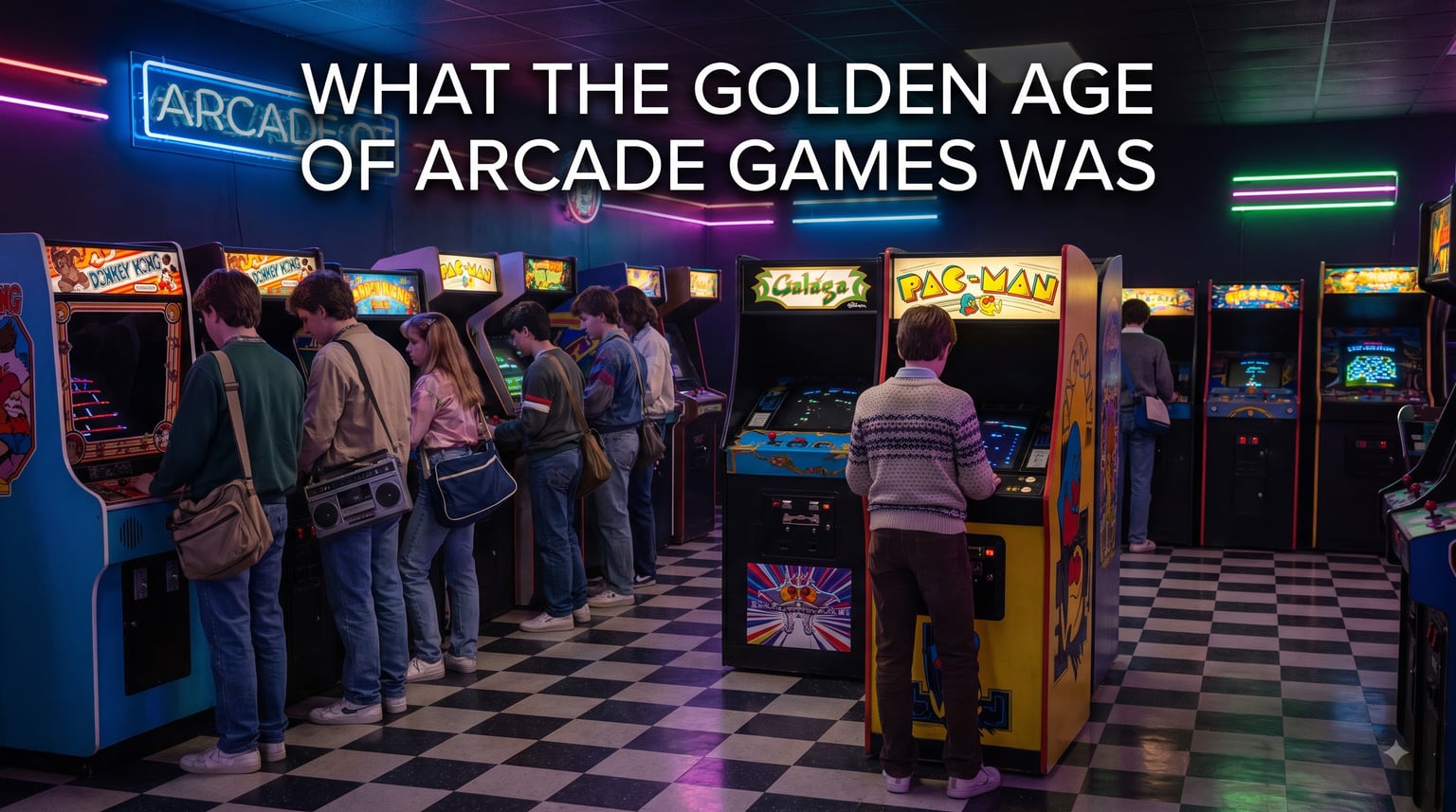
The Golden Age of Arcade Games was the period from the late 1970s to the mid-1980s, roughly 1978 to 1985, when arcade video games experienced explosive growth, rapid technological innovation, and massive cultural influence. During this short but transformative span, names like Space Invaders, Pac-Man, and Donkey Kong turned neighborhood storefronts into social hubs and made video gaming a mainstream form of entertainment.
I have spent years digging through old arcade flyers, talking to collectors, and even restoring a few cabinets myself. In this guide, I want to walk you through exactly what the Golden Age of arcade games was, when it began, what made it special, and why I believe it still shapes how we play today.
Table of Contents
- When Was the Golden Age of Arcades?
- What Came Before the Golden Age (1960s to Mid-1970s)
- What Started the Golden Age of Arcade Games
- Year-by-Year Timeline: The Peak Years (1978-1985)
- Iconic Games That Defined the Era
- Technological Innovations of the Golden Age
- Arcade Culture and Social Spaces
- Why Arcades Declined: The End of the Golden Age
- The Lasting Legacy of the Golden Age
- FAQs
- Conclusion
When Was the Golden Age of Arcades?
The Golden Age of arcades is generally dated from 1978 to 1985, a window of just seven years that defined an entire generation of play. Some historians push the start back to 1976 or 1977, when early hits like Breakout and Sea Wolf showed that coin-op machines could turn a serious profit. Others extend the end to 1986 or even the late 1980s, because excellent games kept arriving well after the 1983 crash.
For most people, though, the story starts with Space Invaders in 1978 and ends around 1985, by which point home consoles had begun their long takeover. The era was short, intense, and wildly creative, packed with more lasting classics than any period before or since.
What Came Before the Golden Age (1960s to Mid-1970s)
Before the Golden Age, arcade games existed, but they were rare, expensive, and often clunky. The first recognized arcade video game, Computer Space, launched in 1971 from Nutting Associates and was designed by Nolan Bushnell, who would later co-found Atari. The cabinet was too complicated for most bar patrons, and the controls confused players used to pinball.
That changed in 1972 when Bushnell and Atari released Pong, a simple two-player table tennis simulator. Pong was a sensation. Suddenly, bars and pizza shops wanted their own machines, and people lined up to play during happy hour.
Between 1972 and 1977, several important games paved the way for the boom:
Space Race (1973) by Atari, one of the earliest two-player competitive shooters.
Speed Race (1974) by Taito, a precursor to the racing game genre.
Gun Fight (1975) by Sega, the first microprocessor-driven arcade game.
Breakout (1976) by Atari, a Steve Wozniak-influenced design that influenced a generation of paddle games.
Death Race (1976) by Exidy, a controversial game that hinted at the controversy to come.
By the end of 1977, the stage was set. The technology had caught up, the public was curious, and the coin-op business model had been proven. All the industry needed was a spark.
What Started the Golden Age of Arcade Games
The Golden Age of arcade games officially began when Taito released Space Invaders in Japan in June 1978. Designed by Tomohiro Nishikado, the game was simple: a single cannon at the bottom of the screen, rows of descending aliens, and a haunting four-note heartbeat that got faster as your ammunition dwindled.
Space Invaders did something no earlier coin-op game had managed. It reached a genuine mass audience. In Japan, the game reportedly caused a nationwide coin shortage. In the United States, Atari’s licensed version sold over 60,000 cabinets and earned more than $2 billion in quarters (adjusted for inflation). By 1980, arcade gaming had become a cultural phenomenon.
Three factors turned Space Invaders into the catalyst for the Golden Age:
Affordable hardware. The Intel 8080 microprocessor, introduced in 1974, finally made it cheap to put a powerful computer inside a cabinet.
A scalable business model. Operators could buy a cabinet for around $2,000-$3,000 and earn back the cost in a few busy months at a quarter per play.
Universal appeal. The game’s simple rules and rising difficulty curve made it accessible to anyone, regardless of age or gaming experience.
Within a year, every major arcade in the United States, Japan, and Europe had a Space Invaders machine. The Golden Age had begun.
Year-by-Year Timeline: The Peak Years (1978-1985)
The Golden Age of arcade games was a sprint, not a marathon. Each year brought new classics and new innovations. Here is how the era unfolded.
1978: The Year Everything Changed
Space Invaders launched and proved that video games could compete with pinball for arcade dominance. Nolan Bushnell appeared on the cover of Life Magazine. Atari’s Football arrived and kicked off the sports genre. By December, every operator in the country was ordering more cabinets than the manufacturers could produce.
1979: Diversification Begins
Galaxian by Namco introduced color graphics to the shooter genre. Asteroids by Atari brought vector graphics to a mainstream audience. Lunar Lander and Speed Buggy showed off mechanical hybrid cabinets. The era of single-genre arcades was over.
1980: The Pac-Man Phenomenon
Namco’s Pac-Man, designed by Toru Iwatani, arrived in Japan in May and in the United States by October. It was bright, cheerful, and utterly unlike the shoot-em-ups that dominated the scene. Pac-Man toys, lunchboxes, cartoons, and a hit song by Buckner and Garcia made it the first true video game superstar. Missile Command and Defender also arrived, pushing shooter design forward.
1981: Donkey Kong Reshapes the Industry
Donkey Kong, designed by Shigeru Miyamoto at Nintendo, introduced the platformer genre and gave the world Mario (originally called Jumpman). Other classics released this year include Frogger, Galaga, Qix, Tempest, Tron, and the home version of Donkey Kong by Coleco. The arcade business was running at full speed.
1982: Saturation and Peak Revenue
The golden year of the golden age. Joust, Dig Dug, Q*bert, Pole Position, BurgerTime, Robotron: 2084, and Pitfall all arrived. The arcade industry earned more revenue than the combined gross of pop music and Hollywood box office. ColecoVision, Atari 5200, and the Commodore 64 launched, hinting at the storm to come.
1983: The Crash Begins
The video game crash of 1983 devastated the home console market, but arcades stayed remarkably strong. Mario Bros., Mappy, Elevator Action, and Spy Hunter showed that game design was still improving. However, home consoles were quietly eating into arcade revenue, and operators started to notice.
1984-1985: The Transition Years
Some of the most celebrated arcade games ever made appeared in these two years. Track and Field, Marble Madness, Paperboy, and 1943 demonstrated that the arcade medium still had creative steam. At the same time, the Nintendo Entertainment System launched in the United States in 1985 and would permanently change the home-to-arcade balance.
Iconic Games That Defined the Era
When you ask, “What is the most famous arcade game of all time?”, the answer is almost always Pac-Man. Released in 1980, it sold more than 400,000 cabinets worldwide and grossed over $12.8 billion in quarters (adjusted for inflation). It is the benchmark every other arcade game has been measured against.
But the Golden Age produced hundreds of memorable titles. Here are the ten most influential arcade games of the era, each one shaping a genre or a generation of players:
Space Invaders (1978) – The catalyst that started everything.
Asteroids (1979) – Vector graphics and Newtonian physics in a coin-op.
Galaxian / Galaga (1979 / 1981) – Color shooters and the famous dual-fighter mechanic.
Pac-Man (1980) – The first mainstream game designed for non-shooter audiences.
Missile Command (1980) – A meditation on Cold War anxiety, joystick-only design.
Defender (1981) – One of the first side-scrolling shooters, brutally difficult.
Donkey Kong (1981) – Birthed the platformer and introduced Mario.
Frogger (1981) – Isometric crossover hit beloved by everyone in the family.
Q*bert (1982) – Stylized oddball with one of the most creative cabinet designs.
Joust (1982) – Two-player cooperative arena combat, perfect for arcade socializing.
Every one of these games sold at least 20,000 cabinets and was commonly found in arcades across North America, Europe, and Japan. Together, they form the spine of what arcade enthusiasts still call the Golden Age.
Technological Innovations of the Golden Age
The Golden Age of arcade games was also a Golden Age of hardware innovation. Engineers had to push the technology of their day to its limits, because arcades demanded games that looked and sounded better than anything players could get at home.
Vector Graphics
Games like Asteroids, Tempest, and Star Wars drew lines on cathode ray tubes directly without pixels. This produced sharp, glowing visuals that felt futuristic. Vector graphics faded after the early 1980s, but they gave the era a distinctive look that retro fans still love.
Color and Sprite Animation
By 1980, raster graphics with full color had become standard. Pac-Man’s bright yellow puck, Donkey Kong’s red tie, and Galaga’s blue and red fighters looked like nothing else in entertainment. Smooth sprite animation, where characters moved frame-by-frame as if drawn by hand, quickly became the norm.
Sound Chips and Synthesized Music
Specialized audio chips like the Yamaha YM2149 and Texas Instruments SN76489 let composers build four-channel music that looped indefinitely. The result was iconic soundtracks that stuck in players’ heads for decades. The Galaga “Stage Start” jingle is still recognized by millions.
Scrolling Screens and Larger Playfields
Scramble (1981) and Defender (1981) introduced scrolling screens, allowing players to move across vast in-game worlds. This technology opened the door for the kind of side-scrolling platformers and run-and-gun games that would dominate the next decade.
Innovative Cabinet Designs
Golden Age arcades featured sit-down cockpit cabinets, full-size uprights, drinking-bird-shaped cocktail cabinets, and even environmental cabinets shaped like spaceships. The industry understood that the cabinet itself was part of the entertainment.
Arcade Culture and Social Spaces
Arcades were not just places to play games. They were community hubs where teenagers, college students, and even families gathered to compete, socialize, and escape. The Golden Age of arcade games produced a culture that is unlike anything in modern gaming.
Wherever people gathered during the late 1970s and 1980s, an arcade was likely to follow. Shopping malls, movie theaters, bowling alleys, amusement parks, restaurants, convenience stores, and even laundromats housed cabinets. Some restaurants became known for their arcade walls, while others were simply passed through on the way to the game room.
High Score Culture
Before online leaderboards, the top score on a local arcade machine was a real status symbol. Players wrote their initials on the cabinet with a marker, and arcade operators placed printed high-score boards above the games. Getting your three initials on the Pac-Man machine was a genuine achievement.
Meeting Strangers Through Competition
Players queued up to take the next turn on a popular cabinet, and the person waiting often watched, offered advice, or just waited in tense silence. Forum users from that era still remember becoming friends with strangers over a game of Galaga or Street Fighter. The lack of online anonymity meant physical presence and sportsmanship mattered.
Regional Differences
Not every arcade had the same games. Someone in Tokyo might play in a tiny dedicated Taito arcade with 30 Space Invaders cabinets, while a teenager in suburban Ohio might find a single Donkey Kong machine in a movie theater lobby. In European seaside towns, holidaymakers would discover games they had never seen at home, and bring back tips and stories.
Regional differences also shaped the player base. Japan’s arcade scene developed specialized arcade buildings in the mid-1980s, while American arcades were scattered across malls and family entertainment centers. European arcades often clustered in seaside resort towns, holiday parks, and chip shops. Each region had its own arcade personality.
Where Did Women Fit In?
Arcades in the 1980s are often remembered as male-dominated spaces, but women were a major part of the scene. Pac-Man in particular was marketed explicitly to women, with pack-in cards, fashion tie-ins, and a character design that avoided the shoot-em-up aesthetic. Women and teenage girls crowded around Pac-Man, Centipede, and Frogger cabinets, often in larger numbers than men. The hidden history of female arcade champions, including competitive Q*bert and Pac-Man players, is one of the most overlooked parts of the era.
Why Arcades Declined: The End of the Golden Age
The Golden Age of arcade games ended for several reasons, and the decline was gradual rather than sudden. By 1985, the writing was on the wall, even as some of the best arcade games ever made continued to be released.
The 1983 Video Game Crash
The home console market collapsed in 1983, flooded with low-quality games from publishers like Atari that customers had grown tired of. While this crash mostly damaged the home console market, the loss of consumer confidence spilled into arcades. Some players associated video games with shoddy products, and casual gamers cut back on their quarters.
The Rise of Home Consoles
The Nintendo Entertainment System, launched in the United States in 1985, restored faith in home gaming. The Sega Master System arrived in 1986. Suddenly, players could buy or rent games at home for a fraction of the price of an afternoon at the arcade. The NES did not destroy arcades overnight, but it changed the playing field permanently.
Home Computers
Commodore 64, ZX Spectrum, Atari 800, and Apple II owners had access to thousands of games at home. Many of these home ports were ports of arcade classics, including Pac-Man, Galaxian, and Frogger. As the home catalogue grew, the need to visit an arcade for entertainment shrank.
Changing Entertainment Habits
The 1980s saw the rise of cable television, VCR rentals, and later video rental stores. People’s entertainment time and discretionary spending were split across more options. By 1990, many large mall arcades had closed or downsized.
Per-Game Costs
Arcade operators kept raising the price per play from a quarter to 50 cents and eventually a dollar. For a teenager in 1985, a dollar per play was a serious barrier. Home consoles, with unlimited plays once you bought the cartridge, were a much better value for the same player.
The Lasting Legacy of the Golden Age
The Golden Age of arcade games is not just a historical curiosity. It shaped the way every modern game is designed, marketed, and played.
Game design patterns like rising difficulty, three-letter high scores, time-limited play sessions, multiplayer versus cabinets, attract modes that draw players in, and power-ups that change the rules mid-game were all invented or perfected during this era. Designers today still borrow from the Golden Age playbook, often without realizing it.
The retro gaming scene is built on this legacy. Modern arcade bars, retro arcade museums, and the booming market for restored cabinets all trace back to the games and culture of 1978-1985. Companies like Arcade1Up, My Arcade, and Numskull Designs have built entire product lines around reproducing vintage cabinets at consumer prices.
Independent game developers continue to draw inspiration from the Golden Age. Games like Shovel Knight, CrossCode, and the TMNT: Shredder’s Revenge revive 8-bit and 16-bit aesthetics for modern audiences. Even the largest AAA titles borrow the era’s boss-fight structure, level select screens, and tight coin-op difficulty curves.
For me, the Golden Age of arcade games is more than a story about old technology. It is a story about how a generation of designers, operators, and players turned a simple coin into a $10 billion industry and built the foundation for every game we play today.
FAQs
When did arcade games peak?
Arcade games peaked in the early 1980s, roughly between 1980 and 1982. In 1981 the arcade industry earned more than $5 billion in the United States alone, and 1982 saw annual revenue exceed the combined gross of pop music and Hollywood box office. The peak was short-lived, fading by 1985 as home consoles began to take market share.
What is the most famous arcade game of all time?
Pac-Man, designed by Toru Iwatani and released by Namco in 1980, is widely considered the most famous arcade game of all time. It sold more than 400,000 cabinets worldwide and generated more than $12.8 billion in quarters (inflation-adjusted). Its bright character design, universal appeal, and licensing reach made it a cultural icon well beyond gaming.
What is the oldest arcade game?
The oldest recognized arcade video game is Computer Space, released in 1971 by Nutting Associates and designed by Nolan Bushnell. The first commercially successful arcade video game was Pong, released by Atari in 1972. Both games laid the groundwork for the Golden Age of arcade games that began in 1978.
What were the golden years of gaming?
The golden years of gaming are generally considered to be the period from 1978 to 1985, often called the Golden Age of Arcade Games. This era saw the release of Space Invaders, Pac-Man, Donkey Kong, Galaga, and dozens of other classics. It also coincided with the rise of home consoles, which would eventually overshadow the arcade industry.
Conclusion
The Golden Age of Arcade Games was a brief, brilliant window from 1978 to 1985 that transformed video games from a niche hobby into a global entertainment industry. Space Invaders launched the boom, Pac-Man widened the audience, and Donkey Kong gave the world its most famous mascot. Every year produced new classics, and the era left behind a cultural and design legacy that still shapes how we play today.
If you ever get the chance to drop a quarter into a restored Galaga cabinet or visit a working arcade museum, take it. Standing in front of those bright, noisy machines is the closest thing we have to time travel, and it is the best way to understand what the Golden Age of Arcade Games really was.