
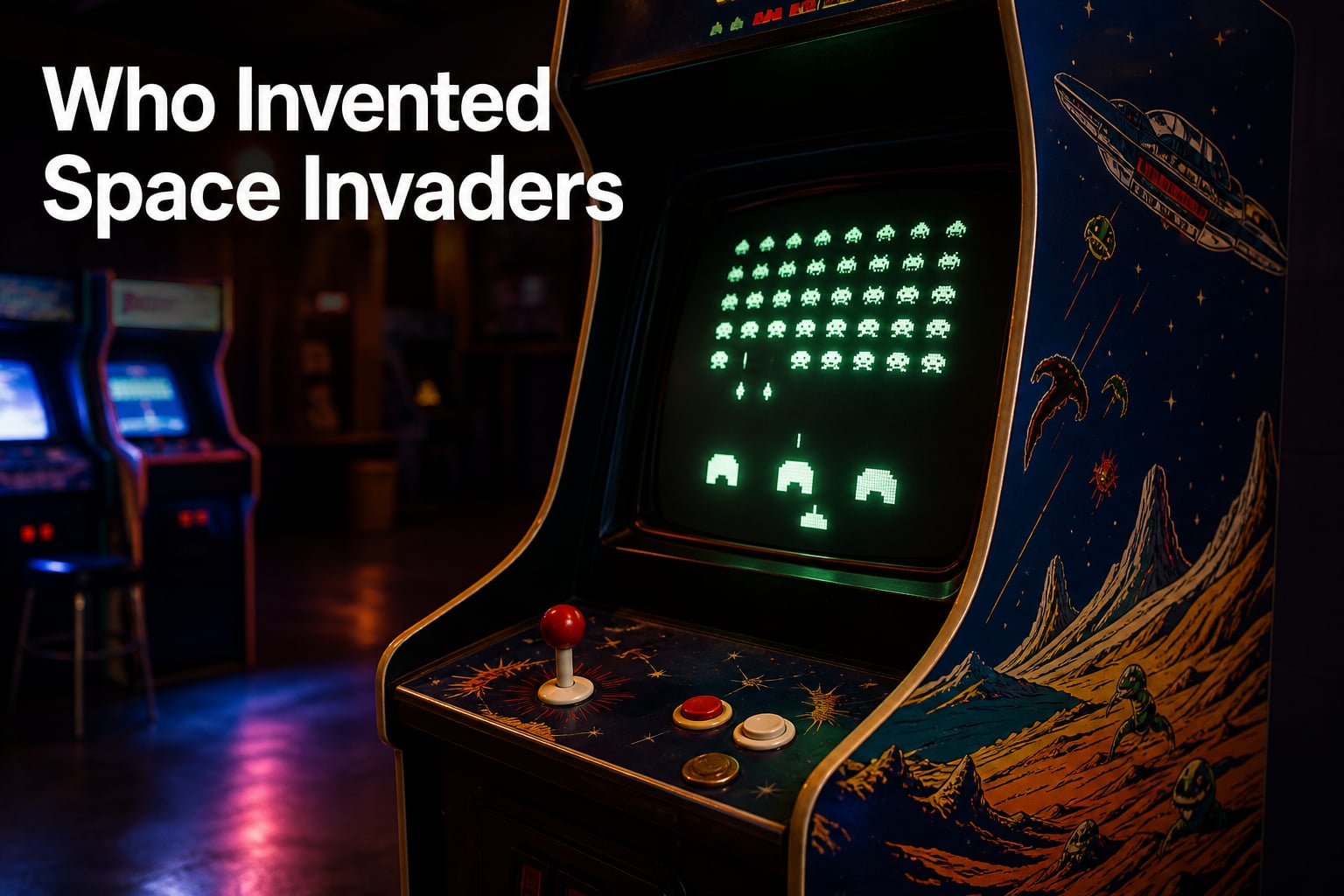
Tomohiro Nishikado invented Space Invaders in 1978 while working as a designer at the Japanese arcade company Taito. He conceived the game, designed the cabinet artwork, programmed the code, built the custom microcomputer inside the cabinet, drew the aliens, and even mixed the sound effects all on his own. That single-person creation story is part of why the question of who invented Space Invaders still fascinates players, historians, and collectors of coin-op games nearly fifty years later.
If you have ever dropped a quarter into a glowing arcade cabinet, that alien-grid was probably the first thing to make you feel like a hero. Below is the full story of who invented Space Invaders, how it was built, and why a single Japanese engineer’s vision ended up reshaping the video game industry.
Table of Contents
- Who Invented Space Invaders and Why Does It Matter?
- Tomohiro Nishikado: The Designer Behind the Cabinet
- How Space Invaders Was Created Step by Step?
- The Custom Hardware Built for Space Invaders
- Why Do the Aliens Speed Up in Space Invaders
- Taito’s Role in Releasing Space Invaders in 1978
- The Cultural Impact of Space Invaders on Gaming
- So Who Invented Space Invaders and Why It Still Matters
- FAQs
Who Invented Space Invaders and Why Does It Matter?
Tomohiro Nishikado is the Japanese engineer who invented Space Invaders in 1978. He did it under the roof of Taito Corporation, a Tokyo-based arcade manufacturer that produced, distributed, and owned the rights to the game. Nishikado created it as an internal project, the company tested it, and Taito released it to arcades in Japan in June 1978 before expanding worldwide.
The reason this matters goes beyond trivia. Before Space Invaders, arcade games were mostly simple action, driving, or sports titles. Nishikado’s design introduced the shoot ’em up genre, popularized high-score tables, and gave us the first true video game blockbuster. Answering who invented Space Invaders is really answering who set the template for every modern action game.
Tomohiro Nishikado: The Designer Behind the Cabinet
Tomohiro Nishikado joined Taito in 1968 as an electrical engineer after studying at a technical school in Tokyo. He spent his first years at the company designing electromechanical arcade machines, the kind with relays, motors, and light bulbs, before the industry shifted to microprocessors in the mid-1970s.
By the time he started working on his breakthrough game, Nishikado had already designed or co-designed several smaller Taito titles, including pioneering electro-mechanical shooting games and early microprocessor hits like Gun Fight (1975). He was, by his own account, more interested in setting his own creative direction than in waiting for company assignments. That rebellious streak is what pushed him to invent Space Invaders as a personal project during slow work hours.
In interviews, Nishikado has described himself as an introvert who found video games liberating because he could create entire worlds without depending on a large team. He has also admitted, with characteristic humility, that he is not especially good at his own game. That anecdote alone has made him a beloved figure in coin-op game history.
How Space Invaders Was Created Step by Step?
The creation of Space Invaders unfolded over roughly a year of part-time work between 1977 and 1978. Nishikado began by sketching his ideas on paper, then built the hardware, then wrote the code, then refined the visuals. He worked largely alone, with Taito management only stepping in when the prototype was ready to evaluate.
The first inspiration was Atari’s 1976 hit Breakout. Nishikado loved the satisfying feel of knocking out colored blocks, but he wanted to make the targets come alive. He experimented with tanks rolling across the screen, then with soldiers marching in formation, before settling on the alien invaders that became the game’s signature.
The aliens themselves evolved through several drafts. Early concepts featured crabs, octopuses, and squids drawn in a crude, sketchy style. Nishikado kept refining the silhouettes until the final three-row formation of octopuses, crabs, and squids emerged. The bonus UFO at the top of the screen was added late in development because Nishikado wanted players to have a risky, high-value target to chase when the basic grid was nearly cleared.
He was also inspired by H.G. Wells’ War of the Worlds and the popular 1953 film adaptation. The marching alien grid, the descending attack pattern, and the lonely lone cannon defending Earth all grew out of that imagery. You can see it clearly in the cabinet art, which shows a frantic human shooter facing a wall of descending extraterrestrials.
The Custom Hardware Built for Space Invaders
Off-the-shelf hardware could not run Space Invaders at the time. Nishikado designed and built a dedicated microcomputer from scratch using discrete TTL components, a layout that mostly resembled the Intel 8080 instruction set. He had no monitor to display his work, so he wired LEDs directly to the processor to verify his code was executing correctly.
The alien sprites were not sprites at all in the modern sense. Nishikado’s hardware used bitmap graphics, and he later remarked that he had not even heard the term “sprite” when he built the game. He simply drew the alien shapes pixel by pixel and stored them as bitmaps on ROM. This was unusual for the era and became one of the things that made Space Invaders feel so visually distinct from its competitors.
One of the most fascinating quirks of this custom hardware was the behavior of the enemies. As Nishikado destroyed more aliens, the remaining sprites required less processing time to draw each frame, so the game ran faster. The speed-up was not a designed feature. It was an unintended side effect of the processor struggling to keep up with the original 55 rows of invaders.
Why Do the Aliens Speed Up in Space Invaders
The aliens speed up as you shoot them because the original 8080-class processor used in the cabinet could not redraw the full grid quickly enough. When the grid was full, the processor spent more time per frame drawing each alien, so the march was slow. With fewer aliens left, the processor had more idle time, so the frame rate climbed and the survivors zipped across the screen.
Nishikado has said in interviews that he noticed the speed-up during testing and immediately loved it. He realized it created rising tension that pushed players to take smarter shots instead of spraying randomly. That accidental mechanic became one of the most copied design ideas in gaming history.
Taito’s Role in Releasing Space Invaders in 1978
Taito released Space Invaders to Japanese arcades in June 1978 and to North America by late summer of the same year. The company handled manufacturing, cabinet production, distribution, marketing, and the all-important licensing of the game for home systems. Without Taito, Nishikado’s invention would have stayed in a Tokyo workshop.
The game was a phenomenon from the moment it hit the floor. Demand was so extreme that the Japanese government reportedly had to increase production of 100-yen coins because arcades were running out of change. Space Invaders was the first arcade game to gross more than one billion dollars in quarters, a milestone that defined the golden age of video games.
Taito also aggressively licensed the title for home consoles. The Atari 2600 port, released in 1980 and sold by Atari under license from Taito, became the first killer app for home consoles and drove Atari to record sales. Later, Taito expanded the brand with sequels like Space Invaders Part II and licensed hundreds of merchandise and modern revivals.
The Cultural Impact of Space Invaders on Gaming
Space Invaders established conventions that still define video games today. The high-score table, the lives system, the descending enemy pattern, the destructible shields, the four-note heartbeat that quickens as aliens approach, the attract sequence that draws in passers-by, all of these began with Nishikado’s invention.
The game also legitimized arcade gaming as a global pop culture force. In Japan, the United States, and Europe, Space Invaders was the first piece of software many people had ever touched. It inspired a generation of designers, including the people who built Pac-Man, Galaxian, Galaga, and decades of modern shooters.
Modern revivals keep the spirit alive. Taito has released miniature cabinet replicas, mobile versions, and themed merchandise, and the game has appeared in films, television, and even a Google Doodle celebrating its anniversary. Few inventions from 2026 still earn the kind of attention that Space Invaders commands.
For collectors of coin-op games, Space Invaders holds a special place. Original upright cabinets command serious prices, restored Midway and Taito units are prized centerpieces, and the cabinet art remains one of the most recognizable images in gaming history. Understanding who invented Space Invaders is the first step toward appreciating why the game still commands that kind of reverence.
So Who Invented Space Invaders and Why It Still Matters
So who invented Space Invaders? Tomohiro Nishikado, a single Japanese engineer at Taito, who in 1978 built an entire shoot ’em up on a custom microcomputer in his spare time. That answer is more than a trivia fact. It explains the personality of the game itself: focused, intense, and unmistakably human in feel despite its alien subject.
For anyone interested in coin-op games, the lesson is clear. The next time you slide a quarter into a glowing upright cabinet, every descending invader, every piercing sound, every rising heartbeat you hear is a direct line back to Nishikado’s hand-built prototype. Space Invaders is still here, still being played, and still earning its place as the first true masterpiece of the arcade era.
FAQs
Who invented the game Space Invaders?
Tomohiro Nishikado, a Japanese engineer working at Taito Corporation, invented Space Invaders in 1978. He designed, programmed, built the hardware, drew the art, and mixed the sound on his own.
What year was Space Invaders invented?
Space Invaders was invented in 1978. Taito released it to Japanese arcades in June 1978 and rolled it out in North America later that same year.
What country made Space Invaders?
Space Invaders was made in Japan. It was developed and published by Taito Corporation, a Tokyo-based arcade company, and its creator Tomohiro Nishikado was a Japanese engineer.
Did Tomohiro Nishikado make Space Invaders by himself?
Yes. Nishikado designed the game, wrote the 8080 assembly code, built the custom microcomputer, drew the alien art, and mixed the sound effects entirely on his own. Taito handled manufacturing and distribution.
What came first, Pac-Man or Space Invaders?
Space Invaders came first. It was released in June 1978, while Pac-Man followed in 1980. Both games were created in Japan and shaped the golden age of arcade gaming.
Why do the aliens speed up in Space Invaders?
The aliens speed up because the original processor could not redraw the full grid fast enough. As you shoot invaders, fewer sprites mean less processing, so the survivors move faster. Nishikado kept the quirk because it raised the tension.