
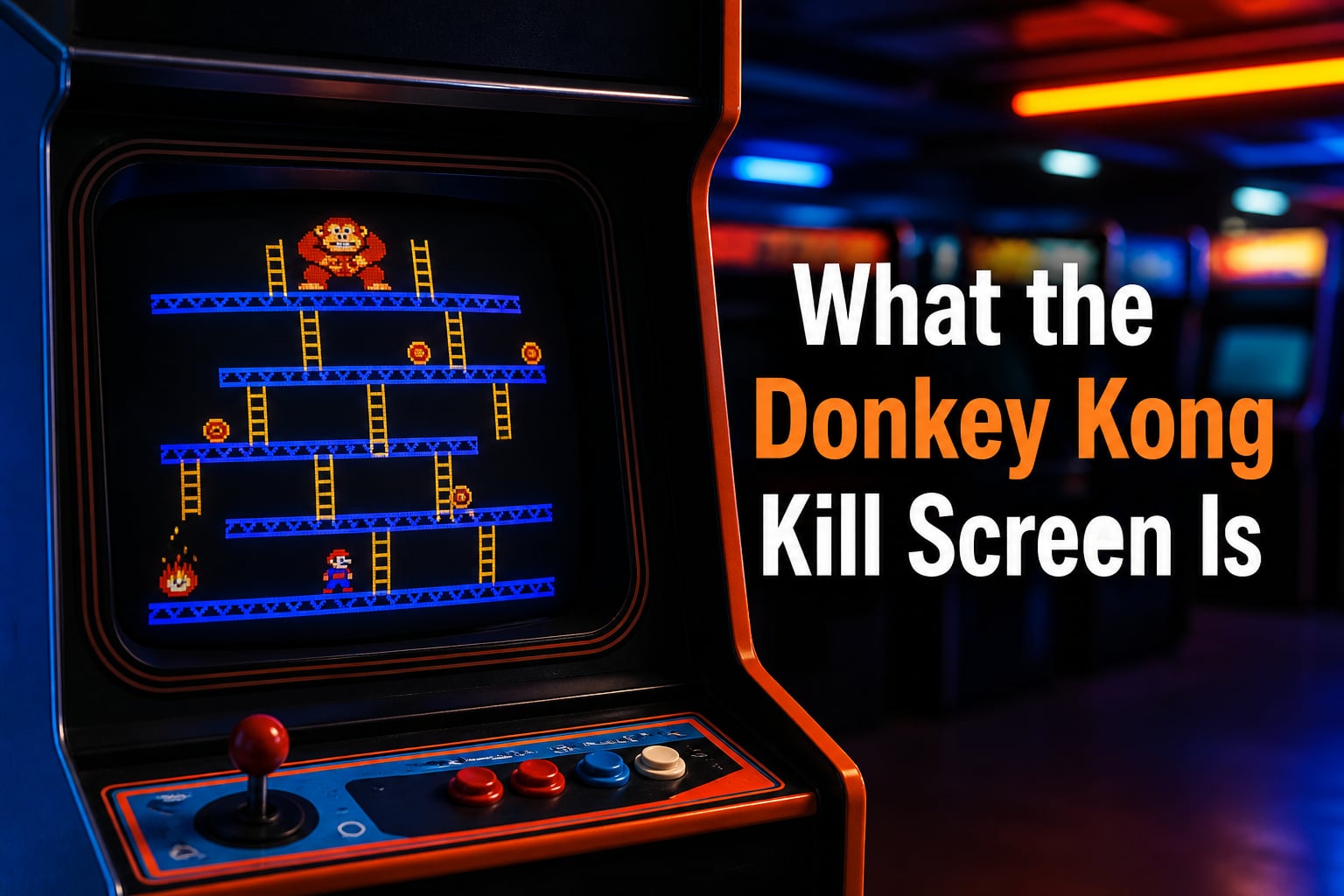
A kill screen is a level in a video game where a programming bug makes it impossible to continue playing. The Donkey Kong kill screen is the most famous example in arcade history, occurring at level 22 when an integer overflow crashes the bonus timer down to just 4 seconds.
For over 40 years, players believed this screen was unbeatable. The 2007 documentary The King of Kong turned it into a pop culture landmark. Then, in February 2025, a player named Kosmic found a way through using emulator tools, proving that what seemed impossible was merely improbable on a cosmic scale.
In this guide, I’ll walk you through exactly what the Donkey Kong kill screen is, how the bug works at the code level, why it became legendary, and how someone finally broke through it after four decades.
Table of Contents
- What Is a Kill Screen? (Definition)
- The Donkey Kong Kill Screen Explained
- How the Bug Works: Integer Overflow Explained
- Level 22: The Infamous 4-Second Timer
- The King of Kong Connection (Cultural History)
- The Broken Ladder Glitch Explained
- The 2025 Breakthrough: How Kosmic Beat the Kill Screen
- Donkey Kong vs. Pac-Man Kill Screens
- Famous Players and the Competitive Legacy
- Frequently Asked Questions
- Conclusion
What Is a Kill Screen? (Definition)
A kill screen is a point in a game where a programming error or hardware limitation makes further progress impossible. The game doesn’t crash or freeze. Instead, it presents a level that no amount of skill can beat.
This is different from a “game over.” A game over means you failed and can try again. A kill screen means the game itself is broken at that point. No matter how perfectly you play, you cannot advance.
Kill screens were most common in early arcade games from the 1980s. These games ran on limited 8-bit hardware with strict memory constraints. Programmers used small data types to save memory, and when player scores or level numbers exceeded what those data types could hold, strange things happened.
The Donkey Kong kill screen is the gold standard. It’s the one most gamers have heard of, even if they’ve never touched an arcade cabinet. Pac-Man has one too, at level 256, and we’ll cover how that compares later in this article.
The Donkey Kong Kill Screen Explained
The Donkey Kong kill screen triggers at level 22, which is the 117th screen of the game. When Mario reaches this point, something goes wrong with the bonus timer that tracks how long the player has to complete the stage.
Instead of showing a normal countdown like 7000 or 5000, the timer displays just 400. That translates to roughly 4 seconds of real time. The player needs to climb all the way to Pauline and clear the level within those 4 seconds, which is physically impossible.
To put that in perspective, even the fastest speedrunners in the world take 15 to 20 seconds to complete a single screen. Four seconds is not enough time to even reach the first ladder, let alone navigate the entire stage.
What makes this so fascinating is that the game doesn’t crash. Everything looks normal. Mario can still move, jump, and climb. The barrels still roll. Kong still stands at the top. But the clock is rigged against you from the first frame.
Players who reach this screen see Mario die almost instantly as the timer hits zero, and there is nothing they can do about it. That helplessness is what earned it the name “kill screen.”
How the Bug Works: Integer Overflow Explained
The Donkey Kong kill screen is caused by an integer overflow in an 8-bit register. Let me break that down in plain terms.
Computers store numbers using binary data. An 8-bit register can hold values from 0 to 255. That means 256 is the maximum number it can represent. If you try to store 256 in an 8-bit register, it wraps back around to 0. Store 257, and you get 1. Store 260, and you get 4.
Now, here’s where the game’s bonus timer comes in. Donkey Kong calculates the bonus timer for each level using a simple formula:
Bonus Timer = 10 x (Level + 4)
Let’s trace this through the levels to see how it works:
Level 1: 10 x (1 + 4) = 50, which the game displays as 5000. Plenty of time.
Level 5: 10 x (5 + 4) = 90, displayed as 9000. Still generous.
Level 9: 10 x (9 + 4) = 130, displayed as 13000. Getting tighter but manageable.
Level 21: 10 x (21 + 4) = 250, displayed as 25000. Skilled players can still handle this.
Level 22: 10 x (22 + 4) = 260. But 260 is greater than 255, the maximum an 8-bit register can hold. The value overflows. Instead of 260, the register stores 4.
That overflow to 4 is what the player sees on screen. The bonus timer shows 400, which the game interprets as 4 seconds of play time. One tiny miscalculation in the code, and the game becomes unwinnable.
This is a classic integer overflow error. The programmers at Nintendo in 1981 likely never expected anyone to reach level 22. The arcade game was designed to be brutally difficult, with the assumption that most players would never get close to this point. They were using an 8-bit variable because it was efficient, and the overflow was simply an edge case they didn’t anticipate.
Level 22: The Infamous 4-Second Timer
When you reach level 22 in Donkey Kong, the screen loads normally. You see the familiar girders, ladders, and barrels. Pauline stands at the top, waiting to be rescued. But then you look at the bonus timer.
It reads 400. In Donkey Kong, the bonus timer counts down in units, where 100 units equals roughly 1 second of real time. So 400 means you have about 4 seconds before Mario dies.
Four seconds is not enough time to do anything meaningful in this game. The fastest known completion of any Donkey Kong screen takes around 8 seconds with near-perfect play and favorable barrel patterns. Most screens take 15 to 30 seconds for a skilled player.
Even the opening animation of Mario spawning and the player registering visual input takes about a second. By the time your brain processes what’s on screen and your fingers move the joystick, the timer has already burned through a quarter of its allocation.
Players describe the experience as surreal. The music plays. The barrels roll. Everything looks like a normal game of Donkey Kong. But it’s over before it begins. The timer hits zero, Mario loses his last life, and the game ends.
There is no strategy, no trick, and no shortcut that can overcome 4 seconds. For decades, this was accepted as an absolute wall. The game was simply broken at this point, and that was that.
The King of Kong Connection (Cultural History)
The Donkey Kong kill screen went from an obscure programming bug to a mainstream cultural reference thanks to the 2007 documentary The King of Kong: A Fistful of Quarters. The film follows Steve Wiebe, a mild-mannered science teacher, as he attempts to break Billy Mitchell’s world record score on Donkey Kong.
To break the record, Wiebe needs to reach the kill screen. The documentary builds tension around this goal, and there’s a famous moment where someone in the arcade shouts “kill screen coming up” as Wiebe approaches level 22. That line became iconic among gaming fans.
Billy Mitchell, the reigning champion and one of gaming’s most polarizing figures, is portrayed as the villain of the story. His rivalry with Wiebe gave the kill screen a human drama that extended far beyond the technical details of an 8-bit overflow.
The documentary also cemented the idea that reaching the kill screen was the ultimate achievement in Donkey Kong. It wasn’t just about score anymore. Getting to level 22 proved you were among the elite.
This cultural elevation is a big reason why the Donkey Kong kill screen is more famous than the Pac-Man kill screen, even though both are equally fascinating from a technical standpoint. The King of Kong gave Donkey Kong’s bug a story, characters, and stakes that resonated with people who had never even played the game.
The Billy Mitchell controversy deepened in later years when many of his records were disputed and eventually removed from Twin Galaxies leaderboards over allegations of using emulator tools instead of original arcade hardware. This added another layer of drama to the kill screen legacy and fueled ongoing debates in the competitive arcade community.
The Broken Ladder Glitch Explained
There’s another piece of the kill screen puzzle that most explanations gloss over: the broken ladder glitch. This is directly connected to how the 2025 breakthrough became possible, so it’s worth understanding.
In Donkey Kong, the barrel stage features ladders that Mario uses to climb between platforms. The game uses a randomizer to determine barrel behavior, including how barrels interact with ladders. Sometimes a barrel reaches a ladder and decides whether to roll down it or continue along the platform.
The broken ladder glitch occurs at the kill screen level because of how the game’s code handles ladder state data when the level number overflows. Certain ladders become what players call “broken,” meaning barrels can travel down them but Mario cannot climb up them in the normal way.
The key technique involves something called “4-frame down, 1-frame up.” In Donkey Kong, the game runs at 60 frames per second. Mario’s position on a ladder is updated frame by frame. The glitch exploits the fact that the game checks Mario’s ladder-climbing status every few frames, not every frame.
By pressing down for exactly 4 frames and then up for exactly 1 frame, a player can trick the game into letting Mario climb a broken ladder. This is a frame-perfect input, meaning it must be executed on the exact correct frame every time. Miss by one frame, and it fails.
Human players cannot reliably perform frame-perfect inputs in real time. The timing window is about 16 milliseconds. That’s why this technique was only discovered through emulator analysis, where players can slow the game down and test inputs frame by frame.
The 2025 Breakthrough: How Kosmic Beat the Kill Screen
In February 2025, a player known as Kosmic achieved what was thought to be impossible: they cleared the Donkey Kong kill screen. After 44 years, someone finally found a way past level 22.
Kosmic didn’t hack the game or modify the code. Instead, they used emulator tools to execute frame-perfect inputs with absolute precision. The method combines the broken ladder glitch with precise barrel manipulation to clear the level before the timer runs out.
Here’s roughly how it works. The broken ladder glitch lets Mario take a shortcut up a ladder that the game thinks is broken. This saves precious frames. Combined with favorable barrel patterns, which are determined by the game’s randomizer, Mario can theoretically reach Pauline in under 4 seconds.
The catch is that the barrel patterns need to cooperate perfectly. The game’s randomizer produces a specific sequence of barrel behaviors, and only certain sequences allow the route to work. The probability of getting the right sequence is staggeringly low.
How low? Kosmic calculated the odds at approximately 1 in 40 octillion. To put that number in perspective, 40 octillion is roughly 50 billion times the number of stars in the observable universe. It is, for all practical purposes, an impossibility for a human playing in real time.
But with emulator tools, Kosmic could reroll the randomizer until the perfect sequence appeared. They essentially played the lottery until they won, using save states and frame-by-frame analysis to execute the precise inputs needed.
This raises an important question: did Kosmic really “beat” the kill screen? The competitive arcade community is divided. Some argue that emulator-assisted runs are a separate category from original hardware play. Others say the achievement is valid because no game code was modified and the inputs are theoretically possible on a real machine.
What Kosmic’s breakthrough also revealed is that clearing level 22 doesn’t mean you’ve beaten the game. The timer bug continues on subsequent levels, and eventually the game reaches what is now called the “true kill screen” at level 22-6, where the combination of timer bugs and broken ladders makes the game genuinely unwinnable even with frame-perfect play.
Donkey Kong vs. Pac-Man Kill Screens
The Donkey Kong kill screen isn’t the only famous one in arcade history. Pac-Man has an equally notorious kill screen at level 256, and comparing the two reveals interesting differences in how 8-bit limitations affected early games.
Pac-Man’s kill screen works differently. Instead of a timer overflow, it’s a level-drawing error. Pac-Man uses an 8-bit counter to track the level number. At level 256, the counter overflows to 0. The game then tries to draw the level using a lookup table, and the 0 index causes it to render garbage data across half the screen.
The result is a split screen where the right half of the maze is filled with random symbols and broken walls. The left half looks normal, but because the right side is corrupted, Pac-Man cannot eat enough dots to complete the level. The game becomes stuck.
Both kill screens stem from 8-bit overflow, but they manifest in completely different ways. Donkey Kong’s overflow affects the timer calculation, making the level completable in theory but impossible in practice. Pac-Man’s overflow corrupts the level itself, making it structurally broken.
Donkey Kong’s kill screen is arguably more dramatic because the game looks fine. Everything appears normal until you notice the timer. Pac-Man’s is more visually obvious because half the screen is clearly broken.
Other arcade games had similar issues. Dig Dug, Galaga, and Defender all had edge cases at high levels, though none became as culturally significant as these two. The 8-bit era was full of these hidden walls, and discovering them became a badge of honor for dedicated players.
Famous Players and the Competitive Legacy
The Donkey Kong kill screen has attracted some of the most dedicated players in arcade history. Billy Mitchell was the first player publicly documented reaching the kill screen, achieving it in 1982. His score of 874,300 stood as the benchmark for decades.
Steve Wiebe’s story, documented in The King of Kong, brought mainstream attention to the competitive scene. His pursuit of the record and his eventual arrival at the kill screen inspired a generation of players to take arcade competition seriously.
Hank Chien, a New York plastic surgeon, broke both Mitchell’s and Wiebe’s records in the early 2010s, pushing scores past 1.1 million. His runs consistently reached the kill screen, and he helped refine the strategies for maximizing points before the inevitable timer crash.
The speedrunning community has a complex relationship with the kill screen. For emulator-assisted tool runners, Kosmic’s 2025 breakthrough opened new possibilities. For original hardware purists, the kill screen remains an unbreakable wall, and that’s part of its enduring mystique.
Frequently Asked Questions
What does ‘kill screen’ mean?
A kill screen is a level in a video game where a programming bug or hardware limitation makes it impossible to continue playing. The game doesn’t crash but instead presents a level that cannot be beaten regardless of player skill. The Donkey Kong kill screen at level 22 is the most famous example.
What level is the Donkey Kong kill screen?
The Donkey Kong kill screen occurs at level 22, which is the 117th screen of the game. At this point, an integer overflow in the 8-bit bonus timer register causes the timer to drop from a normal value like 26000 down to just 400, giving the player roughly 4 seconds to complete the level.
What is the kill screen in Pac-Man?
The Pac-Man kill screen occurs at level 256, where an 8-bit counter overflows to 0 and causes the game to render corrupted data across half the screen. Unlike Donkey Kong’s timer bug, Pac-Man’s kill screen is a visual corruption that makes the level structurally impossible to complete.
Has anyone beaten the Donkey Kong kill screen?
In February 2025, a player named Kosmic cleared level 22 using emulator-assisted frame-perfect inputs combined with the broken ladder glitch. However, the odds of success are approximately 1 in 40 octillion, making it impossible for a human to achieve in real-time play. The game also has a true kill screen at level 22-6 that cannot be bypassed.
Why is the Donkey Kong kill screen so famous?
The kill screen became famous largely because of the 2007 documentary The King of Kong, which followed Steve Wiebe’s attempt to break the world record by reaching the kill screen. The film gave the programming bug a human story and introduced it to audiences far beyond the competitive arcade community.
Conclusion
The Donkey Kong kill screen is a perfect storm of limited hardware, unexpected player skill, and cultural timing. A simple 8-bit integer overflow at level 22 turned a programming oversight into one of the most famous moments in video game history.
What the Donkey Kong kill screen is, at its core, is a reminder that games are built by humans. Every piece of code has limits, and when players push past what the designers imagined, they find the seams. Whether you see it as a bug, a feature, or a challenge, there’s no denying it captured something special about the golden age of arcades.
If you want to experience it yourself, you can reach level 22 in MAME or on original hardware. Just don’t expect to beat it. Unless, of course, you have 40 octillion tries to spare.