
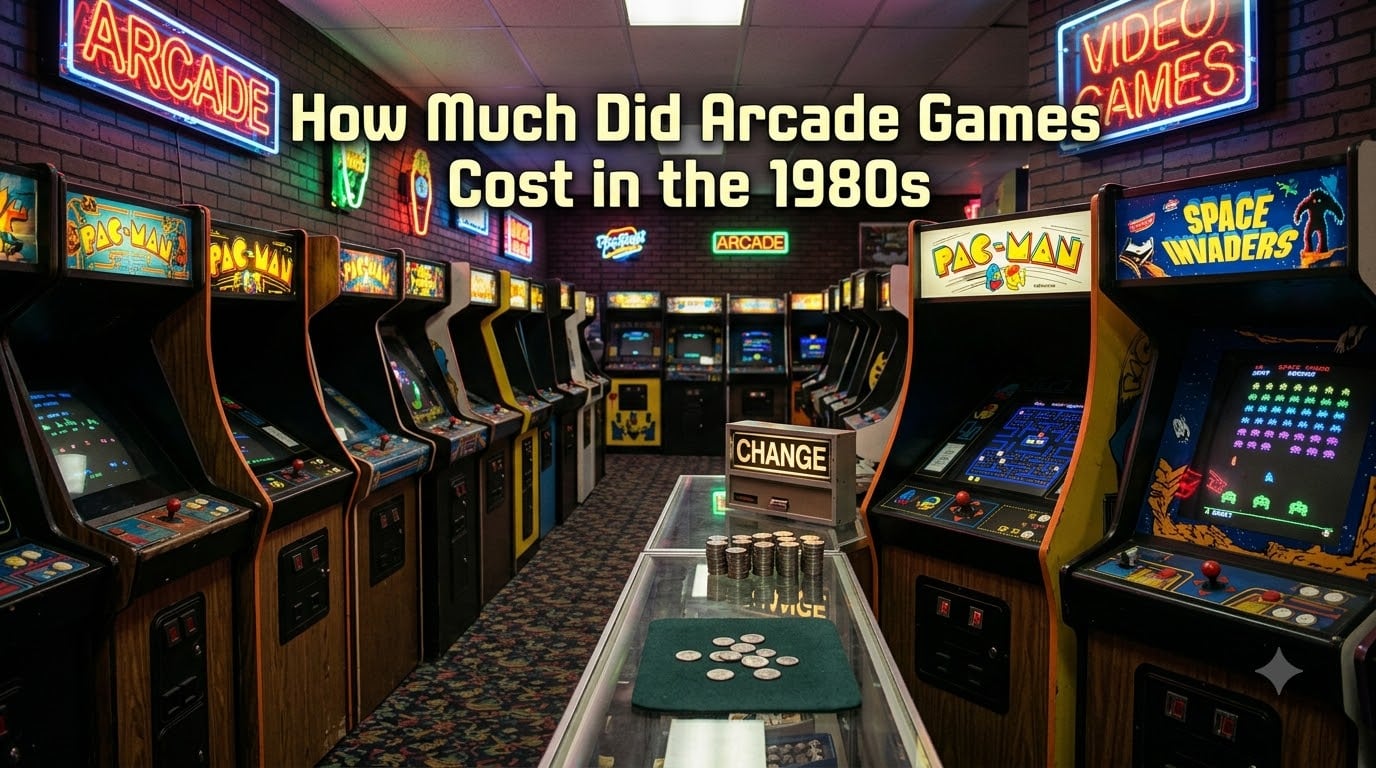
Arcade games in the 1980s cost 25 cents per play for standard titles, with premium games charging 50 to 75 cents. That quarter was the universal currency of the golden age of arcades, and a single coin typically bought you 3 to 5 minutes of gameplay. Adjusted for inflation, that 25-cent play in 1980 is worth roughly $0.75 to $1.00 in 2026 dollars.
I remember my first trip to a real arcade like it was yesterday. My older cousin handed me a roll of quarters and pointed toward the Pac-Man cabinet. That single experience captures what made 1980s arcades special: cheap, accessible entertainment that pulled entire neighborhoods together. But how much did arcade games actually cost back then, and how do those prices compare to today? Let me break down the numbers.
Table of Contents
- How Much Did Arcade Games Cost to Play in the 1980s?
- Year-by-Year Arcade Pricing Evolution Through the 1980s
- Premium Arcade Games That Cost More Than a Quarter
- What Did Arcade Cabinets Cost Operators in the 1980s?
- Tokens vs Quarters: How Arcades Obscured Real Costs
- Arcade Games vs Home Consoles: A 1980s Cost Comparison
- What 1980s Arcade Prices Look Like in 2026 Dollars
- Frequently Asked Questions About 1980s Arcade Prices
- Final Thoughts on 1980s Arcade Pricing
How Much Did Arcade Games Cost to Play in the 1980s?
The standard arcade game price in the 1980s was 25 cents per play, and that figure stayed remarkably consistent across the decade. Most games gave you one credit for a quarter, and that credit translated into a single life or a few minutes of play, depending on the game. A skilled player could stretch a single quarter into 15 or 20 minutes on games like Galaga or Defender.
For most kids, a trip to the arcade meant a finite budget. Five dollars bought you 20 quarters, which could last an entire Saturday afternoon if you were good. For less experienced players, that same five dollars might disappear in an hour. The quarter-per-play model was a sweet spot for operators and players alike: affordable enough to attract repeat visits, profitable enough to keep the lights on.
By the late 1980s, the standard pricing started shifting upward. The rise of more elaborate cabinets with better graphics and sound pushed operating costs higher. By 1989, many new releases charged 50 cents per play as the default. That transition marks the end of the quarter era and the beginning of modern arcade pricing.
Year-by-Year Arcade Pricing Evolution Through the 1980s
Arcade pricing did not stay perfectly flat across the decade. While 25 cents remained the standard, the year a game launched often determined its price point. New releases in 1980 through 1985 almost universally charged a quarter, but by 1986 and 1987, premium titles started breaking the mold.
From 1980 to 1984, virtually every new arcade game charged 25 cents per credit. This was the heyday of Pac-Man (1980), Donkey Kong (1981), and Galaga (1981). Operators standardized on a quarter because it was the largest common coin in circulation, and it felt fair to consumers.
Starting in 1985, a handful of premium games began charging 50 cents. Dragon’s Lair (1983) was one of the first to break the quarter barrier, leveraging its laserdisc technology and animated sequences to justify the higher price. By 1987 and 1988, hits like Street Fighter II and Final Fight also commanded 50 cents per play in many locations.
By 1989, 50 cents became the new normal for blockbuster releases. Games like Teenage Mutant Ninja Turtles and Hard Drivin’ routinely charged two bits and a quarter, or in some cases, a full 75 cents. The shift reflected rising development costs, more expensive hardware, and operators trying to maximize returns on high-traffic titles.
Premium Arcade Games That Cost More Than a Quarter
Not every arcade game cost the same 25 cents. Premium titles with cutting-edge graphics, longer play sessions, or dedicated cabinet designs often charged more. Understanding these premium prices reveals how arcades tiered their offerings.
Pac-Man cost 25 cents per play when it launched in 1980, but its sequels and updated cabinets sometimes charged 50 cents. The game’s popularity was so massive that operators had no problem charging extra, since lines formed regardless of price.
Dragon’s Lair charged 50 cents when it arrived in arcades in 1983. Its laserdisc technology made it more expensive to operate, and the animated sequences justified the higher price point for many players. Some premium arcades even charged 75 cents for Dragon’s Lair during its first year.
Deluxe sit-down cabinets like Out Run (1986) and After Burner (1987) typically cost 50 cents to $1 per play. These cabinets featured moving seats, steering wheels, and force feedback that made them attractions in their own right. Operators could charge more because the experience was unique.
Dedicated cocktail table cabinets sometimes charged 25 cents per player, meaning a four-player game of Gauntlet could cost $1 total. This per-player pricing was common for multiplayer games and helped operators maximize revenue during peak hours.
What Did Arcade Cabinets Cost Operators in the 1980s?
While players paid quarters, operators faced much larger upfront costs. A new arcade cabinet in the early 1980s cost between $2,000 and $3,000, and premium cabinets could run $4,000 or more. These prices reflect the cost of commercial-grade hardware, licensing fees, and the specialized engineering that went into each machine.
An arcade operator in 1982 might pay $2,500 for a Pac-Man cabinet, $3,000 for a Donkey Kong, and upwards of $3,500 for a Q*bert or Galaga. Sit-down racing cabinets and laserdisc games like Dragon’s Lair could cost $4,000 to $5,000 because of their specialized hardware and larger physical footprint.
The payback period for a popular arcade game was typically 12 to 18 months. A successful Pac-Man cabinet could generate $300 to $500 per week in revenue at a busy location, meaning operators could recoup their investment within a few months for top titles. Slower games in low-traffic spots might never pay back at all.
Beyond the cabinet itself, operators paid ongoing location fees to the businesses that hosted their machines. A typical arrangement gave the host business 20% to 40% of the coin revenue. A mall arcade might house 50 to 100 machines, each generating dozens of plays per day during peak times. Multiply that by 365 days a year, and you can see how the economics scaled.
Tokens vs Quarters: How Arcades Obscured Real Costs
Many 1980s arcades stopped accepting quarters and switched to token systems by the mid-decade. Tokens were custom brass or plastic coins that players purchased at a front desk, often in bulk. The shift to tokens served several purposes for operators, but it also had psychological effects on players.
Tokens made it harder for kids to know exactly how much money they were spending. A kid with a roll of quarters could count them and see the damage to their allowance in real time. A kid with a handful of tokens could not easily convert that back into dollars, which encouraged more play.
Tokens also gave operators pricing flexibility. While a quarter was fixed at 25 cents, a token could be sold at 20 cents each in bulk, or 25 cents individually. Some arcades charged four tokens for a dollar, while others used a 1:1 token-to-quarter ratio. This variability let operators test different price points and maximize revenue based on local conditions.
Players often preferred tokens because they were lighter than quarters and easier to carry. A tube of 50 tokens weighed less than a roll of 40 quarters, and tokens did not get spent as quickly because they felt like play money rather than real currency.
Arcade Games vs Home Consoles: A 1980s Cost Comparison
The 1980s saw the rise of home gaming consoles as a direct alternative to arcades. The Atari 2600 launched in 1977 at $199, and the Nintendo Entertainment System (NES) debuted in 1985 at the same price point. These consoles represented a significant upfront investment but offered unlimited play once you owned them.
An Atari 2600 console cost $199 in 1980 dollars, equivalent to roughly $750 in 2026 money. Game cartridges for the system retailed between $30 and $40 each. Compare that to arcade costs: a family spending $20 per month at the arcade could buy two cartridges and a console within a year, then play at home for free.
The Nintendo Entertainment System launched in the US at $199.99 in 1985, with games priced at $40 to $50 each. Popular titles like Super Mario Bros. cost $49.99 at launch. Adjusted for inflation, that NES console is worth about $590 in today’s dollars, and each cartridge was equivalent to $120 to $150.
The math explains why arcades declined in the late 1980s and early 1990s. Once families owned a console and a library of games, the per-play cost of arcade gaming felt steep. A single $1 arcade session cost more than renting a movie, and home gaming offered unlimited replays for the same upfront investment.
What 1980s Arcade Prices Look Like in 2026 Dollars
Inflation makes 1980s arcade prices feel surprisingly affordable by modern standards. A 25-cent play in 1980 equals about $1.00 in 2026 dollars, meaning a modern arcade charging $1 per play is actually cheaper in real terms than a 1980s arcade charging a quarter.
Premium 50-cent games from 1985 equate to roughly $1.45 in today’s purchasing power. A 1988 Street Fighter II session that cost 50 cents would cost about $1.30 to play in 2026 dollars. Modern arcades often charge $2 to $3 per play, which is two to three times more expensive than 1980s premium pricing in real terms.
The $5 Saturday arcade trip that lasted all day in 1983 would cost roughly $15 to $17 in 2026 dollars for the same experience. When you account for modern arcade pricing of $2 to $3 per game, that same budget today might buy only 5 to 8 plays instead of 20. The golden age quarter economy was remarkably efficient for consumers.
This inflation comparison helps explain why 1980s arcades felt so special. A quarter bought meaningful entertainment, and even modest allowances translated into hours of fun. Today’s $5 bill gets a player through only a handful of games at a Dave & Buster’s, making arcades feel less like everyday entertainment and more like special occasions.
Frequently Asked Questions About 1980s Arcade Prices
How much did it cost to play an arcade game in the 80s?
The standard cost to play an arcade game in the 1980s was 25 cents per play. This quarter-per-play model was standard for most games from 1980 through 1985. Premium titles like Dragon’s Lair charged 50 cents or more, and by 1989, many new releases had shifted to 50 cents as the default price.
How much did an arcade game cost in 1984?
In 1984, the average arcade game cost 25 cents per play. This was the peak of the quarter era, and virtually every game on location charged the same price. A few early premium titles like Dragon’s Lair charged 50 cents, but the quarter remained the standard for nearly all new releases that year.
How much did arcade cabinets cost operators in the 1980s?
Arcade cabinets cost operators between $2,000 and $4,000 each in the early 1980s. Standard upright cabinets like Pac-Man or Donkey Kong typically cost $2,500 to $3,000, while premium sit-down cabinets and laserdisc games could cost $4,000 to $5,000. Operators typically recouped their investment within 12 to 18 months for popular titles.
What was a quarter worth in the 1980s compared to today?
A quarter in 1980 had the purchasing power of approximately $1.00 in 2026 dollars. That means a 25-cent arcade play in 1980 is equivalent to a $1.00 play today. Premium 50-cent games from the mid-1980s would cost about $1.45 to $1.75 in modern purchasing power, making modern arcade prices significantly more expensive in real terms.
Final Thoughts on 1980s Arcade Pricing
The 1980s arcade economy was a golden age of affordable entertainment, with games costing 25 cents per play and a $5 bill stretching across an entire afternoon. Operators paid $2,000 to $4,000 per cabinet but earned that investment back in 12 to 18 months for popular titles. Inflation reveals that those quarters packed real purchasing power, equivalent to roughly $1.00 each in 2026 dollars.
Understanding how much arcade games cost in the 1980s helps explain why that era remains so beloved. The pricing model struck a rare balance: accessible to kids with limited allowances, profitable enough to keep arcades thriving, and fair enough that skilled players got serious value. Modern arcades charge more in nominal terms but also feel more like special-occasion entertainment than the everyday hangouts of the 1980s.
If you want to experience 1980s arcade pricing today, your best bet is a retro arcade or a home cabinet running original ROMs. Some vintage arcades still operate on token systems, though the tokens usually cost $1 each rather than 25 cents. Either way, the next time you drop a quarter into a classic cabinet, take a moment to appreciate that you are holding about a dollar’s worth of 1980s entertainment in your hand.