
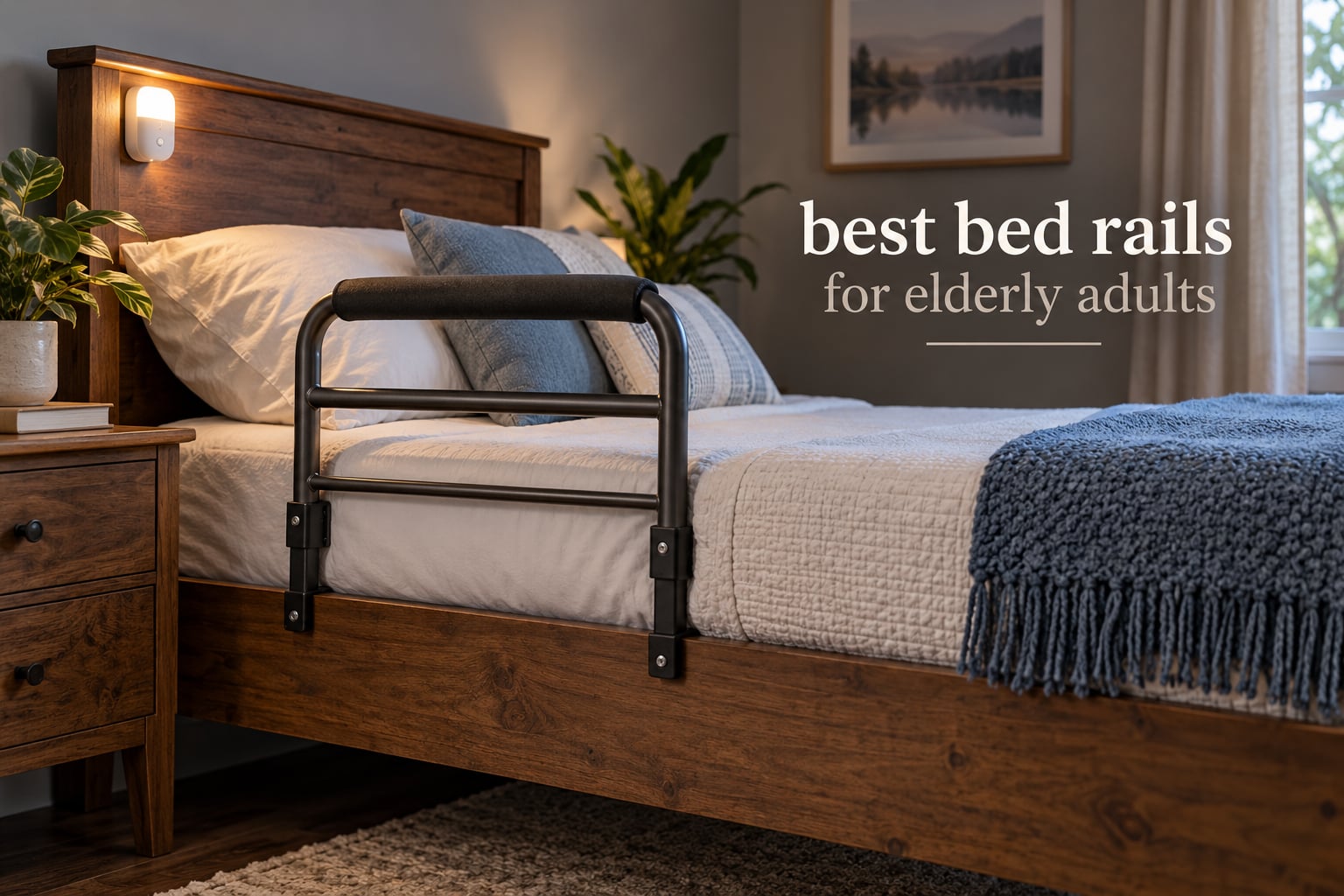
A fall out of bed is one of the most common ways an older adult gets seriously hurt, and it usually happens in the dark, half asleep, with no one in the room. The best bed rails for elderly adults give that person something firm to push against during the nightly sit-to-stand transfer, and in some cases a physical barrier that stops a restless sleeper from rolling onto the floor.
Those are two different jobs, and almost every confusing buying decision in this category comes from treating them as one. A bedside handle is a transfer aid: you grab it to roll over, sit up and stand. A guard rail is a barrier: its job is to stop a roll-out. If the goal is a steadier handhold, a short handle solves it with almost no entrapment risk. If the goal is stopping a two-in-the-morning roll-out, you need something longer, higher and anchored properly.
We compared eight rails side by side across the specs that actually decide whether a rail works in a specific bedroom: load rating, mattress thickness range, bed type compatibility, grip width, support legs, and whether the rail can be folded or pivoted away for caregiver access. Six of the eight we looked at carry independent ASTM F3186-17 certification, which is the safety standard for adult portable bed rails.
One safety note before the picks. A bed rail can create an entrapment gap if it is fitted to the wrong mattress, and a rail is never a restraint. If the person using it has dementia, tries to climb over it, or has a habit of throwing the covers and moving around the bed all night, talk to an occupational therapist before ordering. More on that further down.
While you are choosing hardware, it also helps to know the bed underneath is sound. Our guides to the best bed frames and best metal bed frames cover the frame types that accept rails most cleanly.
Table of Contents
- Top 3 Best Bed Rails for Elderly Adults in 2026
- All 8 Bed Rails for Elderly Adults Compared in 2026
- 1. Medline Adjustable Bed Assist Bar: Best Overall Transfer Bar
- 2. Vaunn ASTM Certified Bed Rail: Best Value Certified Bar
- 3. Medical King Bed Assist Rail: Best Budget Roll-Off Stop
- 4. Stander EZ Adjust Bed Rail: Best Premium Extendable Guard
- 5. Able Life Extend-A-Rail: Widest Mattress Fit
- 6. Lunderg Bed Assist Rail with Motion Light: Best for Night Trips
- 7. KingPavonini 380 lb Bed Rail: Best for Larger Bodies and King Beds
- 8. WeHwupe Bed Rail: Best Budget Transfer Grip
- How to Choose Bed Rails for Elderly Adults: Key Things to Consider
- Bed Rails for Elderly Adults vs. Bed Assist Handles: Which Do You Need?
- Who Should Not Use Bed Rails for Elderly Adults
- Frequently Asked Questions
- Final Verdict on the Best Bed Rails for Elderly Adults
Top 3 Best Bed Rails for Elderly Adults in 2026

Medline Adjustable Bed…
- Foam-padded handles
- Tool-free assembly
- Folds flat with storage pouch
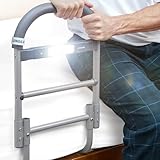
Lunderg Rail with Motion Light
- Motion-activated LED light
- 300 lb tested steel
- Five-minute setup
All 8 Bed Rails for Elderly Adults Compared in 2026
Read this table as the short version of the whole article. The load rating tells you whether the rail suits the body it supports. The mattress range tells you whether it will sit tight enough to avoid an entrapment gap. The best-for column tells you which of the two jobs that rail was designed to do.
| Product | Specs | Action |
|---|---|---|
| Medline Adjustable Bed Assist Bar |
|
Check Latest Price |
 Vaunn ASTM Certified Bed Rail Vaunn ASTM Certified Bed Rail |
|
Check Latest Price |
 Medical King Bed Assist Rail Medical King Bed Assist Rail |
|
Check Latest Price |
| Stander EZ Adjust Bed Rail |
|
Check Latest Price |
 Able Life Extend-A-Rail Able Life Extend-A-Rail |
|
Check Latest Price |
| Lunderg Rail with Motion Light |
|
Check Latest Price |
 KingPavonini 380 lb Bed Rail KingPavonini 380 lb Bed Rail |
|
Check Latest Price |
 WeHwupe Bed Rail WeHwupe Bed Rail |
|
Check Latest Price |
1. Medline Adjustable Bed Assist Bar: Best Overall Transfer Bar
Medline Adjustable Bed Assist Bar for Seniors with Nylon Bag for Storage
27.5 x 14 x 43.75 inch
6.4 lb
Foam-covered handles
Storage pouch
Pros
- Most reviewed rail we tested
- Multiple gripping positions
- Folds flat for travel
- Tool-free keyed assembly
- Deep pouch for phone and meds
Cons
- Not for adjustable beds
- Strap can bunch under the mattress
- Instructions need the photo
This is the rail I would put at the side of a bed for someone recovering from hip or shoulder surgery, and it is the one most caregivers in our conversations had already bought for a parent. It does not stop roll-outs. It gives a hand. The single rail sits low enough along the mattress edge that a person can reach it from several positions, which matters more than raw strength when the arms are weak.
Buyers describe the foam-covered handles as comfortable during a long hold, and the multiple gripping surfaces let someone push up without finding the exact spot where the padding ends. The keyed holes in the frame also stop the parts being assembled in the wrong order, which sounds minor until you are fitting it at 11pm beside a parent who cannot wait.
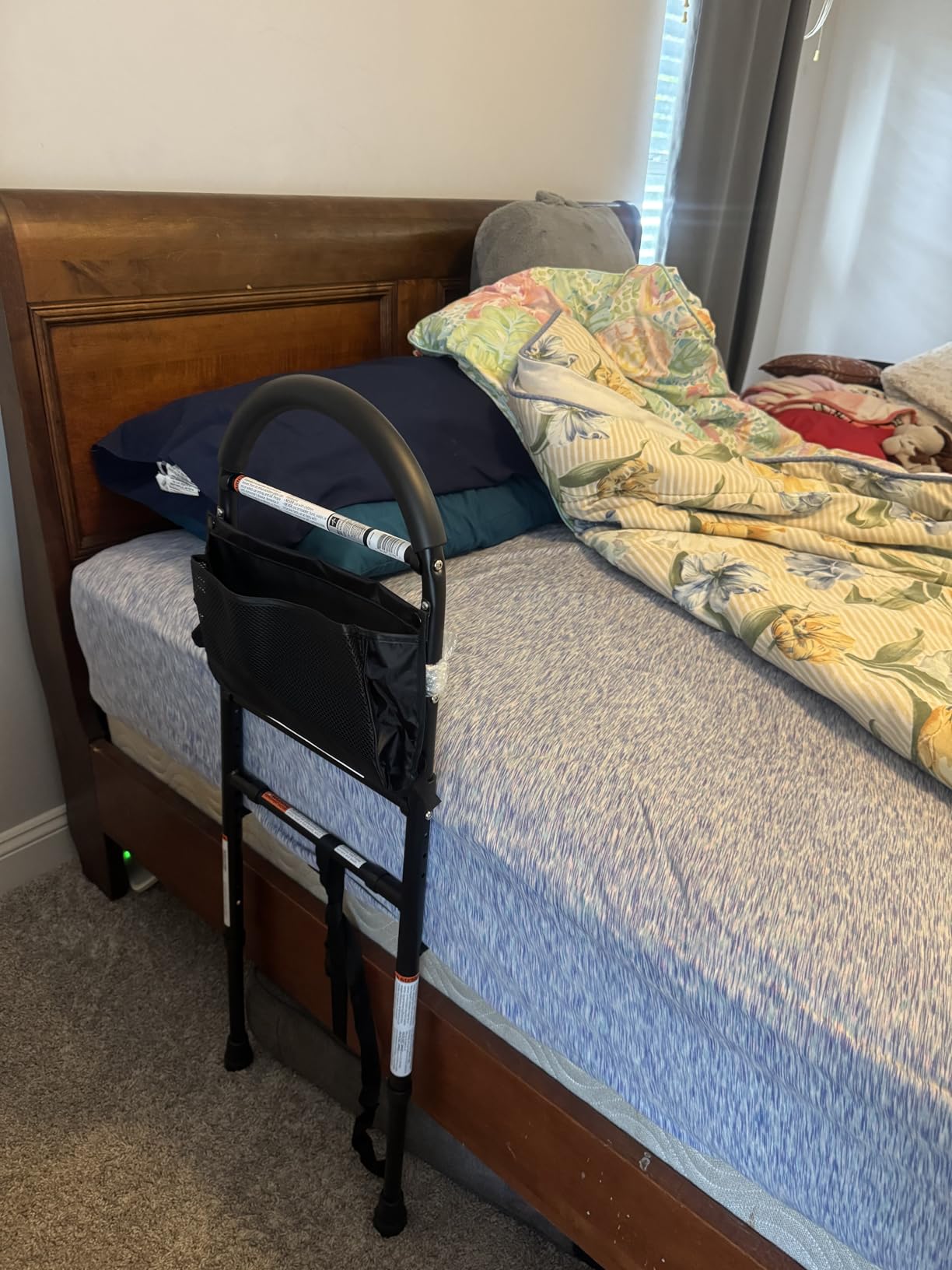
The fold-flat design is the feature that earns its keep in real households. It collapses to a slim shape that fits a closet or a car boot, so the same rail works in a bedroom, a hospital room and a holiday visit without being bought twice. Many owners buy a second unit for a second bed for exactly that reason.
Fit is where care is needed. The rail slides under the mattress with a safety strap reaching to the far side of the frame, and the mattress weight alone usually holds it steady. It is not designed for articulating or power adjustable beds, where the frame geometry moves under the mattress. The non-removable safety stickers on the bar also bother a lot of people cosmetically, and a few users cut the strap off entirely, which we would not recommend.
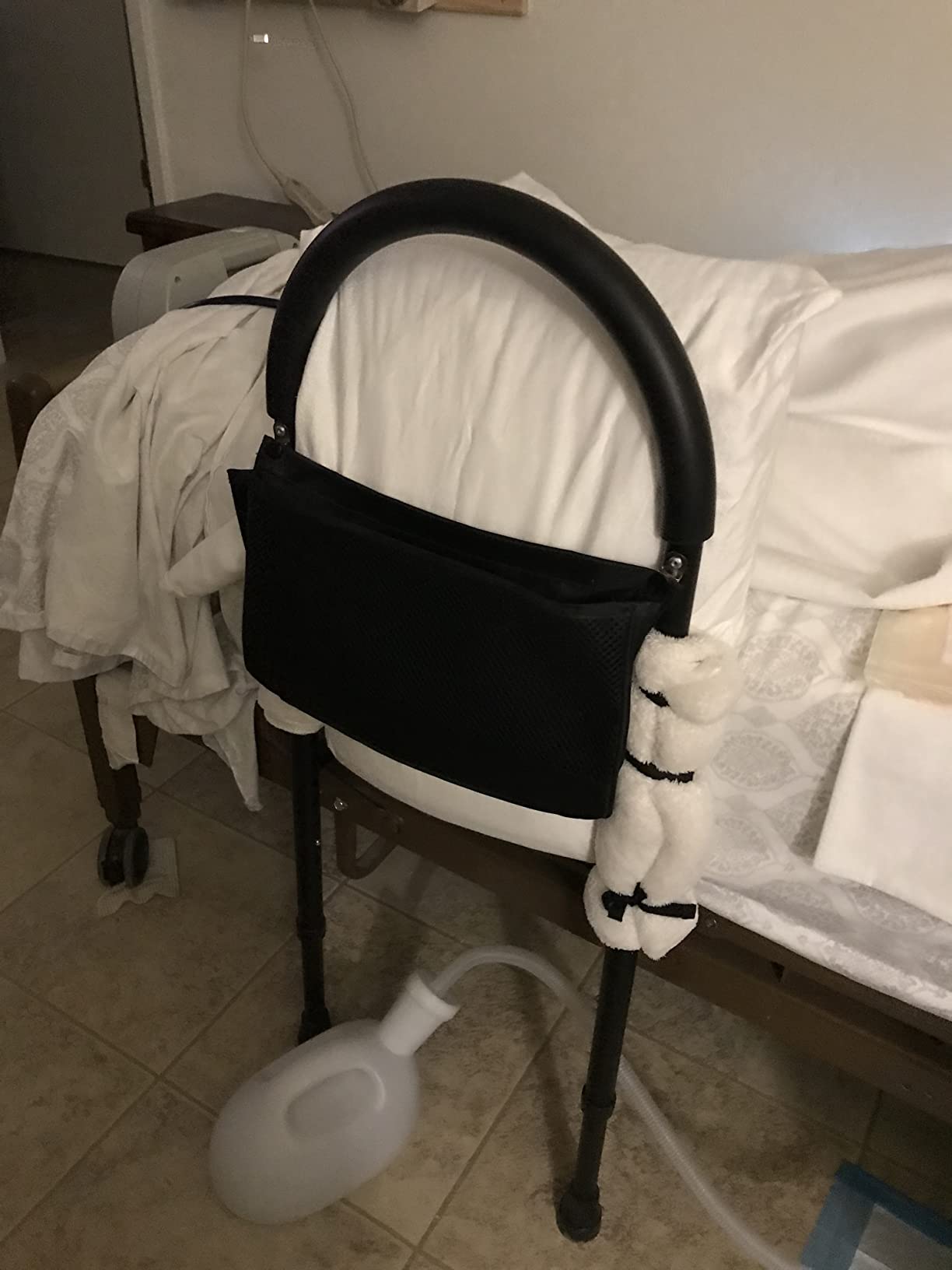
Where it fits best in a bedroom
This rail works hardest in a home where the bed is against a wall on one side and open on the other, with the open side being where the person transfers from a wheelchair or walker. Because it sits low and flat, it also disappears enough during the day that it does not make the bedroom feel like a care facility. Buyers frequently comment on how much easier it makes the morning sit-to-stand, and one caregiver noted the biggest win was shoulder and wrist pain easing because the person no longer had to push hard off the mattress to roll over.
It also travels. For an older adult splitting time between their home and a relative’s house, a rail that folds into a car is worth more than any feature that stays behind.
Where it falls short
If the goal is stopping a heavy sleeper from rolling onto the floor at 3am, this is the wrong shape of product. Its coverage is short and low, and it will not stop a determined roll. It also will not work on a Sleep Number style adjustable base or on an articulating frame, which covers a meaningful share of the beds people over 70 now own. Check the bed type first, because no amount of foam padding compensates for a frame that moves.
The printed instructions also assume you are looking at the product while you read them. Buyers who tried to work from the written guide alone report confusion about which bracket faces which way.
2. Vaunn ASTM Certified Bed Rail: Best Value Certified Bar
Vaunn Medical Bed Rail for Elderly Adults Safety, ASTM F3186-17 Certified, Adjustable Bed Assist Handle and Grab Bar for Seniors, 300 lb, Tool-Free Assembly
20W x 37H inches
8 lb
Powder-coated steel
1 year warranty
Pros
- Independently ASTM F3186-17 tested
- Wide 20 inch grip area
- Adjusts for twin to California king
- Tool-free and fast to assemble
Cons
- Needs 13 inches of floor clearance
- Not for motorized adjustable beds
- Heavier than basic rails
If the person using the rail has a caregiver who will be beside the bed for transfers, this is the one I would pick for a certified safety record at a mid-tier price. The ASTM F3186-17 certification is the headline number buyers look for on a device being used by someone vulnerable, and this listing states it plainly along with a 300 lb load rating on a powder-coated steel frame.
The 20 inch grip area is the standout physically. It is wide enough for a person to grab it at a comfortable angle whether they are lowering themselves to sitting or pushing up from a low position, and the foam padding plus horizontal stabilizer bars keep the handhold from twisting under load.
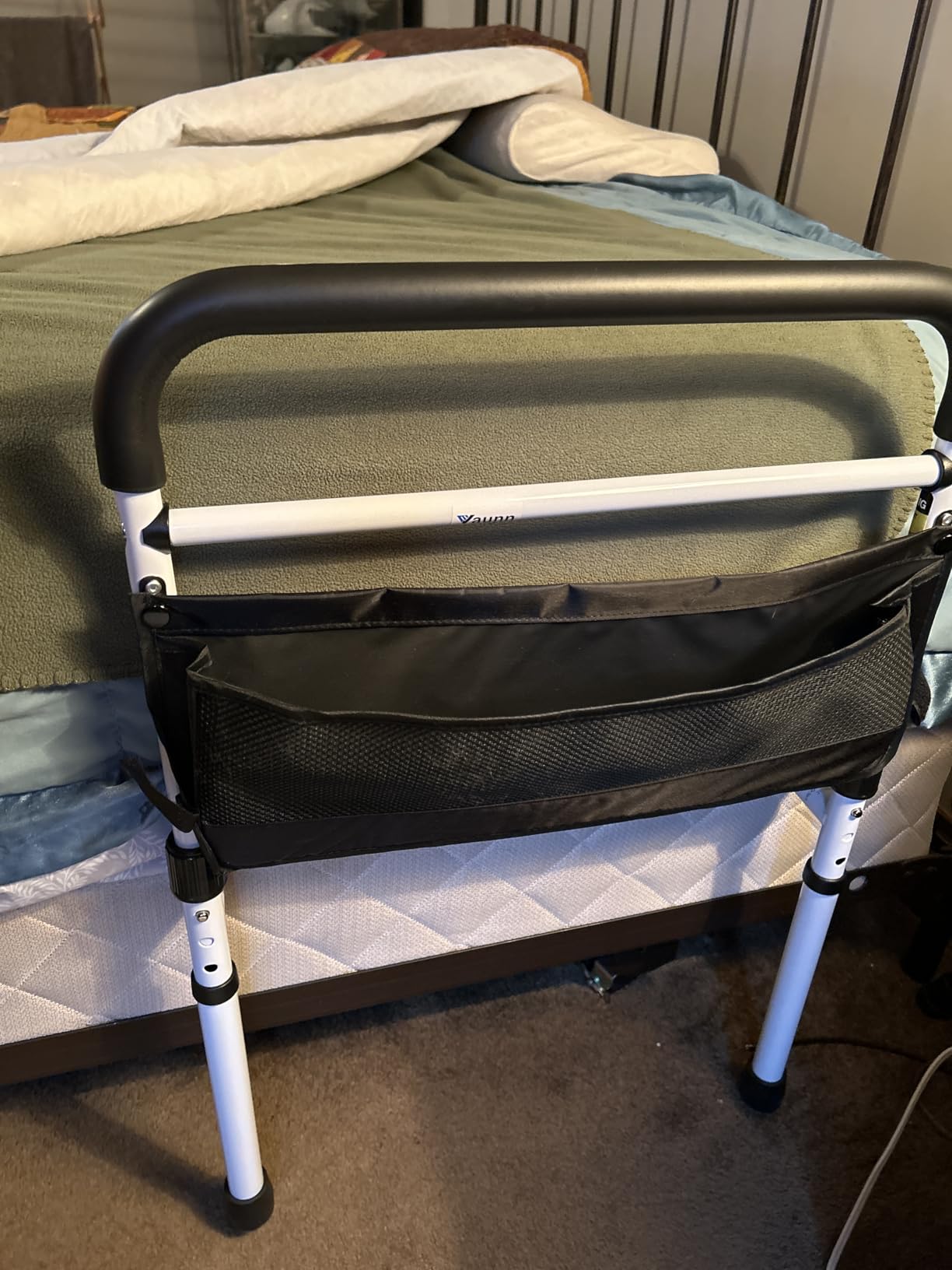
Height and width both adjust, covering twin through California king, and assembly takes minutes with no hardware. Buyers treat the wipe-clean surface and the included storage pouch as practical wins rather than extras, because a rail beside a bed collects the phone, glasses and water bottle that otherwise end up on the floor during a night.
Two compatibility facts are worth checking before ordering. It needs 13 inches of floor clearance beneath the bed to sit at the correct height, which rules out some low-profile platform beds and many storage beds with a recessed base. It is also not intended for motorized adjustable bases or most Sleep Number style mattresses.
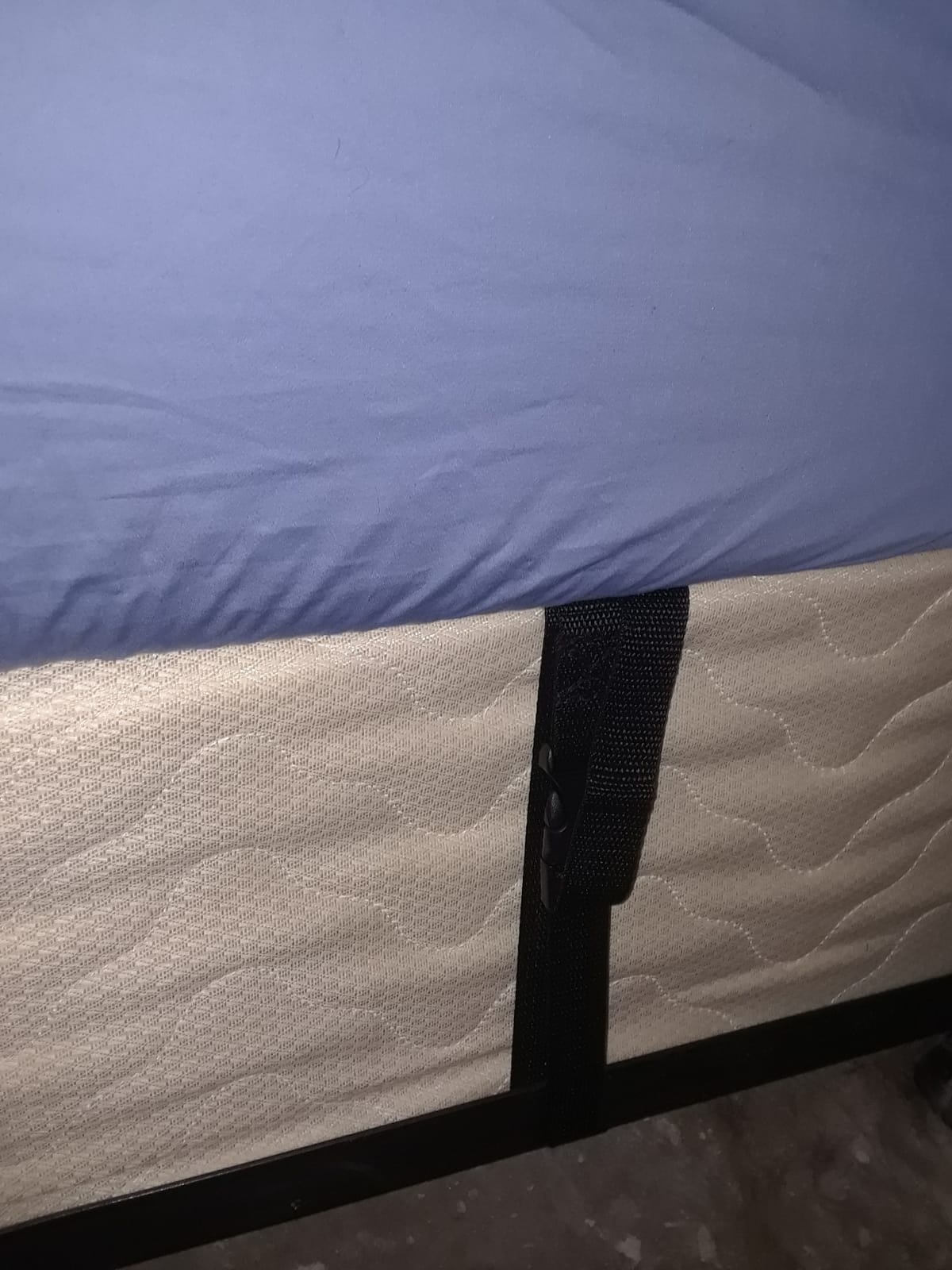
Best for transfer-heavy nights
This is a strong match for post-stroke care where one side is weaker, because the wide grip gives the stronger arm a landing spot close to the body’s centre of gravity. The certified load rating and steel frame also suit anyone whose body weight makes a plastic-and-thin-wire rail feel springy under load.
For an occupational therapist doing an equipment trial in a client’s home, a rail with a stated certification and a documented load rating is much easier to write into a care plan than one without.
Where the floor clearance rule bites
The 13 inch clearance requirement is the reason this one fails more often than its rating suggests. Modern beds with a low platform base, storage drawers or a metal frame with a crossbar underneath cannot give it the height it needs, and forcing it to sit lower changes the gap at the mattress.
It is also the wrong pick for a person who wants a rail that disappears during the day for making the bed, since this design does not fold or pivot down.
3. Medical King Bed Assist Rail: Best Budget Roll-Off Stop
Bed Rails For Elderly Adults Safety Bed Assist Rails For Seniors
6 lb weight
Black
Non-slip hand bar
Removable bag
Pros
- Sturdy for sit-up pulling
- Tool-free height adjustment
- Removable pouch for glasses and books
- Works as a transfer aid and a stop
Cons
- Strap too short for a queen box spring
- Instructions unclear and wrong
- Lowest rating in the group
This rail earns its place by doing both jobs at a modest weight. Recent reviews on this listing are dominated by post-surgical recovery use, where the rail is described as solid enough for a user to pull themselves to a sitting position without the frame shifting.
The slide-under-mattress mount is simple and the height adjusts without tools. A removable storage bag holds glasses, remotes and a book, which is one of the most repeated requests in caregiver threads we looked at: somewhere to put the phone and the water glass that would otherwise be knocked off the nightstand in the dark.
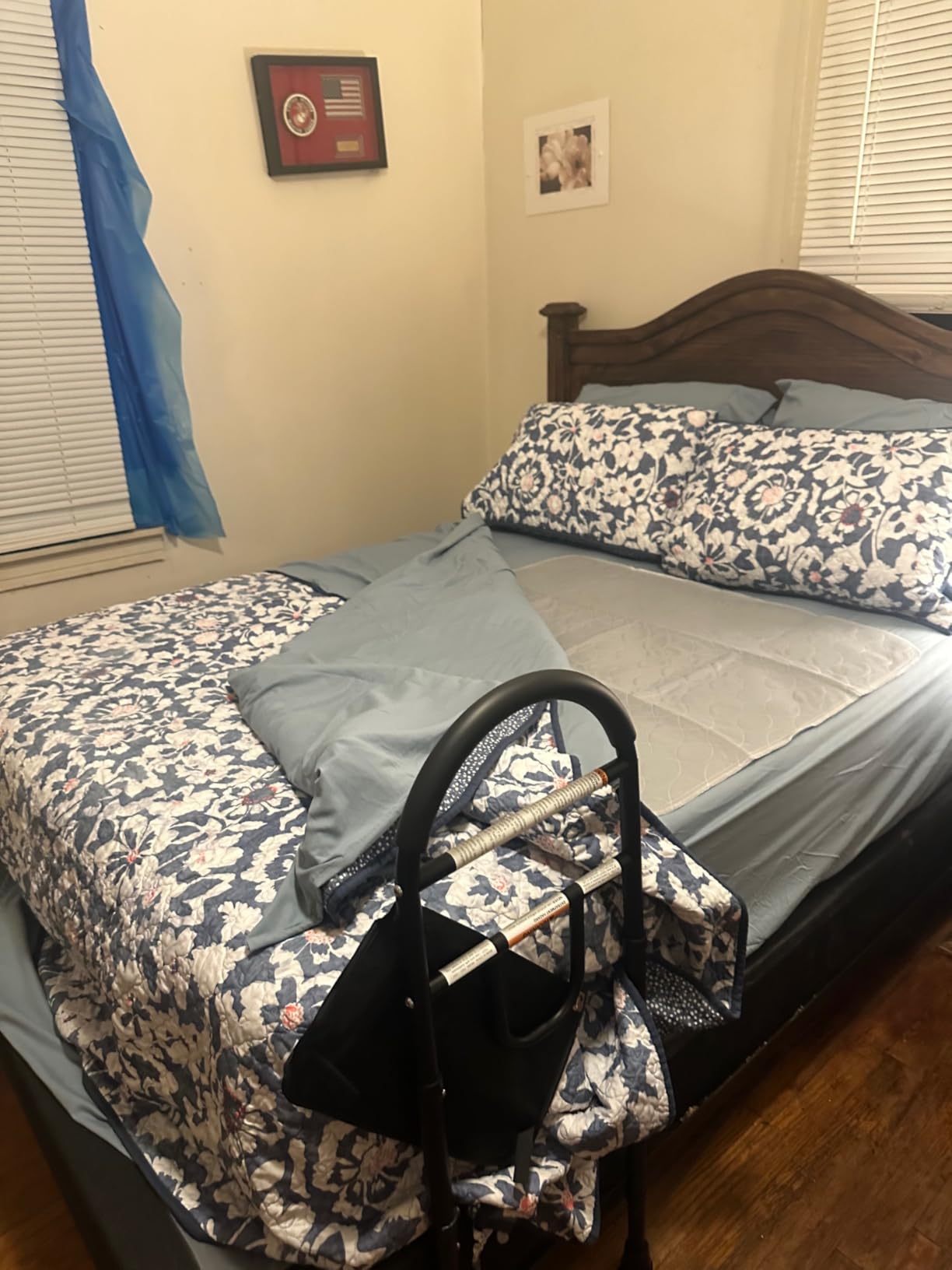
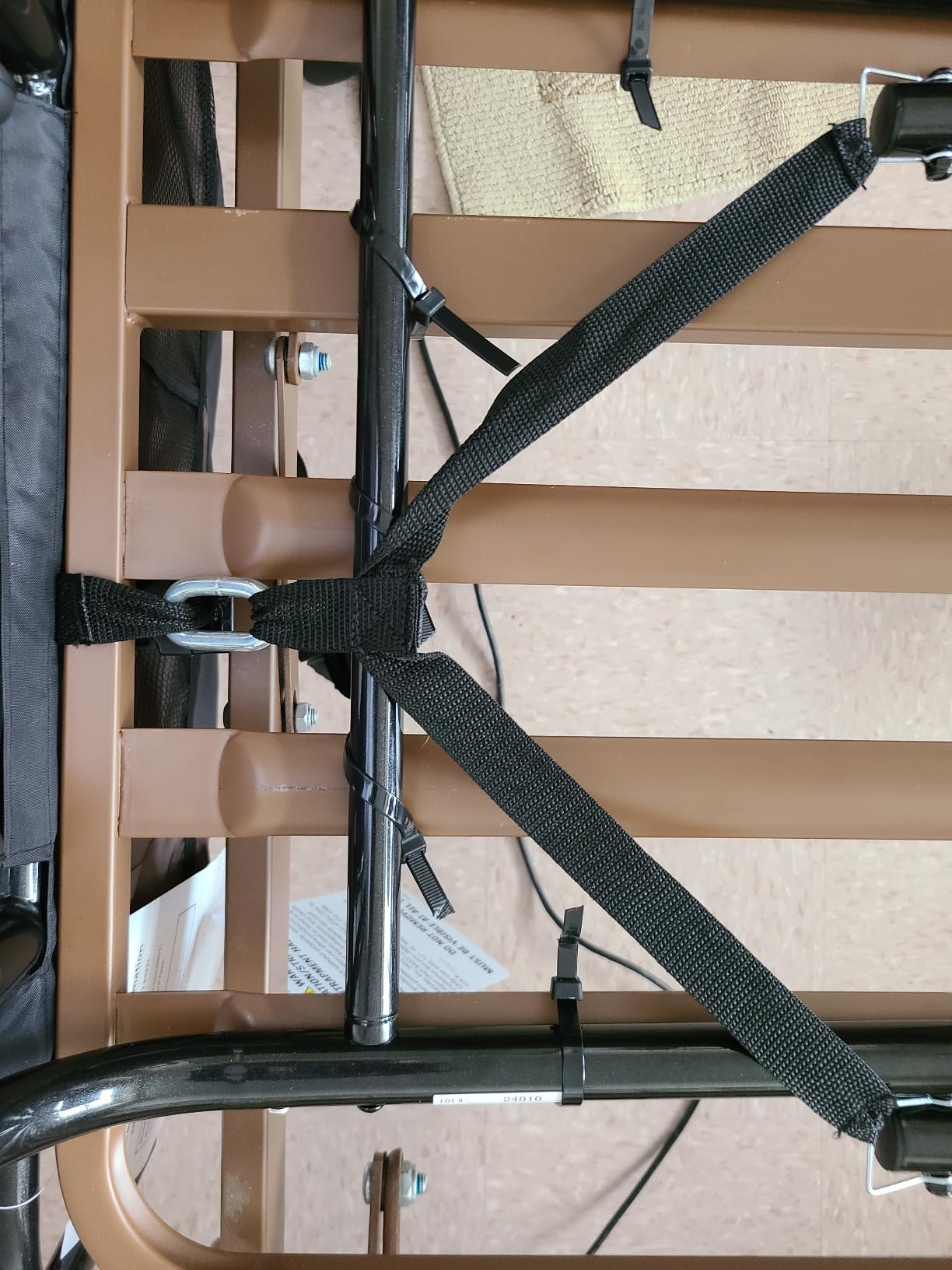
The practical problem is the strap. Buyers consistently report that the included security strap is too short to wrap around a queen box spring, so the rail needs anchoring to the bed frame by another method. On a twin or full with a low-profile frame it is a non-issue, but on a queen the fix is extra work that the instructions do not explain.
At 4.4 stars this is the lowest average rating in the group, and the gap is about documentation rather than hardware. The written directions are criticized for being unclear and for referencing removable packing washers that are not in the box.
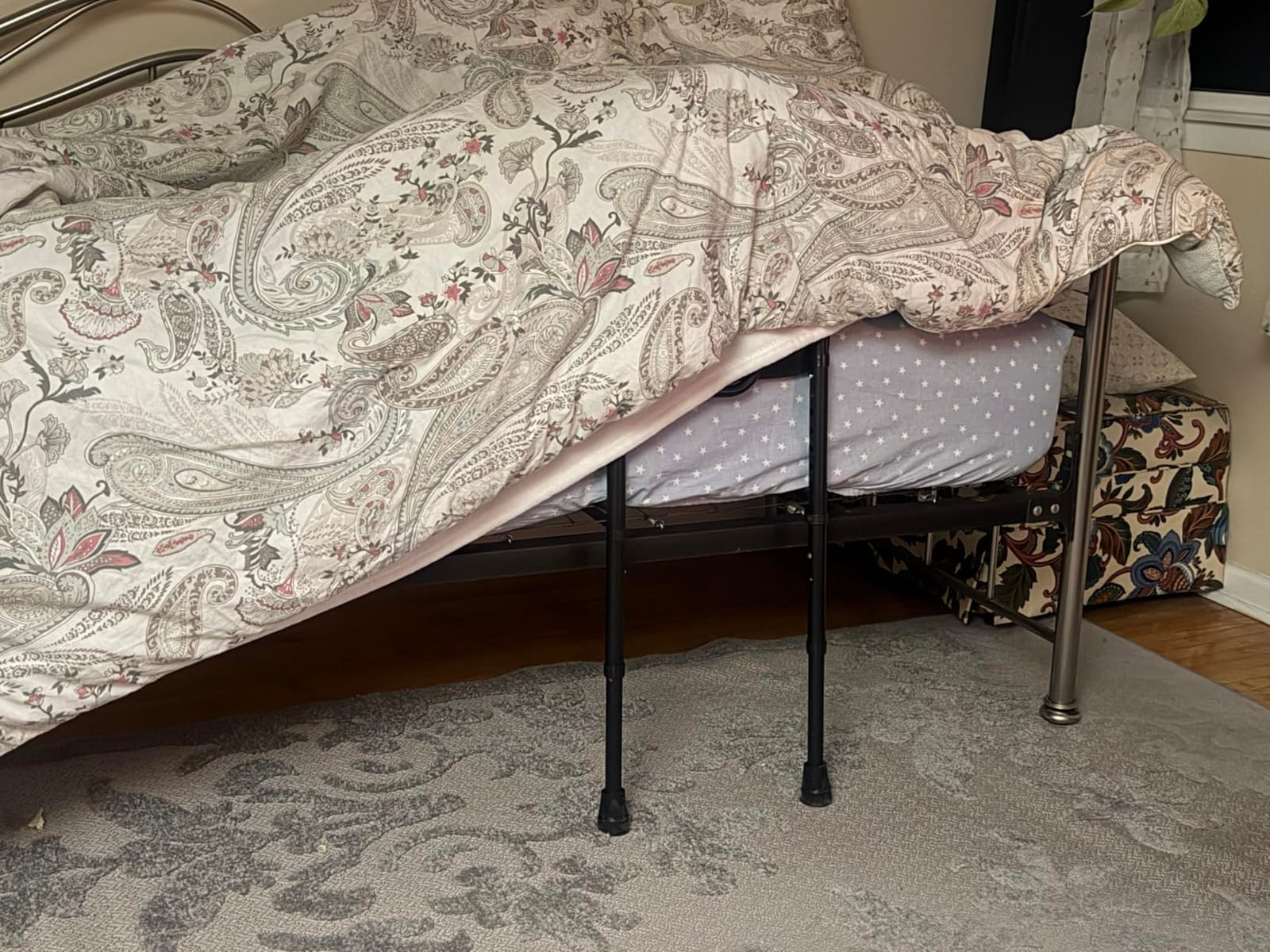
Best for a first rail on a small bed
For a twin or full bed in a spare room that someone visits occasionally, this is a sensible first purchase. It gives a firm handhold, stops a shallow roll toward the edge, and does not permanently modify the bed, which matters in a house you may sell later.
Caregivers using it for hip recovery report that being able to pull up to sitting without a caregiver’s arms is the difference between asking for help once and asking for it every time.
Where the fit falls apart
If the bed is a queen with a traditional box spring, plan on anchoring this rail to the frame yourself rather than relying on the supplied strap. The result is safe, but it converts a tool-free install into a hardware job.
It is also a handle in shape, not a barrier. A person who rolls hard against it during the night will move it, because nothing is bolted to the frame.
4. Stander EZ Adjust Bed Rail: Best Premium Extendable Guard
Stander EZ Adjust Bed Rail, Adjustable Senior Bedrail and Safety Assist Railing for Elderly Adults with Organizer Pouch, ASTM Safety Approved Guard-Rail, Black
25 x 26 x 23 inches
10 lb
Powder-coated steel
1 year warranty
Pros
- ASTM F3186-17 certified
- Longest coverage here at 20-30 inches
- Folds down out of sight
- 300 lb capacity
- Large multi-pocket pouch
Cons
- Highest cost in the roundup
- Cannot face another rail on the same bed
- Anchoring can block an adjustable base
This is the barrier rail we would put beside someone who has already fallen out of bed twice. A caregiver in one eldercare thread described the goal plainly: not day-to-day transfer help, but stopping a third fall. For that job, length and height matter more than anything else on the list.
The rail extends from 20 to 30 inches with a knob twist, which is the longest coverage in this roundup, and it carries a 300 lb rating. It is also one of the few adult bed rails in this group independently tested to ASTM F3186-17, the certification that matters most when the rail is acting as a barrier rather than a grab bar.

The feature premium buyers mention more than any other is the pivot. One tug drops it down and away, so the bed can be made in the morning and the rail is out of sight for the rest of the day. Several owners said they bought it for that reason alone, before the fall-prevention argument even came up.
Fit covers platform beds, box springs and slat beds with 10 to 14 inch mattresses. The large multi-pocket organizer pouch keeps remotes, glasses, a phone and medication in reach, which reduces the midnight trip to the dresser that so many night falls start with.
Best for a restless sleeper
Long coverage is the whole point here. Someone who scoots across the bed at night is far less likely to clear a 30 inch rail than a 13 inch one, and buyers describe it as feeling heavy and solidly anchored rather than light and tappable.
One caregiver for a blind relative recommended a rail mainly as a tactile landmark: a consistent object at the edge of the bed that a person who cannot see can find with a hand before sitting up.
Where it does not fit
The under-bed extension means two of these cannot face each other across one bed, so a wide double needs a different plan for the second side. Anchoring the rail to the frame can also stop an adjustable base from elevating, and one reviewer with limited hand dexterity found the drop-down lock hard to operate from inside the bed.
It is the highest cost item in this roundup, and the price gap is wide enough that we would steer budget buyers toward the Vaunn or WeHwupe first.
5. Able Life Extend-A-Rail: Widest Mattress Fit
Able Life Bedside Extend-A-Rail, Adjustable Senior Bed Safety Railing and Stand Assist Grab Bar, Extendable Guardrail for Seniors and Elderly Adults, ASTM Safety Approved Bedrail
18 x 20 x 20 inches
7.15 lb
Twin to California king
300 lb rated
Pros
- ASTM F3186-17 certified
- One-hand 20-30 inch extension
- Widest mattress tolerance at 8-15 inches
- Works for wheelchair transfers
Cons
- Second highest cost here
- No adjustable bed use
- Soft mattresses can break the fit
The Able Life rail exists for one reason above all: it fits the widest range of mattress thicknesses we found, from 8 to 15 inches. If a household has an unusual mattress, a thick pillow top or a recently replaced bed, that tolerance removes the single most common reason a rail ends up with a dangerous gap.
Extension is a push button rather than a knob twist, so it goes from 20 to 30 inches one-handed. For a user with limited grip strength, that difference decides whether the rail gets adjusted at all or stays stuck at its shortest setting.
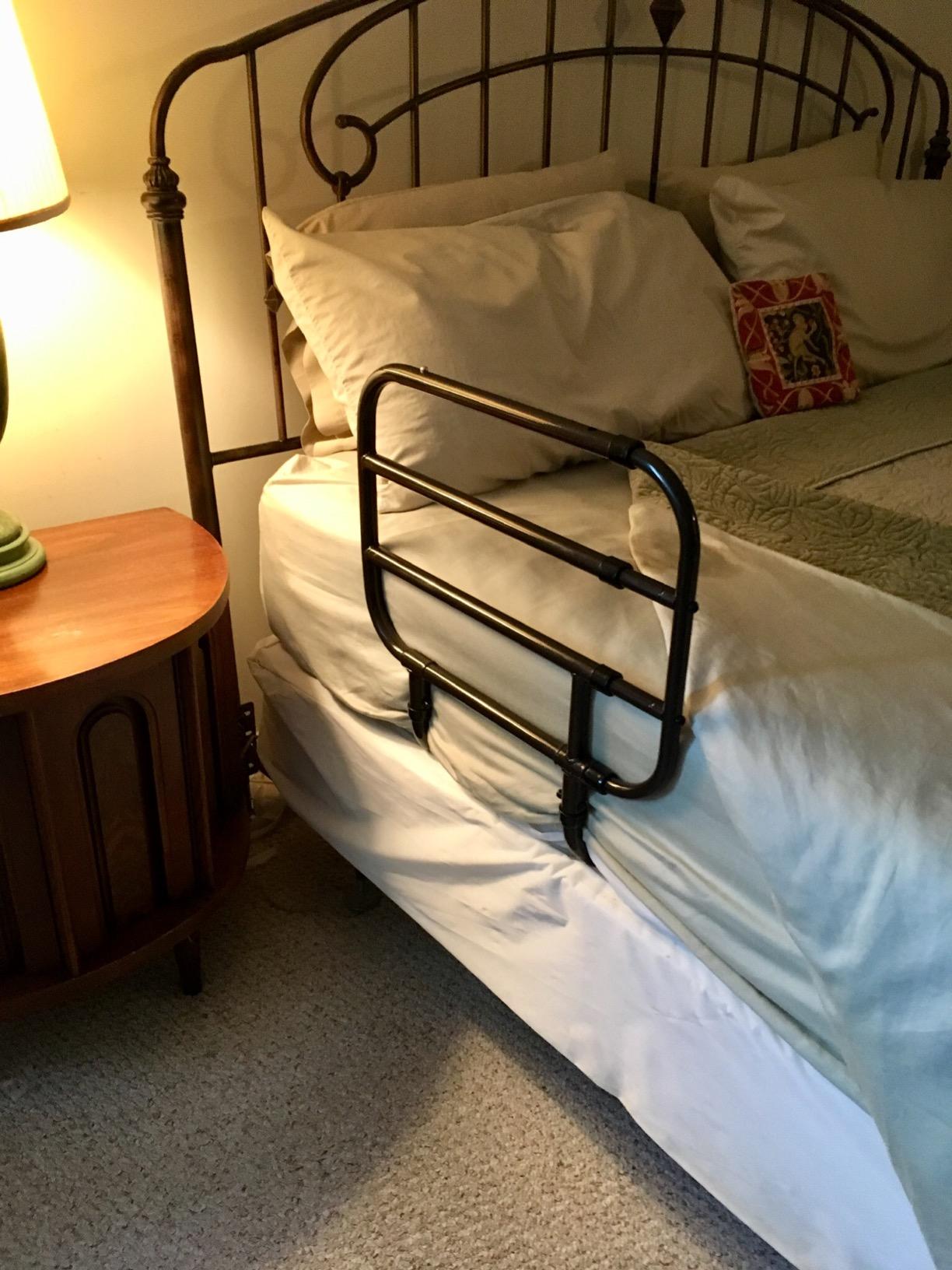
It carries the same ASTM F3186-17 certification and 300 lb rating as the Stander, and buyers describe the support bar as strong enough for a person to push themselves upright or transfer into a wheelchair. The home design also reads as furniture rather than medical equipment, which some families specifically care about.
It fits twin, full, queen, king and California king frames. The one caveat on fit is extra-soft mattresses, where the rail can compress and sit away from the bed rather than gripping it.
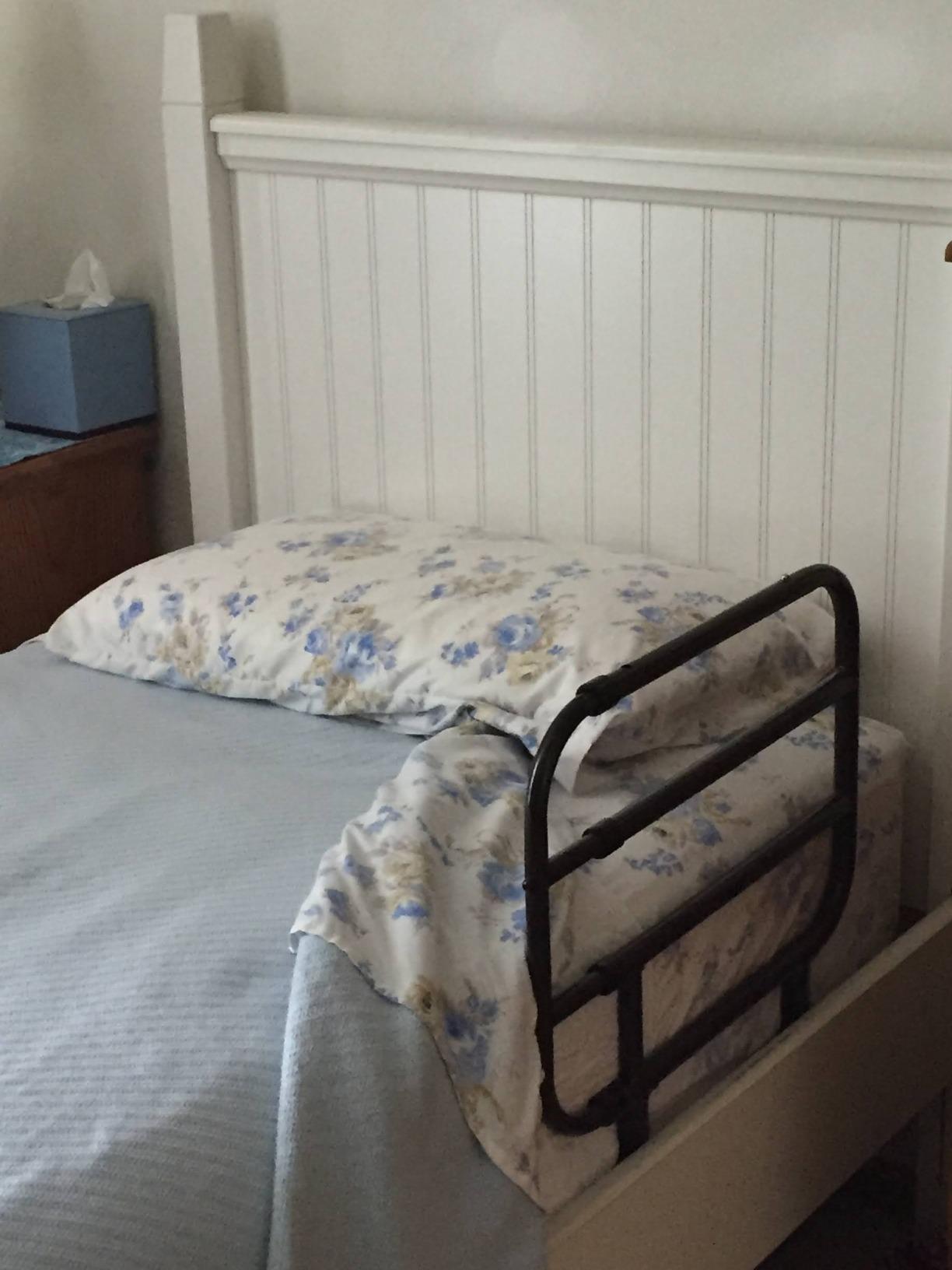
Best for wheelchair transfers
This is the rail to shortlist when a person transfers sideways into a wheelchair or walker every morning. The bedside support bar is placed close to the transfer side, the extension is quick, and the certification gives a clinician something concrete to note in a care plan.
Users recovering from surgery who cannot push off the mattress report that the handle position makes the difference between an independent sit-up and needing a second person.
Where it falls short
It is not for adjustable beds, and it is not for extra-soft mattresses. The wider mattress tolerance does not extend to platform beds without a box spring, so a low modern base still rules it out even when the thickness is fine.
At 4.5 stars with a solid review base, it sits just below the two rails above it in owner enthusiasm, mostly on price rather than function.
6. Lunderg Bed Assist Rail with Motion Light: Best for Night Trips
Lunderg Bed Assist Rail for Seniors with Motion Light & Non-Slip Grab Bar
25.4W x 20.6H inches
2 lb
Carbon steel
Rechargeable light
Pros
- Highest average rating here at 4.7
- Motion light avoids waking a partner
- 300 lb tested steel
- Five-minute tool-free setup
Cons
- Not for adjustable beds
- Light needs periodic recharging
- Smallest coverage of the group
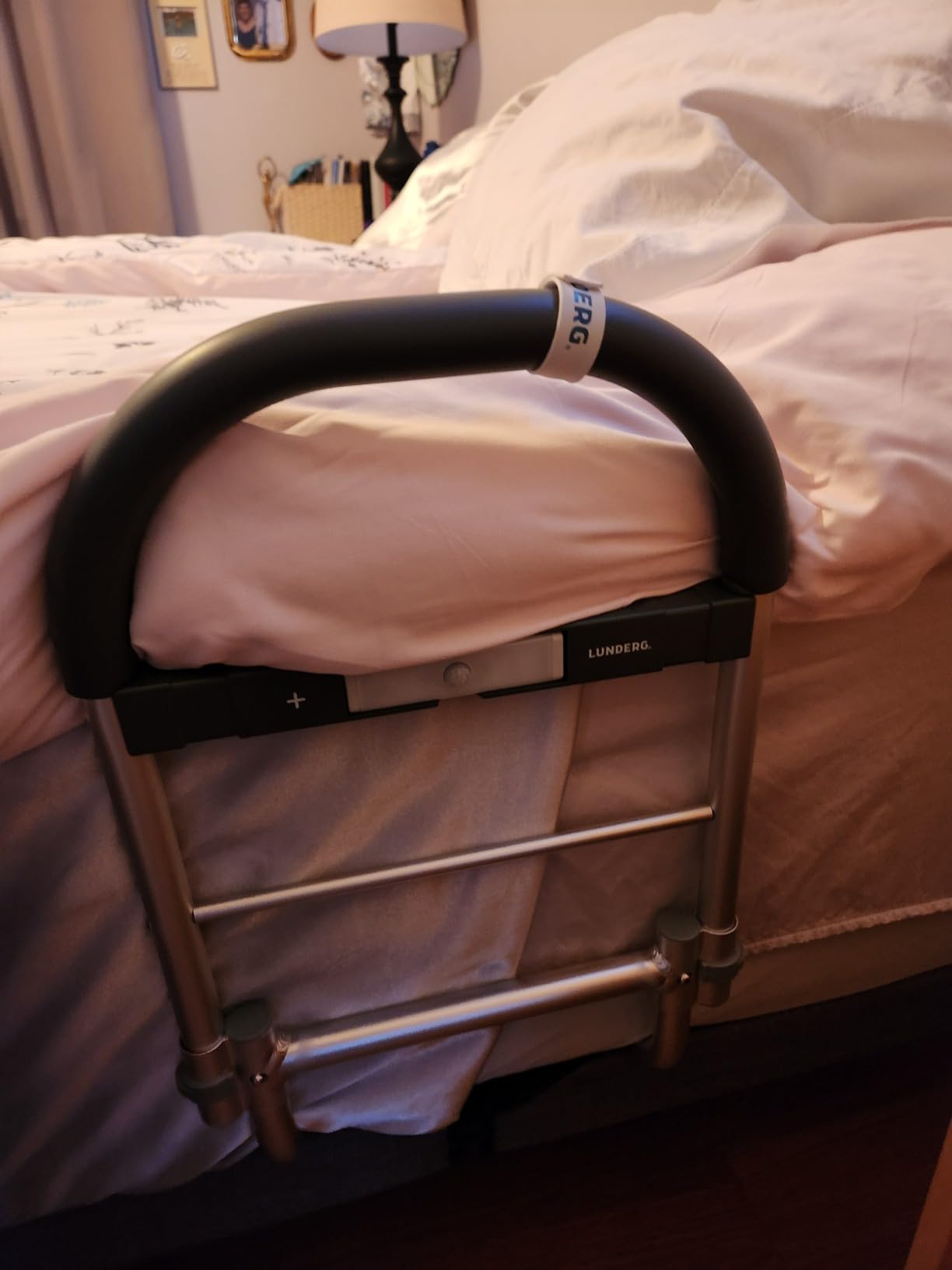
This rail at 4.7 stars has the highest average rating of the eight, and the reason is one feature nobody else here has: a motion-activated light. It comes on when someone moves, stays on for about 60 seconds per activation in automatic mode, and runs off a rechargeable battery that lasts weeks between charges.
Owners describe it as the thing that lets a loved one get to the bathroom without turning on a harsh overhead light that wakes a spouse, or without calling for help. That is a direct answer to the fall pattern that starts with getting out of bed in the dark.
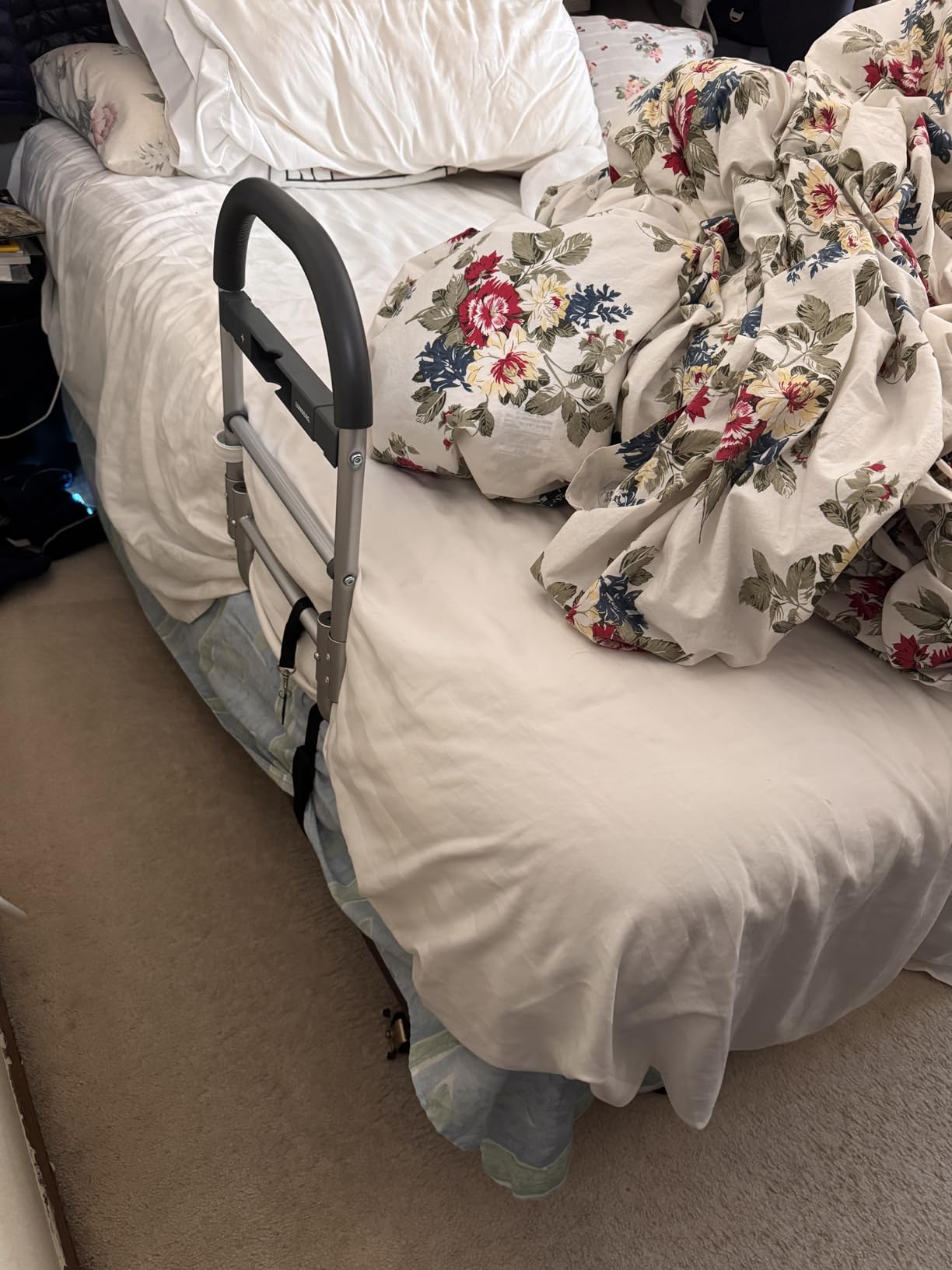
Everything else about it is a well-executed assist rail. It is load tested to 300 lb with four horizontal stabilizing bars, which owners repeatedly praise as firm and wobble-free, and at 2 lb it is the lightest unit listed. It arrives partly assembled, so setup is about five minutes with push-pin connectors rather than a bag of parts.
Fit covers twin to king with 7 to 13 inch mattresses and works with box spring, slat or platform frames, with an adjustable strap for securing to the base.
Best for shared bedrooms
The strongest case for this rail is a shared room where turning on a light is not an option. The motion sensor handles a single trip to the bathroom and then goes dark, which is easier on the eyes than a bedside lamp and easier on a sleeping partner than a hall light switch.
It also suits a home where a caregiver needs the person to be able to reach the bathroom independently at night rather than waiting for assistance.
Where it is the wrong tool
Its footprint is small, giving less fall coverage than the extendable rails, so it is a transfer aid with a light attached rather than a barrier. It is not suitable for adjustable beds. The light also adds bulk and needs recharging, which is a fair trade but not a free one.
For a heavier person or a king bed where reach is an issue, the longer rails cover more ground.
7. KingPavonini 380 lb Bed Rail: Best for Larger Bodies and King Beds
KingPavonini Bed Rails for Elderly Adults Safety, 380 LBS, Model BM03-1
34.7W x 20.9H inches
5.5 lb
380 lb load rating
3-12 inch mattresses
Pros
- Highest load rating here at 380 lb
- Longest extension at 34.7 inches
- Fits thinnest mattresses from 3 inches
- Works without strapping on a heavy mattress
Cons
- Not for adjustable beds
- One-sided pouch slots
- Only about 5 inches show above thick mattresses
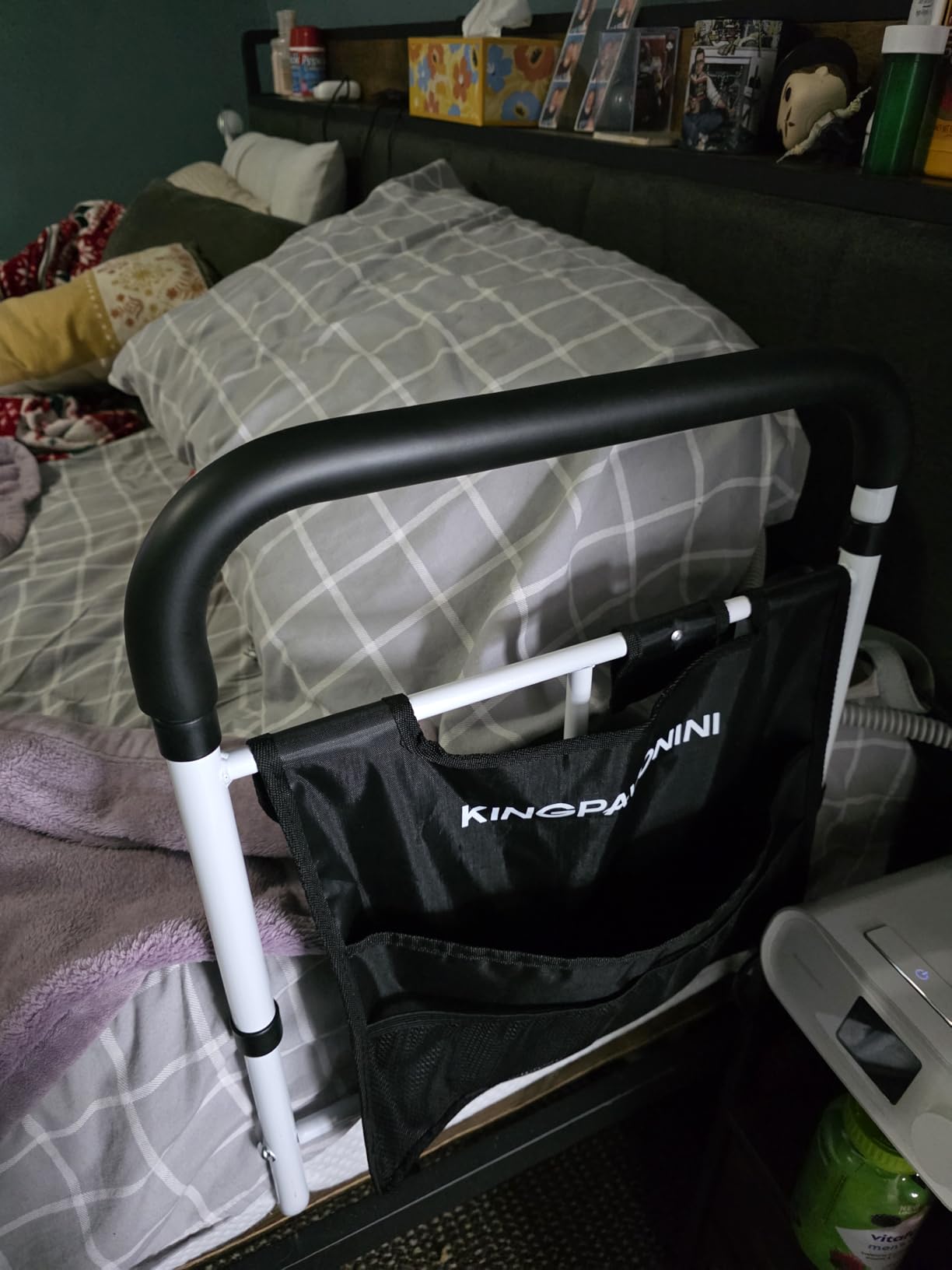
Two numbers set this rail apart: a 380 lb load rating, the highest in this roundup, and a horizontal extension of 28.6 to 34.7 inches. That reach is what makes it work on a king bed, where a person can only comfortably reach one rail at a time and the nearest grip point may otherwise be out of range.
Height adjusts from 17.6 to 20.9 inches and the padded curved handle is shaped for a recovery hand that cannot form a full fist. The listing states ASTM approval, and the frame holds without strapping to the base on a heavy mattress, which removes the fiddliest part of installation on most beds.
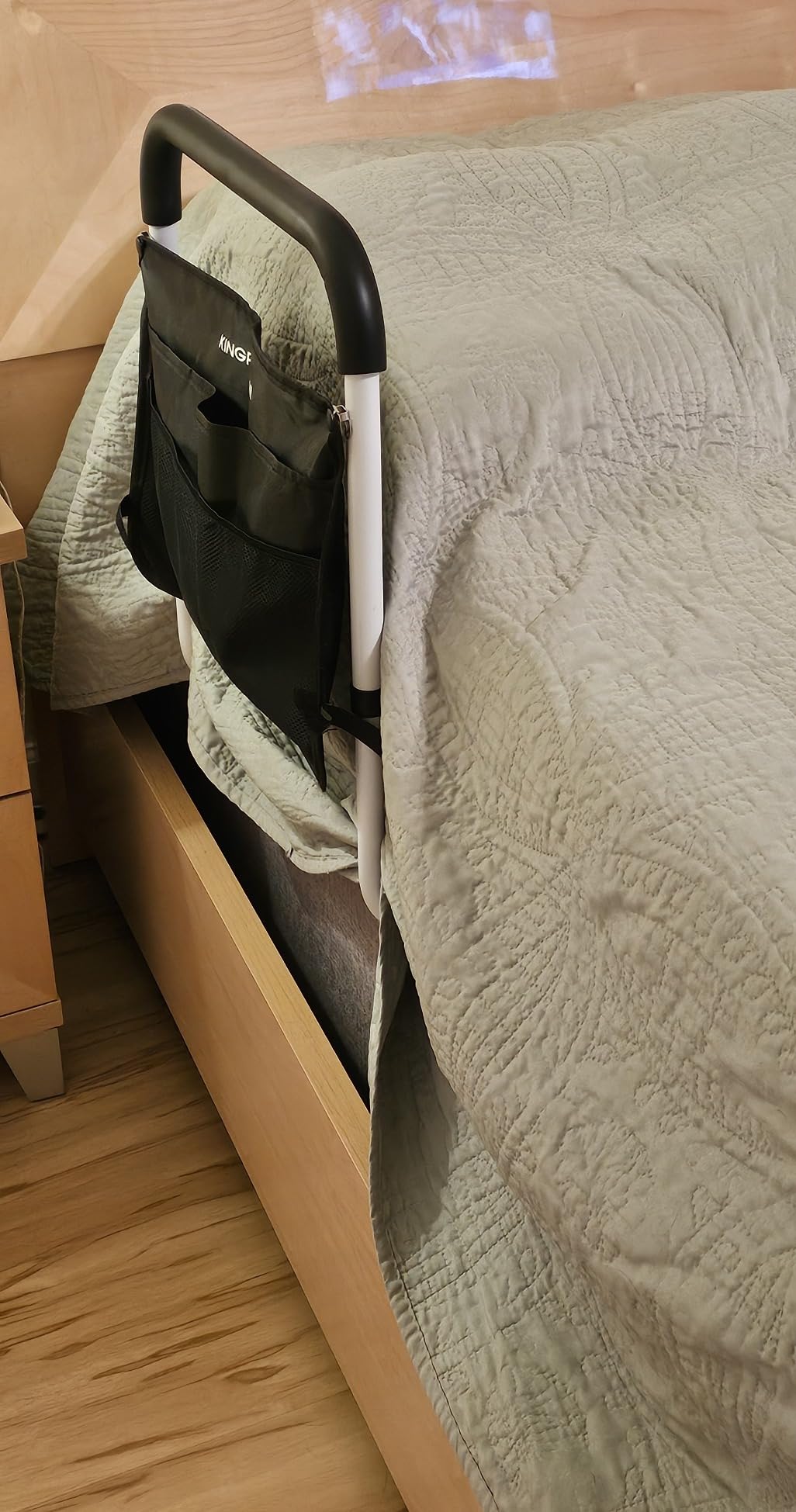
The mattress range of 3 to 12 inches is unusually wide at the thin end, so it fits the thinner mattresses common on platform beds where a standard rail would stand away from the surface and open a gap.
Users also report using it as a stabilizer when a foam topper shifts, which is a practical side benefit nobody designed it for. It ranks first in its category, with a majority of its reviews at five stars.
Best for bariatric users and king mattresses
If the person weighs above the 300 lb that most rails in this group are rated to, this is the only unit here with headroom. The 380 lb rating also gives a margin for a person who pushes off hard during a transfer rather than leaning gently.
For a king bed, the longer extension means the grip lands where the person’s hand actually is, instead of near the middle of a mattress they have to roll across to reach.
Where the extra size costs you
Only about 5 inches of rail shows above a very thick mattress, so on a thick mattress the extra length is less useful than it sounds. The storage pouch has slots on one side only, which is the one complaint that repeats in the reviews.
It is not for adjustable beds, and on a low or fixed profile frame it can project further into the room than the shorter rails.
8. WeHwupe Bed Rail: Best Budget Transfer Grip
WeHwupe Bed Rails for Elderly Adults Safety with Bedside Storage Pocket
12.3W x 21.4H inches
4.5 lb
Alloy steel
Mesh pocket
Pros
- Lowest cost in the roundup
- 350 lb rated ASTM-tested frame
- Foam-padded non-slip grip
- Tie-down straps included
Cons
- Narrowest rail width at 12.3 inches
- Not for lift beds
- Smallest review base here
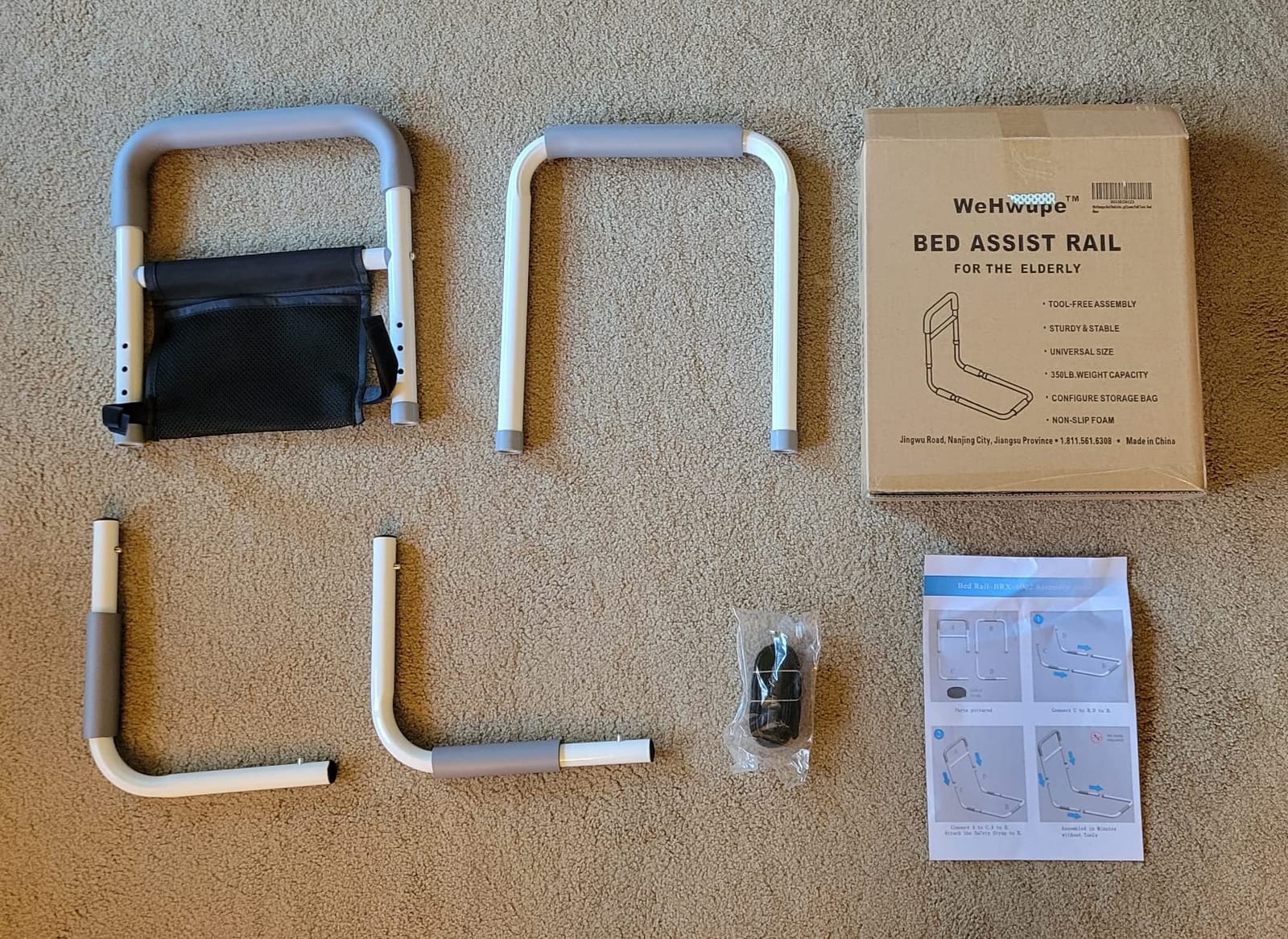
This is the entry point for someone who needs a steady grab bar and does not need a barrier. It carries an ASTM safety tested frame rated to 350 lb, soft non-slip foam padding on the handrail, and a small mesh pocket that works well for a phone or a water glass within reach.
Assembly is tool-free with tie-down straps included in the box, and the frame wipes down with a damp cloth. At 4.5 lb it is light enough to move between rooms, and the height adjustment lets it be set to suit the bed rather than the other way round.
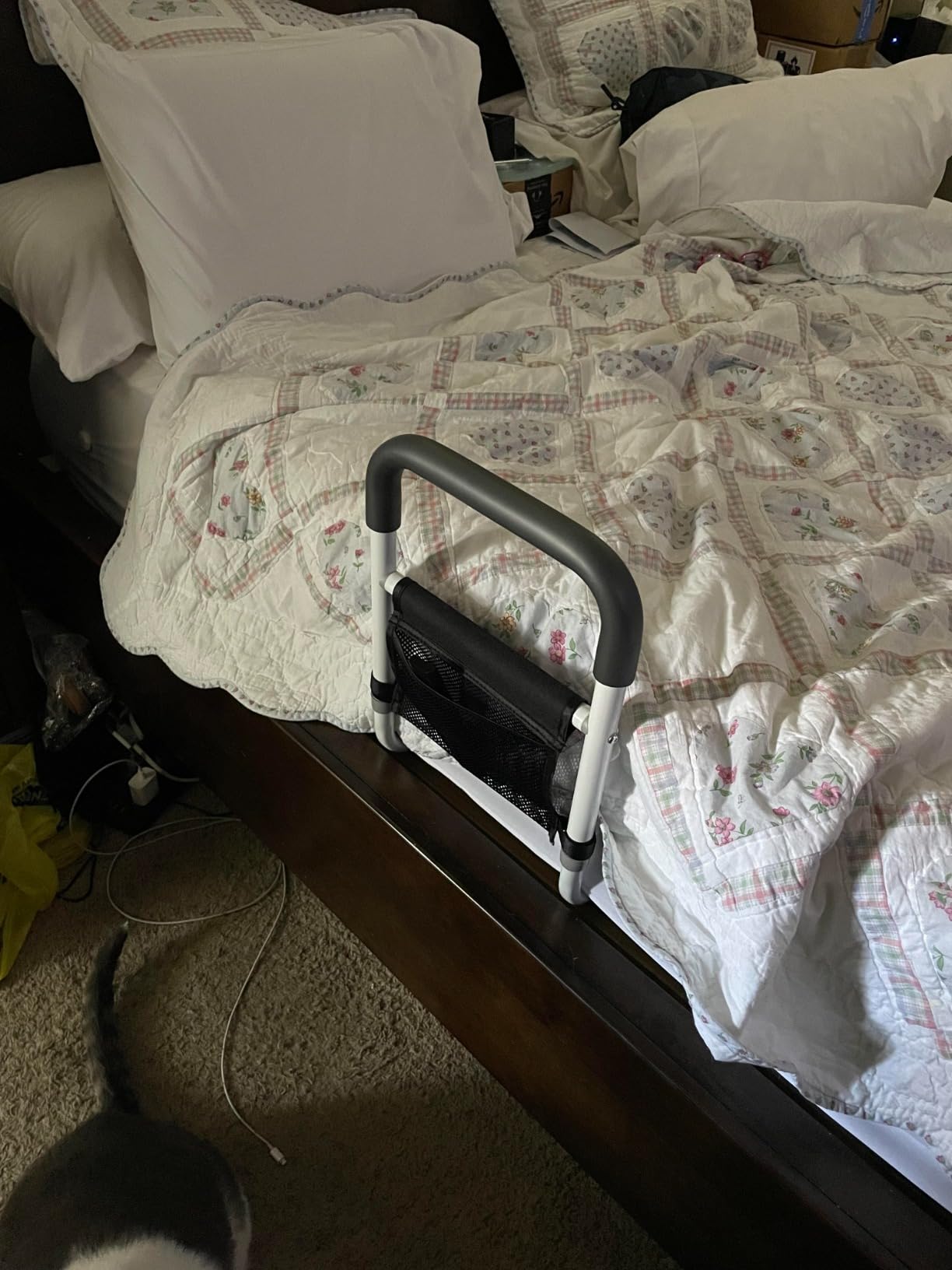
Buyers treat it as a budget grab bar rather than a fall barrier, and at a 12.3 inch width it is the narrowest rail here. That makes it more of a handhold for a person who needs one thing: something firm to push against when sitting up, standing and lowering back down.
It fits king, queen, full and twin frames. It is not suitable for adjustable mattresses or automatic lift beds, which rules it out for power bases.
Best for a first, low-risk rail
The lower entrapment exposure of a short handle makes this a sensible first purchase for a person who is still mobile but has started complaining about the morning transfer. Nothing about the setup can trap a limb the way a longer barrier rail can.
It also works as a second bed rail in a home where the main bedroom has a certified unit and the spare room needs something basic.
Where the small footprint shows
Twelve inches of rail is a handhold, not a guard. Anyone who rolls at night will move past it, and a person who needs to be stopped mid-roll needs the Stander or the Able Life instead.
It has the smallest review base of the eight, so treat the specification claims as newer and less battle-tested than the rails above it. If you want a safety device with a long public record, the certified options carry more weight.
How to Choose Bed Rails for Elderly Adults: Key Things to Consider
Work through these five questions in order. The order matters, because a beautiful rail that does not fit the bed is worth nothing, and most returns we could trace in the reviews come down to a bed type that was never checked before ordering.
Key things to consider before buying bed rails for elderly adults
Bed compatibility. Box spring beds with a traditional frame accept almost every rail, including ones that slide under the mattress with a safety strap. Platform and slat beds give less to clamp onto, so look for a rail with an explicit platform bed rating and a frame strap. Adjustable or power bases rule out most portable rails by design, because the frame moves underneath the mattress.
Weight capacity. Most rails here are rated 300 lb, with the KingPavonini at 380 lb and the WeHwupe at 350 lb. Choose on the person’s actual weight plus the force of a hard push-off, not on an average. A springy rail under a heavy user is a fall waiting to happen.
Entrapment prevention. Look for ASTM F3186-17 certification and a stated mattress thickness range. After fitting, run the fist test: if your closed fist fits loosely between rail and mattress, the rail is too tall for that mattress. If the mattress itself is due for replacing, our guide to the best bed bug mattress encasements is a useful starting point on keeping a mattress in service longer.
Clinician input. An occupational therapist who has seen the person sleep and move can tell you whether the goal is transfer help or roll-out prevention, and whether the person’s cognition and mobility make a barrier rail safe. That single conversation prevents most of the bad outcomes described in safety guidance.
Rail length and access. A rail that extends to 20 to 30 inches stops more roll-outs but blocks the exit path a person needs for a midnight bathroom trip. A rail that folds or pivots down solves the daytime problem of making the bed and giving a caregiver full access from that side.
Which rail shape matches your bed and goal
A bed assist handle is short, low and mostly a grab point. Entrapment exposure is the lowest of any rail type because there is little structure to create a gap, and a person can always climb over it without much risk of being stuck.
A half-length rail with floor support legs is the mid option. Two legs reach the floor and take the load instead of the mattress edge, which suits soft or thick mattresses and higher weight capacity. It blocks more of the side than a handle without being a full barrier.
A full-length or extendable guard rail is the barrier option. It is the only type here that reliably stops a roll-out, and it carries the highest entrapment risk if it is fitted to a thin mattress or a soft one.
The adjustable-base compatibility question deserves its own warning. None of the eight rails we tested is rated for a motorized power base, and several listings say so explicitly. If the bed articulates, your options are a bed-exit alarm, a low hi-lo bed with floor matting, or a rail designed and rated for that specific frame by its manufacturer.
Will Medicare or insurance pay for a bed rail?
Usually not on its own. Medicare’s durable medical equipment benefit covers items it classifies under specific HCPCS codes, and a portable bed rail bought for home use generally does not qualify as a covered item by itself. Where coverage does appear is when the rail is part of an intermittent nurse or therapy assessment that also supports other covered equipment, such as a hospital bed, a pressure-relieving mattress or a transfer device.
The route that works is through a physician’s order and a supplier that bills Medicare directly. Ask for the written assessment that names the rail and why it is needed, and check with the plan before ordering, because the answer differs between Original Medicare and Medicare Advantage plans. Medicaid, long-term care insurance and some Veterans benefits have their own rules, and long-term care insurance in particular sometimes covers durable medical equipment rails that Medicare does not. Expect to pay out of pocket for a standalone rail.
Installation and gap-check checklist
Before the first night of use, work through this list. It takes about ten minutes and it catches nearly every problem we saw described in reviews.
First, confirm the mattress thickness sits inside the rail’s rated range and do the fist test on both the top gap and the gap at the foot end. Second, attach the safety strap to the far side of the bed frame or base, not just around the box spring, and pull it tight. Third, push the rail outward and upward with both hands and confirm there is no wobble or slide. Fourth, load it the way the user will, sitting down hard, and check that nothing shifts. Fifth, run a folded bedsheet through the rail so the user cannot tangle fabric in it overnight. Sixth, check that the rail does not block the route to the bathroom or the side the caregiver works from.
One more thing before you order. Many suppliers flag opened bed rails as non-returnable for hygiene reasons, so read the return terms before the box is opened, not after.
Bed Rails for Elderly Adults vs. Bed Assist Handles: Which Do You Need?
Start from the person’s goal, because the two products answer different problems. If the issue is the transfer itself, a person who cannot push off the mattress or feels unsteady lowering down, you want a bedside handle or assist rail with a wide, padded grip that sits close to where the hand already goes.
If the issue is roll-out prevention, a person who has already fallen out of bed or who scoots to the edge during a restless night, you want an extendable guard rail that stands high enough and runs long enough to stop the movement before it starts.
Entrapment risk follows the same line. A short handle creates fewer gaps and offers no barrier to climb, so it carries the lowest risk. A long guard rail protects better against roll-out and creates more places for a head or limb to get caught if the fit is wrong.
One caregiver forum thread we read put it more bluntly: people need a firm, steady handhold for sitting, sitting up and standing, not a wall in front of them. Too long a rail blocks the very exit path needed for a 2am bathroom trip, which is how a safety device creates the problem it was bought to solve.
Our rule of thumb is that if the person can get in and out of bed with a hand to hold, start with a handle and only upgrade to a barrier after a fall or a clear pattern of rolling out.
Who Should Not Use Bed Rails for Elderly Adults
A rail is the wrong tool for a few specific groups, and choosing it anyway is how a well-intentioned purchase turns into a serious fall.
People with dementia or advanced cognitive impairment who try to climb over a rail are at higher risk of a fall from rail height, which is a worse injury than the roll-out the rail was meant to prevent. A bed-exit alarm with a caregiver response plan is a safer substitute.
People who are extremely restless sleepers, who move across the whole bed or throw the covers off all night, need a barrier that is properly fitted rather than a partial one, or they need a different solution entirely.
People with very small body frames or a very small bed are at risk of a rail reaching past the mattress edge or leaving an open side. For a narrow twin, a very short bed, a hospital bed with its own integrated rails, or a bed with an odd frame, an integrated rail system is safer.
People on power adjustable bases should not use a portable rail unless the manufacturer rates it for that specific frame. Most of the eight we tested explicitly say not to, and forcing one is how the base stops elevating or the rail ends up loose when the head rises.
Safer alternatives across the board include lowering the bed to its lowest setting and adding a floor mat, switching to a hi-lo or full electric hospital bed with integrated rails, using a bed-exit alarm, or adding a floor-level transfer pole such as a SuperPole that gives a stable grip without any barrier at all. A nightly check-in routine and good bedside lighting solve more night falls than hardware does.
Frequently Asked Questions
Are bed rails for elderly adults covered by Medicare?
Usually not as a standalone purchase. Medicare’s durable medical equipment benefit covers items assigned to specific HCPCS codes, and a portable bed rail bought for home use generally does not qualify on its own. Coverage is more likely when the rail is part of a written physician assessment that also supports covered equipment such as a hospital bed or pressure-relieving mattress. Get the order and assessment from a doctor, use a supplier that bills Medicare directly, and check with your plan first, because rules differ between Original Medicare and Medicare Advantage.
What are the safest bed rails for elderly adults?
The safest bed rails for elderly adults are the ones independently tested to ASTM F3186-17, the federal safety standard for adult portable bed rails under 16 CFR Part 1270, and fitted to a mattress inside the rail’s rated thickness range. In this roundup the Vaunn, Stander, Able Life and KingPavonini rails state ASTM certification. Short assist handles carry the lowest entrapment risk; long barrier rails stop more roll-outs but create more gaps if the fit is wrong.
What are some alternatives to bed rails for elderly people?
The main alternatives are a low bed with floor matting beside it, a hi-lo or full electric hospital bed with integrated rails, a bed-exit alarm that alerts a caregiver, a floor-level transfer pole that gives a stable grip without any barrier, a bed ladder or bed steps for safer climbing, and better bedside lighting with a clear route to the bathroom. For dementia-related night wandering, a bed-exit alarm is safer than a rail that the person might try to climb.
What size mattress does a bed rail fit?
It depends on the model. The rated ranges in this roundup run from 3 to 12 inches for the KingPavonini, 7 to 13 inches for the Lunderg, 8 to 15 inches for the Able Life, 10 to 14 inches for the Stander, and any thickness for the Medical King rail. Width matters too: most fit twin through king, and the Vaunn covers twin through California king. After fitting, slide a closed fist between the rail and the mattress. If it fits loosely, the rail is too tall for that mattress.
What is the best assistive bed rail for elderly adults?
For a steadier transfer, the Medline Adjustable Bed Assist Bar is the strongest all-round pick, with the widest review base in the group, multiple gripping positions, foam-covered handles and a folding design. For a certified bar with a wider grip, the Vaunn model carries ASTM F3186-17 certification and a 300 lb rating. For stopping a roll-out, the Stander EZ Adjust extends from 20 to 30 inches and is one of the few certified barrier rails here.
Final Verdict on the Best Bed Rails for Elderly Adults
The Medline Adjustable Bed Assist Bar is our pick for most households. It has the largest body of real-world use behind it, it is the least ambiguous of the eight about what it is for, and its folding design lets it move between rooms and between beds. If the person needs a firmer, certified handhold, the Vaunn rail adds a documented ASTM F3186-17 test and a wider grip at the cost of needing floor clearance.
When roll-out is the actual problem, go to the Stander EZ Adjust. Nothing else here covers as much of the bed side, and it pivots out of the way when you want to make the bed. Go to the Able Life instead if the mattress is unusually thick or thin. Go to the KingPavonini if the person is heavier or sleeps in a king, where reach is the issue. Go to the Lunderg if the real hazard is a dark 2am trip to the bathroom.
Before anything arrives at your door, measure the mattress thickness, confirm the bed type, and read the return terms, since opened rails are often treated as non-returnable. If there is any doubt about cognition, climbing habits or a power base, speak to an occupational therapist first. That one conversation is worth more than any spec sheet.