
If you teach, the printer is the machine that decides how your lesson plans actually get made. Worksheets, permission slips, graded work, anchor charts, quizzes, exit tickets, parent letters, visual schedules for students who need them, and a hundred small color jobs that sound trivial until you count them across a school year. Every one of those pages comes out of a machine you chose, and the wrong choice turns into a running bill you pay in ink.
That is why sticker price is a useless way to shop for the best printers for teachers. A two-cartridge inkjet can look like the smart buy and then cost more in a single term than a refillable tank printer would have. A cheap laser with a starter cartridge often ships with a high-yield chip already fitted. What actually decides the outcome is running cost per page, page yield, duplex, paper capacity, and whether the machine will still work after it sits unused for ten weeks.
So I compared ten currently sold classroom printers across the numbers teachers care about: black and color speed, stated page yield, automatic duplex, automatic document feeder size, tray capacity, and connectivity. We weighed all ten against the workloads real teachers report, from a single worksheet a week to a grade team that shares one machine. Every model below is current-generation hardware, and every figure comes from the manufacturer’s own specifications rather than a marketing roundup.
If your printing is mostly text, skip ahead to the monochrome laser picks. If color is a daily part of your classroom, the tank inkjets are where the money math changes completely.
Table of Contents
- Top 3 Best Printers for Teachers (October 2026)
- All 10 Printers at a Glance
- 1. Epson EcoTank ET-2800: Best Overall Printer for Teachers
- 2. Canon MegaTank G3270: Best Value for Cheap Color Printing
- 3. Brother DCP-L2640DW: Best Monochrome Laser for High Volume
- 4. Canon PIXMA TS3720: Best Budget Starter for Light Printing
- 5. Canon PIXMA TS6520: Best Budget Inkjet With Automatic Duplex
- 6. Brother MFC-L3720CDW: Best Color Laser for Department-Sized Printing
- 7. HP LaserJet Pro MFP 3101sdw: Best Monochrome Laser for a Shared Team
- 8. Brother Work Smart 1410: Best for Non-Technical Staff and Shared Rooms
- 9. HP LaserJet MFP M235sdw: Best Compact Monochrome Laser
- 10. HP Envy 6155: Best for Everyday Homework Printing
- How to Choose a Printer for Your Classroom
- Keeping an Inkjet Usable Over Summer Break
- Frequently Asked Questions
- Final Verdict: Which Printer Should You Buy?
Top 3 Best Printers for Teachers (October 2026)
These three cover the widest range of real classroom workloads. One is the best all-round value, one is the cheapest way to get color in volume, and one is the fastest way to push out black-and-white stacks.
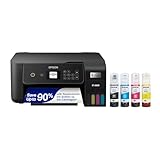
Epson EcoTank ET-2800
- Refillable tank system
- 4500 black and 7500 color pages per ink set
- Print scan and copy in one unit

Canon MegaTank G3270
- 6000 black and 7700 color pages per ink set
- Borderless printing
- 1.35 inch LCD
All 10 Printers at a Glance
Here is the full lineup in one place, so you can see the shape of the field before reading the individual verdicts. The page yield column is the one to read twice, because it is what your ink bill is actually built on.
| Product | Specs | Action |
|---|---|---|
| Epson EcoTank ET-2800 |
|
Check Latest Price |
| Canon MegaTank G3270 |
|
Check Latest Price |
 Brother DCP-L2640DW Brother DCP-L2640DW |
|
Check Latest Price |
 Canon PIXMA TS3720 Canon PIXMA TS3720 |
|
Check Latest Price |
 Canon PIXMA TS6520 Canon PIXMA TS6520 |
|
Check Latest Price |
 Brother MFC-L3720CDW Brother MFC-L3720CDW |
|
Check Latest Price |
 HP LaserJet Pro MFP 3101sdw HP LaserJet Pro MFP 3101sdw |
|
Check Latest Price |
 Brother Work Smart 1410 Brother Work Smart 1410 |
|
Check Latest Price |
 HP LaserJet MFP M235sdw HP LaserJet MFP M235sdw |
|
Check Latest Price |
 HP Envy 6155 HP Envy 6155 |
|
Check Latest Price |
1. Epson EcoTank ET-2800: Best Overall Printer for Teachers
Epson EcoTank ET-2800 Wireless Color All-in-One Supertank Printer – Black
Ink tank all-in-one
10 ppm black / 5 ppm color
4500 black and 7500 color page yield
Simplex only
Pros
- Cartridge-free tank system keeps per-page cost low
- Up to 4500 black and 7500 color pages per ink set
- Print scan and copy in one unit
- USB and Wi-Fi with app-based control
Cons
- Simplex only so double-sided handouts need manual flipping
- 100-sheet tray means frequent refills on big runs
- Epson advises genuine ink and third-party ink can affect warranty
The ET-2800 is the pick I keep coming back to because the running cost math is the least punishing of anything in this list. Epson rates a single set of bottled ink at up to 4500 black pages and 7500 color pages, and states that a replacement set is equivalent to roughly 90 individual cartridges. For a teacher printing a few hundred pages a month, that is most of a school year covered before you touch a bottle.
It is a true all-in-one, so scanning a page of student work and printing it back for a small-group reading set happens on the same machine. Connectivity covers USB and Wi-Fi, and the 1.5-inch LCD keeps basic jobs manageable without a phone.
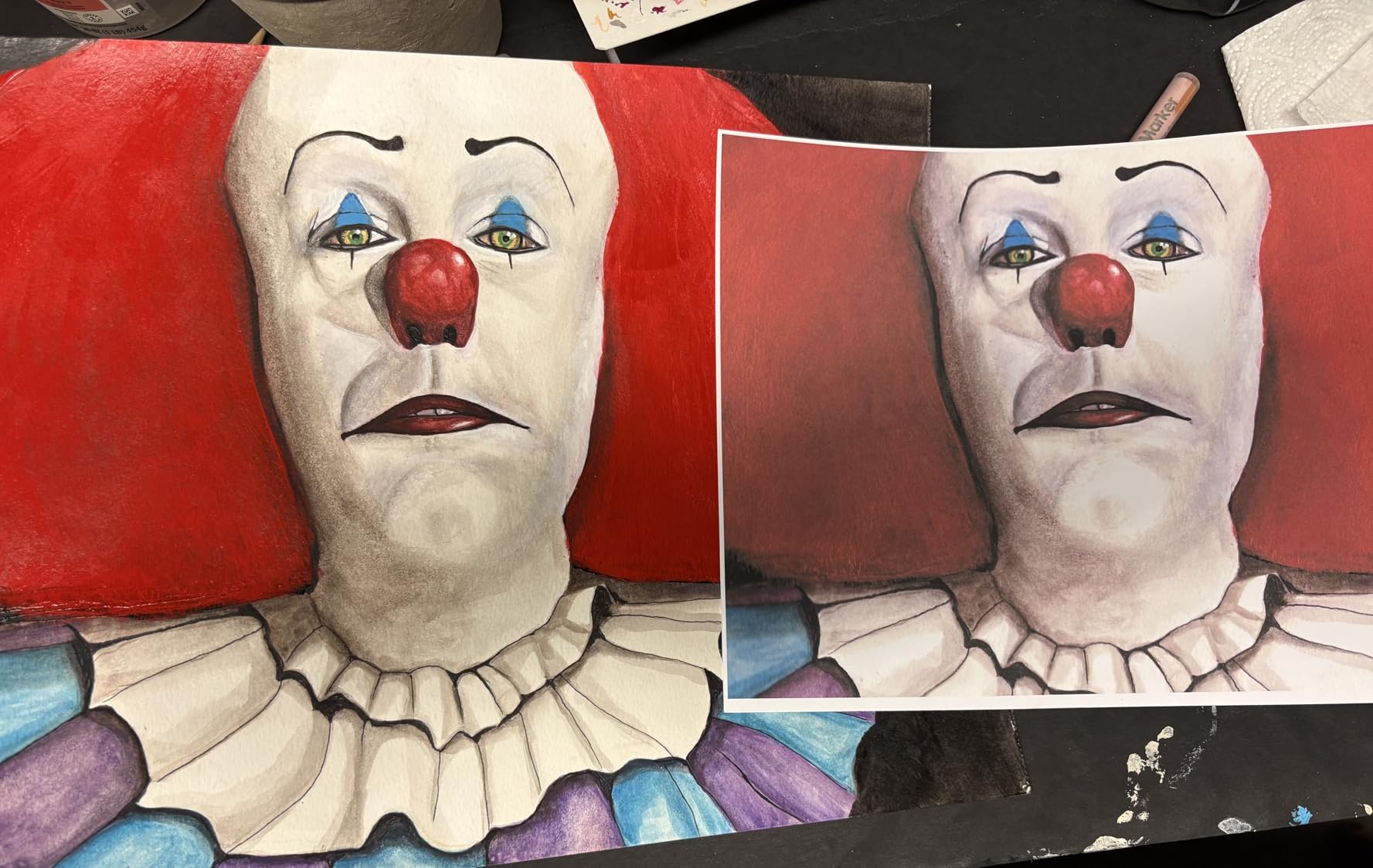
The numbers that matter most: 10 pages per minute black, 5 per minute color, maximum sheet capacity of 100, and a maximum media size of 8.5 x 14 inch. Resolution runs to 5760 x 1440, which is more than you need for paper but plenty for laminated reference cards and visual aids. It draws 12 watts, weighs 11.4 pounds, and carries a 1-year limited warranty.
Two limitations shape who this suits. There is no automatic duplex, so double-sided worksheets mean re-feeding sheets by hand, which quietly eats your time in the middle of a prep period. And the 100-sheet tray is small, so a 30-copy reading set for three sections means refilling partway through.
What you save with the refillable tank system
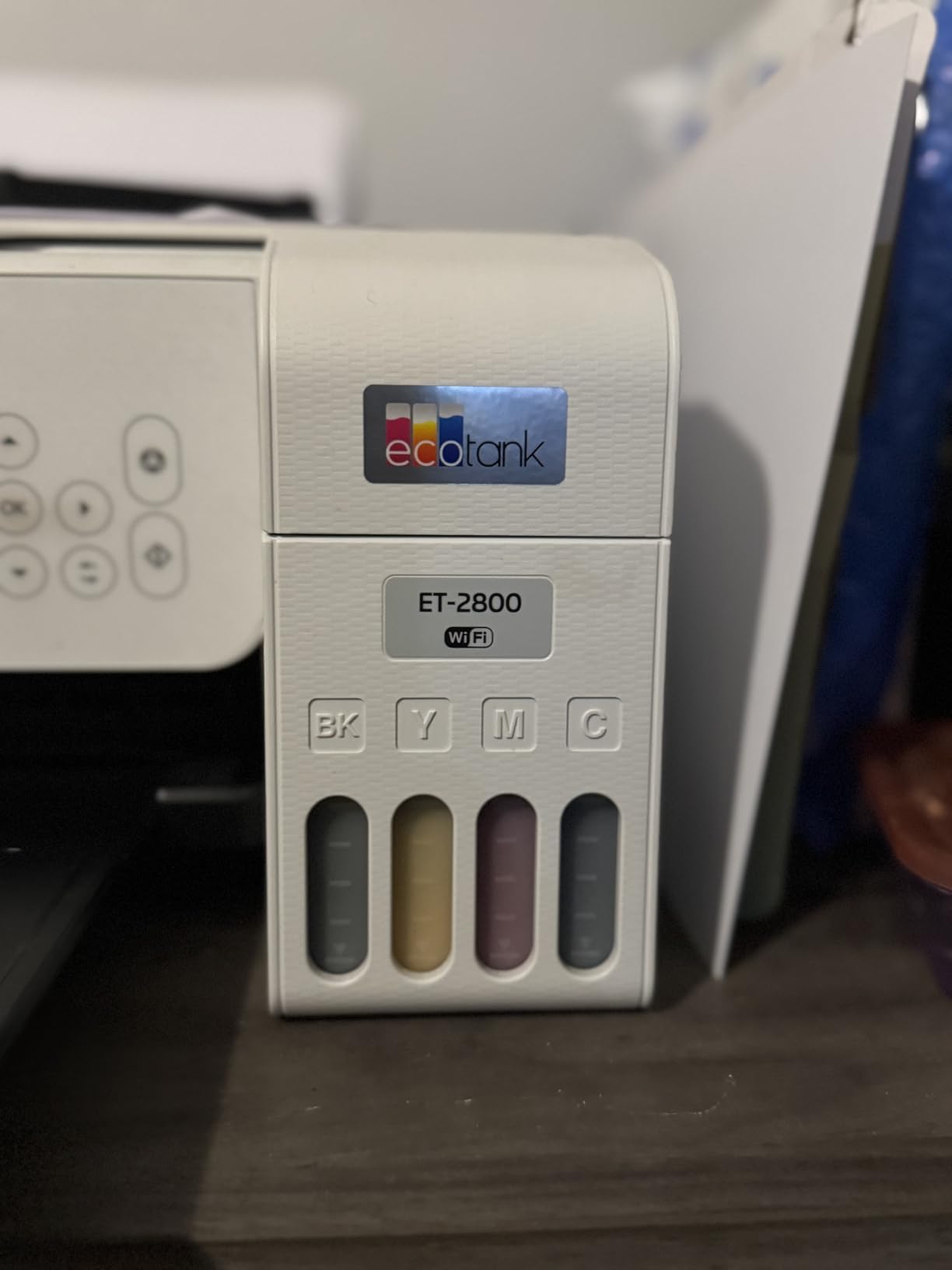
Owner reviews center on the running cost drop after switching from cartridges, and the refill process is genuinely simple: pour, prime, print. The 4500-page black yield also means fewer printhead-adjacent interruptions caused by running out of ink in the middle of a job, which is the failure teachers complain about most.
Where it will frustrate you
If you routinely print two-sided handouts in batches of 200 or more, the missing automatic duplex is the deal-breaker, and a monochrome laser is the better tool. Teachers on a tight schedule should also factor in the 100-sheet tray before committing.
2. Canon MegaTank G3270: Best Value for Cheap Color Printing
Canon MegaTank G3270 All-in-One Wireless Color Printer
Ink tank all-in-one
11 ppm black / 6 ppm color
6000 black and 7700 color page yield
100-sheet tray
Pros
- Integrated tank with up to 6000 black and 7700 color pages per set
- Print copy scan plus borderless printing
- 1.35 inch square LCD for job settings
- Handles envelopes card stock and square photo sizes
Cons
- Single-sided printing only
- 100-sheet tray and no document feeder
The MegaTank G3270 is the pick if color is not a once-a-month treat. Canon rates a single ink set at up to 6000 black pages and 7700 color pages, the highest stated color yield in this group, and ships with up to two years of ink in the box. For anchor charts, visual vocabulary cards, graded work with color coding, and a steady stream of student projects, that is where tank ink earns its keep.
It is slightly quicker than the ET-2800 on paper, at 11 pages per minute black and 6 per minute color. Paper handling is the part that impressed me most in the spec sheet: it supports square photo sizes, envelopes, and card stock, which matters when a lesson involves stickers or a craft build.
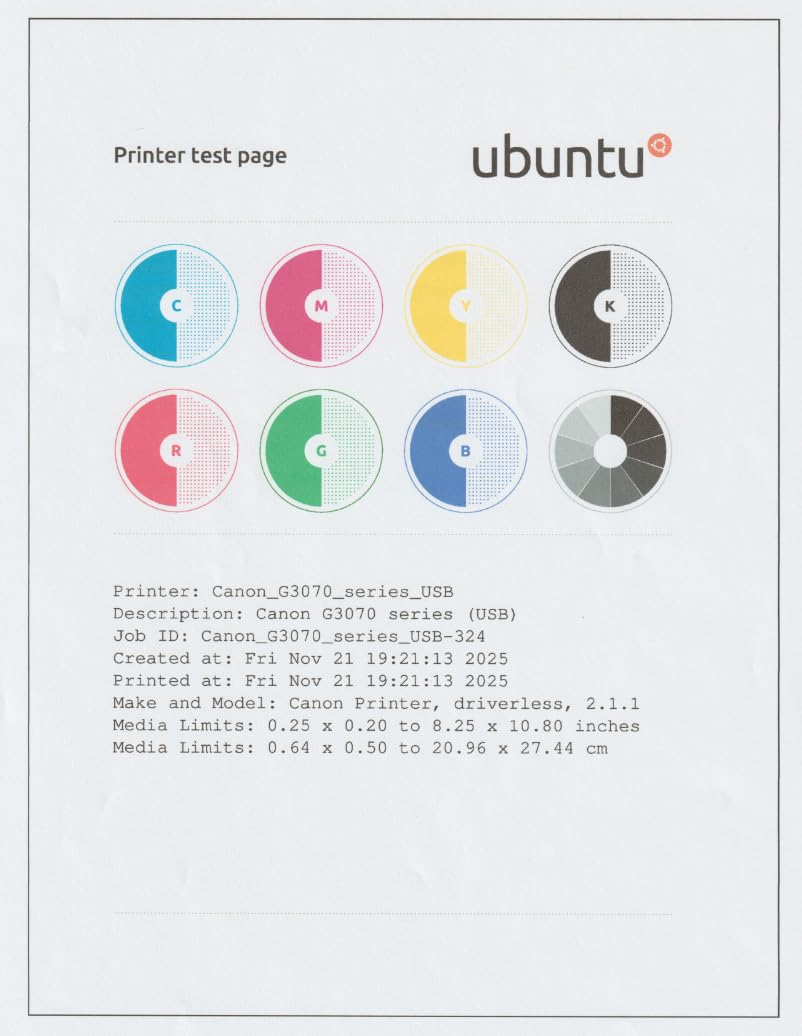
Other details worth noting: maximum sheet capacity of 100, flatbed scanning, 99-copy maximum runs, a single paper tray, and a 1-year warranty. It weighs 13.2 pounds and measures 21.9 x 16.4 x 10.6 inches, so it needs a real shelf rather than a corner of a desk. Resolution is 4800 x 1200 dots per inch, and it draws 16 watts.
Reviews praise the drop in ink cost and the simple refill process. The recurring gripes are the ones already flagged: single-sided printing only, and a small screen that makes multi-page batch settings fiddly.
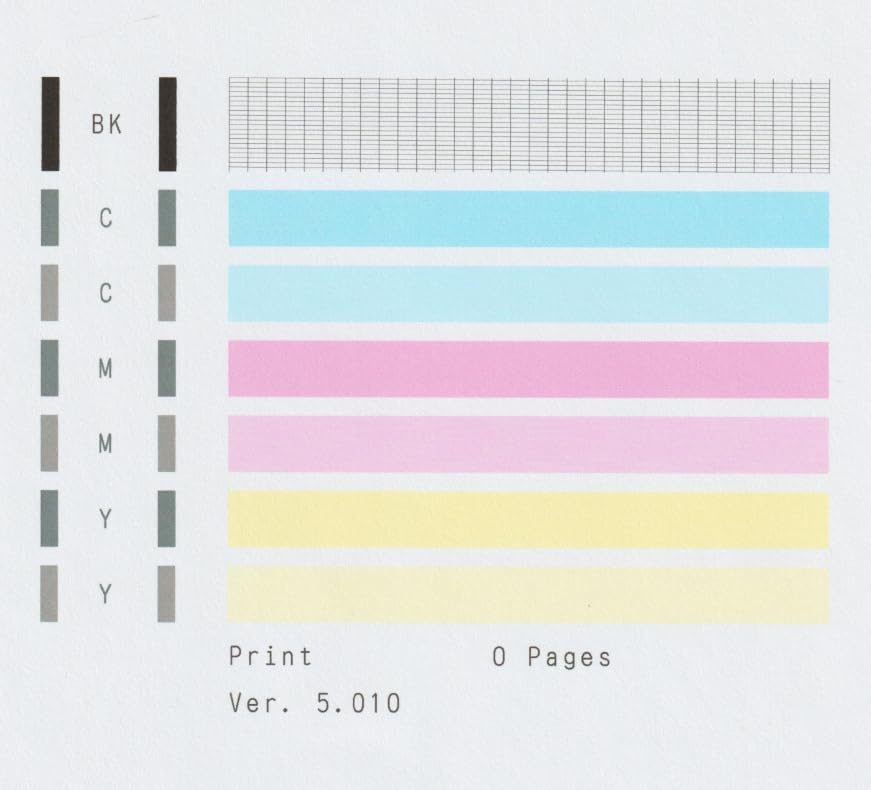
Why the page yield is the whole story here
At 7700 color pages per set, a teacher printing 200 color pages a month is looking at well over two years of supply from one fill. That is the reason this machine ranks second overall despite lacking duplex and an ADF: among the tank printers here, running cost per color page is what determines whether color printing stays affordable.
The card stock support is a quiet advantage too. Teachers repeatedly ask which printers handle thicker media for craft projects and laminated visual aids, and this one lists card stock among its supported types.
Where it will frustrate you
Single-sided output only is the hard limit. If double-sided handouts are routine, you will spend real time flipping paper. There is also no document feeder, so scanning a 20-page packet means twenty trips to the flatbed.
It is also a larger footprint than the ET-2800. In a small classroom with one shared shelf, plan where it sits before you commit.
3. Brother DCP-L2640DW: Best Monochrome Laser for High Volume
Brother DCP-L2640DW Wireless Compact Monochrome Multi-Function Printer, Copy, Scan, Duplex, Mobile Printing
Monochrome laser all-in-one
36 ppm black
Automatic duplex
50-page ADF
250-sheet tray
Pros
- Fast monochrome output up to 36 pages per minute
- Automatic duplex cuts paper for two-sided handouts
- 50-page ADF speeds scanning and copying
- Dual-band Wi-Fi plus Ethernet and USB
- Sharp black text with affordable toner
Cons
- On-device scanner menu is awkward next to the mobile app
- Wi-Fi and firmware password setup can frustrate
- Monochrome only with no color output
When the job is worksheets, tests, and graded work, a monochrome laser changes the conversation. The DCP-L2640DW prints up to 36 pages per minute black and rips through a stack of 30-copy reading sets before a class period ends. It also has the three things teachers ask for most: automatic duplex, a 50-page automatic document feeder, and a 250-sheet paper tray.
Toner is powder, not liquid. That single fact removes the clogging risk that ruins an inkjet sitting unused over summer break, which is why laser wins for anyone whose schedule has long gaps in it.
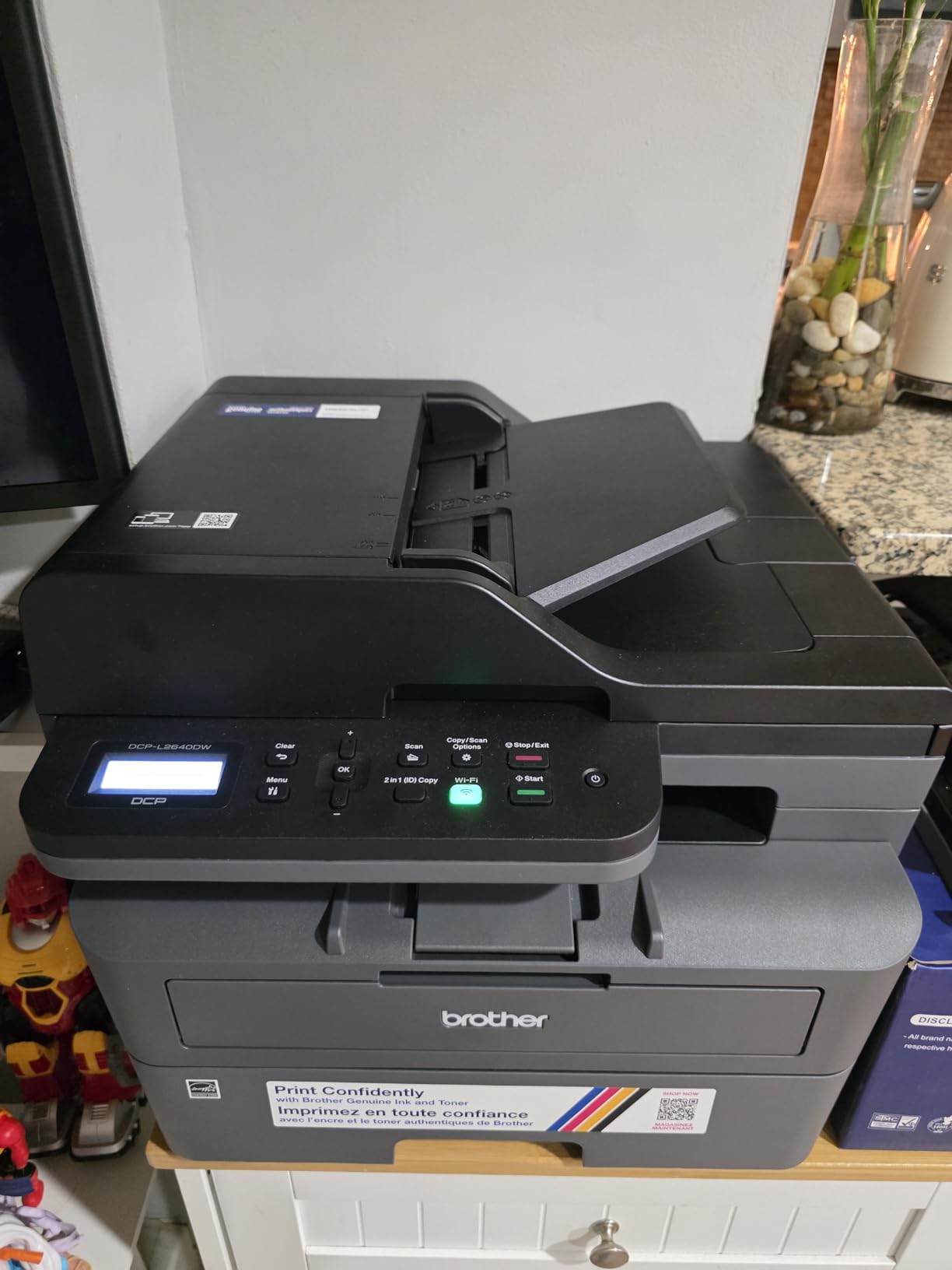
Spec details: print resolution up to 1200 x 1200, copy resolution 600 x 600, first page out in 8.5 seconds, scan speeds up to 23.6 pages per minute black and 7.9 color, a 120-sheet output tray, one Ethernet port, and a 1-year limited warranty. It uses Brother TN830 or TN830XL toner. It weighs 25 pounds at 15.7 x 16.1 x 12.5 inches.
Owner reviews focus on speed, sharp text, and affordable toner, and most work is done through the Brother Mobile Connect app. The friction points are the on-printer scanner menu and the Wi-Fi setup process, which some users describe as more steps than expected.
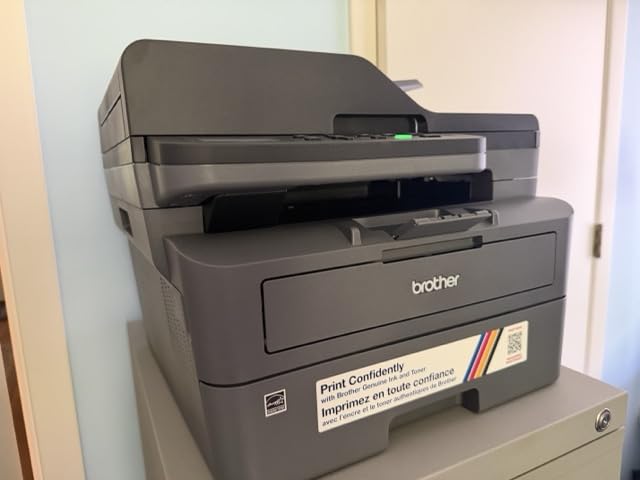
Why duplex plus a 50-page feeder changes a teacher’s week
Automatic duplex halves the paper for two-sided handouts and removes the babysitting that manual flipping demands. The 50-page feeder means a set of graded work goes through without you standing over the lid, which is the difference between scanning during a planning period and scanning after hours.
It is also the smallest-footprint machine here that still offers all three features, and dual-band Wi-Fi on both 2.4GHz and 5GHz bands makes it a sensible pick for a school network where the crowded 2.4GHz band is congested.
Where it will frustrate you
It is monochrome. There is no color path at all, so color anchor charts, visual aids for special education, and student work with color coding have to go to another machine or a different budget line.
That one gap is the entire reason this printer sits at number three rather than first for a lot of teachers. If your printing is 95 percent text, move it to the top of your own list.
4. Canon PIXMA TS3720: Best Budget Starter for Light Printing
Canon PIXMA TS3720 Wireless All-in-One Printer for Basic Home Printing, White
Cartridge inkjet all-in-one
7.7 ppm black / 4 ppm color
60-sheet tray
Simplex only
Pros
- Low entry point for a print copy and scan all-in-one
- Two easy-to-replace cartridges keep setup simple
- Dual-band Wi-Fi with app-free connect and Chromebook support
- Supports borderless photos and multiple paper sizes
Cons
- Single-sided printing only
- 60-sheet paper capacity is small
- Modest speed of about 7.7 black pages per minute
The TS3720 is here for the specific case of a light printing load. If you print a weekly vocabulary sheet, a handful of parent letters, and some colored exit tickets, this machine does all of it and stays compact at 8.7 pounds. It is also the smallest machine on the list, so it fits a shelf beside a Chromebook cart.
Reviews describe it as well suited to lesson plans and worksheets at a modest entry price, balanced against the lack of automatic duplex and the small tray. That is an honest description, not a hedge.
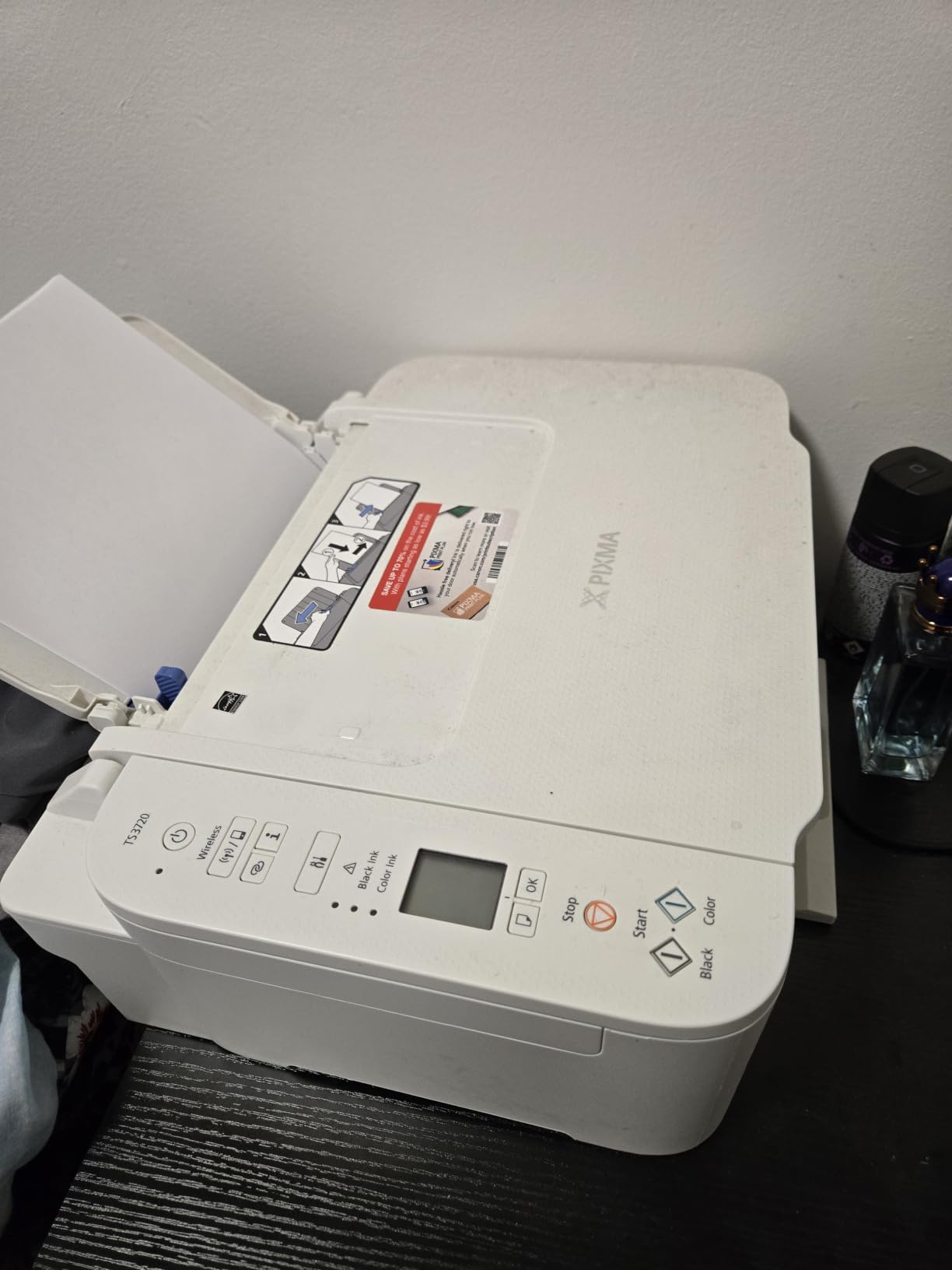
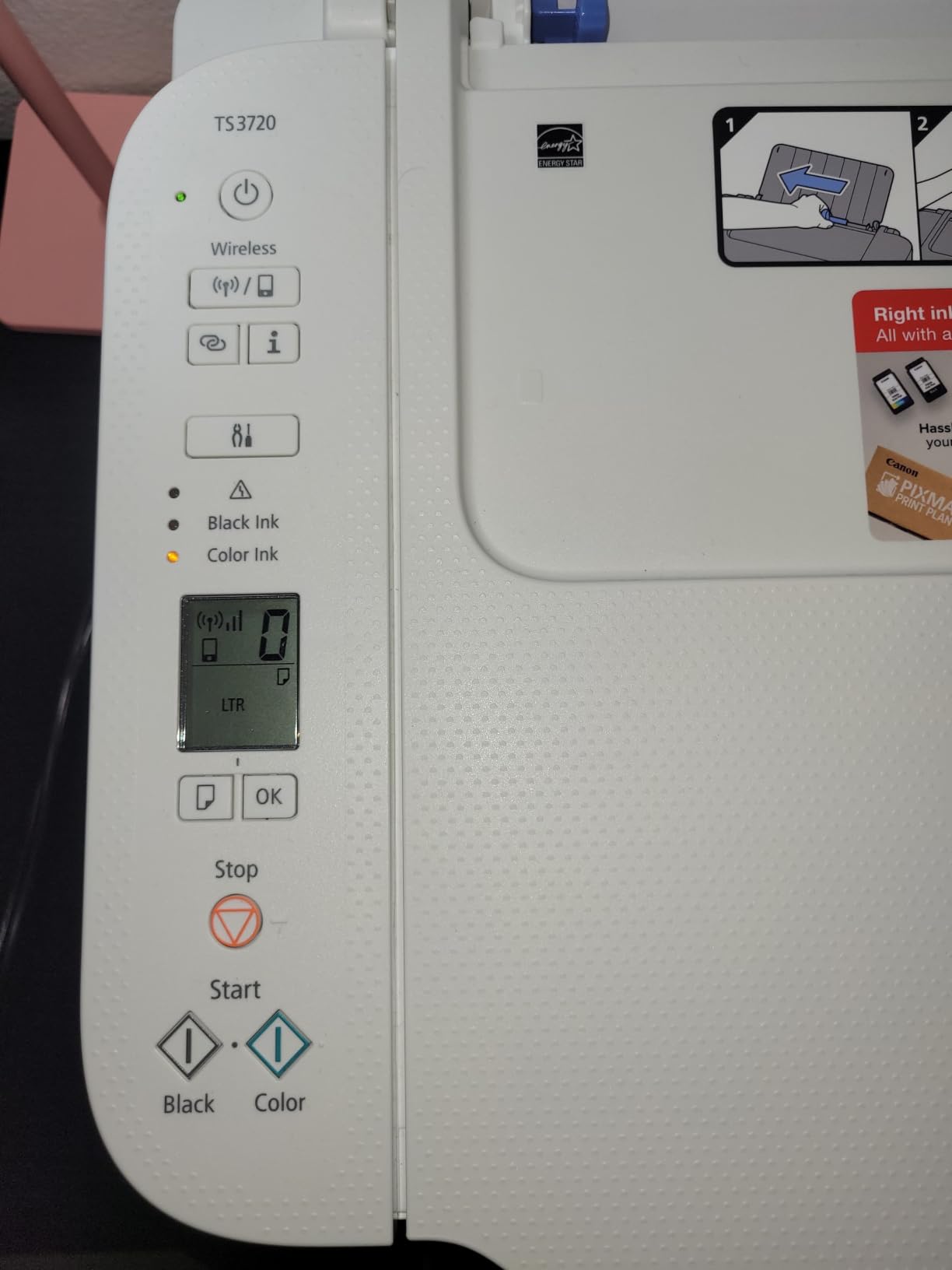
Specifications: 7.7 pages per minute black, 4 per minute color, 60-sheet maximum capacity, flatbed scanner, single tray, and a 1.5-inch segment LCD. Resolution goes to 4800 x 1200 dots per inch in both color and black and white. It uses Canon CL-276 and PG-275 cartridges, includes a 1-year manufacturer warranty, and supports Canon PRINT, Apple AirPrint, Mopria, and Chromebook connections.
It draws only 12 watts and runs at 17.2 x 12.9 x 5.8 inches, so it is kind to a small classroom shelf and a tight power strip.
Where a budget printer still does the job
Dual-band Wi-Fi with app-free connection means setup does not depend on IT approval, which is a real advantage in a building where network changes are slow. Borderless photo support means a printed visual aid can go straight into a pocket folder without a white margin eating half the card.
For a homeschool teacher or a co-op with light weekly volume, this is the least complicated way to get a reliable color all-in-one on a shelf.
Where it will frustrate you
Speed is the honest limit. At 7.7 black pages per minute, a 25-copy worksheet set takes several minutes, and that is on top of single-sided output. The 60-sheet tray means refilling twice during a 60-page run.
Most importantly, the cartridge running cost is the thing that punishes you later. If your volume grows past about 100 pages a month, the per-page cost of refillable tanks beats cartridges quickly. Buy this for light duty, not as a way to cut a big ink bill.
5. Canon PIXMA TS6520: Best Budget Inkjet With Automatic Duplex
Canon PIXMA TS6520 Wireless Color Inkjet Printer, Duplex Printing, Copier/Scanner, 1.42″ OLED Display, Compact, White
Cartridge inkjet all-in-one
14 ppm black / 9 ppm color
Automatic duplex
1.42 inch OLED display
Pros
- Automatic two-sided printing at an entry price
- Two-cartridge hybrid system gives sharp text and vivid color
- 1.42 inch monochrome OLED shows ink levels and status
- Compact footprint with dual-band Wi-Fi
- Scan and copy built into the same unit
Cons
- Cartridge ink costs more per page than tank models
- No document feeder for multi-page scanning
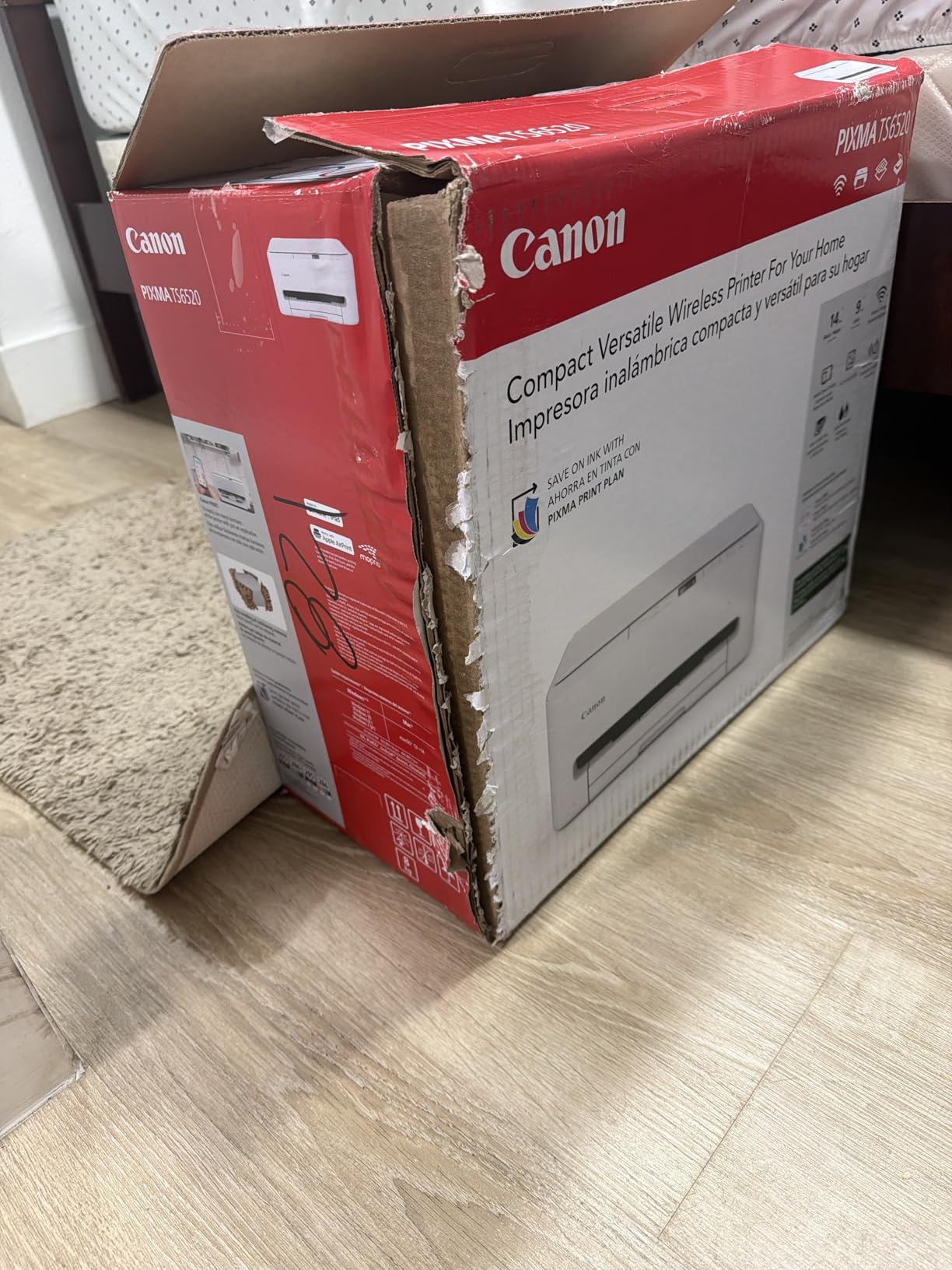
Automatic duplex on an inkjet at this price is unusual, and that single feature is the reason to look here. Most budget inkjets print one side and leave the flipping to you. The TS6520 handles two-sided handouts on its own, which halves paper use and removes the part of printing that eats your prep time.
It is also quick for its class, at 14 pages per minute black and 9 per minute color, with first page out in 7.5 seconds black and 9.5 seconds color. That speed matters when a student is standing at the machine between activities.
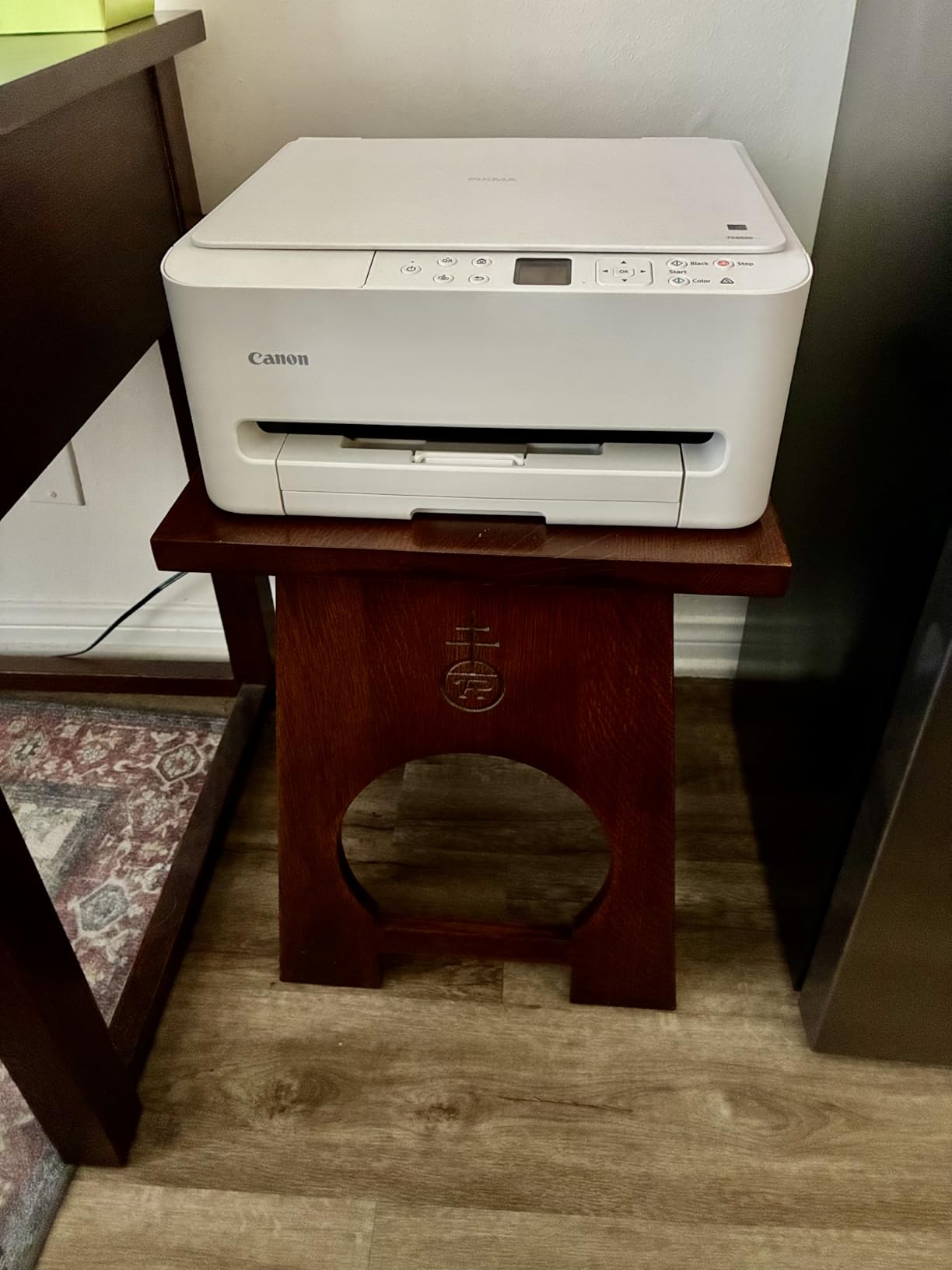
The 1.42-inch monochrome OLED display is a genuine quality-of-life feature at this level, showing ink levels and status without opening an app. It uses a hybrid cartridge setup, PG-295 pigment black plus CL-286 dye color, and prints to 1200 x 1200 dpi. Copy speed reaches 11 pages per minute. It comes with a 3-year manufacturer warranty, which is the longest in this group.
It supports Canon PRINT, Apple AirPrint, and Mopria, with dual-band Wi-Fi, borderless printing up to 8.5 x 11 inches, and borderless output for visual materials. It weighs 15.4 pounds at 14.8 x 14 x 6.7 inches.
Why duplex is worth more than a bigger screen
A duplex unit changes your total paper spend and your time at the same time. Teachers who print double-sided handouts regularly report that auto duplex removes a manual step from every single job, and it is one of the highest-impact features on this list for very little extra complexity.
Reviews specifically call out the rare pairing of automatic duplex and an OLED status screen at this price point, which tells you the value is real rather than a spec-sheet trick.
Where it will frustrate you
The cartridge system is the catch. Two-cartridge ink costs more per page than a tank system, so at high volume the running cost climbs fast. There is also no document feeder, meaning multi-page scanning happens one flatbed lid at a time.
If you are printing under roughly 150 pages a month with a real mix of color, this is a good match. Above that, move to a tank printer and accept manual duplex, or move up to a laser.
6. Brother MFC-L3720CDW: Best Color Laser for Department-Sized Printing
Brother MFC-L3720CDW Wireless Color Laser Printer, Scanner, Copier, Fax, Auto Duplex, 250-Sheet Capacity
Color laser all-in-one
19 ppm black and color
Automatic duplex
50-page ADF
250-sheet tray
Pros
- Color laser output at 19 pages per minute with automatic duplex
- 250-sheet tray plus 50-page document feeder
- 3.5 inch color touchscreen with 48 shortcuts
- Print copy scan and fax in one unit
- Dual-band Wi-Fi plus Wi-Fi Direct
Cons
- Color laser toner costs more to run than ink tanks at large color volumes
- Bulky and heavy footprint
- Higher entry cost than inkjet alternatives
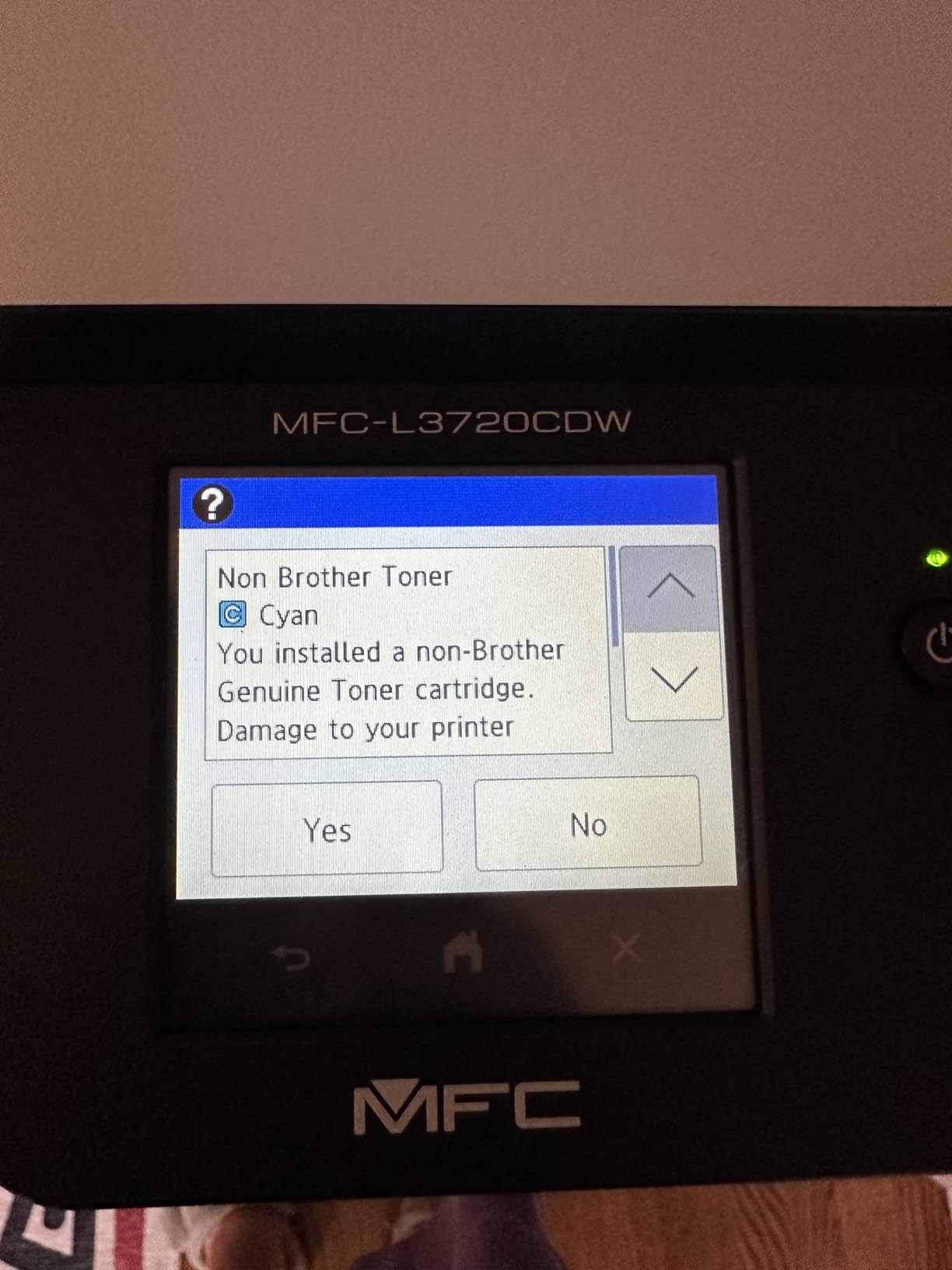
A color laser solves a problem no inkjet in this list solves: fast, sharp color in volume, with duplex and a feeder as standard. The MFC-L3720CDW prints up to 19 pages per minute in both black and color, has a 250-sheet adjustable tray and a 50-sheet automatic document feeder, and outputs the first page in under 15 seconds.
The 3.5-inch color touchscreen with 48 customizable shortcuts is the feature that matters most in a shared machine. Anyone can tap the icon for a double-sided handout job without a password, an app, or a manual.
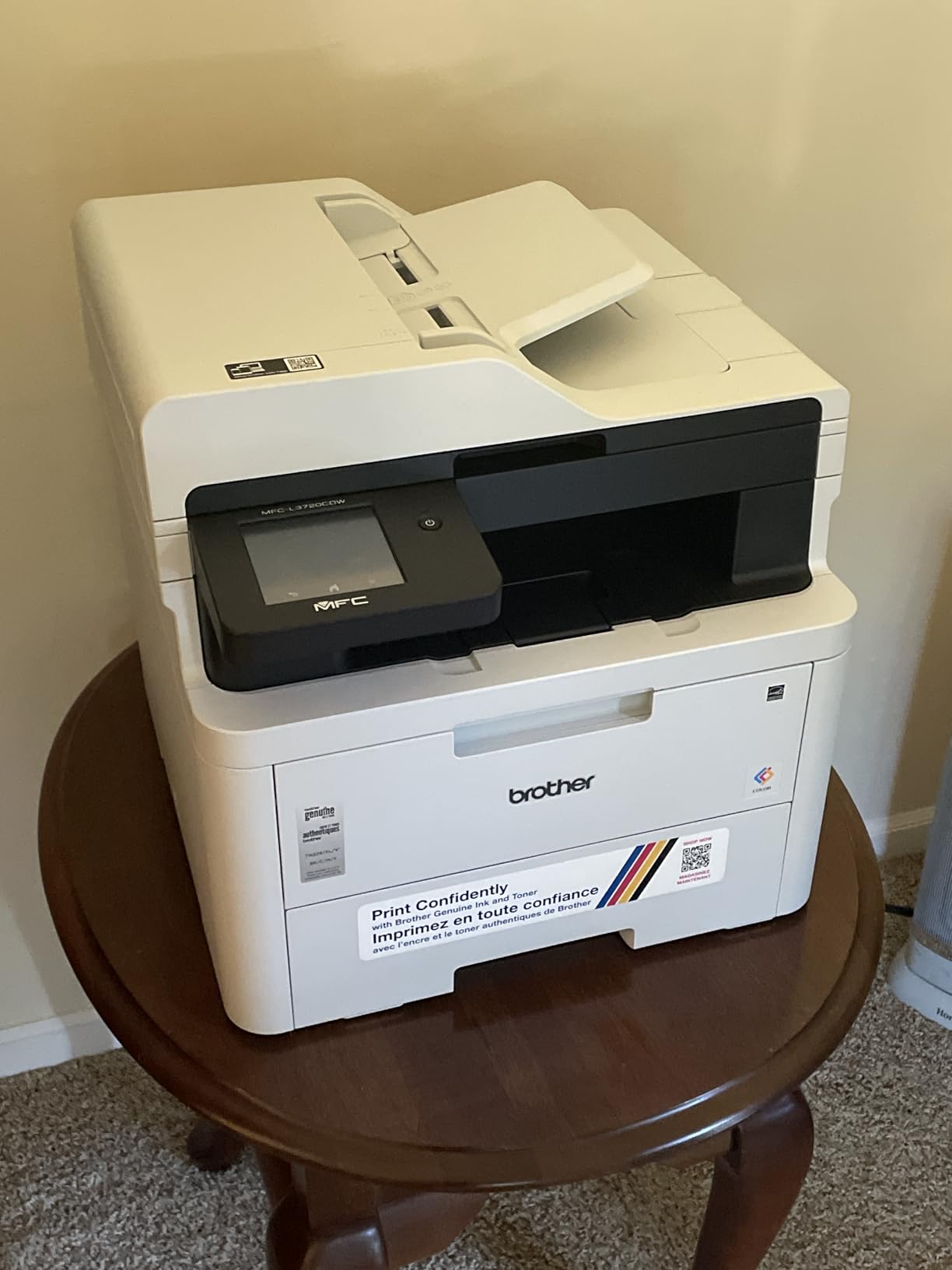
It handles print, copy, scan, and fax, covers paper sizes from 4 x 6 up to 8.5 x 14, and takes TN229 series toner plus a DR229CL drum unit. Resolution reaches 2400 x 600 dpi. Copies per run top out at 99, and the output tray holds 150 sheets. It carries a 1-year limited warranty.
The weight is the thing to plan for: 44 pounds and 16.1 x 17.5 x 15.8 inches. This is not a machine that lives on a classroom shelf. It belongs on a cart, a cabinet top, or a department office desk.
What a shared color laser saves you
If a grade team, department, or small school office shares one unit, the combination of a 250-sheet tray, a 50-page feeder, and touchscreen shortcuts removes the two biggest shared-printer complaints: constant refilling and hunting for settings. Reviews highlight exactly this shared-office workflow.
It also supports Wi-Fi Direct alongside dual-band Wi-Fi, so a substitute teacher or a student on a guest tablet can print without joining the main network.
Where it will frustrate you
Color laser toner is expensive to run at large color volumes, and the reviews name this as the main reservation. Very heavy color printing is cheaper on a tank inkjet. A personal teacher printing anchor charts once a month will not get enough value from this machine.
The size is the second limit. If your printer has to live on a desk in a small classroom, this is the wrong footprint, and the weight makes moving it a two-person job.
7. HP LaserJet Pro MFP 3101sdw: Best Monochrome Laser for a Shared Team
HP LaserJet Pro MFP 3101sdw Wireless Black and White All-in-One Laser Printer, Office Printer, Duplex, Best-for-Small Teams (9D2X4F)
Monochrome laser all-in-one
40 ppm black
Automatic duplex
50-page ADF
250-sheet tray
Pros
- Fastest black output here at 40 pages per minute with auto duplex
- 250-sheet input tray and 50-sheet document feeder
- Quiet operation and crisp professional text
- Self-healing Wi-Fi reconnects after outages
- AirPrint and Mopria support
Cons
- Firmware restricts it to HP chip cartridges which locks in OEM toner
- Paper tray and build described as somewhat flimsy
- HP Smart software can report the printer offline
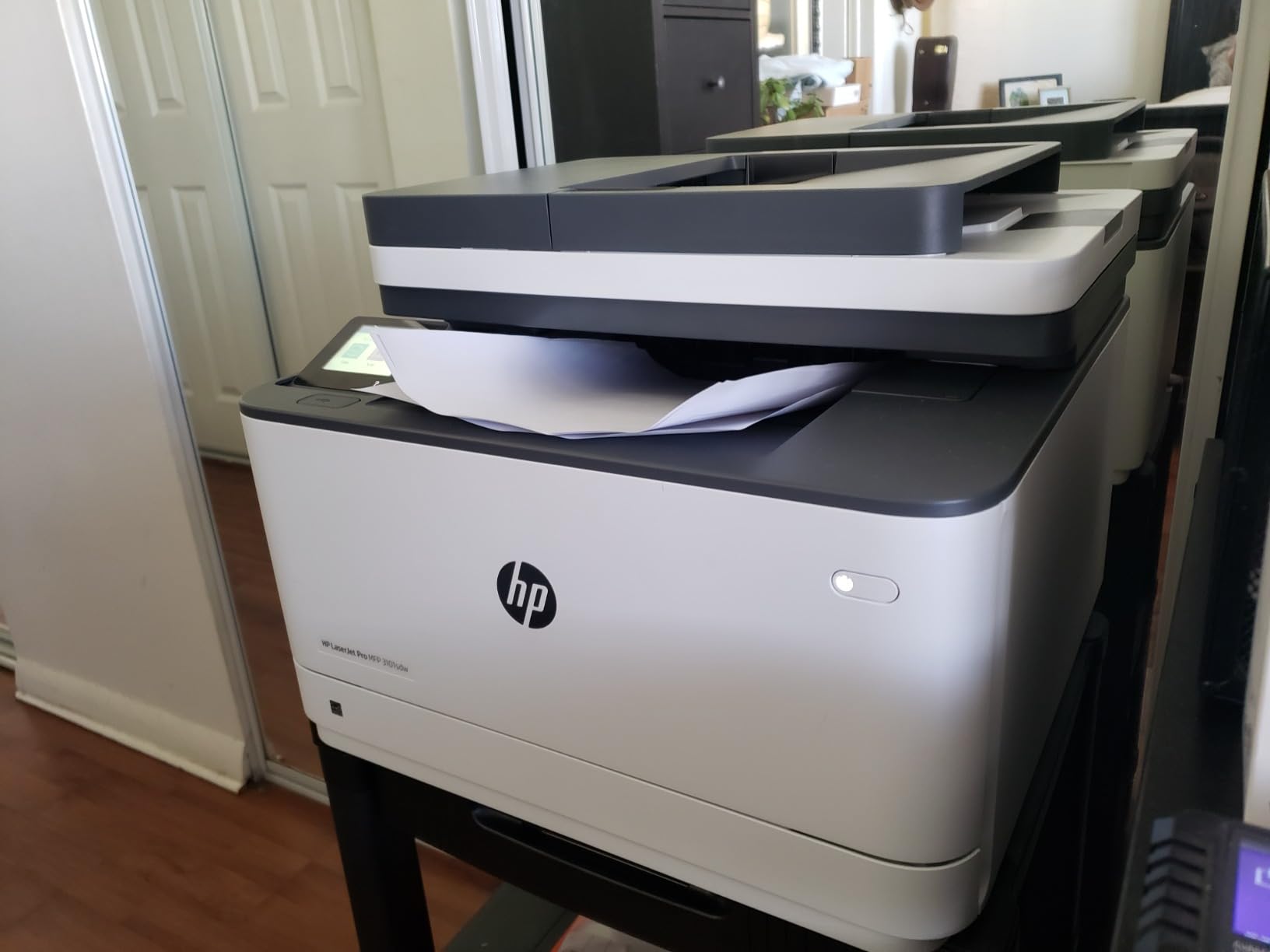
This is the fastest monochrome machine here, at up to 40 pages per minute, and it rates 4.5 out of 5 among owners, the highest score in this group. For a grade-level team sharing one printer across several classrooms, that combination of speed, a 250-sheet tray, and a 50-page feeder is the whole argument.
Owners consistently mention two things beyond speed: it is quiet enough to sit in a shared room, and the self-healing Wi-Fi reconnects on its own after an outage or a power interruption. That last one is more valuable in a school than it sounds, because school networks drop.
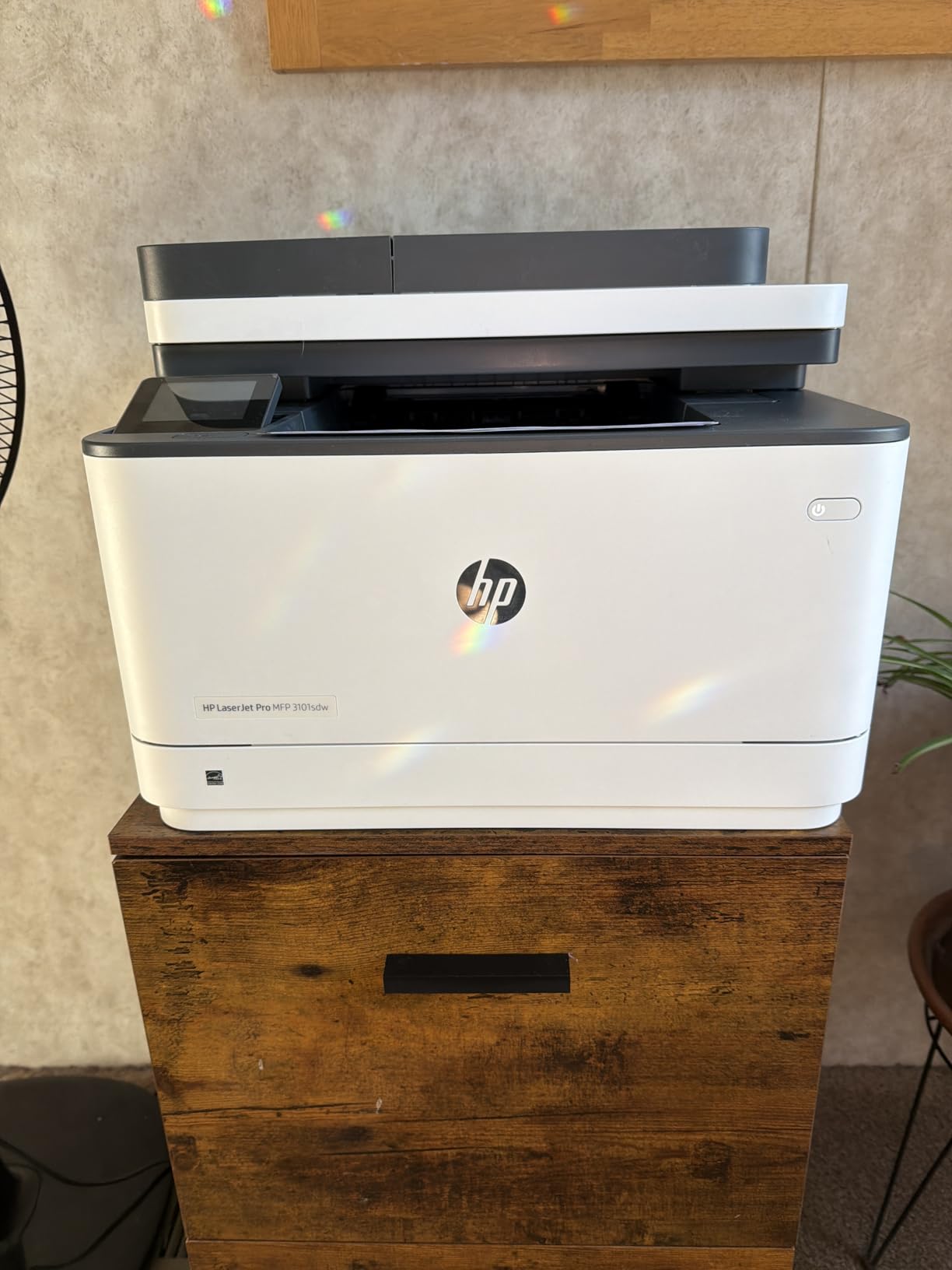
First page comes out in 7 seconds. Print and copy resolution reach 1200 x 1200 dpi, copies per run go up to 999, and the output tray holds 250 sheets. Connectivity covers wireless, Ethernet, USB, Apple AirPrint, and Mopria. It supports paper sizes including 8.5 x 14, weighs 23.1 pounds, and includes a 1-year limited warranty.
It is a compact shape for a laser, at 15.7 x 16.5 x 12.3 inches, so it is more realistic in a small office than a full-size color laser is.
Why speed matters for a shared printer
When several people queue for one machine, first page time and sustained speed decide how long the line is. Seven seconds to a first page and 40 pages per minute sustained means a 30-copy quiz set is done before a bell rings, and quiet operation means the wait is not disruptive to the room around it.
The self-healing wireless is the sleeper feature for schools specifically. A printer that reconnects itself after the network drops at lunch is worth more than one that needs an IT ticket.
Where it will frustrate you
The toner lock-in is the real issue. HP’s firmware restricts this printer to cartridges containing HP chips or circuitry, so third-party toner is not an option and the running cost is set by the manufacturer. Budget for that before you buy, not after.
Owners also describe the paper tray and build quality as somewhat flimsy, and the HP Smart app as intermittently reporting the printer offline even while jobs print. Some users report a long wake-up from sleep before the first job.
8. Brother Work Smart 1410: Best for Non-Technical Staff and Shared Rooms
Brother Work Smart 1410 Wireless Color Inkjet All-in-One Printer with 2.7” Touchscreen and Automatic Duplex Printing | Includes Refresh Subscription Trial(1) (MFC-J1410DW)
Color inkjet all-in-one
16 ppm black / 9 ppm color
Automatic duplex
20-page ADF
150-sheet tray
Pros
- 2.7 inch color touchscreen with direct cloud app access
- Automatic duplex in a compact footprint
- Print copy scan and fax with a 20-page document feeder
- Up to 16 ppm black and 9 ppm color
- Brother Mobile Connect app for menu navigation
Cons
- Cartridge ink costs more per page than tank printers
- 20-sheet ADF is small next to laser models
- 150-sheet tray needs frequent refills
This is the touchscreen pick. The 2.7-inch color display gives direct access to Google Drive, Dropbox, Box, and OneDrive, so a teacher can pull a file and print it without opening a laptop, finding a file path, or emailing it to themselves from the phone.
It is also quick, at 16 pages per minute black and 9 per minute color, with first page out around 6.2 seconds black and 9.6 seconds color. Resolution goes to 1200 x 6000 dpi, and it handles paper up to 8.5 x 14 inches with automatic duplex and a 20-sheet single-sided ADF.
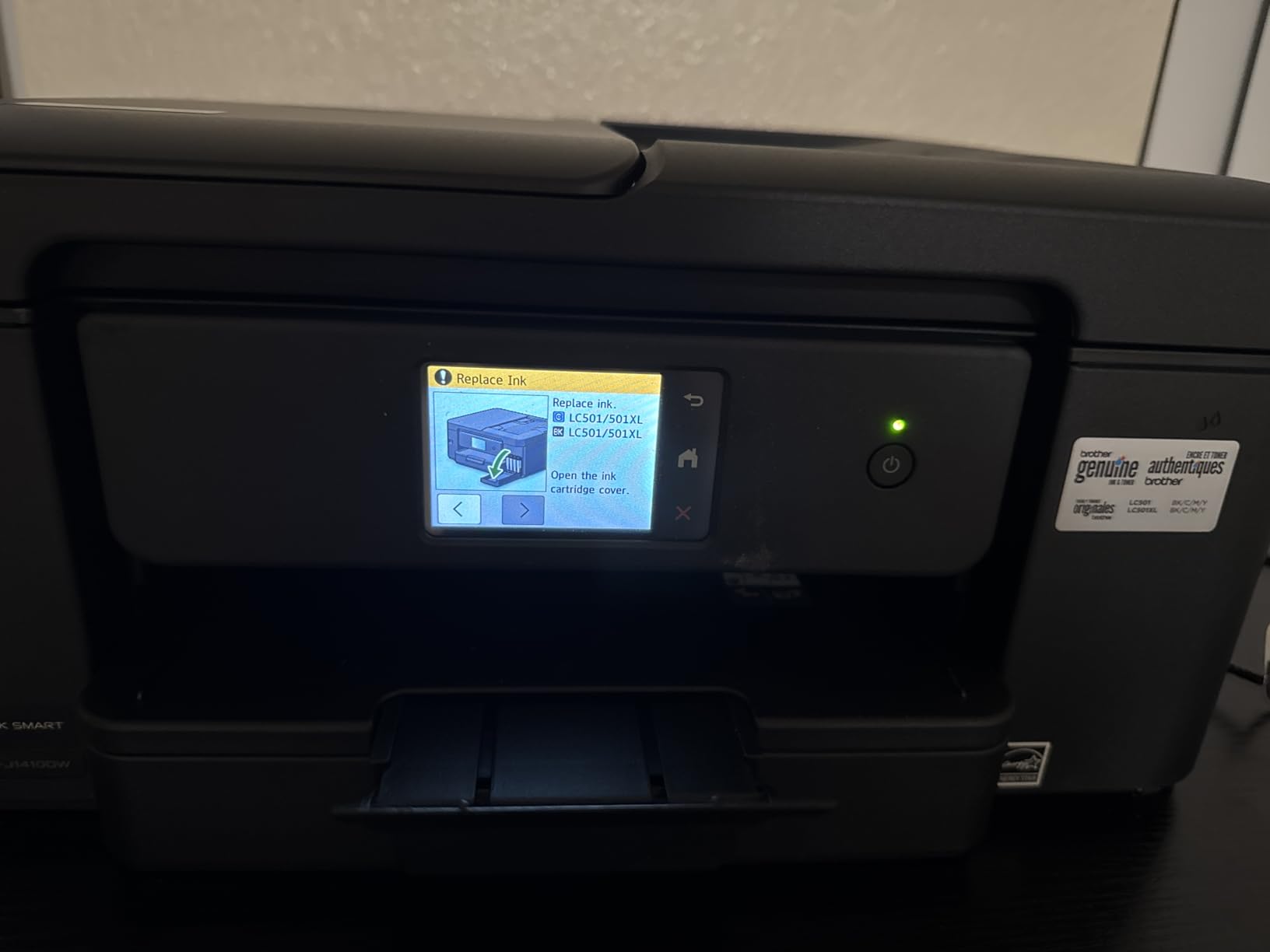
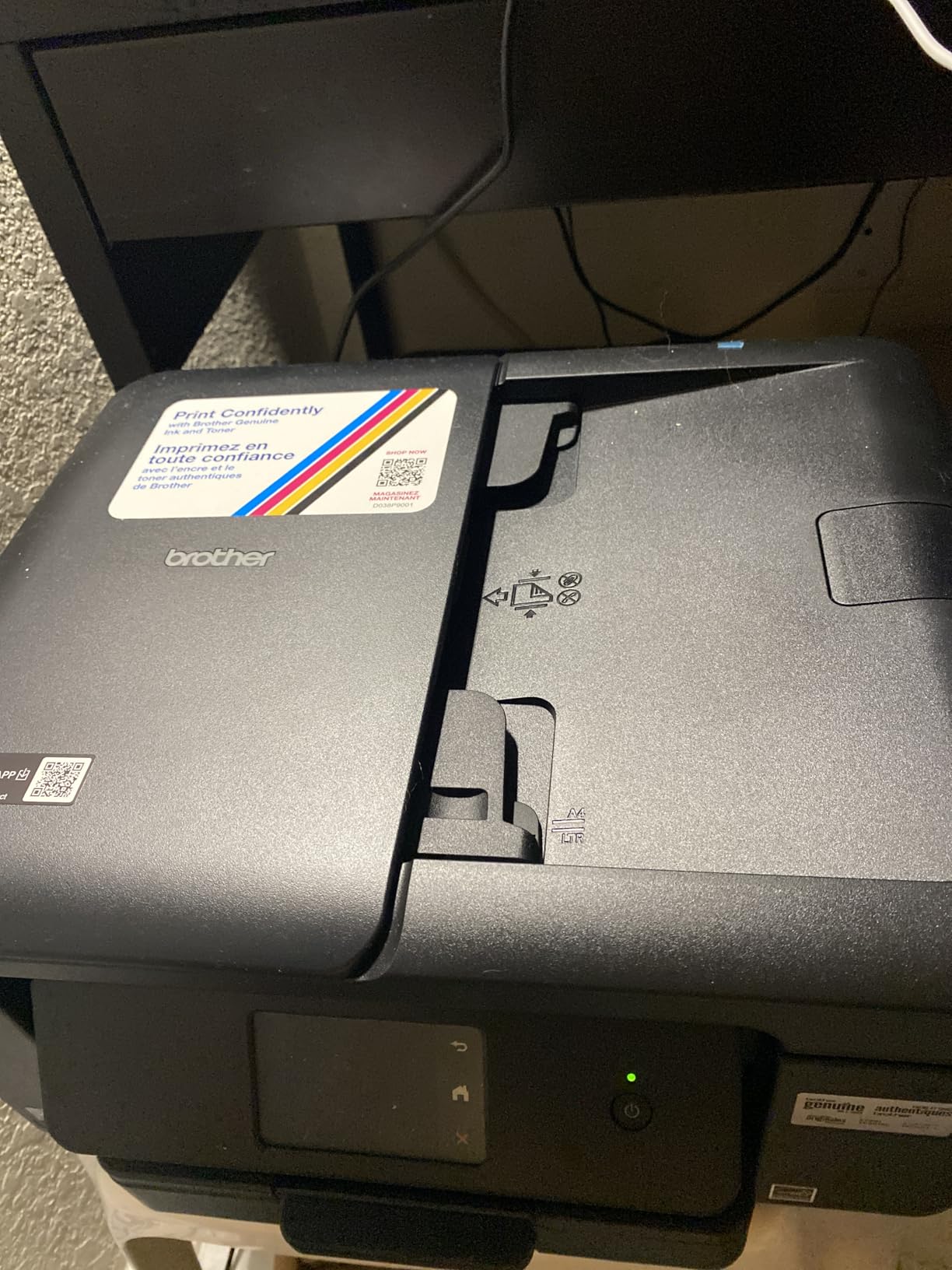
Print, copy, scan, and fax all live in one unit, and the Brother Mobile Connect app handles menu navigation and ink monitoring from a phone. It has a 150-sheet tray, a single tray design, up to 99 copies per run, and a 1-year limited warranty.
At 16.8 pounds and 13.5 x 15.4 x 7.2 inches, it is one of the more compact all-in-ones here, which is why it works in a room where several staff share space.
The single-tray design is worth noting too, since it keeps the footprint down but means all paper goes through the same feed.
When a screen beats an app
A touchscreen earns its place in a room with more than one user, a substitute, or support staff who are not going to install anything. Cloud shortcuts mean the common jobs take two taps instead of a menu tree.
If you are the only person using the machine and you are comfortable with an app, this feature matters far less, and you should weigh the running cost instead.
Where it will frustrate you
Choose it for workflow, not for volume. Teachers printing hundreds of pages a week in color will spend more on ink here than on a MegaTank or EcoTank.
9. HP LaserJet MFP M235sdw: Best Compact Monochrome Laser
HP LaserJet MFP M235sdw All-in-One Laser Wireless Printer, Scan/Copy, Black & White, Duplex, Best-for-Office
Monochrome laser all-in-one
30 ppm black
Automatic duplex
Single-sided scan and copy
150-sheet tray
Pros
- Up to 30 pages per minute with fast in-class duplex printing
- Crisp true black output
- Compact footprint suited to small offices
- Dual-band Wi-Fi with self-reset plus Ethernet and USB
- Scan to email and scan to PDF
Cons
- Scan and copy are single-sided only
- HP software setup described as messy across devices
- Replacement toner can be costly relative to the printer
The M235sdw is the answer for a teacher who wants laser speed and duplex in a footprint that fits an ordinary shelf. It runs up to 30 pages per minute black, gets a first page out in 7 seconds, and prints double-sided automatically, which makes it a step up from every simplex inkjet in this list.
Owners consistently praise one specific thing: the black is genuinely black, not the grey cast some laser printers produce. For dense worksheets, math problems, and photocopiable handouts, that difference is visible and welcome.
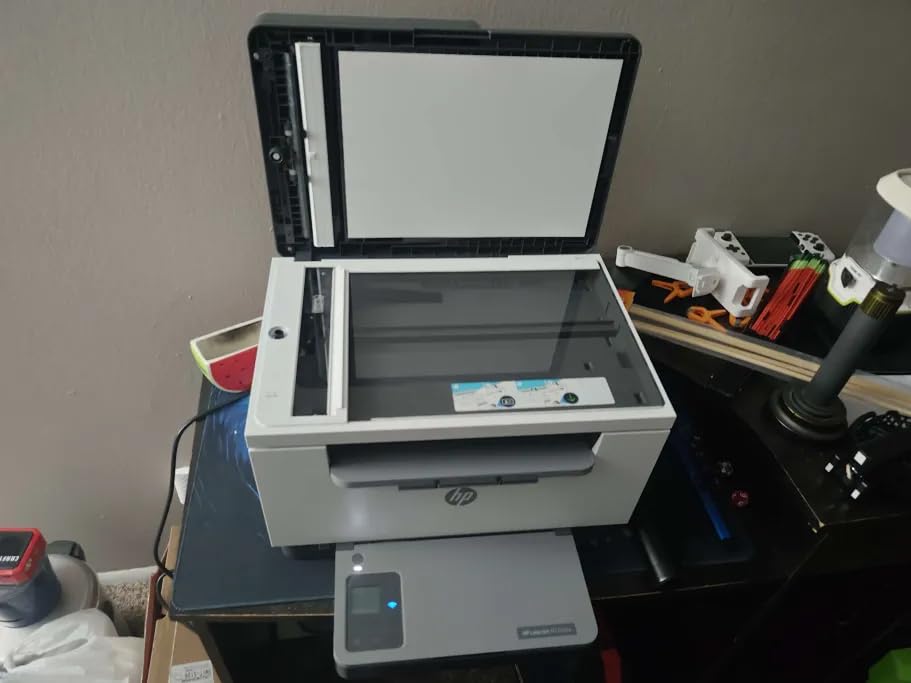
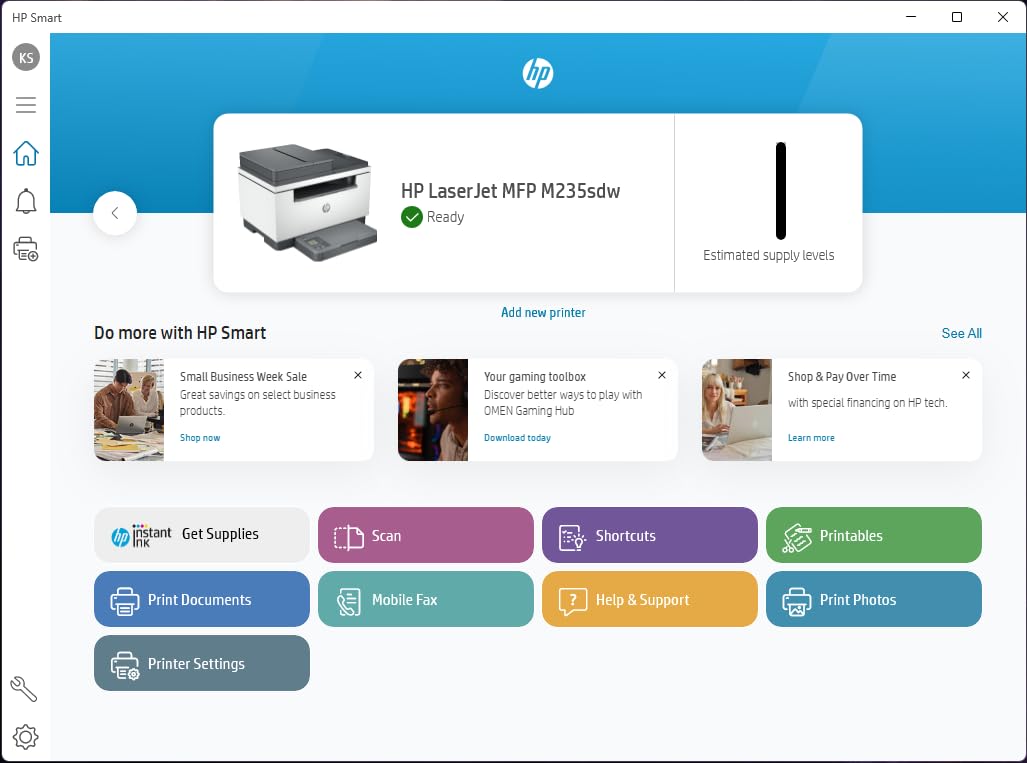
It is designed for offices of one to five people. Connectivity covers dual-band Wi-Fi with self-reset, Ethernet, USB, wireless direct printing, AirPrint, Mopria, and Chromebook, and it scans to email and to PDF. It handles paper up to 8.5 x 14 inches.
Resolution is 600 x 600 dpi for printing and 300 x 300 for copying, copies per run go up to 99, and the output tray holds 150 sheets. It weighs 21 pounds and measures 12.13 x 16.46 x 11.59 inches, making it the smallest laser footprint here. It includes a 1-year limited warranty.
What a compact laser changes for a small classroom
Twenty-one pounds and a shallow depth mean you can put it on a shelf rather than a cabinet top, and still get automatic duplex plus 30 pages per minute. For a single teacher printing tests and worksheets, that is the useful middle ground between an inkjet and a full office machine.
Scan to email also helps when a document has to go to a colleague or a parent, without printing and re-printing it.
Where it will frustrate you
Scanning and copying are single-sided only, so a two-sided handout scanned for records has to be fed twice. That is a real gap if you archive a lot of student paperwork.
HP’s configuration software is the other complaint, described by owners as messy and hard to set up across devices. And replacement toner can be a large share of the original cost over a school year, so include it in your total-cost thinking.
10. HP Envy 6155: Best for Everyday Homework Printing
HP Envy 6155 Wireless All-in-One Color Inkjet Printer, Print, Scan, Copy, Duplex Printing Best-for-Home, 3 Month Trial of Instant Ink Included, AI-Capable (C2WR7A) Portobello
Color inkjet all-in-one
10 ppm black / 7 ppm color
Automatic duplex
100-sheet tray
Pros
- Color print copy and scan with automatic duplex at an entry price
- 2.4 inch color touchscreen for straightforward job selection
- Dual-band Wi-Fi that resolves connection issues
- HP AI formatting strips headers and footers from web pages
- Made with at least 60 percent recycled plastic
Cons
- Works only with cartridges containing original HP chips
- 100-sheet input tray is small for classroom runs
- No document feeder for multi-page scanning
The Envy 6155 is a modern-generation replacement for the older budget models still circulating in roundup articles, and the difference is the feature set. Automatic duplex at an entry-level color price is the headline, with a 2.4-inch color touchscreen that makes job selection obvious for anyone using the machine.
It prints up to 10 pages per minute black and 7 per minute color to 4800 x 1200 dpi. The HP AI formatting is more useful than it sounds: it strips headers, footers, and stray web furniture off pages before printing, which saves both paper and your cleanup time.
Dual-band Wi-Fi auto-detects and resolves connection issues, which is helpful in a building with crowded wireless. It copies at up to 10 pages per minute, has a 100-sheet input tray and a 100-sheet output tray, and comes with a 3-month Instant Ink trial and a 1-year limited hardware warranty.
It is light, at 11.2 pounds, and compact at 17.05 x 5.35 x 14.21 inches, drawing 12.2 watts. It is made with at least 60 percent recycled plastic content.
Why the touchscreen matters at this level
A 2.4-inch color screen on a printer this size is unusual, and it takes the guesswork out of switching between duplex, color, and copy settings. For a teacher in a shared room, or a parent printing homework after school, that removes the most common source of frustration.
The AI print cleanup is a quiet second win, because a web page printed raw wastes two inches of paper on every sheet and a frustrating amount of trimming time.
Where it will frustrate you
Cartridge lock-in is the main one. Like the HP laser above, it works only with cartridges containing original HP chips or circuitry, so third-party ink is off the table and running cost is fixed. The 100-sheet input tray is small for classroom runs, and there is no document feeder at all.
Also check the included 3-month Instant Ink trial before the term ends, because it converts to a paid subscription unless cancelled. If your volume is light and steady, cartridges are manageable. If it is heavy, a tank printer is cheaper.
How to Choose a Printer for Your Classroom
Start with your monthly page volume, not the price tag. Almost every other decision follows from that number, and it is the one question searchers ask most often: do schools and classrooms use laser or inkjet printers? The honest answer is both, and the split follows the volume.
Inkjet or laser: the decision rule
Under about 100 pages a month, a cartridge inkjet is fine. Between 100 and 500 pages a month, a refillable tank inkjet is usually the cheapest way to keep color affordable. Above 500 pages a month, or if almost all of it is black text, a monochrome laser wins on running cost and on reliability.
The reason is in the hardware. Inkjet sprays liquid ink through nozzles, and liquid ink can dry in place if the machine sits unused, which is exactly what happens over a long summer break. Laser toner is powder fused to the page with heat, so there is nothing to dry out. A printer that will be idle for weeks at a time belongs in laser territory.
How much duplex and feeder capacity you actually need
Automatic duplex halves your paper use on two-sided handouts and removes the flipping step. It is the single most useful feature on this list for regular worksheet printing. The automatic document feeder matters if you scan graded work or copy packets, and anything above 30 sheets saves real time.
If you print double-sided handouts weekly, drop any simplex machine from your list. That rule alone eliminates four of the ten printers here.
Connectivity on a school network
Look for dual-band Wi-Fi, which covers both 2.4GHz and 5GHz, plus AirPrint, Mopria, and Chromebook support. Support for Wi-Fi Direct lets someone print without joining the school network at all, which is the practical workaround when IT is slow to approve a device.
Ethernet is worth having even on a wireless machine, as a fallback when the wireless drops mid-term.
What page yield really tells you
Page yield is the number of pages a cartridge or tank is rated to produce, and it is the closest thing to a real running-cost figure. Divide the price of a full ink set or toner cartridge by its stated page yield and you get your cost per page. A tank rated at 7700 color pages behaves very differently from a cartridge rated at a few hundred, and that single calculation settles most comparisons.
Where a page yield is not published, the honest signal is the ink system itself. Cartridge printers cost more per page the more you print, and subscription ink programs only look cheap if your volume is steady and predictable.
Choosing for a shared grade-team printer
When several people share one machine, prioritize a touchscreen or Wi-Fi Direct so anyone can start a job without a password, a large paper tray so nobody is refilling mid-run, and an ADF of 40 sheets or more for scanning. In that scenario, the monochrome laser options at positions three, seven, and nine are the ones to compare, and a color laser makes sense if the whole team prints in color.
Teachers running art projects or cardstock builds can compare our guide to printers for artwork and heavy-color output, and for classroom maker activities our beginner 3D printer picks cover the fabrication side of the same projects. For everything we have tested across resin and filament machines, our full 3D printer roundup ranks the lot.
Keeping an Inkjet Usable Over Summer Break
Nozzle clogs after a long idle period are the most repeated complaint in teacher forums, and the fix is preventive rather than technical. If your printer is a refillable tank or cartridge inkjet, print one full page in color once a week during the break, or once a month at minimum, and the ink stays moving through the heads.
Keep the unit plugged in rather than switching it off at the wall, since most modern inkjets run a short cleaning cycle when powered on. Keep the cartridges or tanks above the minimum line, because running a tank dry is what causes the permanent streaks people end up paying to fix.
If you already have streaks, a cleaning cycle from the printer’s own maintenance menu is worth trying before anything else. A laser has no equivalent problem, which is the practical reason teachers with long idle stretches often choose monochrome laser.
Frequently Asked Questions
Do schools use laser or inkjet printers?
Both, and the split follows volume. Low-volume users usually get a cartridge inkjet. Offices and shared machines run monochrome laser, which is cheaper per page on text and cannot clog when idle. Color laser appears where color volume is genuinely high.
Which printer is best for teachers?
For most classrooms, the Epson EcoTank ET-2800, because its refillable tanks cut per-page cost and one ink set covers up to 4500 black and 7500 color pages. Teachers printing mostly text should pick a monochrome laser such as the Brother DCP-L2640DW instead.
Is HP or Epson better?
Epson built its reputation on refillable EcoTank ink, which is the cheaper choice at volume. HP competes with cartridge and subscription ink plus strong laser ranges. Pick Epson for low running cost, and HP for touchscreens, print cleanup features, and a broad laser lineup.
What printer has the least amount of problems?
Monochrome laser printers have the fewest moving parts exposed to ink, and they cannot clog over a long break. Among the models here, the HP LaserJet Pro MFP 3101sdw and Brother DCP-L2640DW are rated highly by owners, with setup software and toner lock-in as the most common complaints.
What is the best printer for schools?
For a shared office or grade team, a monochrome laser with a 40-page automatic document feeder, a 250-sheet tray, and a large touchscreen wins. The Brother MFC-L3720CDW covers the color case with a 3.5-inch touchscreen and 250-sheet tray. Neither category suits a single teacher printing ten pages a week.
Final Verdict: Which Printer Should You Buy?
For most teachers, the Epson EcoTank ET-2800 is the best printer for teachers in 2026 because running cost decides the outcome and refillable tanks win that comparison. One ink set covers up to 4500 black and 7500 color pages, which means a school year of mixed printing without cartridge economics.
Print mostly black text, or sit idle for long stretches? The Brother DCP-L2640DW gives you 36 pages per minute, automatic duplex, and a 50-page feeder with no clog risk. Print a lot of color? The Canon MegaTank G3270 carries the highest stated color yield in this group at 7700 pages per set. Sharing one machine across a team? The HP LaserJet Pro MFP 3101sdw handles duplex at 40 pages per minute with a self-healing connection that survives a school network drop.
Whatever you pick, measure your monthly page volume before you buy, include the full cost of a year of ink or toner in the comparison, and run one color page a month through an inkjet if it will sit idle over break. That single habit prevents the most common printer failure teachers run into.